
You wake up, swing your legs out of bed, and feel it straight away. The knees are stiff, the hands don't want to grip the kettle, and by the time you've decided whether to cancel a walk or push through it, the day already feels negotiated around pain. That's what arthritis pain management usually looks like in real life, not one perfect treatment, but a layered plan that helps you move, sleep, work, and keep some confidence in the mix.
In Australia, arthritis is not a niche issue. The ABS reported 3.7 million people, or 14% of the population, were living with arthritis in 2022, and prevalence rose to 44% in people aged 75 and over. Among people with arthritis, 47% used medication, 15% used exercise or physical activity, and 4.6% used physical therapies in the previous two weeks, which tells you that medicine still takes centre stage even though movement-based care matters too (ABS data reported in RheumAP). The practical challenge is rarely finding one silver bullet. It's building a routine that keeps the bad days manageable and stops the good days from being wasted.
Table of Contents
- What Living With Arthritis Pain Actually Feels Like
- Understanding the Main Types of Arthritis and Their Pain Patterns
- Daily Movement, Posture and Pacing Habits That Actually Help
- How Hands-On Osteopathic Care Fits Into Your Pain Plan
- Medication, Injections and Other Short-Term Rescue Options
- Sleep, Weight, Nutrition and Small Aids That Make a Real Difference
- Your Weekly Plan, Red Flags and How to Access Care Locally
What Living With Arthritis Pain Actually Feels Like
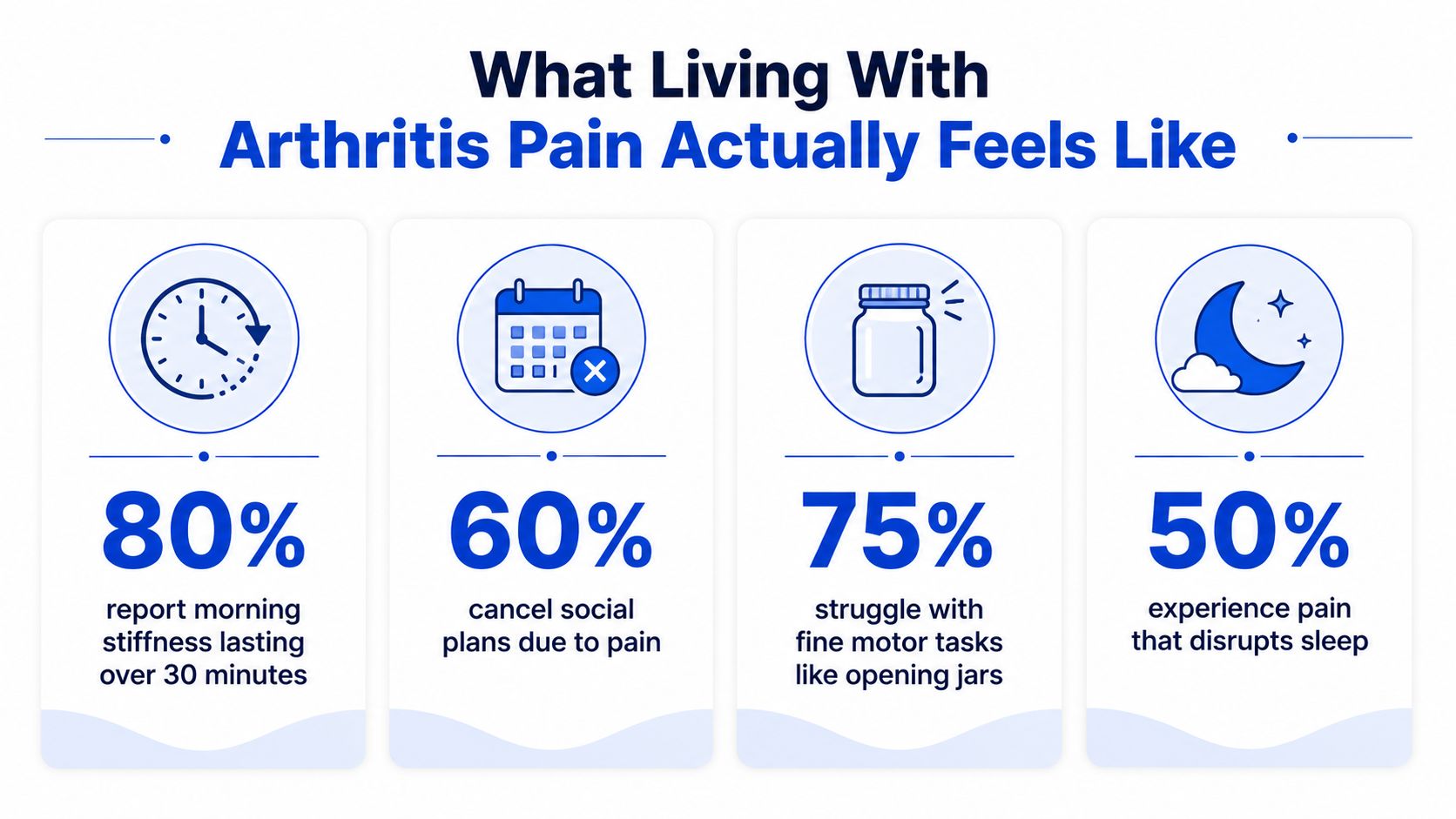
You know the routine. You wake with stiff fingers, wait a while before the joints loosen, and then discover the jar lid still won't budge. Later, the hips complain after sitting too long, the knees ache on stairs, and sleep feels lighter because every turn in bed reminds you a joint is irritated. That pattern is exhausting because arthritis pain isn't just pain, it's friction against ordinary life.
Practical rule: if pain changes how you move, sleep, or plan the day, it's already affecting function, not just comfort.
The other thing patients often notice is that arthritis pain behaves inconsistently. A joint can feel tolerable in the morning, flare after a longer walk, then settle again once you've cooled down, only to stiffen up later in the evening. That's why chasing zero pain usually backfires. A better target is steady function, enough movement to keep the joint from seizing up, and enough restraint to avoid the next-day flare.
The daily impact matters because Australian data show arthritis is often disabling, not mild. AIHW reported that in the 2017 to 18 National Health Survey, 53% of people with arthritis had severe or moderate bodily pain, compared with 17% of people without arthritis, and 43% were limited in everyday activities because of it (AIHW). That kind of burden changes the aim of treatment. The goal is not heroics, it's a plan that helps you get through mornings, stay on your feet longer, and stop pain from shrinking your world.
Understanding the Main Types of Arthritis and Their Pain Patterns
The label matters less than the pattern, because the pattern tells you what helps and what doesn't. Osteoarthritis, rheumatoid arthritis, and mixed mechanical pain can all hurt, but they don't behave in the same way. If you treat them as identical, you waste time and often make things worse.
Osteoarthritis usually dislikes load
With osteoarthritis, pain often rises with prolonged standing, walking, lifting, or repeated joint use. Rest may settle it temporarily, but too much rest leaves the joint stiffer and more reluctant when you move again. That's why people with osteoarthritis often do better with shorter bouts of activity, spaced through the day, rather than one big effort that wipes them out.
Inflammatory arthritis behaves differently
Rheumatoid arthritis and other inflammatory patterns usually bring more obvious morning stiffness, swelling, and fatigue. The joint can feel hot, puffy, and slow to respond, and the whole body can feel heavy rather than just one sore knee or wrist. Those signs matter because they point toward medical review, not just self-management.
Mixed pain needs a mixed response
A lot of people have a blend of stiffness, sensitivity, and mechanical overload. They may notice weather changes, longer car rides, or standing in the kitchen all day make things worse, while gentle movement helps, up to a point. That is exactly why one-size-fits-all advice fails. A plan for mixed pain has to cover load, mobility, flare control, and when to escalate.
A clear diagnosis from a GP or rheumatologist is the foundation. If the joint picture is wrong, the treatment plan can drift for months. An osteoarthritis routine won't fully suit inflammatory disease, and inflammation-focused medication won't fix poor load management.
For a visual cue on how joint patterns can differ in the upper limb, see this wrist pain reference image.
Daily Movement, Posture and Pacing Habits That Actually Help
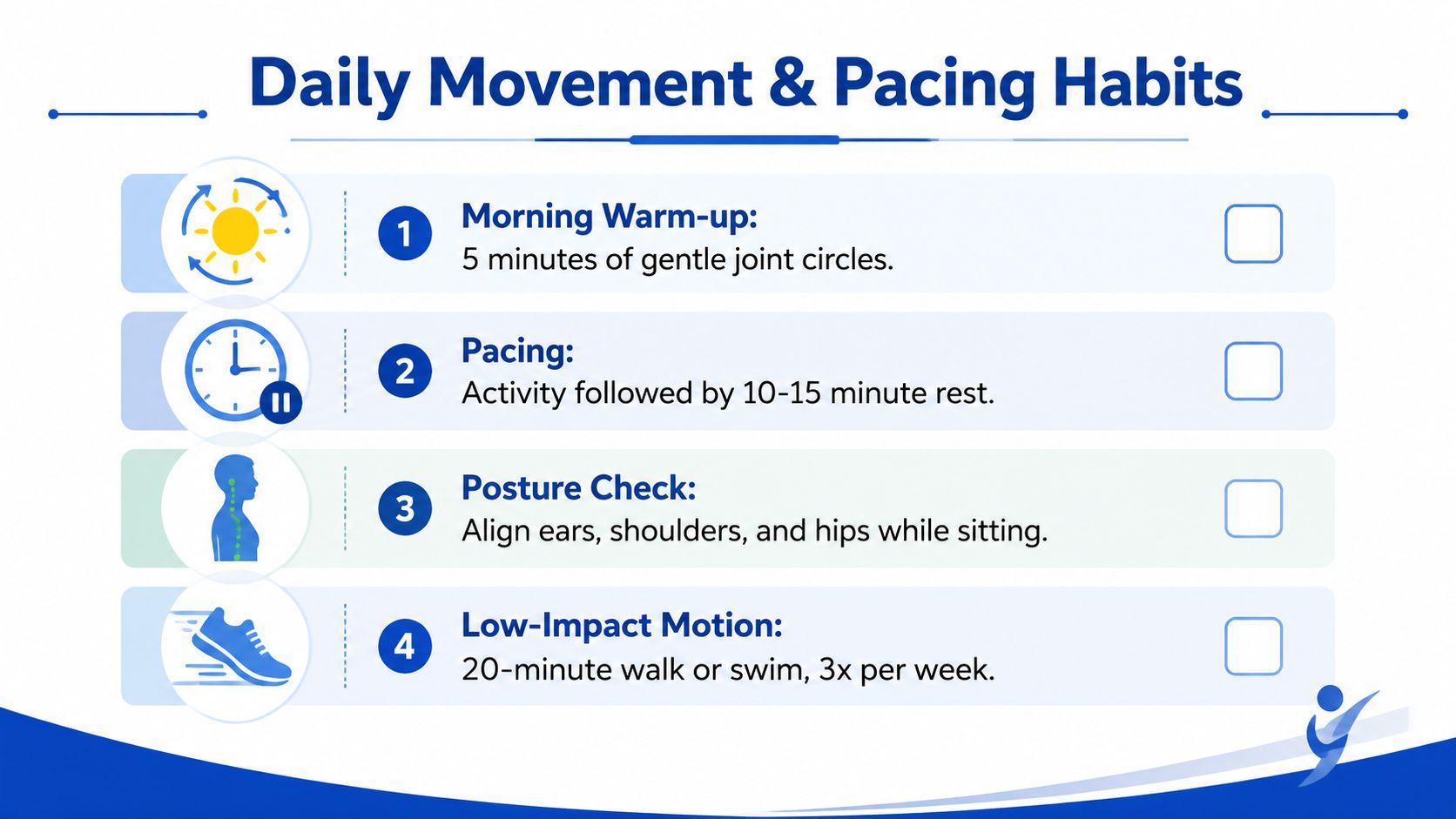
The best routine is the one you'll repeat on a sore Tuesday. Start with gentle movement before you decide how bad the day is, because stiff joints often lie to you at first. Ten slow ankle circles, a few knee bends while holding the bench, or opening and closing the hands can be enough to signal that the body is not broken, just reluctant.
Practical rule: if an activity reliably leaves you worse the next day, cut the dose before you cut movement altogether.
Build the day around smaller loads
Movement works best in chunks. Break jobs into 10 to 15 minute blocks, alternate heavier and lighter tasks, and don't stack the same joint load for long stretches. If you're gardening, for example, prune for a short burst, then stand upright and walk a little before kneeling again. If you're at a desk, get up regularly instead of waiting for pain to force the break.
Use low-impact strength and mobility
Low-impact aerobic activity is usually kinder than all-or-nothing fitness sessions, and simple strength work helps joints tolerate daily life better. Good starter options include seated heel raises, wall push-ups, slow controlled squats to a chair, and calf raises at the kitchen bench. The point isn't to train like an athlete. It's to give the muscles around the joint enough capacity to share the load.
Keep posture practical, not perfect
Posture isn't about sitting like a statue. For office workers, align ears, shoulders, and hips, keep both feet supported, and vary the position before stiffness builds. For retirees, the same principle applies at the kitchen bench, in the car, or while watching TV. A better posture is the one you don't need to fight every five minutes.
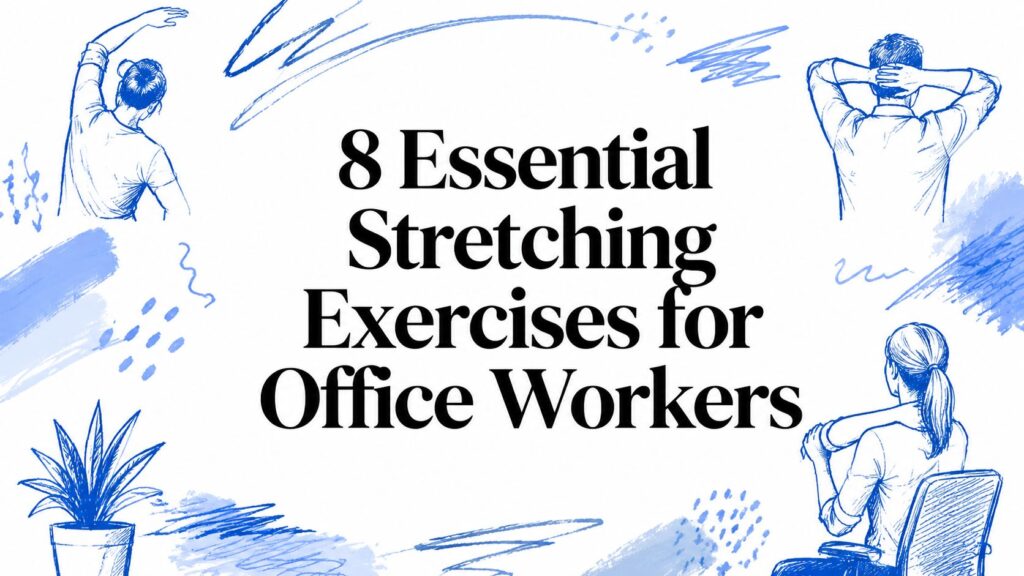
For a quick desk-friendly movement reference, this stretching guide for office workers shows the kind of gentle reset that pairs well with pacing.
How Hands-On Osteopathic Care Fits Into Your Pain Plan
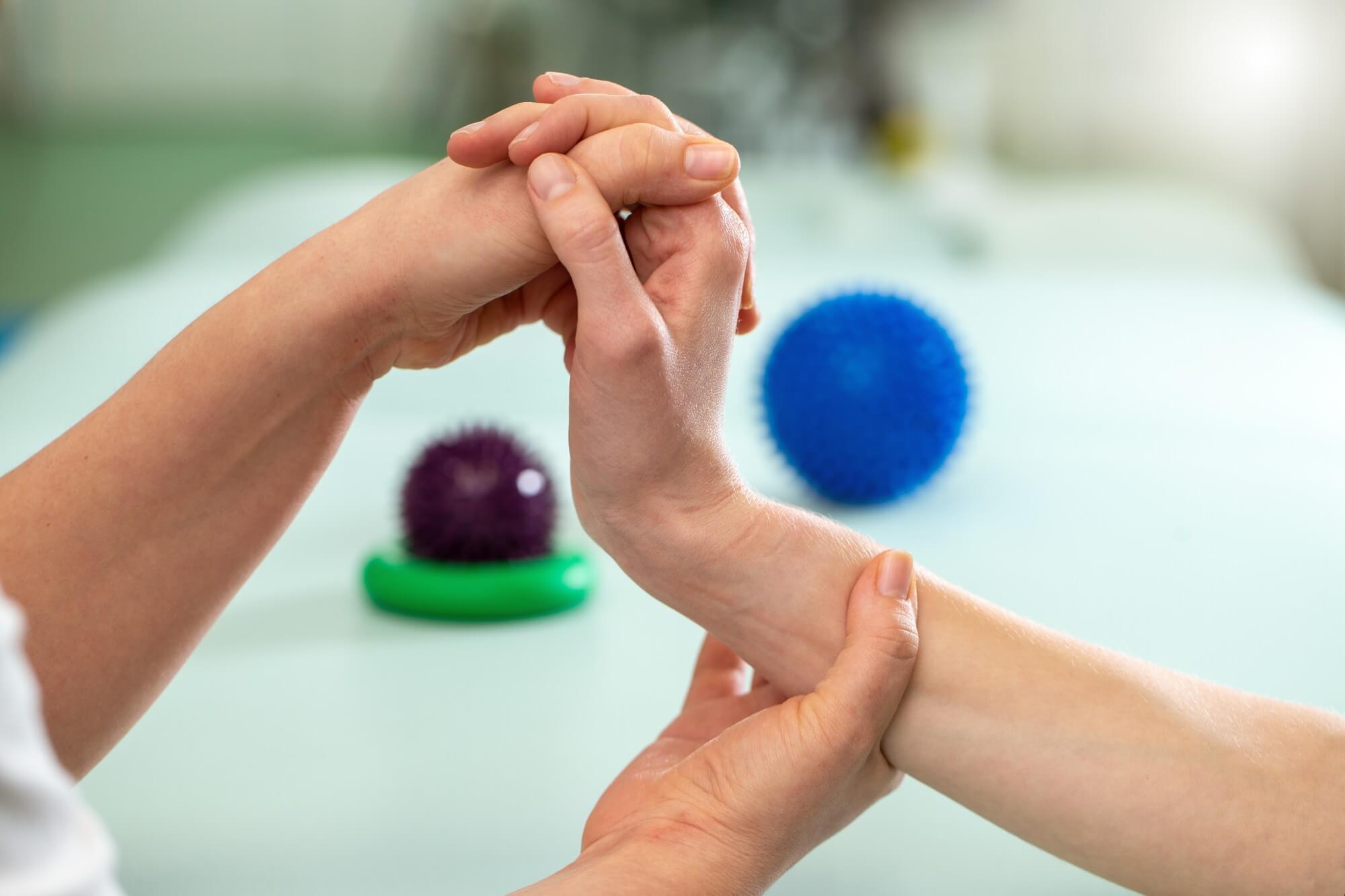
Hands-on care is worth considering when pain has become sticky, protective, and hard to shift with home strategies alone. A first osteopathic visit at Bayside Osteopathic Health typically starts with a full history and movement assessment, then progresses to gentle soft-tissue work, joint articulation, and mobilisation matched to the person's age, irritability, and movement pattern. That matters because arthritic pain is rarely just about one sore joint. It often includes guarding, altered posture, and surrounding muscle tension.
If you want a simple way to think about it, osteopathy aims to reduce the noise around the joint so movement feels less threatening. That can mean easier mornings, better tolerance for walking or gardening, and a clearer sense of which home exercises are worth keeping. It doesn't mean the arthritis disappears.
The limitation is important. Osteopathy can't reverse joint damage, and it shouldn't be sold as a cure. It tends to work best when it sits beside exercise, pacing, sleep work, and medical review where needed. That's the part people often miss. The best outcomes usually come from combining care rather than expecting one method to carry the whole load.
Useful expectation: manual treatment should make movement easier and more usable, not create a fantasy of “fixed forever”.
Some people ask whether osteopathy is the same as physiotherapy. The overlap is real, especially around exercise advice and rehabilitation, but osteopaths usually place more emphasis on a whole-body structural assessment and hands-on manual therapy. If you want a clinician to assess how your movement, stiffness, and loading habits fit together, osteopathy may suit that preference. The right choice depends on the pattern of pain, the person's goals, and what they're likely to follow through on.
If you're comparing options, this osteopathic consultation example gives a sense of the kind of rehabilitation-focused approach that can sit alongside self-management.
Medication, Injections and Other Short-Term Rescue Options
A flare can turn a normal week into a grind. A person who could manage a short walk on Monday may be limping by Thursday, sleeping poorly, and avoiding stairs because every movement feels loaded. Medication has a role within a broader pain management plan, especially when it helps calm things enough to keep you moving.
Compare the common options
| Option | Typical Use | Rough Duration of Relief | Main Caution |
|---|---|---|---|
| Paracetamol | Mild pain relief | Short term, variable | May not be enough on its own |
| Topical NSAIDs | Localised joint pain | Short term | Skin irritation can occur |
| Oral NSAIDs | Moderate flares | Short term | Stomach and blood-pressure risks |
| Corticosteroid injection | Knee flare or inflammatory flare | 1 to 3 weeks (review) | Temporary benefit, not a cure |
| Disease-modifying medication | Inflammatory arthritis | Ongoing control | Needs medical supervision |
The short-term rescue tools are the ones people ask about most, and the evidence helps set expectations. In a review of osteoarthritis treatments, intra-articular corticosteroid injections eased knee OA pain for 1 to 3 weeks, with an effect size of 0.72 and NNT of 4. NSAIDs also improved pain and function versus placebo in knee OA, with pain effect size 0.32 and function 0.29 in that same review. Those figures matter because they show the usual trade-off, a useful reduction in pain for a limited period, not a lasting fix.
For inflammatory arthritis, disease-modifying treatment sits in a different category and needs GP or rheumatology oversight. Opioids and tramadol belong much later in the conversation, if at all, because they do not solve the joint problem and can bring their own issues. The cleaner question is not what strongest thing can I take, it is what gives enough relief to keep me moving while the underlying plan catches up.
Sleep, Weight, Nutrition and Small Aids That Make a Real Difference
Poor sleep makes pain louder. People feel that before they can explain it, a bad night leaves joints more reactive, patience shorter, and the next day harder to pace. A simple sleep reset starts with a consistent bedtime, a cool dark room, and a short wind-down stretch so the body isn't trying to settle while already braced.
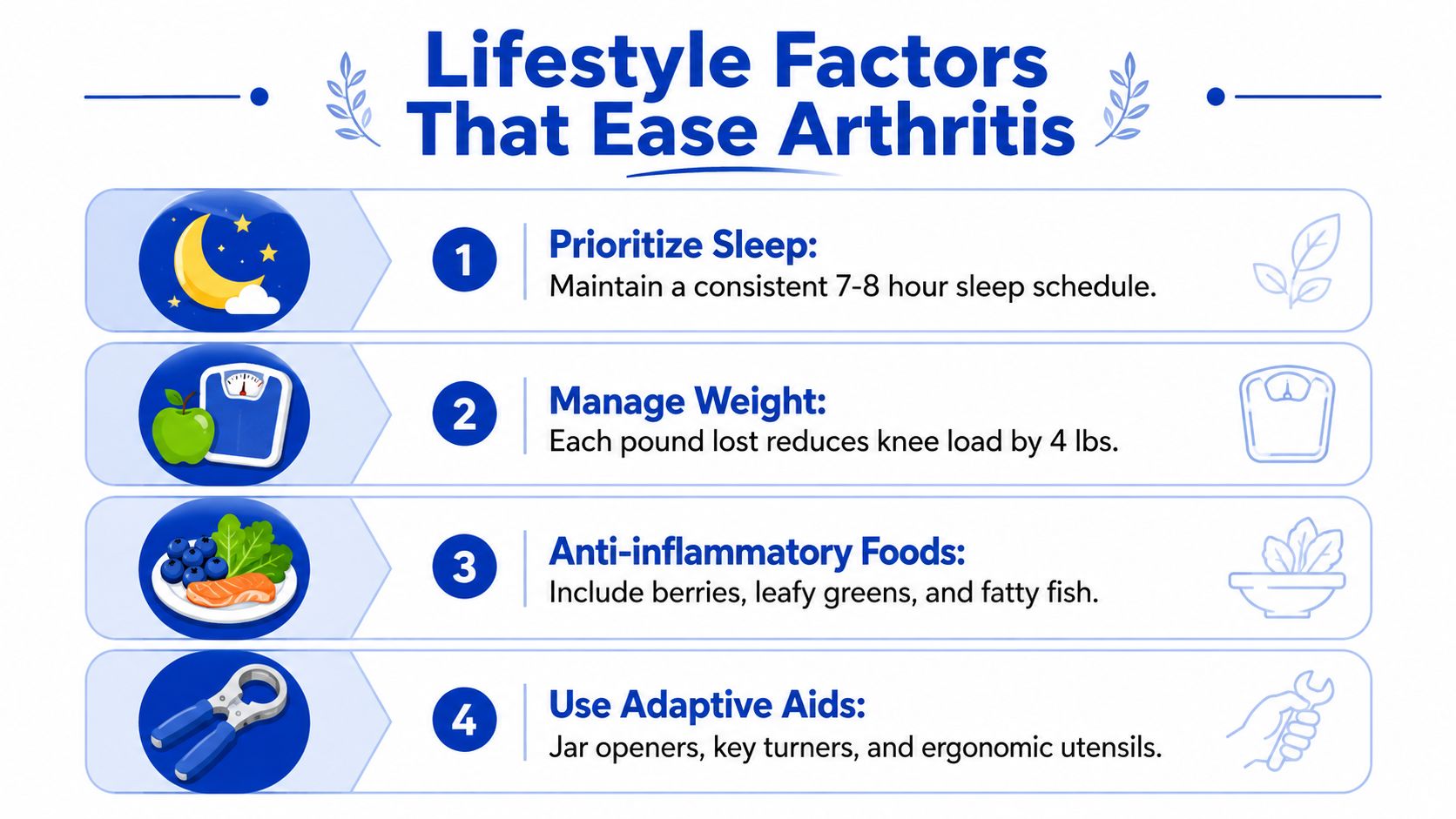
Weight is a sensitive topic, so it needs to be handled without drama. The practical point is simple, less load means less stress on weight-bearing joints, especially hips and knees. You do not need a crash diet. You need something sustainable enough that your knees still feel it a few months later.
Keep the changes small and visible
Nutrition works best when it's realistic. Aim for an overall eating pattern that leans on vegetables, fruit, oily fish, and less ultra-processed food rather than looking for miracle ingredients. Some people also discuss omega-3s and vitamin D with their GP, but the bigger win usually comes from the whole pattern, not a single supplement.
Small aids often do more than people expect. A jar opener, ergonomic cutlery, supportive footwear, a walking stick set at the right height, or a heat pack for stiffness can change what the day looks like without needing a whole new diagnosis. These tools don't prove weakness. They preserve energy for the parts of life that matter.
A short list is usually enough:
- Sleep: keep the same wind-down routine on most nights.
- Load: use the lightest tool that still gets the job done.
- Footwear: choose stable shoes before the joint gets tired.
- Heat or cold: use either one based on whether the joint feels stiff or hot.
The point is not to overhaul your life. It's to remove small daily obstacles that keep reminding the joint to flare.
Your Weekly Plan, Red Flags and How to Access Care Locally
A workable week usually has a rhythm, not a perfect script. Monday might be a short walk and a few chair squats. Midweek could include a GP review if medication needs adjusting, or an osteopathy session if stiffness and movement control have stalled. The rest of the week is built around pacing, sleep, and repeating the parts that reduce flare-ups rather than waiting for pain to vanish first.

Red flags deserve a clear line. Sudden severe joint swelling, a hot red joint, fever, a locking joint, or pain after a fall needs prompt medical review. Those signs are different from the usual ups and downs of chronic arthritis pain, and they shouldn't be managed by guesswork.
Practical rule: if the joint looks angry, swollen, hot, or suddenly unusable, don't treat it like a routine flare.
There's also a local access issue people don't always get told about. In Australia, eligible patients with a chronic condition can access up to five rebated allied health sessions per calendar year through a GP Management Plan and Team Care Arrangement, and osteopathy may be included depending on the practitioner's registration. That pathway can make a proper assessment and follow-up far more doable, especially if you need hands-on care plus home guidance rather than medication alone.
The YouTube clip below is a useful reminder that the most helpful arthritis plan is usually the one you can repeat.
If arthritis pain is getting in the way of walking, sleeping, or getting through the week, book a visit with Bayside Osteopathic Health. We assess how your body moves as a whole, then shape hands-on care and practical home strategies around the way your pain behaves.