
You might be lying on a treatment table with a stiff neck, watching cups go on your back and wondering whether you're about to feel relief, pressure, or just a few strange circles on your skin. That's a common question individuals have in the room, because how cupping therapy works matters more than whether it looks dramatic.
Cupping has been used across different healing traditions for a long time, but the modern conversation is much more practical. The useful question is what the cups are doing to skin, fascia, capillaries, and pain signalling, and why those visible marks are not the same thing as “toxins leaving the body”. A physiology-first explanation also helps you judge where cupping fits alongside osteopathic care, especially when you want a gentle tool that supports movement rather than a standalone cure.
Table of Contents
- Why People Choose Cupping and How It Works
- The Suction Mechanism from Vacuum to Tissue Response
- Main Cupping Styles and How They Differ in Practice
- What the Bruises Really Mean at a Cellular Level
- What a Cupping Session Actually Feels Like
- What the Australian-Relevant Evidence Shows
- Where Cupping Fits in Osteopathic Care and Who Should Avoid It
Why People Choose Cupping and How It Works
A common scene plays out in clinic rooms across Australia. Someone arrives with a stiff upper back, lies face down, and watches as glass or silicone cups are placed over the painful area. The first question is usually simple, Will this hurt? The more useful one is, What is happening inside my body right now?
Cupping makes sense to many people because it offers a visible, hands-on way to work with pain and stiffness without promising a miracle. The measurable part is the vacuum force created at the skin surface. That force lifts tissue, changes local circulation, and produces a response that can be observed in the body rather than explained through detox language. For people who want a treatment that can sit beside exercise, mobility work, and osteopathic care, that practical explanation matters more than the folklore around it.
Why the visual marks matter
The marks are what individuals typically notice, but they are not the point of the treatment. They show that suction has changed the local mechanics in the skin and superficial tissue. They do not show that waste has been pulled out of the body.
Practical rule: if a treatment description leans hard on “detox”, it is probably selling a story, not the physiology.

The useful promise is modest and specific. Cupping can help a tight area feel looser, which may make hands-on treatment, mobility work, and exercise easier to tolerate. That is a different claim from saying it fixes every pain problem at once.
The Suction Mechanism from Vacuum to Tissue Response
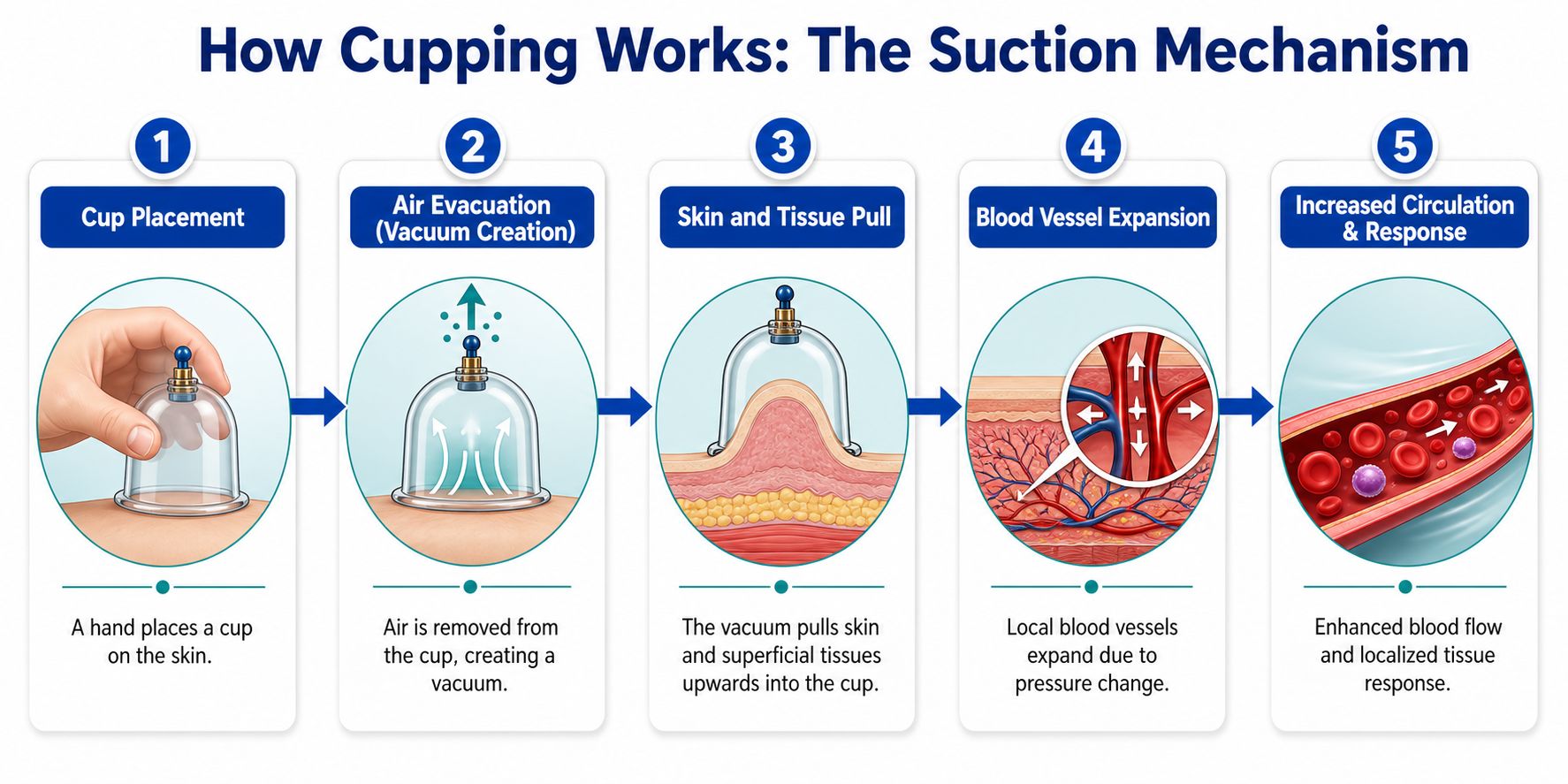
Cupping works because the cup creates localised negative pressure. Think of a suction cup pressed against a tiled wall. The more air you remove, the harder the cup pulls on the surface beneath it, and the more tension builds in the material that's being held in place.
From cup placement to tissue lift
The same thing happens on skin. Once the air inside the cup is evacuated, the skin and superficial fascia are drawn upward into the cup, which stretches the tissue and recruits blood into that area. A mechanistic review describes this as a combined mechanotransduction + microcirculatory effect, where tissue deformation can trigger vascular and cellular responses that may reduce pain and stiffness mechanistic review.
That suction can come from different methods. Traditional fire cupping uses heat to remove air before the cup is placed, while modern sets often use a hand pump or built-in suction mechanism. The physics is the same, even if the tools look different.
What the tissue does next
Once the tissue is lifted, capillaries can dilate and blood flow changes locally. In current mechanistic literature, that sequence is linked to improved microcirculation, increased tissue oxygenation, endothelial repair, granulation, and angiogenesis. None of that means the body is being “flushed” in a literal sense. It means the pressure change creates a measurable local environment that may support recovery.
A simple way to picture it is this. The cup doesn't reach deep muscles and grab them directly. It changes the tension in the layers closest to the skin, and those layers then influence how the area feels and moves.
The Australian evidence map also describes dry cupping as creating a mild vacuum, while wet cupping draws blood from the dermal microcirculation, with possible effects on subcutaneous blood flow and autonomic activity Australian evidence map. That distinction matters because the first step in cupping is always mechanical, not mystical.
Main Cupping Styles and How They Differ in Practice
A cupping session can look simple from the outside, but the method behind it changes what the body experiences. The type of cup, whether the skin is broken, and whether the cup stays still or moves all affect sensation, aftercare, and the level of caution a practitioner needs to use.
Dry cupping and wet cupping are not the same
Dry cupping relies on suction alone. The skin stays intact, and the goal is to create a local mechanical pull through negative pressure. Wet cupping adds small superficial incisions before the cups are applied, so a small amount of blood enters the cup. That changes the feel of the treatment, and it also changes the bleeding and infection considerations.
That difference matters in practical terms. A person who tolerates dry cupping for tight neck muscles may still be a poor candidate for wet cupping, especially if they have clotting concerns, take blood-thinning medication, or have fragile skin. The two methods should be treated as different procedures, not as two versions of the same thing.
Static, sliding, and the materials used in practice
Static cupping keeps the cups in one place. Sliding cupping uses oil so the cup can move across a muscle band, which creates a different sensation and often feels more like broad tissue mobilisation than a fixed pull. The choice depends on the area being treated and how much pressure the person can comfortably tolerate.
The cup itself matters too. Practitioners may use glass, plastic with a pump, or medical-grade silicone. Glass is often linked with traditional fire cupping, plastic pump systems are common in modern clinics, and silicone cups usually allow more movement-based work. The material changes how suction is created, how much control the practitioner has over intensity, and how easy it is to adjust the treatment during the session.
Dry cupping and wet cupping share a name, but they are different interventions, and the safety rules are not identical.
The better question is not which style is universally best. It is which version fits the person's skin, pain pattern, and risk profile. That is the level of detail that helps cupping sit safely alongside osteopathic care rather than being treated as a standalone cure.
What the Bruises Really Mean at a Cellular Level
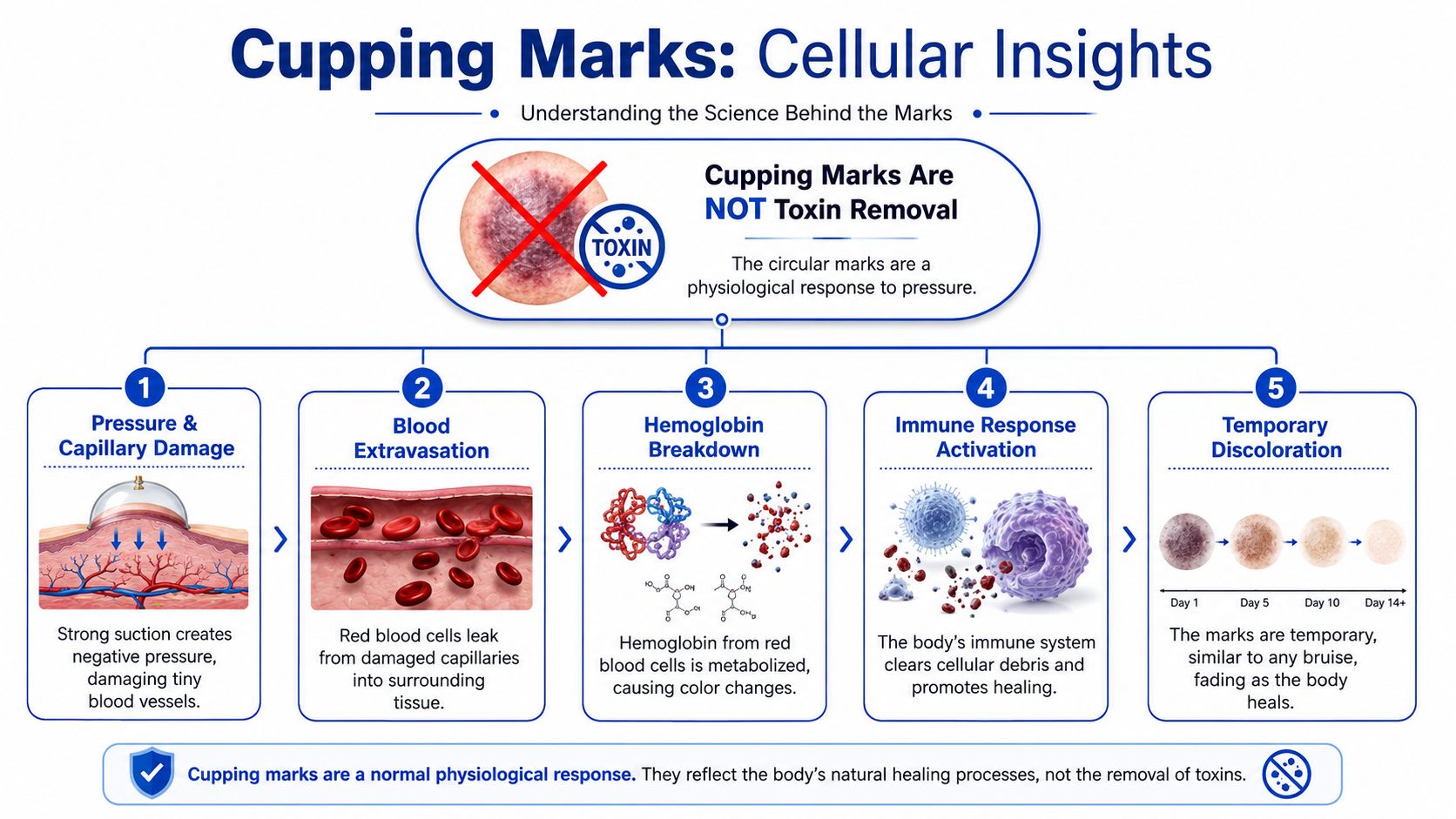
The circular marks catch everyone's eye, and they're often sold as evidence that “toxins” have been pulled out. That idea doesn't hold up well against the clinical explanation. Mainstream sources frame those marks as temporary ecchymosis, basically a bruise-like response caused by suction-induced capillary rupture Cleveland Clinic explanation.
Why colour changes happen
When suction is strong enough, tiny blood vessels can break and a small amount of blood enters the surrounding tissue. The body then clears that material in the same general way it handles other bruise-like changes. The colour of the mark mostly reflects how much the local capillaries were stressed, not how much “waste” was removed.
A mechanistic review proposes a more specific biochemical pathway. After suction-induced capillary rupture, macrophages phagocytise red blood cells and upregulate heme oxygenase-1. That enzyme metabolises heme into biliverdin, bilirubin, carbon monoxide, and iron, and those by-products are associated with antioxidant, anti-inflammatory, and neuromodulatory effects HO-1 pathway review.
What that means in plain language
This is a local inflammatory-mechanical response, not a detox event. The body is responding to pressure, tissue stretch, and small amounts of blood escaping into tissue. That response may be part of why some people feel better afterwards, but it doesn't mean cupping is cleaning the bloodstream or removing some hidden poison.
The marks usually fade as the tissue recovers, just like other bruises do. If a practitioner says the darkness proves the body was full of toxins, that's not a clinically sound interpretation.
What a Cupping Session Actually Feels Like
A well-run session starts before any cup touches the skin. The practitioner should ask about your pain, your medications, your skin, and any history that changes the risk of bruising or bleeding. Consent matters here, because the treatment feels unusual even when it's appropriate.
The usual sequence in the room
You'll normally be positioned on a treatment table, often prone for back or shoulder work. The skin is prepared, the cups are placed, and you'll feel a pulling or stretching sensation rather than sharp pain if the intensity is set well. Many people describe it as strong pressure that settles after the first moments.
How long the cups stay on depends on the technique and the area being treated. Static cups are left in place for a set period, while sliding cups are moved along the muscle line once the tissue has adapted to the suction. The goal isn't to create the biggest mark possible. It's to create a tolerable response that helps the tissue relax.
After the cups come off, people often notice warmth, a sense of looseness, and the familiar circular marks. That's the immediate after-effect, and it usually tells you the tissue has been mechanically stressed, not harmed in a dangerous way when the treatment has been done properly.
Aftercare that actually helps
Hydration is sensible, but the bigger issue is how you move afterwards. Gentle movement usually serves you better than aggressive stretching straight away. It's also wise to avoid intense heat exposure right after treatment if your skin is already sensitive.
Useful aftercare habit: treat the area as newly loaded tissue, not as a problem that needs to be forced open again.
A thoughtful follow-up plan matters more than a single dramatic session. If cupping helps, it should make the next step in care easier, whether that's mobility work, exercise, or hands-on treatment that addresses the reason the area got tight in the first place.
What the Australian-Relevant Evidence Shows
The best current picture is more cautious than the marketing suggests. Australian evidence reviews have found that cupping has a place for some pain and soft-tissue problems, but the effect is modest rather than dramatic, and the treatment is best understood as supportive care rather than a cure Australian evidence and safety analysis. That matters because the popular story often promises more than the research can support.
Where the evidence is strongest
Cupping seems most defensible as a short-to-medium-term adjunct for pain and movement restriction. In plain terms, it may help settle a painful, guarded area enough for the rest of treatment to work better, much like easing a stuck hinge so the door can move more freely. A 2024 systematic review on low back pain reported high-quality evidence that cupping improved pain at 2 to 8 weeks after treatment, with an effect size of d = 1.09 and 95% CI 0.35 to 1.83 (p = 0.004) 2024 systematic review. The useful takeaway is the time course. The benefit reported there sits in a short follow-up window, which fits a symptom-relief role rather than permanent structural change.
What cupping cannot reliably claim
Cupping cannot claim broad detoxification, whole-body cleansing, or a universal fix for chronic disease. The published evidence is condition-specific, strongest for pain outcomes, and still mixed across other uses. That is why a careful clinician treats it as one tool among many, not as a replacement for diagnosis, exercise, load management, or medical assessment.
If someone has a stubborn neck, back, or shoulder problem, the realistic expectation is straightforward. Cupping may reduce local pain and stiffness enough to make movement and rehabilitation easier, but it does not replace the full plan of care.
Where Cupping Fits in Osteopathic Care and Who Should Avoid It
A patient may come in hoping cupping will “fix” a stubborn shoulder or low back, then leave with a clearer result. The cup can ease a tight, guarded patch of tissue, but that is only one part of the clinical picture. In osteopathic care, cupping works best as a supporting tool inside a broader plan that may also include joint articulation, mobility work, movement advice, and home exercise. Used that way, it can help settle a painful area enough for the rest of treatment to be more effective. On its own, it rarely explains or resolves the full reason someone is in pain.
How it compares with hands-on osteopathic care
Osteopathic treatment looks at how the whole body is moving, not only the sore spot. Cupping may improve local tissue glide and reduce the sense of tightness, while broader osteopathic techniques can address joint motion, posture-related strain, and the movement habits that keep loading the same area. The two approaches are different jobs in the same workshop. One loosens the stuck bolt. The other checks whether the frame is still pulling everything out of line.
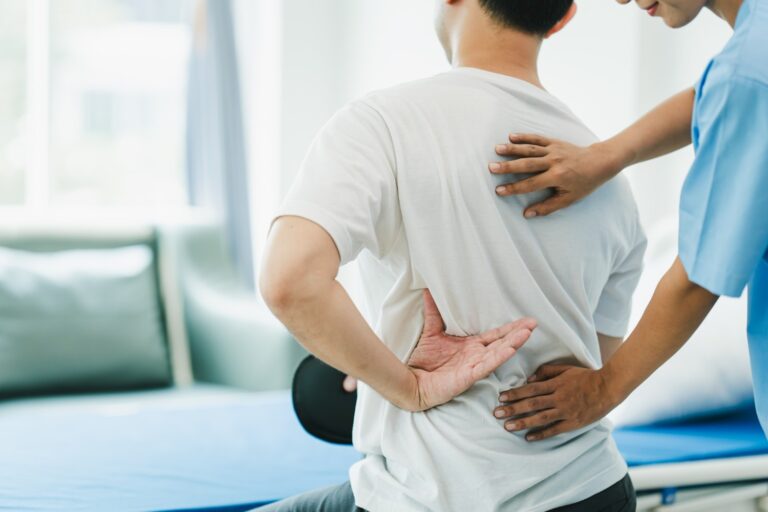
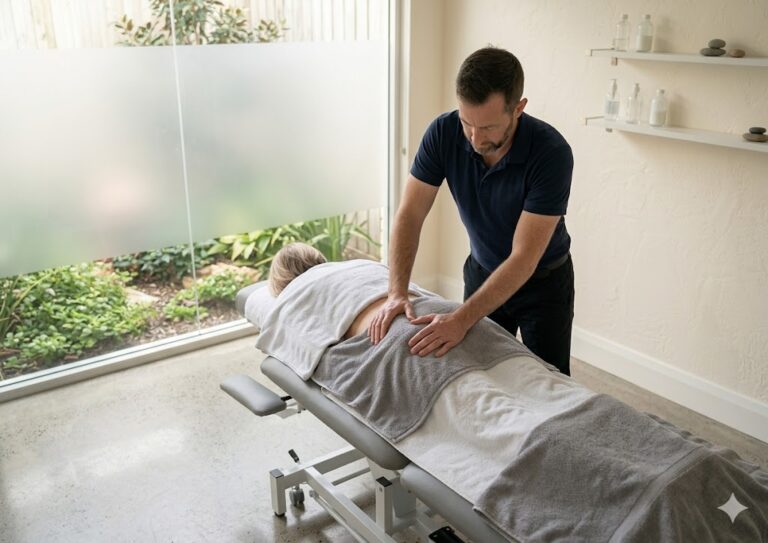
For readers who want a visual comparison, this example of hands-on soft tissue care shows the kind of broader manual context cupping may sit within. A tight upper back may need local release, but it also needs attention to why that region keeps tightening during work, training, or daily posture.
Some people should pause and ask for medical advice first. That includes people taking anticoagulants, people with bleeding disorders, people with active skin conditions in the area, some pregnant patients depending on the region being treated, people with severe cardiovascular conditions, and anyone who has had recent surgery. Wet cupping carries extra caution because the skin is broken, so the safety discussion changes in a practical way.
Cupping in Context, When It Helps and When to Seek Advice First
| Situation | Typical Role of Cupping | Precaution or Action |
|---|---|---|
| Tight neck or upper back from posture strain | May help reduce local tension and improve movement | Ask whether dry or sliding cupping suits your skin and pain pattern |
| Low back pain with stiffness | Can be a short-term adjunct to hands-on care and exercise | Confirm the treatment is part of a broader rehab plan |
| Sensitive skin or easy bruising | May not be appropriate, or may need very gentle settings | Discuss bleeding risk and alternatives first |
| Anticoagulant use or bleeding disorder | Often not a first-choice treatment | Seek medical guidance before treatment |
| Active rash, wound, or infection in the area | Usually not suitable | Treat the skin issue first |
| Recent surgery | Needs careful review | Ask the surgeon or treating clinician before any suction-based work |
If you are unsure whether cupping fits your presentation, ask one direct question in the consultation. “What problem are we trying to change, and how will we know if it is working?” That keeps the discussion tied to outcome, not folklore.
If you are dealing with back, neck, or shoulder pain and want a careful, evidence-informed opinion on whether cupping belongs in your plan, book a visit with Bayside Osteopathic Health. Their approach combines hands-on osteopathic care, movement advice, and practical self-care so you can make a clear decision about what is likely to help your body move better.