

You're half-awake on the couch, one hand under a baby who's still feeding, the other brushing over a sore little lump that wasn't there yesterday. It feels stubborn, maybe a bit hot, and the usual advice sounds oddly cheerful for how miserable it feels. Most parents in this moment want one thing, a clear answer on whether this is something they can settle at home, or the start of mastitis.
A blocked milk duct is one of those breastfeeding problems that sounds simple until you're living it at 2 a.m. In practice, it usually shows up in the early postpartum weeks, when feeds are still settling and breasts are changing fast. Australian evidence on mastitis-related blocked duct problems found the highest incidence in the first four weeks postpartum, with a combined incidence of 11.1 episodes per 1,000 breastfeeding weeks across weeks 0 to 25, and one analysis estimating about one in four women breastfeeding up to 25 weeks postpartum experienced mastitis, with the Australian study in that review reporting the highest incidence at every time-point among the studies compared (systematic review).
Table of Contents
- A Tender Lump and a Long Feed
- What a Blocked Milk Duct Actually Is
- What to Do in the First 24 Hours
- Stopping the Next One Before It Starts
- When to Call Your GP About a Blocked Duct
- Where Osteopathic Care Fits In
- Questions Parents Quietly Carry
A Tender Lump and a Long Feed
The classic moment goes like this. Baby is latched, the feed is long, and your breast still feels like there's a pea-sized knot sitting in one spot, stubborn and sore. You re-check the latch, shift positions, and wonder if you're missing something obvious, because it doesn't feel like the internet version of a “simple plug”.
That confusion is normal. Early breastfeeding is full of moving parts, and a tender lump in the breast often lands right when supply, latch, and feed timing are still being worked out. Australian clinical and hospital education sources describe blocked or plugged ducts as a common breastfeeding problem, and some estimates put them as affecting up to two-thirds of breastfeeding women (blocked milk duct and mastitis handout).
What it often feels like
A blocked milk duct usually feels localised, not like your whole breast has changed. You might notice a sore lump, a patch of tenderness, or a spot that feels full even after a feed. Often, you still feel otherwise well, which is part of why people keep trying to “fix” it themselves long after they should have paused and reassessed.
Practical rule: if it's one sore area and you otherwise feel okay, treat it as inflammation and milk-flow trouble first, not as a failure on your part.
The important pattern in Australia is the timing. Guidance and research both point to the early postpartum window as the main risk period, which is why the first few weeks deserve the most attention, not the least. If you're dealing with this now, the aim isn't to squeeze the lump into submission, it's to keep milk moving gently while the tissue calms down.
What a Blocked Milk Duct Actually Is
The old mental model is a clogged pipe. That idea is comforting because it suggests a simple mechanical fix, but it's not the best way to think about it. Australian consumer guidance now frames a blocked duct as localised breast inflammation, and says the ducts are not necessarily blocked, because surrounding tissue can become congested and inflamed and narrow the milk flow (Raising Children Network).
Inflammation narrows the flow
That matters because it changes what helps. If the problem is swelling and tenderness around the duct, then gentle drainage makes more sense than forceful kneading. The goal is to reduce pressure, improve milk flow, and avoid adding more irritation to tissue that's already unhappy.
A simple blocked duct often looks like a local lump, tenderness, and maybe mild redness, with the parent otherwise feeling well. Mastitis sits further along the same spectrum, where the local breast symptoms are often paired with fever, flu-like aches, or feeling generally unwell. Once that systemic picture appears, it's no longer something to treat as a stubborn plug at home.
The breast tissue is irritated first. Milk flow gets caught up in the irritation, not the other way round.
That's why aggressive massage can backfire. Hard pressure may bruise inflamed tissue and make swelling worse, which is the opposite of what you want when the breast is already tender. The biological target is calmer tissue and better drainage, not a bigger workout for the breast.
What to Do in the First 24 Hours
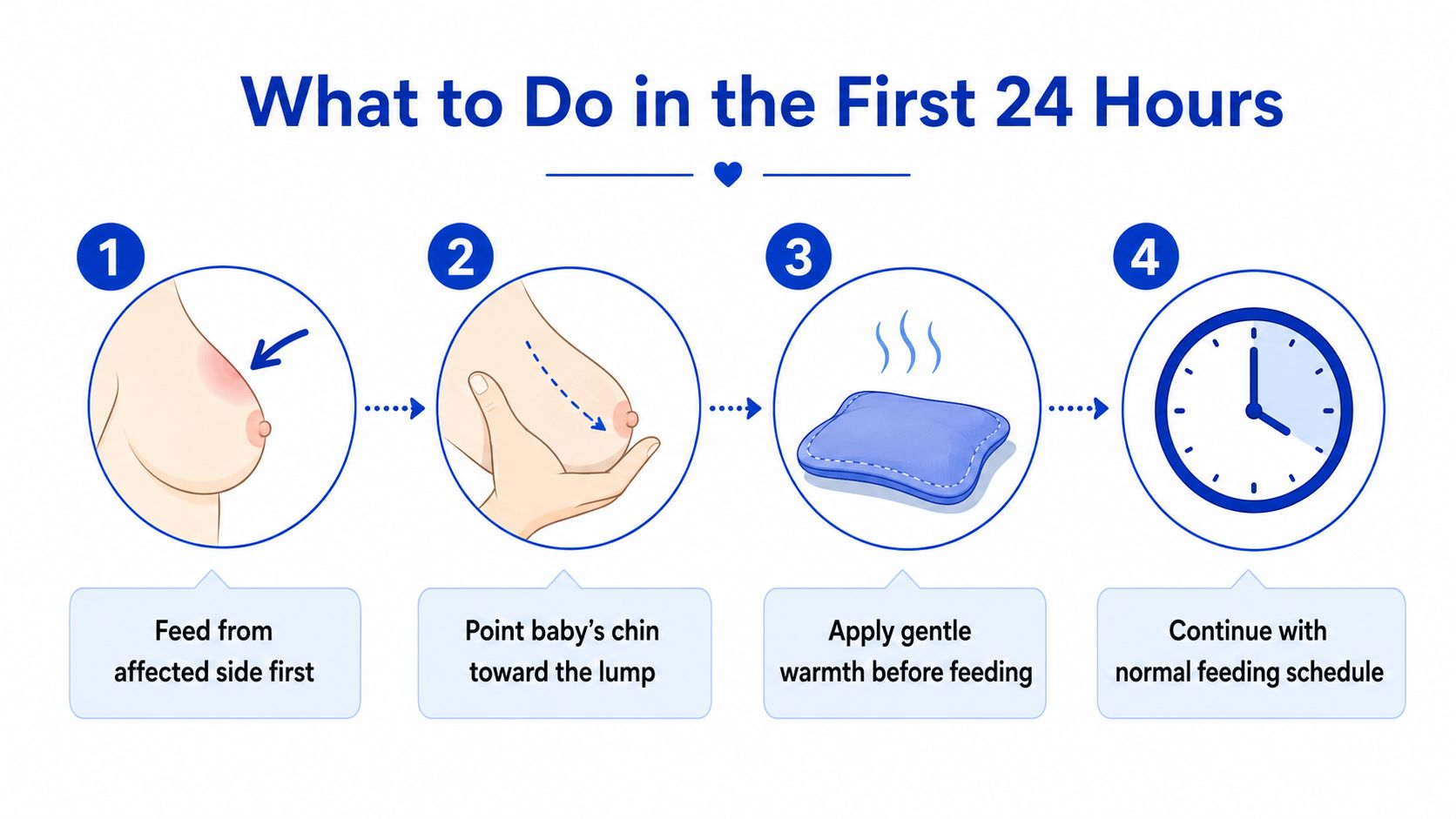
Start with the next feed, not with a marathon of poking and pressing. Offer the affected side first if baby will tolerate it, because that's usually when milk transfer is strongest, then keep the session calm and unhurried. If it helps, gently shape the breast so baby can get a deeper latch and the lump isn't being pinched under the mouth.
A brief warm compress before the feed can help milk start moving more comfortably, but warmth should stay short and soothing, not prolonged. After feeding, a cold pack is often better for the swelling side of the problem, because inflammation tends to respond badly to heat that goes on too long. If baby can't fully drain the breast, express only a small amount for comfort, not a full emptying session that tells the body to make even more milk.
The point to watch is not whether the lump has vanished. The better benchmark is whether pain is easing, milk is flowing more easily, and the breast feels softer after feeds. If you're not seeing any shift within a day, that's a signal to review the plan rather than repeating the same routine harder.
Good enough looks like this: less pain, better flow, and some softening after feeds. The lump can take longer to fade.
Avoid deep rubbing, hard squeezing, or trying to “work it out”. That kind of pressure can irritate breast tissue, especially if the area is already inflamed. Queensland Children's Health advises escalation if symptoms are not relieved within 24 hours, because it may be bacterial mastitis rather than a simple plug (Queensland Children's Health).
If you're getting help with positioning or soft-tissue work, this kind of practical body care often sits alongside feeding support rather than replacing it, and resources such as this osteopathic treatment example can help explain the sort of gentle approach people usually mean.

Stopping the Next One Before It Starts
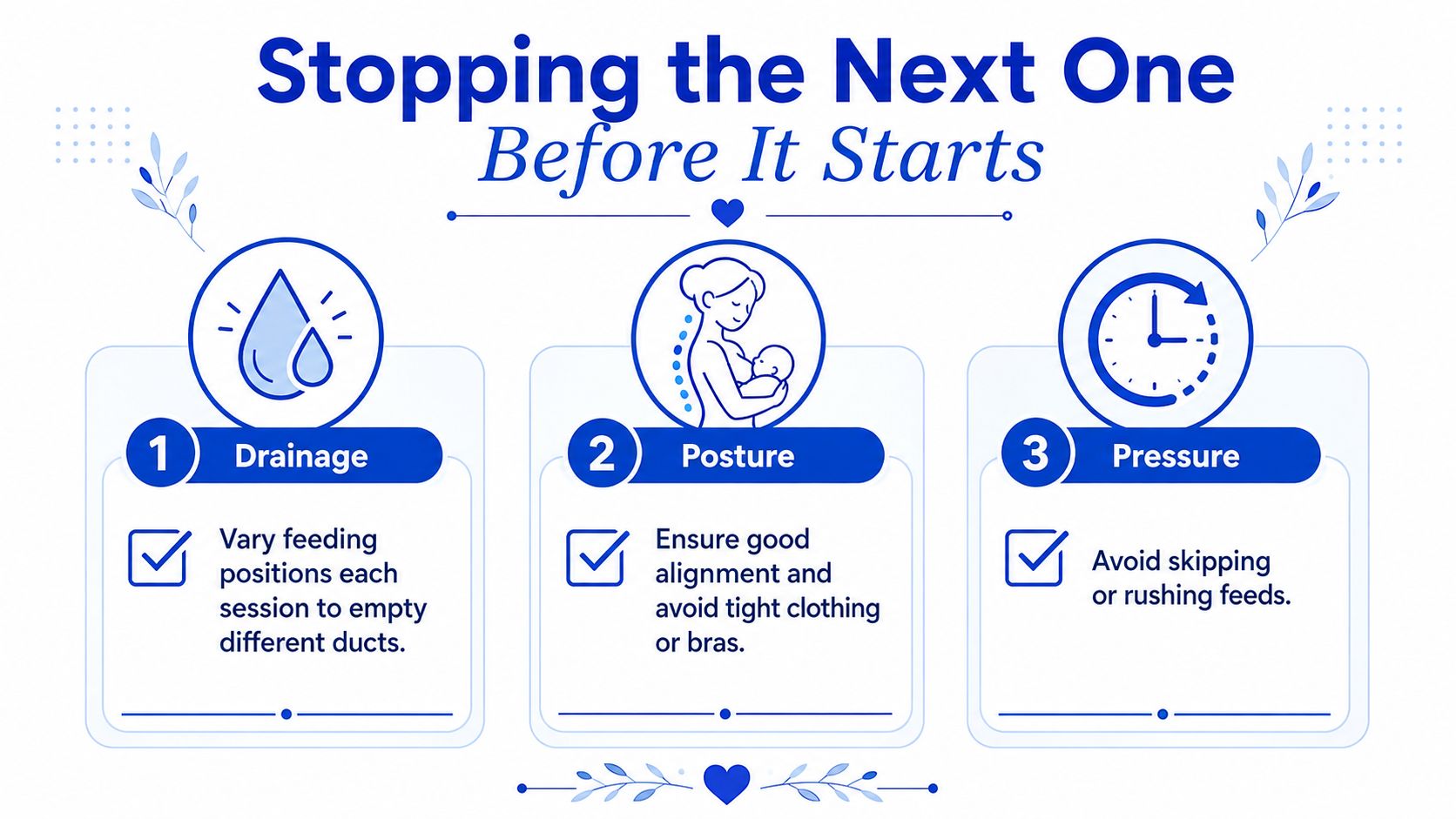
Prevention works best when it's boring and repeatable. The main levers are drainage, posture, and pressure, not stripping the breast clean or adding a dozen extra pumping sessions because you're frightened of another lump. If the breast is emptied in different ways across the day, the tissue tends to tolerate feeding better than when every session presses the same area.
Varying feeding positions can help different parts of the breast empty over time. A good bra matters too, because tight bands, underwire, straps, carriers, and even a seatbelt or shoulder bag can compress breast tissue and set up the same pattern again. Rushed feeds and skipped feeds can also leave milk sitting too long, which is where inflammation often starts.
A simple prevention habit list looks like this:
- Shift positions across the day: Don't let every feed load the same area of the breast.
- Check for pressure points: Look for bras, bras underwires, tight sleepwear, or carriers that dig in.
- Respect feed timing: Rushing or stretching feeds too far apart can increase stasis.
- Keep pumping purposeful: Pumping isn't a prize for overworking the breast, it's a tool for milk removal when needed.
- Build in rest: Fatigue doesn't cause every blocked duct, but it can make recovery harder.
The other useful habit is paying attention to posture and the upper body. Breastfeeding often happens while shoulders are rounded, breath is shallow, and the ribcage stays tight for long stretches. If that's you, this posture support image is a good reminder that the whole feeding setup matters, not just the breast itself.

When to Call Your GP About a Blocked Duct
A blocked duct that stays local and starts easing is one thing. A breast problem that spreads, feels worse, or comes with body-wide symptoms needs a different response. Australian guidance says to seek review if symptoms are not improving after 24 hours, or sooner if fever or flu-like symptoms show up.
What to treat as a same-day call
- Fever or sudden illness: If you're hot, shivery, achy, or feel properly unwell, don't keep treating it as a simple plug.
- Redness that spreads: A wedge of redness or worsening breast heat suggests mastitis rather than a settling lump.
- A harder or bigger lump after home care: If the area is growing, not softening, or more painful after a day, it needs reassessment.
- Ongoing symptoms beyond 24 hours: If the usual home measures haven't shifted things, the plan has to change.
Doctors are mainly checking whether this is still inflammatory breast pain, or whether infection has moved in and antibiotics are needed. They're also looking for signs of an abscess, especially if a lump becomes more painful, more swollen, or starts behaving like a pocket rather than a diffuse area of inflammation.
The practical difference matters because breastfeeding can usually continue safely through treatment, and parents often worry they'll be told to stop feeding. That is rarely the first move. Keeping milk moving is usually part of the recovery plan, but it has to be paired with the right medical review when the warning signs are there.
Where Osteopathic Care Fits In
Osteopathic care sits alongside lactation support, and it also sits alongside medical care when bacterial mastitis is a concern. Its value is as a complement, especially when a blocked milk duct appears together with tight shoulders, rib discomfort, shallow breathing, or a posture that turns holding baby into a full-body strain. A breast lump can be driven by local inflammation, and the surrounding tension often makes feeding positions harder to maintain, which is part of why gentle, timed drainage matters more than forceful kneading.
In session, a practitioner may use soft-tissue work around the chest, upper back, ribs, and thoracic spine, then add gentle articulation where movement is restricted. The aim is not to treat the breast as an isolated structure. The aim is to reduce the strain around it so feeding positions feel more manageable, breathing is less restricted, and you can stay in a position that helps milk move without fighting your own body.
Who helps with what
| What You're Experiencing | First Call | What They'll Likely Help With |
|---|---|---|
| Latch feels off, nipple pain, baby doesn't seem to drain well | Lactation consultant | Positioning, latch, milk transfer, feed mechanics |
| Breast lump, local tenderness, posture strain, upper back tightness | Osteopath | Gentle tissue work, rib and thoracic mobility, posture support |
| Fever, spreading redness, feeling unwell | GP | Mastitis assessment, antibiotics if needed, abscess check |
| Lump keeps returning in the same spot | GP plus lactation support | Recurrent causes, feeding pattern review, further assessment |
A useful way to approach this is as team care. One clinician looks closely at feeding mechanics, another looks at body tension and movement, and the GP steps in when infection or a complication needs medical treatment. If you already have a support plan, bring the feeding history with you, because the details of position, pressure, and timing matter.
If you're in the Bayside area and want this treated as a body-and-feeding problem rather than a one-note “massage it harder” problem, Bayside Osteopathic Health offers gentle, practical care that fits alongside the rest of your postpartum support.
Questions Parents Quietly Carry
Should I keep feeding on the affected side?
Usually, yes. Keeping milk moving is part of calming the inflammation, and avoiding the side can make stasis worse.
Is it safe to breastfeed if I'm on antibiotics?
In many cases, yes, but the exact medicine and your situation matter. Your GP will choose treatment with breastfeeding in mind and tell you what to watch for.
What if the same lump keeps coming back?
That deserves a proper review, not just repeated home treatment. Recurrence in the same spot can point to the same pressure pattern, latch issue, or a problem that needs medical assessment.
Do I need to wean if this keeps happening?
Not automatically. Ongoing blockages usually mean the feeding pattern, drainage, or underlying inflammation needs a closer look, not that breastfeeding has to stop.
Why didn't harder massage fix it?
Because the problem is often inflamed tissue narrowing milk flow, not a stubborn knot that needs brute force. Gentle drainage and timely reassessment usually work better than digging into a sore breast.
When should I stop guessing and get help?
If you're worse after 24 hours, if you have fever or flu-like symptoms, or if the breast is more red, hard, or painful, get reviewed. The quicker you change course, the less likely it is to escalate.
If you're tired of trying to self-diagnose a sore breast in the middle of broken sleep, the team at Bayside Osteopathic Health can help you sort out the body tension, posture strain, and movement issues that often sit alongside breastfeeding discomfort. Book a visit if you want gentle, practical care that fits with lactation support, not advice that tells you to just massage harder and hope.