
Shoulder pain during reaching, lifting or sleeping can feel as though it must come from the rotator cuff. But what can rotator cuff tests really tell you? They may reproduce pain, reveal weakness or show a movement deficit, yet no single test confirms a rotator cuff tear or proves impingement. Shoulder symptoms can also involve the acromioclavicular joint, neck, nerves, joint stiffness, bursae or movement patterns around the shoulder blade.
A gentle movement observation may help you describe what hurts, but it isn't the same as a clinician-performed examination. A practitioner positions the shoulder carefully, applies controlled resistance, compares both sides and considers your injury history, age, symptoms, neck movement and overall mobility. Australian guidance supports this broader approach. The RACGP notes that common tests can have very different rule-in and rule-out value, while UNSW guidance states that no single clinical test for rotator cuff syndrome has significant diagnostic accuracy in Australian shoulder guidelines.
The eight examinations below explain what each test examines, how it's performed, what a positive sign may suggest, and where its limitations lie. Don't force any movement. Stop immediately if pain is sharp, severe or worsening. Seek prompt medical attention after a major injury, sudden loss of movement, deformity, marked swelling, numbness or significant weakness.
Table of Contents
- 1. Neer Impingement Test
- 2. Hawkins-Kennedy Impingement Test
- 3. Empty Can Test
- 4. Lift-Off Test
- 5. Drop Arm Test
- 6. Infraspinatus Strength Test
- 7. O'Brien's Crank Test
- 8. Scapular Dyskinesis Assessment
- 8-Point Comparison of Rotator Cuff Tests
- From a Positive Sign to the Right Next Step
1. Neer Impingement Test
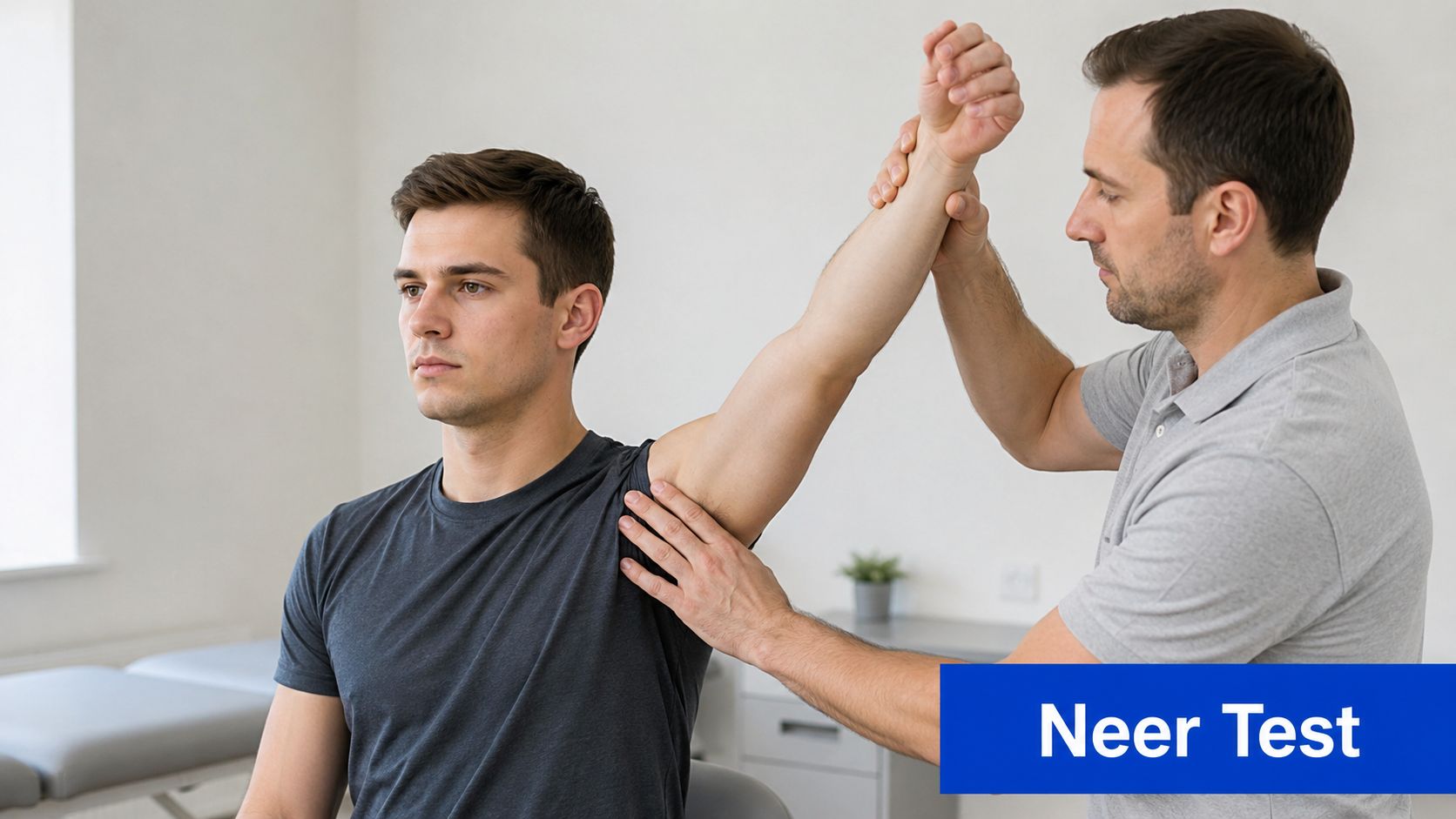
The Neer test screens for structures that may become compressed as the arm moves overhead. It can help assess symptoms that appear while reaching into a cupboard, hanging washing or lifting the arm.
How the examination is performed
You usually sit or stand while the clinician stabilises your shoulder blade. With your arm relaxed, they guide it forwards and upwards through elevation, rather than asking you to lift it actively. Holding the shoulder blade still limits compensation and helps the examiner observe how the shoulder and nearby tissues respond.
A positive sign is reproduction of your familiar pain during the guided movement, often around the outer or front shoulder. This response may point to irritation involving the rotator cuff or neighbouring tissues. Several shoulder problems can produce the same sensation, so results must be interpreted alongside other findings rather than treated as definitive.
The clinician may ask where the pain starts, whether it feels sharp or aching, and whether the movement matches your usual symptoms. They can compare the opposite side, then assess active movement, strength and neck function. A painful result should not be forced or repeated at home, particularly if symptoms are sharp, severe or worsening.
Practical rule: A painful Neer test is a clue about symptom reproduction, not a standalone diagnosis.
For people who spend long periods at a desk, assessment may also consider thoracic posture, shoulder-blade control and how the neck contributes to arm movement. A whole-body review, such as this functional movement screening example, can place the finding in context and guide an osteopathic assessment at Bayside Osteopathic Health.
2. Hawkins-Kennedy Impingement Test
The Hawkins-Kennedy test examines whether a particular shoulder position reproduces pain associated with rotator cuff-related shoulder symptoms. It's often used in people who report discomfort when reaching across a shelf, putting on a jacket or working with the arm raised.
What happens during the test
The clinician raises your arm so your shoulder and elbow are bent, generally keeping the elbow flexed. They then rotate the forearm downwards in a slow, controlled manner while supporting the arm. You should report the location and quality of any pain rather than trying to push against the movement.
Australian general practice guidance reports the Hawkins-Kennedy test with 91 to 92% sensitivity and 25 to 43% specificity in its review of shoulder injuries. In plain language, a negative result can be more useful for making impingement less likely than a positive result is for confirming it. The test can be sensitive to pain from different shoulder structures, so a positive response doesn't prove that a tendon is torn.
The same RACGP source reports a different pattern when the test is used for detecting a supraspinatus tear. It describes 18.7% sensitivity and 100% specificity, meaning a positive result may be highly suggestive in that setting, while a negative result doesn't exclude a tear. These figures show why clinicians don't treat one manoeuvre as a final answer.
A person with chronic shoulder pain may have both tendon irritation and altered shoulder-blade movement. The examiner may therefore combine Hawkins-Kennedy with active range of motion, resisted strength tests, palpation and questions about sleep, lifting and previous injury.
3. Empty Can Test
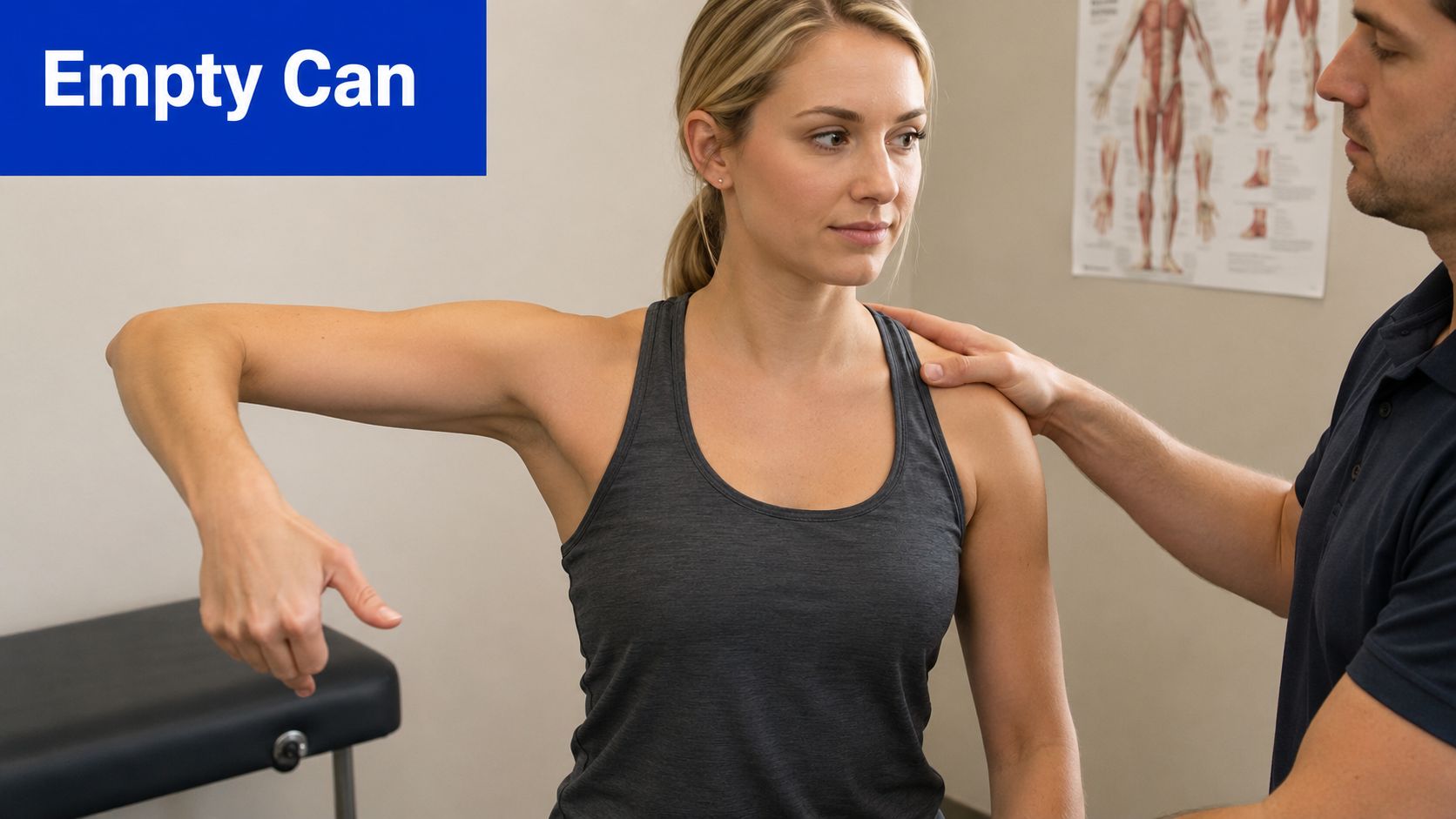
Could weakness while lifting your arm point to a supraspinatus problem? The Empty Can test, also called Jobe's test, examines this rotator cuff muscle, which helps start and control arm elevation. It may be considered when reaching overhead or lifting an object away from the body feels weak or painful.
The clinician positions your arm out to the side and slightly forwards, with the thumb turned down as if emptying a can. You hold that position while the clinician applies controlled downward pressure. The force should match your age, symptoms and strength. Tell the examiner where you feel pain, and avoid forcing through it.
A positive response may involve pain, weakness, or both. Pain without measurable weakness points toward pain-sensitive tissues rather than structural tearing. Inability to resist despite a genuine effort can raise concern about supraspinatus dysfunction or a tear, especially when it agrees with your history and other examination findings.
A PubMed-indexed review reports Jobe testing for supraspinatus tears with sensitivity around 88% and specificity around 62%. The full-can test showed sensitivity around 70% and specificity around 81% in its summary of diagnostic tests. These figures describe performance in a specific evidence context, not an individual diagnosis.
Pain, stiffness or reduced confidence can lower force, particularly in an older adult with gradual symptoms. A clinician compares both sides, checks strength in other positions and considers the neck and nerves. If shoulder pain follows an injury, causes marked weakness, or limits ordinary use, arrange an assessment rather than relying on a self-check. At Bayside Osteopathic Health, an osteopathic assessment can place this finding alongside movement, neck and whole-body factors.
4. Lift-Off Test
Reaching behind your back can expose a different problem from the one found during overhead movement. The Lift-Off test assesses the subscapularis, a rotator cuff muscle that helps rotate the arm inward and stabilise the shoulder.
You'll usually place the back of your hand against your lower back, with your elbow bent. The clinician asks you to lift your hand away from your back and may apply gentle resistance to see whether you can maintain the position. The movement should be gradual. If placing the hand behind the back is already painful or impossible, the examiner may choose a modified test, such as a belly-press or belly-off variation.
What a positive result may mean
Difficulty lifting the hand, an inability to hold it away from the back or a marked difference between shoulders may suggest subscapularis weakness or dysfunction. Pain can also limit the effort, so the clinician must distinguish pain inhibition from genuine loss of muscle control.
For example, a person with anterior shoulder pain may struggle to fasten clothing, reach into a back pocket or tuck in a shirt. Those everyday limitations help the examiner understand whether the test result reflects a meaningful functional problem.
The Lift-Off test shouldn't be forced. A stiff shoulder, arthritis-related restriction or recent injury can make the starting position unsuitable, and pushing into that position may aggravate symptoms. A practitioner will examine internal rotation in other ways and may assess the neck, upper back and shoulder blade before deciding what the finding means.
The result becomes more useful when it agrees with the history and other findings. A test that can't be completed tells the clinician something, but it doesn't name the damaged structure by itself.
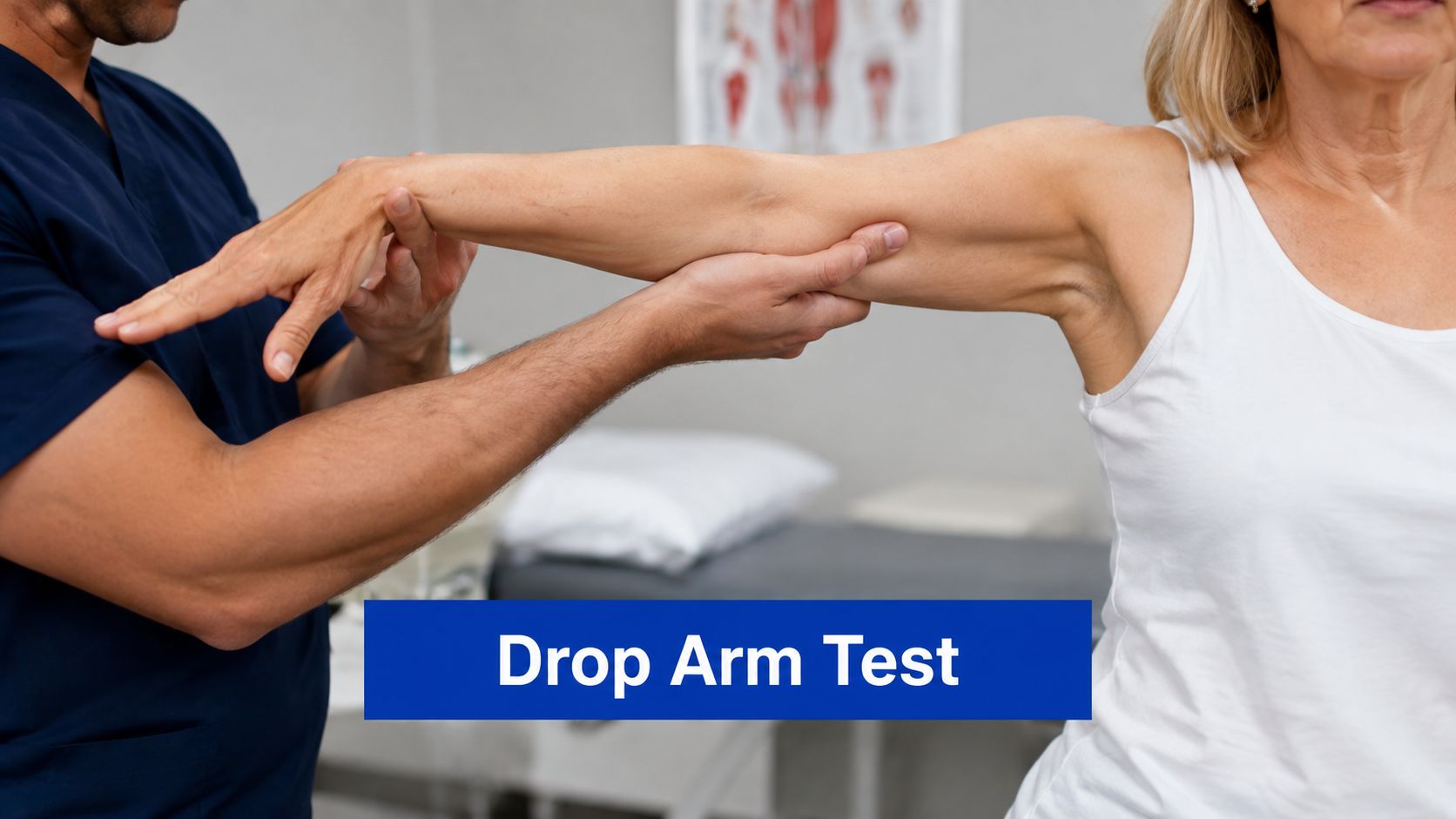
5. Drop Arm Test
The Drop Arm test looks at how well you can control the arm while lowering it from a raised position. Unlike a movement that only reproduces pain, this examination focuses on strength and controlled motor function.
The clinician raises your arm to the side, usually to shoulder height, then asks you to lower it slowly. You're not expected to jerk, hold your breath or push through severe pain. The examiner watches for a sudden drop, an inability to start the descent or a major difference between sides.
A sudden loss of control may suggest substantial rotator cuff weakness, including possible tear-related dysfunction. Australian guidance describes drop-arm-type findings as potentially highly specific but insensitive, which means a clear positive result can be useful for ruling in a problem, while a normal result doesn't reliably rule one out as explained in the RACGP shoulder injury review.
How clinicians interpret the movement
The pattern matters. A sudden drop is different from a gradual lowering caused by discomfort, fear or fatigue. The examiner may repeat the movement only if it's safe, then compare active elevation, resisted strength and passive range of motion.
Consider someone who developed immediate weakness after falling onto an outstretched hand. A drop arm response in that context deserves prompt medical review, especially if the person can't raise the arm normally. In contrast, a person with longstanding pain may lower the arm slowly but guardedly because movement hurts.
Don't use this test repeatedly at home. Lifting the arm to the testing position can be unsafe after trauma, and repeated attempts can irritate a painful shoulder. If you suddenly can't control or lift your arm, arrange medical assessment rather than trying to confirm the result yourself.
6. Infraspinatus Strength Test
Can the shoulder rotate outward with steady force? External rotation at the side examines the infraspinatus, a posterior rotator cuff muscle that helps turn the upper arm outward. Clinicians may use it when symptoms appear while placing a hand behind the head, reaching for a seatbelt or rotating the arm against resistance.
You sit or lie with your elbow bent to about a right angle and held close to your ribs. The clinician stabilises the shoulder blade with one hand and supports or holds the wrist with the other. You rotate the forearm outward while the clinician applies inward resistance, building the pressure gradually and asking you to hold the position for about five seconds. The examiner compares sides and watches for shoulder shrugging, elbow movement or loss of control.
Pain and weakness provide different information. Pain with near-normal force can reflect an irritable shoulder, while reduced force with little pain may suggest infraspinatus dysfunction, a broader rotator cuff problem or, sometimes, nerve involvement. A result cannot distinguish these causes by itself. Previous injury, arm dominance and natural strength differences also affect comparison.
Pain and weakness are different findings
A desk-based worker with a rounded upper-back posture may show reduced external-rotation endurance without having a structural tear. An osteopathic assessment may therefore include active and passive shoulder movement, sensation, reflexes, neck screening, the upper back, rib movement, shoulder blade control and breathing-related muscle tension. This rehabilitation movement example shows why strength findings are considered alongside guided movement.
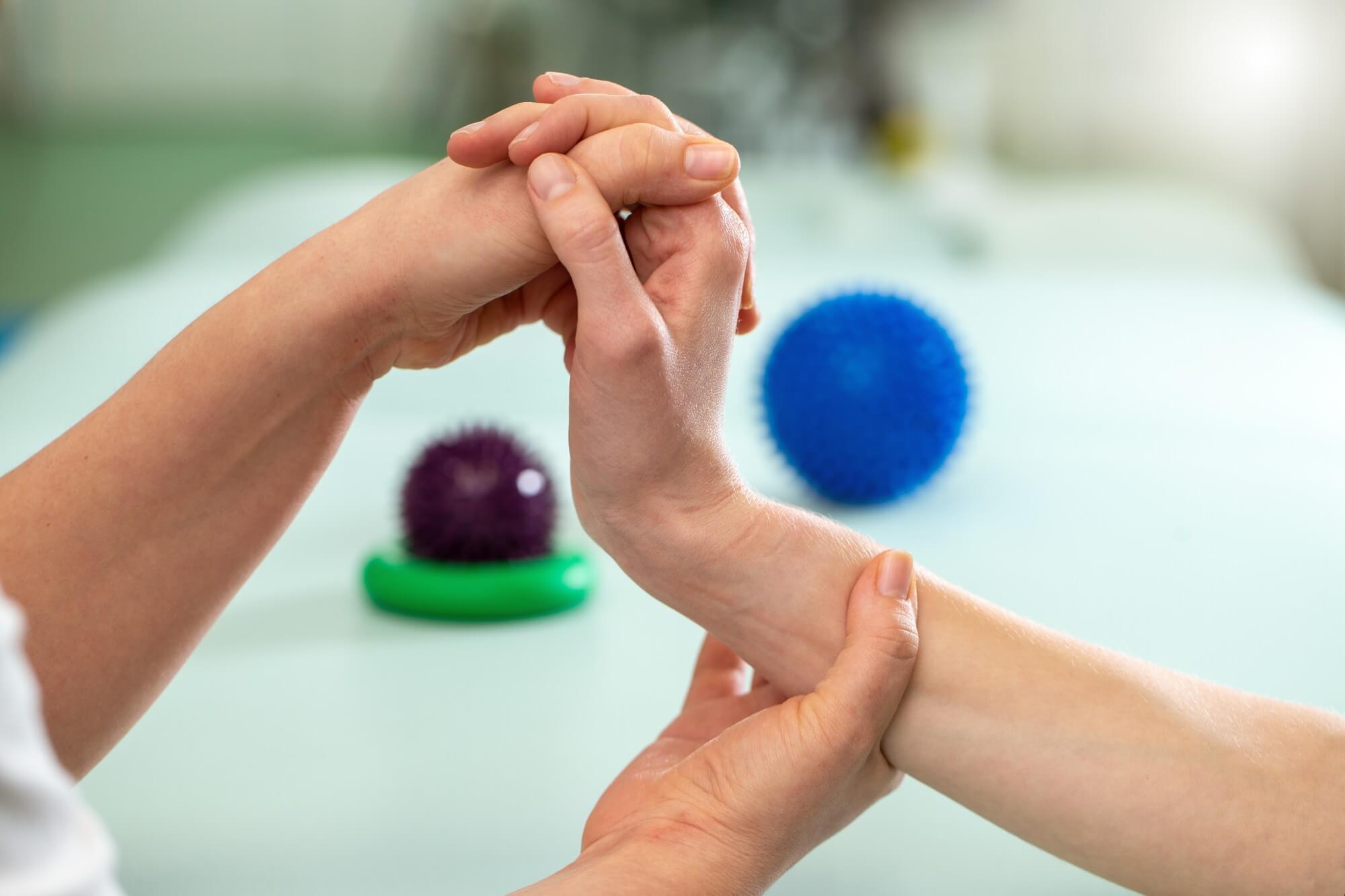
Self-checking should stay gentle. Avoid heavy resistance bands or having someone force the arm outward. Stop if the movement causes sharp pain. Sudden weakness, loss of control or a new neurological symptom warrants professional review. A clinician at Bayside Osteopathic Health can place this finding alongside your history and whole-body examination before suggesting the next step.
7. O'Brien's Crank Test
Not every painful shoulder movement comes from the rotator cuff. O'Brien's test, also called the active compression test, helps clinicians consider the supraspinatus region and the acromioclavicular, or AC, joint at the top of the shoulder.
The examiner positions your arm forwards and slightly across your body, with the thumb initially pointing down. You'll try to hold the arm while the clinician applies downward pressure. The position is then repeated with the thumb pointing up. The examiner asks whether pain changes between the two positions and where you feel it.
Pain that is felt over the AC joint and eases in the second position may increase suspicion of AC joint involvement. Pain deeper in the shoulder may be interpreted differently. Neither response confirms a particular diagnosis, and the result should be considered with tenderness over the joint, cross-body movement, strength and the history of impact or overhead loading.
Why location matters
Someone who fell directly onto the shoulder may have a different pattern from a person whose symptoms developed gradually while lifting at work. The test can help organise the examination, but it shouldn't be used to decide on treatment in isolation.
The clinician may also assess the neck and upper back because pain can be referred or influenced by movement elsewhere. If the test reproduces familiar pain, that's useful information. If it causes a new, sharp pain, the examination should stop rather than continue for the sake of completing the manoeuvre.
A positive O'Brien's test doesn't prove that the rotator cuff is torn. It may point towards a pain-sensitive structure, and the next step depends on the complete clinical picture.
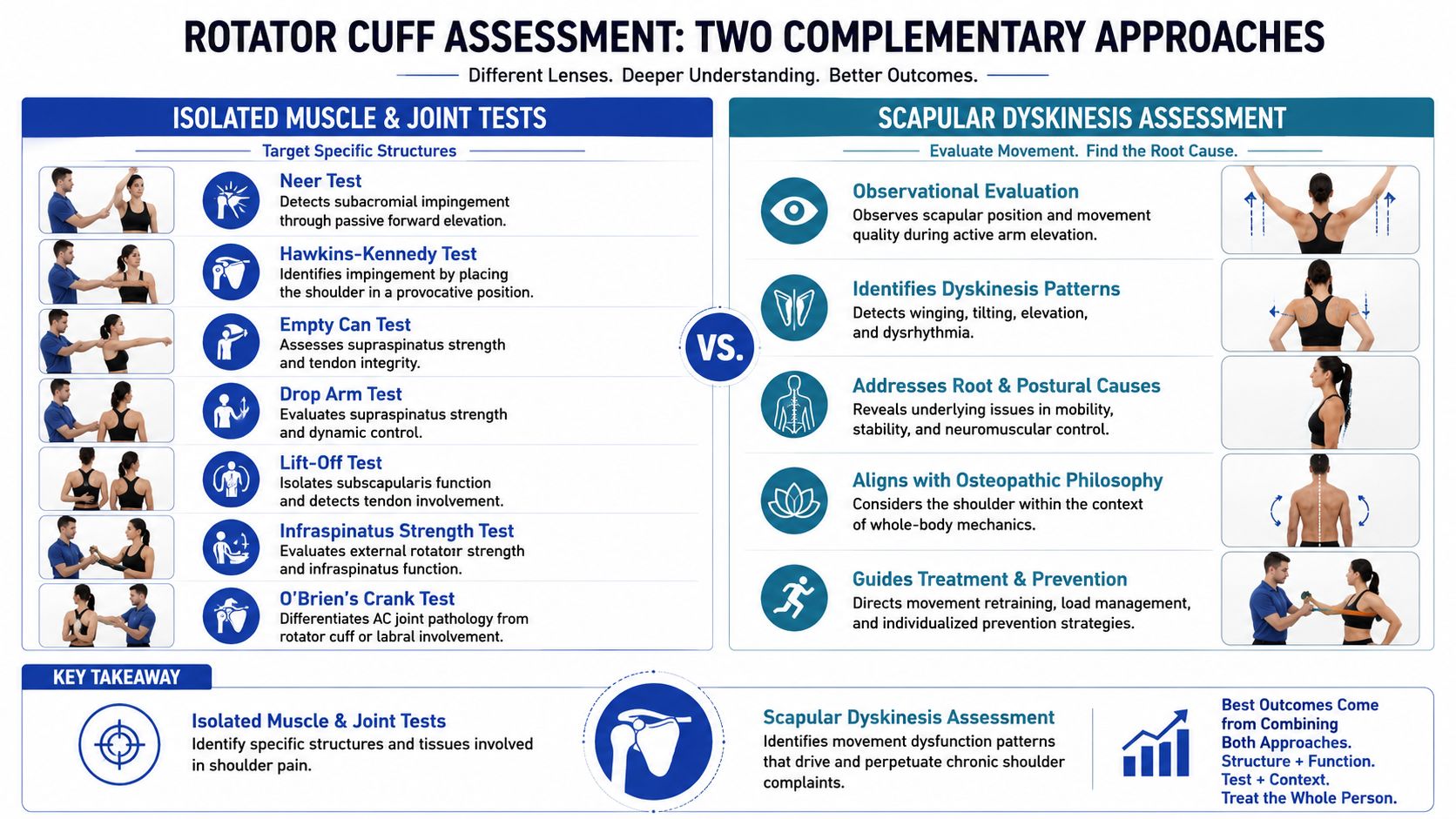
8. Scapular Dyskinesis Assessment
The shoulder blade provides a moving base for the arm. A scapular dyskinesis assessment observes how that base moves during elevation, rather than testing one tendon with a single resisted position.
The clinician watches from behind and from the side while you slowly raise and lower your arms, often through flexion and abduction. They may look for winging, early shrugging, uneven timing, excessive forward tilt or a medial border lifting away from the ribs. They'll compare both sides and may repeat the movement with a light load if that's safe.
What the clinician is looking for
A changed shoulder-blade pattern can accompany pain, weakness, reduced mobility or altered control. It doesn't automatically mean that poor posture caused the problem. Some people move asymmetrically without pain, while others develop protective movement because the shoulder hurts.
An office worker who spends much of the day at a laptop may shrug early or rotate the shoulder blade differently after prolonged sitting. An older person with shoulder stiffness may avoid part of the movement and appear to have altered scapular control. The examiner will relate the observation to range of motion, strength, thoracic mobility and daily function.
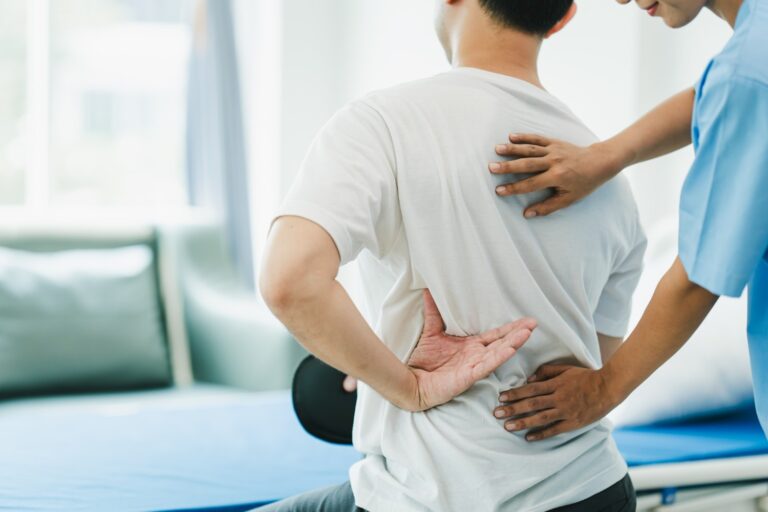
You can observe your shoulder blades in a mirror, but self-viewing is limited and shouldn't involve repeated painful lifts. A short demonstration of the type of movement assessed is available in this shoulder movement video. For a more complete view, a practitioner may assess you from several angles, as shown in this spine and shoulder assessment image.
8-Point Comparison of Rotator Cuff Tests
| Test / Assessment | Implementation Complexity 🔄 | Resource Requirements ⚡ | Expected Outcomes 📊 | Ideal Use Cases 💡 | Key Advantages ⭐ |
|---|---|---|---|---|---|
| Neer Impingement Test | Low 🔄, passive forward elevation; requires scapular stabilization | Minimal ⚡, no equipment; supine or seated | High sensitivity (72–95%), low specificity; good screening 📊 ⭐⭐ | Initial impingement screen; monitoring conservative care | Quick, accessible, low-cost; early detection aid ⭐ |
| Hawkins‑Kennedy Impingement Test | Low‑Moderate 🔄, controlled internal rotation at 90° | Minimal ⚡, no equipment; may prefer supine for control | High sensitivity; higher specificity than Neer; better localization 📊 ⭐⭐⭐ | Confirming impingement; differentiating causes before treatment | More specific for impingement; mimics symptomatic movement ⭐ |
| Empty Can Test (Jobe's) | Moderate 🔄, active resisted abduction in internal rotation | Minimal ⚡, examiner applies downward resistance; patient strength needed | Moderate–high specificity for supraspinatus; detects tears and weakness 📊 ⭐⭐⭐ | Supraspinatus tear detection; strength assessment; rehab monitoring | Isolates supraspinatus; functional strength test ⭐ |
| Lift‑Off Test (Gerber) | Moderate 🔄, active internal rotation behind back against resistance | Minimal ⚡, requires patient flexibility and examiner resistance | Very high specificity (95–98%) for subscapularis; variable sensitivity 📊 ⭐⭐⭐ | Suspected subscapularis tear; anterior shoulder dysfunction assessment | Highly specific for subscapularis; targets anterior treatment ⭐ |
| Drop Arm Test | Low 🔄, passive abduction then controlled active lowering | Minimal ⚡, no equipment; requires patient cooperation | Very high specificity (92–98%) for large tears; low sensitivity 📊 ⭐⭐ | Detecting large/full‑thickness rotator cuff tears; referral decisions | Clear pass/fail result; correlates with tear severity ⭐ |
| Infraspinatus Strength Test | Low‑Moderate 🔄, resisted external rotation at side (0° abd) | Minimal ⚡, examiner resistance; comfortable for most patients | Moderate sensitivity (50–68%) for posterior cuff dysfunction; early detection 📊 ⭐⭐ | Posterior cuff weakness screening; guiding external rotation rehab | Isolates infraspinatus; tolerable for painful shoulders ⭐ |
| O'Brien's Crank (Active Compression) | Moderate 🔄, specific 90°/10–15°/IR positioning with two‑phase test | Minimal ⚡, no equipment; requires precise positioning | Good sensitivity for AC and supraspinatus involvement; variable specificity 📊 ⭐⭐ | Suspected AC joint vs supraspinatus pathology; treatment planning | Helps implicate AC joint vs cuff; simple clinical differentiation ⭐ |
| Scapular Dyskinesis Assessment | Moderate‑High 🔄, dynamic observation; interpretive skill required | Low ⚡, no equipment but needs space and examiner experience | High clinical relevance to chronic/postural issues; less quantifiable 📊 ⭐⭐⭐ | Chronic shoulder pain, postural dysfunction, movement retraining | Identifies root movement dysfunction; guides comprehensive rehab ⭐ |
From a Positive Sign to the Right Next Step
A positive rotator cuff test usually means that a movement reproduced pain, exposed weakness or showed reduced control. It doesn't prove a tear, and it doesn't always identify the structure causing the symptoms. Australian shoulder guidance recommends combining findings because common physical tests can produce false positives, miss pathology or respond to more than one condition in the UNSW rotator cuff syndrome guideline.
The most useful interpretation depends on the test's purpose. A highly sensitive test may be more helpful when negative because it can make a condition less likely. A highly specific test may be more helpful when positive because it can make a particular problem more likely. The Hawkins-Kennedy findings described earlier demonstrate how the same test can have different meaning depending on whether the question is impingement or a supraspinatus tear.
Your clinician may combine several kinds of information:
- Symptoms: Pain at rest, night discomfort, pain with reaching, clicking or a sudden change after injury.
- Function: Whether you can dress, lift, reach overhead or lower the arm with control.
- Strength: Whether weakness remains when pain is reduced or the position changes.
- Movement: Active and passive range, shoulder-blade control, upper-back mobility and neck movement.
- History: The timing of symptoms, previous injury, work demands and activity changes.
Imaging can become important when symptoms persist, weakness is substantial, trauma occurred or a procedure is being considered. Australian management data shows that ultrasound use for rotator cuff-related shoulder pain rose from 19.1% to 41.9% of management occasions between 2000 and 2016, while imaging was ordered in 43.4% of presentations and ultrasound referrals occurred for 53.0% of new presentations in the Australian evidence review. That pattern reflects the role of imaging as a complement to examination, not a replacement for clinical reasoning.
The same Australian review notes that skilled ultrasound can have diagnostic accuracy equivalent to MRI for rotator cuff pathology. However, imaging findings still need context because asymptomatic rotator cuff tears on ultrasound are common, and a highly sensitive MRI can show changes that aren't responsible for your pain as discussed in Australian guidance on chronic shoulder pain.
Don't repeatedly provoke the shoulder to see whether a test remains positive. Stop if pain is sharp, severe or worsening. Seek prompt medical review after significant trauma, sudden weakness, deformity, marked swelling, numbness or a sudden loss of movement. Book a detailed assessment for persistent, recurrent or activity-limiting pain, especially when symptoms disturb sleep or interfere with normal tasks.
An osteopathic assessment at Bayside Osteopathic Health may be appropriate when you want a whole-body movement review, gentle hands-on care, mobility guidance and customized self-care. The practitioners can assess how your shoulder, neck, upper back and surrounding tissues work together, then discuss suitable care or referral when further medical investigation is needed. Visit Bayside Osteopathic Health for booking information and to take the next step with a plan suited to your symptoms.
Bayside Osteopathic Health provides gentle, hands-on osteopathic care for shoulder discomfort, mobility restrictions and movement-related strain, with assessment that considers how your whole body moves. If rotator cuff symptoms are limiting work, sleep or everyday activity, visit Bayside Osteopathic Health to arrange an assessment and discuss practical treatment, movement advice or referral.