
You wake with a stiff neck, turn towards the alarm, and feel a familiar catch before the day has even started. Or perhaps your knee feels tight after hours at a desk, and walking to the kitchen doesn't loosen it as quickly as you'd hoped. These moments can make you wonder whether the joint needs rest, stretching, exercise, or hands-on care.
Joint mobilization techniques are controlled manual movements that help a restricted joint glide, rotate, or move more comfortably. Osteopaths use them alongside assessment, movement advice, and active rehabilitation, rather than treating the painful area as though it exists in isolation. The aim is often practical: make movement easier so you can use exercise and everyday activity more effectively.
Table of Contents
- Why Your Stiff Joints Might Need Gentle Hands-On Help
- Understanding Joint Mobilization and Its Grades
- Common Osteopathic Mobilization Techniques
- What the Evidence Shows About Mobility Gains
- When Mobilization Is Not a Standalone Fix
- What to Expect During a Bayside Osteopathy Session
- Safe Self-Care and When to Seek Professional Help
Why Your Stiff Joints Might Need Gentle Hands-On Help
You reach for a cup, turn your head, or rise from a chair, and the joint catches before the movement feels complete. Stiffness can make the surrounding muscles tighten and encourage you to avoid certain positions. Over time, that change may affect nearby areas. A sore neck can alter how you sit and turn, while a painful knee can change how you climb stairs or stand.
Joint mobilisation techniques let an osteopath assess and address that restriction without forcing the joint. The practitioner supports the body part and applies slow, measured movements, often repeating a small glide or oscillation within a comfortable range. You may notice pressure, a gentle stretch, or resistance gradually easing. Sharp or alarming pain is not an expected part of the technique.
Hands-on care as a bridge to movement
The most useful way to understand mobilisation is as a bridge to movement. If pain or stiffness makes an exercise difficult, a carefully chosen technique may make it more comfortable for a short time. You can use that window to practise strength, balance, range of movement, or everyday tasks with better control.
The improvement may be immediate, but it does not replace active rehabilitation. For people with arthritis, persistent neck pain, or age-related stiffness, progress between appointments usually depends on regular movement and the exercises suited to their ability. Australian guidance for hip and knee osteoarthritis places manual therapy in a short-term supporting role, while exercise and functional training remain central. The detailed recommendation appears later in this article.
A useful expectation: mobilisation may open the door to easier movement, but regular movement helps you keep walking through it.
Older adults need an additional safety check. New or rapidly worsening pain, a fall or injury, unexplained weight loss, fever, unusual night pain, marked weakness, numbness, or changes in bladder or bowel control should be assessed by an appropriate health professional rather than treated as ordinary stiffness. Osteopathic care should follow a proper history and examination, especially when bone health, medications, or several medical conditions may affect treatment choices.
A whole-body assessment
An osteopathic assessment considers more than the joint that hurts. The practitioner may review posture, spinal movement, muscle tension, walking pattern, work habits, previous injuries, and general health. This helps connect the local symptom with the way your body moves, without assuming that every problem comes from somewhere else.
Osteopathy has a long history in Australia. Osteopathy Australia reports that the profession has been practised in the country for over 100 years and taught in Australian universities since the early 1980s. Australia's long-standing osteopathic history describes how hands-on care developed alongside formal education and broader clinical practice.
For a Bayside resident, that background helps explain why modern treatment is more than one manoeuvre repeated for every person. Practitioners select graded methods and adjust them to your symptoms, age, movement capacity, and response during the appointment.
Understanding Joint Mobilization and Its Grades
A joint mobilisation follows a principle similar to easing a sticky door. The osteopath supports the joint, moves it in a controlled way, notices where it catches, and works gradually within the range it tolerates.
The movement is passive, meaning you relax while the practitioner guides part of the joint's motion. The aim may be to settle sensitivity, encourage a smoother glide, or address a firm restriction over time. Mobilisation is generally slower and more deliberate than manipulation, which uses a faster thrust.
Australian manual physical therapy teaching uses a four-grade mobilisation framework. The grades describe the size of the movement and how close it comes to resistance. This shared language helps the practitioner adjust the treatment instead of applying the same force to every stiff joint.
The four grades in plain language
The right grade depends on the joint, your symptoms, and your response during treatment:
- Grade one: small oscillations near the beginning of the available range. An osteopath may choose this when the joint is irritable and comfort is the priority.
- Grade two: larger rhythmic movements that remain away from the firmer end of the range. This can help you tolerate movement without placing immediate stress on a sensitive joint.
- Grade three: a larger movement that approaches tissue resistance. It may suit stiffness when pain sensitivity is not the main limitation.
- Grade four: a smaller movement performed near the end of the available range. It requires careful assessment because the tissues are challenged closer to their limit.
These grades are not steps every patient must climb. Someone with an acutely painful or arthritic joint may need a gentler approach. Someone with a persistent, firm restriction may tolerate a more substantial movement. The osteopath checks how the joint and symptoms respond before changing the grade.
The practical rule: more force is not automatically better. The right grade matches the joint's irritability and the outcome being targeted.
Modern joint mobilisation methods developed during the 1940s and 1950s, building on earlier osteopathic articulation practices from 1890 or earlier, according to the historical account from Osteopathy Australia. The Australian history overview describes graded methods as techniques that developed over time, rather than one fixed procedure.
This history also helps explain the Australian approach to mobilisation. Practitioners consider assessment, dosage, resistance, and your response during the appointment. Hands-on care may ease movement in the short term, but it often works best as an adjunct to exercises that build strength, control, and confidence between sessions. Older adults should also discuss new severe pain, a fall, or a sudden change in function with an appropriate health professional before treatment.
Common Osteopathic Mobilization Techniques
People often ask what will happen during treatment. The answer depends on the joint, but three broad approaches appear frequently in osteopathic care.
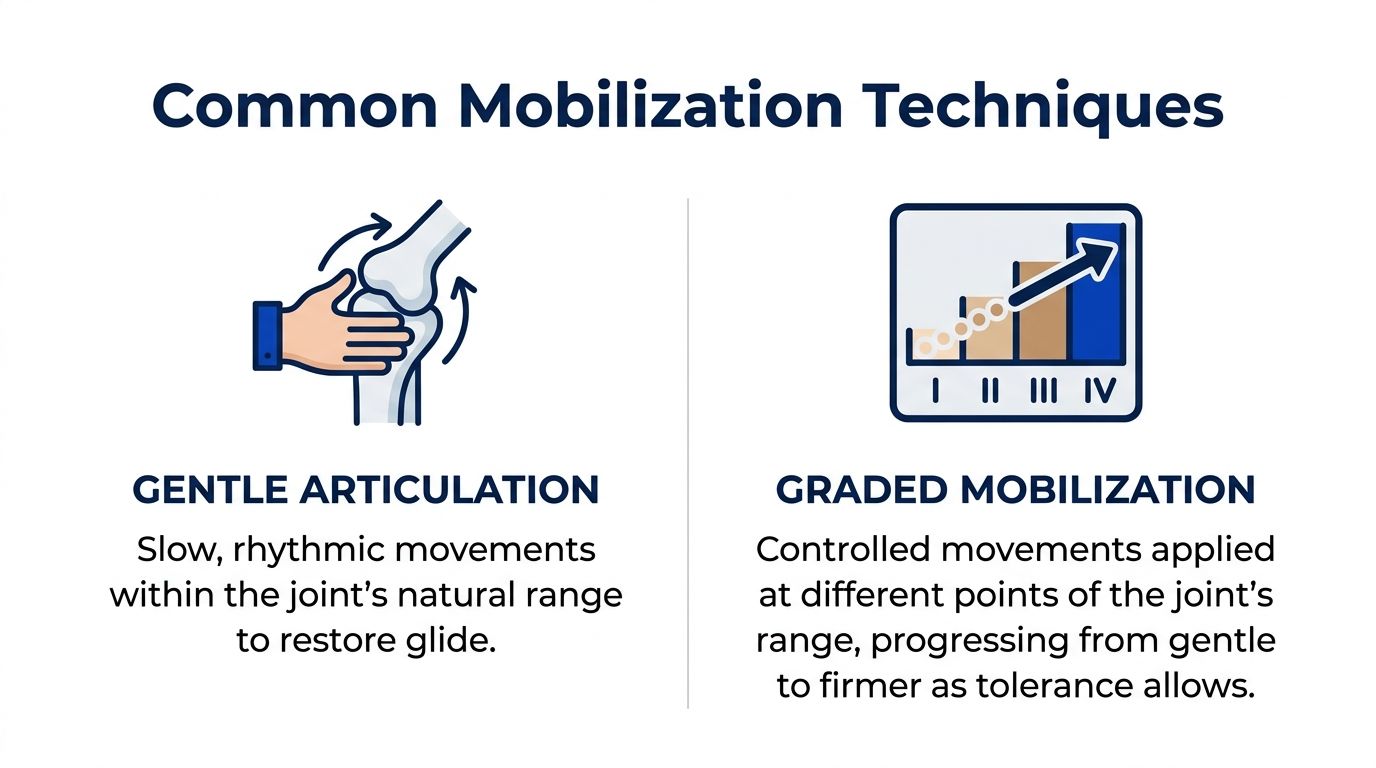
Gentle articulation uses slow, repeated movements through a joint's available range. Your shoulder, ankle, or spine may be guided through comfortable arcs while you remain relaxed. This style can suit a person who feels guarded or generally stiff, because the practitioner can keep the movement flowing and adjust it moment by moment.
Graded mobilisation applies a more specific glide or oscillation at a chosen part of the range. Kaltenborn-style work is commonly described as a sustained glide, where the practitioner positions the joint and applies controlled pressure rather than repeatedly moving the whole limb. The aim is to address a particular restriction without using unnecessary force.
Mulligan's Mobilization with Movement combines a practitioner-applied glide with an active movement from you. For example, you might bend the knee, turn the neck, or lift the arm while the osteopath supports and guides the joint. The movement should feel easier, not more painful, while the technique is being applied.
| Technique | Patient Action | Common Use |
|---|---|---|
| Gentle articulation | Relax and allow slow movement | General stiffness, guarded movement, and comfortable range exploration |
| Graded mobilisation | Remain relaxed while a specific glide is applied | A firm restriction in a shoulder, hip, knee, or other joint |
| Mulligan's Mobilization with Movement | Actively perform the movement while the practitioner supports the joint | A movement that changes noticeably with a guided glide |
There isn't one universal “best” method. The choice depends on the joint, your age, your symptoms, the available range, your medical history, and what happens during the first few repetitions. A technique that suits shoulder stiffness may not suit an older person with an irritable arthritic knee.
For neck treatment, safety deserves particular attention. The Australian Physiotherapy Association's manual therapy factsheet advises minimum force and avoiding end-range neck rotation thrusts. It also supports trialling mobilisation before thrust techniques. Those principles reinforce a sensible clinical approach, start gently, monitor the response, and stop if the treatment produces concerning symptoms.
You can see how hands-on work may sit alongside other approaches in this remedial massage and muscle therapy resource, although massage and joint mobilisation target different tissues and shouldn't be treated as interchangeable.
What the Evidence Shows About Mobility Gains
A shoulder that will not reach overhead or a knee that feels painful during walking can make hands-on treatment seem appealing. The useful clinical question is whether research shows changes beyond the treatment table. Australian and Australia-linked evidence gives a measured answer: mobilisation may improve selected mobility and pain outcomes, while results vary with the joint, condition, and technique.
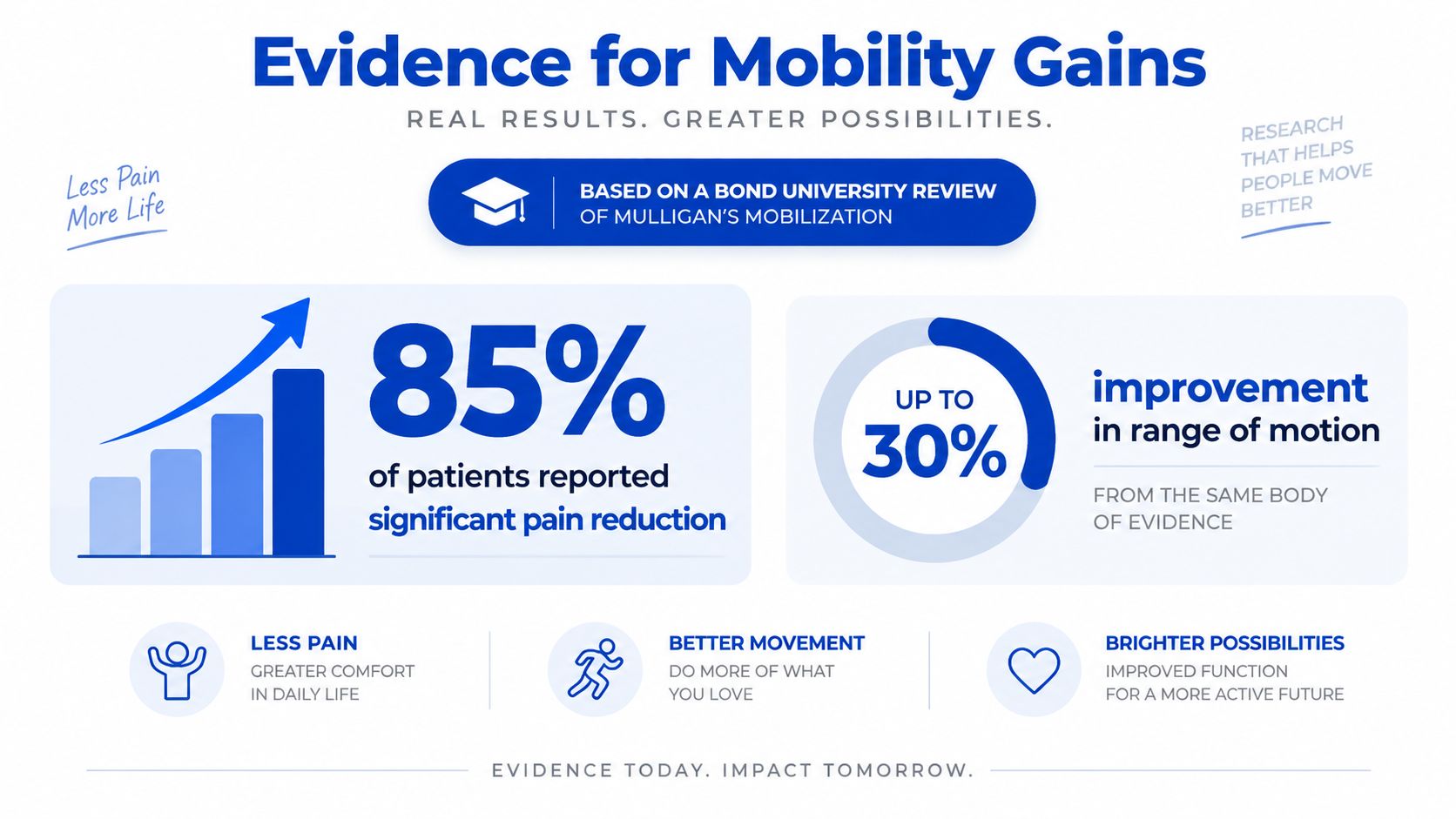
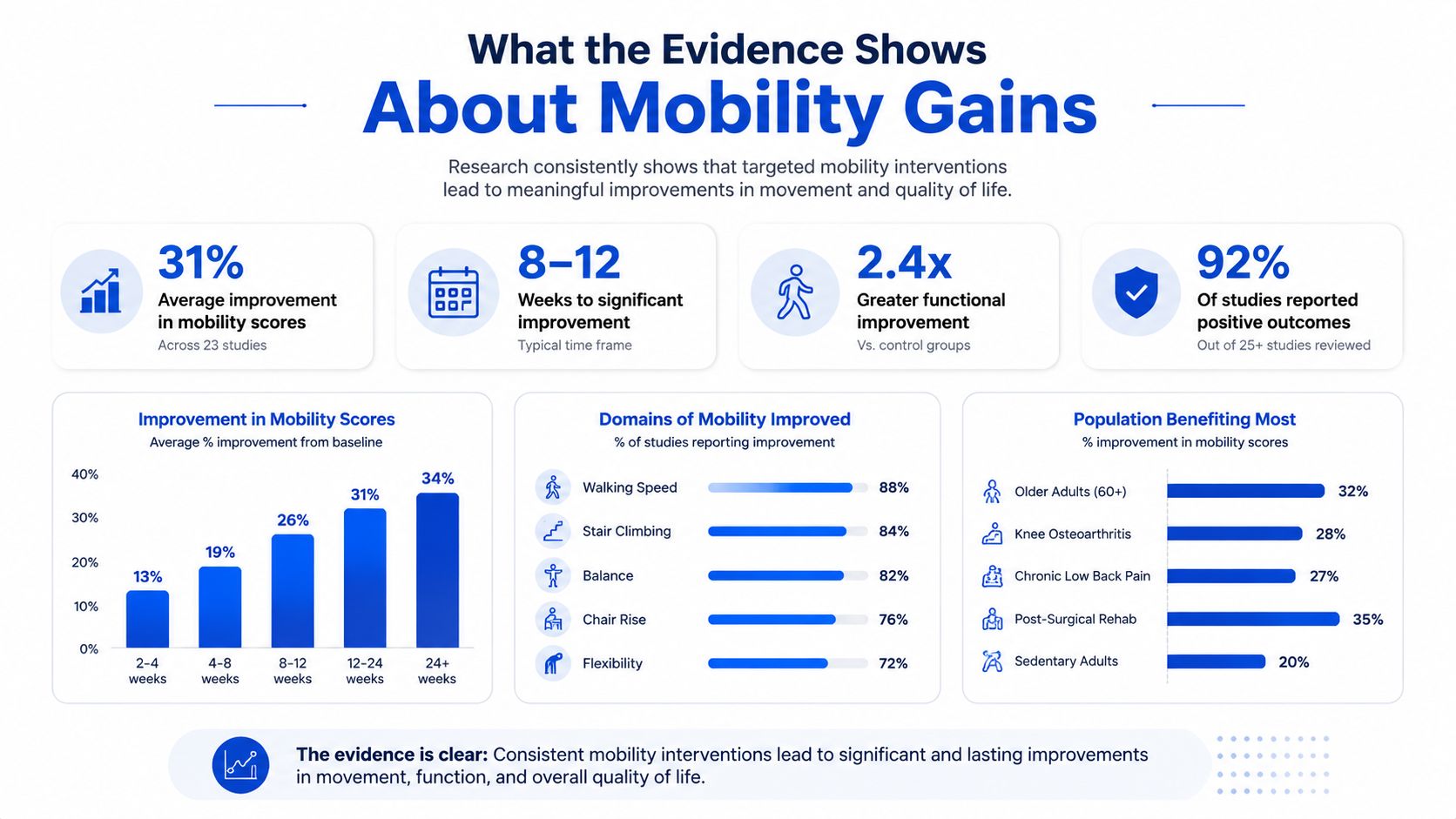
A systematic review from Bond University examined Mulligan's Mobilization with Movement for peripheral joints and different pathologies. Positive effects appeared in 24 of 25 studies, or 96%, among the evidence included in that review. The Bond University systematic review supports that specific finding.
That result describes the group of studies, not a guaranteed response for one person. It also applies to the method and body regions examined, rather than proving that every mobilisation style suits every joint.
Range of movement can change measurably
A separate meta-analysis of studies published between 2008 and 2018 reported statistically and clinically significant range-of-motion improvements across several conditions. For shoulder adhesive capsulitis, mean gains ranged from 12.30° to 26.09°. For hip pain, reported gains ranged from 4.50° to 14.80°. These figures should not be attributed to the Bond University review because they come from a different evidence summary.
For someone with a stiff shoulder, even a measurable change may affect daily tasks. Reaching overhead, putting on a jacket, or fastening clothing can become easier. PEDro-indexed evidence reported a 26.80° improvement versus control for posterior mobilisation in adhesive capsulitis. A set of joint techniques produced a 20.14° improvement versus control in abduction, with both results reported as statistically significant.
The practical meaning depends on the starting point and the task that matters to the patient. A few degrees may have little value for one activity and make a noticeable difference for another. Hands-on care can improve the available movement, while repeated practice helps a person use that movement with confidence.
Pain sensitivity may change quickly
A randomised trial involving people with osteoarthritic knees measured pressure pain threshold after accessory knee joint mobilisation. The mobilisation group had an immediate 27.3% increase, compared with 6.4% after manual contact and -9.6% in a no-contact control. The figures are reported in the PubMed record for the knee mobilisation trial.
The comparison suggests that the response was not explained only by being touched. The trial also found a greater reduction in the timed up-and-go measure than control conditions, connecting the intervention with a functional mobility outcome as well as pain sensitivity.
These findings support realistic optimism. Mobilisation may create a short window in which movement feels easier, particularly when pain or stiffness makes active rehabilitation difficult to begin. Strengthening, practice, and activity changes remain important for maintaining useful movement.
For readers managing arthritis, this arthritis and joint mobility guide can support a conversation with a qualified practitioner about suitable movements and treatment options. Older adults should seek assessment for unexplained swelling, sudden loss of function, fever, a recent fall or injury, or pain that is severe or worsening before hands-on treatment is considered.
When Mobilization Is Not a Standalone Fix
A common hope is that an osteopath can mobilise an arthritic knee, stiff hip, or painful neck and solve the problem through hands-on treatment alone. That expectation is understandable. A joint may feel freer immediately after treatment, and the relief can be more noticeable than the gradual benefits of exercise.
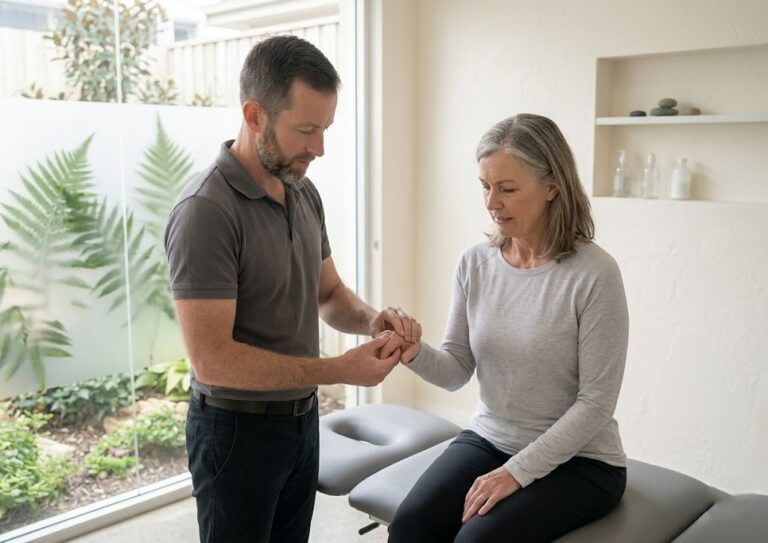
The problem is that short-term improvement and long-term capacity aren't the same thing. For knee and hip osteoarthritis, the Royal Australian College of General Practitioners recommends manual therapy, including stretching, soft tissue work, and joint mobilisation or manipulation, as a short course and an adjunct to active management. The RACGP manual therapy recommendation explains that the practical role is to enable exercise and functional training.
Use the easier window
Suppose your knee bends more comfortably after mobilisation. That change can make it easier to practise a sit-to-stand movement, walk with a more natural pattern, or complete a strengthening exercise. The treatment has then served a valuable purpose, but the exercise is still doing the longer-term work of building confidence and physical capacity.
The same logic applies to a stiff shoulder. A hands-on technique may help you lift the arm far enough to practise controlled movement, but repeatedly using the improved range is what helps make it useful in daily life.
The decision frame: use hands-on care to open the door, then use active movement to keep the door open.
Neck pain needs a particularly honest discussion about certainty. A 2025 neck-pain meta-analysis found only very low-certainty evidence for benefits in pain and disability. That doesn't make mobilisation automatically inappropriate. It means the treatment should be individualised, monitored, and combined with approaches that help you manage movement and function yourself.
Cost, access, and treatment time also matter. A plan that depends entirely on frequent passive care may be difficult to maintain, while a plan that teaches you practical exercises and self-management can give you more control between visits. A responsible practitioner should explain what the hands-on component is intended to change, how you'll measure progress, and when it makes sense to reduce or stop it.
What to Expect During a Bayside Osteopathy Session
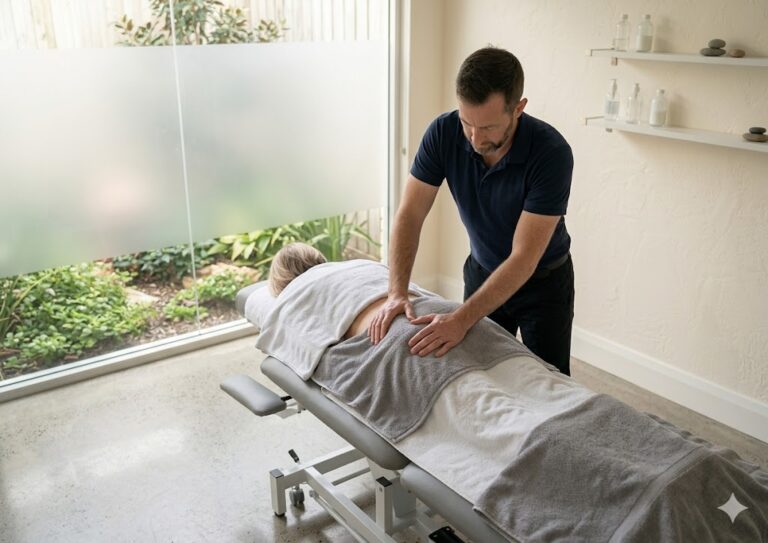
A first appointment usually begins with questions, not hands-on treatment. You'll discuss when the stiffness started, what aggravates it, what helps, your general health, previous injuries, medications, and the activities you want to return to. The practitioner may then observe posture and movement and assess the relevant joints and surrounding areas.
That whole-body approach helps distinguish a local restriction from a movement problem involving several regions. For example, a practitioner might assess the upper back and shoulder blade when you report difficulty turning your neck, or look at the hip and ankle when knee movement feels limited.
How the treatment unfolds
Once the assessment is complete, the osteopath explains the proposed technique and checks that you're comfortable. Treatment may begin with soft-tissue work or gentle articulation, followed by a graded glide or an active movement technique if the earlier response suggests it's suitable.
You may notice a firm pressure, a mild stretch, or a repeated rocking sensation. The osteopath should ask how it feels and reassess the movement rather than increasing the force automatically. Sharp pain, unexpected tingling, dizziness, or a strong sense that something is wrong should be reported immediately.
A typical plan may include:
- A clear baseline: you identify a movement or task that currently feels restricted.
- A targeted technique: the practitioner applies mobilisation within an agreed comfort range.
- A response check: you repeat the movement so both of you can judge whether it has changed.
- A practical next step: you receive movement or self-care advice to use between sessions.
The purpose isn't to make the session feel dramatic. It's to find a safe, useful change and connect it with an activity you can continue at home.
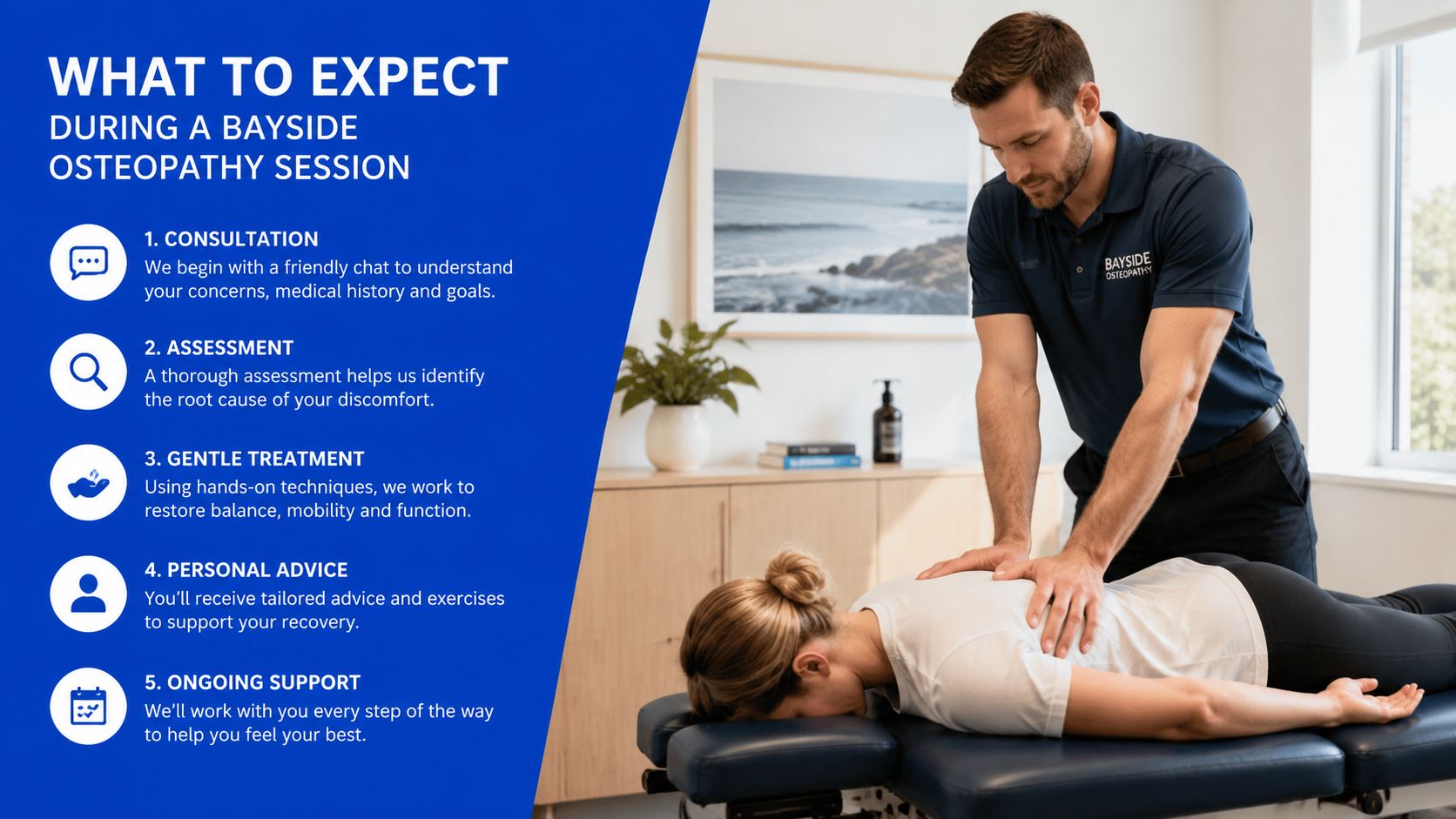
Bayside Osteopathic Health provides hands-on osteopathic care, including joint articulation and gentle mobilisation, alongside movement advice and practical self-care guidance. If you're eligible under an applicable plan, the clinic can also discuss Medicare options. Before booking, ask what the proposed technique is intended to achieve, what active exercises will support it, and how you'll know whether the plan is helping.
Safe Self-Care and When to Seek Professional Help
Self-care should feel manageable, not like a test of willpower. Start with gentle movement through a comfortable range, such as slowly turning your head, bending and straightening the knee, or moving the shoulder within the range that doesn't create sharp pain. Keep the motion smooth and stop before you have to force the joint.
Warmth may make stiffness easier to manage, particularly before movement. Short posture breaks can also help if sitting contributes to your symptoms. Stand up, change position, and take a comfortable walk rather than holding one posture for a long period.
A simple safety checklist
- Stay below sharp pain: mild stretch or pressure may be acceptable, but stabbing pain isn't a target.
- Avoid forceful neck manoeuvres: don't attempt end-range neck rotation thrusts yourself. The APA guidance linked earlier emphasises minimum force for neck manual therapy.
- Track function: note whether you can turn, walk, reach, or rise from a chair more comfortably, rather than judging progress only by how the joint feels immediately.
- Respect medical history: older adults and people with arthritis should have new or worsening symptoms assessed before trying vigorous hands-on techniques.
Seek professional advice promptly if you have severe night pain, numbness, symptoms after recent trauma, or symptoms that aren't improving after a short trial of sensible self-care. A practitioner should also assess persistent swelling, marked weakness, unexplained changes in function, or symptoms that feel unusual for you.
You can use this guide to when to see an osteopath as a prompt for your appointment questions. The central idea is simple: choose gentle movement when it feels safe, seek assessment when progress stalls, and treat mobilisation as support for active recovery rather than a replacement for it.
If stiffness, neck discomfort, arthritis-related pain, or restricted movement is making daily activities harder, Bayside Osteopathic Health offers personalised assessment, gentle joint mobilisation, articulation, and movement advice for the Bayside community. Book a consultation to discuss what your joint needs, which techniques may suit you, and how to build a practical plan you can continue at home.