
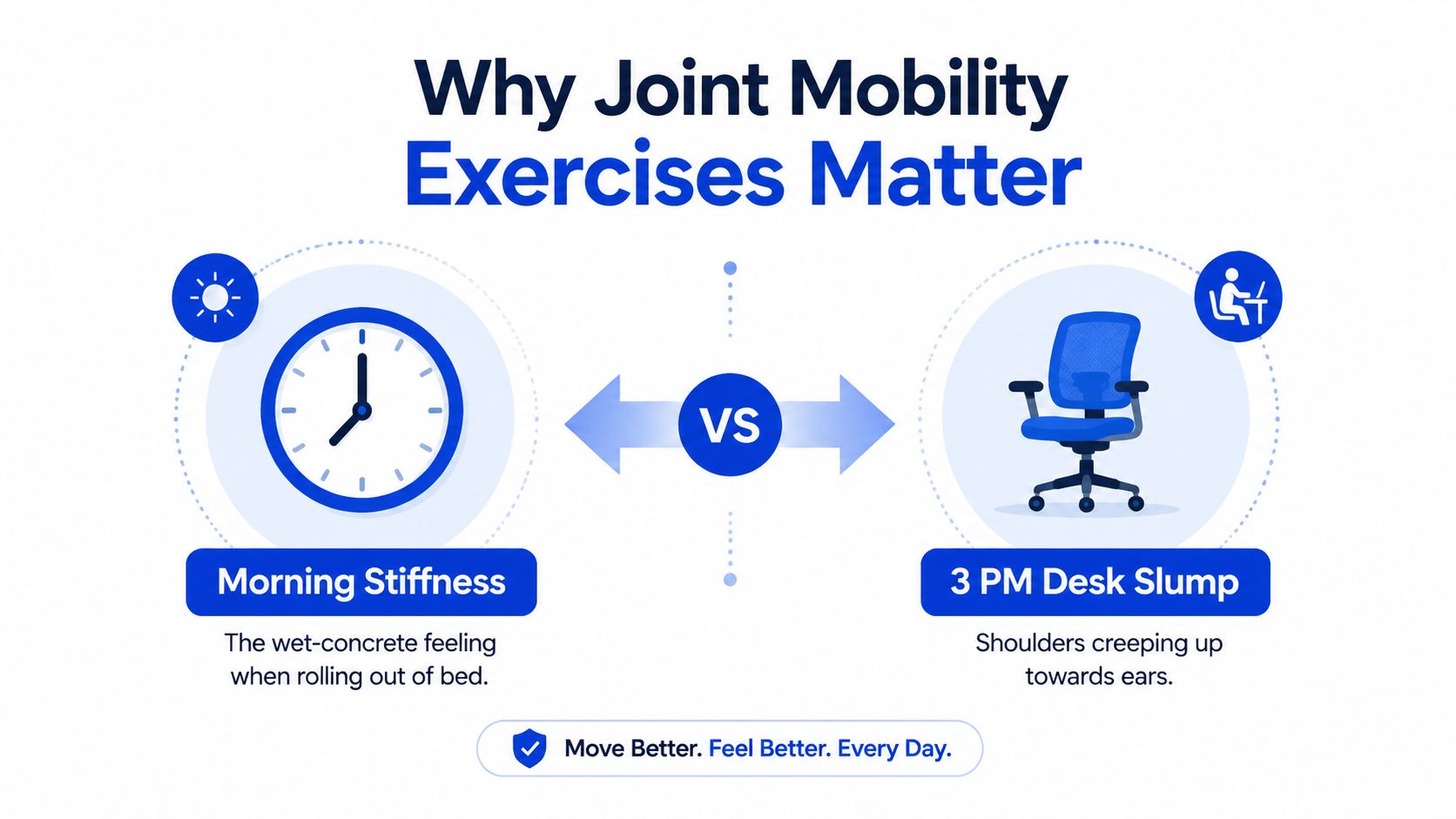
You wake up feeling as though your joints have spent the night setting like concrete. Later, after several hours at a desk, your neck feels compressed, your shoulders have crept towards your ears and standing up takes a conscious effort. That pattern is common, but it doesn't mean you should push harder or stop moving altogether.
Joint mobility exercises can help you regain practical control through comfortable movement. The right approach is gentle, regular and adaptable, particularly if you have arthritis, persistent pain or a sedentary job. Australian guidance supports flexibility and range-of-movement work as part of broader exercise, while also giving useful safety cues for adjusting the dose when symptoms change. Arthritis Australia's physical activity guidance recommends gentle joint movements for warming up and cooling down, and advises people with inflammatory joint conditions to keep affected joints moving gently during a flare without force or resistance.
Table of Contents
- Why Joint Mobility Exercises Matter for Everyday Movement
- Essential Mobility Routines for Major Joints
- Modifications for Arthritis and Sedentary Workers
- Safety Cues and Progression Guidelines
- Integrating Mobility Work into Your Daily Routine
- When to Seek Osteopathic Care
Why Joint Mobility Exercises Matter for Everyday Movement
A patient once described her morning movement as “walking through wet concrete”. She could stretch her calves and hamstrings, yet still struggled to turn her head, reach into a cupboard or take the first steps down the hallway. Another patient, a remote worker, had a different version of the same problem. By mid-afternoon, his shoulders were lifted, his upper back was rigid and his hips felt stuck after hours in one position.
Stretching may create a temporary feeling of length, but mobility is more than passive flexibility. Flexibility is the amount a joint or muscle can be moved with outside assistance. Mobility is your ability to actively control movement through the range available to you. A shoulder that can be pulled overhead by someone else isn't necessarily a shoulder you can control safely overhead yourself.
Movement gives joints useful information
Gentle, repeated movement helps distribute synovial fluid across joint surfaces. It also stimulates sensory receptors in the joint capsule, muscles and surrounding tissues, giving your nervous system clearer information about position and movement. That can make a joint feel less guarded and help you coordinate the muscles that support it.
Cartilage doesn't have its own direct blood supply in the same way muscle does. Joint loading and unloading help circulate nutrients through the surrounding fluid and tissues. In practical terms, controlled compression followed by decompression gives the joint a reason to keep exchanging fluid rather than remaining still for long periods.
Sedentary routines make this more important. Hours spent sitting can leave the hips, spine and shoulders moving through a narrow portion of their available range. The body becomes efficient at the positions you repeat, so a joint may feel restricted when you ask it to perform an unfamiliar movement.
Clinical rule: Stiffness usually responds better to calm, graded movement than to complete rest, but a hot, swollen or sharply painful joint needs modification rather than force.
You don't need an elaborate programme to begin. A few slow neck turns, shoulder circles, ankle movements and controlled hip shifts can act as a daily maintenance signal. For desk workers, placing a simple posture reminder such as this corporate ergonomics visual near the workstation can make movement breaks easier to remember.
Australian arthritis guidance recommends that adults aim for at least 30 minutes of activity on most days, and notes that activity can be split into shorter sessions. Arthritis Australia explains how activity can be broken into manageable periods, which suits people who find a long exercise session unrealistic.
Essential Mobility Routines for Major Joints
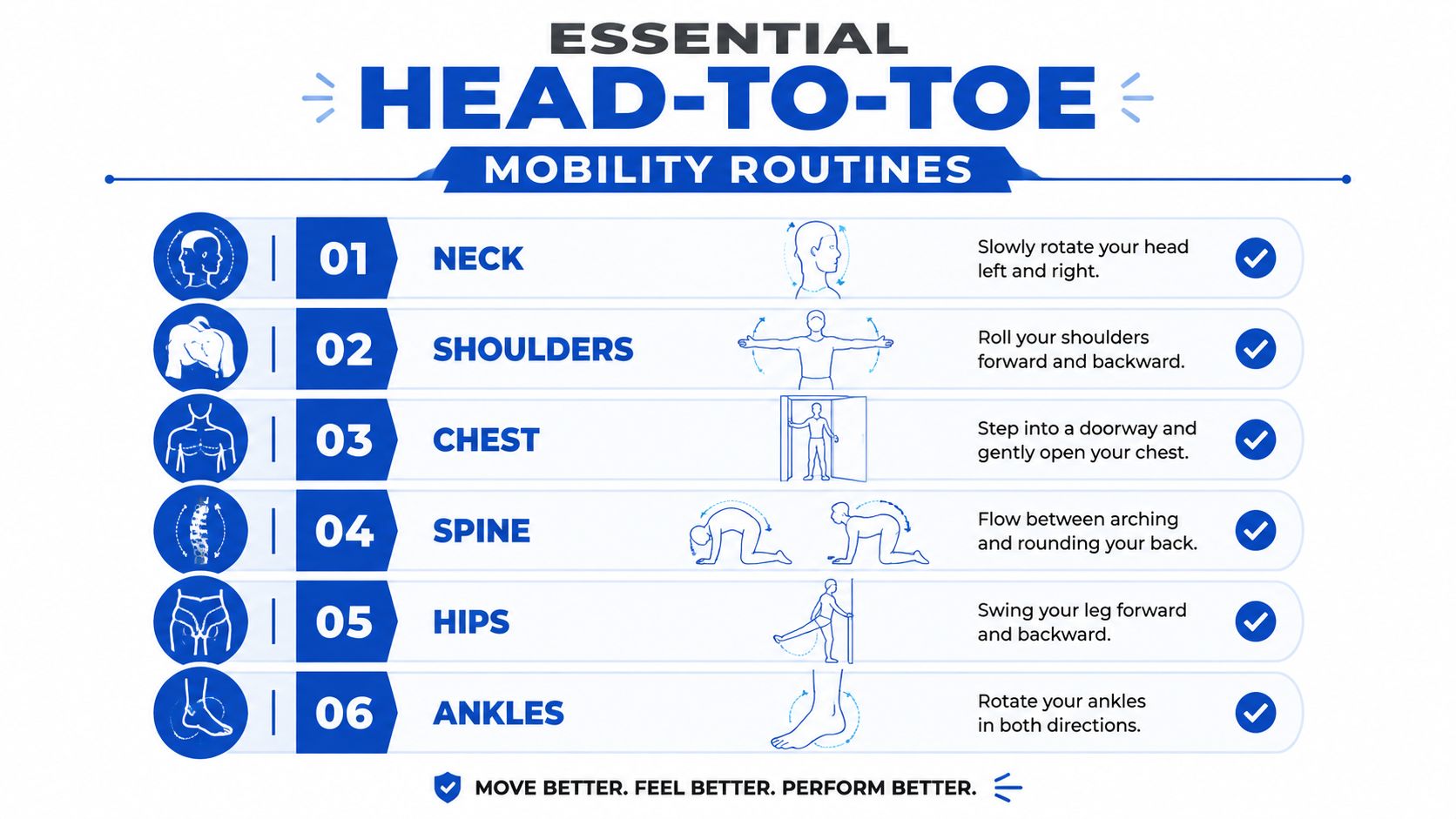
Treat this sequence as a daily movement check-in, not a test of how far you can stretch. Move slowly, breathe normally and keep the range comfortable. If one area is irritable, reduce the movement or skip that drill and continue with another region.
Neck and shoulders
Start with cervical rotations. Sit or stand tall, let your jaw relax and turn your head slowly towards one shoulder, then return to centre and repeat on the other side. Use five controlled repetitions each way, taking roughly three seconds to turn and three seconds to return. Follow with gentle lateral flexion, bringing one ear towards the same-side shoulder without lifting the shoulder. Avoid pushing on your head or forcing the final few degrees.
For the shoulders, make small controlled articular rotations. Raise one arm forward, circle it out to the side and return it beside your body, keeping the ribs quiet. Wall slides are another useful option. Stand with your back near a wall, slide the arms upwards only as far as you can without arching your lower back. Perform five to eight repetitions, and avoid hiking the upper trapezius towards your ears.
Spine and hips
Move into cat-cow from hands and knees, or use a seated version if kneeling isn't suitable. Slowly round and extend the spine, thinking about each segment moving rather than chasing a dramatic arch. Use six to ten repetitions with an unhurried rhythm. The common mistake is moving only from the neck or lower back while the middle of the spine stays fixed.
For thoracic rotation, sit with both feet supported and cross your arms over your chest. Turn through the upper back while keeping the pelvis facing forwards. Make five repetitions per side, pausing briefly at the comfortable end. Don't pull on your neck or allow your knees to swing with the torso.
Desk workers often need hip movement that isn't limited to sitting with the hips bent. Try supported 90/90 transitions, moving from one hip position to the other with your hands behind you or on a stable surface. Start with four to six slow transitions. A supported deep squat hold can be useful if your knees, hips and ankles tolerate it. Hold the position for 15 to 30 seconds, using a door frame or bench, and avoid dropping into the depth.
Knees and ankles
Terminal knee extensions can be performed standing with the back of the knee supported by a rolled towel or a soft exercise ball. Gently straighten the knee, tighten the thigh and return to a relaxed position. Use eight to twelve repetitions per side without snapping the joint. For a supported knee flexion arc, hold a bench and bend the knee gradually, then straighten it again. Don't force a painful or swollen knee into deeper flexion.
Knee symptoms don't always originate at the knee. Limited hip control or ankle dorsiflexion can change how the knee tracks during stairs, squats and walking. That doesn't mean every knee problem can be solved by moving another joint, but the whole movement chain deserves attention.
Finish with ankle circles and dorsiflexion mobilisations. Keeping the heel grounded, guide the knee gently forwards over the middle toes, then return. Complete eight slow circles each direction and eight forward glides per side. Keep the foot planted and avoid letting the arch collapse or the ankle roll outward.
A demonstration can help you understand the rhythm and positioning. Use the video below as general movement education, not as a substitute for assessment when you have an injury, swelling or persistent pain.
Modifications for Arthritis and Sedentary Workers
Arthritis doesn't require you to abandon movement, but it does require you to adjust the dose. During a flare, avoid vigorous exercise for a red, hot, swollen or very painful joint. Australian guidance recommends gentle movement to help limit stiffness, while cautioning against force and resistance in an affected joint. Better Health Channel's arthritis exercise advice also supports reducing intensity and allowing more rest when symptoms flare.
Begin with a smaller, unloaded range. Seated hip circles may be more appropriate than standing circles, and a slow ankle pump may be preferable to a loaded squat. Warm water can make movement feel easier, while a warm pack may help some people prepare for gentle activity. Heat isn't suitable for every inflammatory presentation, so use your symptoms and professional advice as a guide.
Flare-day principle: Keep the joint moving within a calm range, but don't try to prove that you can tolerate your usual routine.
Sedentary workers need a different emphasis. Prolonged sitting commonly limits hip extension, reduces movement through the thoracic spine and keeps the ankles in one position. A short reset can include seated thoracic extension over the chair back, ankle pumps under the desk and a gentle hip flexor release using the edge of a stable chair.
Scale movement through three stages:
- Passive-assisted: Use your hands, a towel or a wall to guide a joint through a small range.
- Active: Perform the movement using your own muscles, without external load.
- Loaded: Add resistance or weight only when active control is comfortable and symptoms remain settled.
These aren't lesser exercises. They're intelligent starting points that let irritated tissues regain tolerance. People who repeatedly push through arthritic pain often create a setback, whereas people who reduce range, intensity and duration during a flare can maintain a more sustainable routine.
| Joint Area | Standard Exercise | Arthritis Modification | Sedentary Worker Modification |
|---|---|---|---|
| Neck | Cervical rotation | Use a smaller, slower range without stretching into pain | Perform gentle turns during screen breaks |
| Shoulder | Wall slides | Slide only to a comfortable height, keeping the movement unloaded | Add seated shoulder circles and relaxed scapular movements |
| Hip | 90/90 transitions | Use seated hip circles with hands supporting the body | Practise hip extension after sitting |
| Knee | Supported knee flexion | Work through a shallow arc and avoid hot or swollen joints | Stand periodically and perform gentle knee bends |
| Ankle | Dorsiflexion glide | Keep the heel down and use a small range | Perform ankle pumps beneath the desk |
For people managing arthritis, this joint mobility resource can reinforce the idea that movement should be adapted rather than abandoned.
Safety Cues and Progression Guidelines
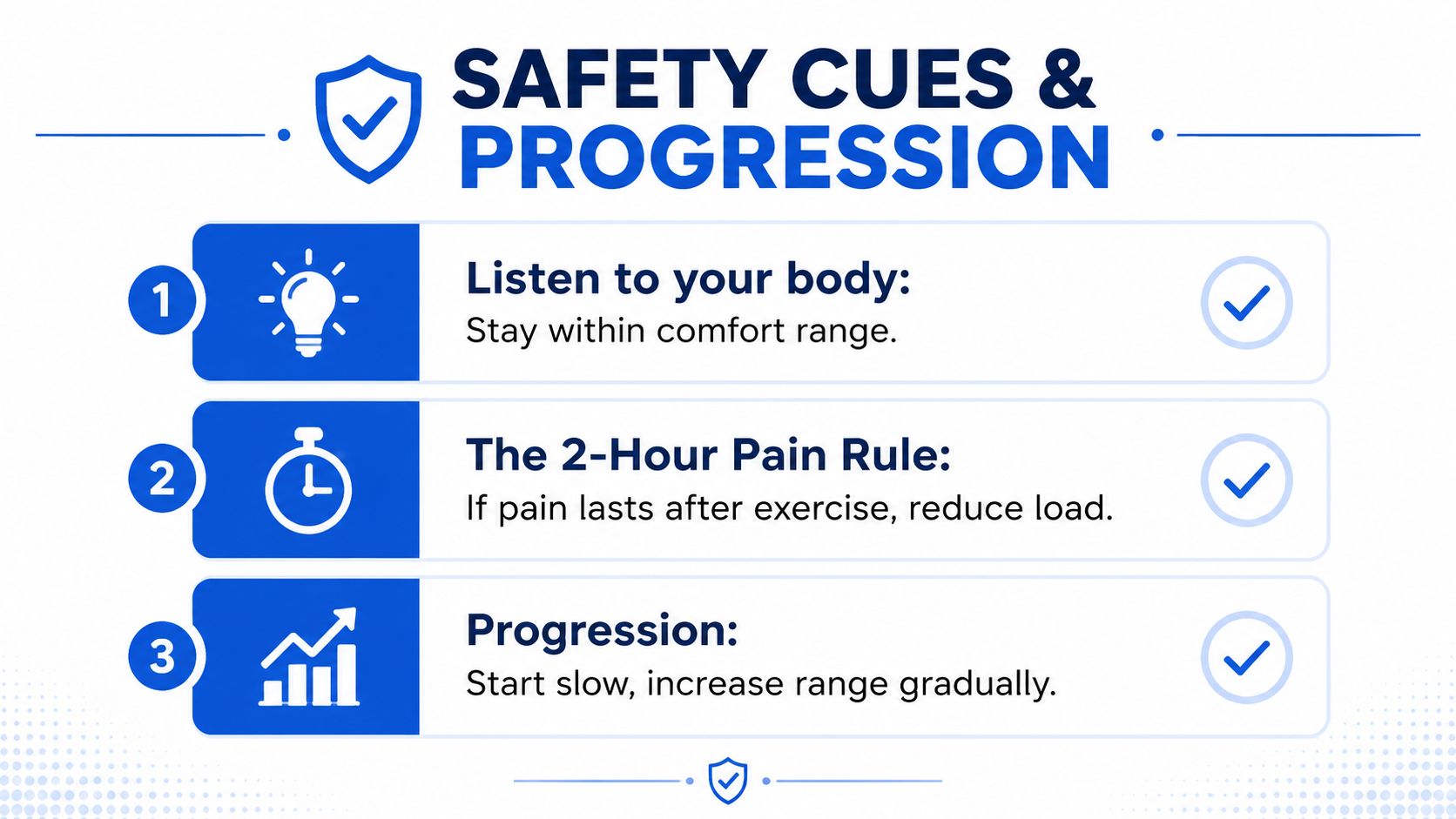
The most useful Australian benchmark for judging an exercise session is the two-hour pain rule. If extra or unusual pain remains for more than two hours after exercise, the session was too demanding and the next session should be reduced. This guidance appears in Australian osteoarthritis resources, including the RACGP recommendations for knee and hip osteoarthritis exercise.
Some sensations are acceptable. A mild stretch, gentle effort or brief localised ache that settles soon after movement is different from sharp pain, catching, spreading symptoms or swelling. A joint that becomes increasingly hot, visibly swollen or less functional needs assessment rather than more repetitions.
Progress through control before range
Use this order:
- Small range: Start with low-amplitude movement that feels smooth and predictable.
- Middle range: Gradually explore more of the available movement while maintaining control.
- End range: Add gentle holds or resistance only when the earlier stages are comfortable and symptoms remain settled.
For knee osteoarthritis, Australian exercise guidance describes gradual progression, comfortable range and careful monitoring after a session. It also provides practical exercise benchmarks, including two to three sets of 10 to 15 repetitions for mobility and strength work, and 15 to 30 second stretches repeated three to five times. Those figures aren't a universal prescription, particularly during a flare, but they offer a useful framework when tolerance is good.
Before starting, ask yourself:
- Is the joint unusually hot, swollen or unstable?
- Can I move without sharp or radiating pain?
- Am I breathing normally rather than bracing?
- Will I have time to observe how I feel afterwards?
- Did the previous session settle within the two-hour window?
Don't bounce at end range, force through resistance or hold your breath. Smooth repetition is more valuable than a large movement performed with compensation.
Integrating Mobility Work into Your Daily Routine
A mobility routine works best when it fits the day you already have. A long session that happens occasionally may feel productive, but short bouts are often easier to repeat and easier to modify when symptoms change. Australian guidance explicitly allows daily activity to be divided into shorter sessions, which makes movement snacks a practical option for busy adults. Arthritis Australia outlines this flexible approach to activity.
Three workable points in the day
Morning: Use five minutes for neck turns, shoulder circles, cat-cow or seated spinal movement, hip shifts and ankle circles. Keep the first repetitions small, as overnight stiffness often improves gradually rather than immediately.
Midday: Set a reminder for a brief desk reset. Stand, look away from the screen, rotate the upper back, move the hips into extension and perform ankle pumps. The purpose isn't to create fatigue. It's to interrupt the fixed position.
Evening: Choose slower movements after work or physical activity. Supported hip transitions, gentle thoracic rotation and relaxed breathing can reduce the sense of compression that builds during the day.
Pair each routine with an existing cue. Move while the kettle boils, perform ankle circles while brushing your teeth, or use television ad breaks for standing mobility. The cue should be visible and reliable, not dependent on remembering at the end of a busy day.
| Day | Main focus | Practical placement |
|---|---|---|
| Monday | Neck, shoulders and upper back | Morning and first desk break |
| Tuesday | Hips, knees and ankles | Before a walk or after work |
| Wednesday | Whole-body gentle sequence | Morning |
| Thursday | Thoracic spine and hips | Midday desk reset |
| Friday | Ankles, knees and balance control | Evening |
| Saturday | Comfortable full-body movement | Before recreational activity |
| Sunday | Recovery-focused mobility | Short, easy session |
Keep the plan flexible. If a joint becomes irritable, reduce the range or swap to an unloaded variation rather than treating the schedule as a test of discipline. Consistency builds automaticity, while intensity is only useful when your body can recover from it.
When to Seek Osteopathic Care
Self-managed mobility is reasonable when symptoms are mild, stable and improving with controlled movement. It isn't the right tool for every presentation. Joint locking or catching, unexplained swelling, night pain that disrupts sleep, numbness, tingling or pain that doesn't respond to two weeks of consistent mobility work all justify professional assessment.
Seek timely medical attention for severe or rapidly worsening symptoms, particularly when a joint becomes markedly hot, red or swollen, or when neurological symptoms affect strength or function. Don't use a mobility routine to test a joint that feels unstable or mechanically blocked.
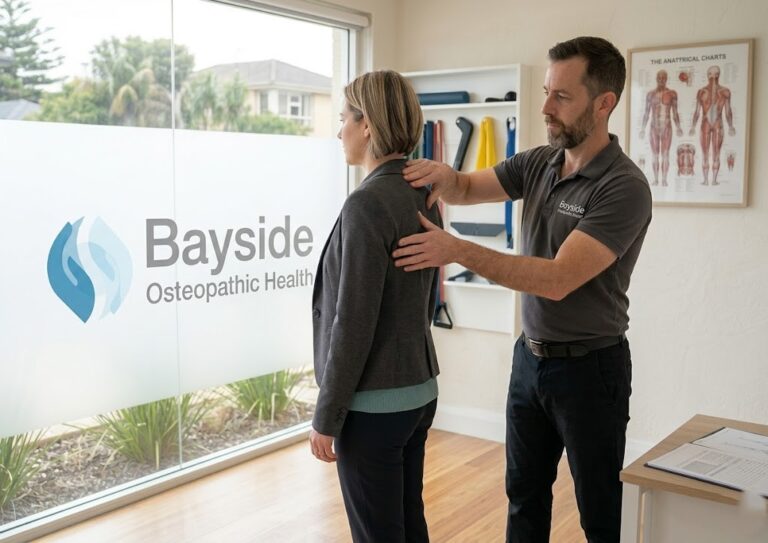
An osteopathic assessment typically considers how the whole body moves. The practitioner may observe posture and gait, test joint range of motion, assess muscle and tissue tone, and use functional movement screening to understand how symptoms appear during everyday tasks. Those findings can shape a more specific plan, such as choosing seated movements for a painful hip, restoring ankle control before loaded squats, or addressing thoracic movement when shoulder elevation is restricted.
| Symptom or Scenario | Recommended Action |
|---|---|
| Mild stiffness that eases with gentle movement | Continue a comfortable routine and monitor response |
| Pain lasting more than two hours after exercise | Reduce range, repetitions or resistance |
| Red, hot, swollen or acutely painful joint | Stop vigorous exercise and seek clinical advice |
| Locking, catching or unexplained swelling | Arrange professional assessment |
| Numbness, tingling or new weakness | Seek prompt medical assessment |
| Persistent symptoms despite two weeks of consistent work | Book an assessment rather than continuing to self-progress |
| Post-surgical recovery or complex multi-joint symptoms | Follow an individual rehabilitation plan |
Bring a short symptom history to your appointment. Note when the problem started, which movements aggravate it, whether swelling or night pain occurs, what exercises you've tried and how long symptoms lasted afterwards. A clear description helps the practitioner distinguish a tolerable training response from a problem requiring a different approach.
This guide to when osteopathic treatment may be appropriate can help you recognise when self-care has reached its limit.

Bayside Osteopathic Health provides gentle, hands-on osteopathic care alongside personalized movement advice for joint stiffness, arthritis-related discomfort and posture strain from desk work. Visit Bayside Osteopathic Health to arrange an assessment and receive a practical mobility plan suited to how your body moves.