

You've tried stretching, bought a massage ball and spent evenings pressing into the same stubborn spot, yet the ache keeps returning. Perhaps it sits between your shoulder blade and spine, across your lower back or deep in your hip. It may feel tight, sticky or difficult to locate, especially when you move, breathe or stay in one position for too long.
That's where people often ask, what is myofascial therapy? The short answer is that it's a gentle, hands-on approach aimed at areas where muscle and connective tissue aren't moving comfortably. In Australian manual-care settings, it's usually one part of a broader osteopathic or physiotherapy plan, rather than a standalone answer to every kind of pain.
Table of Contents
- The Knot That Would Not Let Go
- What Myofascial Therapy Actually Means
- How Practitioners Work the Tissue
- How It Compares With Osteopathy and Other Hands-On Care
- What a First Session Feels Like
- Conditions People Seek It For and What the Evidence Says
- Safe Self-Care at Home and When to Seek Help
- Putting It All Together
The Knot That Would Not Let Go
After three weeks at a desk, a familiar patient might describe a deep ache between the shoulder blade and spine. They've massaged it with their fingers, stretched against a doorway and rolled over a tennis ball. The pressure feels useful for a moment, but the grippy sensation returns as soon as they sit down again. When they take a full breath, the area seems to pull rather than expand.
That “knot” rarely means one muscle fibre has tied itself into a literal knot. A more useful way to understand it is as a small region where muscle, skin and connective tissue are no longer sliding easily over one another. The body can respond by increasing protective tension, which makes the area feel denser, more sensitive and harder to relax.
The web beneath the surface
Fascia is the continuous connective-tissue web that surrounds and links muscles, bones, nerves, blood vessels and organs. You don't usually feel fascia as a separate layer. You notice its behaviour through movement: a smooth glide when things are comfortable, or a pulling, catching sensation when an area has become restricted. This whole-body relationship is also why a practitioner may assess the ribs, neck, arm or pelvis when your main complaint is located beside the shoulder blade.
Common contributors include prolonged posture, repetitive loading, an old injury, surgery, stress-related guarding and periods of reduced movement. These factors can change how the tissues share load. The result may be local tightness, but it can also be a broader feeling that your movement has become less free.
A useful patient question: “Does the area feel restricted when I move, or is the pain changing, severe or accompanied by other symptoms?” That distinction helps determine whether hands-on care is appropriate.
Myofascial therapy begins with that felt experience. Rather than digging harder into the sore spot, the practitioner looks for how the restricted area relates to the rest of your movement. The next step is to understand what the treatment involves and why its slower style differs from ordinary deep-tissue massage.
What Myofascial Therapy Actually Means
To understand what myofascial therapy means, start with the word itself. Myo refers to muscle, while fascial refers to fascia, the connective tissue that wraps around and links structures throughout the body. The term describes a family of manual techniques, not one fixed procedure performed in exactly the same way by every practitioner.
Think of fascia as a three-dimensional suit beneath the skin. It surrounds each muscle and helps connect neighbouring regions, allowing tissues to glide as you bend, walk, reach and breathe. If one part of that suit becomes less mobile, you might feel the effect nearby. A restricted calf, for example, may alter how you load the ankle, knee, hip or lower back, although that doesn't mean the calf is always the cause of back pain.
Why restrictions feel “sticky”
Postural habits, repetitive strain, injury and protective muscle guarding can all contribute to a less comfortable glide. A patient may describe the sensation as a taut band, a dense patch or a stretch that stops abruptly. Some people feel tenderness under light pressure, while others mainly notice reduced range of motion.
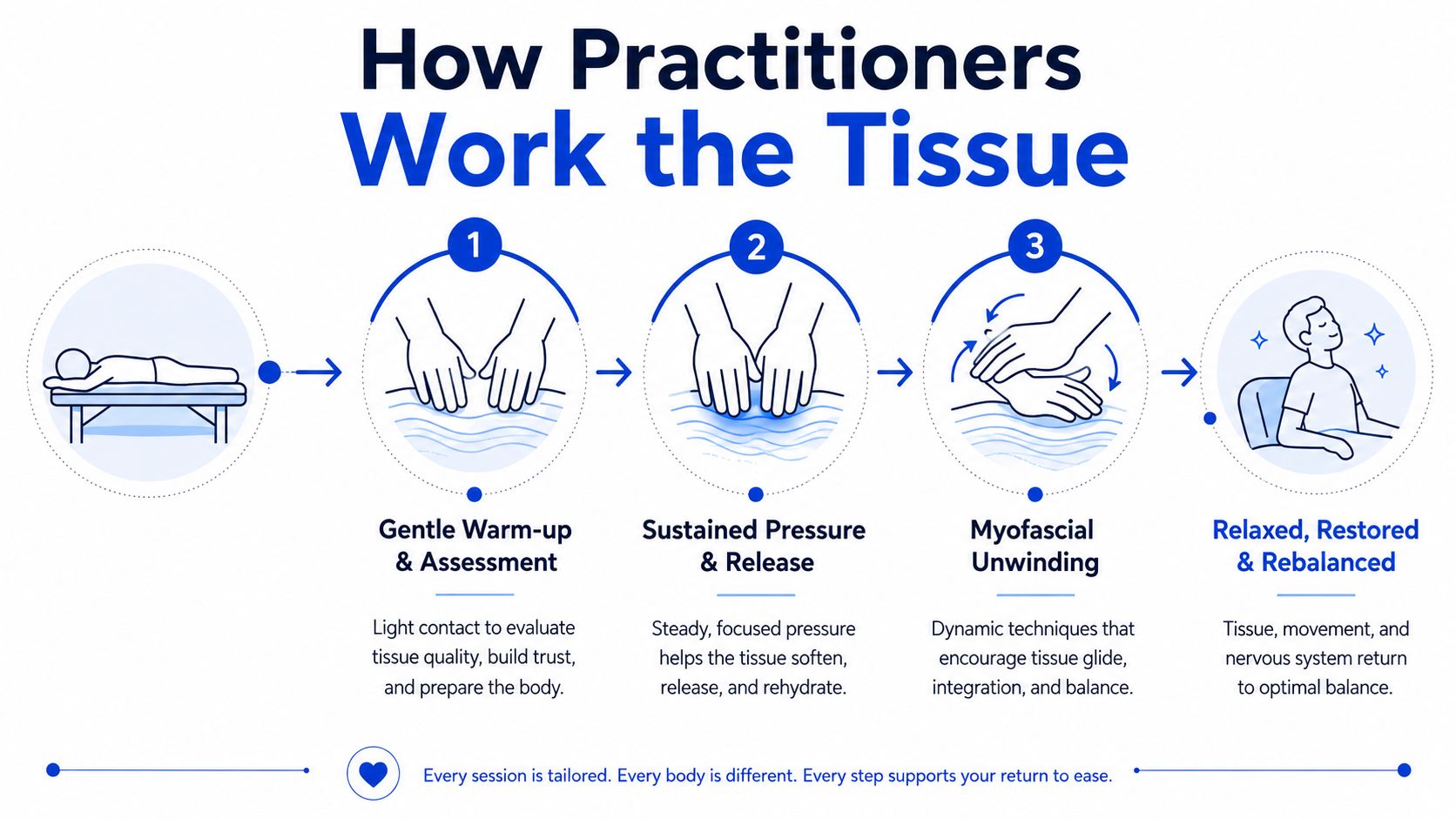
The practitioner uses a careful assessment to decide whether the area is suitable for treatment. They may apply sustained, gentle pressure, guide a joint or limb through movement, and ask you to breathe normally. The aim is to encourage a change in how the area feels and moves, rather than to force tissue into a new position.
Gentle doesn't mean ineffective
Myofascial work is often slower and less forceful than deep-tissue massage. The therapist may hold a contact for long enough to notice a gradual softening, a change in breathing or an increase in comfortable movement. You might feel warmth, a mild tug, a spreading sensation or tenderness that remains within a tolerable level.
Deep pressure can feel satisfying, but more force isn't automatically better. A body that feels threatened by intense pressure may tighten around it. Myofascial therapy instead gives the tissues and nervous system time to respond, while the practitioner monitors your feedback.
The technique may be used alongside joint mobilisation, exercise advice, strength work, ergonomic changes and load management. That wider plan matters because a temporarily easier feeling won't last if the movements, work demands or recovery habits that keep provoking the area remain unchanged.
How Practitioners Work the Tissue
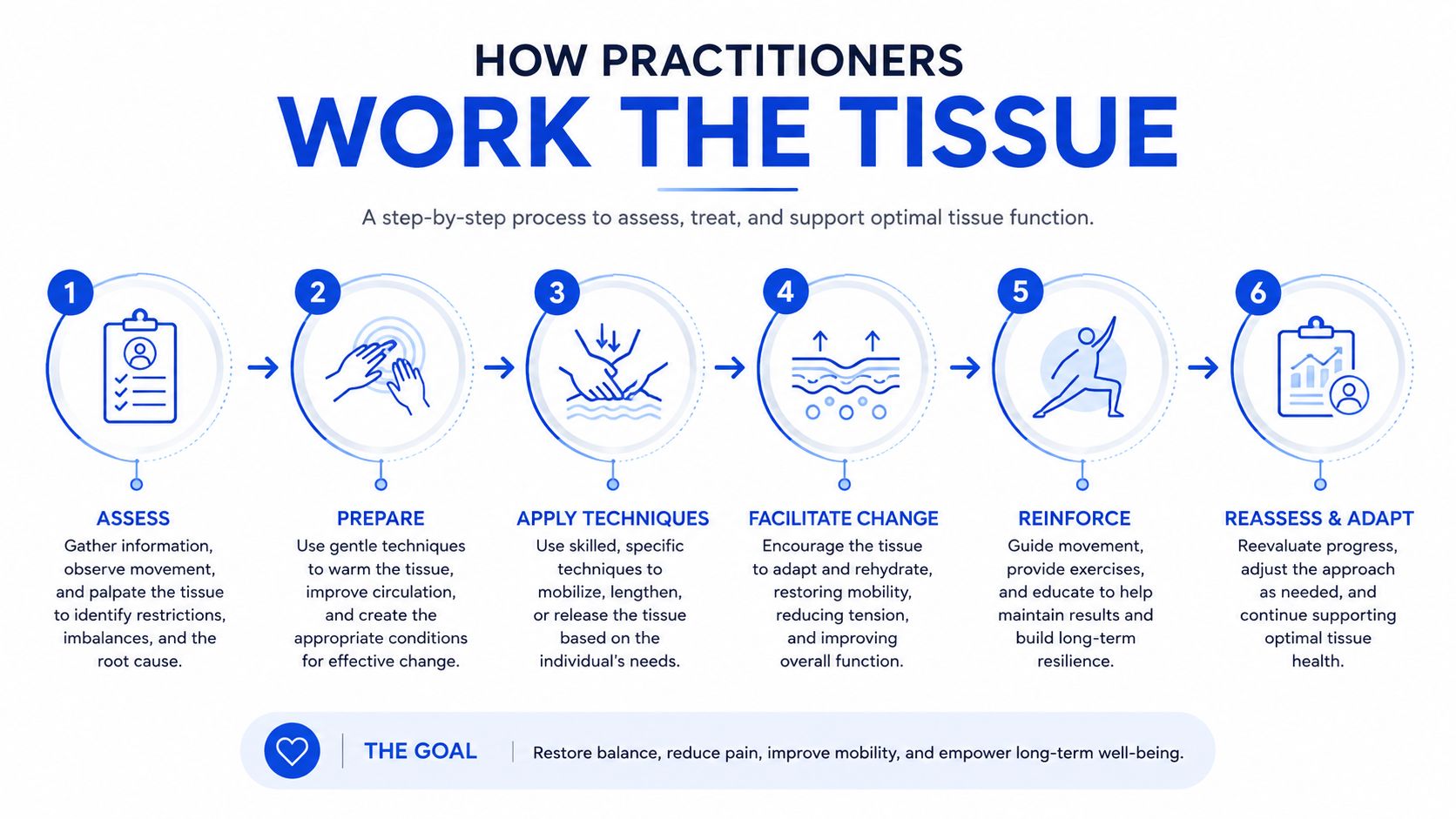
A session usually starts with touch that feels exploratory rather than forceful. The practitioner checks the quality of movement and the way the tissue responds beneath the hands. Different techniques can then be combined according to the area, your symptoms and your comfort.
Common hands-on approaches
- Sustained direct pressure: The practitioner places a hand, thumb or another contact over a sensitive taut band and gradually settles into it. The sensation should remain manageable. You may notice the discomfort spread, fade or change quality as you breathe.
- Myofascial release: This involves a slower hold with little or no oil, allowing the skin and underlying tissue to move together. It can feel like a quiet stretch that builds gradually rather than a rubbing action.
- Cross-hand stretching: The practitioner places the hands on either side of a restricted area and gently moves them in opposite directions. Across the chest or upper back, you may feel a broad, lengthening pull rather than a pinpoint pressure.
- Positional release: A limb or joint is guided into a position that feels easier. Once the area is comfortable, the practitioner waits for a reduction in guarding, sometimes asking you to breathe slowly.
- Active techniques: You may make a small contraction or controlled movement while the practitioner provides resistance or contact. This helps connect the hands-on work with the movement you need outside the clinic.
- Instrument-assisted work: Some practitioners use smooth stainless-steel tools to assess or treat superficial restrictions. The tool should glide with controlled pressure, not scrape aggressively across the skin.
The word “release” can be confusing. It doesn't mean a practitioner has physically broken up a lump or permanently changed the structure in one pass. It usually describes a short-term change in tone, sensitivity or movement that can then be reinforced with active rehabilitation.
Your feedback guides the pressure
Tell the practitioner if the sensation becomes sharp, electric, numb or too intense. A productive treatment shouldn't require you to brace, hold your breath or tolerate pain that feels alarming. The therapist can change the angle, reduce pressure, work elsewhere or stop.
This is especially important when symptoms travel along an arm or leg. A local ache may be appropriate for gentle treatment, but nerve-like sensations require a more cautious assessment.
How It Compares With Osteopathy and Other Hands-On Care
Myofascial therapy is a technique. Osteopathy, physiotherapy, remedial massage and chiropractic are professional approaches or disciplines that may use different techniques within a consultation. That distinction explains why two practitioners can both use soft-tissue contact while offering quite different treatment plans.
| Therapy | Main focus | Uses myofascial work? | Typical session length | Best for |
|---|---|---|---|---|
| Osteopathy | Whole-person assessment, hands-on care, joint movement and practical exercise advice | Often, as one component | Varies by practitioner and needs | People wanting a combined plan for pain and mobility |
| Physiotherapy | Rehabilitation, movement retraining and functional recovery | Often, alongside exercise | Varies by practitioner and needs | Recovery that requires progressive movement and loading |
| Remedial massage | Specific muscular tension and soft-tissue work | Frequently | Varies by practitioner and needs | Localised muscle tightness and recovery support |
| Chiropractic | Assessment and treatment often centred on spinal or joint manipulation | May be included, depending on the practitioner | Varies by practitioner and needs | People seeking care focused on spinal and joint techniques |
An osteopath may use myofascial release around the shoulder, then assess a rib or upper-back joint and prescribe a movement drill. A physiotherapist might use similar soft-tissue contact before retraining shoulder control. A remedial massage therapist may concentrate more directly on the muscles involved, while a chiropractor may make spinal manipulation the central technique.
You can see how remedial massage and muscle therapy may fit within broader soft-tissue care in this visual resource: remedial massage and muscle therapy.
There's overlap, but the treatment goal and clinical reasoning still matter. Ask what the practitioner has found, why they've chosen a technique and what you're expected to do between appointments.
What a First Session Feels Like
Your first appointment normally begins with a conversation, not a treatment table. You'll be asked about when the problem started, what makes it better or worse, previous injuries, medical history, work demands, exercise and any symptoms that might require referral.
The practitioner then watches you move. They may check how you bend, rotate, squat, walk or raise an arm, followed by a more focused assessment of the painful area and related regions. This helps them decide whether the symptom appears suitable for conservative manual care and which techniques are likely to be comfortable.
During the hands-on part
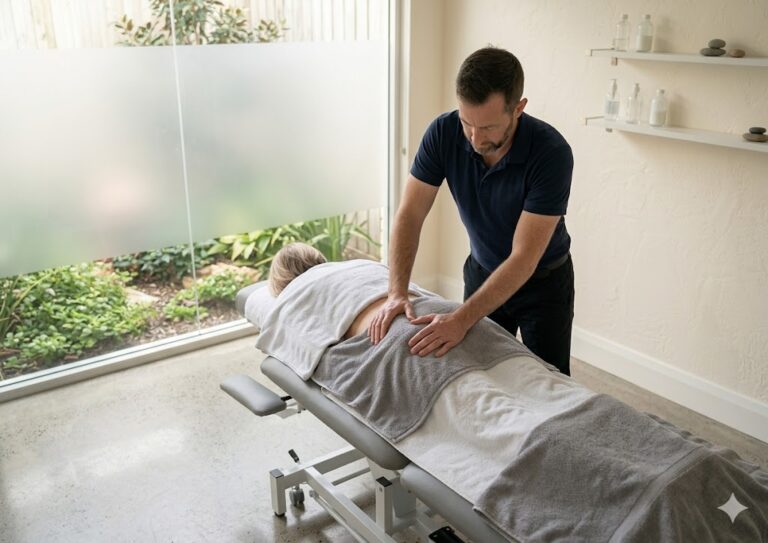
You'll usually remain clothed appropriately or have the area exposed with consent and suitable draping. Contact may begin lightly, then develop into a sustained hold. Common sensations include warmth, a gentle tug, pressure that spreads, a slow easing or mild tenderness.
You should be able to communicate throughout. Treatment can be adjusted at any time, and “less pressure” is a useful clinical instruction, not a failure to tolerate care.
Many people ask whether it will hurt. Some tenderness can occur, particularly over sensitive tissue, but sharp, burning, electric or escalating pain should be reported immediately. The right level is one that allows you to breathe and remain relaxed enough for the practitioner to observe your response.
People also ask how many sessions they'll need. There isn't a reliable universal schedule because the answer depends on the condition, irritability, daily load, sleep, recovery and whether the underlying movement problem is being addressed. A practitioner may recommend a short review period, then adjust the plan according to objective changes and your own experience.
After treatment, gentle movement is usually more useful than complete rest. Drink normally, follow the specific advice you've been given and notice how the area responds over the following day or two. If symptoms become progressively worse or new concerning symptoms appear, contact the practitioner rather than assuming discomfort is part of the process.
Conditions People Seek It For and What the Evidence Says
Patients commonly ask about myofascial therapy for neck and shoulder tension, persistent lower-back pain, tension-type headaches, hip and gluteal tightness, post-exercise soreness, old injury scars and postural discomfort. These complaints generally fall into three broad groups.
- Musculoskeletal symptoms: stiffness, restricted movement, back pain, neck pain and muscular tension.
- Recovery-related concerns: scar sensitivity or reduced mobility after an injury or procedure, where appropriate assessment is essential.
- Headache and postural complaints: tension around the neck, shoulders and upper back that may accompany some headache patterns.
These are reasons people seek care, not guarantees that myofascial work will resolve the problem. A full assessment still matters because similar pain can arise from different tissues or medical conditions.
What Australian evidence can support
Australia has a substantial musculoskeletal-health burden. The Australian Institute of Health and Welfare estimated that 7.3 million people, or 29% of the population, were living with chronic musculoskeletal conditions in 2022, and estimated spending on these conditions reached $14.7 billion in 2020–21, or 9.8% of total health spending. The same source associated musculoskeletal conditions with 10,446 deaths in 2022, equal to 40 deaths per 100,000 people. These figures describe the broader burden, not the effectiveness of myofascial therapy, but they help explain why conservative pain and movement care is relevant in Australia. Australian musculoskeletal-health data
Australian research has examined myofascial release within formal clinical settings. A PEDro-indexed randomised controlled trial investigated muscle activity after myofascial release techniques for low-back pain. Separately, a Nepean Hospital pilot study involving 50 women in an intervention group and 49 in a matched control group reported outcomes for perineal myofascial release during childbirth, including OR=0.15 for a non-intact perineum and OR=0.44 for episiotomy, with registration under ACTRN12623000807651. These findings are condition-specific and shouldn't be transferred to every back, neck or headache complaint. The Australian chronic musculoskeletal conditions report
For related Rolfing and Structural Integration approaches, the Australian federal natural therapies review rated the evidence very low certainty, based on six randomised controlled trials involving 216 participants, and concluded that the evidence was too limited to determine effectiveness for any condition. Australian evidence evaluation of Rolfing and Structural Integration
That calls for modest claims. Myofascial work may help some people with short-term pain, tenderness or movement comfort, but long-term structural change remains uncertain. It can't independently treat systemic disease, replace urgent care for a serious injury or explain pain with red-flag features.
For further context on conservative approaches, see this guide to chronic back pain solutions.

Safe Self-Care at Home and When to Seek Help
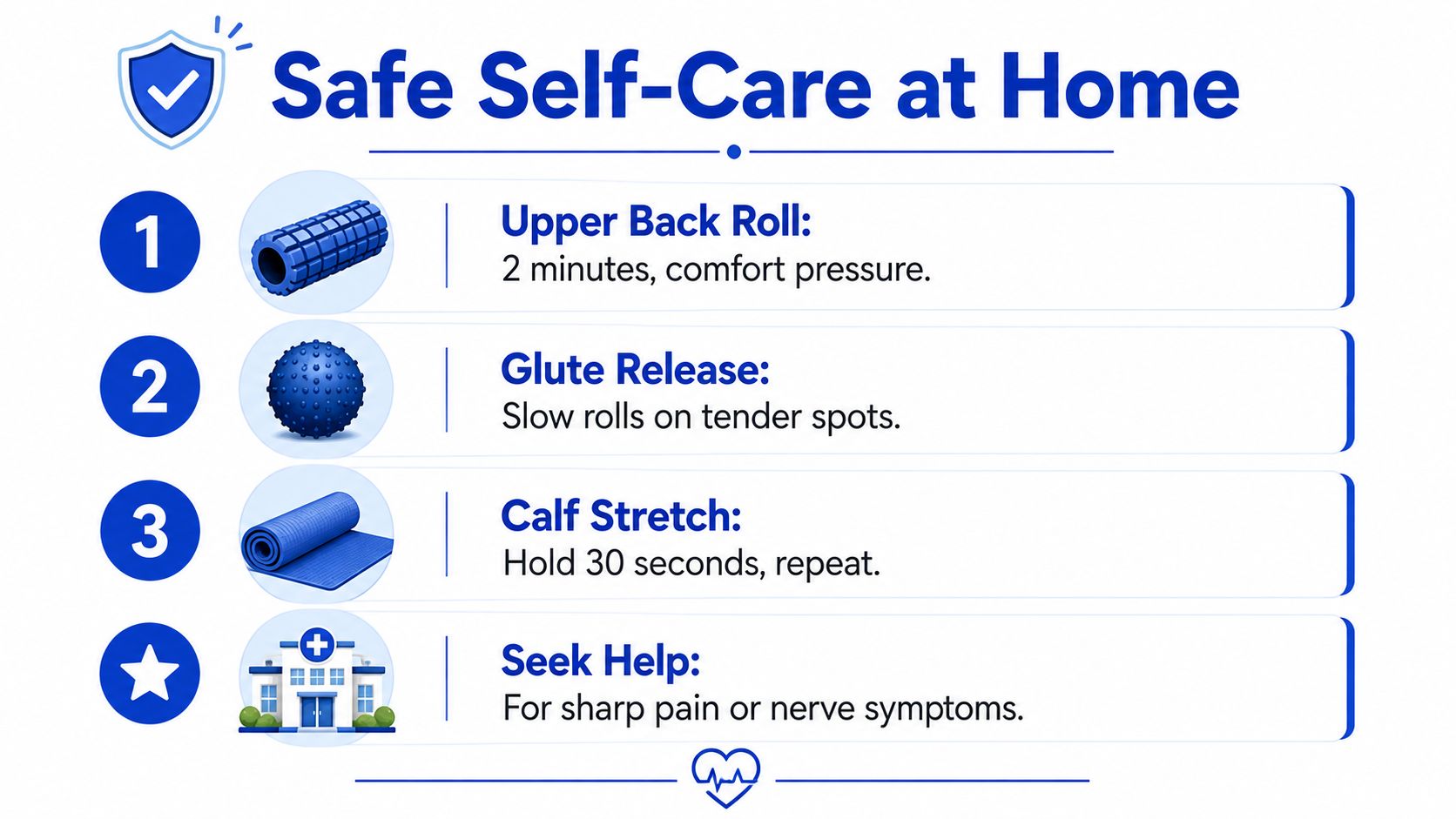
Between appointments, aim for comfortable movement rather than trying to force a “release”. A foam roller can be used over the upper back, glutes and calves, provided the pressure feels tolerable and you're not rolling directly over the spine, joints or a freshly injured area.
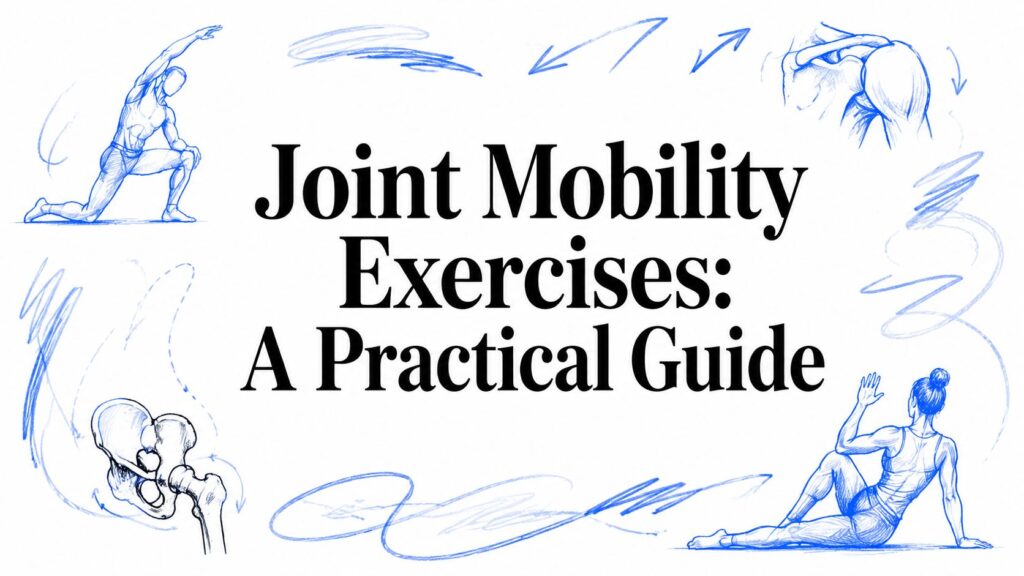
Use a slow pace and spend a short period on each region. A massage ball against a wall can provide more precise contact around the gluteal muscles, while gentle mobility such as cat-camel, open-book thoracic rotations or a supported hip 90/90 position can help you explore movement without aggressive stretching.
Make the routine easier to judge
- Start with warmth: A warm shower or wheat bag can make gentle movement feel more comfortable before you begin.
- Use breathing as a guide: Slow, steady breathing is preferable to bracing or holding your breath.
- Choose comfort pressure: If a spot produces sharp pain, tingling, burning or symptoms down an arm or leg, reduce the pressure or stop.
- Follow movement with normal activity: A short walk or easy range-of-motion work can be more useful than remaining still.
A separate joint mobility and stretching guide can help you think about mobility as a regular practice rather than a forceful attempt to change one painful point. Heat isn't a treatment for every condition, and ice isn't automatically wrong, but neither should be used to mask worsening symptoms while you keep pushing through.
Seek an assessment promptly if you develop sudden weakness, numbness around the saddle area, unexplained night pain, fever or pain after a fall. Stop self-treatment if symptoms are escalating, unusual or accompanied by loss of function. A qualified practitioner can decide whether manual care is suitable or whether you need another form of medical evaluation.
Putting It All Together
Myofascial therapy makes most sense as one layer of a broader care plan. Fascia forms a connected web around the body, but a recurring sore spot may also reflect how you move, how quickly you increase activity, the demands of your workstation, your sleep or the way you recover from exercise.
The hands-on part can make movement feel easier for some people. That opportunity is most useful when it's followed by practical changes, such as graded strengthening, mobility work, altered loading, regular breaks from sitting and a clearer understanding of which activities settle or aggravate your symptoms.
The realistic aim isn't to chase a perfect body. It's to make the next movement more comfortable and build capacity over time.
Try observing your symptoms across a consistent period of gentle home movement. If the knot, stiffness or pain keeps returning, don't assume you have to live with it. Book an assessment so the practitioner can examine the whole pattern, explain the likely contributors and decide whether myofascial work belongs in your plan.
Bayside Osteopathic Health provides gentle, hands-on osteopathic care that can include soft-tissue work, joint articulation, movement advice and practical self-care for persistent back, neck and joint symptoms. Visit Bayside Osteopathic Health to arrange an assessment and discuss whether myofascial therapy could form part of an individualised care plan.