
Osteopathy treatment is a regulated, hands-on allied health approach that assesses how the whole body moves and uses manual techniques to reduce pain, restore mobility, and support the body's natural healing. In Australia, 3,172 osteopaths were registered by 30 June 2023, representing 0.4% of the regulated health practitioner workforce (Ahpra workforce data).
You may have reached this page after trying a heat pack, over-the-counter pain relief, and a few days of rest, only to wake with the same stiff lower back or tight neck. Perhaps you're still avoiding a walk along the Bayside foreshore, lifting your grandchildren, returning to sport, or sitting through a full workday because movement feels unpredictable.
That's where a careful osteopathic assessment can help clarify what's contributing to the problem. Rather than treating the painful spot in isolation, an osteopath considers your history, posture, movement patterns, joints, muscles, connective tissues, daily load, and recovery habits. Treatment is usually individualised and may combine hands-on care with movement advice and practical changes at home or work.
Osteopathy isn't a quick fix or a replacement for medical diagnosis. It's a structured conservative-care pathway that can suit people with persistent musculoskeletal pain who want both symptom relief and a clearer plan for rebuilding comfortable movement.
Table of Contents
- Understanding Osteopathy Treatment for Everyday Pain
- How Osteopathic Techniques Work on Your Body
- Conditions Osteopathy Commonly Helps With
- Osteopathy vs Physiotherapy and Chiropractic Care
- What to Expect During an Osteopathy Session
- Safety, Arthritis, and Self-Care Between Visits
- Medicare, Costs, and Booking at Bayside Osteopathic Health
Understanding Osteopathy Treatment for Everyday Pain
A typical patient doesn't arrive with a neat, single-joint problem. They may describe a lower back that tightens after driving, a neck that aches by late afternoon, or a shoulder that hurts whenever they reach overhead. They've often adapted without realising it, shifting weight onto one leg, turning the whole body instead of the neck, or avoiding activities that used to feel routine.
Osteopathy treatment is a regulated allied health service in Australia. An osteopath takes a clinical history, examines how you move, and uses hands-on techniques to address restrictions, muscle tension, joint stiffness, and the way different regions of the body share load. The aim is to reduce pain, improve mobility, and help you return to useful activity with a plan you can manage.
More than massage
Massage may relax tight muscles, but osteopathic care involves reasoning from the full presentation. The practitioner asks when symptoms began, what aggravates them, what eases them, whether pain travels, and how work, sleep, exercise, previous injury, or health conditions affect your capacity.
The hands-on component might include soft-tissue work, stretching, joint mobilisation, or articulation. The choice depends on the examination. A sore shoulder, for example, may be influenced by limited movement in the upper back, guarding around the ribs, or reduced control of the shoulder blade, not only by the shoulder tissues themselves.
Australia's regulated osteopathy workforce is relatively small but active. More than 95% of registered osteopaths held practising registration in 2022, indicating that most registered practitioners were available to provide care (Ahpra workforce data).
Practical rule: Good treatment should leave you with a clearer explanation, a sensible next step, and enough confidence to move, not a promise that every symptom will disappear immediately.
For persistent pain, progress is usually measured through function. You might turn your head more easily, tolerate sitting for longer, walk with less hesitation, or resume a valued activity. Hands-on treatment can support those changes, but the long-term result depends on how well the plan matches your capacity and goals.
How Osteopathic Techniques Work on Your Body
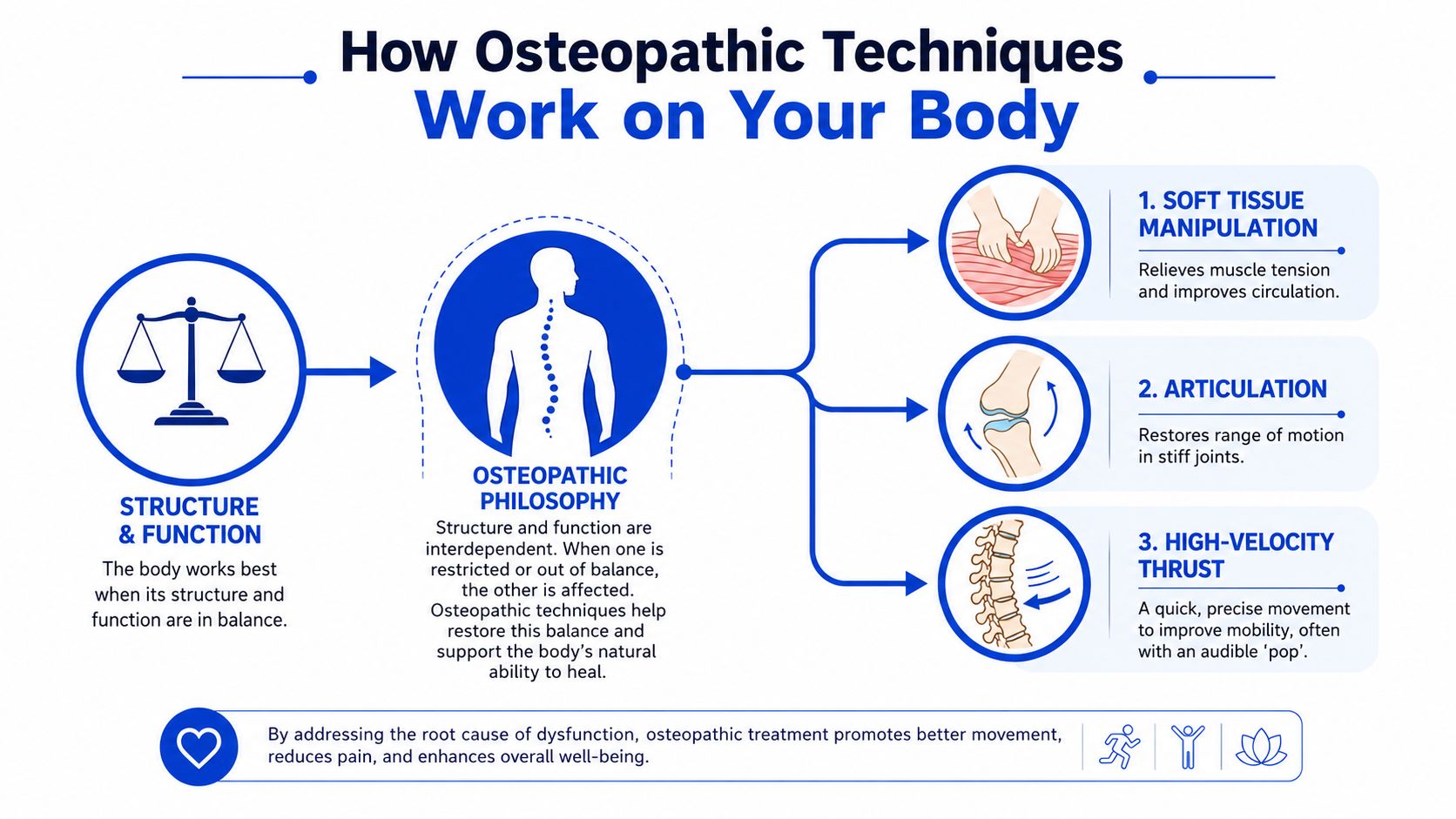
Osteopathic practice is built around the relationship between structure and function. In plain terms, stiff joints can change how muscles work, guarded muscles can alter movement, and repeated movement habits can keep loading the same tissues. The body isn't a collection of separate parts, so the assessment looks for useful connections without assuming that every painful area has one hidden cause.
A session may include several techniques, but there isn't a fixed sequence that suits everyone.
The hands-on options
Soft-tissue treatment: The osteopath may use massage, compression, stretching, or myofascial work to reduce muscle guarding and make movement more comfortable. Think of loosening a tight cable before adjusting the pulley. A muscle that's protecting an area may need calming before a joint can move freely. You can read more about the tissue-focused approach in this myofascial therapy resource.
Joint articulation: This involves gentle, rhythmic movement through a joint's available range. It can help a stiff neck, hip, ankle, or upper back move with less resistance. Unlike a rapid thrust, articulation is gradual and gives you time to report how the movement feels.
Mobilisation: The practitioner applies controlled movement to a joint or region while monitoring your response. Mobilisation can be particularly useful when pain, age-related stiffness, or recent injury makes forceful techniques unsuitable.
Muscle energy techniques: You may be asked to contract a muscle gently against the osteopath's resistance, then relax while the joint or muscle is repositioned. This active participation can help change muscle tone and improve range without relying entirely on passive force.
Indirect and cranial approaches: Some practitioners use lighter indirect techniques when tissues are irritable, the person is recovering from surgery, or a more forceful approach would be inappropriate. These methods should still be explained in clear clinical terms, without mystical claims about invisible forces or guaranteed whole-body effects.

Why technique selection matters
The same manual technique can feel helpful for one patient and aggravating for another. Your osteopath should consider irritability, medical history, medication, recent injury, bone health, neurological symptoms, and your preferences before choosing an approach.
Pain relief after treatment may reflect changes in muscle guarding, joint tolerance, nervous-system sensitivity, confidence, and movement. That doesn't mean the practitioner has physically “put everything back into place”. A more accurate explanation is that treatment can make movement feel safer and easier, creating an opportunity to rebuild capacity through normal activity and specific exercises.
Tell the osteopath if pressure feels too strong, symptoms spread, you feel unwell, or you're uncomfortable with a technique. Collaborative treatment isn't a courtesy. It's part of safe clinical decision-making.
Conditions Osteopathy Commonly Helps With
Australian osteopathy is most closely associated with persistent musculoskeletal pain. National practice research found that 36.4% of presenting complaints had lasted more than 12 weeks, indicating that many patients seek care for ongoing rather than short-lived problems (Australian osteopathy practice profile).
The strongest fit is usually a mechanical or movement-related problem where examination can identify modifiable restrictions, load sensitivities, or coordination issues. Osteopathy may sit alongside a GP, physiotherapist, exercise physiologist, or specialist, especially when symptoms are complex.
| Condition | Primary osteopathic focus |
|---|---|
| Non-specific lower back pain | Improving comfortable spinal, hip, and pelvic movement, reducing protective muscle tension, and supporting graded activity |
| Neck pain and cervicogenic headaches | Assessing neck, upper-back, rib, and shoulder movement, then using suitable mobilisation and self-management advice |
| Shoulder pain and impingement-type symptoms | Improving upper-back and shoulder-blade mechanics while addressing local muscle and joint sensitivity |
| Desk-related postural strain | Reducing sustained-load irritation and changing workstation, sitting, screen, and movement habits |
| Mild-to-moderate osteoarthritis | Maintaining useful joint motion, easing surrounding muscle guarding, and supporting strength and daily function |
| Sports-related muscle and tendon overload | Managing training load, restoring movement, and coordinating a gradual return to sport |
| Pregnancy-related pelvic girdle pain | Using comfortable, pregnancy-appropriate techniques and practical advice around movement and daily tasks |
Back pain has a substantial public-health context in Australia. The Osteopathy Australia summary of national survey data reports that 6.9 million Australians, or 27%, had chronic musculoskeletal conditions in 2020–21, including 3.9 million, or 16%, with back problems (RACGP osteopathy overview).
A useful treatment plan may address the thoracic spine when a shoulder is overloaded, or the hip and ankle when knee symptoms are affected by how the leg accepts load. That doesn't mean the painful joint is irrelevant. It means the clinician tests whether nearby regions are adding to the demand placed on it.
When osteopathy isn't the first step
Seek urgent medical assessment for new bladder or bowel changes, saddle numbness, or marked weakness. Suspected fracture, unexplained weight loss, serious illness, or an inflammatory arthritis flare also needs GP or specialist input before manual treatment.
Osteopathy shouldn't delay investigation of persistent, unexplained, worsening, or systemic symptoms. For chronic pain, it works best as one part of an organised care plan. This chronic back pain resource can help frame treatment as active recovery rather than passive maintenance.

Osteopathy vs Physiotherapy and Chiropractic Care
Osteopathy, physiotherapy, and chiropractic care are all regulated Australian health professions with university-trained practitioners. The practical differences are less about one profession being universally superior and more about the type of assessment, treatment emphasis, and follow-through that suits your problem.
| Aspect | Osteopathy | Physiotherapy | Chiropractic |
|---|---|---|---|
| Main emphasis | Whole-body manual assessment, mobility, load sharing, and individualised care | Exercise prescription, movement retraining, rehabilitation, and function | Spinal and joint assessment, often with an emphasis on adjustments |
| Common hands-on options | Soft-tissue work, articulation, mobilisation, stretching, and selected manipulation | Mobilisation, soft-tissue techniques, exercise-led rehabilitation, and education | Spinal adjustments, mobilisation, and other manual techniques |
| Typical patient journey | Assessment, hands-on care, advice, then review based on response and function | Assessment, measurable rehabilitation goals, progressive exercises, and return-to-activity planning | Assessment, adjustment or mobilisation where appropriate, and follow-up based on symptoms and goals |
| Often suits | People who prefer gentle whole-body manual care with manageable movement advice | People needing structured rehabilitation after injury, surgery, or reduced capacity | People specifically seeking spinal or joint adjustment as part of care |
The trade-offs in real life
Osteopathy may suit someone with recurring back stiffness who wants hands-on treatment and a broader movement assessment, but it won't remove the need to build strength or change an aggravating routine. Physiotherapy is often the clearer choice when a patient needs a staged rehabilitation programme after surgery, a significant sporting injury, or measurable loss of function. The trade-off is that exercise homework may be more demanding.
Chiropractic care may appeal to a person looking for a focused spinal approach or a quick adjustment. A rapid thrust can be appropriate for selected patients, but it isn't necessary for every condition, and it isn't the only way to improve mobility. Gentle mobilisation, exercise, education, and time can also be clinically useful.
A good practitioner should explain why a technique or exercise has been chosen, what benefit is expected, and what would prompt a referral. You can also combine professions when their roles are clear. For example, an osteopath may help settle movement sensitivity while a physiotherapist or exercise physiologist develops a progressive strengthening programme.
What to Expect During an Osteopathy Session
Your first appointment should feel like an assessment, not a conveyor belt of techniques. At Bayside Osteopathic Health, the process begins with a detailed case history covering your symptoms, general health, daily activities, previous treatment, relevant injuries, and goals.
The osteopath will want to know what your pain prevents you from doing. “My neck hurts” is useful, but “I can't check the blind spot while driving” gives the practitioner a functional target to assess and monitor.
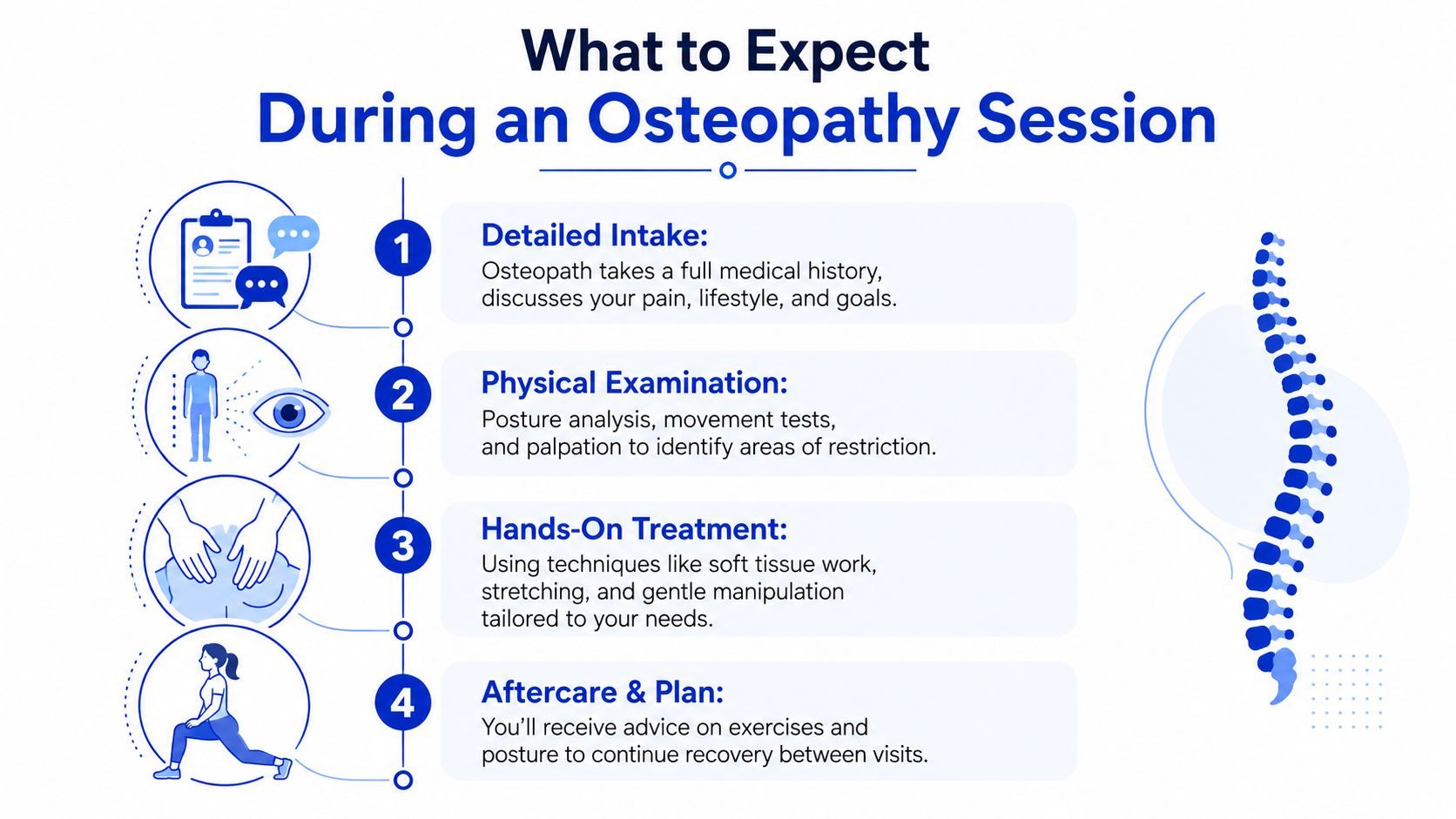
Four parts of the appointment
History and goals: You'll discuss the pain pattern, aggravating activities, relevant diagnoses, medication, previous imaging, and what improvement would look like in everyday life.
Physical assessment: The osteopath may observe posture, test active movement, compare sides, assess balance or loading, and use gentle palpation to identify areas of tension or restriction. The examination should remain relevant to your complaint rather than becoming a general search for abnormalities.
Hands-on treatment: Depending on the findings, treatment may include soft-tissue work, stretching, joint articulation, or gentle mobilisation. The osteopath should explain the technique and check your comfort throughout. You can ask for less pressure, a different position, or a pause at any time.
Plan and aftercare: The appointment closes with practical advice, such as a simple movement routine, a workstation adjustment, pacing guidance, or a position that reduces strain. The plan should be realistic enough to use between visits.
First appointments at the clinic typically allow 45 to 60 minutes for assessment and treatment, while follow-up visits are typically 30 minutes. Those durations are clinic-specific rather than a universal rule, so confirm them when booking.
The response after treatment matters. Mild, temporary soreness can occur after hands-on care, but escalating pain, new neurological symptoms, or feeling unwell should be reported promptly. Your feedback helps the practitioner adjust the next session rather than repeating a protocol that doesn't suit you.
Safety, Arthritis, and Self-Care Between Visits
Osteopathy is non-invasive and generally low risk when provided by a registered practitioner who has taken an appropriate history and examination. Safety depends less on a label such as “gentle” and more on whether the technique matches your health, tissue sensitivity, medications, bone health, and current symptoms.
Older adults and people with osteoarthritis or osteoporosis may still be suitable for care, but the approach needs to change. An osteopath may use slower articulation, supported positioning, and comfortable-range mobilisation instead of forceful manipulation. Arthritic joints aren't “put back in place”. The practical goal is to preserve useful movement, reduce surrounding muscle guarding, and help you remain active without provoking a flare.
What you can do between appointments
Move within tolerance: Short, regular walks or prescribed mobility exercises may be more useful than complete rest. The right amount depends on your symptoms and medical context.
Use heat or cold thoughtfully: Heat can feel soothing for stiffness, while cold may be comfortable during some flare-ups. Protect your skin and stop if either option worsens symptoms.
Adjust the environment: Change desk height, screen position, driving posture, or the frequency of movement breaks. A perfect posture held rigidly all day can still be tiring, so variety matters.
Pace your workload: Alternate heavier and lighter tasks instead of testing a recovering area with one large burst of activity. Increase demand gradually as confidence and tolerance improve.
Protect sleep and recovery: Consistent sleep routines and stress-management strategies can influence how strongly the nervous system responds to pain. They're not a cure, but they support the capacity to recover.
Listen to the response: If you're more sore than expected after a session, tell your osteopath. A change in pressure, technique, timing, or exercise load may make the next appointment more productive.
Osteopathy doesn't replace medication review, medical treatment, strength training, or psychological support when those services are appropriate. Its value is greatest when manual care helps you participate in the broader plan. For people managing stiff or painful joints, this arthritis and joint mobility guide is a useful reminder that daily movement remains part of care.
Medicare, Costs, and Booking at Bayside Osteopathic Health
Medicare access to osteopathy depends on eligibility and referral. In 2025 and 2026, eligible patients generally need a GP referral under a Chronic Disease Management plan, commonly called a CDM plan. The plan may provide up to five subsidised allied health visits per calendar year, shared across eligible services. It does not automatically provide five osteopathy appointments.
The Medicare Benefits Schedule lists osteopathy under item 81350, with a fee of $72.65 and an 85% benefit of $61.80 for face-to-face services from 1 July 2025 (MBS item 81350). The rebate is only part of the payment. Your clinic fee, item claimed, referral details, and the clinic's gap policy determine your out-of-pocket cost.
| Consultation type | Clinic fee | Medicare rebate, CDM | Estimated gap |
|---|---|---|---|
| Initial assessment | Confirm with clinic | Up to the applicable MBS benefit | Clinic fee minus rebate |
| Standard consultation | Confirm with clinic | Up to the applicable MBS benefit | Clinic fee minus rebate |
Ask Bayside Osteopathic Health to confirm current fees before booking. The MBS benefit does not set every provider's charge. Private health insurance may also contribute when osteopathy is included in your extras cover, subject to your fund's limits and eligibility rules.
Booking steps
- Speak with your GP: Ask whether a CDM referral suits your condition and confirm which allied health services are included.
- Contact the clinic: Book by phone or through the clinic's online system. State whether you are using Medicare, private health cover, or self-funding.
- Prepare your information: Have referral details, your private health fund membership number if relevant, imaging reports, medication information, and a brief treatment history ready.
- Confirm the account: Before treatment, ask about the consultation fee, expected rebate, payment method, and likely gap.
Persistent or activity-limiting symptoms warrant a GP discussion, particularly if you are unsure whether osteopathy is appropriate.
Bayside Osteopathic Health provides assessment, hands-on treatment, movement advice, and self-care guidance for back, neck, joint, and arthritis-related concerns. Before booking, contact the clinic by phone or online, ask staff to check your Medicare or private health pathway, and confirm the current consultation fee.