
You wake, roll towards the edge of the bed, and notice that your hips, knees or shoulders don't move as freely as they did yesterday. The first few steps feel awkward. Stairs seem harder, reaching into a high cupboard feels restricted, and you may wonder whether this is just ageing or a sign that something needs attention.
Joint stiffness and pain are common, but they aren't interchangeable sensations. Stiffness describes difficulty moving. Pain describes an unpleasant response to irritation, strain or possible tissue damage. Reading the difference, and noticing what makes each symptom better or worse, can help you choose sensible next steps instead of guessing.
Table of Contents
- When Your Body Feels Stiff but You Cannot Explain Why
- Stiffness Versus Pain and What Each Pattern Means
- How an Osteopath Assesses Stiffness and Pain
- Evidence-Based Ways to Reduce Stiffness Without Medication
- A Simple Weekly Mobility Plan You Can Start This Week
- Warning Signs That Need a Medical Review
- Finding the Right Care in Bayside and Accessing It
When Your Body Feels Stiff but You Cannot Explain Why
You stand after a long drive and your knees feel rusty. After a night on the sofa, your shoulder may resist reaching overhead. A joint can feel tight, blocked or slow to start, while pain may be dull and deep, sharp with one movement, hot and irritated, or sore after unusual effort.
These sensations offer different clues. Stiffness is mainly a movement signal, showing that a joint or surrounding tissues are not moving freely. Pain is mainly a sensitivity or protection signal, warning that the body is responding to irritation, strain or possible tissue stress. They often overlap, but not always. A hip may feel restricted without hurting, while a wrist may move normally yet hurt when you grip.
Practical rule: Judge the whole pattern, not only the first few seconds. Notice what happens after gentle movement, during activity and later that day.
A stiff joint after gardening, an unfamiliar gym session, a long drive or an awkward night may have a clear short-term explanation. The useful question is whether it settles or keeps returning. Stiffness that gradually changes your walking, grip, sleep, work or willingness to exercise deserves attention, even when pain is mild.
Age also provides context, but it does not explain every symptom. Activity-related pain with short-lived morning stiffness can fit an age-related osteoarthritis pattern, as described in the AIHW osteoarthritis overview. That pattern is a starting clue, not a diagnosis. Longer morning stiffness, visible swelling or symptoms in several joints can point in a different direction and should be assessed rather than dismissed as ordinary ageing.
Start by recording the pattern
For several days, write down four details:
- When it starts: Is it worst on waking, after sitting, during movement or later in the day?
- How long it lasts: Does it ease quickly, or remain noticeable through much of the morning?
- What changes it: Does gentle activity loosen it, or does activity reliably increase symptoms?
- What you can see or feel: Note swelling, warmth, redness, clicking, locking or giving way.
A short phone note can show a pattern that one difficult day hides. You might find that your knee tolerates level walking but reacts to stairs, or that both hands feel stiff in the morning and evening. Those details help a GP, physiotherapist or osteopath decide which questions to ask and whether the pattern seems more mechanical, inflammatory or age-related.
Your working position may contribute too. Review this posture and corporate ergonomics illustration as a visual prompt for considering how sitting, reaching and repeated tasks fit your symptoms. It cannot diagnose the cause, but it can help connect daily habits with what you feel.

Stiffness Versus Pain and What Each Pattern Means
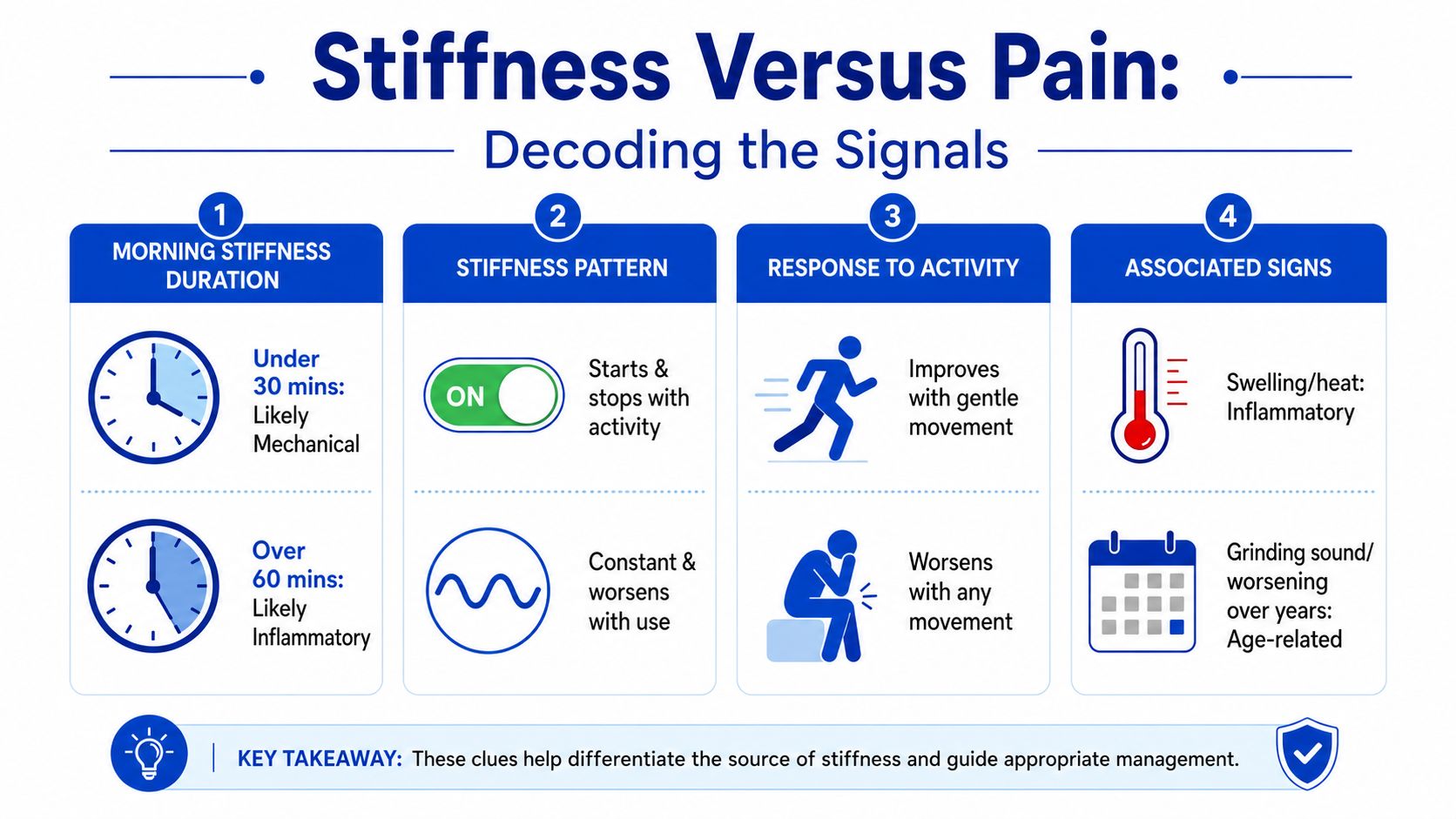
The same word, “stiffness”, can describe very different experiences. Four clues help you read the pattern: how long morning stiffness lasts, how symptoms respond to activity and rest, whether the joint is swollen or warm, and how many joints are involved. These clues cannot diagnose the cause, but they can help distinguish a likely mechanical, inflammatory or age-related process before you arrange care.
Morning stiffness duration
Stiffness that settles within 30 minutes is commonly associated with a mechanical osteoarthritis pattern, especially when discomfort follows activity. Australian guidance describes early-morning stiffness lasting less than 30 minutes. The RACGP also advises that symptom severity should guide management, rather than relying on a label or scan alone.
Stiffness that continues much longer, particularly with swelling or pain in several joints, raises more concern about inflammation. One time threshold cannot confirm a diagnosis. Duration becomes more useful when read alongside the other clues.
Activity response
A mechanical joint may feel restricted after rest, then loosen with controlled movement. A knee that aches after running, climbing stairs or standing for a long time fits this pattern more closely than one that hurts at rest while becoming increasingly swollen.
Inflammatory symptoms can remain active during rest and may become more irritable with use. Activity response is a direction of travel, not a guaranteed test. Some mechanical pain worsens with movement, while some inflammatory symptoms ease briefly once the joint is moving.
Swelling and heat
Visible swelling, warmth, redness or ongoing puffiness deserves attention. Compare the joint with the other side if possible. A noticeable difference can reflect inflammation, injury or another process that needs medical assessment.
Number and symmetry of joints
A single joint affected after a clear twist, fall or change in training may suggest a local injury. Stiffness in several joints, especially a matching pattern such as both hands, calls for different questions. Rheumatoid arthritis affected about 514,000 Australians, or 2.0%, in 2022, according to the Australian Institute of Health and Welfare arthritis data.
Age adds context, but it does not explain every new symptom. Arthritis affected an estimated just under 3.7 million Australians, or 14.5% of the population, in 2022, with prevalence highest among people aged 75 and over at 48.9%, according to Australian Bureau of Statistics arthritis data. These figures show why age-related change is common, not why a new or worsening problem should be dismissed as inevitable.
How an Osteopath Assesses Stiffness and Pain
An osteopathic assessment starts with your story, not with a collection of forceful techniques. The aim is to understand what changed, what your body can do now, and which loads or movements reproduce the problem.
The conversation comes first
You may be asked when the symptoms began, whether there was an injury, what your mornings feel like, and whether walking, work, sleep or exercise changes the symptoms. Your practitioner may also ask about previous episodes, general health, medications and what you want to return to. Saying “I want to climb the stairs without bracing myself” is more useful than saying “my knee is stiff”.
The history also helps identify when an osteopathic assessment isn't the right first step. Hot swelling, systemic symptoms, significant trauma or neurological changes can require medical review.
Movement shows the strategy your body has adopted
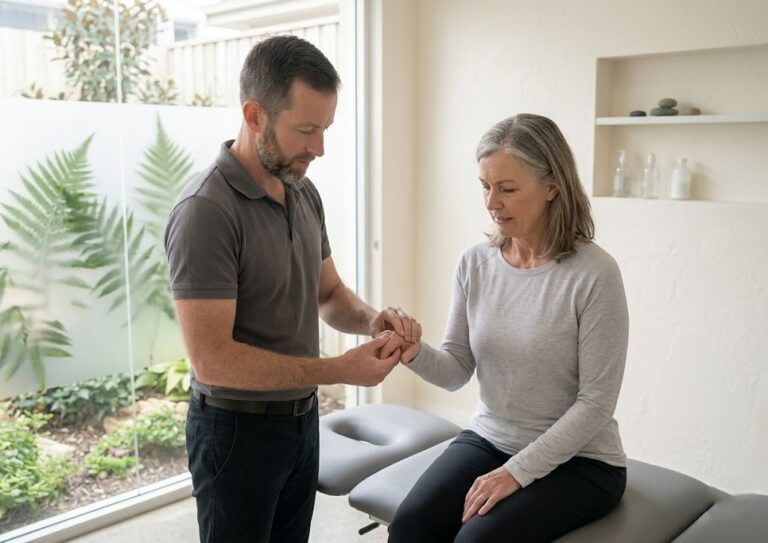
The practitioner may watch you walk, squat, reach, turn or rise from a chair. They may compare sides and assess how far a joint moves comfortably, rather than pushing straight into a painful limit.
A restricted ankle can alter a squat. A guarded hip can change the way you load your knee. This doesn't prove that a distant area caused your pain, but it can show where your body is compensating.
Hands-on assessment adds information
Gentle palpation helps assess muscle tone, tenderness, joint motion and the texture of surrounding tissues. The osteopath may compare the painful area with nearby regions and ask you to describe what you feel throughout the process.
Common techniques can include joint articulation, soft-tissue release, muscle energy technique and gentle joint mobilisation. The choice depends on your symptoms, comfort, medical history and the movement goal you identified together.
You can see an example of the broader osteopathic assessment approach.
Assessment is collaborative
You don't need to lie passively on a treatment table and hope someone finds the answer. Tell the practitioner when a movement feels familiar, when pressure feels too much, and what activity you need to manage afterwards. A useful session should leave you with a clearer explanation, practical movement options and guidance about when to seek further medical care.
Evidence-Based Ways to Reduce Stiffness Without Medication
Waiting until pain becomes severe can make movement feel more threatening and daily tasks harder to rebuild. The Australian osteoarthritis research-priorities process identified 90 ranked knowledge gaps across prevention, symptom control and care pathways, reinforcing that people still need clearer answers about what to do early, not only what to do after function has declined. You can read the full Australian osteoarthritis research-priorities paper.
The most sensible approach is usually gradual and specific. You don't need to choose between doing nothing and launching into an intense exercise programme.
Match the strategy to the response
- Graded exercise: Start with a movement that feels manageable, such as walking, cycling, water exercise or controlled strengthening. Increase time before intensity, and avoid treating soreness as proof that the joint has been damaged.
- Hands-on care: An osteopath can help with movement restrictions, muscle guarding and load planning. Manual treatment works best when it supports your own movement practice rather than replacing it.
- Heat before movement: Warmth can make a stiff area feel easier to move, particularly before gentle mobility. Use a comfortable temperature and stop if your skin becomes irritated.
- Cold after aggravation: Cold may feel useful after an activity that leaves a joint sore or puffy. Protect the skin and avoid prolonged application.
- Sleep positioning: Use pillows or a comfortable supported position to reduce twisting and sustained pressure. The right position is the one that lets you change posture naturally rather than holding one rigid shape.
- Weight management: Excess body weight can amplify symptoms in weight-bearing joints. Australian research found that people with obesity and hip or knee arthritis reported more pain, stiffness, functional difficulty and poorer health-related quality of life than non-obese peers, as reported in this Australian study of weight and hip or knee arthritis.
A single strategy rarely solves a long-standing movement problem. Combining a tolerable mobility routine with sensible load management and targeted professional support is more practical than repeatedly resting until symptoms settle, then returning abruptly to the same demand.
A short video can help you visualise gentle movement ideas:
For another visual reference, see this arthritis joint mobility illustration.
A Simple Weekly Mobility Plan You Can Start This Week
A useful plan should be easy enough to repeat on an ordinary week, including days when your joints feel less cooperative. Treat the schedule below as a starting template, not a prescription. If one movement reproduces sharp pain, swelling or a familiar injury symptom, stop and ask for individual guidance.
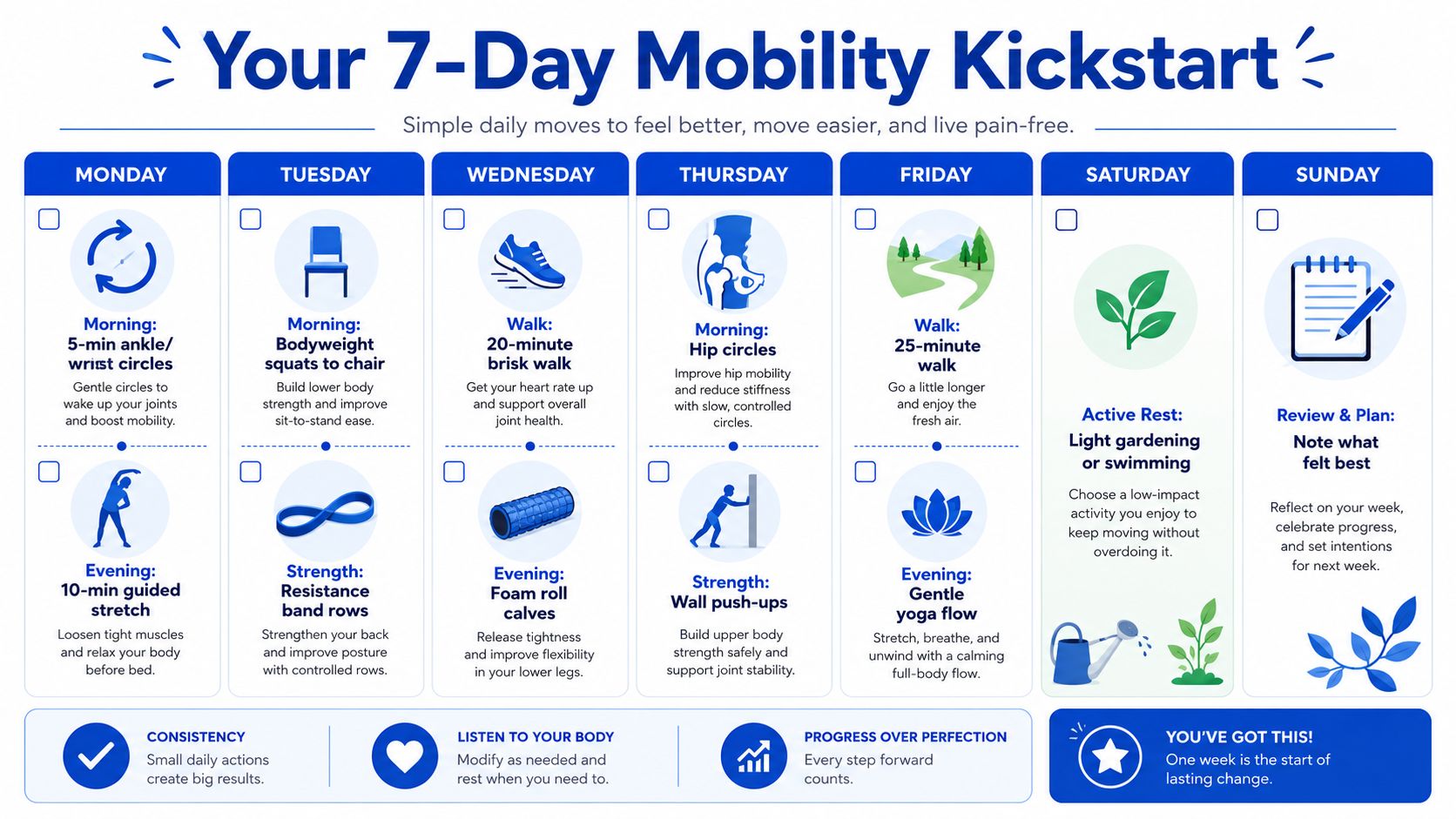
The seven-day template
Monday: Begin with ankle and wrist circles for about five minutes. In the evening, complete a gentle ten-minute stretch, keeping the movements smooth rather than forcing range.
Tuesday: Practise bodyweight squats to a chair, using the chair as a depth and balance guide. Add resistance-band rows if they feel comfortable, keeping the effort controlled and your shoulders relaxed.
Wednesday: Take a brisk walk at a pace that still allows you to speak comfortably. Finish with gentle calf rolling if it feels soothing, not painful.
Thursday: Use hip circles within an easy range, then add wall push-ups. Keep your hands at a height that lets you maintain a steady trunk and avoid shoulder pinching.
Friday: Take a slightly longer walk than Wednesday if your symptoms have remained settled. A gentle yoga flow in the evening can provide a calm transition into rest.
Saturday: Choose active rest, such as light gardening or swimming. Break gardening into manageable tasks and change position regularly instead of staying bent for a long period.
Sunday: Review the week. Write down which movements felt helpful, which activities caused a flare, and what you could repeat without feeling apprehensive.
Adjust the load, not your confidence
On a flare day, reduce the range, slow the pace or shorten the session. Add minutes before adding resistance, speed or complexity. A plan that feels almost too easy but gets repeated is more useful than an ambitious routine you abandon after one difficult session.
Warning Signs That Need a Medical Review
Many mechanical symptoms respond to conservative care, but some features should move you towards a GP or specialist rather than self-management alone. The Australian Bureau of Statistics reported that 93.9% of adults with arthritis experienced bodily pain in the previous four weeks, including moderate, severe or very severe pain categories, so pain itself is common. Its intensity, pattern and associated signs determine how urgently you need help, as shown in the ABS Health Conditions Prevalence release.
Use the pattern, not panic
Book a prompt medical review if a joint is hot, visibly inflamed or persistently swollen. A swollen joint may reflect inflammatory arthritis, infection or injury, and early assessment can help determine which tests or treatment are appropriate.
Morning stiffness lasting more than an hour, especially across several joints, also deserves GP review. Unexplained weight loss alongside joint pain is another reason not to assume that the symptoms are age-related.
Seek assessment after trauma if pain is substantial, the joint looks deformed, or you can't use the limb normally. Locking or giving way may indicate a structural problem, while numbness and tingling can point towards nerve involvement rather than a joint-only issue.
| Sign or symptom | Likely conservative care | See GP promptly |
|---|---|---|
| Brief stiffness after rest that eases with gentle movement | Gradual mobility, load adjustment and monitoring | If the pattern keeps worsening or limits ordinary tasks |
| Soreness after a clear increase in gardening, training or walking | Reduce the load, use comfortable movement and arrange care if it doesn't settle | If pain follows a significant fall, twist or impact |
| Persistent swelling, warmth or redness | Don't rely on self-care alone | Arrange medical review |
| Stiffness lasting more than an hour in the morning | Record the pattern and avoid forcing the joint | Arrange medical review, particularly with multiple affected joints |
| Occasional clicking without pain or loss of function | Monitor and maintain comfortable movement | If the joint locks, gives way or becomes difficult to use |
| Tingling, numbness or weakness | Stop aggravating activities and seek advice | Arrange medical review because nerves may be involved |
Osteopathic care can continue alongside medical treatment when appropriate, but it shouldn't replace a GP review when red flags appear. If you're unsure, describe the symptom to your medical practice and ask how quickly you should be seen.
Finding the Right Care in Bayside and Accessing It
The pattern you have been tracking can guide your first choice of care. Stiffness that lasts briefly and eases with gentle activity may suit a cautious self-management trial, provided no warning signs are present. Symptoms that return with a particular movement or increase in load may benefit from an osteopathic or physiotherapy assessment. Swelling, prolonged morning stiffness, symptoms in several areas, or changes you cannot explain should be discussed with a GP first.
An initial osteopathic appointment generally includes a detailed history, movement screening, and hands-on assessment. The practitioner should explain what they find, identify activities you can continue, and outline a plan for building comfortable movement. Bayside Osteopathic Health provides hands-on osteopathic care, including soft-tissue work, joint articulation, mobilisation, and movement coaching for people managing joint stiffness, postural strain, or arthritis-related discomfort.
Paying for allied health care
Private fees differ between clinics and practitioners. Ask for the current consultation fee when booking. If you have Extras cover, your private health insurer may offer a rebate for eligible osteopathic services, subject to your policy and annual limits. Many Bayside clinics also provide on-site HICAPS claiming, so eligible health-fund claims can be processed during the appointment.
A GP may decide that you qualify for a Chronic Disease Management plan, previously called an Enhanced Primary Care plan. Eligible patients can access up to five Medicare-rebated allied health visits per year, according to Services Australia's Chronic Disease Management information. Ask your GP whether the plan fits your circumstances, then confirm the rebate and expected out-of-pocket cost with the clinic before attending.
Common questions
How much does a session cost?
There is no single fee. Clinics set their own prices, while rebates depend on your Extras policy or Medicare eligibility. Ask for both the consultation fee and expected rebate before booking.
What should I wear?
Choose comfortable clothing that allows you to walk, bend, and move the affected area. You may need to expose part of the region being assessed, so practical, non-restrictive clothing is useful.
How many visits will I need?
The answer depends on how long symptoms have been present, your movement goals, your response to treatment, and whether a medical condition is involved. A useful plan should include home movement and clear review points, rather than appointments continuing without a defined purpose.
If stiffness is changing how you walk, work, sleep, or exercise, write down the four pattern clues from this article and take them to your appointment. Visit Bayside Osteopathic Health to discuss joint stiffness and pain, receive an individual movement assessment, and develop a practical plan for more comfortable activity in Bayside.