
You've finished another long day at a Bayside desk. Your shoulders have crept towards your ears, your jaw feels tight, and turning your head while reversing the car takes more effort than it should. A foam roller or massage ball can feel appealing, but the useful question isn't whether myofascial release techniques feel good. It's which technique suits your symptoms, how much pressure is appropriate, and when hands-on self-care should give way to professional assessment.
Myofascial release works best as a layered toolkit. Used thoughtfully, it can help you explore short-term changes in tension, movement and comfort. Used aggressively, or treated as a cure for every form of persistent pain, it can irritate already sensitive tissues and delay the care you need.
Table of Contents
- What Myofascial Release Actually Is and Why It Helps
- Benefits and Honest Limits of Myofascial Release Techniques
- Step-by-Step Myofascial Release Techniques You Can Use Today
- Progressions and Modifications for Different Bodies
- Red Flags, Contraindications, and When to See an Osteopath
- Building a Simple Myofascial Self-Care Routine
What Myofascial Release Actually Is and Why It Helps
A practical fascia primer
Fascia is a continuous web of connective tissue that wraps around and links muscles, bones, nerves and other structures. You don't need to memorise its anatomy to use myofascial release effectively. Think of it as a sliding support layer that helps tissues move in relation to one another.
When an area is affected by prolonged sitting, repetitive loading, injury or general lack of movement, the tissues may feel less mobile. You might notice stiffness, a pulling sensation or discomfort that seems to spread beyond the exact spot you first noticed. That doesn't mean fascia is always the sole cause. Pain is influenced by joints, muscles, nerves, sleep, stress, training load and your broader health.
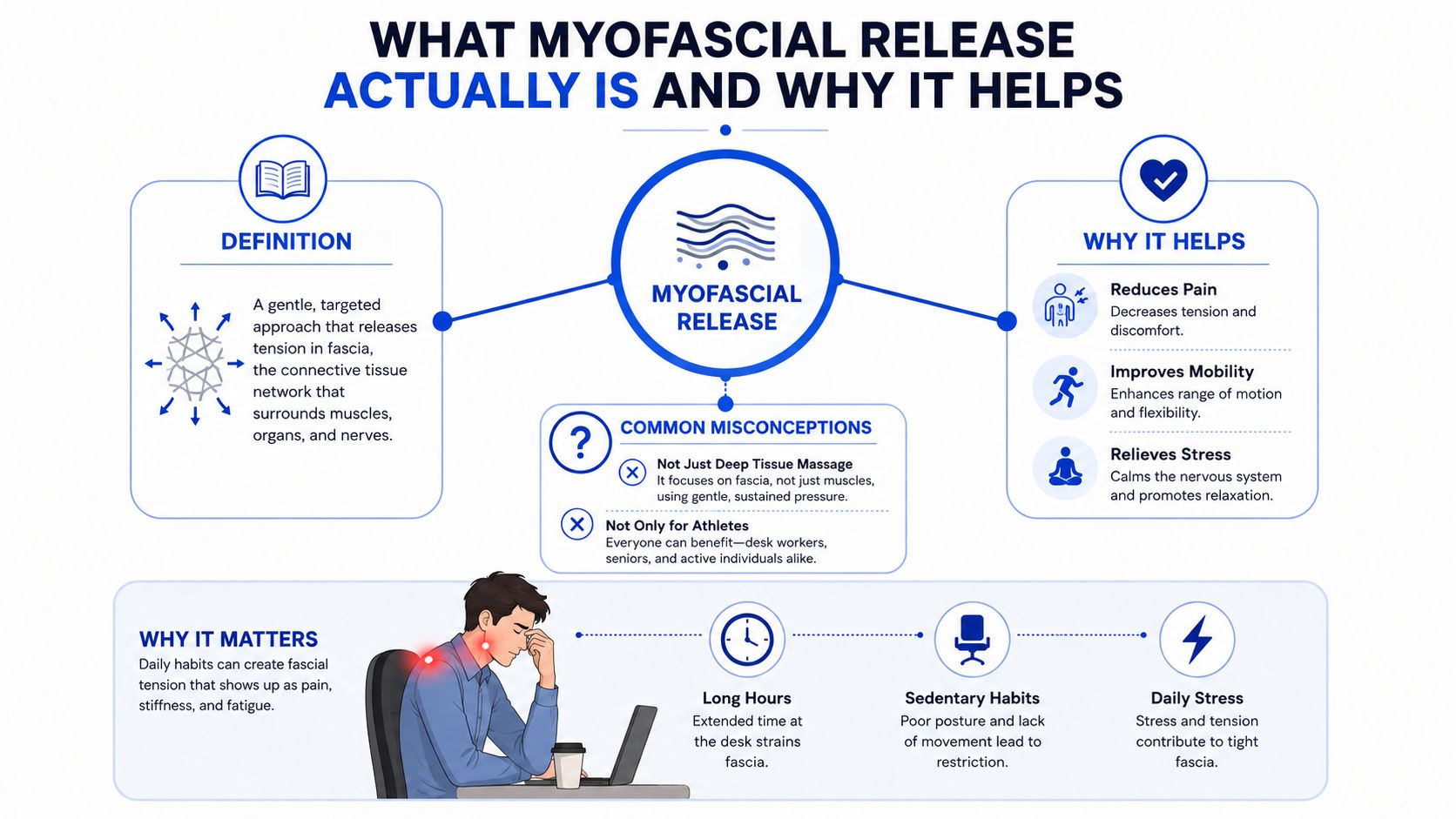
Myofascial release techniques generally use sustained pressure, gentle traction or slow shear over an area that feels restricted. Rather than repeatedly rubbing across the muscle, you stay with a contact and allow the sensation to change. The aim is to encourage easier movement and a calmer response from the body, not to force tissue into submission.
A quick massage usually uses rhythmic strokes, kneading or broader compression. Myofascial release feels more patient. The pressure is often gentler than people expect, the contact lasts longer, and the practitioner watches for a change in tissue resistance, breathing or movement.
How it should feel
A useful home technique usually produces a dull, tolerable ache that gradually softens. You may feel warmth, easier breathing or a sense that the area is less guarded. Sharp pain, electric sensations, numbness, pins and needles or pain that spreads along a limb are different signals. Stop rather than trying to push through them.
A useful visual guide for desk-related strain is this posture and corporate ergonomics resource. It's a reminder that tissue work may change how you feel for a while, but your chair, screen position, workload and movement breaks still influence what happens next.
Practical rule: If you have to brace, hold your breath or grit your teeth, reduce the pressure. A release should make movement feel more available, not make you feel attacked by the tool.
Benefits and Honest Limits of Myofascial Release Techniques
Myofascial release techniques have a place, but the effect depends on the problem you're trying to solve. A brief change in range of movement after foam rolling may be useful before exercise. Relief from post-exercise tenderness may help you return to comfortable movement. Neither result proves that a single technique has corrected the underlying cause of recurring pain.
The strongest Australian-context evidence in this brief concerns chronic low back pain. A 2021 meta-analysis pooled eight randomised trials involving 375 participants and found statistically significant improvements in pain and physical function compared with control, with standardised mean differences of -0.37 for pain and -0.43 for physical function. The evidence was rated moderate for those outcomes, while balance, trunk mobility, pain pressure threshold, mental health and quality of life had low to very low certainty, as reported in the Frontiers in Medicine meta-analysis.
That distinction matters. A technique may help one outcome without improving every aspect of your health. A separate PEDro evidence record also describes the findings as outcome-specific, which supports using soft-tissue work, then reassessing function rather than assuming broad whole-person change.
| Outcome | Evidence strength | Typical effect |
|---|---|---|
| Pain in chronic low back pain | Moderate for the reviewed outcome | Statistically significant improvement |
| Physical function in chronic low back pain | Moderate for the reviewed outcome | Statistically significant improvement |
| Balance and trunk mobility | Low to very low certainty | No consistent significant improvement |
| Mental health and quality of life | Low to very low certainty | No reliable broad benefit established |
| Persistent, complex musculoskeletal pain | Insufficient as a stand-alone treatment | Use as part of a broader plan |
The historical picture is cautious. A 2018 systematic review of chronic musculoskeletal pain identified only eight relevant trials from 513 records and concluded that the evidence wasn't sufficient to warrant myofascial release as a treatment for chronic musculoskeletal pain. That doesn't mean the method is useless. It means your plan should match the evidence, your goals and your response.
For acute soreness, postural tension and short-term mobility work, self-release can be a reasonable experiment. For persistent pain, arthritis-related stiffness or repeated flare-ups, it's rarely a complete solution. Exercise, education, sleep support, load management and an accurate assessment may matter more than finding a harder ball.
Step-by-Step Myofascial Release Techniques You Can Use Today
Start with one area, not your entire body. Use slow breathing and keep the pressure low enough that you can relax around the contact. The following techniques are practical options, but they aren't appropriate over an injury, wound, swelling or unexplained painful area.
1. Sustained upper trapezius pressure
Sit in a supported chair with both feet on the floor. Use the opposite hand to find a tender area in the upper trapezius, the fleshy part between the neck and shoulder, then apply pressure with your thumb or knuckle.
Aim for a tolerable sensation rather than maximum intensity. If the discomfort starts around 7/10, reduce pressure until it sits closer to a manageable 4/10, breathe normally and hold for 30 to 90 seconds. The point should gradually feel less prominent. Don't press directly onto the neck, collarbone or the top of the spine.
2. Thoracic extension on a foam roller
Lie on your back with your knees bent and feet supported. Place a foam roller across the mid-back, not under the low back or neck, and cross your arms over your chest.
Make small, slow rolls, taking roughly 3 to 5 seconds for each movement. Pause where the mid-back feels stiff and allow your ribs to move as you breathe. You're looking for easier extension through the upper back, not a painful rolling sensation over the spine or shoulder blades.
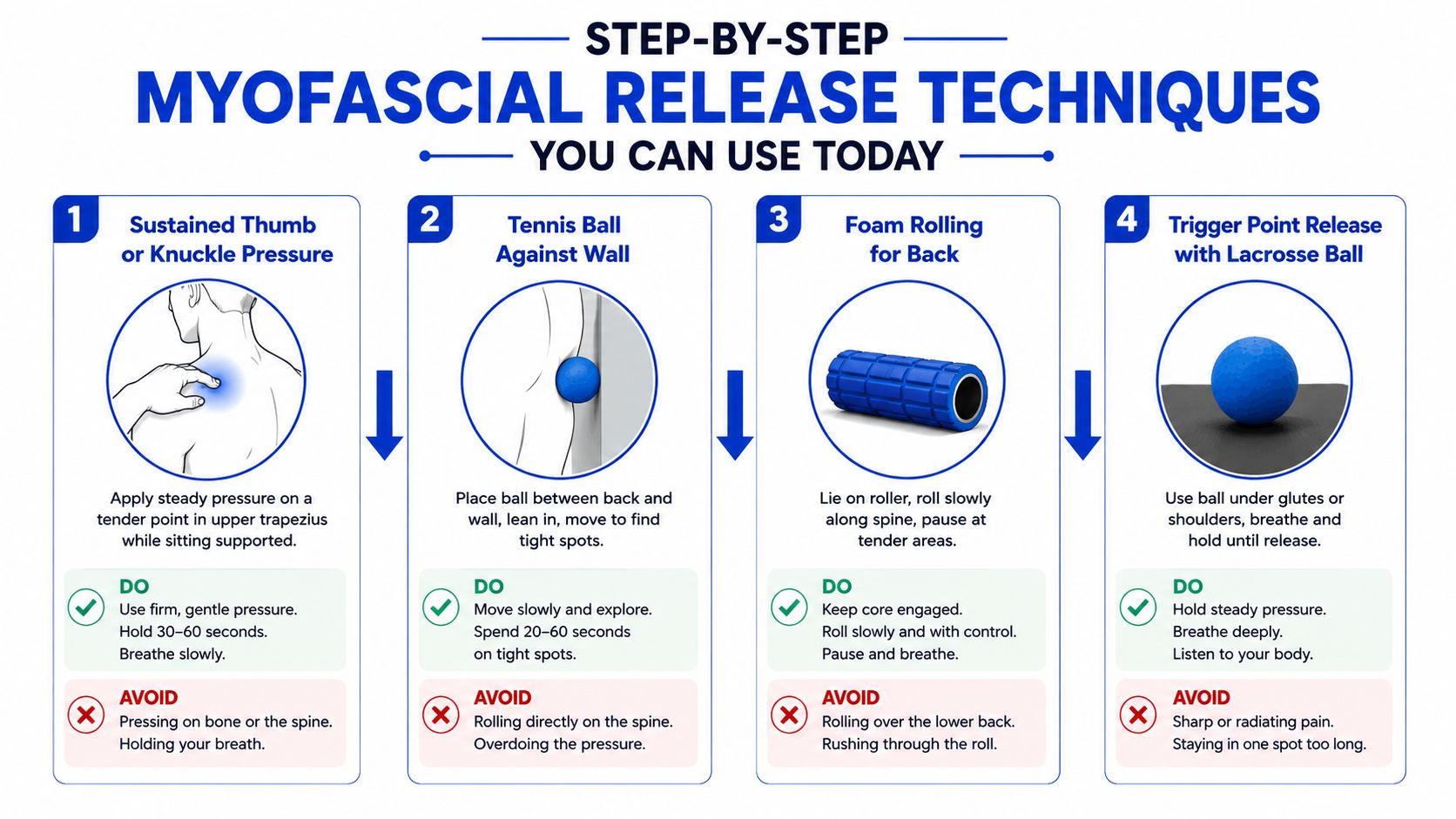
3. Gluteal ball work against a wall
Place a tennis ball or lacrosse ball between your gluteus medius area and a wall. This gives you more control than lying on the ball, because you can shift weight through your legs.
Move in small circles until you find a tender spot, then stay there for 20 to 60 seconds. Keep the sensation broad and dull. Stop if it becomes sharp, shoots down the leg or causes tingling. Don't place the ball directly over the tailbone, hip bone or a painful joint.
4. Gentle skin rolling on the outer thigh
Sit or lie comfortably and use the pads of your fingers to gently lift and roll the skin along the outer thigh. Work over a small area rather than dragging forcefully from the hip to the knee.
This is a superficial technique, so it shouldn't feel like deep pressure. Use it to explore how the skin and surface tissues move, particularly when firmer tools feel too intense. Redness can occur, but bruising, burning or lasting tenderness means you've used too much force.
A targeted remedial massage and muscle therapy visual can help you compare self-care with clinician-guided soft-tissue work. For another demonstration, watch the embedded video below, then keep the pressure more conservative than the most intense technique shown.
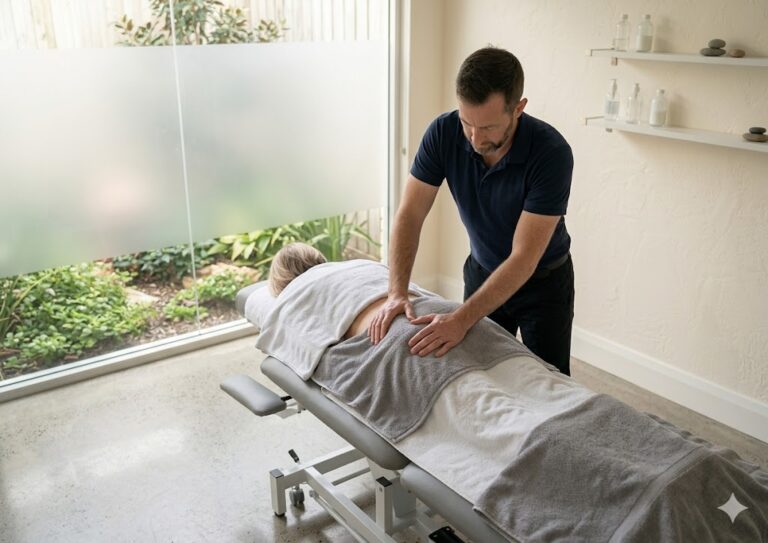
After any technique, stand up and test a relevant movement. Turn your head, walk around or raise your arms. If movement is easier and the area feels settled, that's a useful response. If you feel bruised or more guarded, treat that as feedback to reduce the intensity or stop.
Progressions and Modifications for Different Bodies
The right progression isn't “more pain equals more benefit”. It's more control with an appropriate dose. Begin with a method that lets you breathe, adjust your body weight and stop immediately.
Beginner options
Choose a low-density foam roller, a tennis ball rather than a lacrosse ball, or wall-supported work instead of floor-based pressure. Use a bench, chair or your hands to reduce body weight through the contact point. Keep holds brief, around 20 to 30 seconds, and reassess your movement immediately afterwards.
For upper trapezius work, use a broad thumb contact rather than a pointed knuckle. For the thoracic spine, place the roller higher and use only small movements. If getting down to the floor is difficult, perform the gluteal ball technique against a wall.
For regular users
If the beginner version feels comfortable and produces a useful movement change, you can try a firmer roller or lacrosse ball. Extend a hold towards 60 to 90 seconds only when the sensation remains dull and manageable.
Add gentle active movement rather than increasing pressure. For example, use small arm movements while the upper back rests over the roller, or perform ankle pumps while a calf or gluteal area is supported. Active movement can help you test whether the change transfers into a task.
Arthritis and chronic stiffness
People with arthritis, joint replacements, osteopenia or generally sensitive tissues should avoid treating bony prominences as targets. Use softer tools, lower pressure and joint-sparing positions. A wall is often safer and easier to control than lying heavily on a ball.
Avoid forcing a joint into an end position while applying pressure. If a region is hot, swollen or in an inflammatory flare, don't try to “break through” it with a roller.
Good progression feels like: warmth, easier breathing and a softening or melting sensation. It shouldn't produce guarding, sharp pain or symptoms that linger and interfere with ordinary movement.
Red Flags, Contraindications, and When to See an Osteopath
Self-treatment is reasonable only when you have a familiar, stable pattern and no warning signs. Don't use myofascial release techniques over an acute fracture, open wound, active infection, deep vein thrombosis, recent surgery in the target area, suspected tumour or undiagnosed mass. These situations need medical guidance, not pressure from a ball or roller.
Some conditions call for clearance or substantial modification. Osteoporosis, inflammatory arthritis flares, pregnancy, a hernia near the treatment site, advanced diabetes with neuropathy and anticoagulant medication can all change how pressure should be applied. A clinician can help you choose a safer position, avoid vulnerable structures and decide whether hands-on care is appropriate.
The National Pain Report 2025 summary reports that 54% of Australian respondents waited more than two years for a diagnosis and 44% waited over three years. That prolonged delay means many people arrive at hands-on care with deconditioning, uncertainty and a complicated symptom history. Your assessment should account for that context rather than reducing every symptom to “tight fascia”.
Use this decision check
- Self-manage cautiously: The discomfort is familiar, mild to moderate, localised, and improves or settles with gentle movement and low-pressure work.
- Modify or seek clearance: You have arthritis, reduced bone density, pregnancy, neuropathy, anticoagulant use, a joint replacement or a recent procedure.
- Book an assessment: Pain persists beyond two weeks, keeps returning, or hasn't improved with sensible self-care.
- Seek prompt medical review: You have numbness, tingling, weakness, bowel or bladder changes, unexplained severe pain, night pain that disrupts sleep, fever or unexplained weight loss.
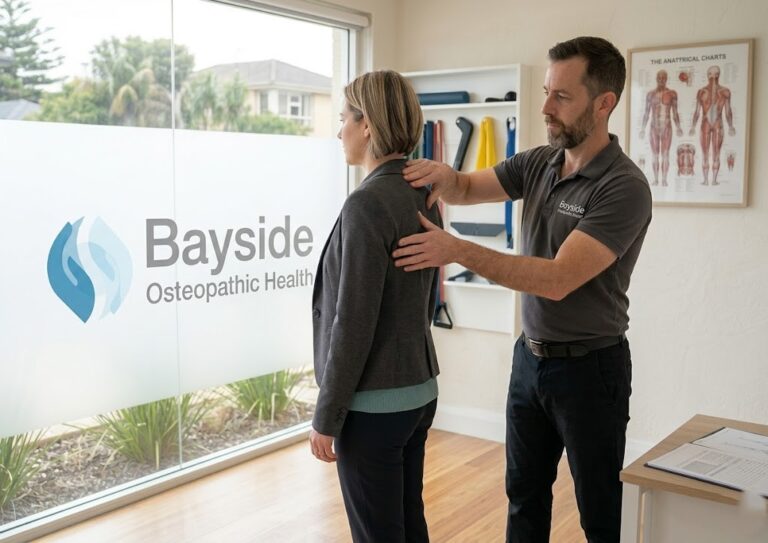
An osteopathic consultation is particularly useful when you can't identify what is driving the restriction, when several areas compensate for one another, or when a technique helps briefly but your usual activities bring the symptoms straight back. A practitioner can assess movement, screen for issues that shouldn't be self-treated and combine soft-tissue work with joint articulation, gentle mobilisation and movement advice. This spine and shoulder assessment image reflects the broader clinical context that a tool alone can't provide.

Building a Simple Myofascial Self-Care Routine
A routine works when it fits your day. Set a 10-minute daily minimum and choose one or two areas, such as the upper back and gluteal region. Do it after a shower, following a walk or before bed, when you're less likely to turn self-care into another task you postpone.
Add a longer session two to three times each week if your body responds well. Spend roughly 20 to 25 minutes combining foam-roller work, one ball technique and easy movement. Keep the session exploratory. You don't need to work through every tender spot or finish feeling sore.
Pair the techniques with habits that help you keep the change:
- Breathe slowly: Spend five minutes using relaxed nasal breathing, without forcing deep breaths.
- Move gently: Walk, perform an easy mobility circuit or change positions regularly after desk work.
- Support ordinary recovery: Drink to thirst, sleep as well as you can and avoid using release work to compensate for an excessive training or work load.
Track function instead of chasing a perfect pain score. Note your sleep quality, morning stiffness, ease of turning your head, comfort at your desk or ability to walk. If those markers don't improve, or if symptoms become more widespread, change the plan and arrange an assessment.
Myofascial release techniques can be one useful layer within care. They're less reliable as a stand-alone answer for complex chronic pain, and they should never replace assessment when warning signs are present.
Bayside Osteopathic Health offers osteopathic assessment, gentle soft-tissue work, joint articulation, movement advice and practical home strategies for persistent back, neck, joint and posture-related discomfort. If you'd like your technique checked or want a plan matched to your body and goals, visit Bayside Osteopathic Health to arrange an appointment.