

Serious harm from osteopathic treatment is uncommon but not impossible. Australian evidence includes an estimated one adverse effect per 50,000 high-velocity thrust procedures, while a national survey found 4 adverse events among 51 osteopathy users, all described as minor symptoms such as increased pain, soreness, tiredness or neck cracking (Australian evidence summary, Australian population survey). The practical question is whether what you feel afterwards is mild, local and settling, or new, severe and getting worse.
You may be asking because you've booked an appointment, or because you've just left one with an aching back and are wondering whether treatment helped or harmed you. This guide will help you judge that situation calmly, understand what an osteopath may do, and know when to contact the practitioner, your GP or an emergency department.
Table of Contents
- Worrying About Treatment Before It Even Begins
- What an Osteopath Actually Does to Your Back
- How Often Does Osteopathic Treatment Actually Cause Harm
- Normal Soreness Versus a Real Red Flag
- How Qualified Osteopaths Reduce the Risk
- When You Should Avoid Osteopathic Treatment
- When to Seek Urgent Care After a Session
- Making a Confident Choice About Your Back Care
Worrying About Treatment Before It Even Begins
You have booked an appointment, but lie awake wondering whether treatment could crack a rib, worsen a disc problem or leave your back more painful. If chronic pain has already made movement feel unsafe, allowing someone to move the sore area can seem like a gamble.
That concern deserves a practical answer. Osteopathy covers different hands-on methods, so the force and speed used matter. Gentle mobilisation raises a different safety question from a rapid thrust that may produce a cracking sound. The treatment plan should also account for your symptoms, medical history, examination findings and comfort.
Manual spinal care is not unusual in Australia. A review in the Medical Journal of Australia reported that spinal manipulation was already common by 1996, with a one-year prevalence of 15% in the general population (Medical Journal of Australia review). That history does not make every technique appropriate for every person. It places the question within ordinary healthcare safety discussions, where suitability and warning signs matter.
Use the pattern of your symptoms as an early decision threshold:
- Mild and settling: local soreness, stiffness or tiredness that gradually eases and resembles a temporary treatment response.
- New and escalating: severe pain, progressive weakness, spreading numbness or changes in bladder or bowel function. These symptoms need prompt medical attention.
- Uncertain: symptoms that do not clearly fit either pattern. Contact the osteopath or seek medical advice instead of trying to interpret them alone.
The goal is not to promise zero risk. It is to distinguish a short-lived reaction from a change that should alter your next step, using the available Australian evidence and clear practical thresholds.
What an Osteopath Actually Does to Your Back
Osteopathy isn't one single manoeuvre. During a back appointment, an osteopath may use their hands to assess movement, reduce muscle tension, guide joints through a comfortable range and help you develop strategies for movement between visits.
The common techniques feel different:
- Soft-tissue treatment involves pressure, stretching or kneading through muscles and surrounding tissues. It may feel like a firm massage, with tenderness during or after treatment.
- Myofascial release uses sustained pressure and slow movement around areas that feel restricted. The sensation is usually gradual rather than sudden.
- Joint articulation or mobilisation moves a spinal or pelvic joint repeatedly through part of its range. You might notice pressure or a gentle rocking sensation, but there shouldn't be a forced movement.
- Muscle energy techniques ask you to contract a muscle gently against the practitioner's resistance, followed by relaxation and repositioning.
- High-velocity, low-amplitude manipulation, often called an HVLA thrust, is a quick, small movement applied to a joint. A popping or cracking sound can occur, although the sound itself doesn't prove that anything was damaged.
A practitioner may combine these approaches rather than relying on one method. The choice should reflect your symptoms, age, medical history, examination findings and comfort. Someone with acute pain, osteoporosis or a previous spinal injury may need a more conservative plan than a healthy adult seeking help for mild stiffness.
A patient can also decline HVLA manipulation. You're entitled to ask, “What technique are you proposing, what will it feel like, and what are the alternatives?” A useful visual distinction between gentler joint movement and faster manipulation is shown in this comparison of mobilisation and manipulation.
The important safety point is that treatment shouldn't be selected by habit. A careful osteopath explains the proposed technique, checks consent and adapts or stops when your response suggests that a different approach is appropriate.
How Often Does Osteopathic Treatment Actually Cause Harm
The answer depends on what counts as “harm.” A brief increase in soreness and a serious neurological complication may both be labelled adverse events, even though they carry very different implications. For a patient deciding what to watch for, severity, duration and new neurological symptoms matter more than the label alone.
Australian survey data found that 4 of 51 osteopathy users reported adverse events after treatment. The reported effects included increased pain, soreness, tiredness and neck cracking. The published findings described these as minor effects, not structural injuries (Australian population survey).
A separate Australian evidence summary reported an estimated one adverse effect per 50,000 high-velocity thrust procedures among manipulative physiotherapists. Estimates for cervical manipulation ranged from approximately 1 in 50,000 to 1 in 5 million manipulations, while one review estimated severe neurological compromise at 1.46 per million cervical manipulations (Australian evidence summary). These figures concern different procedures and cannot be converted into a precise risk for every osteopathic back session.
| Practical category | Decision threshold |
|---|---|
| Minor reaction | Mild soreness, tenderness, tiredness or a short-lived increase in familiar pain that begins to settle |
| Serious concern | Severe or worsening pain, a new neurological symptom, or a reaction that does not follow a settling pattern |
The available figures are not a personal guarantee. Some evidence relies on voluntary practitioner reporting, which can miss events or record them inconsistently. The studies also differ in their practitioners, body regions, treatment methods and definitions, so their estimates should not be combined into one universal rate.
A useful way to interpret the evidence is to set a threshold before treatment. Mild soreness can occur without indicating damage. A symptom that becomes progressively worse, feels substantially different from the original complaint, or affects strength, sensation or walking deserves prompt clinical attention.
Serious harm is uncommon, while mild soreness is a recognised possibility. Risk can increase when forceful treatment is used without adequate screening or when relevant medical history has not been disclosed. The consultation and examination therefore provide an important safety filter. Clear consent also gives you the opportunity to discuss alternatives or stop if the proposed approach does not feel appropriate.
Normal Soreness Versus a Real Red Flag
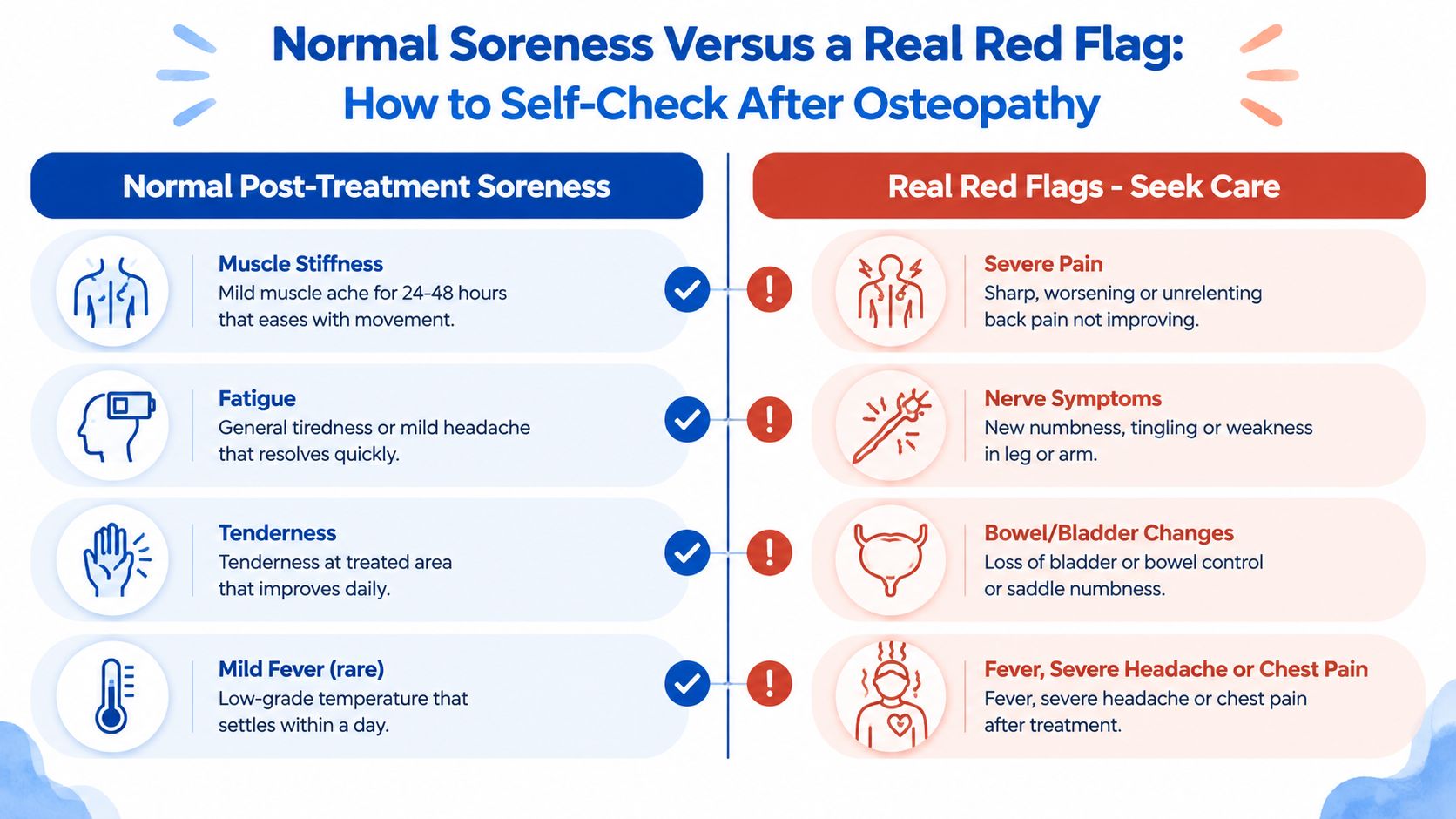
A back that feels more tender after treatment can cause immediate worry, especially when you are watching closely for signs of harm. Mild soreness, local tenderness, tiredness or a slight headache can occur after hands-on care. The safer pattern is familiar discomfort that stays mild and starts to settle, much like muscle soreness after an activity your body is not used to.
A review of osteopathy studies found increased pain in some low back pain trials and occasional back muscle spasticity, but no serious adverse events in the reviewed evidence (review of adverse events in osteopathy studies). This supports a practical distinction, not a guarantee that every symptom after treatment is harmless.
A simple symptom check
Use three questions to decide which pattern you are seeing:
- Is the sensation similar to my original complaint? A familiar ache in the treated area is generally less concerning than a new symptom in a limb or a different part of the body.
- Is it mild and settling? Discomfort that eases with rest, ordinary movement and time follows a different course from pain that keeps escalating.
- Is there any neurological change? New or worsening weakness, numbness, spreading pins and needles, difficulty walking, saddle numbness, or bladder and bowel changes needs medical attention.
Seek prompt medical review if sudden severe pain feels unlike the original problem, or if you develop new neurological symptoms, dizziness or visual disturbance. Symptoms that continue worsening rather than settling also warrant assessment. Bladder or bowel changes are particularly important, so do not watch them at home.
Practical rule: Familiar, mild soreness that is clearly improving usually fits a treatment reaction. New, severe, neurological or progressive symptoms should be treated as a red flag.
Two days can provide a useful reference point, but it is not a rule that overrides your judgement. If discomfort is still getting worse after that point, contact the osteopath and seek medical advice. You can ask for help before symptoms become dramatic.
How Qualified Osteopaths Reduce the Risk
Safe care starts before anyone touches your spine. In Australia, ask yourself whether the practitioner can answer four basic questions clearly.
Is the practitioner properly registered?
Check that the osteopath is registered with the Australian Health Practitioner Regulation Agency, AHPRA. Registration and professional standards provide an important baseline, while continuing professional development helps practitioners maintain their clinical knowledge. Registration doesn't remove all risk, but it gives you a clear way to verify who you're seeing.
Has the practitioner taken a proper history?
A first appointment should include questions about your current symptoms, previous injuries, surgery, osteoporosis, cancer history, medications, pregnancy where relevant, neurological symptoms and recent changes in health. Tell the practitioner about blood thinners, long-term steroid use and any diagnosis that affects bone strength or healing.
You should also receive an explanation of the proposed treatment, potential risks and alternatives. Consent isn't a formality. It's the point at which you decide whether the suggested technique matches your preferences.
Was there an examination before treatment?
An osteopath may assess your posture, spinal and limb movement, strength, sensation and reflexes. Blood pressure may be relevant in some presentations. These checks help identify cases where hands-on treatment should be modified, delayed or referred for medical assessment.
Can the treatment change during the session?
A skilled practitioner won't force a planned technique because it was written in the appointment plan. They should ask how you're responding, explain what they're doing and stop if you report sharp pain, unusual symptoms or distress. Mobilisation, muscle energy work and soft-tissue treatment may be considered when a high-velocity thrust isn't appropriate.
A practical rehabilitation plan can also reduce the pressure to rely on repeated hands-on treatment. You can see an example of movement-focused care in this rehabilitation image.

When You Should Avoid Osteopathic Treatment
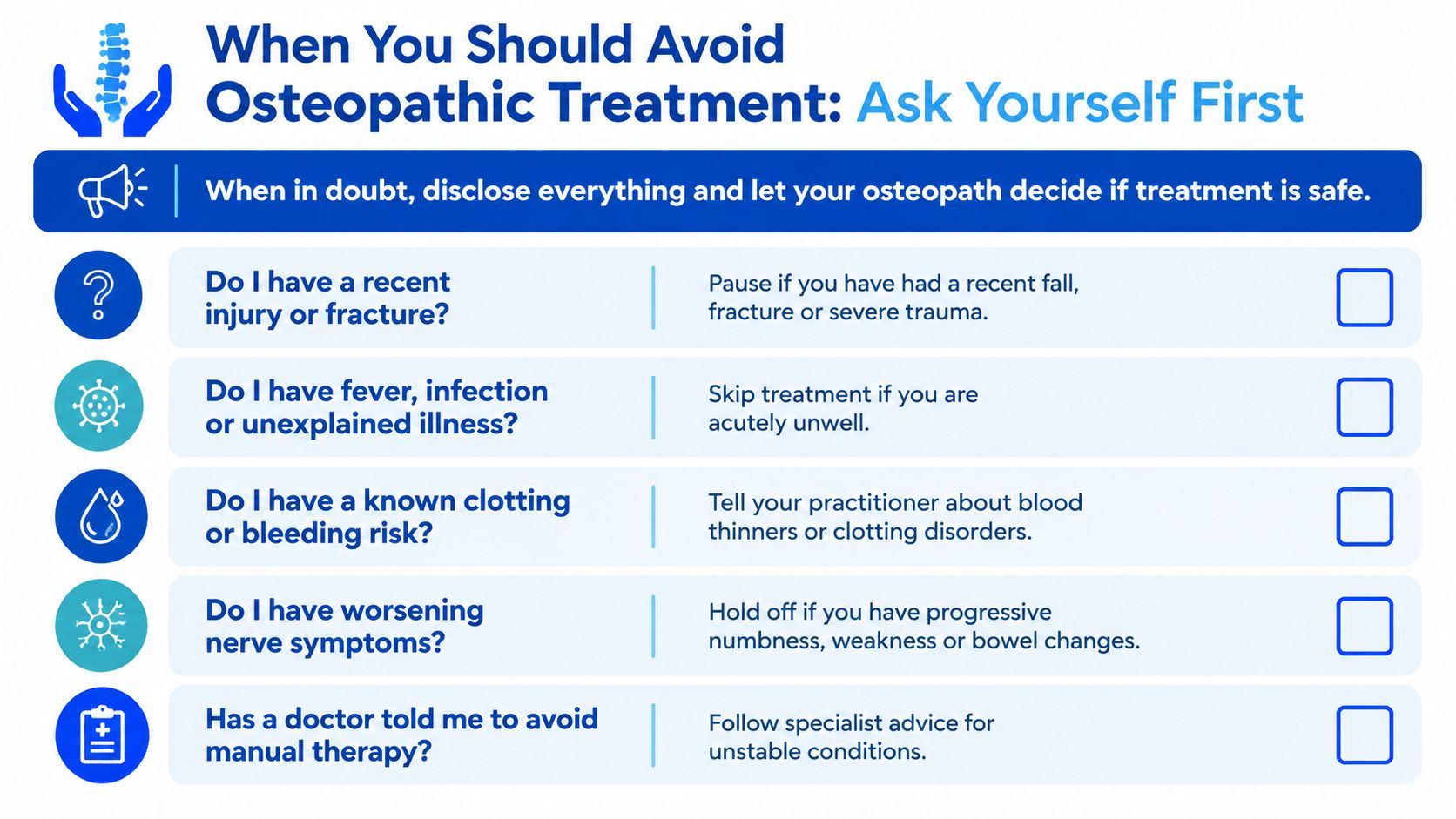
The safest first question isn't “Which technique should I choose?” It's “Could this symptom need medical assessment before any hands-on care?” An osteopath can assess many musculoskeletal problems, but they can't replace imaging, blood tests or specialist review when those are needed.
Pause and arrange medical advice first if you have:
- Sudden or unexplained severe pain: Especially when it began without an obvious movement or strain.
- Recent trauma: A fall, accident, suspected fracture or significant impact needs appropriate assessment before manipulation.
- Systemic symptoms: Fever, unexplained illness, unexplained weight loss or night pain that wakes you should be disclosed and assessed.
- Important medical history: Cancer, osteoporosis or long-term steroid use can change the safety of forceful treatment.
- Progressive nerve symptoms: Worsening weakness, spreading numbness, saddle-area numbness, or loss of bladder or bowel control requires urgent medical attention.
- Relevant current conditions: Recent spinal surgery, pregnancy, inflammatory arthritis or active infection should be discussed before booking hands-on care.
The practical rule is not that every person with one of these factors can never see an osteopath. It's that the practitioner needs the information before selecting a technique. They may recommend a GP review, coordinate with another health professional, or use a gentler approach after confirming that treatment is suitable.
A referral isn't a failure of osteopathy. It's evidence that the practitioner recognises the limits of hands-on care and is putting diagnosis before treatment.
When to Seek Urgent Care After a Session
A sore back after treatment can be unsettling. The useful question is whether the response is settling in the expected direction or crossing a threshold that needs medical assessment. Do not book another treatment first if new neurological or systemic symptoms appear.
Monitor at home
Mild local aching, stiffness or tiredness may be observed when it resembles your original symptoms and starts to improve. Follow the practitioner's self-care advice, and contact the osteopath if the sensation is unfamiliar, worsening, or different from what you were told to expect.
Arrange same-day medical review
Contact your GP or an urgent medical service if pain continues to worsen after two days, a persistent headache or substantial bruising develops, or your symptoms fail to show an improving pattern. Explain that they began after hands-on treatment and describe the technique used, if you know it.
A practical threshold is change, not just discomfort. Expected soreness should gradually become easier. A new symptom, a marked increase in pain, or a response that does not begin settling deserves a clinician's review.
Attend an emergency department immediately
Seek emergency assessment for new weakness in an arm or leg, difficulty walking, spreading numbness, saddle anaesthesia, or loss of bladder or bowel control. Sudden severe pain, chest pain, fever with significant back pain, or a severe headache unlike your usual headaches also requires immediate care.
These warning patterns are screened for because they can indicate serious spinal, vascular or infectious problems. As noted earlier, Australian safety evidence has highlighted rare serious risks associated with cervical manipulation, while the reviewed low back pain trials found no serious events. A low observed rate is reassuring, but it is not a reason to dismiss symptoms that match an emergency pattern.
Contact the osteopath within a day for unexpected worsening, but do not wait for a clinic response when weakness, bladder or bowel changes, severe neurological symptoms, or rapidly escalating pain occur. Prompt escalation is appropriate, not an overreaction.
Making a Confident Choice About Your Back Care
The question “can an osteopath damage your back” becomes more useful when you turn it into a risk-management decision. Serious complications are uncommon, but your personal risk depends on your health history, the body region treated, the technique selected and the quality of screening.
Take this checklist to your first appointment:
- Verify registration: Check the practitioner through the AHPRA public register.
- Write down symptoms: Include where they are, when they began and whether they're changing.
- Disclose your history: Mention osteoporosis, anticoagulants, previous surgery, fractures, cancer history, pregnancy and neurological symptoms.
- Ask about options: Request an explanation of manipulation, mobilisation, soft-tissue work and exercise-based care.
- Confirm consent: Make clear that you want treatment to stop if you feel unsafe or uncomfortable.
- Agree on follow-up: Ask what response is expected and when to seek advice if symptoms don't settle.
Shared decision-making protects you because it prevents assumptions. You don't have to accept a cracking technique, and you can pause treatment at any point. A clinic that welcomes questions is more likely to create a plan that matches your age, symptoms, medical history and comfort.
For people with desk-based pain or postural strain, an assessment can also include practical movement and workplace advice. This corporate ergonomics resource illustrates the broader focus beyond the painful spot.

Serious harm remains statistically rare, while temporary soreness is a recognised possibility. Choosing an AHPRA-registered practitioner, sharing your full history and monitoring your response gives you a realistic basis for proceeding, without treating either reassurance or fear as a substitute for clinical judgement.
Bayside Osteopathic Health offers individual assessment and gentle hands-on care for acute and persistent back pain, including soft-tissue work, joint mobilisation, movement advice and practical home-care strategies. Visit Bayside Osteopathic Health to discuss your symptoms, ask about suitable treatment options and arrange an appointment with an Australian osteopath.