
You notice it in ordinary moments. Reaching for the seatbelt produces a catch through the shoulder. Turning to check a blind spot feels restricted. Standing from a low chair takes more preparation than it used to, even though no single injury explains the change.
Mobility usually fades. A joint moves slightly less, a muscle stops contributing at the end of a range, and your nervous system begins choosing an easier route. By the time a household task exposes the problem, the limitation may involve several areas rather than one painful spot.
The practical answer to how to improve mobility isn't a longer stretching routine. It's a progressive combination of strength, balance, coordination and usable range, adjusted to your symptoms and daily demands.
Table of Contents
- Why Mobility Slips Before You Notice It
- A Quick Self-Assessment You Can Do at Home
- Mobility Drills for Spine, Hips, Shoulders and Ankles
- Stretching Is Not the Whole Answer
- Two Weekly Plans You Can Stick To
- Posture, Daily Habits and Desk-Side Fixes
- Red Flags and When an Osteopath Should Be Your Next Step
Why Mobility Slips Before You Notice It
A desk worker may turn towards a second monitor without difficulty, yet struggle to reverse the car comfortably. A parent may lift a toddler easily but feel a sharp catch when reaching behind to fasten a seatbelt. These tasks reveal mobility changes because several joints must share movement, while strength, balance and coordination keep the action controlled.
Small losses often stay below the threshold that attracts attention. The ankle bends a little less, the hip rotates less freely, or the upper back contributes less during a turn. You still complete the task, but another joint or muscle takes on more of the demand. Over time, that compensation can make ordinary movement feel less predictable.
Cartilage, fascia and the nervous system respond to repeated movement habits. Spending much of the day in a narrow set of positions makes those positions familiar and efficient, while less-used ranges may feel threatening or poorly controlled. That does not automatically indicate tissue damage. It may mean your body needs gradual exposure, strength and improved coordination, rather than forceful stretching.
Practical rule: A movement that feels restricted is not automatically a movement that should be forced.
A desk worker may turn towards a second monitor without difficulty, yet struggle to reverse the car comfortably. See this illustration of arthritis and joint mobility as a reminder that comfortable movement can change before a clear injury appears.
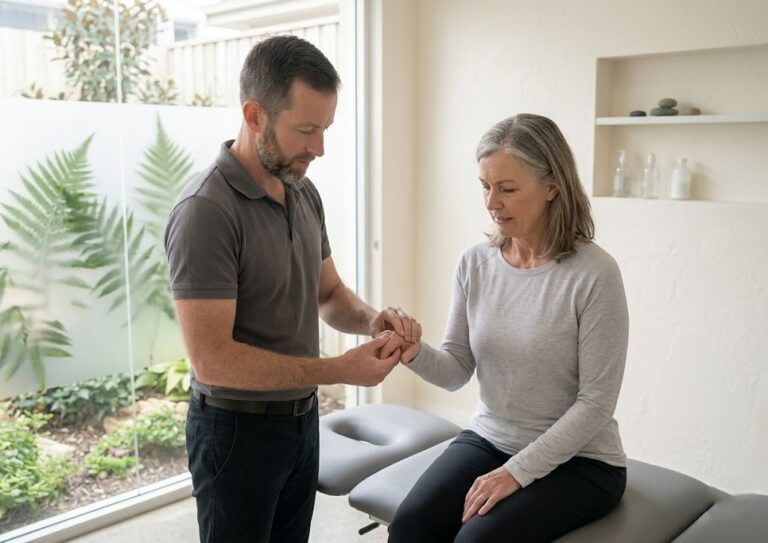
Australian arthritis data shows why the issue extends beyond comfort. The Australian Institute of Health and Welfare estimates that more than 6.1 million Australians live with arthritis or a musculoskeletal condition, and almost 1.2 million Australians have disability associated with arthritis and related disorders. Earlier national data also found that about one-third of people with arthritis-associated disability reported difficulty walking 200 metres or bending to pick something up, as reported in the AIHW arthritis and musculoskeletal conditions report.
The federal movement framework treats mobility as a combined capacity. Adults are advised to accumulate moderate-to-vigorous activity for 30 minutes or more on most days, complete muscle-strengthening activity on 2 or more days each week, and perform functional activities for mobility, balance and coordination on 3 or more days each week, according to the Australian 24-hour movement guidelines. Breaking up prolonged sitting also matters. Mobility responds to repeated practice in the positions your life requires, not a single stretching session after a day of remaining still.
A Quick Self-Assessment You Can Do at Home
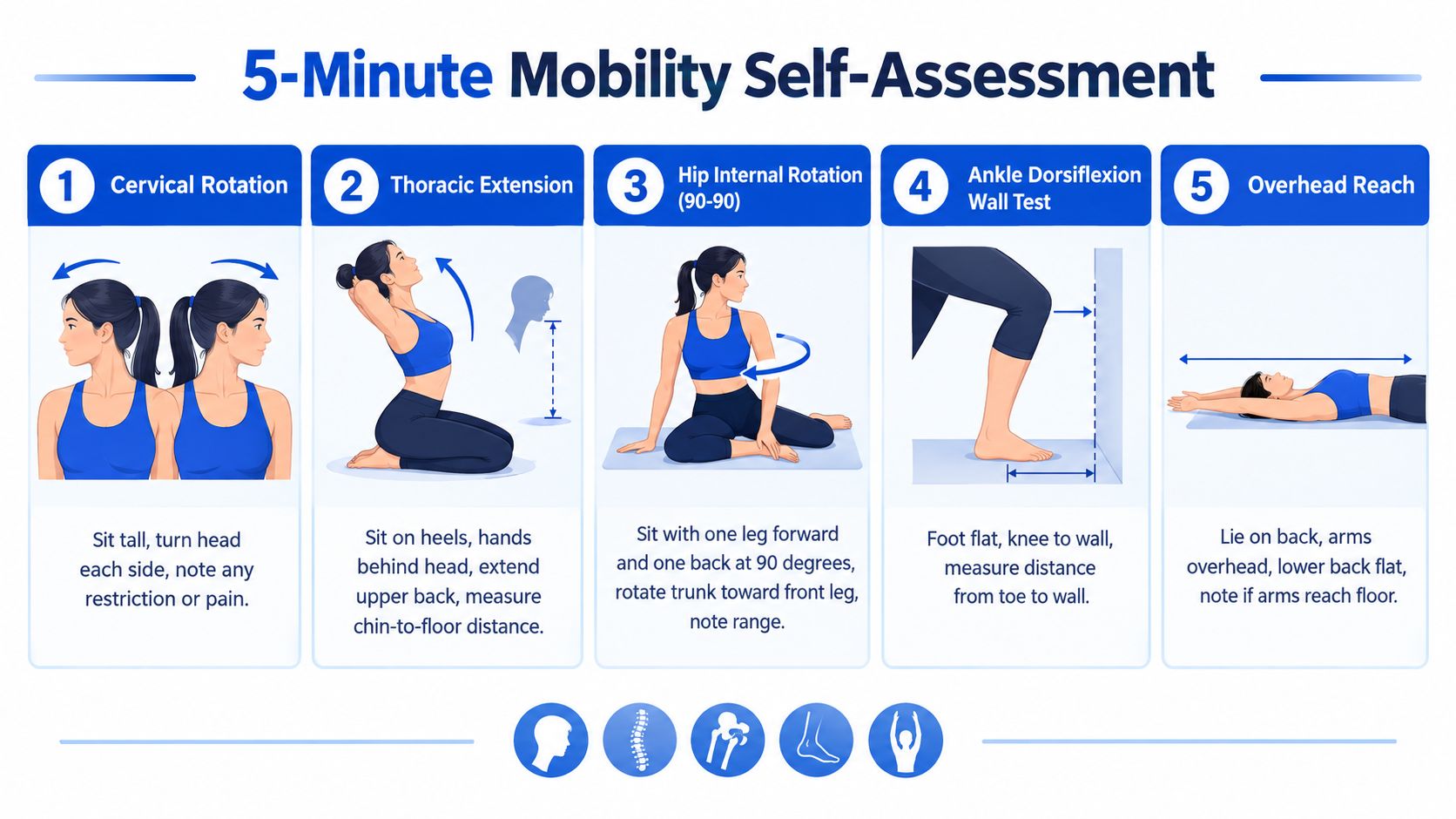
A walk may feel fine, yet turning your head, reaching overhead or stepping down can reveal a control problem. Use this screen after an easy walk or gentle movement, not immediately after waking. Record the result on each side, and treat it as a baseline rather than a diagnosis.
Start with the neck and upper back
Cervical rotation: Sit tall with your feet supported. Relax your shoulders and turn your head slowly to the right, then the left, keeping your chin level. Compare the sides. The useful finding is a comfortable, broadly similar turn without a catch or trunk movement. A restriction can involve the neck joints, protective muscle tension or limited contribution from the upper back.
Thoracic extension: Sit on your heels if comfortable, place your hands behind your head and gently extend through the upper back. Notice whether the movement comes from the mid-back instead of the lower back. There is no meaningful side-to-side pass mark for this test. Marked stiffness, discomfort or an inability to extend comfortably suggests that the thoracic spine or nearby tissues need attention.
Check the hips and ankles
Hip internal rotation in 90-90: Sit with one leg forward and the other behind, both knees bent to roughly right angles. Keep the front knee grounded as you rotate your trunk towards that leg, then compare sides. Stay within a controlled, comfortable range. Limited movement may involve the hip capsule, deep hip muscles or the pelvis's ability to control rotation.
Ankle dorsiflexion wall test: Face a wall with one foot flat and the toes several centimetres away. Keep the heel down and move the knee towards the wall. Gradually move the foot back until the knee cannot reach the wall without the heel lifting. A practical reference is whether the knee can touch the wall with the foot 10 centimetres away while the heel remains grounded. A shorter distance can reflect calf stiffness, ankle joint restriction or reduced control through the foot.
Finish with the shoulders
- Overhead reach: Lie on your back with your legs comfortable and your lower back gently flat. Reach both arms overhead towards the floor without flaring your ribs or arching your lumbar spine. Reaching the floor, or coming close, while keeping the back position steady suggests useful control. A gap may reflect shoulder restriction, tight chest tissues, limited thoracic extension or poor coordination between the ribs and pelvis.
Stop immediately if a test causes sharp pain, radiating pain, numbness or pins and needles. Stop as well if you feel unstable or cannot control the position. These symptoms are not a cue to push harder through a home exercise video. Arrange an assessment with an osteopath, particularly when symptoms are new, worsening or difficult to localise.
The result should guide your next choice. A stiff ankle with good balance calls for a different starting point from a flexible ankle that collapses under load. Mobility depends on strength, balance and coordination as well as range, so compare the findings with the Australian 24-hour movement guidelines, including regular activity, muscle strengthening and functional work for mobility, balance and coordination, outlined in the Australian 24-hour movement guidelines.
Mobility Drills for Spine, Hips, Shoulders and Ankles
Mobility improves when a joint can move, support load and respond without losing control. Treat these drills as practice for strength, balance and coordination, not as a stretching circuit. Choose a comfortable range, move slowly, and reduce the volume during a flare. The suggested sets are starting points, not targets you must complete.
Ankles first
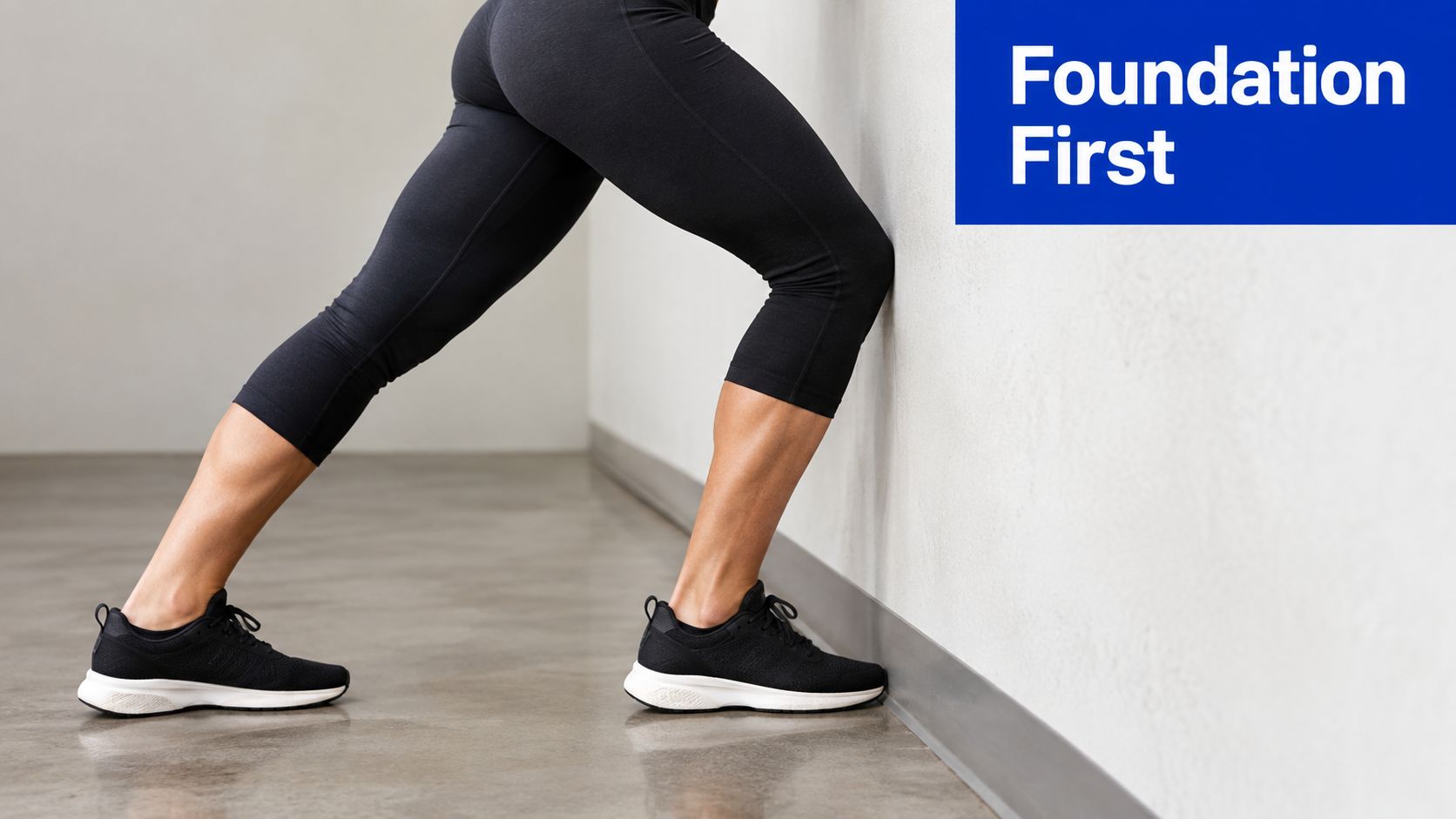
Wall ankle mobilisation: Stand facing a wall with one foot forward. Keep the heel down and guide the knee towards the wall, then return. Complete 2 sets of 10 repetitions on each side with a controlled tempo. If the heel lifts, move closer to the wall or shorten the range. Progress by increasing the distance gradually, then add a light balance challenge once the movement remains steady.
Supported calf raise: Hold a bench or wall, rise through the balls of both feet, pause briefly, then lower with control. Use 2 sets of 10. If the calf or Achilles area becomes more painful, reduce the height or hold the raised position without moving. Progress to single-leg raises only when you can keep the ankle aligned and control the lowering phase.
Build hip rotation and control
90-90 hip switches: Sit in a 90-90 position and move both knees from one side to the other without forcing the end range. Complete 2 sets of 8 each side. Place your hands behind you if balance limits the movement. Progress by sitting taller, reducing hand support or pausing briefly at each end. A smaller range with good control is more useful than a larger range that causes the pelvis to collapse.
Hip hinge to chair: Stand in front of a chair, send the hips backwards and touch the chair lightly before standing. Use 2 sets of 8, keeping the knees tracking over the feet. If the hips or back are sensitive, raise the seat with a firm cushion and shorten the range. Progress by holding a light object close to the chest, provided the back and knees remain controlled.
Add movement through the spine and shoulders
Open-book thoracic rotation: Lie on your side with the hips and knees comfortably bent. Reach the top arm across the body, then open it towards the floor behind you while allowing the upper back to rotate. Perform 2 sets of 6 each side. Keep the range smaller if the shoulder or back pinches. Progress by extending the legs slightly or pausing at the open position.
Prone Y-T-W raises: Lie face down or perform the exercise standing with your chest supported. Move the arms into a Y, T and W shape with the neck relaxed, using small, deliberate lifts. Complete 2 rounds of 8 repetitions for each shape. If lifting causes discomfort, keep the arms supported and practise the positions isometrically. Progress with light resistance when the shoulder blades move without shrugging.
Use these drills alongside regular activity, muscle strengthening and functional balance work, consistent with the federal physical activity recommendations. They help practise range and coordination, but they do not replace strength work. Start with the region that scored weakest in your self-check, then add the others as tolerance improves.
Stop immediately for sharp pain, radiating pain, numbness or pins and needles. Stop as well if you feel unstable or cannot control the position. New, worsening or difficult-to-localise symptoms warrant assessment by an osteopath rather than repeated attempts to push through a video.
Stretching Is Not the Whole Answer
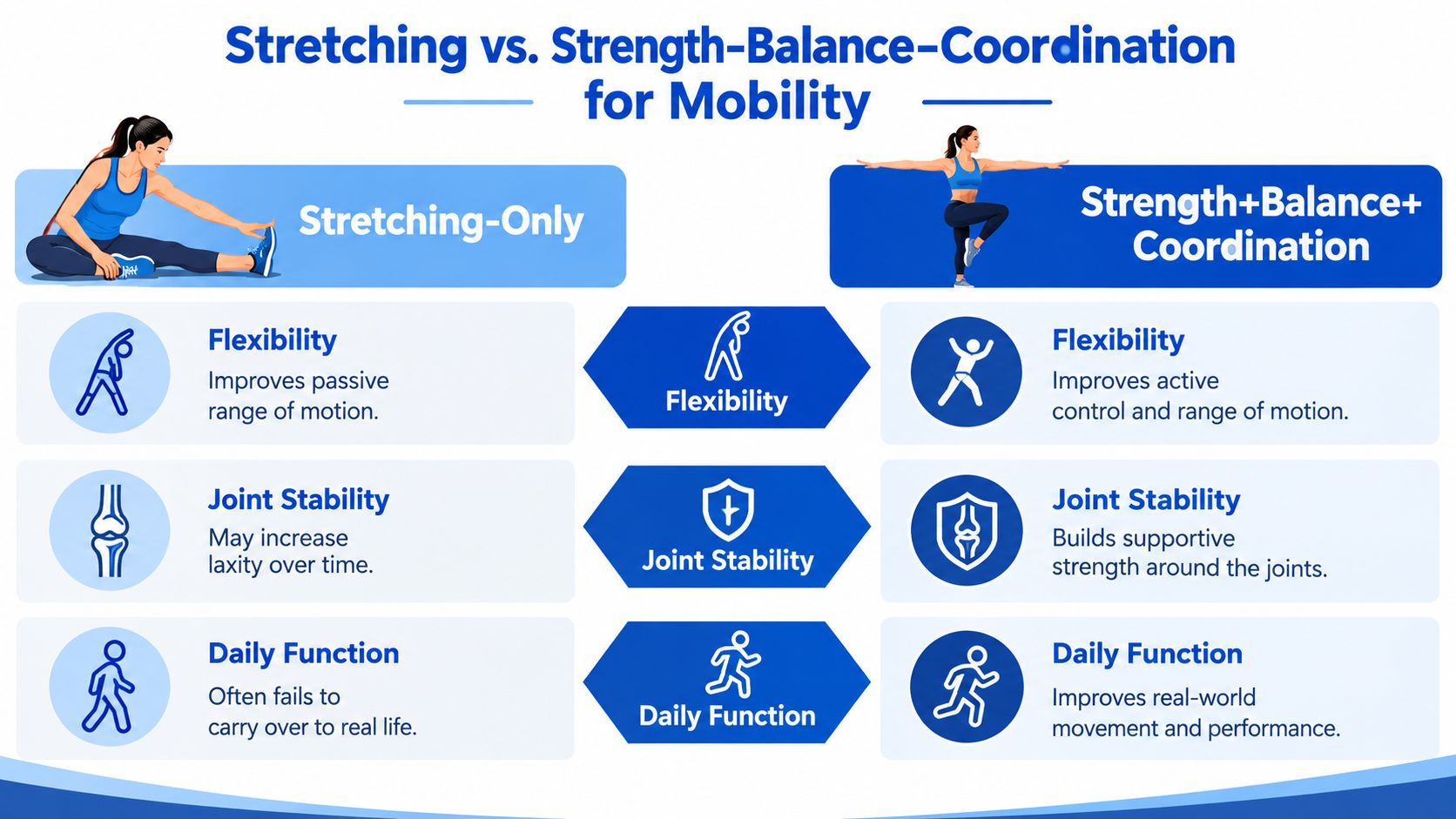
Stretching can make a range feel easier, but ease isn't the same as control. A passive hamstring stretch asks how far the leg can move while another position supports you. A single-leg sit-to-stand asks whether your hip, knee and ankle can organise that range while producing force and managing balance.
That difference matters during daily tasks. Strength and coordination teach your nervous system where the joint is, how much force to use and how to respond when the surface, speed or fatigue changes. A stretch may reduce the sensation of tightness for a while, but it won't necessarily prepare you to step off a kerb or rise from a low chair.
| Approach | What it can help | Where it falls short |
|---|---|---|
| Stretching only | Passive range, short-term comfort and tolerance of a position | Doesn't reliably build load capacity, balance or movement control |
| Strength, balance and coordination | Active range, joint support and task-specific confidence | Requires gradual progression and may expose weakness before it improves |
| Combined plan | Comfortable range plus usable control under everyday load | Needs consistency and sensible symptom monitoring |
A doorway pec stretch can be useful when the chest feels restricted. It becomes more relevant when paired with loaded band rows, which ask the upper back and shoulder muscles to support the position. The trade-off is that strengthening can feel harder and may produce ordinary muscular fatigue. That effort is part of the adaptation, provided symptoms remain controlled and settle normally.
The Australian guidelines don't tell adults or older adults to stretch more as a standalone solution. They emphasise muscle strengthening, functional activities for mobility, balance and coordination, and reducing prolonged sitting. The recommendations for older adults also include several hours of light activity daily.
Static stretching still has a place. It can be a comfortable warm-up, a way to explore a restricted position or a tool for temporary symptom relief. It should sit underneath the harder work, not replace it.
Two Weekly Plans You Can Stick To
A workable plan spreads movement across the week. One ambitious session can leave you sore, tired and less active afterwards. The templates below are deliberately modest, and either can be shortened during a difficult week. They combine mobility with strength, balance and coordination rather than treating flexibility as the whole task.
General adult plan
This plan suits a desk-based adult without a current injury. Keep the effort comfortable and fit walking around your existing routine.
| Day | General Adult (25-40s, desk-based) | Older Adult (65+, stiffness or falls concern) |
|---|---|---|
| Monday | Ankles and hips, 15 minutes. Add a light walk. | Sit-to-stand and supported balance, 10 to 15 minutes. |
| Tuesday | Moderate walk plus band rows, 20 to 30 minutes. | Gentle walk in a familiar setting, with rests as needed. |
| Wednesday | Open books and overhead reach, 10 minutes. | Thoracic rotation and ankle mobilisation, 10 minutes. |
| Thursday | Moderate activity and hip hinge practice, 20 to 30 minutes. | Sit-to-stand, supported calf raises and light walking. |
| Friday | Ankles and hips, 15 minutes. Progress one exercise slightly. | Supported balance and gentle hip movement, 10 minutes. |
| Saturday | Strength and balance, 20 minutes, followed by an easy walk. | Longer warm-up, then a supervised or supported movement session. |
| Sunday | Rest or relaxed light activity. | Complete rest or gentle movement only. |
Use Monday and Friday for ankle and hip work, Wednesday for spinal mobility, and Tuesday and Saturday for strength or balance. Progress one variable at a time, such as range, repetitions, resistance or balance demand. A small increase is easier to assess than changing the whole session.
Older adult plan
Older adults with stiffness or falls concerns should use support, allow a longer warm-up and choose predictable surroundings. Falls prevention deserves particular attention because falls are the leading cause of hospitalised injuries and injury deaths among older Australians. In 2019–20, falls among Australians aged 65 and over caused about 133,000 hospitalisations and about 5,000 deaths, according to the AIHW falls fact sheet.
Keep two complete rest days if recovery is slow. New swelling, sudden loss of function or a noticeable increase in instability calls for clinical review rather than a harder session.
During a flare week, halve the plan. Keep the movements gentle, remove progression and rebuild only after ordinary activity feels settled again. Pain that escalates, persists or changes your walking is a reason to stop and seek assessment.
Posture, Daily Habits and Desk-Side Fixes
A desk can leave your neck stiff, hips underused and balance less adaptable by the end of the day. One posture correction will not undo that pattern. Mobility improves when daily movement adds strength, balance and coordination, alongside the Australian 24-hour movement guidelines' advice to break up prolonged sitting and include regular activity.
Choose one change you can repeat.
- Break sitting regularly: Stand, walk briefly or perform a few sit-to-stands during the workday. Frequent short breaks are usually easier to maintain than one ambitious reset.
- Set the screen at eye level: Raise the monitor so your head can stay balanced over your shoulders. Reposition the chair or second screen rather than repeatedly turning your neck.
- Use a standing phone routine: Take calls standing when practical, with both feet supported. This adds light movement without turning every call into a workout.
- Choose stable everyday footwear: A secure shoe with a stable heel counter can make walking feel more predictable. It will not correct every foot or balance problem, so persistent instability still needs assessment.
- Reset the upper back before bed: Spend two gentle minutes over a rolled towel or chair back, breathing normally. Avoid forceful extension, and stop if it causes neck, arm or chest symptoms.
Use the desk posture illustration to check your workstation without chasing a rigid “perfect posture”. Comfortable variation is generally more useful than holding one position all day.
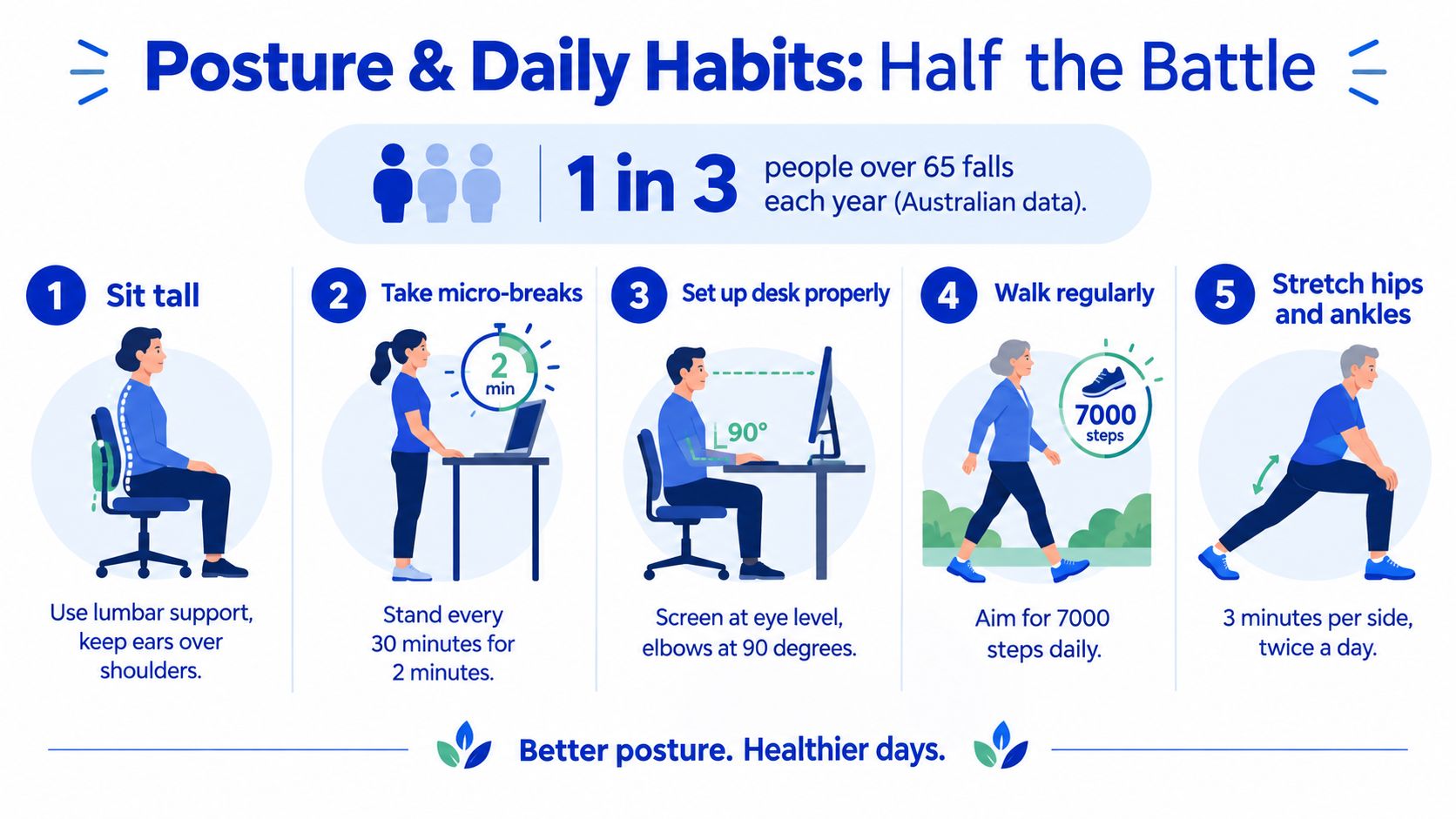
A short mobility reset supports your formal plan only if it remains tolerable. Keep the first habit automatic, then add another once it no longer requires much thought. If a desk adjustment or drill repeatedly brings on spreading pain, numbness, marked weakness or worsening balance, stop experimenting and arrange an osteopathic assessment.
Red Flags and When an Osteopath Should Be Your Next Step
A mild, familiar stiffness that eases as you warm up can suit self-directed mobility work. Stop treating it as a stretching problem when pain persists, function changes, or symptoms suggest inflammation, joint restriction, or nerve involvement. Mobility depends on strength, balance, and coordination as well as range.
Arrange an assessment before progressing if you notice:
- Morning stiffness lasting over 30 minutes, especially across several joints.
- Night pain that does not ease when you change position.
- Visible or ongoing joint swelling.
- Locking, giving way, or sudden loss of function.
- Numbness, tingling, or pain travelling into an arm or leg.
- Unexplained weight loss or fever.
- Sharp pain that remains after 72 hours of normal activity.
These signs do not establish a diagnosis. They do show that repeating online drills could aggravate the wrong problem or delay appropriate care. The Australian 24-hour movement guidelines support regular activity, strength work, and less prolonged sitting, but they do not replace assessment when red flags appear.
An osteopathic appointment should start with your history and goals, not a predetermined technique. The practitioner will observe how you move, examine relevant joints and muscles, and screen neurological function when symptoms warrant it. You should receive a clear working explanation, including whether hands-on care, home exercise, medical review, or imaging referral is appropriate. The neck and spine assessment illustration shows why connected movement can matter more than treating one sore spot alone.
For this week, repeat the self-assessment when warm and choose the stiffest region. Use five minutes of its most comfortable drills, alongside ordinary walking and strength work that fits your capacity. Stop if symptoms spread, weakness develops, balance worsens, or the area fails to settle, then arrange an assessment.
Bayside Osteopathic Health provides hands-on assessment and osteopathic care for joint stiffness, arthritis-related discomfort, postural strain, and persistent neck or back pain. Visit Bayside Osteopathic Health to discuss treatment, movement advice, and practical home exercises.