
You've spent the afternoon at a desk, your shoulders have crept towards your ears, and there's a stubborn ache between your shoulder blades. You stretch, roll your shoulders, and press into the tight spot with your thumb. The pressure feels helpful for a moment, but the rope-like band soon returns.
That experience is common among office workers, drivers, carers, tradespeople, parents, and anyone whose body repeats the same positions or tasks. In Australia, 360,180 serious musculoskeletal disorder claims were recorded across the period from 2009–10 to 2013–14, representing 60% of all serious claims in that period, according to Safe Work Australia's musculoskeletal disorder statistics. Soft tissue mobilization techniques are relevant because they target some of the muscles, tendons, ligaments, fascia, and other tissues involved in this broad burden.
The important point is that hands-on care usually offers a window of easier movement, not a permanent reset button. The most useful results tend to appear when treatment is followed by sensible loading, exercise, movement breaks, and changes to the habits that keep irritating the area.
Table of Contents
- Why Your Shoulders Feel Like Knotted Rope
- What Soft Tissue Mobilization Actually Means
- The Main Techniques in Plain English
- What the Evidence Really Says About Results
- What Happens During a Typical Session
- Safety, Contraindications, and Who Should Take Care
- Self-Care and Aftercare That Actually Helps
- When to Book a Professional and What to Ask
Why Your Shoulders Feel Like Knotted Rope
By late afternoon, a desk-bound worker may notice a heavy strip of tension running from the base of the neck towards the shoulder blade. It can feel like a cord buried beneath the skin, too deep to stretch and too tender to ignore. The natural response is to dig into it with a thumb, lean against a massage ball, or ask someone to “get the knot out”.
That pressure can feel relieving because touch changes the sensory information reaching the nervous system and may temporarily reduce the sense of threat around movement. It can also make a stiff area feel more available for a short period. But the underlying irritation may remain if the shoulder continues to sit still, the same muscles keep working without a break, or the person avoids using the area because movement feels uncomfortable.
The “knot” is often a useful description of a sensation, not proof that a literal lump has been tied inside the muscle.
Posture is only one contributor. Repetitive reaching, lifting, gripping, long periods of under-use, sudden increases in exercise, poor sleep, and stress can all influence how muscles guard and how sensitive a region feels. A shoulder that stays raised while you type may gradually become familiar with tension, while the upper back receives less varied movement than it needs.
This is why a quick stretch may not solve the problem. Stretching changes one part of the experience, but the body also needs tolerable movement and gradually restored strength. The visual guide to neck pain and osteopathic neck relief can help you picture how neck and shoulder symptoms may relate to the way the surrounding body moves.

Soft tissue mobilization techniques fit into this picture as a targeted way to reduce sensitivity, improve short-term mobility, and make active rehabilitation more comfortable. The practical question isn't why the shoulder feels knotted. It's what kind of input will help you move better afterwards.
What Soft Tissue Mobilization Actually Means
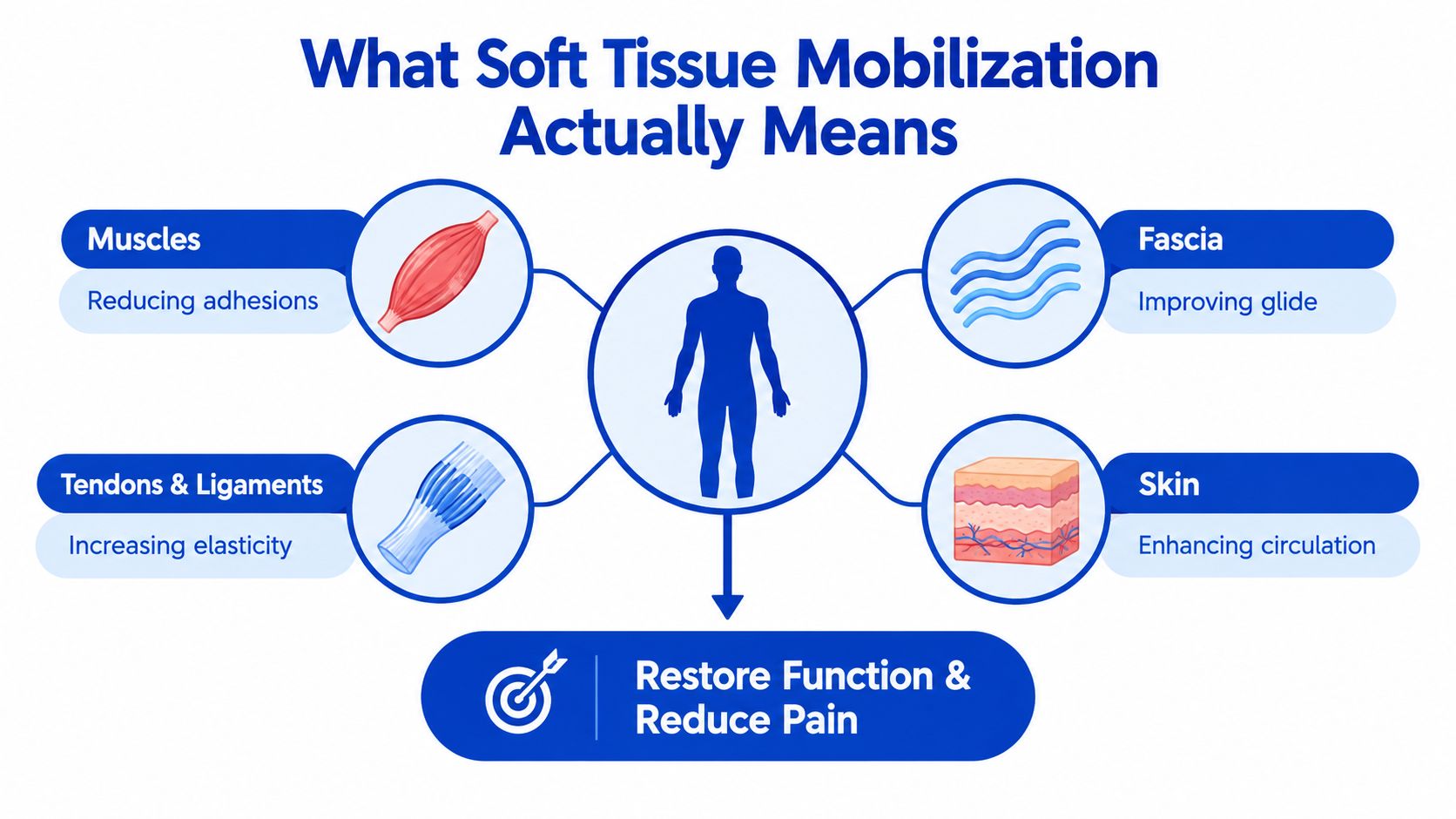
Soft tissue mobilization is skilled movement applied to non-bony tissues, including muscles, fascia, tendons, ligaments, and skin. A practitioner may use pressure, sustained contact, gliding, kneading, gentle stretching, or controlled friction, depending on the assessment and the person's tolerance.
Think of a bedsheet that has been folded in the same place for months. The fabric isn't necessarily damaged, but it has become creased and resistant. Pulling it aggressively may create new wrinkles or tear the material. Slow, measured tension and repeated movement are more likely to help the sheet lie smoothly again. Soft tissue treatment uses a similar principle, although the body is more complex than fabric and the technique isn't ironing tissue flat.
What the practitioner is assessing
A practitioner doesn't find the sorest point and push. They may compare movement on both sides, observe how you breathe and position yourself, feel for areas that move differently, and test whether a restriction changes when another joint or muscle is involved. The treatment is then adjusted to the tissue response, symptoms, and broader movement pattern.
The hands-on contact may aim to:
- Reduce sensitivity: Calm an area that feels unusually painful or guarded.
- Improve short-term glide: Encourage layers of tissue to move relative to one another.
- Prepare movement: Make a stretch, joint mobilisation, walk, or strengthening exercise easier to perform.
- Restore confidence: Give you a less threatening experience of moving a painful region.
Soft tissue mobilization isn't the same as a joint manipulation or chiropractic adjustment. Joint-focused care directs attention towards the movement of a joint and its surrounding structures, while soft tissue work concentrates on muscle and connective tissue. Some osteopathic appointments may use both approaches, but they aren't interchangeable terms.
Australian manual therapy developed within a structured clinical tradition. The Maitland approach is part of that history. The manual therapy overview describes milestones including the founding of the Australasian Massage Association in 1906, Australia's first 3-month manual therapy certificate programme in 1965, and 12-month postgraduate diploma courses in 1974. The same source also reflects how formal hands-on practice became linked with assessment, movement, and clinical reasoning rather than a uniform routine.
In osteopathic care, techniques are selected after considering how the person moves as a whole. The intention isn't to force a body part into compliance. It's to provide a controlled stimulus that supports comfortable movement and the body's capacity to adapt.
The Main Techniques in Plain English
A practitioner's hands are tools, but each technique has a different feel and purpose. The names can sound technical, so it helps to treat them as different settings on the same instrument rather than separate treatments that must always be used alone.
Myofascial release uses slow, sustained pressure into a region of fascia and muscle. The practitioner may wait at a point of resistance while you breathe and allow the area to settle. It's like easing a crinkled tablecloth towards flatness instead of tugging sharply at one corner.
Trigger point work applies focused pressure to a particularly tender spot within a muscle. You may feel local discomfort or a familiar ache elsewhere, sometimes called referred pain. The pressure should remain tolerable and purposeful. The practitioner may hold, release, and then reassess movement rather than trying to overpower the point.
Cross-fiber friction uses short strokes across the direction of tissue fibres. It may be selected around a tendon, scar, or other area where the practitioner wants more specific contact. This is a focused technique, not a general rubbing motion, and it isn't suitable for every painful or inflamed area.
Effleurage consists of smooth, gliding strokes across the surface. The contact is often lighter and rhythmic, with the aim of warming the area, providing sensory input, and helping the person settle into movement.
Petrissage involves lifting, kneading, or gently squeezing soft tissue. It reaches a different depth and rhythm from gliding strokes, and the practitioner may use it to mobilise muscle layers or reduce the feeling of general muscular tension.
| Technique | What It Feels Like | Pressure / Speed | Main Goal |
|---|---|---|---|
| Myofascial release | Slow pressure and a gradual sense of easing | Sustained and measured | Improve tolerance and tissue mobility |
| Trigger point work | Focused pressure on a tender spot | Firm but controlled | Reduce local sensitivity and guarding |
| Cross-fiber friction | Short strokes across the tissue direction | Specific and relatively brisk | Provide targeted stimulation |
| Effleurage | Warm, smooth gliding contact | Light to moderate and rhythmic | Settle the nervous system and prepare tissue |
| Petrissage | Lifting, kneading, or squeezing | Moderate and variable | Mobilise muscle layers and reduce tension |
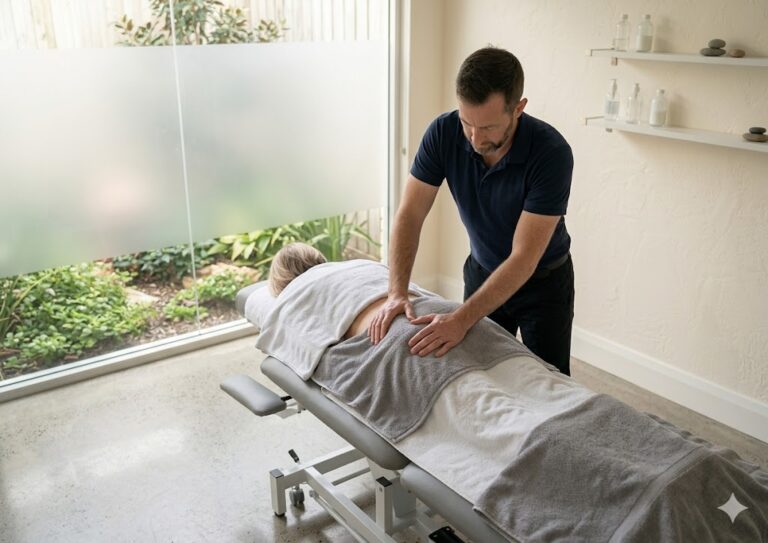
A session may blend several approaches. For example, a practitioner could begin with broad gliding contact, use sustained work around a restricted shoulder region, and then move into active shoulder rotation. The remedial massage muscle therapy illustration offers a visual reference for the hands-on nature of this work.
Instrument-assisted soft tissue mobilization, or IASTM, uses a shaped tool rather than the therapist's hands alone. A recent meta-analysis reported moderate-certainty evidence for pain reduction, with a pooled SMD of 0.60 across 11 studies involving 427 participants, while evidence for function was lower certainty, with an SMD of 0.40 across 333 participants. Those findings support IASTM as an adjunct that may help you tolerate movement and exercise, not as a stand-alone solution. The figures come from the Australian Government evidence appendix on IASTM.
What the Evidence Really Says About Results
The most defensible claim is modest: soft tissue mobilization techniques may reduce pain and improve movement in the short term for some people. That doesn't mean every technique works for every diagnosis, or that a temporary change proves a tendon, fascia, or joint has been structurally “fixed”.
Evidence summaries describe short-term gains in joint range of motion after IASTM, while Australian manual therapy guidance describes soft tissue techniques as controlled manoeuvres intended to help a joint return towards normal function within its physiological range. The practical implication is important. A temporary mobility gain is most useful when you use it to practise an exercise, walk more comfortably, or gradually load the affected area.
Pain, range, and function aren't the same outcome
Pain reduction can happen without a lasting improvement in strength or daily function. A person may turn their neck more easily after treatment but still need a plan for lifting tolerance, sleep position, work breaks, or neck and upper-back conditioning.
The evidence isn't perfectly consistent. A 2022 systematic review judged the evidence very low quality and didn't support clinically meaningful improvements in pain, function, or range of motion across several body regions, while a newer review reported moderate-certainty evidence for pain reduction but only low-certainty evidence for function. These contrasting conclusions are summarised in the PubMed record for the 2022 systematic review.
| Condition | Evidence Quality | Typical Outcome | Caveat |
|---|---|---|---|
| Neck and shoulder complaints | Mixed | Possible short-term pain or movement relief | The cause of the symptoms still needs assessment |
| Low back pain | Mixed | Temporary reduction in sensitivity may occur | Active rehabilitation remains central |
| Tendon-related pain | Variable | Treatment may improve tolerance to loading | Irritated tissue may respond poorly to aggressive friction |
| Restricted joint movement | Some support for short-term ROM change | Easier movement during a brief window | The gain may not persist without practice |
The research doesn't justify promises of permanent structural correction, scar tissue removal, or a cure for chronic pain. It does support a more useful clinical role: hands-on care can create a window of relief in which movement feels safer and exercise becomes more achievable.
Use the relief as an opportunity, not as the entire treatment.
What Happens During a Typical Session
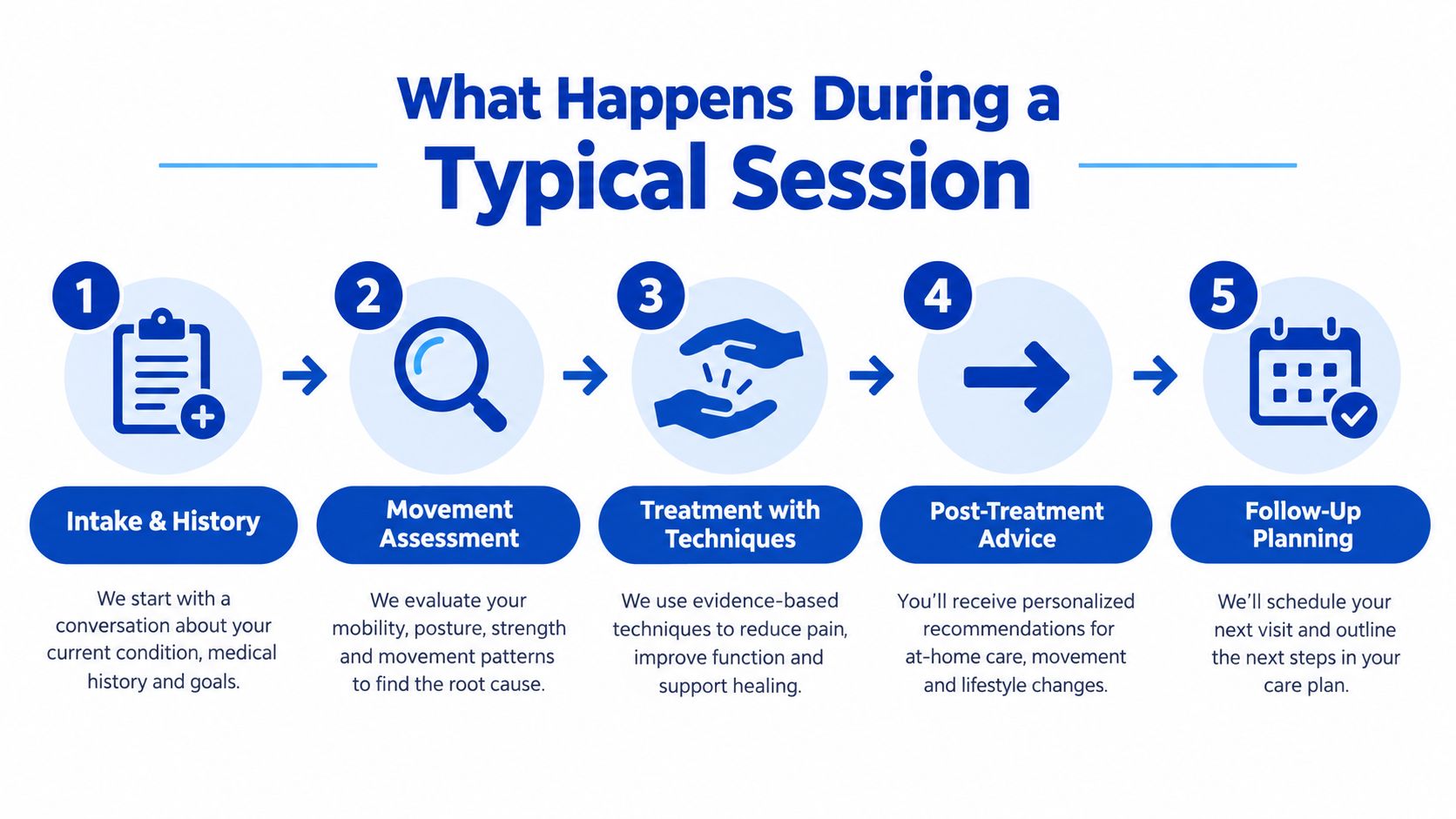
A first appointment usually begins with conversation, not pressure. The practitioner asks about when the problem started, what aggravates it, what helps, your work and activity demands, previous injuries, medications, and relevant health conditions. They'll also screen for symptoms that require medical assessment rather than hands-on treatment.
The physical assessment may include watching you walk or move, checking posture, comparing range of motion, and gently palpating areas that feel tender or restricted. You should be told what the practitioner plans to do and why. Informed consent matters before soft tissue or bony tissue treatment, and you can ask for a change or stop at any stage.
How the hands-on part feels
You may lie on your back, side, or stomach, with towels or clothing arranged to keep you comfortable and covered. Some techniques use oil to allow smooth gliding, while others need direct contact without oil so the practitioner can anchor or assess the tissue.
Expect pressure, warmth, pulling, or a mild ache. You shouldn't have to brace, hold your breath, or endure sharp pain. Tell the practitioner if the sensation becomes intense, spreads in an alarming way, produces pins and needles, or feels unlike the problem being treated.
A typical appointment may run for 30 to 45 minutes, depending on the service and assessment. That time includes discussion, movement testing, treatment, and advice, so a practitioner may address only the areas that matter most rather than working everywhere.
This video provides another way to see how hands-on treatment can fit alongside clinical movement advice:
Mild post-treatment soreness can occur and should settle within 24 to 48 hours. The practitioner should explain what they found, what response to expect, and which exercises or activity changes will help you use the new movement.
Safety, Contraindications, and Who Should Take Care
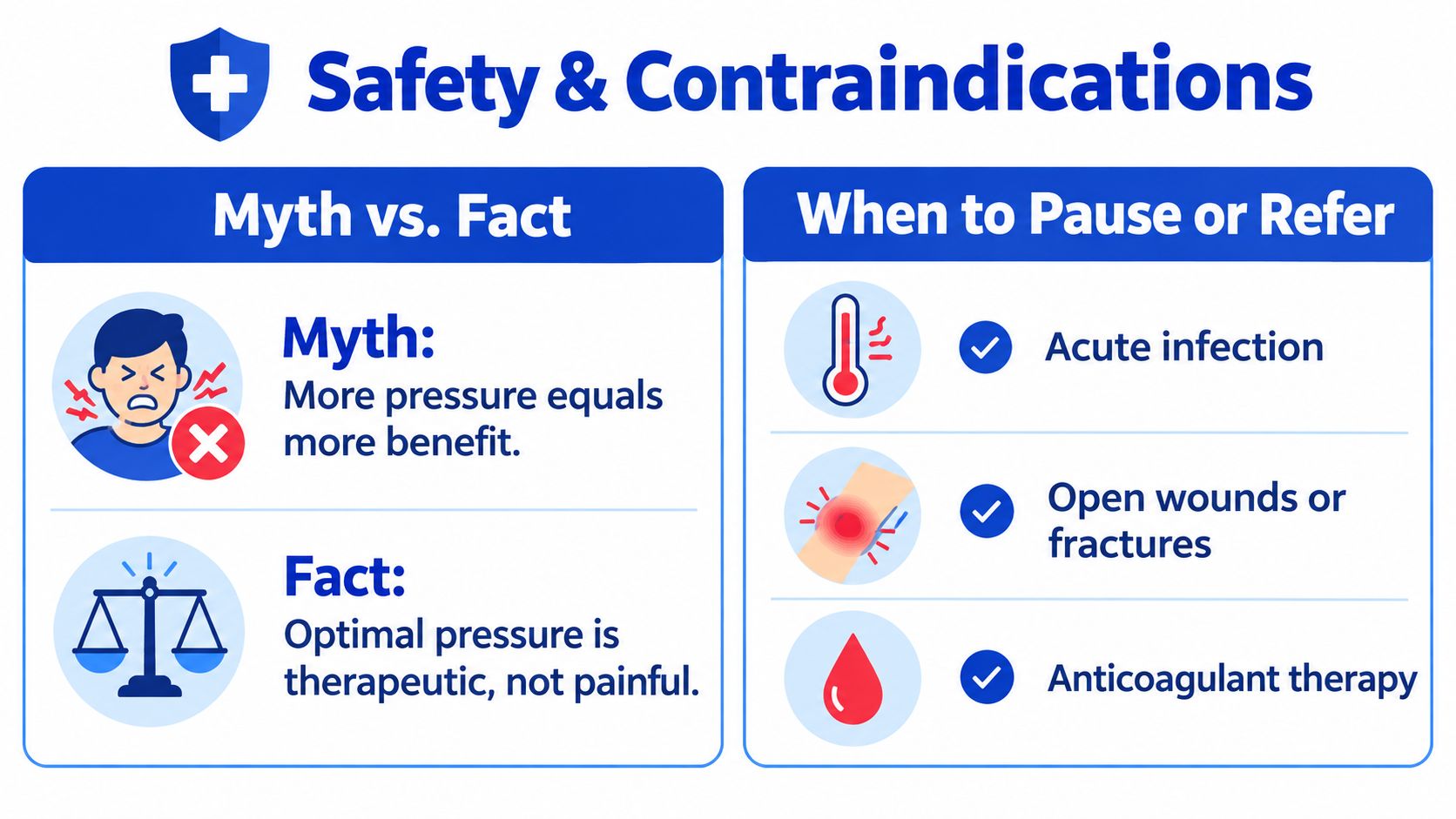
Soft tissue mobilization has a gentle reputation, but “gentle” doesn't mean universally appropriate. The right pressure depends on the tissue, the condition, the person's health, and the purpose of treatment. Harder pressure can bruise tissue, irritate an already inflamed area, and increase protective muscle guarding.
Avoid treatment over or near an acute fracture, open wound, active infection, deep vein thrombosis, suspected malignancy, severe osteoporosis, recent surgery, or acute inflammation until an appropriately qualified health professional has assessed the situation. These aren't minor details to mention halfway through an appointment. They can change whether treatment is suitable at all.
Health conditions that need extra planning
Older adults may have more fragile skin and connective tissue. People taking anticoagulants may bruise more easily, while long-term corticosteroid use can affect tissue vulnerability. Pregnancy requires modified positioning and technique, and uncontrolled cardiovascular conditions require medical consideration before hands-on care.
Tell the practitioner about:
- Current medicines: Include anticoagulants, corticosteroids, and medicines that affect bleeding or cardiovascular function.
- Recent procedures: Explain surgery, injections, wounds, or changes in symptoms.
- Bone health: Mention osteoporosis, fractures, or a history of fragility injuries.
- Systemic symptoms: Report fever, unexplained swelling, feeling unwell, or rapidly changing pain.
- Pregnancy or other health changes: These details allow safer positioning and treatment choices.
A single session also shouldn't be sold as a fix for a long-standing problem. Australian physiotherapy guidance places manual techniques within broader professional care, with decisions, informed consent, and realistic discussion of benefits. The Physiotherapy Board of Australia codes and guidelines are a useful reference for the professional expectations surrounding safe, patient-centred practice.
Seek medical assessment first if symptoms suggest something more serious than ordinary muscular tension. Hands-on treatment should never delay investigation of unexplained or rapidly worsening symptoms.
Self-Care and Aftercare That Actually Helps
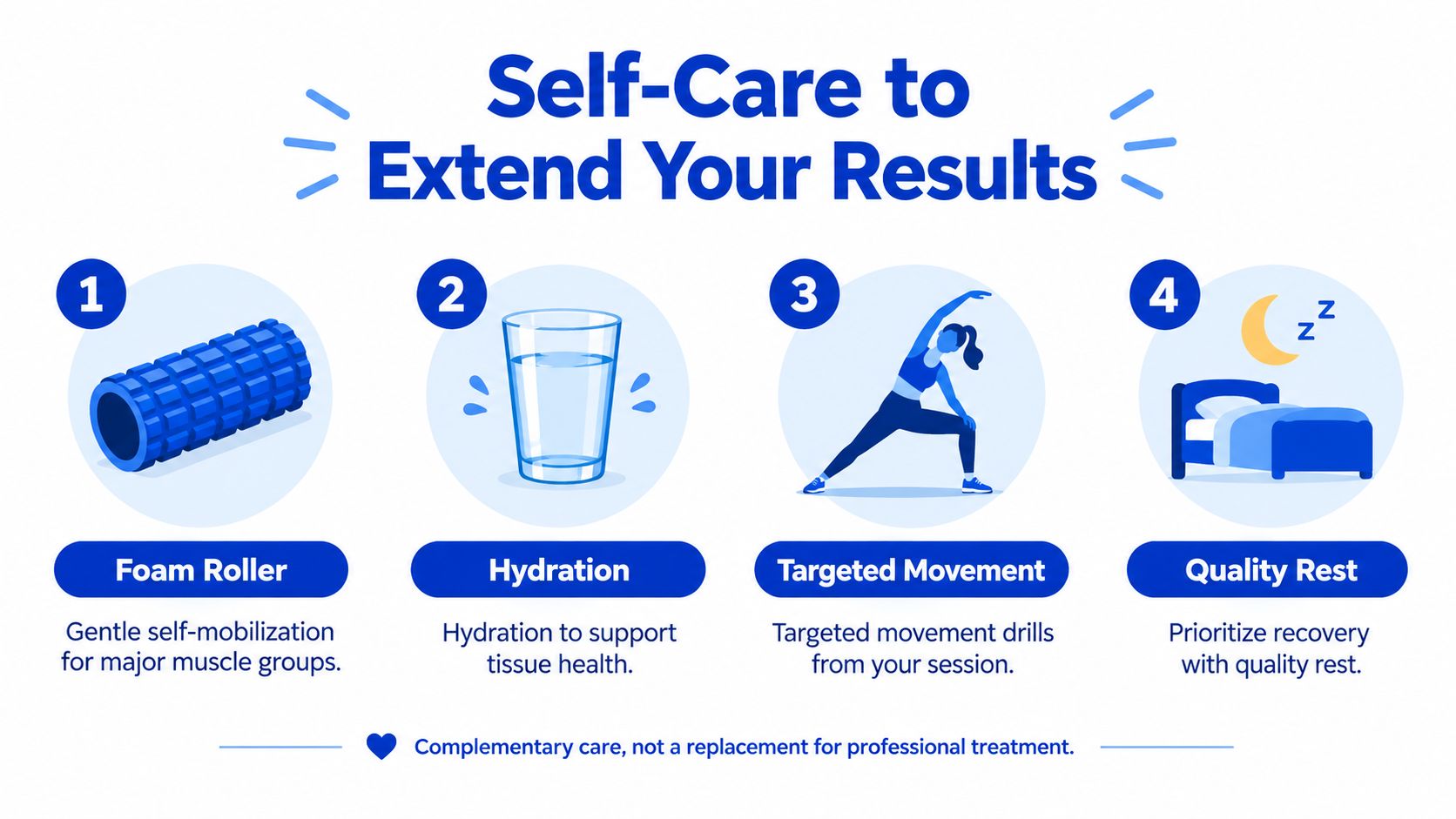
The hours after treatment are a chance to practise the movement that felt restricted. Self-care doesn't replace assessment or rehabilitation, but it can help you keep using the short-term change rather than waiting passively for the next appointment.
A foam roller can provide broad, comfortable pressure to major muscle groups. Move slowly, avoid rolling directly over a painful joint or bony prominence, and don't chase pain. If a region becomes sharper, more sensitive, or noticeably worse afterwards, reduce the pressure or leave it alone.
Make the mobility gain useful
Try a short, easy movement routine that reflects the area treated. This might include comfortable neck turns, shoulder blade movements, thoracic rotation, hip mobility, or a gentle walk. The exact exercises should match your symptoms and the advice from your practitioner.
Heat may make stiffness feel easier before movement, while a comfortable sleep position can reduce repeated overnight irritation. Hydration and regular meals support general recovery, but neither can compensate for excessive training or poor load management.
The lasting driver is graded use of the body, not the roller itself.
Return to sensible activity gradually. Take posture breaks during computer work, vary repetitive tasks, walk when appropriate, and rebuild resistance exercise at a level that your symptoms tolerate. Track how you feel over the following 24 to 48 hours, and treat a clear flare-up as information that the dose needs adjusting, not as a test of toughness.
When to Book a Professional and What to Ask
Self-care is reasonable for a mild, familiar problem that is steadily improving. Consider booking an assessment when pain persists beyond two weeks, flare-ups keep returning after ordinary activity, restricted movement affects daily tasks, or stiffness after an injury isn't settling.
Red flags need medical attention before routine soft tissue treatment. Arrange prompt assessment for unexplained swelling, night pain, numbness, fever, sudden weakness, or symptoms that are rapidly changing. A practitioner may refer you to another health professional when the presentation doesn't fit a straightforward soft tissue problem.
Questions worth asking
A good appointment should leave you with more than temporary relief. Ask:
- Training and approach: What qualifications do you hold, and how do you combine hands-on care with exercise?
- Technique choice: Which technique are you considering, and why does it suit my symptoms?
- Expected response: What should I feel during and after treatment?
- Plan: How will we judge whether treatment is helping?
- Self-care: What movement or loading should I practise between appointments?
The distinction between osteopathy and massage therapy can be confusing, so this osteopathy and massage therapy comparison may help you think about the different purposes and assessment styles.
Treat the first visit as a two-way interview. You're looking for a practitioner who listens, explains the reasoning, respects consent, and gives you an active plan rather than making broad promises about permanent correction.
Bayside Osteopathic Health includes tailored soft-tissue work, gentle mobilisation, movement advice, and practical self-care for people managing neck, back, joint, and postural discomfort. Visit Bayside Osteopathic Health to learn more and book an assessment focused on helping you move with greater comfort and confidence.