
Musculoskeletal pain is pain that comes from the body's moving parts, including muscles, bones, joints, ligaments and tendons, and it can range from a fresh strain to ongoing persistent pain. It's also very common in Australia, where around 7.3 million people, or 29% of Australians, were living with chronic musculoskeletal conditions in 2022 according to the Australian Institute of Health and Welfare summary on musculoskeletal conditions and comorbidity.
You might be reading this because your back feels tight when you get out of bed, your neck seizes after a day at the laptop, or your shoulder keeps nagging you every time you reach overhead. It settles a bit, then returns. That pattern confuses a lot of people.
Pain like this often isn't just about one sore spot. It's often a whole-body movement problem, where posture, work habits, old injuries, stress, sleep, sitting time, and everyday load all play a part. That's why one tablet, one stretch, or one day of rest often doesn't fully solve it.
A gentle osteopathic view looks at how your body is functioning as a system. If one area is stiff, another area usually starts overworking. If your hips don't move well, your lower back may pick up the slack. If your upper back is rigid, your neck and shoulders often complain.
Table of Contents
- Introduction to Musculoskeletal Pain and Why It Matters
- Understanding How Your Musculoskeletal System Works
- Acute Versus Chronic Musculoskeletal Pain Explained
- Common Causes and Risk Factors Behind Musculoskeletal Pain
- Recognising Symptoms and How Musculoskeletal Pain Is Assessed
- Gentle Treatment Prevention and Self Care for Lasting Relief
- When to Seek Professional Help and What to Expect in Bayside
Introduction to Musculoskeletal Pain and Why It Matters
You get out of bed and your back feels tight enough to change how you move. After a shower and a bit of walking around, it eases. Later that day, after sitting at a desk, driving, lifting shopping, or chasing after children, the ache returns. Many Bayside adults know this pattern well.
Musculoskeletal pain means pain coming from the parts of the body that help you hold yourself up and move. That includes muscles, joints, bones, tendons, and ligaments. It can feel local, such as a sore shoulder or aching knee, but the reason it keeps returning is often broader than one tender spot.
Why does that matter? Because pain can shrink daily life. You stop turning your head fully when reversing the car. You avoid longer walks. Sleep becomes lighter. Exercise starts to feel risky, so you do less, and the body often gets less tolerant of load over time.
Musculoskeletal pain is common across Australia, as noted earlier, and it affects far more than sport or exercise. It shows up in desk work, parenting, commuting, gardening, poor sleep, stress, and the steady build-up of everyday strain. In other words, it is often a movement and load problem as much as a pain problem.
A simple way to understand it is to picture the body as a group carrying shopping bags together. If one person in the group gets tired, the others take more weight. For a while, that works. Then another part starts to grumble. A sore knee may change how you walk. A stiff upper back may leave the neck doing extra work. The painful area is real, but it is not always the whole story.
That whole-body view is a big part of osteopathic care. A gentle assessment looks at how you move, where you are stiff, what is overworking, how posture and daily habits may be adding load, and what your body currently tolerates. The goal is not only to name the sore part. It is to understand why that part has been asked to do too much.
For Bayside adults, that can be reassuring. Many musculoskeletal problems respond well to a calm explanation, practical changes in movement and load, and hands-on care matched to the person in front of you. If you are eligible, Medicare-supported care may also be part of the next steps through your GP, depending on your situation.
Understanding How Your Musculoskeletal System Works
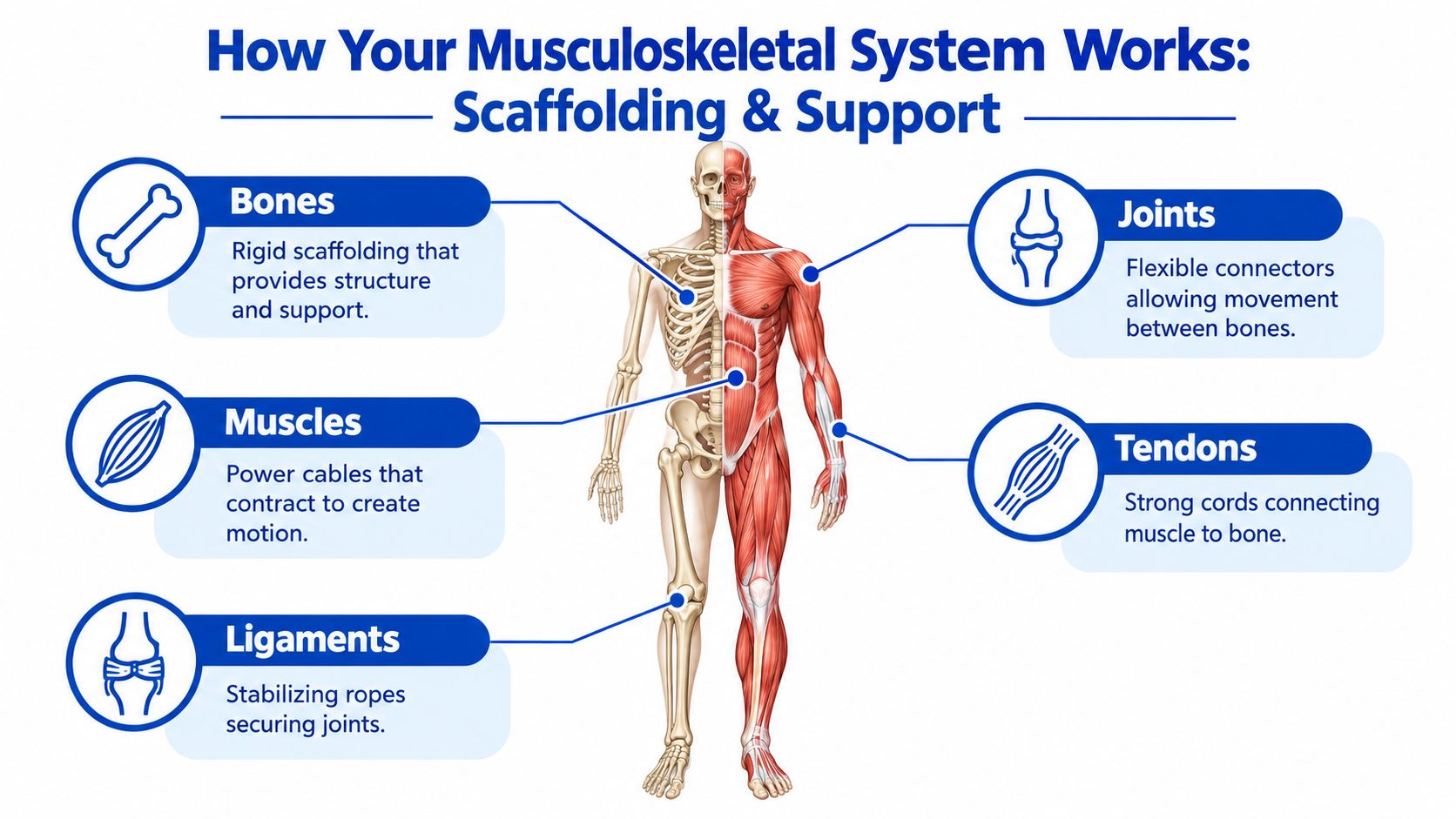
Think of your body like a well-built outdoor tent or a piece of scaffolding. The frame gives shape. The ropes stabilise it. The moving parts need enough freedom to bend without collapsing. When one section gets too tight or too loose, the whole structure feels the strain.
The parts all work together
Here's a simple way to picture each part:
- Bones are the framework. They give the body shape and support.
- Joints are the meeting points. They allow bending, turning, reaching, walking, and lifting.
- Muscles create movement and control. They help you stabilise as much as they help you move.
- Tendons connect muscle to bone, passing force from one to the other.
- Ligaments help hold joints steady, a bit like strong guide ropes.
If all of those tissues share the load well, movement usually feels smooth. If one area gets overloaded, stiff, irritated, or weak, the body starts compensating. That's when pain can begin.
Pain doesn't always mean damage
This point often surprises people. Pain is real, but it doesn't always mean something is badly damaged. Sometimes tissues are irritated because they're under more strain than they can currently tolerate. Sometimes a joint is moving poorly, so nearby muscles stay switched on all day. Sometimes a body part has become more sensitive after weeks or months of repeated aggravation.
A simple example is desk posture. If you sit in one position for hours, your body isn't “wrong” or “broken”. It's just being asked to hold one load, in one shape, for too long. Even a good posture becomes an unhelpful posture when you never vary it.
Practical rule: Bodies usually cope better with varied movement than fixed positions.
Load, tolerance, and sensitivity
A useful way to understand musculoskeletal pain is to think about load versus tolerance. Load is what you ask the body to do. Tolerance is what the body can comfortably handle right now.
When load stays within tolerance, tissues adapt. When load repeatedly exceeds tolerance, pain may show up. That load might come from lifting boxes, gardening, long drives, poor sleep, repetitive mouse use, stress-related muscle tension, or suddenly doing too much after doing very little.
Sometimes pain also lingers because the body becomes more alert to movement and pressure. In plain terms, the alarm system gets easier to trigger. That doesn't mean the pain is “in your head”. It means the body has become protective, and calming that protectiveness often requires a mix of movement, reassurance, pacing, and time.
Acute Versus Chronic Musculoskeletal Pain Explained
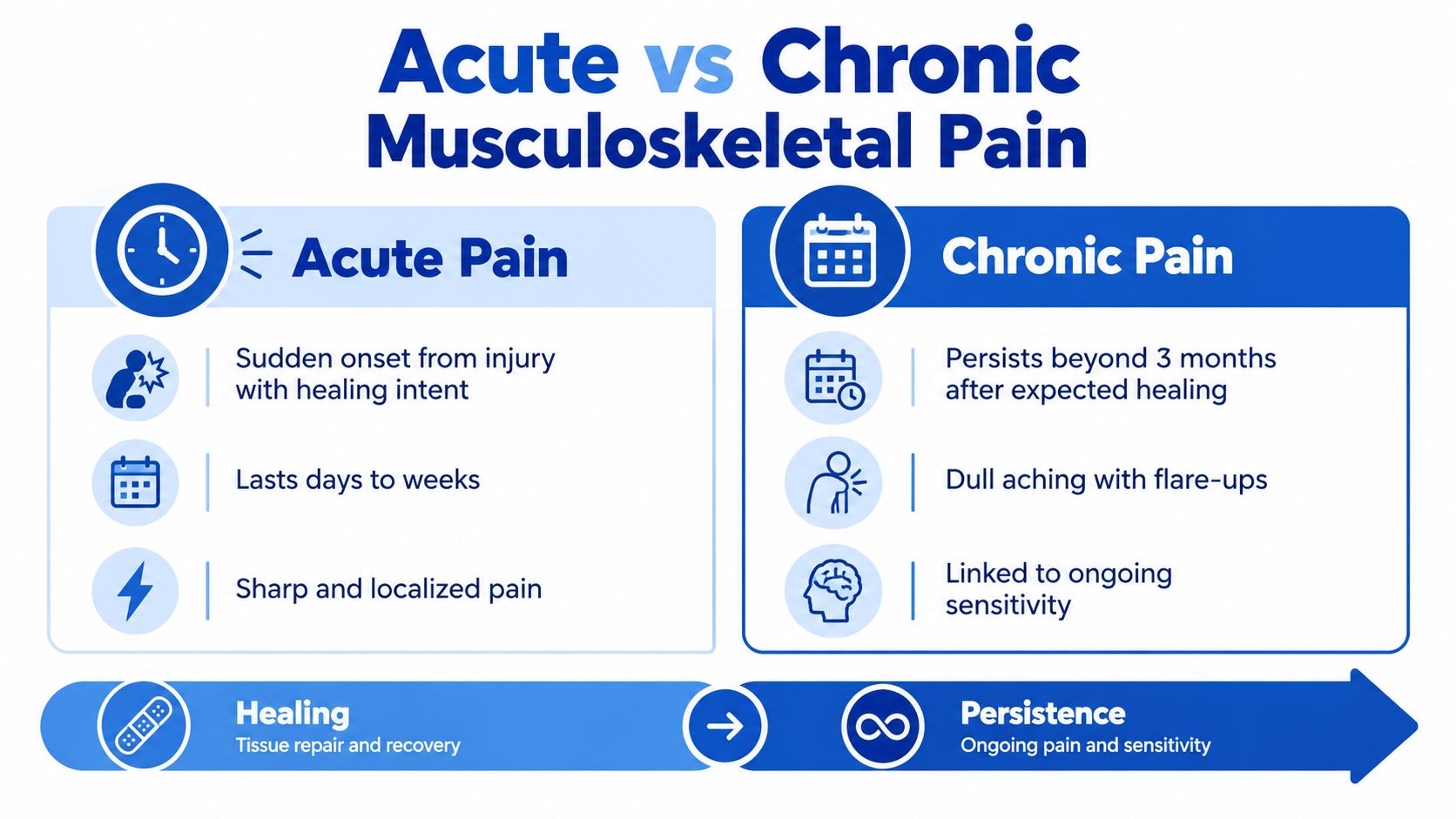
Not all musculoskeletal pain behaves the same way. Some pain is short-lived and clearly linked to a strain or awkward movement. Other pain hangs around well past the expected healing window and seems to flare for reasons that aren't always obvious.
A simple side-by-side view
| Feature | Acute Pain | Chronic Pain |
|---|---|---|
| Typical onset | Often starts suddenly after a strain, twist, lift, or impact | Often builds gradually or persists after the original trigger |
| Usual pattern | Sharp, localised, protective | Aching, stiff, recurrent, sometimes broader or less predictable |
| Purpose | Acts like an alarm during the healing stage | Often reflects ongoing sensitivity, reduced tolerance, or repeated aggravation |
| Rest response | Brief rest can help settle it early on | Rest alone often doesn't solve it and may lead to more stiffness |
| Movement | Needs sensible protection at first, then gradual return | Usually improves with pacing, graded movement, and better load management |
| What it often needs | Time, reassurance, calm loading | A broader plan that considers movement, habits, sleep, stress, and confidence |
Acute pain is usually clearer
Acute pain often makes sense. You lift something awkwardly, roll an ankle, sleep in a strange position, or do a burst of activity your body wasn't ready for. The area feels sore, tight, or sharp, and the body protects it.
That kind of pain can be unsettling, but it often has a clear short-term reason. In many cases, the goal is to calm irritation, avoid big aggravations, and reintroduce movement sensibly rather than stop moving entirely.
Later in the section, this short video gives a useful overview of how musculoskeletal pain can present and why whole-person care matters.
Chronic pain behaves differently
Chronic musculoskeletal pain is different because the issue isn't always just tissue healing. A body part may remain sensitive because it's repeatedly overloaded, under-conditioned, or protected so much that normal movement starts to feel threatening.
People often say, “I rested, so why does it keep coming back?” Usually, it's because rest alone doesn't rebuild capacity. A back, neck, shoulder, or knee tends to do better when it gradually relearns movement and load.
If pain has become persistent, the question often shifts from “What did I injure?” to “What is keeping this area irritated or underprepared?”
Common Causes and Risk Factors Behind Musculoskeletal Pain
Musculoskeletal pain can start in many ways, but most patterns fall into a few practical buckets. Some begin with a clear injury. Others build slowly through repetition, stiffness, deconditioning, or age-related change. Quite often, several factors stack together.
Injury, overuse, and repetitive strain
A straightforward starting point is a strain, sprain, awkward lift, sporting incident, or sudden increase in activity. This kind of pain often feels easier to understand because there's a clear trigger.
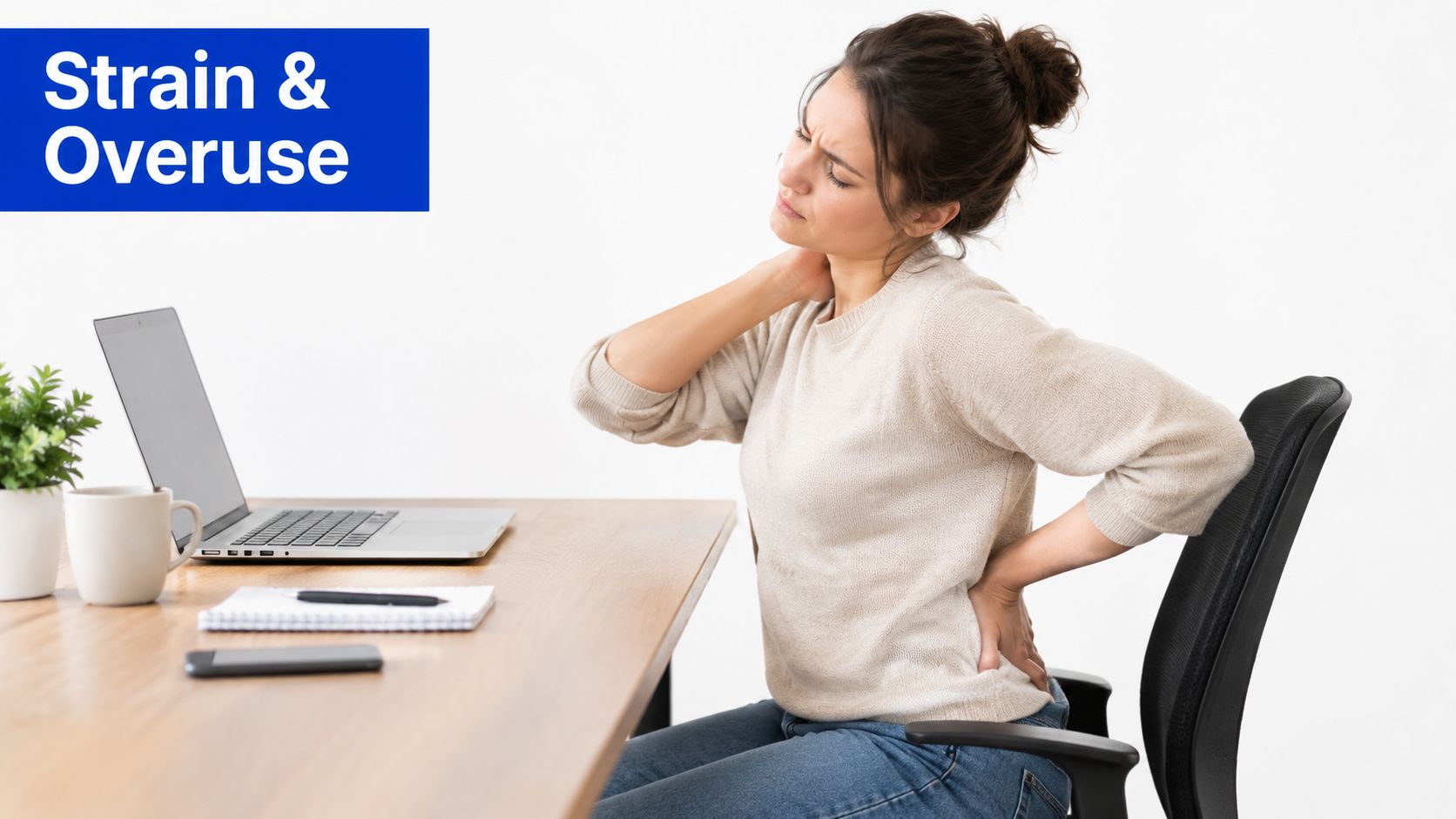
Then there's overuse. That's the slow build. Typing, mousing, driving, painting, lifting grandchildren, carrying tools, or doing the same gym movement too often can gradually irritate tissues. If you spend long periods at a computer, simple ergonomic habits that help prevent repetitive strain can reduce the repeated load that builds through the neck, shoulders, wrists, and lower back.

Posture matters, but variety matters more
People often ask if “bad posture” is the cause. Usually, the bigger issue is staying in one posture too long. A slumped posture can be irritating. So can a rigid upright posture if you hold it all day.
For office and remote workers, this explains why pain keeps returning after short-term fixes. Australian worker-focused data in the 2025 media release on musculoskeletal pain and tech neck reports that the dominant musculoskeletal problems are low back pain at 81%, neck pain at 68%, and mid back pain at 66%. The same source states that 64% of Australians reported neck pain, 70% of neck-pain sufferers said it limited movement or day-to-day activities, 18% of musculoskeletal disorders required workers' compensation, and annual economic costs exceeded $55.1 billion.
Ageing and long-term conditions
As people get older, tissues often become less tolerant of sudden spikes in load. Joints may stiffen. Muscle mass may decline if activity drops. Recovery can take longer. Conditions such as osteoarthritis and osteoporosis can also shape how pain presents.
The AIHW summary on musculoskeletal conditions notes that about 4 million Australians have some form of chronic back pain, 3.6 million have arthritis, and more than 900,000 live with osteoporosis. The same source reports $14.7 billion was spent on musculoskeletal conditions in 2020–21, representing 9.8% of total national health expenditure, and earlier figures recorded 536,804 hospitalisations with a musculoskeletal condition as the principal diagnosis in 2016–17.
Why back pain deserves special attention
Back pain is a major part of this picture. According to the AIHW burden of disease update for musculoskeletal conditions, back pain and problems accounted for 31% of total musculoskeletal burden in 2011 and 34% in the 2023 update. In plain terms, spinal pain carries a very large share of the burden.
That's one reason a whole-body approach matters so much. A sore back is rarely just about the back. Hip mobility, ribcage stiffness, work setup, walking tolerance, lifting habits, sleep quality, and stress can all influence how the back copes.
Recognising Symptoms and How Musculoskeletal Pain Is Assessed
People often expect musculoskeletal pain to feel dramatic. Sometimes it does. Often, though, it shows up as a quieter pattern that gradually interferes with normal life.
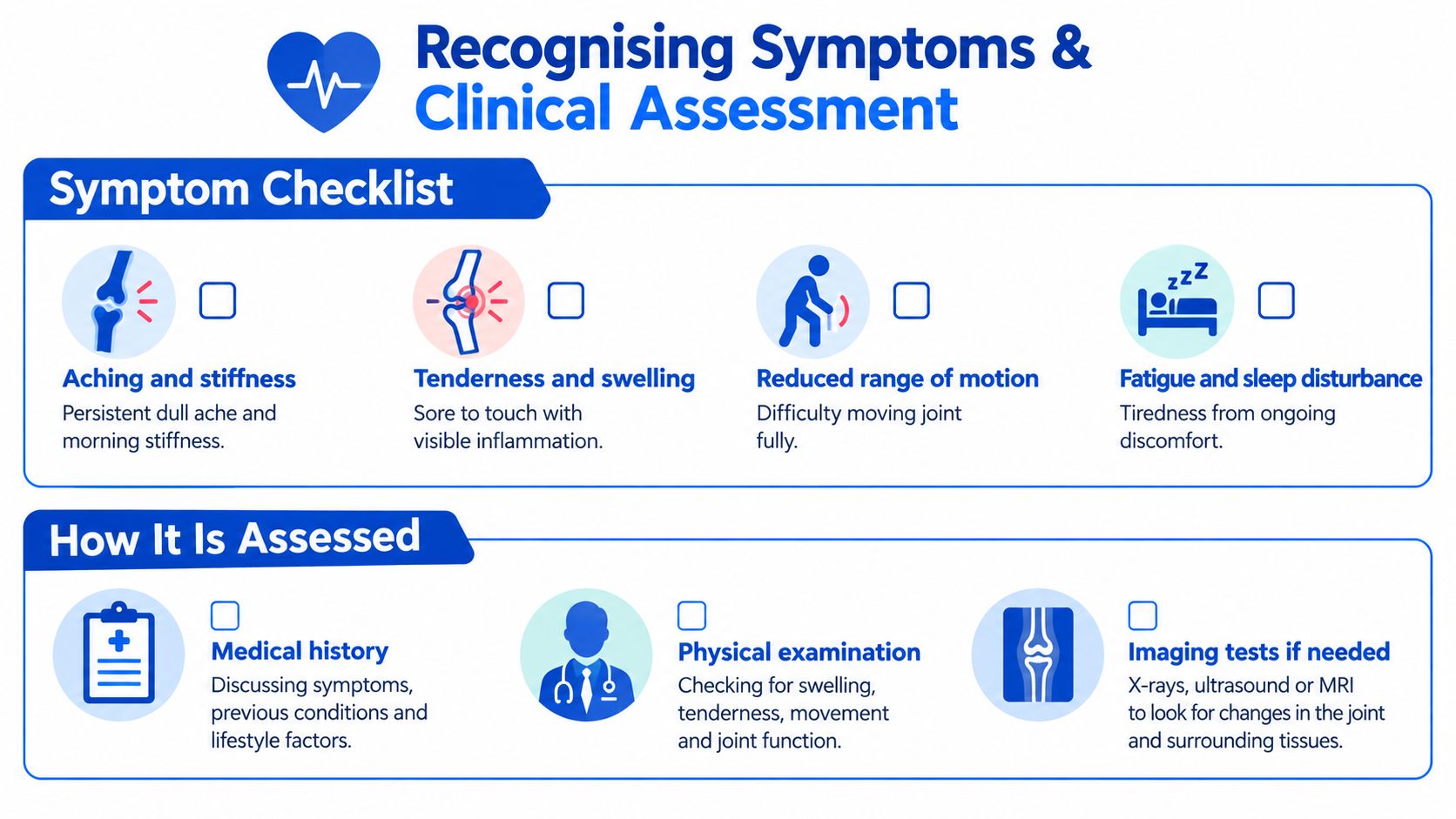
Common signs people notice first
Typical symptoms include:
- Aching and stiffness that's worse first thing in the morning or after sitting still
- Tenderness when you press an area, lean on it, or move in a certain direction
- Reduced range of motion such as difficulty turning your head, bending, squatting, or reaching
- Pain linked to activity or posture such as symptoms that build during desk work, walking, lifting, or housework
- Flare-ups that come and go depending on load, sleep, stress, or how active you've been
Some people also notice that the painful area isn't the only problem. They may feel less coordinated, less strong, or more hesitant to move.
What an assessment usually involves
A good musculoskeletal assessment is usually calm, practical, and hands-on. It often starts with listening. When did the pain begin? What makes it better or worse? What's your workday like? How are you sleeping? What activities are you missing?
After that, a clinician usually looks at how you move as a whole. That may include posture, walking, turning, bending, balance, and the way nearby joints and muscles are sharing the load. Gentle hands-on assessment can help identify stiffness, tension, tenderness, and movement patterns that may be feeding the problem.
Bring a simple timeline to your appointment. Note when the pain started, what flares it, what eases it, and how it affects work, sleep, exercise, or chores.
When scans are and aren't part of the picture
People often assume they need imaging straight away. Sometimes they do. Often they don't. Many musculoskeletal problems can be assessed clinically first, especially when the story clearly fits a strain, overload pattern, or mechanical irritation.
Imaging or referral may be considered when symptoms are severe, unusual, persistent, or suggest something more complex. The main value of the first assessment is often not just naming a body part. It's understanding why your body is struggling with that load right now.
Gentle Treatment Prevention and Self Care for Lasting Relief
Don't need a harsh or complicated plan. They need the right mix of calm hands-on care, sensible movement, and small daily changes that lower irritation and rebuild confidence.
What gentle treatment can look like
Osteopathic care often focuses on helping the body move more freely and share load more evenly. Depending on the person, that might include soft-tissue work for tight muscles, gentle joint articulation, or mobilisation for areas that feel restricted.
If you'd like to understand one part of that hands-on approach, this overview of soft tissue mobilisation techniques in manual therapy shows the kind of tissue-focused work often used to reduce tension and improve comfort. In Bayside, Bayside Osteopathic Health provides assessment of posture and whole-body movement, along with gentle manual care and movement advice suited to the individual.
Why movement is part of the treatment
Treatment isn't only what happens on the table. The body usually changes best when hands-on care is paired with movement. That might mean walking, gentle mobility work, graded strengthening, or pacing your return to normal tasks.
If rest has become your main strategy, this is often the turning point. Rest can calm a flare. But for many persistent problems, the long-term answer is rebuilding tolerance.
Self-care that usually helps more than people expect
A few simple habits often make a real difference:
- Change position often. If you work at a desk, stand up, walk, stretch, or reset your sitting position regularly.
- Use pacing. Break bigger jobs into smaller blocks before the pain spikes.
- Keep movement gentle and regular. A short walk is often more useful than waiting for a “perfect” pain-free day.
- Support sleep where you can. A calmer bedtime routine and a comfortable sleep position often help the body recover better.
- Notice stress load. Many people carry stress in the jaw, neck, shoulders, chest, and lower back without realising it.
Small, repeatable changes usually beat heroic efforts followed by flare-ups.
Prevention is often about capacity, not perfection
Many adults think prevention means finding one perfect chair, pillow, stretch, or posture. In reality, prevention usually comes from building a more adaptable body. Better hip mobility, stronger legs, steadier core control, more walking, varied positions, and smarter work habits all help tissues tolerate life better.
For arthritis-related discomfort, the same broad principle applies. Joints often prefer gentle circulation, regular movement, and load that is steady rather than spiky. The aim isn't to ignore pain. It's to respond to it in a way that helps the body feel safer and move better over time.
When to Seek Professional Help and What to Expect in Bayside
Sometimes musculoskeletal pain settles with sensible self-care. Sometimes it doesn't. Knowing when to get help can stop a short-term problem from becoming a long-running one.
Signs it's time to book an assessment
Consider professional help if:
- Pain keeps returning despite rest, stretching, or changing your routine
- Movement is shrinking and you're avoiding bending, walking, lifting, or exercise
- Work or sleep is being affected and the problem is starting to shape your day
- You're not sure what triggered it or the pain pattern feels confusing
- The issue feels broader than one sore spot and you suspect posture, mobility, or workload are all part of it
Prompt medical review is also important if pain follows a significant fall or trauma, if you develop marked weakness, fever, unexplained weight loss, or if symptoms feel severe or unusual.
What a first visit is usually like
Many people worry that an appointment will be rushed or forceful. It shouldn't be. A thoughtful first visit usually involves a case history, discussion of your symptoms and routine, and a movement assessment that looks at how the body is functioning together.
If you'd like a simple preview, this guide on what to expect after osteopathic treatment and care can make the process feel more familiar. You can usually expect a practical explanation, a working plan, and advice on what to do between visits.

Medicare-aware next steps
For some Bayside adults, Medicare-related support may be available where applicable under certain eligible care plans. The exact pathway depends on your circumstances and whether your GP has arranged the relevant plan. If you're unsure, it's worth asking before or during booking so you know what documents to bring.
The main point is simple. If pain is lingering, recurring, or limiting your life, you don't need to keep guessing. A whole-body assessment can help make sense of the pattern and give you a calmer, more useful next step.
If you're dealing with back, neck, or joint pain that keeps returning, Bayside Osteopathic Health offers gentle hands-on osteopathic care, movement assessment, and practical self-care guidance for Bayside adults. The focus is on understanding how your body is moving as a whole, not just chasing the sore spot. If that sounds like the kind of help you've been looking for, it's a sensible next step to book an assessment and get a clear plan.