
By the end of a workday, many people can feel the pattern building. You've leaned towards a laptop for hours, twisted to grab something from the back seat, lifted a grocery bag one-handed, skipped a walk because you were busy, and gone to bed tense. Nothing seems dramatic in the moment, but those small habits can add up to a sore, stiff, easily irritated back.
That's why back injury prevention tips work best when they're practical and combined. Prevention isn't about freezing yourself into one “perfect” posture or avoiding activity. It's about setting up your environment well, changing position often, handling load sensibly, staying active, recovering properly, and getting help when your body starts giving you clear warnings.
This matters in Australia. Back problems affected an estimated 3.7 million Australians, or 16% of the population, and they were the third leading cause of disease burden at 3.6% of total burden, according to the Australian Institute of Health and Welfare burden snapshot. For many adults, prevention needs to fit real life, including desk work, lifting, exercise, sleep, stress, food, and ongoing support.
The eight strategies below are built around those daily pressure points. If your pain is persistent, worsening, spreading, or paired with other concerning symptoms, get a proper medical assessment rather than trying to push through.
Table of Contents
- 1. Maintain Proper Posture and Use Ergonomic Support
- 2. Build Strength Around the Spine, Not Just the “Core”
- 3. Practise Proper Lifting and Bending Techniques
- 4. Stay Active and Avoid Prolonged Immobility
- 5. Manage Stress and Tension Through Relaxation Techniques
- 6. Optimise Your Sleep Posture and Sleeping Environment
- 7. Maintain Healthy Body Weight and Nutrition
- 8. Seek Ongoing Professional Support When Your Back Keeps Warning You
- Back Injury Prevention: 9-Point Comparison
- Build a Back-Smart Routine That Lasts
1. Maintain Proper Posture and Use Ergonomic Support
For desk workers and remote workers, the biggest problem usually isn't one bad sitting position. It's staying in the same position too long while the screen, chair, keyboard, and phone all encourage slumping or reaching.
Australian guidance has shifted in that direction. Public-facing prevention advice now puts more emphasis on movement breaks, workstation setup, car-seat adjustment, and reducing device strain rather than treating back prevention as only a lifting issue. The Australian Chiropractors Association Spinal Health Month campaign also recommends stretching every 10 minutes on mobile devices and every 30 minutes on computers.
Set up the space so your body doesn't fight it
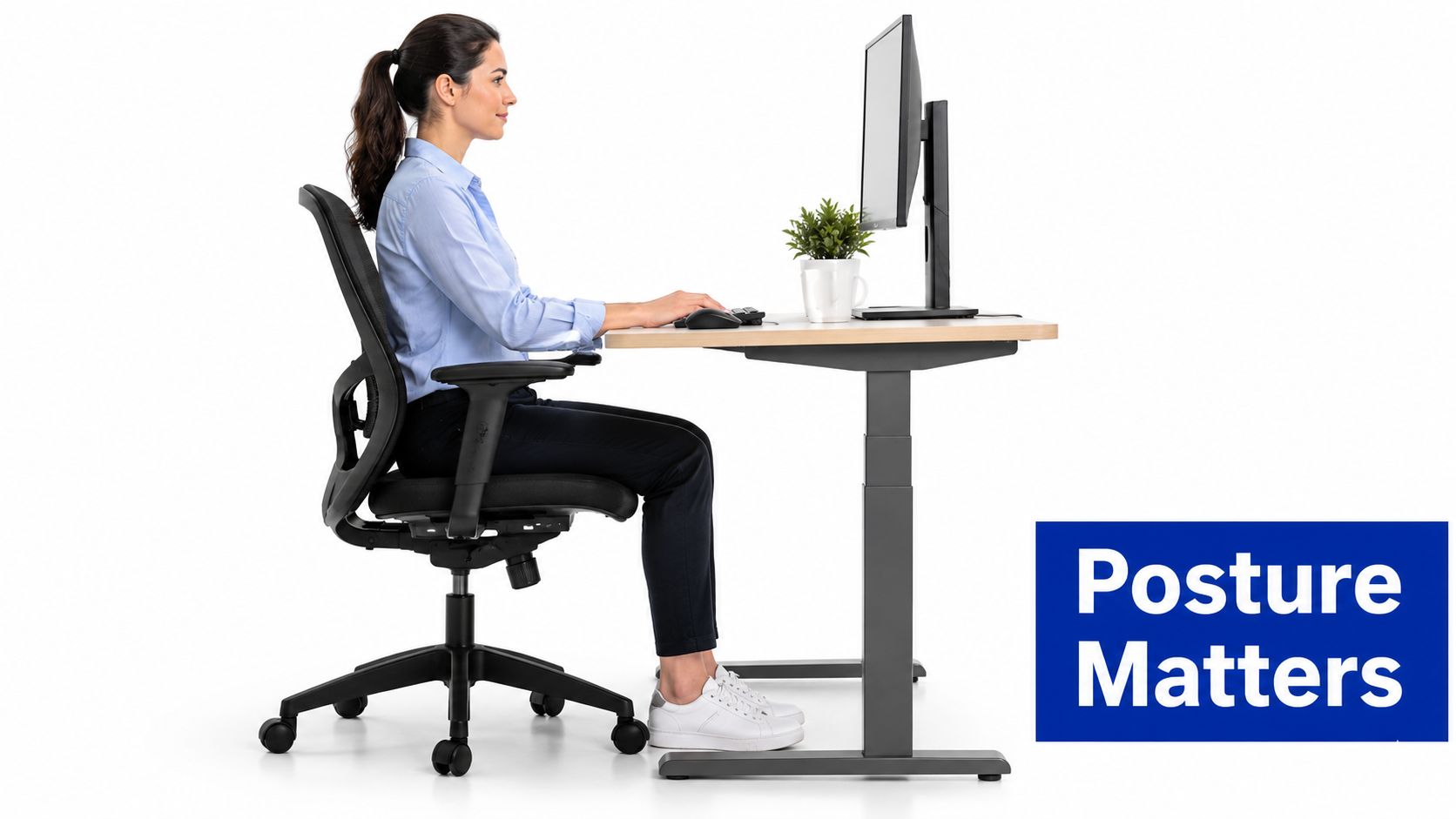
A good setup should make the easier position the healthier one. That means your monitor is roughly at eye level, your keyboard is close enough that you don't shrug forward, and your chair supports your lower back without tipping you into a rigid posture.
If you work from a laptop, a stand plus a separate keyboard and mouse is usually a better option than hunching over the screen. A visual guide like this corporate ergonomics posture image can help you compare your desk with a more supportive layout.

Practical rule: Ergonomic equipment should help you move better. It shouldn't trap you in one position all day.
Small changes that reduce cumulative strain
- Raise the screen: Put the top of the monitor around eye level so your neck and upper back don't drift forward.
- Support the lower back: Use a chair with lumbar support, or add a small cushion if the chair is flat.
- Keep tools close: Place the mouse, phone, notebook, and water bottle within easy reach to reduce repeated twisting.
- Change positions often: Alternate between sitting, standing, and short walking breaks instead of relying on posture alone.
Drivers can use the same principle. If you spend long periods in the car, adjust the seat so you're not reaching for the wheel and consider a small lumbar support if the seat feels hollow through the lower back.
2. Build Strength Around the Spine, Not Just the “Core”
People often hear “strengthen your core” and immediately think of crunches. That usually misses the point. Your back is better protected when the muscles around your trunk, hips, and pelvis work together during everyday tasks such as walking, carrying, reaching, and getting up from the floor.
For older adults, office workers, and active people returning to exercise, the best program is usually the one you can do consistently and progress gradually. It doesn't need to look advanced to be useful.
Start with control before intensity
A person who can brace gently, breathe well, and move the hips without overworking the lower back is often in a better position than someone doing high-effort exercises with poor control.
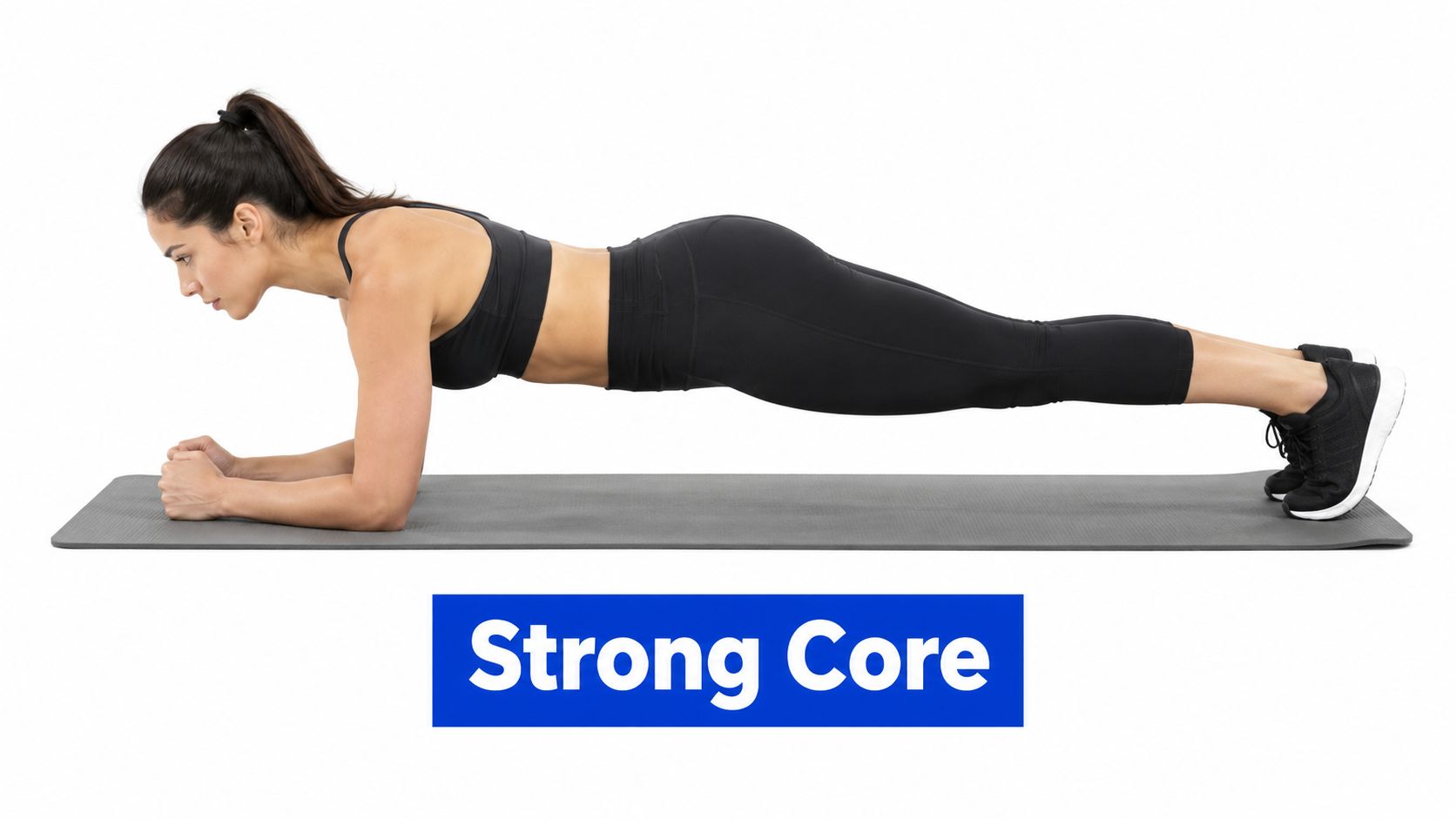
That's why early strength work often starts with simple drills. A supervised rehab-style program, such as the kind shown in this exercise rehabilitation image, reflects what many people need at first: calm repetition, good form, and progression that matches their current capacity.

Useful exercise choices
- Begin with low-load control: Pelvic tilts, breathing-based abdominal activation, bird dogs, and dead bugs can teach better control without a lot of strain.
- Add endurance gradually: Side planks, front planks, and loaded carries can build the kind of support your spine needs across the day.
- Train the hips too: Glute bridges, step-ups, and sit-to-stand variations help take unnecessary load away from the lower back.
- Stop chasing fatigue: If the exercise leaves your back more irritated each time, scale it down and improve technique first.
I often find that people feel better when they stop trying to “smash the core” and instead learn how to move with less bracing and more control.
3. Practise Proper Lifting and Bending Techniques
Lifting is still one of the clearest pressure points for back pain, especially when people are tired, rushed, or working in awkward spaces. In Australia, lifting, pushing, pulling, or bending accounted for 24% of work-related injury or illness cases in 2021 to 2022, according to Safe Work Australia reporting cited in an Australian Chiropractors Association media release.

That doesn't mean every lift is dangerous. It means repeated loading, poor planning, and awkward body positions matter more than many realise.
What good lifting usually looks like
The safest lift is often the one you redesign. Move the object closer, clear the path, split the load, or get help before your body has to compensate.
For everyday lifting, these habits tend to work well:
- Test first: Nudge or partially lift the object before committing to the full movement.
- Keep it close: Holding the load near your body reduces the lever arm and usually feels more controlled.
- Use the legs and hips: Bend through the hips and knees rather than folding only through the waist.
- Turn with the feet: Pivot instead of twisting through the trunk while carrying.
Parents lifting children, gardeners moving pots, and retail staff unloading stock all run into the same issue. The risky part is often the awkward reach, the uneven carry, or the repeated bend, not just the object's weight.
A short demonstration can help if you learn visually:
Don't force a “perfect” textbook lift in every situation. Aim for a controlled load, a close hold, and less twisting.
4. Stay Active and Avoid Prolonged Immobility
One of the most useful back injury prevention tips is also one of the simplest. Don't stay still for too long.
Australia's Low Back Pain Clinical Care Standard recommends reducing long periods of inactivity and using self-management plus physical activity early. It also notes that no specific exercise is required at the acute stage. The practical message in the Low Back Pain Clinical Care Standard is clear. Short bouts of movement and avoiding prolonged sitting are generally preferred over bed rest for most non-specific back pain presentations.
Movement beats over-resting
Many people swing between two extremes. They either do too much too soon, or they stop moving almost completely because they're afraid of making the pain worse.
A steadier approach works better for most backs. If walking is comfortable, walk. If sitting makes you stiff, stand up sooner. If standing in one place is the problem, break it with a short change of task.
Easy ways to move more during the day
- Use short breaks well: Stand up, reach overhead, walk to the kitchen, or do a lap around the office.
- Build movement into routine tasks: Walk during phone calls, take stairs when practical, or park slightly further away.
- Restart gently after a flare: A few minutes of walking or gentle mobility can be more useful than waiting for the back to “settle itself”.
- Match the activity to the person: An older adult might start with steady walking. A tradesperson may need mobility and pacing between heavier tasks.
This matters for desk workers, drivers, and home-based workers who don't think of themselves as inactive because they feel busy all day. The body still notices long hours in one position.
5. Manage Stress and Tension Through Relaxation Techniques
Stress doesn't just affect mood. It changes how people breathe, brace, sleep, and carry tension through the neck, shoulders, ribcage, and lower back. A person under pressure often sits more rigidly, clenches more, and recovers less well.
Australian-facing guidance increasingly reflects that whole-person view. Prevention advice now highlights stress, sleep, physical activity, weight, and smoking as part of reducing recurrence instead of relying on posture cues alone, as outlined in Healthdirect's back injuries guidance.
The back often reacts to the day, not just the task
You can have a reasonable workstation and still finish the day tight and sore if you've spent hours rushing, holding your breath, and moving from one demand to the next. That doesn't mean the pain is “just stress”. It means the nervous system and the musculoskeletal system influence each other.
I often see this with people who say, “My back goes out when work gets hectic.” They may not be lifting more. They're usually sleeping less, bracing more, and taking fewer movement breaks.
A tense back often needs two things at once. Better movement and less threat.
Simple ways to lower physical tension
- Use short breathing resets: Slow nasal breathing or box breathing for a few minutes can reduce that guarded, braced feeling.
- Pair relaxation with movement: Gentle stretching after a stressful meeting often works better than trying to meditate while still physically keyed up.
- Protect transition points: The drive home, lunch break, and pre-bed period are useful times to downshift rather than keep pushing.
- Reduce all-day clenching: Uncross your legs, drop your shoulders, unclench your jaw, and let the abdomen soften between tasks.
People with recurring pain often do better when they stop separating “physical” care from “mental” recovery. The body doesn't divide the day that neatly.
6. Optimise Your Sleep Posture and Sleeping Environment
Many people wake with more pain than they had the night before. That usually points to a recovery problem rather than a pure daytime problem. Sleep is when irritated tissues calm down and muscles finally get a chance to stop working, so an awkward sleep setup can keep the back grumbling.

Make the bed support your shape
The best sleep posture is usually the one that lets the spine rest without sustained twisting or sagging. For many people, that means side sleeping with a pillow between the knees or back sleeping with a pillow under the knees.
Stomach sleeping can be harder on the neck and lower back because it often combines rotation with extension. Some people tolerate it, but many wake stiffer from it.
What to change first
- Check the pillow: If your neck bends sharply up or down, the pillow height may be wrong for your build and sleep position.
- Support the legs: A pillow between the knees can reduce strain through the hips and lower back for side sleepers.
- Avoid collapsing mattresses: If the mattress sags through the middle, your back has to absorb that shape for hours.
- Give new positions time: A better setup can feel unfamiliar at first, especially if your current habits are old ones.
People with arthritis, older adults, and anyone already waking stiff often notice that a small adjustment in pillow support changes the whole night. Sleep posture won't solve every back problem, but poor sleep support can keep a manageable issue from settling.
7. Maintain Healthy Body Weight and Nutrition
Food won't “fix” back pain on its own, but your daily eating patterns affect energy, inflammation, tissue repair, and body weight. Those things influence how easily you move and how well you recover from both work and exercise.
This section is where many people either become too strict or too casual. Neither extreme helps much. A sustainable approach usually works best.
Think support, not punishment
A healthy eating pattern for back health should support muscle maintenance, regular movement, and steady recovery. If your diet leaves you tired, under-fuelled, or constantly hungry, it usually becomes harder to exercise, sleep well, and make good decisions when pain flares.
For people carrying extra weight, gradual change tends to be more realistic than dramatic overhauls. For older adults, the priority may be enough protein and consistent meals to maintain muscle and confidence with movement.
Habits that usually help
- Build meals around basics: Include a protein source, vegetables or fruit, and enough energy to get through the day without crashing.
- Drink regularly: Mild dehydration can make people feel flatter, stiffer, and less inclined to move.
- Limit all-or-nothing dieting: Repeated restriction often backfires and can reduce the consistency needed for exercise and recovery.
- Notice lifestyle clusters: Poor sleep, stress eating, inactivity, and smoking often travel together and can keep pain recurring.
This is one of the less glamorous back injury prevention tips, but it matters. A body that's well fed, reasonably strong, and regularly active usually tolerates life better than a body that is run down and inflamed by poor habits.
8. Seek Ongoing Professional Support When Your Back Keeps Warning You
Self-management matters, but so does knowing when you need a closer look. If your back repeatedly flares with ordinary activity, never fully settles, or changes the way you work, exercise, or sleep, it's time for a more individual plan.
Back problems remain a major health burden in Australia. The Australian Institute of Health and Welfare reported 177,000 hospitalisations with a principal diagnosis of back problems in 2021 to 2022, equal to 690 hospitalisations per 100,000 population, in the national work-related musculoskeletal context summarised by Safe Work Australia. That's a reminder that persistent back issues deserve attention before they escalate.
Personal assessment matters more than generic advice
One person's issue is too much sitting. Another's is deconditioning after an injury. Another is sleeping badly, lifting poorly at work, and trying to restart exercise too aggressively on weekends.
A hands-on assessment can help identify movement habits, stiff areas, strength gaps, and aggravating tasks that generic online advice can't fully account for. For people considering care, this guide to what to expect after osteopathic treatment gives a useful picture of the kind of supportive follow-up many patients want.

When support is especially useful
- Recurring flare-ups: The pain settles, then returns with work, housework, or training.
- Reduced confidence: You've started avoiding lifting, walking, sport, or travel because the back feels unreliable.
- Mixed triggers: Symptoms seem tied to several factors at once, such as desk work, stress, poor sleep, and weekend activity.
- Slow recovery: You've tried rest, stretching, or home exercise, but progress keeps stalling.
Good support should leave you with more than a treatment session. It should give you a clearer plan for movement, loading, pacing, and recurrence prevention.
Back Injury Prevention: 9-Point Comparison
No single tip protects every back in every situation. A desk worker who stiffens up after long meetings, a parent lifting a child from the floor, and a runner returning after time off all need the same basic goal, but they usually need a different starting point.
A more useful way to compare these nine points is to match them to the part of daily life that places the most strain on your back right now.
For desk work, posture and ergonomic support often give the quickest relief from low-grade strain, especially if your day involves hours of sitting, driving, or looking down at a screen. For lifting tasks at work and home, bending and carrying technique matters more because one rushed, awkward effort can flare things quickly. If inactivity is the bigger issue, regular movement and gradual conditioning usually deserve attention before anything more advanced.
Exercise adds another layer. Strength work around the spine helps when the back feels underprepared for normal loads, but it needs to match your current capacity, not your ideal version of yourself. Sleep and stress also deserve more weight than people often give them. Poor sleep can leave the back stiff and irritable the next morning. Ongoing tension can keep muscles braced all day, which makes ordinary tasks feel heavier than they are.
Nutrition and body weight tend to work more slowly, but they influence the background load your back carries over months and years. Professional support sits in a different category again. It becomes more useful when warning signs keep repeating, several triggers are stacking together, or you are no longer sure which change will give the best return.
If you want a quick way to prioritise, use this order: fix the stressors you face most often, then add the supports that help you recover from them. Someone at a computer all week may get more from workstation changes, walking breaks, better sleep, and a short strength plan than from focusing on lifting technique alone. Someone in a manual job may need the reverse.
The point is coordination. These strategies work best when they reinforce each other across desk work, lifting, inactivity, exercise, sleep, stress, nutrition, and ongoing support, rather than being used as isolated fixes.
Build a Back-Smart Routine That Lasts
The most effective back injury prevention tips usually look ordinary from the outside. You raise your screen instead of craning down at it. You stand up before stiffness sets in. You carry the shopping in two smaller trips instead of one awkward heave. You add a few strength exercises that match your current capacity. You sleep in a position that lets your back settle rather than twist for hours. None of those changes is dramatic, but together they lower the daily load your back has to absorb.
That combined approach also fits what we know about recurrence. Back pain often isn't driven by one single error. It's shaped by a pattern. Workstation strain, long periods of sitting, repeated bending, rushed lifting, poor sleep, stress, low activity, and inconsistent recovery can all stack up across the week. When people improve several of those areas at once, the plan tends to feel more realistic and more durable.
A simple weekly routine might look like this. Set up your desk and car seat properly on Monday. Keep movement breaks going throughout the workweek. Practise safer lifting with laundry, groceries, garden tools, or gym equipment. Add two or three short strengthening sessions that focus on control and consistency rather than intensity. Protect sleep by checking your pillow, bedtime habits, and preferred sleep position. If stress is pushing your body into constant tension, build in short breathing or walking resets before that tension becomes your normal.
The routine should still match the person. An office worker with device strain needs a different emphasis from a tradesperson, a golfer, or an older adult managing arthritis and morning stiffness. Someone recovering from a recent flare may need shorter walks and lighter strengthening at first. Someone already active may need better pacing, technique, and recovery rather than more exercise.
If symptoms persist, limit activity, or keep returning, personalised assessment becomes part of prevention, not a last resort. Bayside Osteopathic Health is one local option for people in the Bayside community who want individual osteopathic assessment, movement guidance, and practical self-care strategies that fit their work and daily life. At the same time, urgent or concerning symptoms should always be assessed through appropriate medical care rather than managed as a routine strain.
The goal isn't to move perfectly all day. It's to make your usual day less provocative and more supportive. That's what tends to protect the back over time.
If your back keeps tightening up at the desk, flaring after lifting, or feeling unreliable during everyday activity, Bayside Osteopathic Health offers hands-on osteopathic care, movement assessment, and practical guidance for how you work and move. You can learn more or book an appointment through Bayside Osteopathic Health if you'd like support building a back-smart plan that fits your routine.