
Joint mobility is the active range of motion you can control, not just how far someone else can move a joint for you. In Australia, this matters far beyond the gym, because arthritis and related conditions affect about 14.5% to 16% of the population, and for many people the issue is whether they can walk, bend, climb stairs, and get through an ordinary day.
You might be reading this because something feels stiff. Maybe bending to tie your shoes is awkward in the morning. Maybe your neck won't turn easily when you reverse the car. Maybe your shoulder feels “tight”, so you stretch it, but the movement still feels blocked.
That's where people often get confused.
They assume stiffness always means a muscle needs stretching. Sometimes that's true. But often, the problem sits in the way a joint moves, the way your muscles control that movement, or the way pain makes your body guard against motion.
When people ask what is joint mobility, they're usually asking a more practical question. They want to know why movement feels limited, whether that's normal, and what to do next if it doesn't improve.
Table of Contents
- Why Simple Stretching Often Fails
- What Joint Mobility Actually Means
- Mobility Versus Flexibility
- The Scale of the Problem in Australia
- How Osteopaths Assess Movement
- Strategies to Restore and Maintain Mobility
Why Simple Stretching Often Fails
A common pattern goes like this. Your hips feel stiff, so you do a few stretches from memory. Your back still feels tight when you get out of a chair. You try reaching overhead, and your shoulder still catches halfway up.
That's frustrating, but it also makes sense.
Stretching targets muscle length. Mobility is broader. It includes how the joint surfaces move, how the surrounding tissues allow motion, how your muscles guide the movement, and whether pain is changing your movement pattern.

Stiff doesn't always mean short muscles
Think about squatting to pick something up from the floor. If your ankles don't bend well, your hips feel blocked, or your back stiffens protectively, a hamstring stretch alone won't solve much. The movement involves several joints working together.
The same thing happens with the shoulder. Many people say “my shoulder is tight” when what they really mean is that lifting the arm feels pinched, weak, or uncoordinated. That isn't just a flexibility issue.
Practical rule: If stretching gives brief relief but the movement still feels restricted in daily tasks, you may be dealing with a mobility problem rather than simple muscle tightness.
Why forcing a stretch can backfire
When a joint is irritated, your body often responds by guarding. Muscles tighten around the area to protect it. If you push hard into that resistance, you may feel more sore without improving usable movement.
That's why some people stretch constantly and still feel stiff. The body isn't refusing to move out of stubbornness. It may be protecting a joint that feels unstable, painful, or poorly controlled.
A better question is not “how far can I stretch?” but “how well can I move this joint under control?”
- Morning stiffness: May improve with gentle movement, but if it keeps returning, there may be an underlying joint issue.
- Blocked movement: A feeling of catching, pinching, or compressing often points to more than muscle tightness.
- Poor control: If you can get into a position but can't hold or repeat it smoothly, mobility is likely part of the problem.
That shift in thinking matters. It turns the goal from chasing looser muscles to restoring movement that helps you live normally.
What Joint Mobility Actually Means
At its simplest, joint mobility means the amount of movement a joint can use actively and under your control. That last part is important. A joint doesn't count as mobile just because someone else can push it further.
Australian health education sources distinguish between active, passive, and functional range of motion, and note that range is commonly measured in degrees with tools such as goniometry, as outlined in this explanation of range of motion and joint movement.
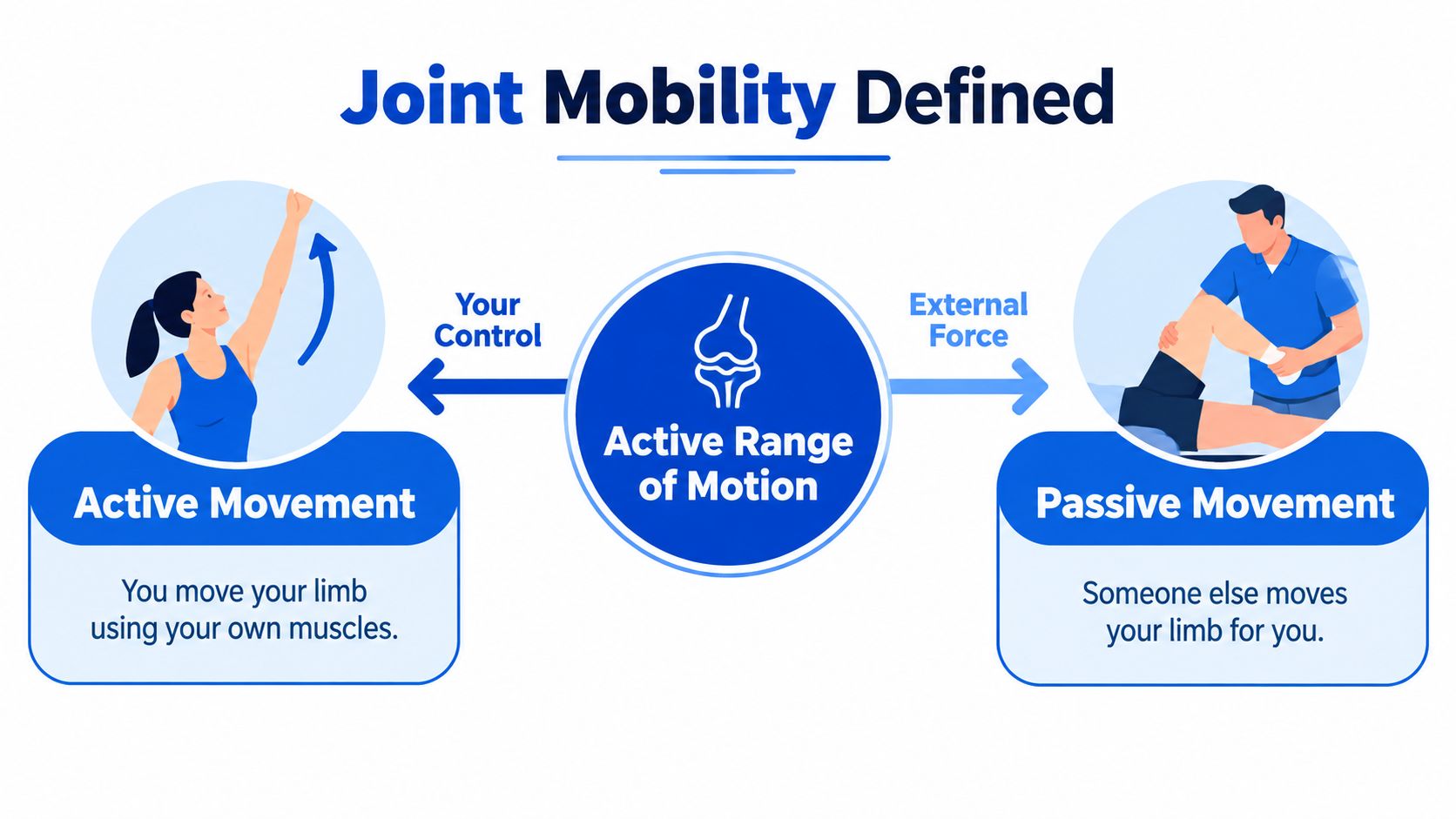
Active, passive, and functional movement
Here's the clearest way to separate the terms:
| Type of movement | What it means | Everyday example |
|---|---|---|
| Active range | You move the joint yourself | Lifting your own arm overhead |
| Passive range | Someone or something else moves it | A clinician moving your arm while you stay relaxed |
| Functional range | The movement you can use in real tasks | Reaching a shelf, climbing stairs, getting off the floor |
A joint may have decent passive range and still poor mobility in real life. That happens when pain, weakness, coordination problems, or protective tension reduce what you can use.
A simple way to think about it
A door is a useful analogy. Flexibility is like how far the door can be pushed open. Mobility is whether the hinges work properly and whether you can open and close it smoothly yourself.
That's why the question what is joint mobility isn't just about angles. It's about usable movement.
A joint with big passive range but poor control can still feel stiff, vulnerable, or unreliable in daily life.
If you've ever seen someone touch their toes easily but struggle to squat, balance, or lift with control, you've seen this difference in action.
Why clinicians measure it
Clinicians often look at range of motion in degrees because that gives a repeatable way to track change over time. But the number alone never tells the whole story.
A useful assessment also asks:
- Is the movement painful?
- Is it smooth or shaky?
- Does one side move differently from the other?
- Can you use that range during normal activities?
If you want a visual example of how pain and movement limitations often overlap in the wider musculoskeletal system, this joint and musculoskeletal pain image illustrates the broader context.
Mobility, then, is not a party trick. It's movement capacity you can rely on.
Mobility Versus Flexibility
People often use these words as if they mean the same thing. They don't.
Flexibility usually refers to the length and extensibility of muscles and other soft tissues. Mobility includes that, but also adds joint mechanics, muscle strength, nervous system control, balance, and confidence in movement.
A person can be flexible and still move poorly. Another person can have only average flexibility but move very well because their joints are controlled and coordinated.
Why mobility matters more in ordinary life
Many don't need extreme range. They need enough comfortable, reliable movement to live well.
That means being able to:
- Walk comfortably
- Turn and look behind you
- Reach overhead without bracing
- Get on and off a chair or bed
- Bend to pick something up without fear
This is why mobility is usually the more useful concept in clinical care. It focuses on what your body can do, not just how far one tissue can be stretched.
The Australian context changes the conversation
In Australia, this isn't a niche issue. Chronic musculoskeletal conditions affect about 7.3 million Australians, or 29% of the population, including 4.0 million with back problems and 3.7 million with arthritis, according to the AIHW report on chronic musculoskeletal conditions.
That helps explain why a generic “just stretch more” message often misses the mark. For many adults, especially those with persistent back, neck, or joint pain, mobility loss isn't about being tight. It's tied to age, pain sensitivity, osteoarthritis, deconditioning, or long-standing movement compensation.
If a movement is limited by pain, guarding, or poor control, more stretching alone may not change the underlying problem.
So flexibility is one piece of the puzzle. Mobility is the whole puzzle assembled into real movement.
The Scale of the Problem in Australia
Joint mobility becomes much easier to take seriously when you look at what it means in daily life across Australia.
The Australian Institute of Health and Welfare reported that in 2004 to 2005, around 14% of respondents to the National Health Survey reported arthritis as a long-term condition, and by 2007 to 2008 more than 3.1 million Australians, or 15.2% of the population, were estimated to have arthritis. The same reporting found that more than 1 million Australians with arthritis, almost one-third of those affected, had activity restrictions in daily tasks, as detailed in the AIHW report on arthritis and disability in Australia.
These figures matter because mobility isn't abstract. It shows up when someone struggles to stand from a low chair, climb stairs, or walk far enough to shop independently.
What tends to restrict a joint
Several things can limit movement at once:
Pain protection
When a joint hurts, the body often limits motion to avoid aggravation.Stiff surrounding tissues
Muscles, tendons, and the joint capsule can all contribute to reduced range.Weakness or poor coordination
Sometimes the available range exists, but the body can't use it confidently.Compensation from somewhere else
A restricted ankle can change the knee. A stiff thoracic spine can affect the shoulder or neck.
This is one reason osteopathic assessment looks at movement as a system rather than chasing a single painful spot.
What an osteopath is watching for
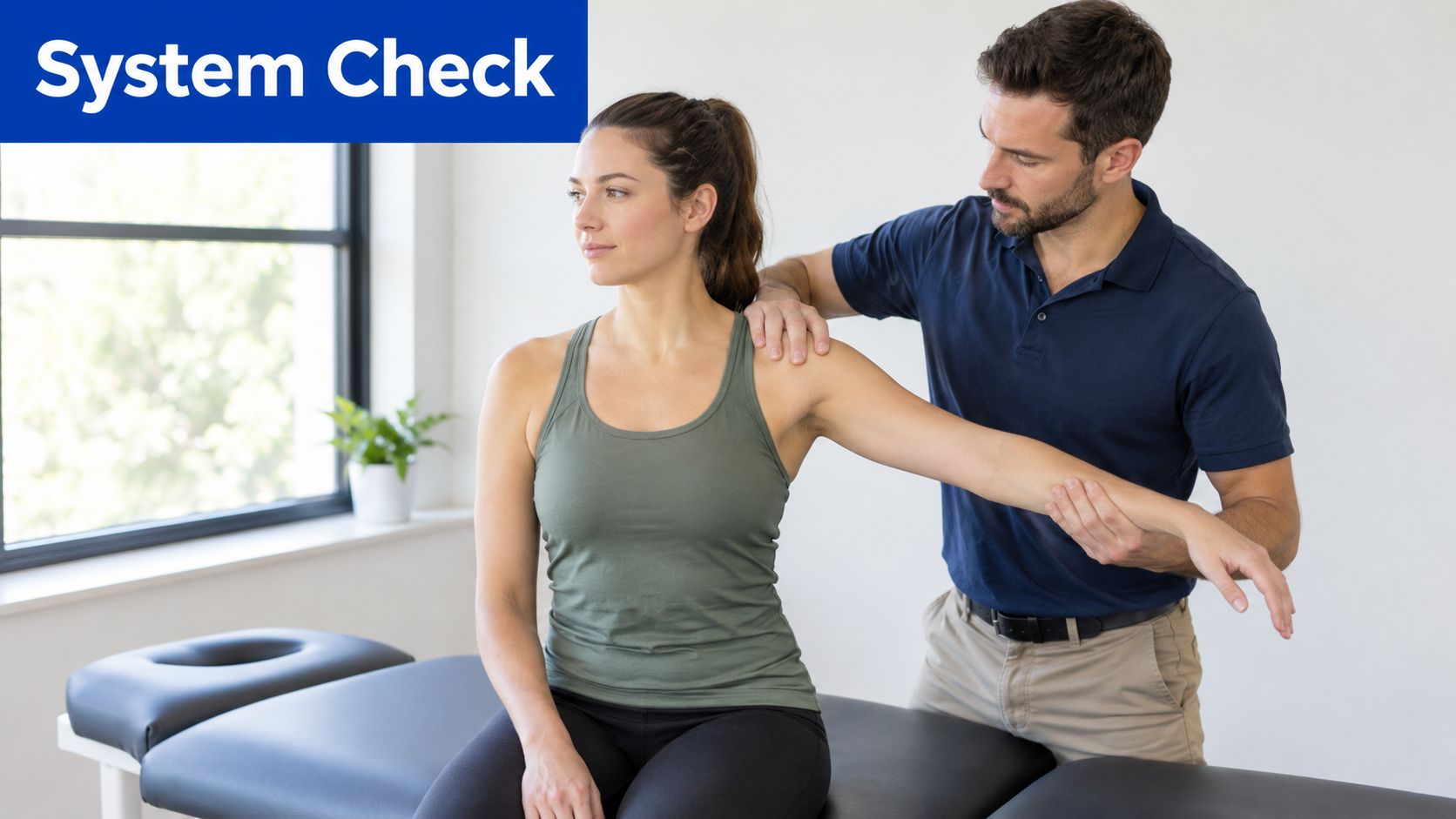
An osteopath usually wants to know more than where it hurts. They'll also look at how you move into and out of positions, whether another region is overworking, and whether the restriction is joint-based, muscle-based, pain-based, or some combination.
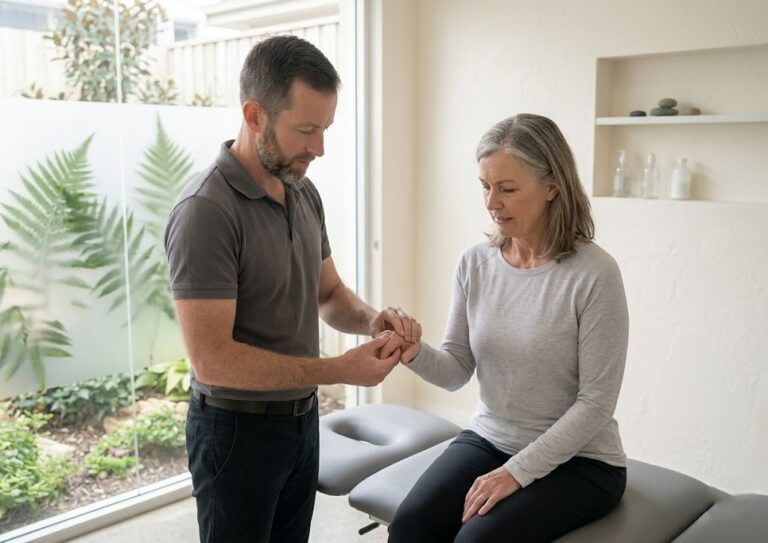
For example, a person with hip stiffness might be overloading the low back during bending. A person with shoulder pain may be using the neck and upper ribs to compensate. This broader view is part of why movement-based assessment can be so useful, especially for longer-term problems. The arthritis and joint mobility image reflects the sort of functional limitation many people recognise.
The point isn't to make movement feel complicated. It's to identify what is limiting it, so treatment and exercise match the problem.
How Osteopaths Assess Movement
An osteopathic assessment usually starts with a simple question. What can't you do comfortably that you want or need to do?
That answer gives the movement problem context. It might be turning your head while driving, getting down to the garden, carrying your child, or walking without stiffening after a short distance.
What gets assessed
A thorough assessment often includes observation of:
Posture and resting position
Not because there is one perfect posture, but because some positions load certain areas more than others.Quality of motion
Smoothness, hesitation, guarding, asymmetry, and compensation all matter.Joint contribution
The practitioner looks at whether the right joint is doing the work, or whether another part is substituting.Soft tissue behaviour
Tension, sensitivity, and protective spasm can all affect movement.Functional tasks
Squatting, reaching, sitting to standing, gait, or step-related movement may reveal more than a treatment table test.
Why hands-on assessment matters
Hands-on assessment can help separate a movement that is mechanically stiff from one that is mainly pain-limited or fear-limited. Those situations can feel similar to a patient, but they often need different management.
For persistent issues, a clinician may also compare active and passive movement. If passive range is available but active range is restricted, control and strength may be central. If both are limited, joint stiffness or tissue restriction may be more prominent.
Sometimes the body can move further than you think. It just doesn't trust the movement yet.
At clinics such as Bayside Osteopathic Health's approach to osteopathic care, the goal is usually to pair this assessment with a practical plan, not just a label.
What treatment may involve
Depending on the person and the problem, an osteopath may use:
- gentle joint articulation
- soft-tissue work
- mobilisation techniques
- movement retraining
- advice about pacing, posture, and daily habits
The important part is that treatment isn't only about reducing pain in the moment. It's about improving your ability to move with less effort, less guarding, and more confidence.
Strategies to Restore and Maintain Mobility
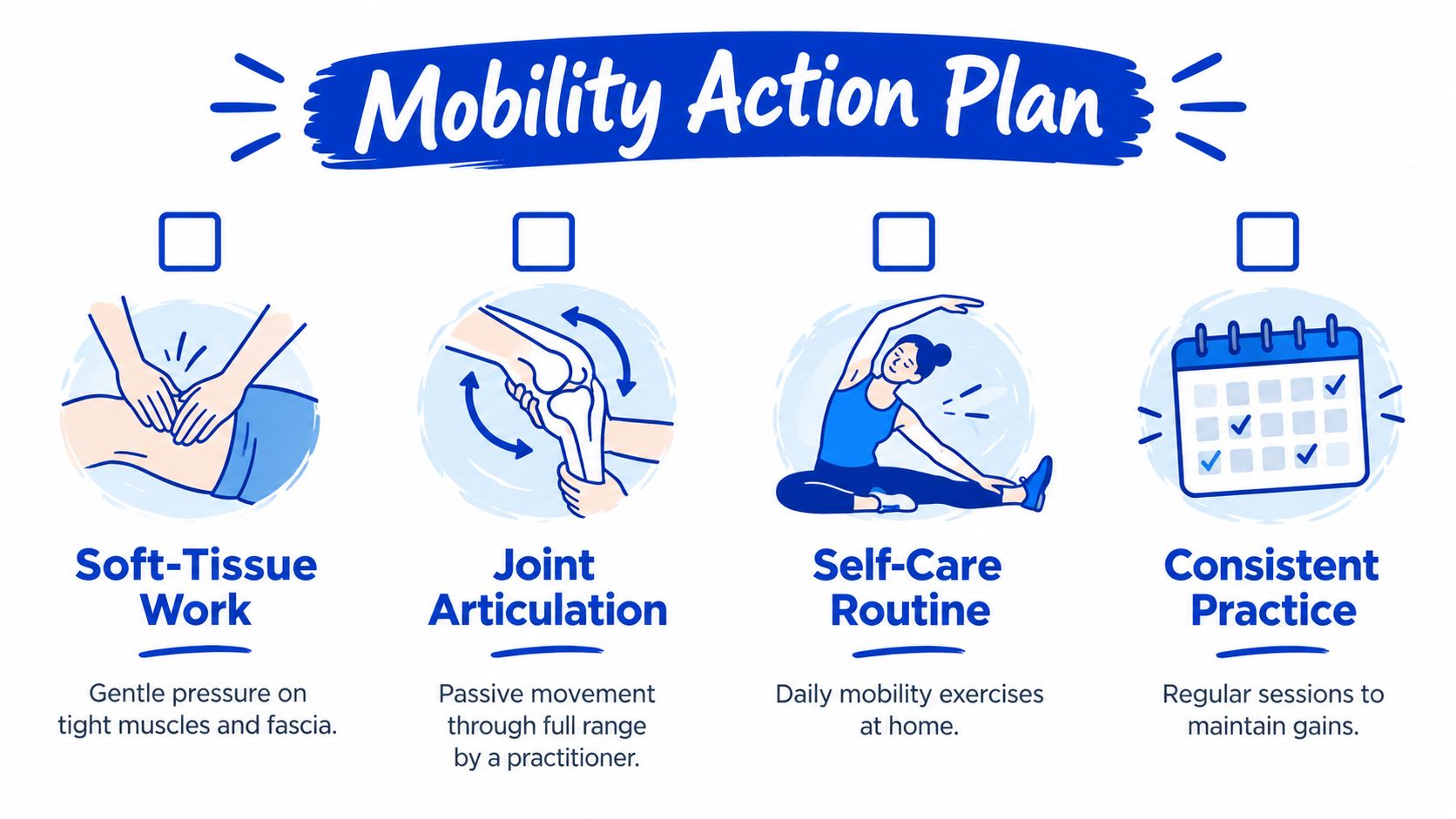
For many, better mobility doesn't come from one dramatic stretch. It comes from a sensible mix of treatment, movement, and repetition.
In osteoarthritis guidance, reduced joint mobility is treated as a meaningful function problem. Osteoarthritis commonly involves pain, stiffness, and limited joint movement, and range-of-motion exercises are recommended to preserve mobility because regular movement helps counter stiffness and shortening of surrounding soft tissues over time, as explained in this Australian overview of osteoarthritis causes and symptoms.
What tends to help most
The most effective plan is usually simple and repeatable.
Gentle movement first
Small, regular motion often works better than forcing end range. This is especially true when pain has made the area protective.Targeted hands-on care when needed
Soft-tissue work and joint articulation can help reduce resistance and improve comfort before exercise.Strength around the joint
Mobility is easier to keep when the body can control the range it has.Daily integration
It helps to connect exercises to normal routines, such as after a shower, before a walk, or during work breaks.
Knowing when to stop guessing
If stiffness settles after a few minutes of movement and doesn't interfere with life, self-management may be enough. If it keeps returning, worsens, or changes how you walk, reach, bend, or sleep, it's worth getting it assessed.
Recent AIHW reporting notes that osteoarthritis affects about 2.1 million Australians and becomes more common with age, rising from 10% at ages 45 to 54 to 30% at age 75 and over. The same source includes a projection that 5.39 million Australians will have arthritis in 2040, up from 4.11 million in 2025, which is a 31% increase, according to the AIHW osteoarthritis overview and projection data.
That's why mobility care shouldn't be framed only as a fitness upgrade. For many people, it's about keeping everyday movement safe and sustainable.
This short video gives another practical view of movement-focused care and exercise:
Better joint mobility usually means better quality of movement, not chasing the biggest possible range.
If you've been wondering what joint mobility is, the most useful answer is this. It's the movement you can use, control, and trust in daily life. When that starts to fade, the right next step isn't usually harder stretching. It's finding out why the movement changed and working from there.
If persistent stiffness, arthritis-related discomfort, or restricted movement is making daily tasks harder, Bayside Osteopathic Health offers hands-on assessment, gentle joint articulation, soft-tissue treatment, and practical movement advice to how your body moves. If you want help working out whether your issue is simple deconditioning or something that needs closer attention, booking an assessment is a sensible next step.