

You wake before the alarm, roll towards the edge of the mattress, and pause. The familiar ache across your lower back is already there. By the time you sit at your desk, lift a child, drive to work, or start a shift, you're already calculating which movements might set it off.
Persistent back pain can feel like a structural mystery, especially when scans or examinations don't identify one obvious injury. In Australia, about 4.0 million people, or 16.4% of the population, experienced back problems in 2019 (Australian Institute of Health and Welfare). The more useful question often isn't “Which single part is damaged?” but “Which combination of loads, habits, health factors, and sensitivities is keeping my back irritated?”
This guide looks at what causes chronic back pain through that broader lens. It explains the main pain mechanisms, how a clinician assesses them, why work and recovery patterns matter, and where gentle osteopathic care may fit alongside medical assessment and active self-management.
Table of Contents
- Living with Persistent Back Pain in Bayside
- The Main Categories of Chronic Back Pain Causes
- Understanding Different Pain Mechanisms
- How Clinicians Assess Back Pain Causes
- Load Management and Lifestyle Factors
- How Gentle Osteopathic Treatment Helps
- When to Seek Professional Care
Living with Persistent Back Pain in Bayside
A Bayside resident may notice the pattern after several demanding weeks: more driving, less sleep, and repeated lifting at work. There was no fall or single moment when the back “went”. Rest helped briefly, heat eased the mornings, and online stretches provided occasional relief. The ache returned as soon as normal activities resumed.
Persistent back pain often reflects accumulated load rather than one hidden spinal fault. Sitting, bending, carrying, work demands, stress, and limited recovery can exceed what the body currently tolerates. Australian health guidance associates back problems with prolonged sitting, lifting, bending, twisting, smoking, low physical activity, body weight, and occupational strain (AIHW back problems overview).

Why the pain keeps returning
A sensitised back may remain reactive after an initial strain. Surrounding muscles can change their timing, movement may become guarded, and the same daily tasks continue to apply demanding loads. Stress and poor sleep can reduce recovery capacity, even after the original tissue injury has settled.
The pain remains real. Pain is a protective experience shaped by tissues, nerves, movement, general health, and context, so a scan does not always identify one complete explanation. AIHW reporting suggests that about 8 in 10 Australians with back pain do not have one identifiable underlying condition. Separately, the Better Health Channel estimates that the cause is unknown in 90% to 95% of cases (Better Health Channel guidance on back pain).
Practical rule: A lack of one clear diagnosis does not make your pain less real. It means assessment should examine the whole load pattern.
Effective care focuses on what aggravates symptoms, what your body currently tolerates, and which gradual changes can restore confidence in movement. Gentle osteopathic care can support that process by considering movement, recovery, work demands, and the broader factors affecting how your back handles load.
The Main Categories of Chronic Back Pain Causes
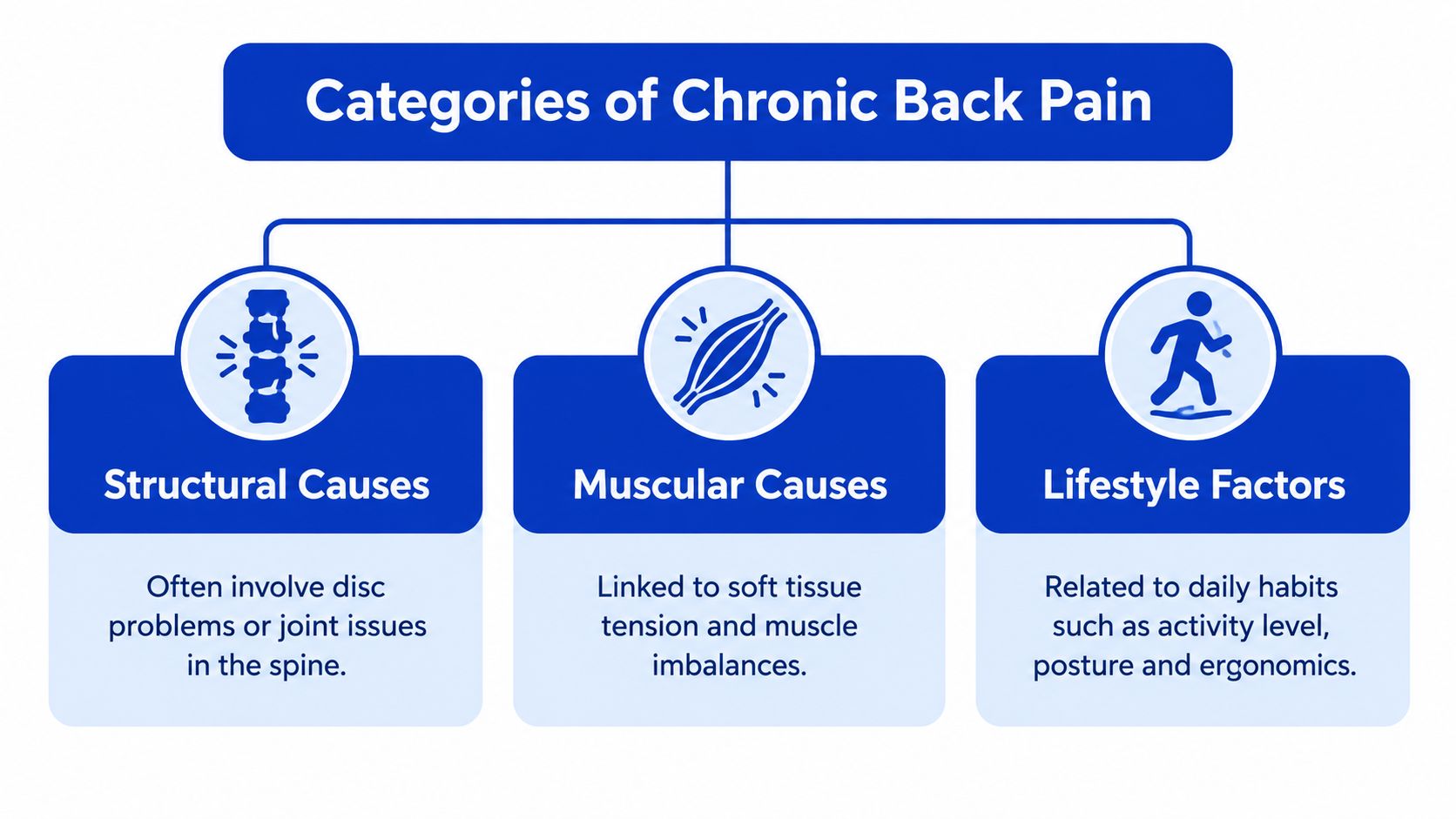
A person asking what causes chronic back pain is usually dealing with several factors at once. Age-related joint change, tight hips, lower activity, and poor sleep can all sit in the same case. No single explanation has to cover everything.
Mechanical and muscular contributors
Mechanical pain comes from how muscles, ligaments, joints, and nearby tissues handle movement and load. Repeated bending, awkward lifting, long periods of sitting, or a sudden jump in activity can irritate soft tissues. Muscles may stay guarded or work less efficiently, which keeps stiffness and movement restriction going.
Posture is part of the picture, but it is rarely the whole story. A position that feels fine for one person can irritate another, depending on how long it is held, how strong the tissues are, how tired the person is, and whether position changes are available.
Structural and degenerative changes
Discs and spinal joints change over time. Osteoarthritis, a herniated disc, osteoporosis-related fracture, and inflammatory arthritis can all contribute when the clinical pattern fits. An image finding still needs context. Symptoms, movement, strength, and neurological signs matter more than the scan alone.
Nerve-related pain
When a nerve is irritated or compressed, symptoms may spread beyond the back into the buttock or leg. Burning, pins and needles, altered sensation, or weakness can point to nerve involvement and deserve a focused assessment.
Inflammatory, referred, and broader health factors
Inflammatory conditions often cause marked stiffness and may ease with gentle activity rather than prolonged rest. Pain can also be referred from outside the spine, including internal organs, especially when symptoms do not change with back movement or appear with other health changes.
The wider health picture matters. In 2022, 72% of people in Australia with back problems also lived with at least one other chronic condition. The most common recorded comorbidities included mental and behavioural conditions at 43%, arthritis at 34%, and asthma at 17%, according to AIHW back problems data. That asthma figure is not decorative. Breathing pattern and thoracic stiffness can change how the trunk handles load, so the rib cage and back should be assessed together.
The practical conclusion is simple. Persistent back pain often needs a plan that accounts for the whole person, not only the painful area.
Understanding Different Pain Mechanisms
Two people can use the same words, “my back hurts”, while describing very different mechanisms. The sensation, timing, triggers, and associated symptoms help a clinician decide what to examine and which advice is safe.
A side-by-side view
| Pattern | Common features | What makes it clinically useful |
|---|---|---|
| Mechanical or soft-tissue pain | Aching, stiffness, or local soreness that changes with movement, position, or load | Often points towards movement tolerance, muscle capacity, joint irritation, or repeated strain |
| Degenerative joint or disc-related pain | Stiffness, restricted bending, and symptoms that may build with activity or certain positions | Structural changes need correlation with the examination rather than treatment based on an image alone |
| Neuropathic pain | Burning, electric, shooting, tingling, numbness, or weakness that may extend into a limb | Signals the need to assess nerve function and consider medical referral when deficits are present |
| Inflammatory pain | Marked stiffness, often more noticeable after rest, with symptoms that may ease during gentle movement | Can warrant medical investigation for inflammatory arthritis |
| Referred or visceral pain | Less predictable with spinal movement and sometimes accompanied by urinary, digestive, fever, or general health symptoms | Requires attention to possible non-spinal causes |
Most Australian chronic back pain remains non-specific, as described in Healthdirect's back pain guidance. That label doesn't mean a clinician has stopped looking. It means the examination hasn't identified one specific disease or injury that fully accounts for the symptoms.
What changes the interpretation
Pain that eases when you alter your chair may behave differently from pain that travels down the leg with numbness. Morning stiffness that improves with movement raises a different question from pain that follows a sudden increase in lifting. A back that feels tight after a poor night's sleep needs a different starting strategy from a back accompanied by fever or bladder changes.
Pain behaviour is information, not a diagnosis.
Avoid making treatment decisions from sensation alone. A burning feeling can arise from several sources, and a dull ache can coexist with nerve sensitivity. A clinician combines your description with physical findings and your medical history before deciding whether hands-on treatment, exercise guidance, medical review, or further testing is appropriate.
How Clinicians Assess Back Pain Causes
A useful assessment starts with more than the question, “Where does it hurt?” The clinician needs to understand when symptoms began, how they behave through the day, what your work requires, and which activities you've stopped doing.

What happens during the consultation
A thorough assessment commonly follows this sequence:
- History and symptom mapping: You'll discuss the onset, location, intensity, daily pattern, aggravating movements, sleep, medication, previous episodes, and relevant health conditions.
- Movement observation: The clinician may watch you walk, bend, rotate, sit, stand, squat, or perform a task that resembles your normal work or home demands.
- Physical examination: This can include spinal and peripheral joint mobility, muscle tone, strength, balance, and tenderness.
- Neurological screening: Reflexes, sensation, muscle power, and symptoms into the legs help identify possible nerve involvement.
- Clinical reasoning: The findings are brought together to decide whether conservative care is suitable, whether another practitioner should be involved, or whether investigations are warranted.
The purpose of this process is to match the intervention to the mechanism. A person with load-sensitive muscular pain may benefit from graded movement and manual therapy, while progressive weakness, systemic symptoms, or suspected fracture requires a different pathway.
Red flags need prompt medical attention
Seek urgent medical advice for back pain accompanied by new bowel or bladder dysfunction, significant neurological weakness, fever, unexplained weight loss, a history of cancer, or major trauma. Sudden severe symptoms with feeling acutely unwell also shouldn't be managed as routine muscle tension.
Most persistent back pain doesn't involve a dangerous condition, which is reassuring. Still, red flags matter because delaying medical assessment can create unnecessary risk.
The following video offers a visual introduction to clinical assessment. It shouldn't replace an examination adapted to your symptoms.
Imaging can be useful when the history and examination suggest a specific problem, but it isn't automatically the first or most informative step. A scan may show age-related changes that don't explain your pain, so the result needs to be interpreted in context.
Load Management and Lifestyle Factors
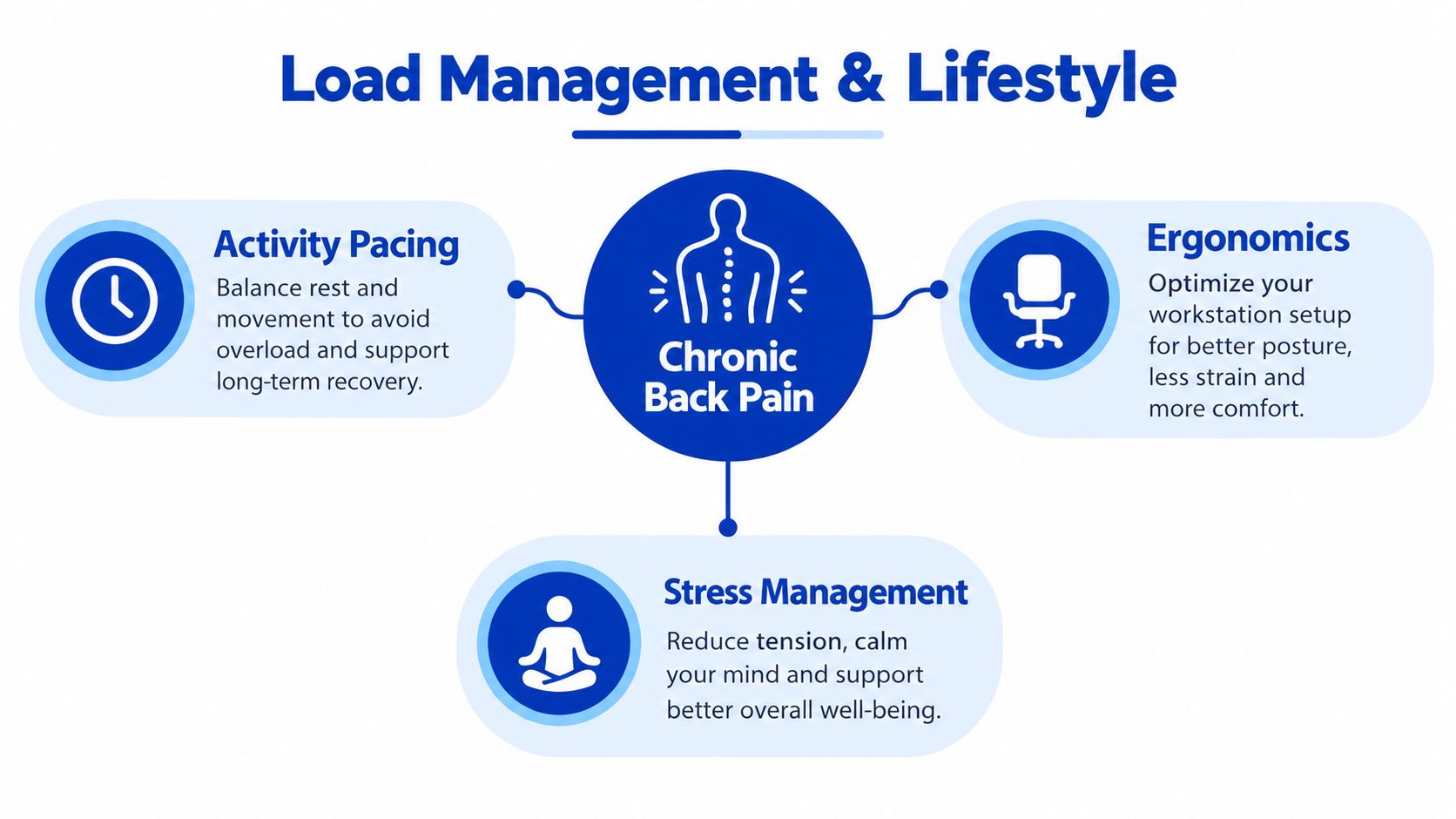
A back may tolerate substantial demand when that demand is familiar and recovery keeps pace. Persistent symptoms often develop when workload rises faster than capacity. Common examples include extra shifts, repeated lifting, prolonged standing, a new exercise programme, or long periods at a laptop without changing position. The problem is often the pattern of loading and recovery, rather than one mysterious structural fault.
Australian guidance associates back problems with occupational demands such as lifting, bending, twisting, pulling, pushing, and prolonged sitting. These factors should be considered alongside sleep, stress, smoking, conditioning, body weight, and general activity, because each can affect how well the body handles repeated load.
Match the strategy to the load
| Daily pattern | Helpful adjustment | Common mistake |
|---|---|---|
| Desk or remote work | Change position regularly, keep frequently used items within easy reach, and build movement into the day | Trying to hold a “perfect” posture for hours |
| Repetitive or physical work | Vary tasks where possible, use the hips and legs for lifting, and reduce combined bending and twisting | Waiting until pain is severe before changing the task |
| Casual or unpredictable shifts | Track which duties trigger symptoms and plan recovery after heavier work | Treating every flare as proof that all activity is harmful |
| Exercise-related pain | Temporarily reduce intensity or volume, then rebuild gradually | Stopping all movement for an extended period |
Work patterns deserve specific attention. An Australian Chiropractors Association report cited a survey in which 94.6% of casual workers reported back pain, while 30% of sufferers said their pain became chronic (Australian Chiropractors Association report). These figures do not establish that casual work causes every person's pain. They do show why unpredictable duties, task variation, and limited recovery belong in a clinical discussion.
Recovery is part of treatment
Start with the clearest mismatch. That may be a workstation that holds you in one position, a sudden return to heavy lifting, or an exercise routine that leaves too little recovery between demanding sessions. Change one or two manageable factors first, then judge how symptoms and function respond.
Gentle manual care may make movement easier, but it cannot compensate for an unchanged work pattern. A practical plan combines symptom relief with graded activity and gradual capacity building. The aim is to make daily loading more predictable, while keeping the body active enough to adapt.
How Gentle Osteopathic Treatment Helps
Gentle osteopathic care makes sense when the aim is to improve movement and reduce sensitivity without relying solely on medication. It doesn't promise to uncover one hidden structural cause in every case. Instead, it examines how joints, muscles, breathing, posture, movement habits, and daily loads interact.
What treatment may include
An osteopath may use soft-tissue techniques to reduce protective muscle tension, joint articulation to explore restricted movement, and gentle mobilisation to help you move with less guarding. The approach should remain within a tolerable range. Forceful treatment isn't automatically more effective, and a technique that provokes a prolonged flare isn't a useful test of toughness.
The assessment also considers regions that may be contributing to how you move. Stiffness through the hips or upper back, reduced trunk control, an altered walking pattern, or repeated work positions can all change the demands placed on the lower back. Treating only the painful spot may provide temporary relief if the daily movement pattern remains unchanged.
Relief and capacity need to work together
Manual therapy can make it easier to start moving, sleeping, or performing prescribed exercises. It shouldn't become the entire plan. Chronic pain improves more reliably when hands-on care is paired with education, sensible activity progression, and practical changes to the tasks that repeatedly aggravate symptoms.
Treatment principle: The goal isn't to make you dependent on appointments. It's to help you understand your symptoms and build confidence in everyday movement.
Medication has a role for some people, but it may provide only partial relief and can carry side effects. A drug-free approach can be useful for people who want to limit medication, can't tolerate particular medicines, or need a broader strategy. It still needs to be appropriate for the individual, and it shouldn't replace medical care for inflammatory disease, fracture, infection, serious nerve compression, or other conditions requiring specialist management.
A practitioner at Bayside Osteopathic Health may combine hands-on osteopathic techniques with movement advice and home-care strategies for persistent back pain. The relevant question isn't whether osteopathy is suitable for everyone. It's whether an assessment identifies a movement and load pattern that can be addressed safely alongside any necessary medical care.
When to Seek Professional Care
Book an assessment when back pain keeps returning despite sensible self-care, disrupts sleep or work, limits ordinary activities, or makes you increasingly cautious about movement. You do not need to wait until symptoms become overwhelming. Early guidance can identify the loads that aggravate your back, screen for warning signs, and establish a manageable starting point.
Prepare for the appointment
Describe the symptoms in your own words rather than trying to name the diagnosis. Note:
- The pattern: When pain appears, what eases it, and whether it travels into the buttock or leg.
- Your demands: Sitting, driving, lifting, standing, sport, caring responsibilities, or repetitive tasks.
- Your recovery: Sleep quality, stress, recent activity changes, and strategies you have tried.
- Relevant history: Previous injuries, chronic conditions, medication, and recent trauma.
A clinician should explain what the examination suggests, which options can be managed conservatively, and what to try first. Leave with a practical plan for ordinary days, symptom flares, and further review.
A first plan might involve two shorter sitting blocks with a walk between them, one lifting technique change at work, and a review in two weeks. The aim is to reduce unnecessary load without stopping all activity. The plan can then be adjusted according to symptom response and function.
Choose the right pathway
An osteopath may suit movement-related pain, stiffness, recurring muscular symptoms, and discomfort that changes with activity or position. Arrange prompt GP or specialist assessment if neurological function is worsening, or if symptoms raise concern about fracture, infection, inflammatory disease, or an internal medical cause. Seek urgent care for severe or rapidly worsening symptoms, significant weakness, or changes in bladder or bowel control. General guidance on back pain and when medical review may be needed is available in Healthdirect's explanation of back pain causes.
Judge progress by function as well as pain intensity. Easier movement out of bed, longer tolerance of sitting or walking, improved sleep, fewer protective movements, and greater confidence with normal tasks all indicate that capacity is catching up with daily demands.
Bayside Osteopathic Health provides gentle osteopathic assessment, soft-tissue work, joint articulation, mobilisation, and personalized movement advice for persistent back pain and related mobility concerns. Visit Bayside Osteopathic Health to discuss your symptoms, understand the loads affecting your back, and book a consultation focused on practical, sustainable movement.