

You wake with a familiar stiffness across your lower back, or finish a day at the desk with a neck that feels heavy and restricted. Rest helps briefly, pain relief takes the edge off, and yet the same problem returns when you resume normal activity. At that point, the useful question isn't only where it hurts. It's why the area keeps becoming painful, what your movement is avoiding, and which changes could help you manage your body with more confidence.
Complete care osteo describes a whole-person approach to those questions. It combines clinical assessment, gentle hands-on treatment, movement advice and practical self-management, rather than treating a sore spot as an isolated event. The aim is a care plan that makes sense for your symptoms today and remains useful when treatment becomes less frequent.
Table of Contents
- Understanding the Complete Care Osteo Approach
- What Whole-Person Osteopathic Treatment Involves
- Common Conditions Treated with Gentle Hands-On Care
- Your Typical Patient Journey at a Bayside Clinic
- Navigating Medicare and Eligibility for Osteopathic Care
- Benefits of Choosing Complete Care Osteopathy
Understanding the Complete Care Osteo Approach
A patient may arrive after weeks of back pain that began with an ordinary task, such as lifting, driving or sitting through a long workday. The initial pain might have settled slightly, but bending still feels guarded, sleep is disrupted and confidence has narrowed. A quick treatment aimed only at the painful area may provide temporary relief without explaining why normal movement remains difficult.
Complete care osteo starts with a broader clinical conversation. The practitioner considers the history of the problem, aggravating activities, previous injuries, general health, work demands, sleep and the movements the patient has begun to avoid. That information helps separate a short-lived irritation from a persistent pattern that needs a more organised plan.

The practical principle: Treatment should help you understand and use your body, not make you feel dependent on repeated appointments.
Looking beyond the painful spot
The body works through linked regions. A stiff hip can change how someone bends, a guarded ribcage can influence breathing and upper-back movement, and reduced ankle mobility can alter the way force travels through the leg. These relationships don't prove that one area is always the cause of pain. They do give the osteopath sensible areas to assess instead of assuming the most painful point tells the whole story.
At Bayside, that assessment may lead to soft-tissue work, joint articulation or gentle mobilisation, followed by advice suited to the patient's actual routine. Someone working remotely may need a different strategy from an older adult managing joint stiffness, even when both describe back discomfort.
A complete plan also includes boundaries. Osteopathy isn't appropriate as a substitute for urgent medical assessment when symptoms suggest a serious condition. A responsible practitioner will identify warning signs, explain when another health professional is needed and avoid promising a guaranteed result.
For readers who want to examine the wider clinical question, this illustrated guide to evidence-based osteopathic therapy provides a useful starting point. The central distinction is simple: complete care addresses pain, movement, contributing habits and the patient's ability to continue progress independently.

What Whole-Person Osteopathic Treatment Involves
Treatment builds a clinical explanation that connects a person's symptoms with movement, environment and goals. It does not require examining every body region indiscriminately. The assessment focuses on findings that may influence function and on the activities the patient needs to resume.
A patient with persistent lower-back pain may have limited hip rotation or reduced ribcage mobility. The osteopath examines those regions alongside the painful area, then decides whether they contribute to the person's movement pattern. This approach avoids assuming that the most painful spot explains the entire problem.
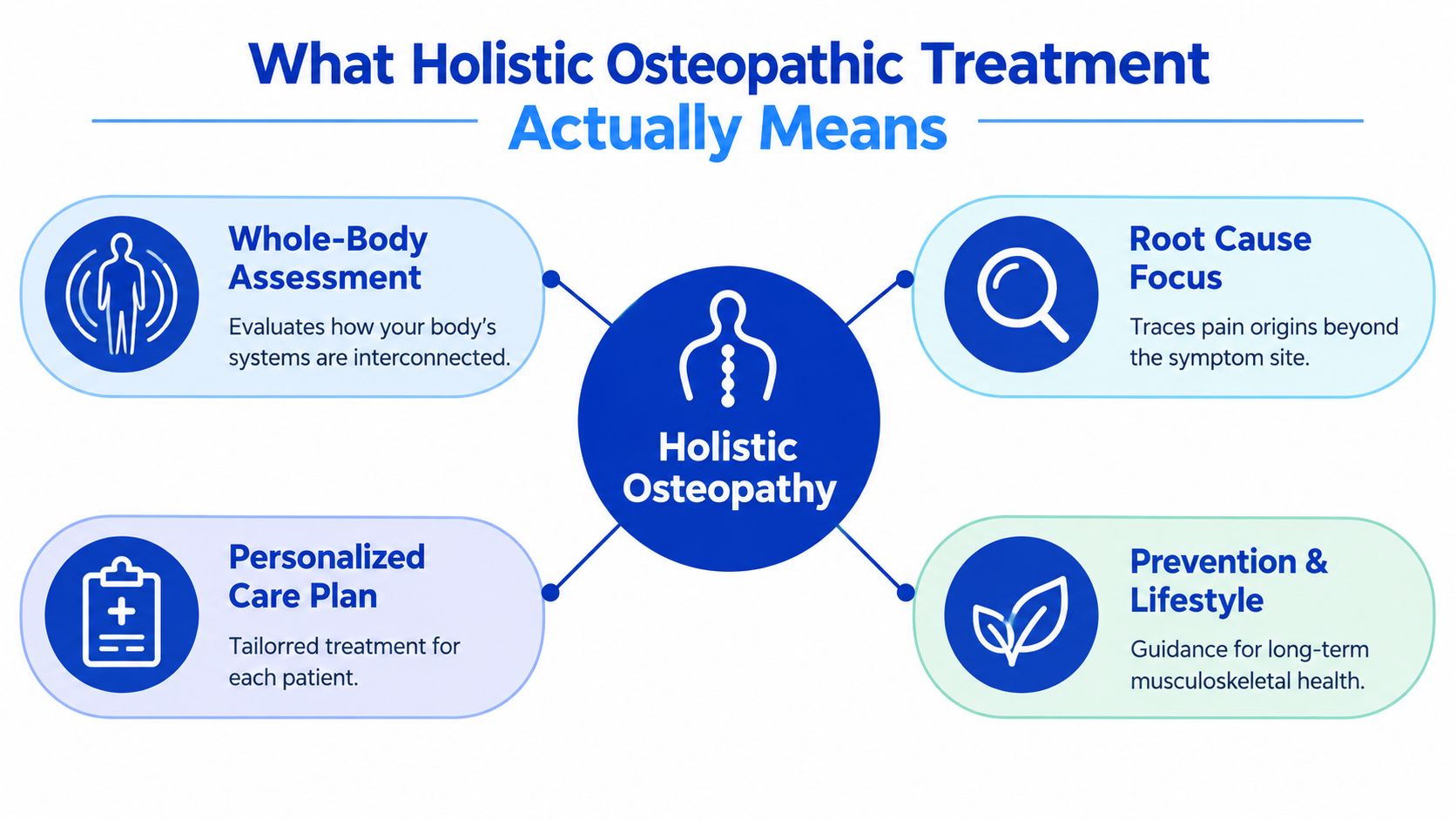
Four parts of the assessment
Whole-body assessment starts with observation and movement. The practitioner may watch you walk, bend, rotate or balance, comparing how different regions contribute to each task. The aim is to distinguish a meaningful restriction from normal variation and identify movements that are limited, painful or unnecessarily effortful.
Root-cause focus means tracing the pattern without assigning responsibility to one structure before the evidence supports it. Symptoms can reflect a recent strain, reduced conditioning, repetitive work, stress, sleep disruption or several factors together. Keeping those possibilities open prevents an overly narrow treatment plan.
A personalised care plan turns the findings into practical priorities. One patient may need short-term symptom relief before starting strengthening. Another may need to rebuild movement confidence and gradually return to a valued activity. The plan should support real daily demands, rather than target every restriction seen on an examination table.
Prevention and lifestyle guidance gives the work a role between appointments. Advice may include pacing, changing a repeated task, practising a short movement routine or gradually rebuilding tolerance to activity. The most useful exercise is one you understand, can perform safely and can fit into ordinary life.
Osteopathy has a longstanding place in Australian healthcare. It has been practised in Australia for over 100 years, was first regulated in Victoria in 1979, became nationally regulated in 1991, and has been taught in Australian universities since the early 1980s, as documented in the history of osteopathy in Australia.
This is structured clinical care, not a wellness shortcut. It should include assessment, informed consent, appropriate technique and review. Hands-on treatment may help reduce symptoms, but long-term progress also depends on building the capacity and confidence to manage activity outside the clinic.
Common Conditions Treated with Gentle Hands-On Care
Osteopathy is commonly considered for musculoskeletal problems where pain, stiffness or altered movement affects daily function. The strongest Australian evidence relates to back and neck pain, so these complaints deserve a more careful explanation than a broad promise that osteopathy can treat everything.
Back and neck pain
For low-back pain, treatment may combine hands-on techniques with advice and exercise rather than relying on manipulation alone. Australian health information describes isolated manual techniques as offering a modest benefit, while integrated osteopathic care appears more promising in randomised trials. A meta-analysis summarised by Healthdirect's osteopathy information reported moderate-quality evidence in an Australian low-back-pain subgroup, with pain reduction of about 12.91 points on the measured scale compared with comparators, and no serious adverse events reported in the reviewed trials.
That finding supports a measured position. Osteopathy may help modulate pain and improve function for some people, particularly when it forms part of an active rehabilitation plan. It doesn't establish that every person will respond, that hands-on care is sufficient by itself or that pain must have one identifiable structural cause.
Neck discomfort often involves a mixture of restricted movement, sustained desk or device use, muscular tension and sensitivity around normal loading. Assessment helps determine whether gentle work and movement advice are appropriate, or whether symptoms warrant referral for another type of evaluation.
Joint stiffness and arthritis-related discomfort
People with joint stiffness often want to keep walking, working, gardening or participating in family life without feeling that every movement carries a penalty. Osteopathic care may focus on comfortable range, surrounding soft tissues and ways to distribute load more effectively. The objective isn't to reverse an arthritic change. It's to support useful movement and help the person make informed activity choices.
Older adults may need a slower progression, clearer home instructions and closer attention to balance, medication, bone health and other medical factors. Gentle techniques can be considered, but gentleness still requires clinical judgement.
Postural and activity-related strain
Postural strain is rarely solved by forcing someone into one perfect position. Bodies move, and a sustainable plan usually alternates positions, builds tolerance and reduces the amount of time spent in one demanding posture. An office worker may benefit from movement breaks and graded conditioning, while a tradesperson may need advice that reflects lifting, reaching and recovery between tasks.
A spine illustration about chronic back pain can help patients visualise why pain may persist, but an image can't diagnose the source of an individual's symptoms. Seek assessment when pain is worsening, limits normal activity or keeps returning despite reasonable self-care.

Your Typical Patient Journey at a Bayside Clinic
The first appointment should reduce uncertainty, not create it. You should know why questions are being asked, what the examination involves and how the proposed treatment relates to your goals.
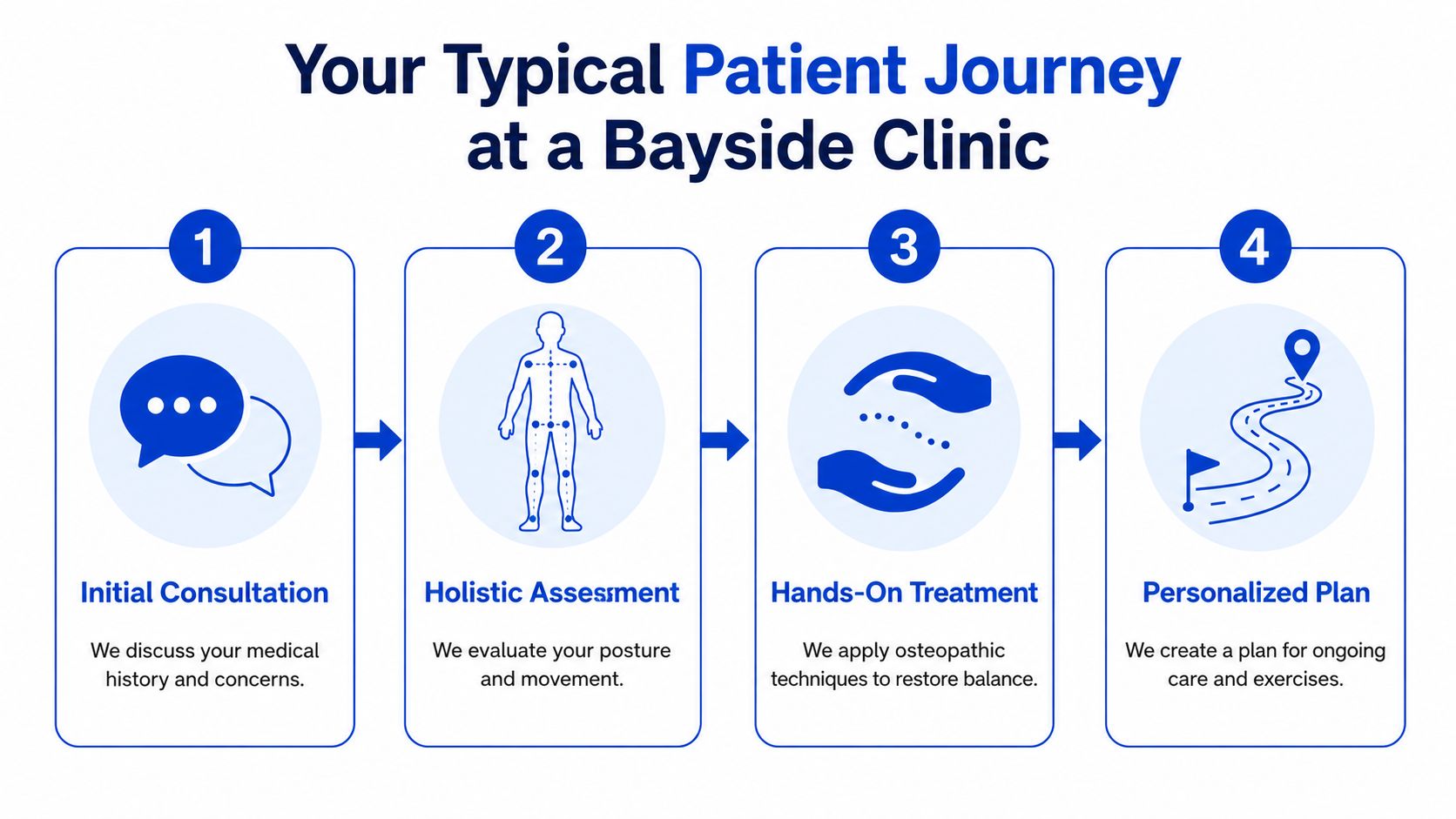
Starting with your story
The consultation covers the onset and behaviour of your symptoms, relevant medical history, previous injuries, work and activity demands. Be specific about what makes the problem better or worse. Tell the practitioner what you've stopped doing, what you're worried about and what a meaningful improvement would look like.
The physical assessment may include posture, walking, active movement and selected clinical tests. An osteopath uses those findings to decide which tissues and movement patterns deserve attention, while remaining alert to signs that require another form of care.
Applying treatment with a purpose
Hands-on work can include soft-tissue techniques, joint articulation and gentle mobilisation. The method should match the patient's presentation and preferences. Some people respond well to a quiet, gradual approach. Others need more emphasis on movement retraining, education or load management than on manual treatment.
Treatment shouldn't be judged only by how the body feels immediately afterwards. A more useful review asks whether you can move more comfortably, sleep more easily, complete a task with less guarding or practise the recommended activity safely.
Turning an appointment into a plan
Home care might involve a small exercise routine, advice about pacing or a change to how you approach a repeated task. Instructions should be clear enough to follow without guesswork. If a movement increases symptoms substantially or creates new concerns, contact the practitioner rather than pushing through automatically.
Australia had 3,147 registered osteopaths at 30 June 2022, rising to 3,172 in 2022/23 and 3,646 in the 2024/25 annual report. Osteopaths represented about 0.4% of registered health practitioners, according to the Ahpra osteopathy workforce information. For a patient, the important point is not the size of the workforce. It's choosing a registered practitioner who assesses carefully, explains options and works within appropriate professional boundaries.
A visual guide to booking an osteopathic appointment can make the first step feel more straightforward. Bring a list of medications, relevant reports and your main questions if that helps you feel prepared.
Navigating Medicare and Eligibility for Osteopathic Care
Medicare coverage for osteopathy is often misunderstood. It generally isn't a standalone benefit available just because someone has back or neck pain. Access may be available through an eligible chronic disease management pathway, subject to the requirements of the treating medical practitioner and the relevant plan.
How the pathway works
Start with a GP assessment. Discuss the ongoing condition, the functional problems it creates and whether a chronic disease management plan is appropriate. If the plan includes osteopathic or other allied health support, confirm the referral details with the clinic before booking.
The practical sequence is usually:
- Discuss eligibility with your GP. The GP determines whether the relevant chronic disease pathway applies to your circumstances.
- Check the referral and provider requirements. Ask which services are included and what information the osteopath needs.
- Confirm the clinic's fees. A Medicare contribution doesn't necessarily remove the full appointment cost, so ask about any gap before treatment.
- Track the shared allocation. Keep records if you're also seeing another eligible allied health professional.
The Medicare arrangement allows up to five allied health sessions per calendar year across all eligible professions, as outlined in this Australian parliamentary discussion of allied health access. Those sessions are shared, not five visits for osteopathy plus five for each other profession.
Using limited visits well
The cap makes planning important for people managing persistent pain. A clinic may prioritise assessment, clear goals, reassessment and a home programme so that subsidised appointments support a broader plan rather than become the only source of care.
You may still have an out-of-pocket gap, and eligibility doesn't guarantee that every requested service will be covered. Contact the GP and clinic directly for current requirements, fees and claiming arrangements because these details can change.
Benefits of Choosing Complete Care Osteopathy
The main advantage of complete care osteo is continuity of thinking. Your symptoms receive attention, but so do the movements, habits and concerns that influence how you function between appointments.
Gentle hands-on treatment can be useful when pain or stiffness makes movement feel threatening. It can create enough comfort for you to begin moving more normally, practising exercises and rebuilding confidence. The durable part of care comes from what you learn to do consistently afterwards.
What this approach can offer
- Individual context: Your work, activity, health history and goals shape the plan.
- Practical progression: Treatment can be adjusted as your movement and tolerance change.
- Self-management: Home strategies give you tools to use outside the clinic.
- Appropriate boundaries: A careful practitioner recognises when referral or medical review is needed.
This approach won't eliminate every source of pain, and no ethical practitioner should promise that it will. It can, however, give you a clearer explanation, a safer starting point and a more useful route towards comfortable activity than repeatedly waiting for symptoms to settle on their own.

If persistent back, neck or joint pain is limiting your routine, Bayside Osteopathic Health offers assessment, gentle hands-on osteopathic treatment, movement advice and personalised self-care planning for Bayside residents. Visit Bayside Osteopathic Health to learn about the care approach and book an appointment suited to your needs.