

You wake with your head turned slightly to one side, or finish a long day at a screen and realise your neck barely wants to rotate. The first instinct is often to stretch hard, hold the neck still, or reach for whatever promises instant relief. A safer approach is more measured: calm the irritation, keep comfortable movement available, and adjust your activity according to how your symptoms respond.
Home care can be useful for uncomplicated neck pain, but it isn't a substitute for assessment when symptoms are severe, persistent, injury-related, or neurological. The practical question isn't just whether to rest or exercise. It's which movement is tolerable today, how much is enough, and when should you stop treating the problem yourself?
Table of Contents
- Understanding Your Neck Pain and Safe Self-Care
- Immediate Relief Strategies for Stiffness and Tension
- Posture Adjustments and Preventative Movement Habits
- Managing Flare-Ups and Pacing Your Daily Activities
- Recognising Red Flags and When to Seek Professional Care
- How Osteopathic Treatment Complements Your Home Routine
Understanding Your Neck Pain and Safe Self-Care
Neck pain can feel alarming because the area is involved in almost every ordinary task, including looking over your shoulder, working, driving and sleeping. A stiff neck after an awkward night may behave differently from pain that travels into an arm, follows an accident, or arrives with fever. Treating these situations as though they're identical is where many home-care plans go wrong.
For uncomplicated symptoms, Australian guidance supports staying active, moving the neck gently and naturally, changing position regularly, and taking breaks from prolonged sitting. The Australian Institute of Health and Welfare reports that neck pain accounted for 6.2% of recorded back-problem hospitalisations, compared with 27% for lower-back pain and 6.0% for radiculopathy. Hospitalisation figures represent more serious or treatment-requiring cases rather than every episode managed at home, but they show that neck pain contributes meaningfully to Australia's healthcare workload. You can read the AIHW overview of back problems and hospitalisations for context.
The basic rule for movement
Use movement to maintain comfort, not to prove flexibility. Turn your head slowly within an easy range, make small side tilts, or gently draw your chin backwards without forcing the neck into a stretch. If a motion clearly increases pain, reduce the range, slow down, or leave it out for the moment.
Complete immobilisation can make ordinary movement feel more threatening and may increase stiffness. A comfortable level of walking, light household activity and regular position changes is generally more useful than spending the day in bed, provided the pain wasn't caused by an injury and activity doesn't worsen it.
Practical rule: A home exercise should leave you feeling the same or easier shortly afterwards. If it causes escalating pain, new symptoms down an arm, or a substantial setback later, it was too much for that day.
Home care aims to settle sensitive tissues and preserve function while the neck recovers. It won't identify every possible cause, and it shouldn't delay professional advice if your symptoms persist for several weeks, interfere with daily life, or keep worsening.
Immediate Relief Strategies for Stiffness and Tension
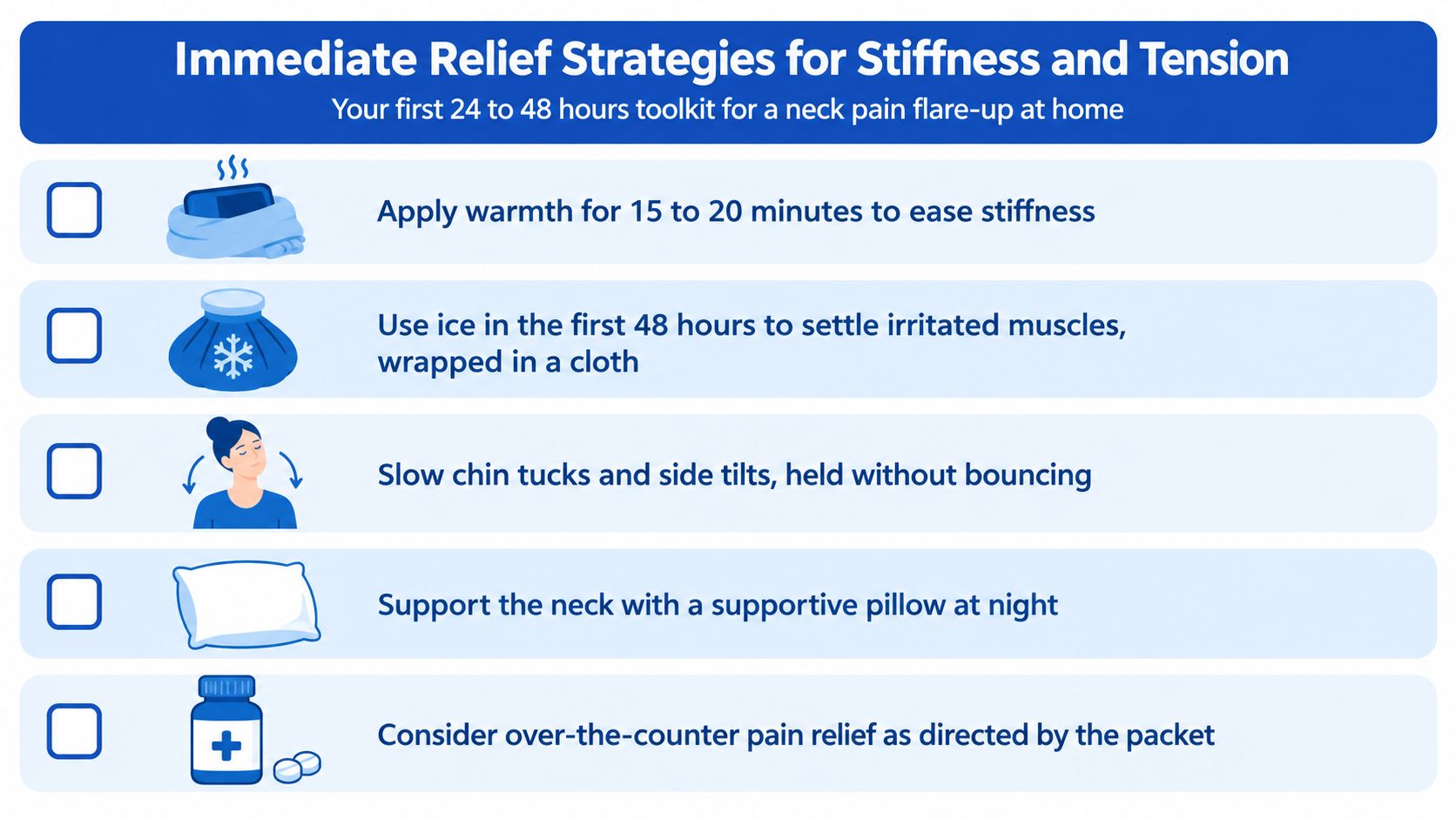
During a flare-up, reduce the number of variables. Choose one comfortable position, use temperature for symptom relief, and reintroduce small movements rather than testing the full range repeatedly.
Use warmth or cold carefully
Heat may ease stiffness and help tense muscles relax. Place a warm pack or hot-water bottle inside a towel and apply it for a short, comfortable period, checking your skin rather than falling asleep with it in place. Cold can be useful when the area feels freshly irritated. Wrap an ice pack in cloth and avoid direct contact with the skin.
Neither option needs to become a test of endurance. Stop if the skin becomes painful, numb, excessively red or uncomfortable. Choose the temperature that makes movement easier, rather than assuming one is universally superior.
Restore easy motion
Try a small sequence while sitting upright:
- Let your shoulders drop and take a relaxed breath.
- Turn your head a little to one side, then return to centre.
- Repeat on the other side without pushing into resistance.
- Nod gently, keeping the movement small.
- Finish with a few shoulder rolls if they don't increase neck pain.
Don't bounce, yank, or hold an aggressive end-range stretch. Light self-massage around the upper shoulders may feel soothing, but avoid digging into a sharply painful spot or pressing directly over the front of the neck.
For sleep, use a pillow that keeps your head and neck in a natural position. If you sleep on your side, the pillow should fill the space between your shoulder and head without pushing your neck upwards. If you sleep on your back, aim for support that doesn't force your chin towards your chest. A comfortable setup matters more than a particular brand or elaborate device.
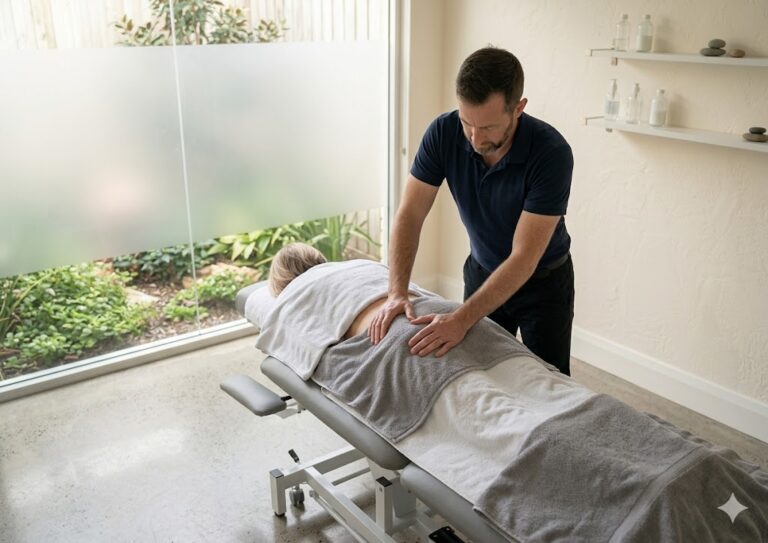
You can also review this remedial massage and muscle therapy resource as a visual reminder that soft-tissue work should complement, not replace, comfortable movement.
Medication may be appropriate for some people, but check the packet directions and ask a pharmacist or doctor if you have health conditions, take other medicines, are pregnant, or aren't sure what's safe for you. Australian guidance also cautions that neck collars generally aren't useful unless a healthcare professional specifically recommends short-term use. A collar can encourage guarding and reduce normal movement when the problem needs gentle mobility.
For a visual demonstration of controlled movement, use the following video as general education, not as a reason to push through symptoms.
Posture Adjustments and Preventative Movement Habits
A workstation rarely causes pain through one perfect “bad posture”. More often, the neck stays in one position for too long while the eyes, shoulders and hands keep working. Even a well-arranged desk becomes uncomfortable if you never change position.
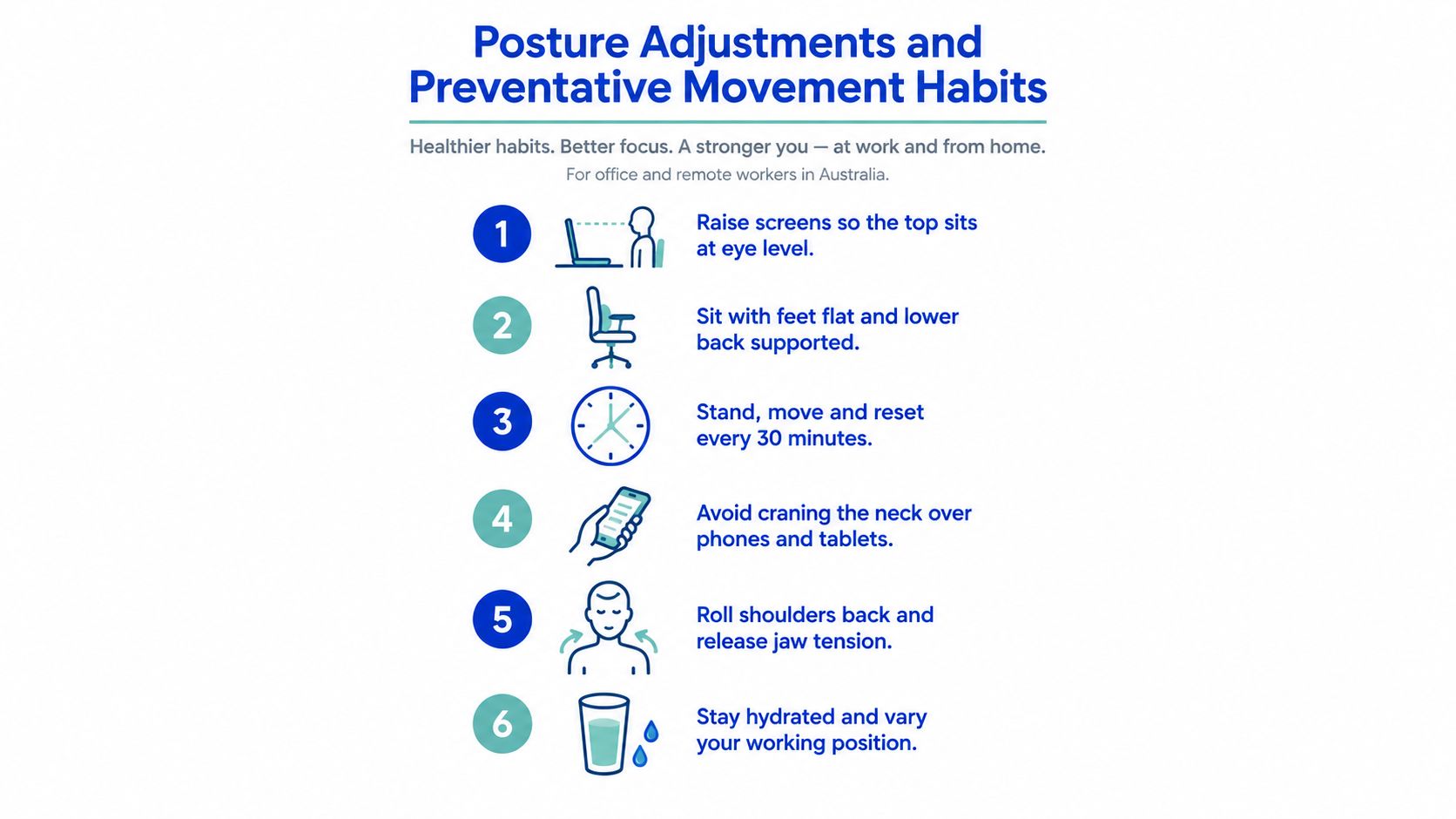
Start with the screen. Australian government-backed guidance recommends positioning a computer screen at eye level, which reduces the need to hold the head down for long periods. A separate keyboard and mouse can help when a laptop needs to be raised. Keep frequently used items close enough that you don't repeatedly reach, rotate or lean forwards.
Build movement into the workday
Don't wait for pain to remind you to move. Stand during a phone call, walk to refill water, change your sitting position, or perform a few relaxed shoulder movements between tasks. The useful habit is variety, not maintaining a rigid “perfect” posture all day.
A chair with back support can improve comfort, but it won't compensate for continuous sitting. Set a timer if you routinely lose track of time. The movement can be modest. You're interrupting sustained loading, not trying to complete a workout beside your desk.
Train capacity gradually
For longer-term control, progressive upper-body resistance has stronger support than relying only on massage, heat or posture correction. RACGP guidance for office workers describes either approximately 2 minutes per day of upper-body resistance exercise on 5 days per week, or 30 minutes of heavier resistance exercise on 2 days per week, with resistance, repetitions and sets increased gradually within symptom tolerance. These benchmarks come from the RACGP guidance on neck and upper-limb pain in office workers.
Suitable starting exercises might include rows with a resistance band, wall slides, or controlled shoulder blade movements. Begin with a level that doesn't reproduce neck pain or radiating symptoms. The same RACGP evidence notes that a systematic review of two randomised trials involving 500 participants found exercise reduced the odds of a new neck-pain episode by 68% compared with no intervention, with an OR of 0.32 and a 95% confidence interval of 0.12 to 0.86. This is prevention evidence, not a guaranteed success rate for established chronic pain.
Ergonomic changes still have value for comfort, but they shouldn't be mistaken for a complete prevention programme. The reviewed evidence found no clear preventive advantage from ergonomic programmes alone, with an OR of 1.00 and a 95% confidence interval of 0.74 to 1.35, as reported in the same RACGP source.
Use this posture and corporate ergonomics resource to check the practical setup around your desk, then pair those changes with regular movement and gradual strength work.
Managing Flare-Ups and Pacing Your Daily Activities
You wake with a tighter neck than yesterday, and the usual reaction is to do too much or almost nothing. Neither helps you judge what your neck can handle today. A flare-up is usually a signal to adjust the dose of movement, load, or time in one position.
Use symptoms to guide the day, not to shut the whole day down.
A simple traffic-light approach works well in clinic and at home:
- Green movements: comfortable or only mildly stiff, and they settle quickly afterwards. Keep these in your routine.
- Amber movements: mildly uncomfortable during or after. Reduce the range, speed, load, or repetitions, then check how you feel over the next few hours.
- Red movements: sharp pain, quickly worsening symptoms, pain spreading into the arm, numbness, tingling, or weakness. Stop that activity. If the symptom is new, persistent, or clearly escalating, get advice.
This is the difference between safe pacing and repeated aggravation. The aim is not to prove toughness. The aim is to stay active enough to prevent deconditioning while avoiding the kind of flare that lingers into the evening or the next day.
Arthritis Australia advises that resting for more than a day or two usually does not help and may make recovery harder. Continued activity is often the better option when symptoms are not linked to trauma, provided you avoid movements that clearly worsen pain. In practice, that means relative rest. Shorten the walk rather than cancelling it. Break up computer work with brief position changes. Delay heavy lifting, and split housework into smaller jobs.
Plan around predictable loads
Some tasks predictably irritate a sensitive neck because they combine time, posture, and limited variation. Driving is a common example. Set the seat so you are not reaching forward for the wheel, use breaks on longer trips, and do not drive if turning to check traffic feels restricted or unsafe. At work, rotate between screen tasks, standing, phone calls, and short walks where possible.
On a bad day, keep the habit but scale the task. Use the easiest version of the exercise, reduce repetitions, or swap to relaxed walking. Then reassess later. If symptoms settle back to their usual baseline, that was probably an acceptable dose. If they continue to build, stay noticeably worse later in the day, or start travelling into the arm, stop testing it and book an assessment.
Pacing protects function, not just comfort. A 2025 Australian Longitudinal Study report found that almost one-quarter of Australians with back or neck pain had changed their work status because of their condition. That is a useful reminder that sensible pacing supports work, driving, sleep, and daily independence while symptoms calm down.
Recognising Red Flags and When to Seek Professional Care
You wake with a stiff neck, turn carefully, and it feels sore but familiar. That situation is usually different from neck pain that appears after a crash, starts suddenly with unusual intensity, or comes with symptoms outside the neck itself. The safest decision comes from the whole pattern of symptoms, not from pain alone.
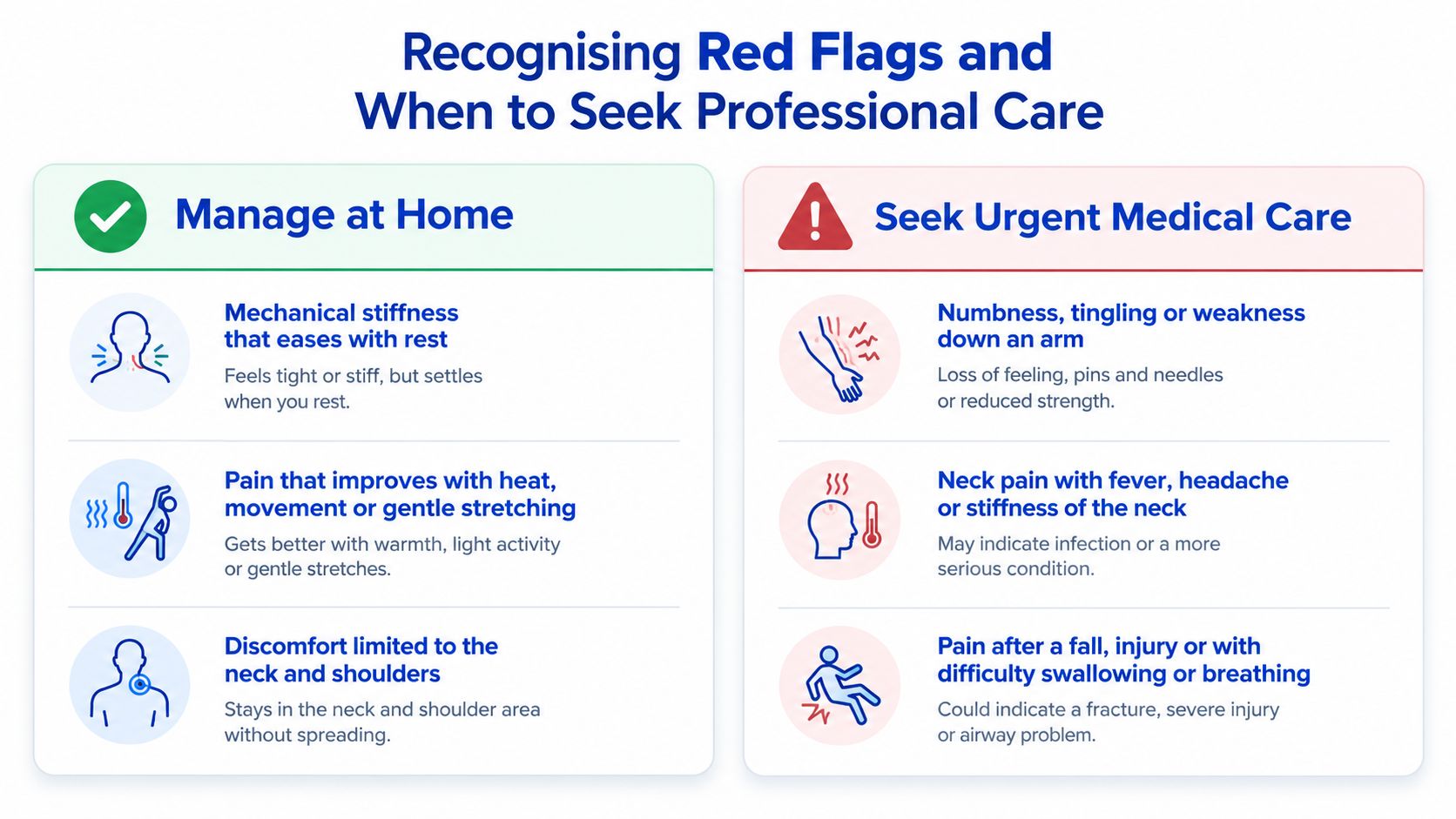
Home care is usually a reasonable starting point when discomfort is mild or moderate, began without trauma, stays local to the neck or shoulder region, and settles at least a little with gentle movement, position changes, heat, or cold. Even then, pacing still matters. If symptoms keep building despite sensible scaling, remain unsettled for several weeks, cause significant distress, or start interfering with work, sleep, driving, or daily tasks, it is time to get medical advice rather than pushing through.
Seek urgent assessment when symptoms change the risk
Some changes move the problem out of the self-management category. Call Triple Zero (000) for sudden severe neck pain, or for neck pain after a traumatic accident. Urgent assessment is also needed if you develop weakness in an arm or leg, changes to vision or hearing, fever, severe or worsening pain, or a strong sense that you are systemically unwell.
Pain that travels into the arm with numbness or weakness needs proper assessment. So does difficulty using a limb, new neurological symptoms, or a rapid change in your usual pattern. In those situations, more stretching is not a sensible test.
For Australian consumers, Healthdirect offers a nurse helpline on 1800 022 222, available 24 hours a day, seven days a week.
Stop self-treatment: Trauma, neurological symptoms, systemic symptoms and rapidly worsening pain need clinical judgement, not a more forceful home exercise.
An osteopath, physiotherapist, or doctor can examine the pattern, assess movement, and decide whether you need further investigation or a different treatment pathway. Getting help early is a practical decision. It means the symptoms no longer fit a straightforward home plan.
How Osteopathic Treatment Complements Your Home Routine
Hands-on care works best when it answers a specific question. Is the neck itself stiff, or is the neck compensating for limited movement through the upper back, ribs, shoulders or surrounding soft tissues? An osteopathic assessment considers how these areas work together rather than treating the painful spot in isolation.
Treatment may include soft-tissue techniques, gentle joint articulation and mobilisation, depending on the person's symptoms, health history and tolerance. The purpose isn't to force a release or promise an instant cure. It's to make a guarded movement more comfortable, reduce unnecessary tension and give you a clearer starting point for active rehabilitation.
That distinction matters during a flare-up. If turning the head is painful, repeatedly stretching into the restriction can reinforce irritation. A practitioner may instead work with nearby tissues, use a smaller movement range, or modify the task that provokes symptoms. Once movement is easier, home exercises can help maintain it and gradually build capacity.
Make treatment part of a daily plan
A clinic session can't replace the habits that load your neck between appointments. Your workstation, sleep position, phone use, driving posture and resistance routine all influence whether improvement lasts. Professional care is most useful when it gives you practical decisions to make at home, such as which movement to practise, which load to reduce, and how to progress without provoking symptoms.
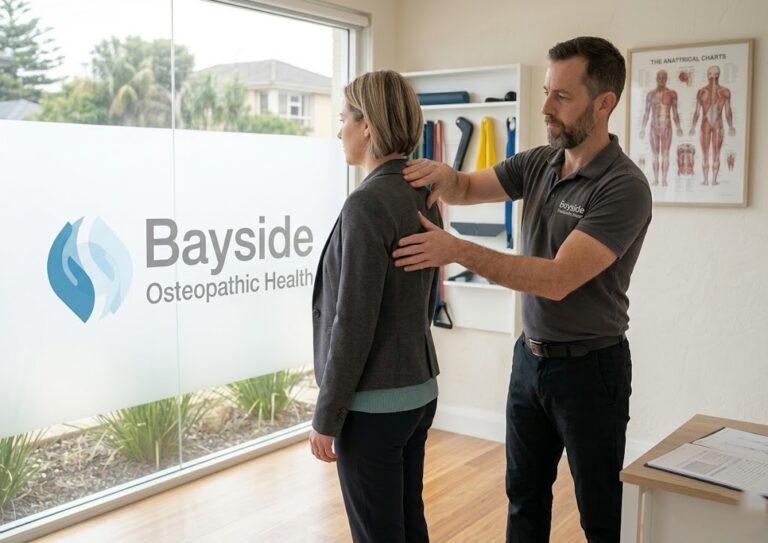
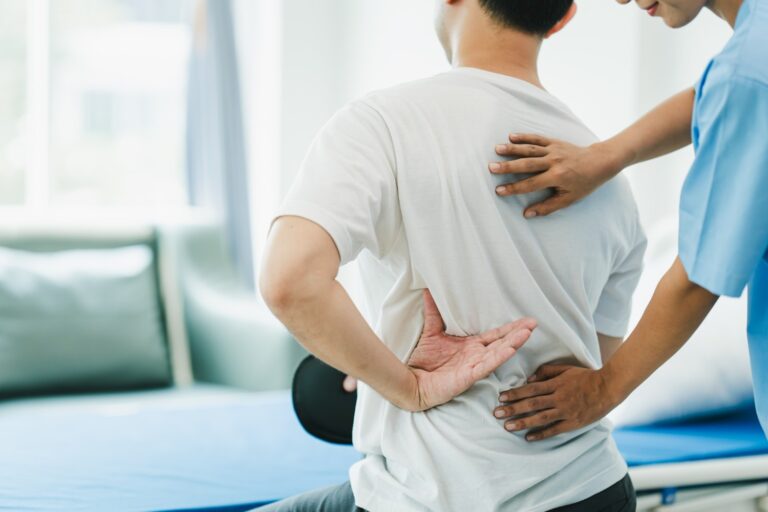
You can see an example of the broader treatment context in this spine and shoulder physical therapy image. The key principle is collaboration between hands-on treatment and self-management. Manual techniques may settle a barrier to movement, but your regular, symptom-guided activity helps your body use that improved movement confidently.
Bayside Osteopathic Health provides gentle, personalised osteopathic care for neck pain, postural strain and mobility concerns, combining hands-on techniques with movement advice and practical self-care. If your neck pain keeps returning, limits work or driving, or hasn't responded to a sensible home routine, visit Bayside Osteopathic Health to discuss an assessment and a plan that fits your daily activities.