
You might be feeling it first thing in the morning. Your back is stiff when you sit up. Your knees need a minute before they trust you. Reaching to pull on socks, turning to look behind you, or getting out of a low chair takes more planning than it used to.
That change can gradually chip away at confidence. Many older adults start doing less because movement feels uncertain, and then movement becomes even harder. From an osteopathic point of view, that cycle matters because the body doesn't work in isolated parts. Hips affect balance. Thoracic stiffness changes shoulder use. Foot and ankle motion influences how safely you walk.
The good news is that gentle, regular mobility work can make daily life feel steadier, safer, and more comfortable. The key isn't pushing hard. It's choosing the right movements, using good support, and paying attention to the messages your body gives you.
Table of Contents
- Why Gentle Movement Is Your Best Medicine
- The Four Pillars of Healthy Senior Mobility
- Your Step-by-Step Gentle Mobility Routine
- Building Your Weekly Mobility Habit
- Safety First and When to See an Osteopath
- Frequently Asked Questions About Senior Mobility
Why Gentle Movement Is Your Best Medicine
A common story in clinic goes like this. Someone notices they've become slower getting out of bed, more cautious on stairs, and less willing to walk far because they don't feel steady. They assume it's “just age”. It often isn't that simple.
A lot of what people call ageing is reduced movement layered on top of normal ageing. That distinction matters. Only 41.8% of Australians aged 65 and over meet national physical activity guidelines, and approximately half of physical decline in older adults is considered preventable through consistent, mobility-focused exercise, according to Better Health Victoria's guidance for physical activity for seniors.
From an osteopathic perspective, that makes perfect sense. If you stop moving a joint through useful ranges, the surrounding muscles stiffen, the nervous system becomes more guarded, and everyday tasks begin to feel heavier than they should. Then people compensate. They twist differently, brace more, shuffle instead of stride, and avoid movements that once felt automatic.
Gentle movement is often the doorway back to confidence, not just to flexibility.
The aim of mobility exercises for seniors isn't to train like an athlete. It's to keep the body available for life. That means being able to stand up without a struggle, turn safely, reach a shelf, step around obstacles, and recover balance when something unexpected happens.
Three practical truths guide this work:
- Small sessions count: A short, well-done routine is far better than waiting for the “perfect” day.
- Comfort matters: Mild effort is acceptable. Sharp or worsening pain is not.
- Whole-body changes matter most: Better ankle motion can help walking. Better chest opening can improve posture and breathing. Better hip strength can make rising from a chair easier.
For many people, seeing movement as part of health care changes everything. If you need a visual reminder that mobility support is part of long-term health management, this chronic disease management guide image reflects that broader view.

The Four Pillars of Healthy Senior Mobility
Mobility isn't one skill. It's a combination of abilities that let you move with control, enough freedom, and enough strength to trust your body.
Mobility is more than stretching
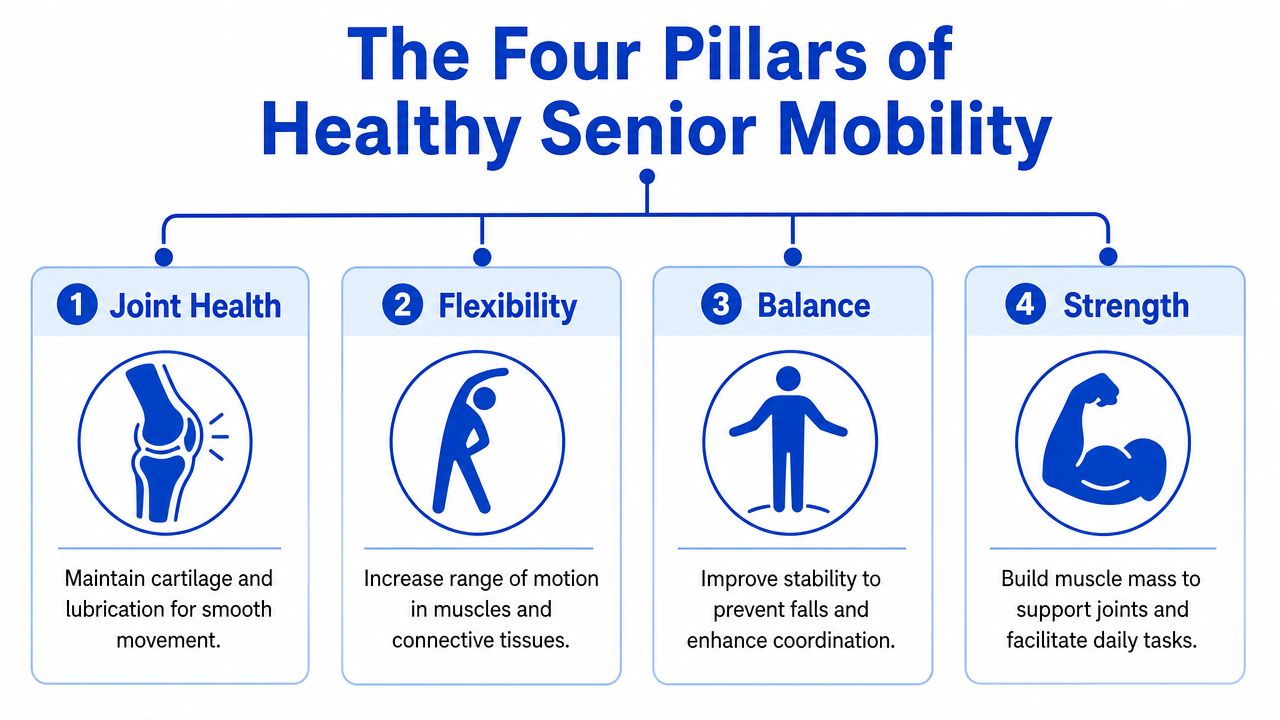
When people say they want “better mobility”, they often mean one of four things. Each pillar supports the others.
| Pillar | What it means | Why it matters |
|---|---|---|
| Joint range of motion | How freely a joint can move | Helps you turn, reach, bend, and step without compensating |
| Strength | The force your muscles can produce | Supports standing, climbing, carrying, and protecting joints |
| Balance | Your ability to stay steady and recover | Reduces the chance of losing footing during daily tasks |
| Flexibility | The length and ease of muscles and soft tissues | Makes movement smoother and less restricted |
This is why a routine made only of stretches often falls short. You may feel looser for a few minutes, but if strength and balance aren't improving, daily function won't change much.
What each pillar changes in daily life
Joint range of motion helps with practical tasks such as turning your head to reverse the car, rotating to reach a seatbelt, or bending enough to put on shoes. Regular functional mobility work can improve joint range of motion by 15–25% within 6–8 weeks according to NeuroMoves' exercise guidance for seniors with disability.
Strength keeps movement efficient. If your hips and thighs are weak, getting out of a chair becomes a pull-through-the-arms task instead of a controlled rise. Stronger muscles also share load better, which can make painful joints feel less overworked.
Balance is your safety net. It matters when you lean into a cupboard, step off a kerb, or turn quickly after hearing the phone ring. The same NeuroMoves guidance notes that balance training such as Tai Chi or clock taps can reduce falls by 30–45% in seniors with mobility impairments.
A body that can move well, support itself, and correct a wobble is far less fragile than one that's only “flexible”.
Flexibility fills in the gaps between intention and execution. If the chest is tight, shoulders often compensate. If the calves are stiff, walking shortens and balance can become less forgiving.
If stiff or painful joints are part of the picture, this arthritis and joint mobility resource image is closely related to the kind of issues many seniors notice in everyday movement.
Your Step-by-Step Gentle Mobility Routine
The best mobility exercises for seniors are simple enough to repeat and safe enough to trust. Start with a sturdy chair without wheels on a non-slip surface. Sit with your feet flat and about hip-width apart. Lengthen through your spine as if a string is gently lifting the crown of your head upward.
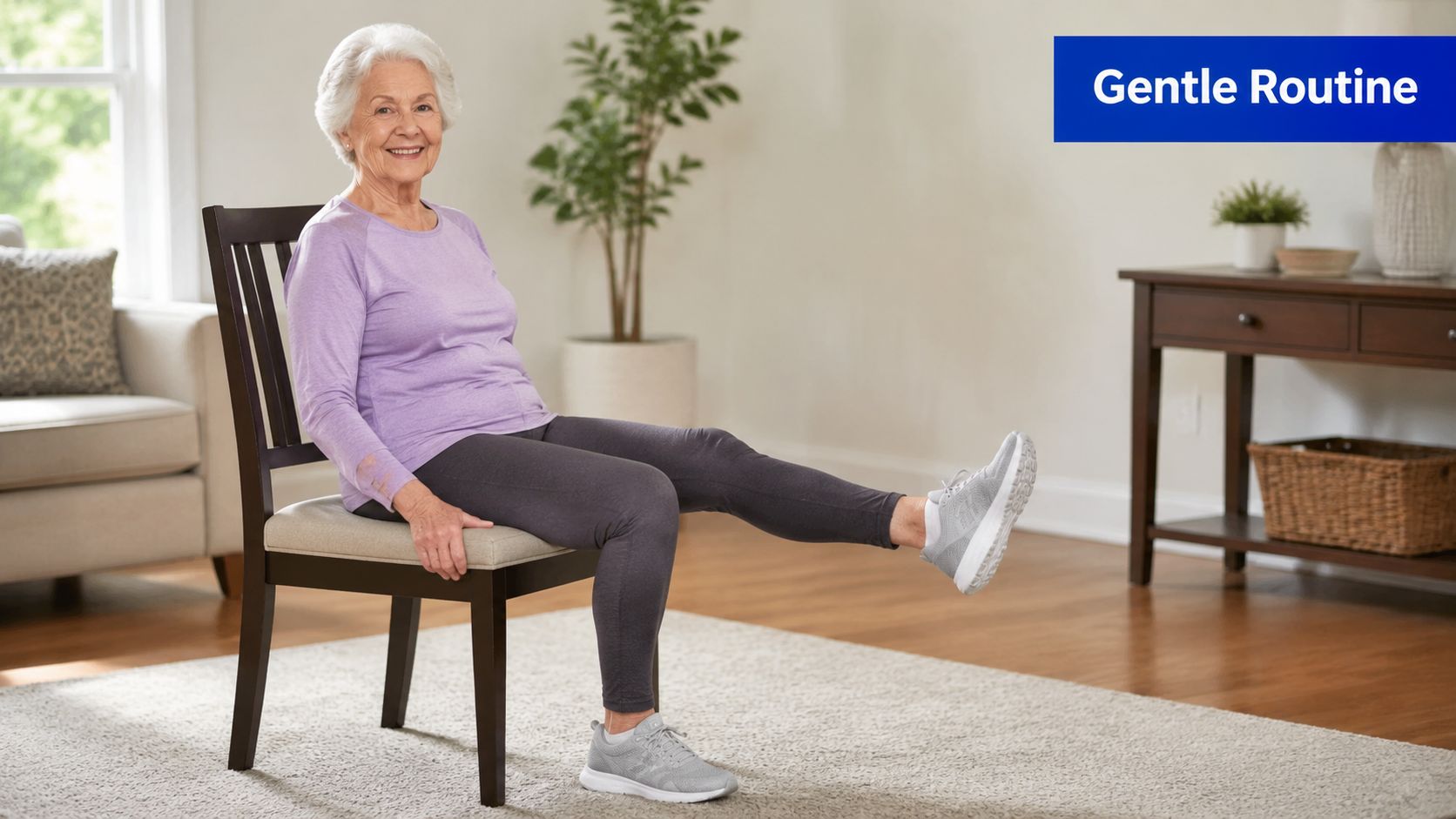
A practical beginner sequence can start with 10 controlled shoulder rolls, a 15-second seated chest opener, and 1 minute of wrist circles, which matches the idea in MoveMed's guide to gentle exercises for seniors with limited mobility that daily activity can be broken into smaller, manageable sessions.
Before you start
Keep these ground rules in mind before every session:
- Use the right chair: Choose a sturdy chair that doesn't roll or slide.
- Stay in a comfortable range: You should feel movement or mild muscular effort, not sharp pain.
- Breathe normally: Holding your breath often makes the body brace.
- Move slowly: Momentum hides weakness and reduces control.
Seated shoulder rolls
Why it helps
Shoulder rolls loosen the upper back and shoulder girdle. They're useful if you wake up hunched, spend a lot of time sitting, or feel tight across the neck and chest.
How to do it
- Sit tall with arms relaxed by your sides.
- Lift both shoulders towards your ears.
- Draw them back gently.
- Let them drop down in a smooth circle.
- Repeat for 10 controlled repetitions.
Make it gentler
Do one shoulder at a time. If neck tension builds, make the circle smaller and slower.
Seated chest opener
Why it helps
This movement counters the rounded posture many people develop when sitting, reading, or using a phone. Opening the chest can make breathing feel easier and can reduce the forward-drawn shoulder position that often contributes to upper back discomfort.
How to do it
- Sit near the front of the chair.
- Reach your arms out to the sides in a soft T shape.
- Gently draw the arms back until you feel a comfortable opening through the chest.
- Hold for 15 seconds without shrugging.
- Relax and repeat if it feels good.
Make it gentler
Bend the elbows into a goalpost shape, or keep the hands lower than shoulder height.
If posture work creates strain between the shoulder blades, reduce the effort. The goal is space, not force.
Wrist and finger circles
Why it helps
Hands and wrists do more work than people realise. These circles are useful for stiffness first thing in the morning, after knitting, gardening, gripping a walking aid, or long periods of inactivity.
How to do it
- Rest the forearms on your thighs or hold the arms slightly forward.
- Open and close the fingers gently.
- Circle the wrists one direction, then the other.
- Continue for 1 minute at an easy pace.
Make it gentler
Support one forearm with the opposite hand and move only one wrist at a time.
This short demonstration can help if you prefer to follow along visually.
Seated marching
Why it helps
Seated marching wakes up the hips, lower abdomen, and thigh muscles used for walking and stepping. It's a good choice if standing work feels too demanding at first.
How to do it
- Sit tall without leaning heavily into the backrest.
- Lift one knee a small amount.
- Lower it with control.
- Alternate legs in a steady rhythm.
- Continue for a comfortable spell, aiming to keep the motion smooth.
Make it gentler
Lift the feet only slightly off the floor, or slide one foot forward and back if hip flexion feels limited.
Heel raises
Why it helps
Heel raises strengthen the calves and train the ankle to contribute to balance. From an osteopathic perspective, ankles are often overlooked, yet they play a major role in walking confidence and how well you recover from small stumbles.
How to do it
- Sit or stand while holding a bench or chair for support.
- Press the balls of the feet into the floor.
- Lift the heels slowly.
- Pause briefly at the top.
- Lower with control.
Make it gentler
Begin seated. If both feet together feel too hard, do smaller lifts and reduce the range.
Supported sit-to-stand
Why it helps
This is one of the most practical mobility exercises for seniors because it directly trains a daily task. It builds strength in the thighs and hips and improves confidence rising from a chair.
How to do it
- Sit on a firm chair near the front edge.
- Place feet under the knees, about hip-width apart.
- Lean the body slightly forward from the hips.
- Press through the feet and stand up.
- Lower back down slowly with control.
Make it gentler
Use the chair arms or a bench for support. You can also start from a higher chair or place a firm cushion on the seat.
If a movement feels good, that's not a licence to rush it. Good mobility work is calm, steady, and repeatable. The body learns best when it feels safe.
Building Your Weekly Mobility Habit
People often overestimate what they can do in one enthusiastic session and underestimate what a modest routine can do over time. For older adults, the second approach wins almost every time.
What works better than bursts of effort
Chair mobility exercise programmes tend to work best when they're done 3–5 times weekly for 20–30 minutes, and consistency matters more than intensity, according to Mosaic Medical Solutions' low-impact exercise guidance for seniors with limited mobility.
That reflects what I see in practice. The body responds well to regular input. If you do too much on Monday, feel sore on Tuesday, and stop until next week, you haven't built a reliable signal for adaptation. A shorter session done often is gentler on joints, easier on confidence, and far more likely to become routine.
A habit usually sticks when it's attached to something you already do. Try one of these:
- After breakfast: Complete your seated routine before clearing the table.
- After the morning news: Do shoulder rolls, marching, and sit-to-stands.
- Before an afternoon walk: Use mobility work as your warm-up.
- Before bed: Choose the gentlest seated options to reduce stiffness.
The best plan is the one you'll still be doing next month.
Sample Weekly Mobility Schedule
Use this as a template, not a test.
| Day | Focus | Duration | Notes |
|---|---|---|---|
| Monday | Seated mobility routine | 20–30 minutes | Shoulder rolls, chest opener, wrist circles, seated marching |
| Tuesday | Gentle walk plus heel raises | 20–30 minutes | Keep pace comfortable and posture tall |
| Wednesday | Chair strength and balance | 20–30 minutes | Sit-to-stand practice with support as needed |
| Thursday | Lighter recovery session | 20 minutes | Repeat easiest seated movements |
| Friday | Full mobility routine | 20–30 minutes | Move slowly and note what feels easier |
| Saturday | Walking or pool movement | 20–30 minutes | Choose a pleasant, low-pressure activity |
| Sunday | Rest or brief seated reset | 10–20 minutes | Focus on comfort, not effort |
A few progression rules keep you safe and moving forward:
- Add one thing at a time. Increase either time, repetitions, or complexity. Don't change all three at once.
- Track function, not perfection. Notice whether standing up, turning, or walking feels smoother.
- Respect recovery. If you feel heavily fatigued or unusually sore, do the easier version next session.
Safety First and When to See an Osteopath
Mobility work should leave you feeling used, not aggravated. Mild muscle fatigue, a sense of warmth, or gentle stretching is usually acceptable. Sharp pain, increasing pain, or symptoms that spread are a different message.
Body signals to respect
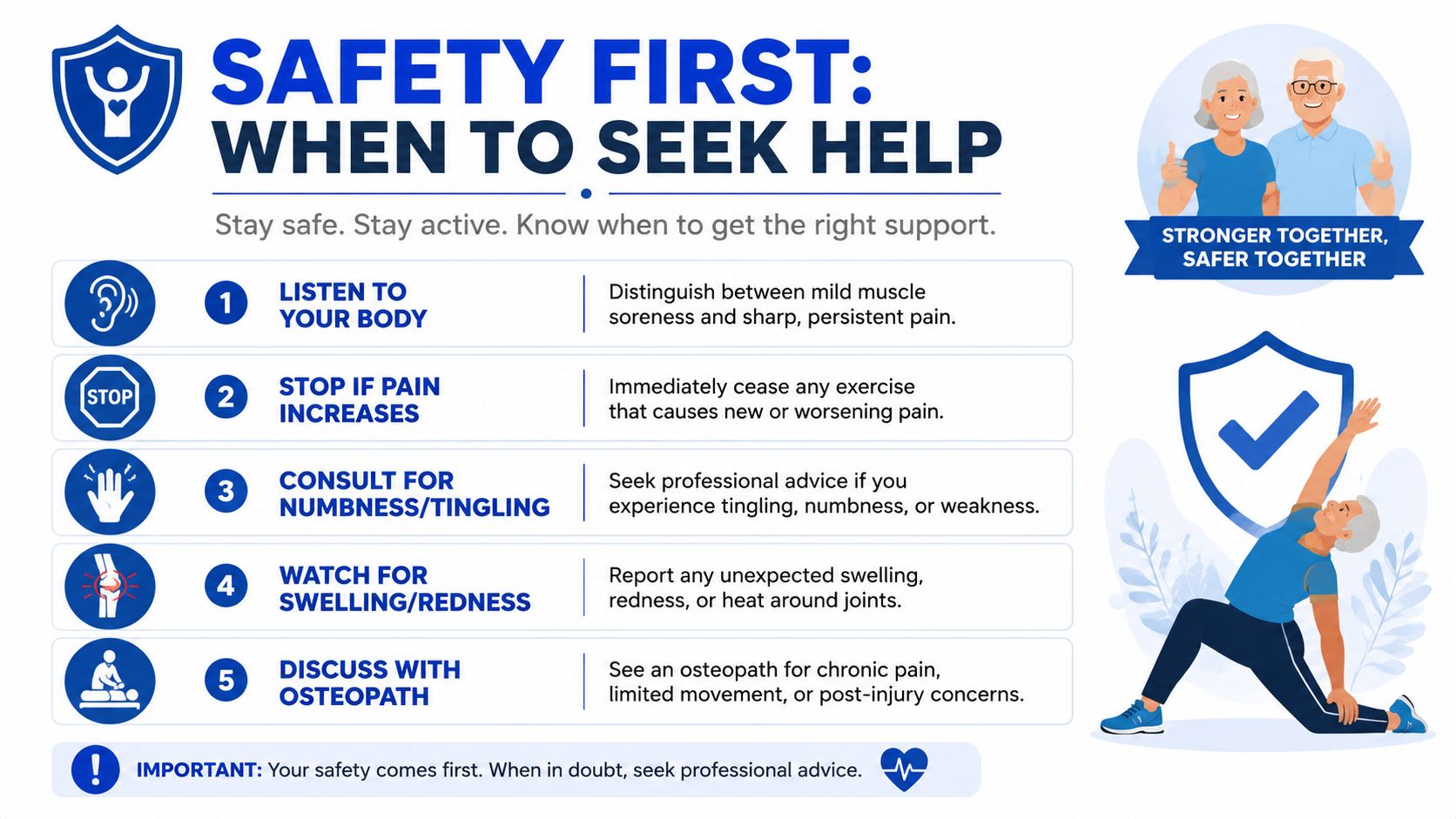
Use this quick safety checklist each time:
- Check your setup: Sit on a sturdy chair without wheels, placed on a non-slip surface.
- Watch your posture: Keep feet flat, roughly hip-width apart, and lengthen through the spine.
- Start below your maximum: A smaller range done well is safer than forcing a bigger one.
- Pause for red flags: Stop if you get sharp pain, pain that rapidly worsens, or a movement that feels unstable.
- Rest when needed: Short breaks improve quality and reduce compensations.
When general exercise advice is no longer enough
Some limits are straightforward stiffness. Others need proper assessment. If pain keeps returning in the same area, if you're changing the way you walk to avoid discomfort, or if a joint feels blocked rather than merely tight, it's worth getting help.
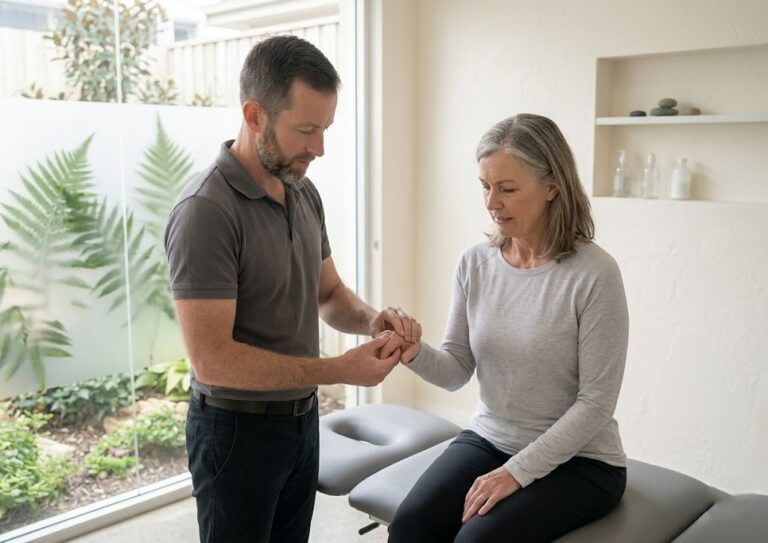
An osteopath looks at how your body is sharing load. Sometimes the sore spot isn't the starting point. A painful knee may be coping with a stiff ankle or hip. A tense neck may be working around a rounded upper back and reduced rib movement. That whole-body view is especially useful when home exercise hasn't matched the problem.
If you're dealing with persistent discomfort, restricted movement, or post-injury uncertainty, this guide to myotherapy, movement and osteopathy reflects the sort of supportive care pathway many people look for.
Stop the exercise. Don't stop the investigation. If your body keeps objecting, find out why.
Frequently Asked Questions About Senior Mobility
Can I do mobility exercises if I have arthritis
Usually, yes. In many cases, gentle movement helps arthritic joints feel less stiff and more cooperative. The key is to move within a comfortable range, warm up gradually, and avoid forcing painful positions. If a joint flares and stays irritated after exercise, the routine needs adjusting.
What if I've had a joint replacement
Many people with joint replacements benefit from mobility work, but the right movements depend on the joint, the timing since surgery, and your surgeon's or treating practitioner's advice. Start with supported, low-risk exercises and follow any movement precautions you've been given.
How do I tell normal effort from a warning sign
Normal effort feels like muscles working, mild tiredness, or gentle stretching. A warning sign feels sharp, catching, unstable, or progressively worse as you continue. Numbness, tingling, and weakness also deserve attention.
How soon will I notice a difference
Some people feel looser within a few sessions because they're moving more often and with better control. Bigger changes usually come from steady repetition. Focus on practical wins such as easier standing, smoother turning, and better confidence walking.
Do I need equipment
No. A sturdy chair, supportive footwear if you're standing, and a clear space are enough for most beginners. The safest routine is usually the simplest one.
If you'd like specific help with stiffness, balance concerns, arthritis-related movement limits, or pain that keeps interrupting activity, Bayside Osteopathic Health offers gentle, whole-body osteopathic care focused on improving comfort and mobility. A personalised assessment can help you understand what your body is tolerating well, what needs modifying, and which exercises are most suitable for you.