

You wake up, turn your head to check the time, and your neck answers with a sharp protest. Maybe it started after a long day at the laptop. Maybe it crept in after sleeping awkwardly on the couch. Sometimes neck stiffness feels minor until you realise reversing the car, looking over your shoulder, or even sitting at your desk has become irritating.
That's a common experience, but it still deserves proper care. Good neck stiffness treatment isn't just about getting through today. It's about calming things down safely, restoring movement, and stopping the same pattern from flaring up again.
Table of Contents
- That Familiar Ache Understanding Neck Stiffness
- First Steps for Immediate Neck Stiffness Relief
- Gentle Stretches and Mobilisations for Neck Mobility
- Improving Your Daily Posture and Ergonomics
- When to Seek Professional Osteopathic Care
- Building a Resilient Neck with Long-Term Prevention
That Familiar Ache Understanding Neck Stiffness
A stiff neck often begins in an ordinary way. You spend hours concentrating without moving much. You sleep with your head turned. You lift something awkwardly. Then the muscles around the neck and upper shoulders tighten, the joints stop gliding comfortably, and turning your head becomes guarded and sore.
For many people, the first thought is, “Did I do something serious?” Most of the time, neck stiffness comes from irritated muscles and joints rather than something dangerous. It can feel severe without meaning severe damage. The neck is mobile by design, so even a small amount of tension can feel very noticeable.

In Australia, this isn't a niche problem. Neck pain affects approximately 20% of adults, contributes to disability, and is associated with an estimated $12.23 billion in health system costs, with more than 3.24 million Australians living with chronic pain that includes neck issues according to Australian posture and spinal pain statistics. That scale matters because it reminds people of something important. If your neck feels stiff and irritated, you're not unusual, and you're not failing to cope.
What neck stiffness usually feels like
Common patterns include:
- Pain with turning that makes checking blind spots or looking down difficult
- A pulling sensation at the base of the skull or into the top of the shoulder
- Morning tightness that eases once you get moving
- Headache with neck tension when the upper neck stays irritated
Sometimes posture plays a clear role. If you spend long stretches leaning toward a screen, neck stiffness and headaches often travel together. This visual guide to posture-related headaches shows the sort of strain pattern many people recognise immediately.
Neck stiffness usually responds best when you do the simple things early, rather than waiting until the area becomes more guarded.
What actually helps
The most effective path is usually straightforward. First, settle the irritation. Then restore comfortable movement. Then deal with the reason it happened, whether that's workstation setup, stress, sleep position, or reduced upper back mobility.
That whole-person view matters in osteopathic care. The neck doesn't work alone. The jaw, upper back, ribs, shoulders, breathing pattern, and stress levels all influence how it feels and how well it recovers.
First Steps for Immediate Neck Stiffness Relief
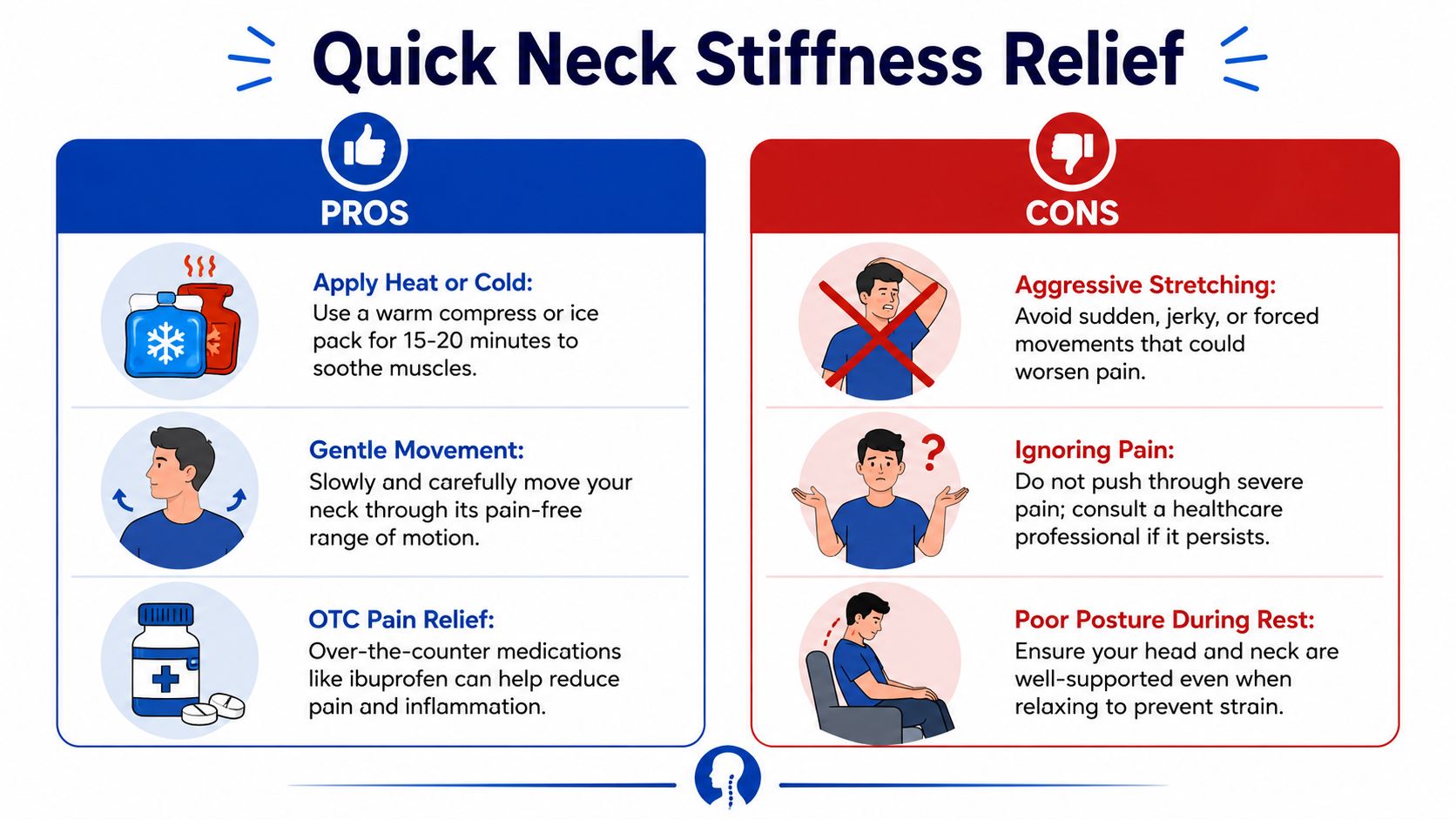
When your neck has just seized up, the goal isn't to force it loose. The goal is to reduce muscle guarding and keep the area moving gently without provoking it. Think calm, not aggressive.
What to do in the first day or two
A simple home approach works well for many mild flare-ups:
Use heat if the neck feels tight and knotted
A warm pack can help muscles relax and can make gentle movement easier. Wrap the heat pack so it feels comfortably warm, not hot enough to irritate the skin.Keep the neck moving in a small, easy range
Turn your head only as far as feels manageable. Nod gently. Tilt slightly side to side. Small movement often helps more than staying still.Rest from aggravating positions
Long bouts looking down at a phone, laptop, or book usually make a stiff neck worse. Change position often.Support the area when sitting
Sit back in the chair, let your shoulders soften, and avoid poking your chin forward. A rolled towel behind the upper back can help some people sit taller without strain.
A practical relief routine
Try this for a few rounds through the day:
- Warm the area first for a short period
- Do three slow head turns each side within a comfortable range
- Add three gentle nods up and down
- Finish with relaxed shoulder rolls to stop the neck doing all the work
If one movement makes the pain sharper, don't push through it. Skip that movement and stay with what feels easier.
Practical rule: If a movement leaves your neck feeling freer after a few minutes, keep it. If it leaves you more protective, scale it back.
What to avoid early on
Some habits delay recovery because they irritate tissue that's already sensitive.
- Aggressive stretching: Don't yank your head into a strong stretch because the area feels “stuck”.
- Long periods of immobilisation: Rest helps, but complete stillness often increases stiffness.
- Heavy upper body training: Pressing, shrugging, or loaded pulling can flare things early.
- Testing it repeatedly: Constantly turning your head to check if it still hurts tends to keep the area on alert.
Over-the-counter pain relief is something many people use as part of self-management. In one study of office workers with neck pain, 35.3% of female office workers reported self-managing with conventional medical strategies such as over-the-counter medications and heat packs in this Australian office worker neck pain study. Medication decisions are best discussed with your pharmacist or GP, especially if you have other health conditions.
When home care is enough
If the stiffness is easing day by day, movement is gradually returning, and there's no arm weakness, numbness, trauma, or worsening pain, home care is often a reasonable start.
If it's not settling, that's usually a sign the problem isn't just a simple muscle spasm. The upper back may be restricted, the neck joints may be irritated, or your body may be holding more tension than you realise.
Gentle Stretches and Mobilisations for Neck Mobility
Once the neck has settled enough that basic movement feels safer, the next step in neck stiffness treatment is to restore motion without forcing it. Many people make a mistake at this point. They go from “barely move” to “stretch hard”. A better approach is repeated, easy movement with good form.
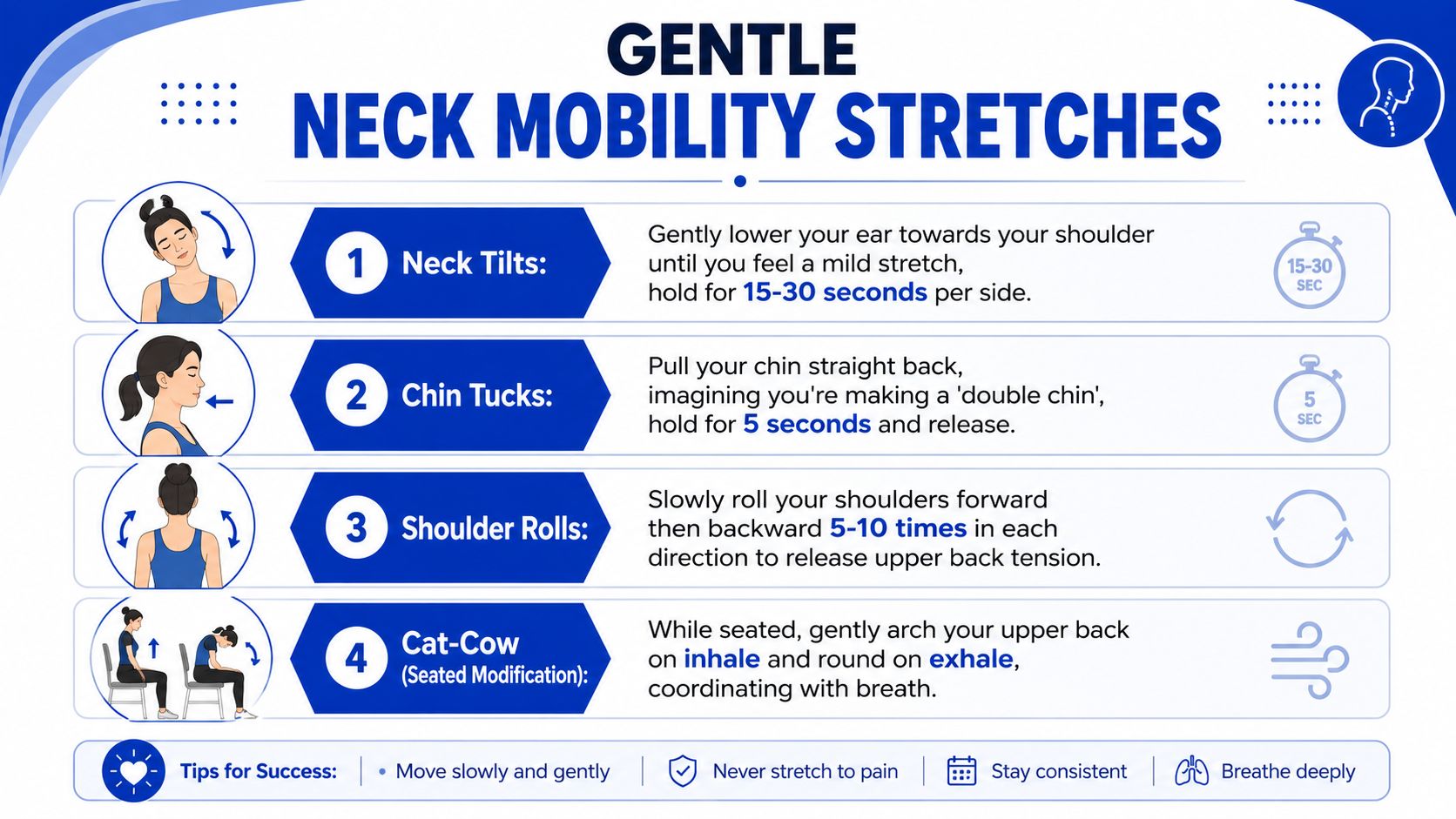
This visual guide is a useful reference before you begin.
Chin tucks for upper neck strain
This is one of the best starting movements if you spend a lot of time at a desk.
How to do it:
- Sit tall with your eyes level
- Gently draw your chin straight back
- Think “make a soft double chin”, not “look down”
- Hold briefly, then relax
You should feel the back of the neck lengthen a little. You shouldn't feel pinching.
Why it helps: chin tucks reduce the forward-head habit that overloads the upper neck and base of skull. They also wake up the deeper neck support muscles that often switch off when posture has been poor for a while.
Side bends for protective tightness
If one side of your neck feels shorter or more guarded, gentle side bending can help.
Try it like this:
- Sit on one hand to stop the shoulder lifting.
- Slowly tilt your opposite ear towards the shoulder.
- Stop at the first mild stretch.
- Breathe slowly, then come back to centre.
This should feel mild. If it creates sharp pain into the shoulder or arm, stop.
Rotation for everyday function
Turning the head is what people miss most when the neck stiffens. Driving, crossing the road, talking to someone beside you, all of it depends on rotation.
Use this approach:
| Movement | How to do it | What to watch |
|---|---|---|
| Gentle head turns | Turn your head left and right in a small, smooth range | Keep the motion slow and avoid pushing into pain |
| Eyes lead first | Look with your eyes before the head follows | This often reduces the feeling of threat and guarding |
| Return to centre softly | Don't snap back to neutral | Smooth return matters as much as the turn |
A helpful trick is to breathe out as you turn. People often hold their breath when they expect pain, and that usually makes the movement feel worse.
Shoulder rolls and seated upper back movement
Neck stiffness rarely belongs only to the neck. The upper back and rib cage often stiffen at the same time, especially after long desk work.
Add these:
- Shoulder rolls: slowly forward, then backward
- Seated cat-cow: gently round and then extend through the upper back
- Chest opening: place hands behind the head or on the chair and gently lift the breastbone
These movements take load off the neck by sharing motion with nearby regions that should be contributing.
Here's a guided video if you prefer to follow along rather than read cues.
For whiplash-related stiffness
If your stiffness began after a whiplash injury, movement should still be guided, but it often needs a more structured approach. The Draft Australian Clinical Guidelines for Whiplash describe short-term symptom resolution of 70 to 75% within 6 to 8 weeks with clinically informed exercise programs that include neck-specific range-of-motion work, thoracic treatment, and psychologically informed exercise for medium and high-risk patients. The same guideline notes that self-SNAG at C1 to C2, performed 3 to 5 times per day for 10 seconds each, can increase cervical range of motion by 12 to 18% within 3 weeks in acute neck pain with headaches.
Move often, but keep the movements boringly gentle. The neck usually improves with repetition and confidence, not intensity.
How often to do these
Short sessions done regularly tend to work better than one big session. A few minutes at a time, spread through the day, is usually easier for the neck to tolerate than a single long stretch session at night.
Stop and seek assessment if symptoms spread into the arm, dizziness appears, headaches escalate sharply, or the neck becomes more irritable each day rather than less.
Improving Your Daily Posture and Ergonomics
You wake up feeling looser, get through the morning reasonably well, then by mid-afternoon the neck starts to tighten again. That pattern usually points to load, not damage. The daily positions your body returns to often matter as much as the stretches or treatment that gave you short-term relief.
For desk-based work, the problem is rarely one single posture held "wrong." It is the accumulation of small habits. A screen that sits too low. A laptop that pulls the head forward. Shoulders that creep up as concentration and stress build. Long stretches without changing position. In clinic, those factors show up together far more often than on their own.
Desk setup that helps
A useful desk setup does one main job. It reduces how long your head stays poked forward and how much your upper traps have to brace.
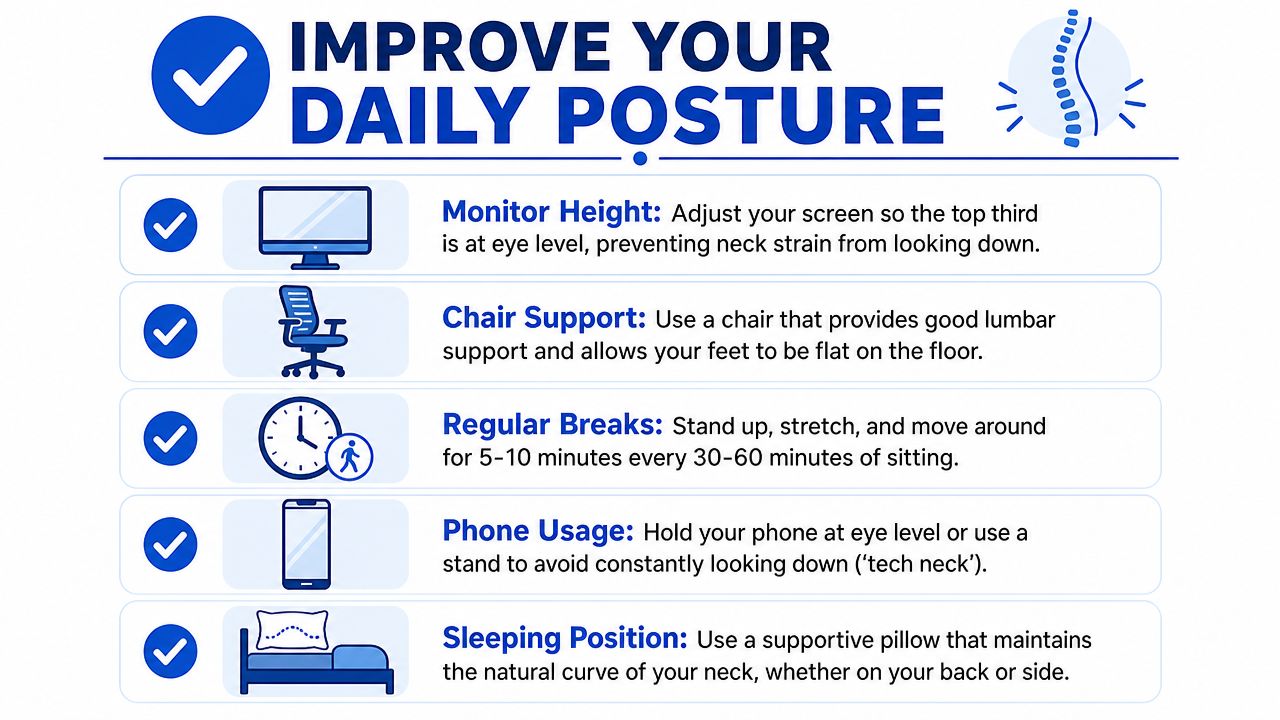
Use these points as a practical baseline:
- Screen height: Lift the monitor so your eyes meet the upper portion of the screen without your chin dropping all day.
- Chair support: Sit back so the chair supports you. Perching on the edge makes the neck and upper back work harder.
- Keyboard and mouse position: Keep them close enough that your elbows rest by your sides instead of reaching forward.
- Feet supported: Put both feet on the floor, or use a stable footrest if needed.
- Laptop use: If you work from a laptop for hours, add a separate keyboard and raise the screen.
If you want a quick visual guide, this office ergonomics visual checklist gives a clear reference for what "good enough" looks like.
Good ergonomics will not keep the neck comfortable if you stay still for three hours. Setups matter. So do interruptions to that setup. A brief reset every 30 to 60 minutes often helps more than chasing a perfect seated posture.
Sleeping and phone habits
Night-time positioning can either settle an irritated neck or keep it stirred up. The pillow is part of that, but not the whole story.
A few simple rules help:
- For side sleepers: choose a pillow height that fills the gap between shoulder and head without bending the neck sideways
- For back sleepers: use a pillow that supports the natural curve of the neck without pushing the head forward
- For phone use: bring the screen up toward eye level instead of folding your neck down to meet it
If you wake stiff but improve within 20 to 30 minutes of moving around, sleep position is worth reviewing. If the neck stays locked well into the day, there is often more going on than the pillow alone.
Stress and bracing patterns
Stress changes muscle tone. People clench through the jaw, hold the shoulders slightly raised, breathe higher into the chest, and move less through the ribcage and upper back. The neck then ends up doing extra work.
A well-set desk helps, but a braced body can still keep the neck sore.
That is why I usually advise patients to pair ergonomic changes with small movement breaks and slower breaths during the day. The goal is not perfect posture. The goal is fewer hours spent in one loaded position, and less background tension for the neck to fight against.
When to Seek Professional Osteopathic Care
Some neck stiffness settles with home care. Some doesn't. The key question is whether the neck is gradually improving or whether it's becoming a recurring problem, a more intense problem, or a problem that includes other symptoms.
Red flags that need urgent medical attention
Seek prompt medical assessment if neck pain or stiffness comes with any of the following:
- Recent trauma: especially after a fall, diving injury, or motor vehicle accident
- Neurological symptoms: numbness, tingling, weakness, or loss of hand coordination
- Severe or worsening headache: particularly if it feels unusual for you
- Fever or feeling unwell: especially with marked neck pain and stiffness
- Pain spreading strongly into the arm: particularly if it's persistent or associated with weakness
- Pain that doesn't settle: if it remains severe or keeps worsening despite sensible care
These situations need proper medical evaluation before any routine manual treatment is considered.
Signs you'd benefit from hands-on assessment
You don't need to wait for a crisis. It's reasonable to book in when:
- the neck keeps “going out” every few weeks
- turning is still restricted after the early flare has calmed
- headaches keep accompanying the stiffness
- the upper back and shoulders also feel locked up
- you're doing the right exercises but not getting traction
A good assessment looks beyond the sore spot. Neck stiffness can be driven by stiff upper thoracic joints, overactive superficial neck muscles, reduced shoulder mechanics, breathing tension, or a body that's become protective after pain.
What osteopathic care usually involves
An osteopath will usually assess:
| Area | Why it matters |
|---|---|
| Neck movement | To identify which directions are restricted or painful |
| Upper back and ribs | These regions often influence how much work the neck has to do |
| Shoulders and posture | Poor shoulder positioning can feed tension into the neck |
| Muscle tone and tenderness | To locate guarding, trigger points, and overload patterns |
| Lifestyle factors | Sleep, stress, workstation habits, and exercise all affect recovery |
Treatment often combines soft tissue work, joint articulation or mobilisation, movement advice, and a home program. In some cases, treatment is very gentle because the neck is highly reactive. In others, more direct mobilisation is appropriate.
For persistent neck pain with mobility deficits, the JOSPT neck pain clinical practice guideline reports that a multimodal protocol had a 68.3% clinical success rate at 7 weeks, compared with 50.8% for physical therapy alone and 35.9% for GP-led conservative care. The same guideline supports a combined approach of manual therapy, exercise, stretching, strengthening, endurance work, and cognitive-affective elements. That's consistent with what tends to work best clinically. Not just hands-on treatment. Not just exercises. The combination.
Clinical reality: Passive treatment alone often feels good in the moment, but results are better when hands-on care is paired with the right exercises and a clear plan for daily habits.
Trade-offs people should understand
Professional care can help a lot, but it isn't magic and it shouldn't be sold that way.
- Hands-on treatment can reduce guarding quickly, but if you return to the same aggravating habits without changing anything, stiffness often returns.
- Exercise builds resilience, but if the neck is too irritated, starting with exercise alone can feel frustrating.
- Rest can calm a flare, but too much rest usually leaves the neck more sensitive and less confident.
That's why the best neck stiffness treatment is individualized. A person with a desk-related stiffness pattern needs a different plan from someone recovering from whiplash or someone whose symptoms are driven by stress, headaches, and jaw tension.
For people exploring care options, this overview of osteopathic support for spinal pain gives a broad sense of how manual care fits into recovery.

Building a Resilient Neck with Long-Term Prevention
The neck usually does best when you stop treating it as an isolated part. It's influenced by how you sit, how you sleep, how often you move, how you breathe, and how much tension you carry through the day.
Long-term prevention usually comes down to a few steady habits:
- Move often: short movement breaks matter more than one perfect stretch session
- Keep basic mobility work going: chin tucks, upper back movement, and gentle rotation are simple but useful
- Make your setup easier on the body: reduce the hours spent with your head dropped forward
- Respect stress as a physical driver: a clenched jaw and lifted shoulders can keep neck stiffness going
- Stay consistent: small changes repeated regularly usually beat dramatic efforts done once
Hydration, sleep quality, and general physical activity also matter. A body that's tired, deconditioned, and tense is more likely to stiffen up when load increases.
The most reassuring thing about neck stiffness is that it's often modifiable. When people understand what's driving it and respond early, they usually feel more in control and less worried by each flare-up. That confidence is part of recovery too.
If your neck keeps tightening up, feels hard to turn, or isn't improving with home care, Bayside Osteopathic Health offers gentle, practical osteopathic care focused on easing pain, improving mobility, and helping you understand why the stiffness keeps returning. If you're in Bayside and want a personalized plan for neck stiffness treatment, it's a good place to start.