
You stand up after a long stretch at the desk and feel that familiar tug through the front of the hips. Or you get out of the car, take a few steps, and realise your stride feels short and stiff. Sometimes it shows up as a dull ache in the low back. Sometimes it feels like your hips won't do what you want them to do.
That feeling is often blamed on age, bad posture, or “tight muscles”, but in clinic it's usually more useful to think about hip mobility as the ability to move the joint well, with control, without your back, pelvis, or knees doing all the extra work. Good mobility isn't about forcing yourself into deep stretches. It's about restoring comfortable movement so everyday tasks feel easier again.
This guide takes a gentler path. It focuses on practical hip mobility exercises, pain-safe modifications, and the small technique details that make a big difference if you're an office worker, an older adult, or someone managing ongoing stiffness. If arthritis or joint irritation is part of the picture, even a simple visual like this arthritis and joint mobility image can help make sense of why pushing harder often backfires.
Table of Contents
- Feeling Stuck How Hip Immobility Affects Your Daily Life
- Why Hip Mobility Is the Key to Moving Well
- 7 Foundational Hip Mobility Exercises You Can Do Today
- How to Move Safely Avoiding Common Hip Mobility Mistakes
- Sample Hip Mobility Routines for Your Lifestyle
- When Exercises Are Not Enough Seeking Osteopathic Care
Feeling Stuck How Hip Immobility Affects Your Daily Life
Hip stiffness usually doesn't announce itself dramatically. It develops gradually. You notice it when tying your shoes, rolling over in bed, walking uphill, or trying to stand upright after sitting through meetings all morning.
For desk workers, the pattern is common. Hours of sitting leave the hips in a flexed position, and when you finally get up, the body doesn't transition smoothly. The first few steps feel awkward, the glutes seem asleep, and the low back often takes over.
Older adults often describe something slightly different. They don't always say “my hips are stiff”. They say they feel less steady, less fluid, or more cautious with turning, bending, and getting in and out of chairs. That matters because reduced hip movement changes how the whole lower body shares load.
Everyday signs your hips may be contributing
- Standing feels harder than it should: You push off your thighs or need a moment before walking comfortably.
- Your stride has shortened: You're walking, but not moving freely through the hips.
- Your back tightens after sitting: The hips aren't contributing enough, so the lumbar spine tries to help.
- Turning feels clunky: Pivoting to reach something behind you feels restricted or guarded.
Good hip mobility feels less like stretching and more like moving without bracing.
A lot of people assume the answer is to stretch harder. Often, that's exactly what irritates things. If the joint is already sensitive, or if your pelvis twists every time you try to mobilise the hip, more force just teaches better compensation.
What helps is a calmer approach. Gentle, repeatable hip mobility exercises can improve comfort, but only if they match the body in front of you. That's why floor-based and chair-based options matter just as much as athletic drills.
Why Hip Mobility Is the Key to Moving Well
The hip is a large, load-bearing joint, but its real importance shows up in how it shares movement with everything around it. Walk, squat, climb stairs, get out of bed, carry groceries, or turn quickly, and the hips need to move with both range and control. If they don't, another area picks up the slack.
Your hips rarely work in isolation
A stiff hip doesn't stay a hip problem for long. The pelvis may rotate to fake movement. The lower back may extend or twist more than it should. The knee may collapse inward or the foot may roll to compensate.
That's one reason low back pain and hip restriction often travel together. In an Australian clinical study involving people with non-specific low back pain, adding targeted hip strengthening to mobility work was significantly more effective for restoring functional ability than mobility exercises alone, with 80% of the strengthening group achieving clinical improvements in function according to the James Cook University study on hip strengthening and mobility for low back pain.
That result matters because it shifts the goal. The aim isn't merely to make the hip “looser”. The aim is to help the hip move well enough, and stay strong enough, that the rest of the body doesn't have to compensate.
Mobility without strength often falls short
People often separate flexibility and strength as if they live in different worlds. In practice, they work together. A hip that can access range but can't control it often feels unstable. A hip that is strong but restricted can still force the back and knees to work too hard.
A simple way to think about it is this:
| Area | What happens when it's lacking | What you often feel |
|---|---|---|
| Hip mobility | The joint doesn't move freely | Stiffness, pinching, short stride |
| Hip control | The pelvis or trunk compensates | Wobbling, twisting, poor balance |
| Hip strength | Other areas absorb the load | Back tension, tired legs, knee strain |
If your low back always tightens during “hip stretches”, there's a fair chance the hip isn't actually getting the movement. Your spine is.
An osteopathic view can be beneficial. Instead of chasing the sore spot, it makes more sense to ask which area has stopped contributing properly. Many people with stubborn back or SI joint discomfort improve once hip movement becomes cleaner and less forced.
7 Foundational Hip Mobility Exercises You Can Do Today
Some of the best hip mobility exercises aren't the flashiest ones. They're the movements you can repeat without flaring things up, and the ones that teach the hip to move without the pelvis and trunk cheating. That's especially important because many common guides lean heavily on standing lunges and balance-demanding drills, while advice on office-worker-friendly hip mobility highlights the need for chair-based or supine rotation drills that limit compensatory pelvis and trunk movement.
Before you start
Use these rules with every exercise:
- Move in a comfortable range: A mild stretch or muscular effort is fine. Sharp, catching, or burning pain isn't.
- Keep the pelvis quiet: If your pelvis rolls or your back arches to create the movement, the hip isn't doing the work.
- Breathe normally: If you're holding your breath, you're probably pushing too hard.
- Start smaller than you think: Better to do a clean small movement than a big messy one.
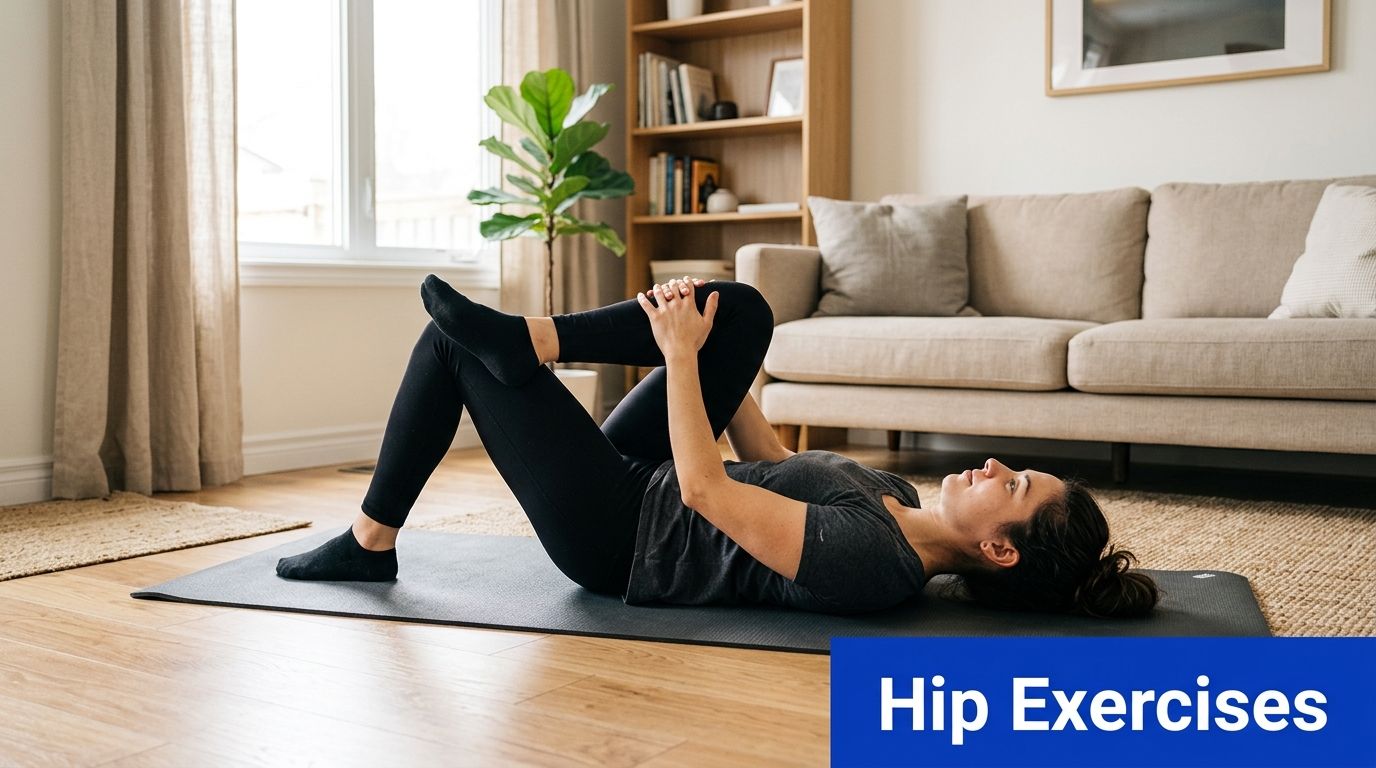
1 Supine hip internal and external rotations
This is one of the most useful starting points for painful or stiff hips because lying down reduces balance demands and makes it easier to keep the pelvis still.
- Lie on your back with both knees bent and feet flat.
- Lift one foot slightly so the hip and knee stay bent.
- Slowly rotate the lower leg inward, then outward, as if the thigh bone is turning in the socket.
- Keep the movement small and smooth.
- Return the foot to the floor and switch sides.
You should feel a gentle movement deep in the hip, not a strain in the groin or low back.
Common mistake: Letting the pelvis rock side to side. Place your hands on the front of your pelvis if that helps you monitor it.
2 Seated figure four stretch
This is a practical option for people who sit a lot and need something they can do during the day without getting on the floor.
Sit tall on a sturdy chair and place one ankle over the opposite knee. Keep the chest lifted. Hinge forward slightly from the hips until you feel a gentle stretch through the buttock of the crossed leg.
A few useful cues:
- Keep the spine long: Don't collapse your chest.
- Support the knee if needed: If the lifted leg feels vulnerable, place a cushion underneath.
- Stay light: This should feel broad and easing, not aggressive.
3 90 90 hip transitions
This drill works internal and external rotation together. It's excellent when done slowly and badly tolerated when rushed.
- Sit on the floor with one leg in front and one leg to the side, both bent.
- Set yourself upright with hands on the floor behind you if needed.
- Slowly rotate both knees toward the other side, aiming to switch into the mirrored position.
- Pause where the movement wants to stop.
- Use the hands as much as necessary.
If sitting on the floor is uncomfortable, sit on a folded towel or cushion to raise the hips.
Practical rule: If a floor exercise makes you dread doing it, regress it. Consistency beats ambition.
A visual walkthrough can help if you're unsure how these transitions should look in real time.
4 Hip flexor rock back
This is a gentler alternative to long, hard lunge stretches.
- Kneel with one knee on a cushion and the other foot in front.
- Tuck the pelvis slightly, as if bringing the belt buckle toward the ribs.
- Instead of lunging forward hard, gently rock your body back and forth through a small range.
- Keep the torso upright.
- Stop before any pinching in the front of the hip.
This works well for people who feel compressed in deep hip extension.
Common mistake: Arching the lower back to fake hip extension. If you feel the stretch mainly in your back, reset.
5 Supported hip CARs
CARs, or controlled articular rotations, are slow circles that improve awareness and control.
Stand beside a wall or kitchen bench for support. Shift onto one leg. Lift the other knee slowly, move it out to the side, rotate gently, and lower it with control. Think quality, not circle size.
This is more of a control drill than a stretch. A small clean circle is ideal.
6 Adductor rock backs
This exercise opens the inner thigh and often helps people who feel stiff in wide stances or side-to-side movements.
- Start on hands and knees.
- Extend one leg out to the side with the foot flat.
- Keep your spine neutral and gently rock your hips back.
- Return to the start without bouncing.
- Repeat, then switch sides.
You may feel a lengthening through the inner thigh and some work around the hip.
Common mistake: Twisting the torso away from the straight leg. Keep the chest square to the floor.
7 Bridge with gentle hip opening awareness
This adds a controlled strengthening element so the hips don't just gain range, they learn to use it.
Lie on your back with knees bent and feet hip-width apart. Press through the feet and lift into a small bridge. At the top, think about gently widening through the front of the hips without flaring the ribs. Lower slowly.
Try this if stretches alone leave you feeling loose for an hour but tight again by evening.
How to Move Safely Avoiding Common Hip Mobility Mistakes
The biggest mistake people make with hip mobility exercises is treating them like a test of toughness. If your hip is irritated, arthritic, or chronically stiff, forcing end-range positions can increase sensitivity instead of improving movement.
The sensation you want
Helpful movement usually feels like one of three things: mild muscular effort, a broad stretch, or gradual easing. Unhelpful movement tends to feel sharp, pinchy, unstable, or hot afterwards.
That distinction matters. A deep glute stretch can be fine. A pinch in the front of the hip joint usually isn't something to push through.
- Green light sensations: mild pulling, warmth, effort, easing stiffness
- Yellow light sensations: brief discomfort that settles quickly when you reduce range
- Red light sensations: catching, sharp pain, joint pain that lingers, symptoms that ramp up later
Pain during movement isn't always a warning, but pain that builds as you keep forcing range usually is.
Why mid range often works better for painful hips
For adults with arthritis or chronic pain, the common advice to “stretch to the limit” often misses the mark. Research on hip mobilisation notes that aggressive end-range stretching can inflame joints, while targeted mid-range distraction and mobilisation can help gate pain signals and restore movement more safely in painful hips, as discussed in this review of hip mobilisation and distraction approaches.
That's why the gentlest exercises in this article matter. Supine rotations, supported circles, and small-range rocking often calm the joint enough for better movement later. For many people, the best first step isn't increasing range. It's reducing threat.
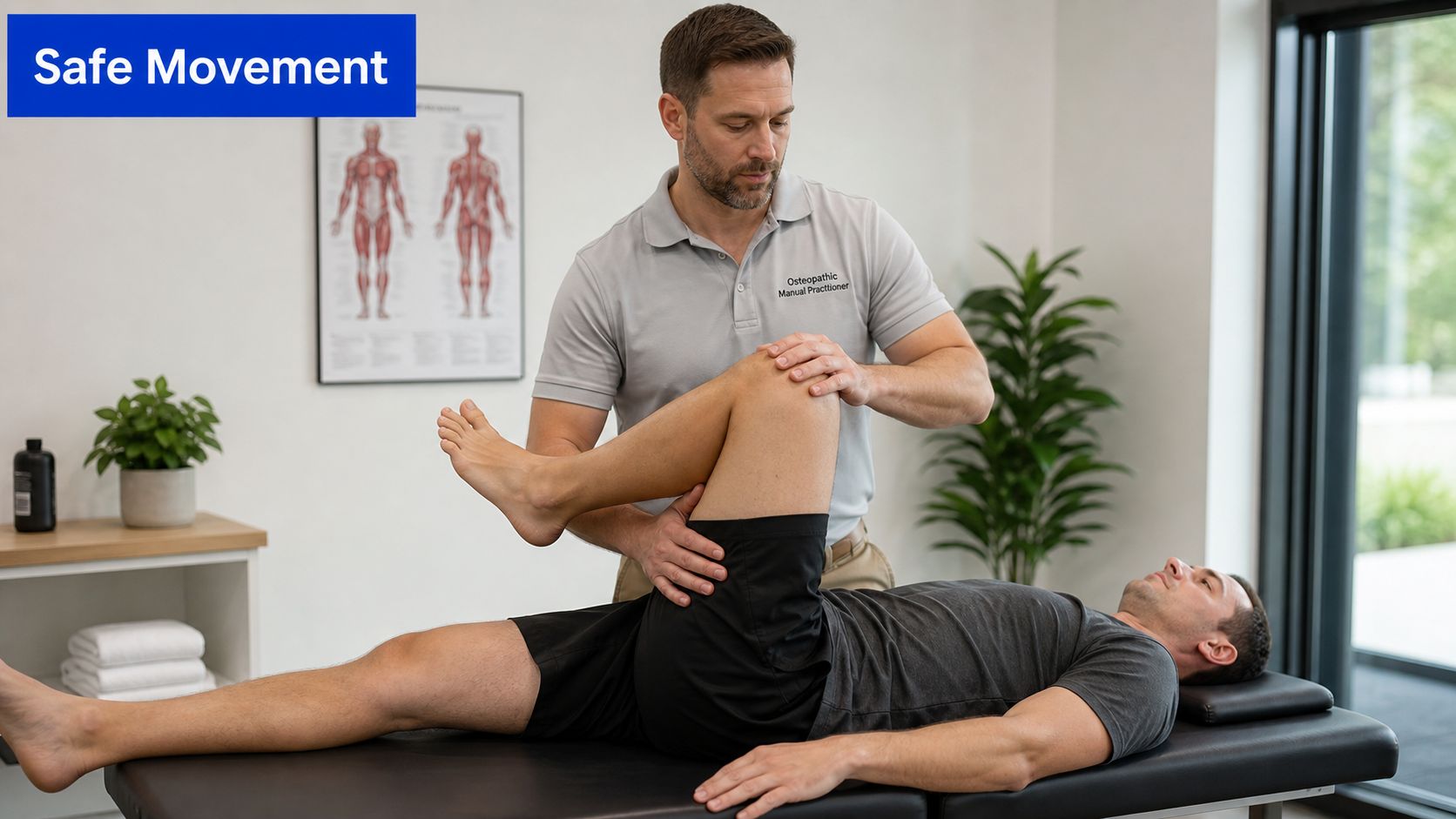
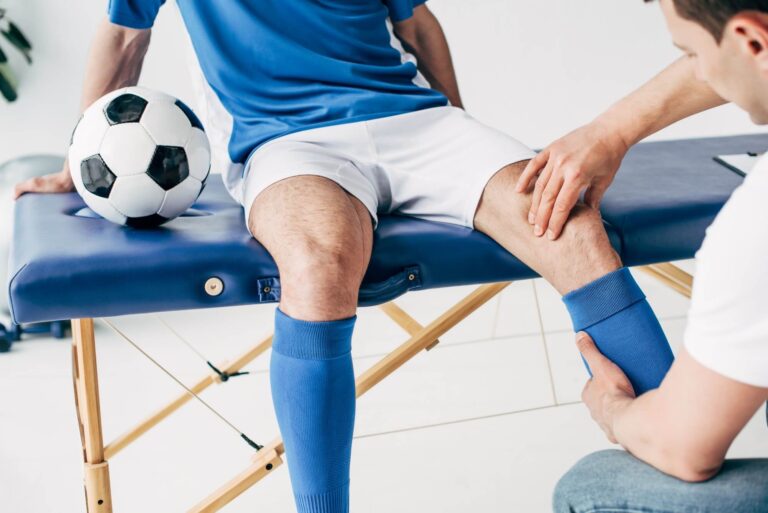
If hands-on work has ever eased your stiffness faster than stretching alone, it may be because techniques that support the joint in a comfortable range can settle guarding. An image like this physiotherapy leg mobilisation view reflects the kind of supported positioning many painful hips tolerate better than self-forced end-range work.
Common mistakes that irritate hips
A short checklist helps:
- Twisting through the pelvis: If the pelvis rolls, you borrow motion instead of creating it in the hip.
- Arching the low back: This commonly happens in hip flexor stretches and standing leg lifts.
- Holding stretches too hard: More intensity doesn't equal better results.
- Skipping easier options: Chair and floor-supported drills are often smarter, not lesser.
- Ignoring the after-effect: If you always feel worse later that day, your dose is too high.
A useful rule is to finish feeling better than when you started, or at least no worse.
Sample Hip Mobility Routines for Your Lifestyle
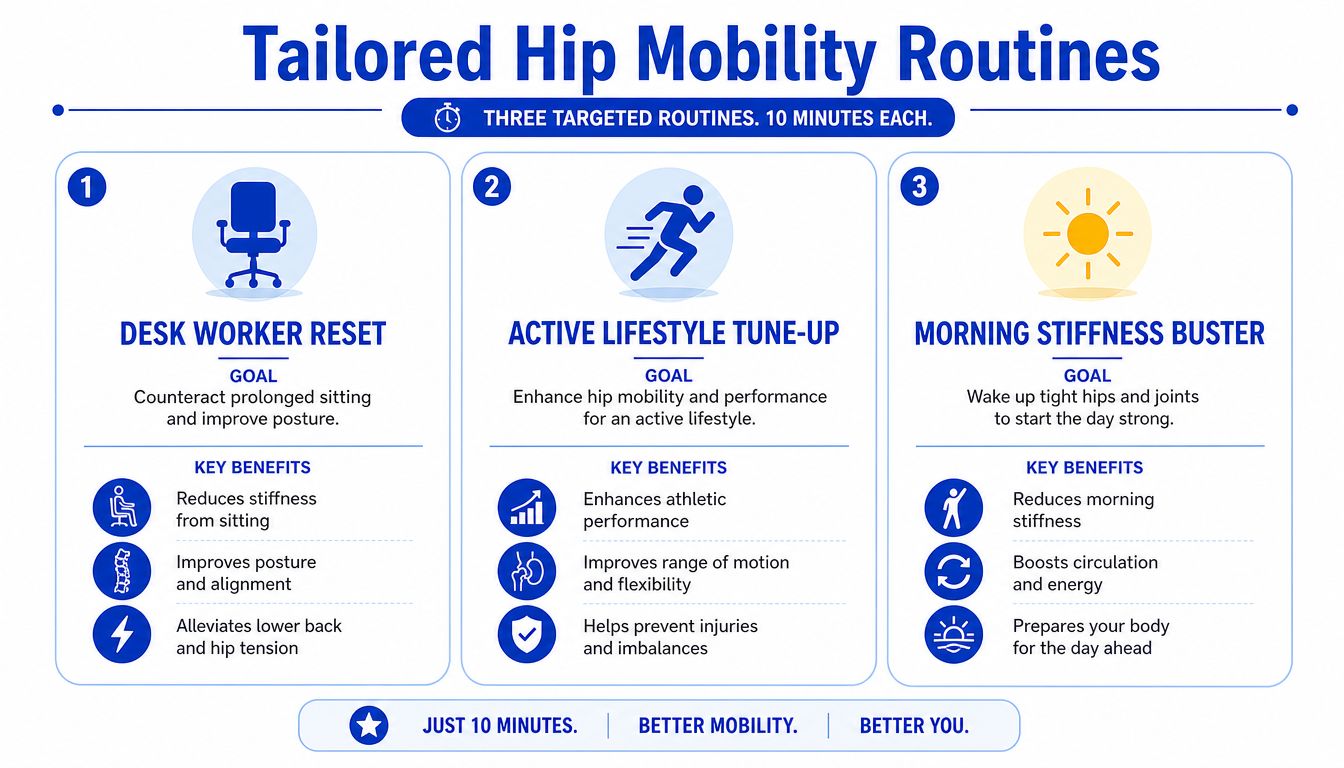
The issue isn't a lack of exercises. What's needed is a routine that will be consistently performed. Short, regular practice works better than occasional marathon stretching. Australian athletics coaching guidance suggests a hip mobility program should be done at least 3 times per week, with a minimum of 24 hours rest between sessions, and each exercise performed for 5 sets of 15 seconds, with the Australian Athletics Coach hip mobility guidelines describing this as a practical way to improve range of motion and reduce stiffness.
Desk worker reset
Use this after long sitting or at the end of the workday.
- Seated figure four stretch for a gentle buttock stretch.
- Supine hip rotations to isolate the joint.
- Supported hip CARs to reconnect control in standing.
- Bridge to wake up the posterior chain.
Keep the pace easy. The goal isn't fatigue. The goal is to stand up and walk more naturally.
Gentle start for older adults
This suits people who feel stiff in the morning or less confident on one leg.
- Begin on the bed or floor: supine hip internal and external rotations
- Move to a chair: seated figure four, with a cushion under the knee if needed
- Add a small bridge: only lifting to a comfortable height
- Finish with a supported stand and march: holding a bench or kitchen counter
This routine should feel steady and reassuring. If getting to the floor is impractical, stay with chair-based and standing-supported options.
Regular, modest practice usually beats a single “good stretch” session done once a week.
Chronic pain soother
This routine is for days when the hip feels irritable and end-range work sounds awful.
| Exercise | Focus | Key cue |
|---|---|---|
| Supine hip rotations | Calm joint motion | Keep the pelvis quiet |
| Hip flexor rock back | Gentle front-of-hip mobility | Small range only |
| Adductor rock backs | Ease side and inner hip stiffness | No bouncing |
| Breathing in a crook lying position | Reduce guarding | Exhale fully and soften |
This isn't the day for heroics. Stay in mid-range, keep movements smooth, and stop while things still feel settled.
When Exercises Are Not Enough Seeking Osteopathic Care
Self-management is useful, but there's a point where repeating the same exercises stops being productive. If you feel a sharp pinch at the front of the hip, a catching sensation, pain that increases as you move, or stiffness that doesn't shift despite regular practice, it's worth getting the joint properly assessed.
Persistent hip restriction may not be coming from the hip alone. The lower back, pelvis, surrounding muscles, walking pattern, and previous injuries can all shape how the joint behaves. That's why a whole-body assessment is often more helpful than just adding more stretches.
Professional care can also help when you're not sure whether you're dealing with muscular tightness, joint irritation, arthritis-related stiffness, or compensation from somewhere else. If that question has been on your mind, this medical consultation image about whether an osteopath can diagnose arthritis reflects the kind of clinical conversation that can bring clarity.

A good assessment should leave you with more than a label. It should give you a clear explanation of what's driving the restriction, what movements are safe to continue, and what to change so your exercises finally start helping instead of irritating the area.
If your hip stiffness keeps returning, or your back and hips never seem to settle for long, Bayside Osteopathic Health offers gentle, hands-on osteopathic care focused on easing pain, improving mobility, and giving you a practical plan you can follow at home.