
You notice it in small moments first. Standing on one leg to put on trousers. Turning quickly in the kitchen. Stepping off a curb and feeling that brief wobble that makes you reach for the bench, the wall, or the nearest steady surface.
For many people, especially if you're managing back pain, neck tension, arthritis, or general stiffness, that unsteady feeling isn't about being “unfit”. It's often a sign that your body needs better coordination, steadier joint control, and a calmer, more reliable way to respond to movement. Good balance isn't about looking athletic. It's about feeling safe in your own body.
Balance and stability exercises can help rebuild that confidence. Done well, they train the small adjustments your body makes all day long. Done poorly, they can feel frustrating, too hard, or aggravating for painful joints. That's why the right approach matters.
Table of Contents
- Why Balance Matters More Than You Think
- Safety First Before You Start Your Exercises
- Foundational Balance Exercises for Beginners
- Progressing Your Stability with Gentle Challenges
- Your Home Exercise Program with Osteopathic Support
- Take Your Next Step Toward Confident Movement
Why Balance Matters More Than You Think
You notice balance changes in ordinary moments first. Stepping off a kerb feels less certain. Turning in the kitchen takes more concentration. A walk on grass that once felt automatic starts to feel like something you need to plan for.
Balance affects far more than falls. It supports the small weight shifts and postural adjustments that let you stand up, reach, carry, turn, and walk without bracing or rushing. When that system is working well, movement feels calmer and more efficient. When it is under strain, everyday tasks can start to feel tiring, stiff, or unpredictable.
Balance is more than not falling
From an osteopathic point of view, balance depends on how well the whole body works together. Your feet need to sense the ground clearly. Your ankles, hips, spine, and neck need enough movement to make the right adjustment at the right time. Your muscles need to respond without excessive tension, and your nervous system needs to trust the information it is receiving.
Pain often disrupts that process. So can stiffness, reduced activity, arthritis, old injuries, or the habit of moving cautiously after a near-fall. I often see people who are strong enough in a general sense, but still feel unsteady because one part of the body is not sharing the load well. A stiff ankle can delay a correction. A guarded lower back can make turning feel awkward. Persistent neck tension can affect how secure you feel when you change direction or look around.
Good balance is a daily function. It can be practised, improved, and adapted to the body you have now.
Why it deserves regular attention
For older adults, and for people living with chronic pain, balance work is often missed until confidence has already dropped. That is usually the wrong time to start thinking about it. Gentle practice done early can help maintain independence, reduce hesitation, and make daily movement feel safer again.
The goal is not athletic performance. The goal is steadier walking, more confidence getting out of a chair, better control on stairs, and less fear during ordinary tasks. Beyond the statistics, the everyday benefits are just as significant. People often tell me they want to feel less wobbly hanging out washing, walking to the letterbox, or playing with grandchildren. Those are the outcomes that matter.
At Bayside Osteopathic Health, balance exercises are rarely given as a generic handout. They are adjusted to the person in front of us. Someone with knee pain may need a smaller range and more support. Someone with persistent back pain may do better with shorter practice and slower weight shifts. Someone returning after a fall may need to rebuild trust before challenge. For eligible patients, that support may also sit within a broader care plan, including Medicare-funded allied health referrals where appropriate.
A simple visual cue can help keep the focus on the bigger picture. Balance practice is part of long-term preventive health and movement confidence, not just a way to test how long you can stand on one leg.
Safety First Before You Start Your Exercises
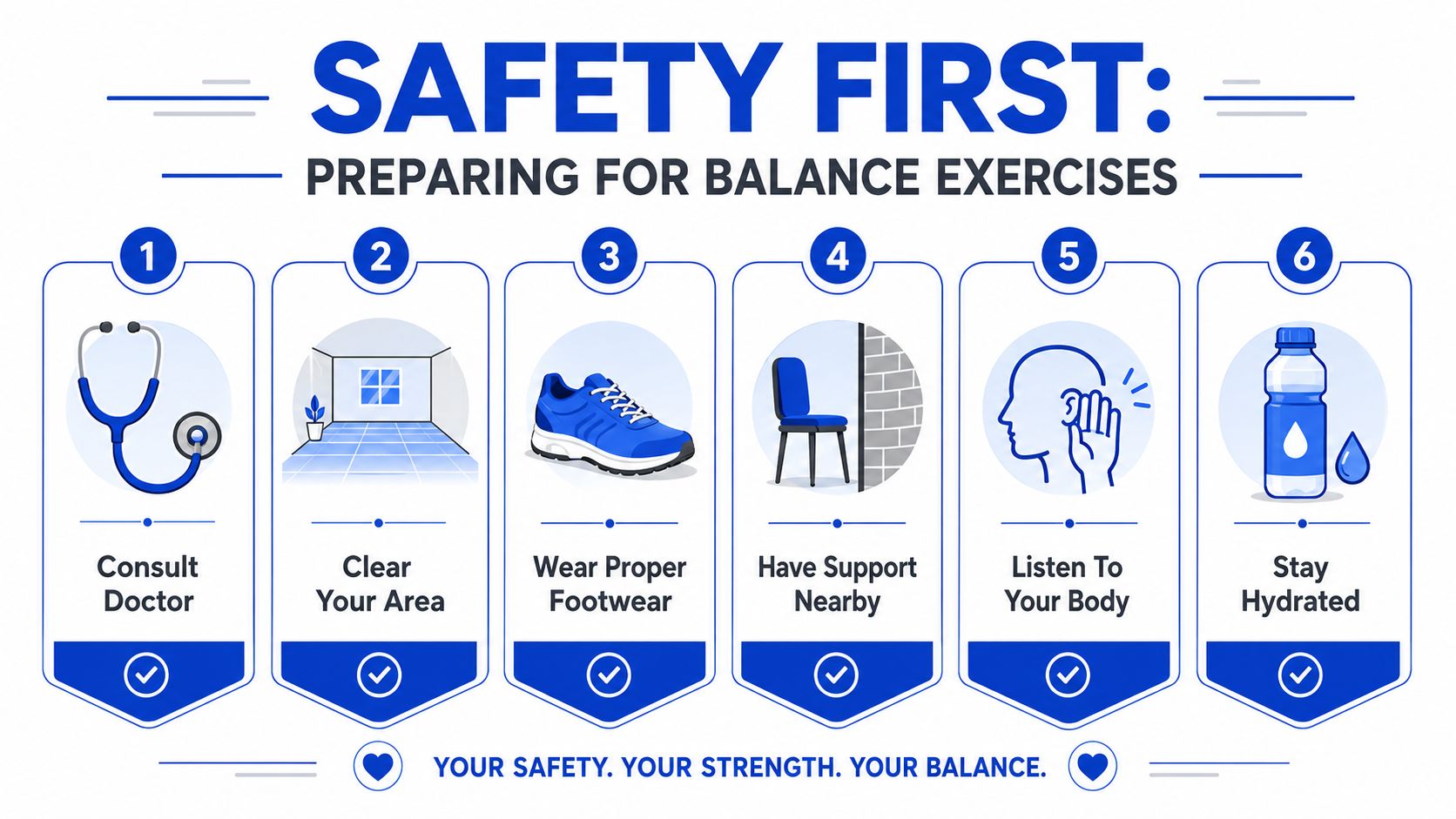
A balance exercise only helps if it feels safe enough to repeat. If you feel threatened by the movement, the body usually responds by gripping, holding its breath, or avoiding the task altogether. That is not a good learning environment for balance.
This matters even more for older adults, people living with chronic pain, and anyone who has had a recent wobble or fall. In clinic, I often scale exercises down before I build them up. A smaller movement done calmly is usually more useful than a harder one done with tension. If your hips are stiff, a few gentle hip mobility exercises to loosen the area before balance work can make standing practice feel steadier and less guarded.
Set up your space properly
Your surroundings shape how confident your body feels.
- Stand near something solid: A kitchen bench, heavy table, or stable chair gives you a quick point of contact if needed.
- Clear the floor first: Remove loose rugs, cords, shoes, pet bowls, and clutter.
- Choose footwear carefully: Supportive shoes can help if you feel very unsteady. Bare feet can work well on a firm, non-slip surface if that feels more secure.
- Keep sessions brief: Short practice often gives better results than pushing until the legs tire and form slips.
- Have a chair nearby: Sitting down between sets can stop fatigue from turning a useful exercise into a risky one.
For home practice, the aim is a calm setup with as few surprises as possible.
Know the difference between effort and warning signs
Balance work should feel like attention and light effort. You may notice your feet pressing into the floor, your hips working, and your posture making small corrections. Those are good signs. Sharp pain, spinning, chest discomfort, sudden shortness of breath, or the sense that you may faint are warning signs.
Practical rule: If you can breathe normally, stay relaxed through the jaw and shoulders, and regain your position without grabbing suddenly, the exercise is usually at an appropriate level.
Check with your doctor first if you have a significant medical condition, recent surgery, or unexplained dizziness. If symptoms feel new, strong, or unusual, stop and get medical advice before continuing.
For people with chronic pain, this distinction matters a great deal. Pain often changes movement before you even notice it. Toes start clawing, the breath gets shallow, and the body braces instead of adjusting. In osteopathic care, we work to reduce that protective tension so the exercise teaches steadiness rather than fear.
Start with support and reduce it gradually
Using support is sensible. It gives the nervous system enough reassurance to practise the movement well.
The trade-off is that too much help removes the challenge your balance system needs. A light fingertip on the bench allows your body to make small corrections. Leaning heavily into the bench does most of the work for you. Start with the amount of support that keeps you calm and controlled, then reduce it bit by bit as confidence improves.
A good starting checklist looks like this:
- Stand tall with soft knees: Locked knees make it harder to adjust.
- Keep your eyes on a steady point: A fixed gaze often settles the body.
- Use one or two fingers first: That gives support without taking away the task.
- Stop before you tire: Good practice comes from clean repetitions, not pushing through shaky form.
If you are under care at Bayside Osteopathic Health, these starting points can be adjusted to match your pain levels, joint stiffness, and confidence on the day. For some patients, that support also sits within a broader management plan, including Medicare-funded allied health referrals where eligible.
Foundational Balance Exercises for Beginners
A good beginner balance program should leave you feeling steadier, not rattled. For many older adults and people living with chronic pain, the right starting point is smaller and gentler than generic exercise guides suggest. That is not a setback. It is often what allows the nervous system, joints, and muscles to work together without flaring symptoms.
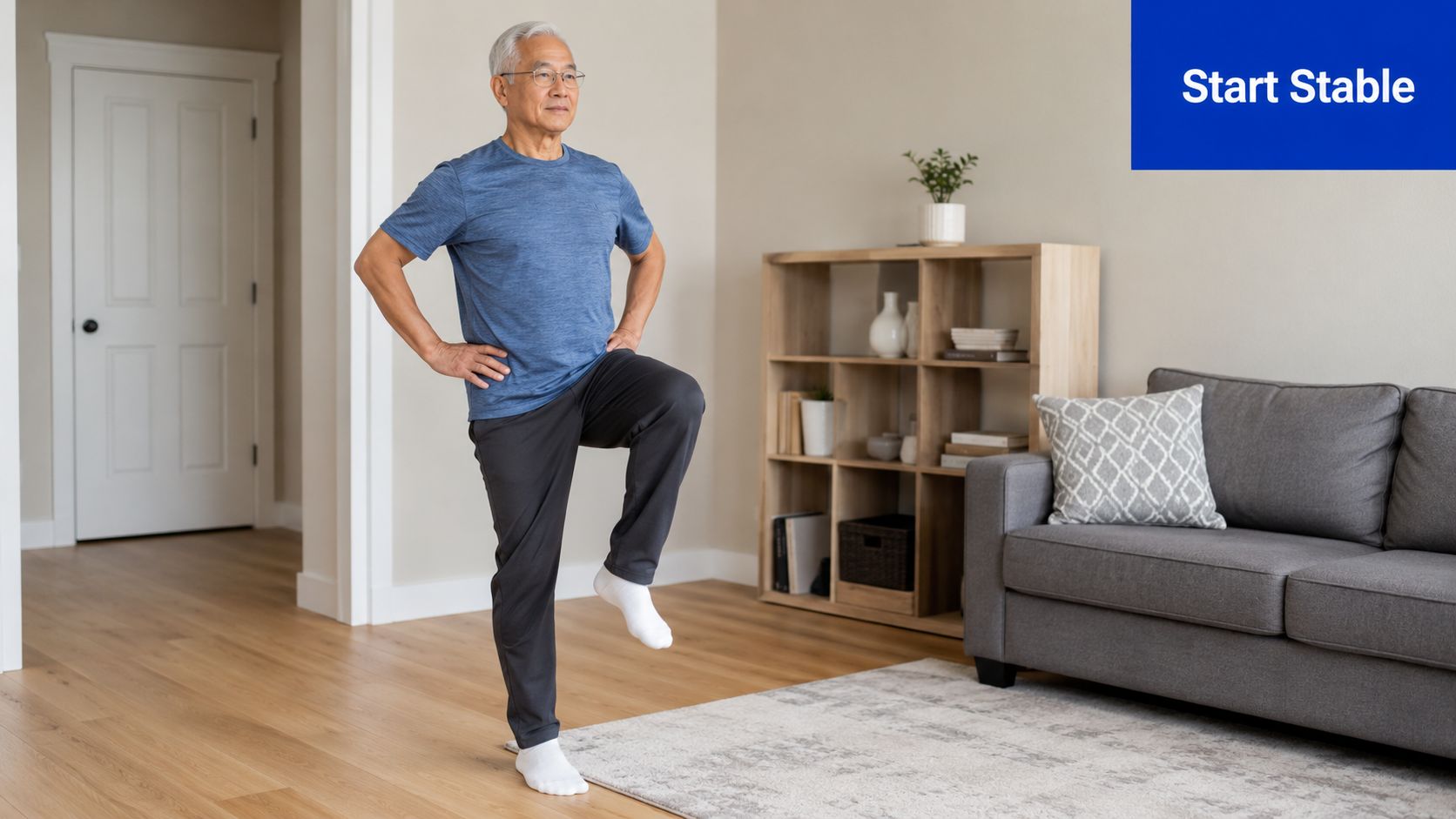
These movements build the basic skills behind steadier walking, turning, stepping around furniture, and recovering from a small wobble. In clinic, I often start here because these drills show how well a person can transfer weight, use the hips, and stay upright without gripping through the toes or holding the breath.
Weight shifts
Weight shifts teach your body to trust one leg at a time. That matters because every step you take is, briefly, a single-leg task.
How to do it
- Stand near a bench or sturdy chair.
- Place your feet hip-width apart.
- Shift your weight slowly onto one leg without leaning your whole body sideways.
- Pause briefly, then return to centre.
- Repeat on the other side for several controlled repetitions.
What you should feel
The standing foot should feel grounded. You may notice the hip muscles on that side working to keep the pelvis level. The goal is quiet control, not a dramatic sway.
If you have knee pain
Keep the movement small and smooth. A smaller transfer is still useful if it lets you practise without aggravating the joint.
If you have back pain
Keep your ribs stacked over your pelvis. If your trunk starts drifting side to side, reduce the shift and slow the movement down.
Supported single-leg balance
Once shifting weight feels calmer, practise lifting one foot slightly from the floor. This helps the ankle, hip, and trunk make the small corrections that keep you upright during daily life.
How to do it
- Stand beside support.
- Rest your fingertips lightly if needed.
- Lift one foot a small distance from the floor.
- Hold for a short, calm pause.
- Swap sides and repeat.
What you should feel
A mild wobble is normal. You want the balance work to come from the ankle and hip, not from scrunching the toes or tightening the jaw.
If you have hip stiffness
Keep the lifted foot low and the hold brief. Balance improves through good organisation, not by lifting the knee high.
If arthritis makes standing painful
Use several short efforts with a rest between them. That usually feels better than forcing one long hold.
Restricted hips can make balancing harder than it needs to be. Gentle hip mobility work and stretching routines often make it easier to stand over one leg without strain.
Here's a helpful visual demonstration before you continue:
Heel raises
Heel raises strengthen the calves and improve how the ankle manages small forward and backward shifts. They are simple, but they carry over well to walking and standing tolerance.
How to do it
- Stand with light hand support.
- Rise onto your toes.
- Pause briefly at the top.
- Lower slowly with control.
- Repeat until the movement quality starts to fade.
What you should feel
Work through the calves and around the ankles. Try to rise straight up rather than rolling in or out through the feet.
If you have forefoot pain
Lift a little lower and move more slowly. A shorter range is often the better choice while things are sensitive.
High knee marching on the spot
Marching adds movement to the balance task. Your body has to accept weight, unload one leg, and stay upright as the base changes from side to side.
How to do it
- Stand near support.
- Lift one knee, then the other.
- Keep the movement slow and controlled.
- Land each foot softly.
- Continue for a comfortable set.
What you should feel
You should feel your weight transfer from one side to the other in a steady rhythm. If the movement becomes rushed, noisy, or jerky, the set is too hard.
If you feel unsteady
Start with very small marches and keep one or two fingertips on support. For some patients, beginning with a seated marching pattern first is the safer option, especially during a pain flare or after a recent fall.
At Bayside Osteopathic Health, these beginner exercises are often adjusted around pain levels, joint stiffness, and confidence rather than age alone. If you are eligible for Medicare-supported allied health care, we can also help fit this sort of home program into your broader treatment plan so the exercises stay realistic and manageable.
Progressing Your Stability with Gentle Challenges
When the basics start to feel easier, many people make one of two mistakes. They either keep doing the same easy version forever, or they jump to something far too hard. Neither works especially well.
Progression in balance and stability exercises should feel like better control, not reckless difficulty. You're not trying to prove anything. You're giving your body a slightly more complex problem to solve.
Reduce support before adding complexity
The simplest progression is often the best one. If you've been holding firmly with one hand, move to fingertips. If you've used fingertips, try hovering the hand nearby for a few seconds. If that feels calm, briefly let go, then return to support.
Unsupported balance asks your body to organise itself rather than outsource the task to your arm. For many people, especially those with chronic pain, that's where real confidence begins.
A gentle progression ladder might look like this:
| Level | Change | What to watch for |
|---|---|---|
| Early | Full hand support | You feel safe and upright |
| Next | Fingertip contact | Less gripping through the shoulder |
| Then | Hover hand near support | Small wobbles, but no panic |
| Later | Brief unsupported holds | Steady breathing and controlled recovery |
Change one variable at a time
Once basic standing balance is improving, add challenge carefully. Change only one thing at once.
You might:
- Narrow your base: Bring your feet closer together.
- Slow the movement down: Longer pauses increase control demands.
- Add head turns: Gentle head movement can challenge coordination.
- Close your eyes briefly: Only if you're safe near support.
- Use a softer surface carefully: A folded towel or cushion changes the feedback from the feet.
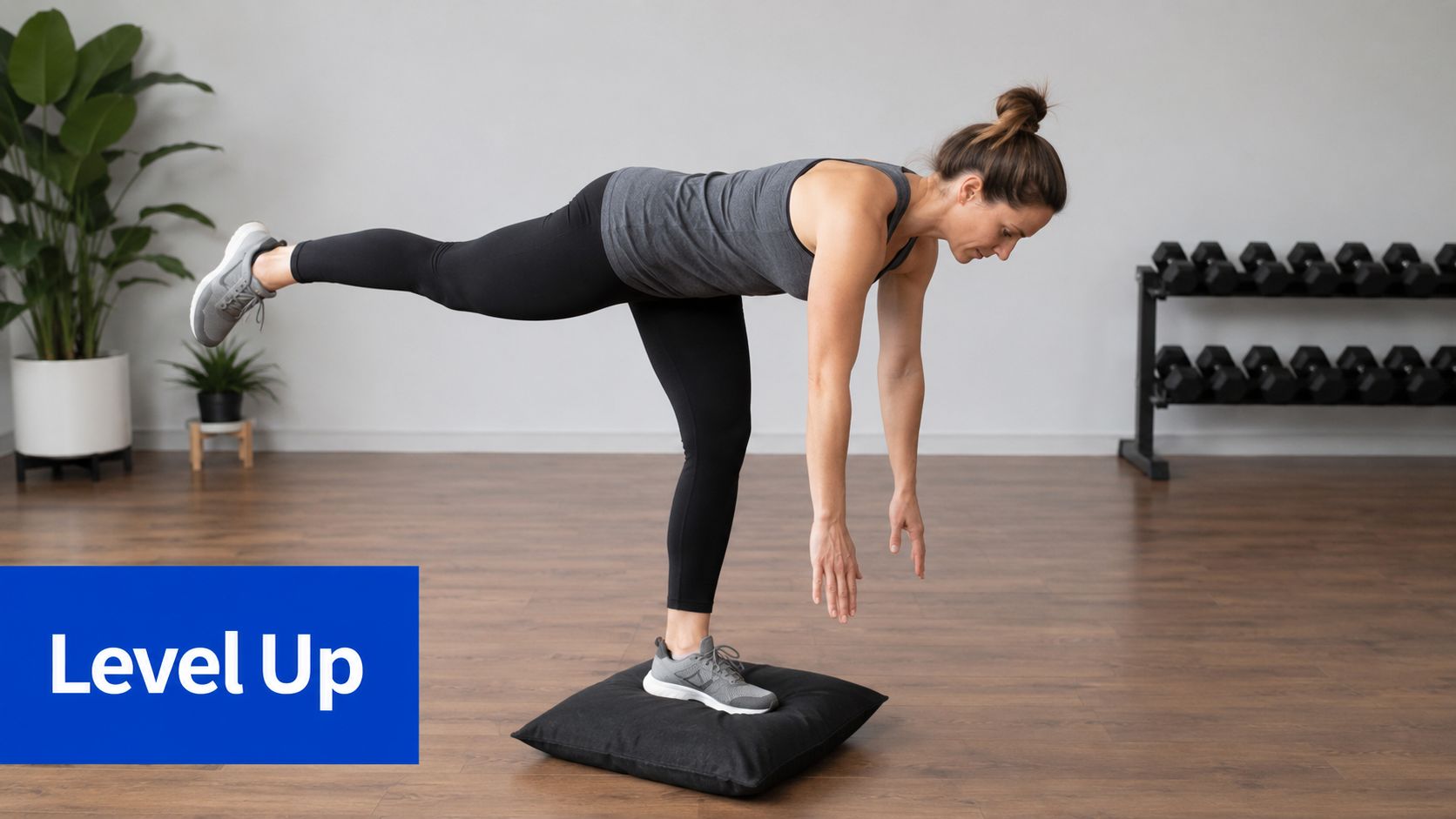
Closing the eyes is a good example of a useful challenge, but not for everyone straight away. If your balance relies heavily on vision, removing that input can feel dramatic. Keep it brief and only when you can recover safely.
“If the exercise becomes jerky, breath-holding starts, or pain increases, it's too hard for today.”
When guided progression matters most
There's a difference between general balance and reactive balance. General balance is staying steady in a position. Reactive balance is what happens when life interrupts you. You trip slightly, misjudge a step, or get nudged while turning.
Research in older adults suggests that Simulated Balance Recovery, which mimics real-life fall situations, is the most effective intervention for improving reactive balance, with gains often appearing after 8 to 12 weeks of consistent training, according to a network meta-analysis published in Frontiers in Aging Neuroscience.
That doesn't mean everyone should start practising near-falls at home. It means there's value in guided, specific progression when balance problems are more significant. In a clinical setting, progression can be customized so the challenge matches the person. A stiff knee, painful hip, guarded back, or fear of falling all change what the right challenge looks like.
Signs you're ready to advance
You're probably ready for a gentle step up if:
- You recover small wobbles smoothly: You don't need to grab immediately.
- Your posture stays organised: You're not twisting or leaning heavily.
- You finish feeling worked, not flared up: The exercise doesn't worsen symptoms later.
- You feel more confident in daily tasks: The training starts showing up in real life.
If one side remains much harder than the other, that's useful information. It often points to a stiffness, weakness, or protective pattern worth addressing directly instead of repeating more reps.
Your Home Exercise Program with Osteopathic Support
A home program works best when it fits the person doing it. Generic lists can be a useful starting point, but they often miss the reasons someone feels unsteady in the first place. One person needs better ankle control. Another needs less fear when loading an arthritic knee. Someone else needs to stop using back tension as a substitute for hip stability.
Why generic programs often fall short
Many people with pain find themselves overlooked, as there's a recognised gap in guidance for low-impact, stability-focused routines for Australians with chronic joint pain or arthritis. Verified data also notes that 15% of adults over 50 report movement limitations related to arthritis, and that guidance often fails to connect home exercise with Medicare-supported allied health care through Australia's Chronic Disease Management Plan, as discussed in this overview of the guidance gap and Medicare connection.
That gap matters because painful joints often need modification, not motivation. A standard single-leg stand may be fine for one person and completely wrong for another. A good osteopathic approach looks at the whole pattern. How you stand. How you shift weight. Whether your rib cage is stiff. Whether your neck is overworking. Whether you're avoiding one hip because it doesn't feel trustworthy.
For some patients, understanding whether symptoms relate to arthritis also helps shape the plan. A clear explanation of osteopathic assessment in arthritis-related care can make exercise choices feel more sensible and less intimidating.

Sample Home Balance Program
Below is a simple example of how a home routine might be organised. It isn't a one-size-fits-all prescription, but it shows the difference between random exercises and a structured plan.
| Phase | Frequency | Exercises | Focus |
|---|---|---|---|
| Settling and awareness | Regularly through the week | Weight shifts, supported standing, gentle marching | Feel the feet, reduce fear, learn steady posture |
| Early control | Regularly through the week | Single-leg balance with support nearby, heel raises, controlled turns | Build ankle and hip control |
| Confidence building | Ongoing | Short unsupported holds, narrow-stance standing, varied reaching tasks | Improve self-correction and calm under challenge |
| Functional carry-over | Ongoing | Practice during daily tasks such as dressing, kitchen work, stepping and turning | Transfer gains into real life |
A personalised program often includes more than exercise alone. It may involve gentle hands-on treatment to reduce stiffness, strategies to settle protective muscle guarding, and practical advice about pacing. That combination can make the exercises feel more achievable because the body isn't fighting them at every step.
Home exercise works better when it matches the body you have today, not the one a generic online program assumes you have.
Medicare support can also matter for eligible patients. Many people don't realise that home-based support for movement and stability may connect with allied health care under the Chronic Disease Management Plan when appropriate. That can make professional guidance more accessible, especially if balance problems are mixed with arthritis, persistent pain, or reduced confidence after a fall.
Take Your Next Step Toward Confident Movement
Balance usually improves subtly. You notice you're turning more easily. You stop reaching for the wall every time you dress. You feel steadier stepping outside. Those changes may seem small, but they add up to something important. More confidence in your body.
The most useful approach is usually the simplest one. Start safely. Practise regularly. Keep the challenge gentle enough that your body can learn, not just tense up. If you live with chronic pain, respect that your exercises may need modification. Progress still counts, even when it looks modest from the outside.
Balance and stability exercises aren't about perfect stillness. They're about teaching your body how to respond well when life moves underneath you. That's the skill that supports walking, reaching, turning, and staying active with less fear.
If you've been feeling unsteady, avoiding movement, or struggling to know which exercises are safe for your back, neck, hips, knees, or arthritis, getting individual guidance can make the process much clearer. The right plan should feel reassuring, practical, and achievable at home.
If you'd like personalised help with balance, mobility, arthritis-friendly exercise, or gentle hands-on care, Bayside Osteopathic Health offers customized osteopathic support for the local community. The team can help you understand why you feel unsteady, modify exercises to suit painful joints, and build a home program that feels safe, realistic, and effective.