
Preparing for Your Osteopath Appointment: A Guide to Dressing for Success
Heading to an osteopath is a proactive step towards better health, but have you considered whether your outfit could change how clearly your practitioner reads your movement? It's common to prioritize comfort first, which matters, but clothing also affects posture checks, gait assessment, palpation, and hands-on treatment.
In Australian osteopathic practice, patients are commonly asked to remove clothing down to shorts and a bra so the osteopath can assess posture, range of motion, and joint function more directly during examination and treatment. Clinics also make it clear that if you're uncomfortable removing clothing, you can usually be treated in loose clothing instead, which supports patient comfort preferences in practice according to Australian osteopathy clothing guidance.
That balance matters. Osteopaths often use soft-tissue work, joint mobilisation, stretching, movement observation, and palpation. Tight or awkward clothing can hide asymmetry, limit movement, or get in the way when we need to assess your shoulders, spine, hips, knees, or feet.
This guide gives you a practical answer to what to wear to an osteopath, with the clinical reasoning behind each choice and clear examples that work well for patients at Bayside Osteopathic Health.
Table of Contents
- 1. Loose-Fitting, Breathable Upper Garments
- 3. Flat Shoes or Minimal Footwear
- 3. Flat Shoes or Minimal Footwear
- 4. Avoiding Tight Jewellery and Accessories
- 5. Moisture-Wicking, Natural-Fibre Fabrics
- 6. Minimal or No Undergarments with Heavy Support
- 7. Easy-Access Clothing That Allows Layering
- 7-Item Clothing Comparison for Osteopath Visits
- Your Checklist for a Successful Osteopathy Session
1. Loose-Fitting, Breathable Upper Garments
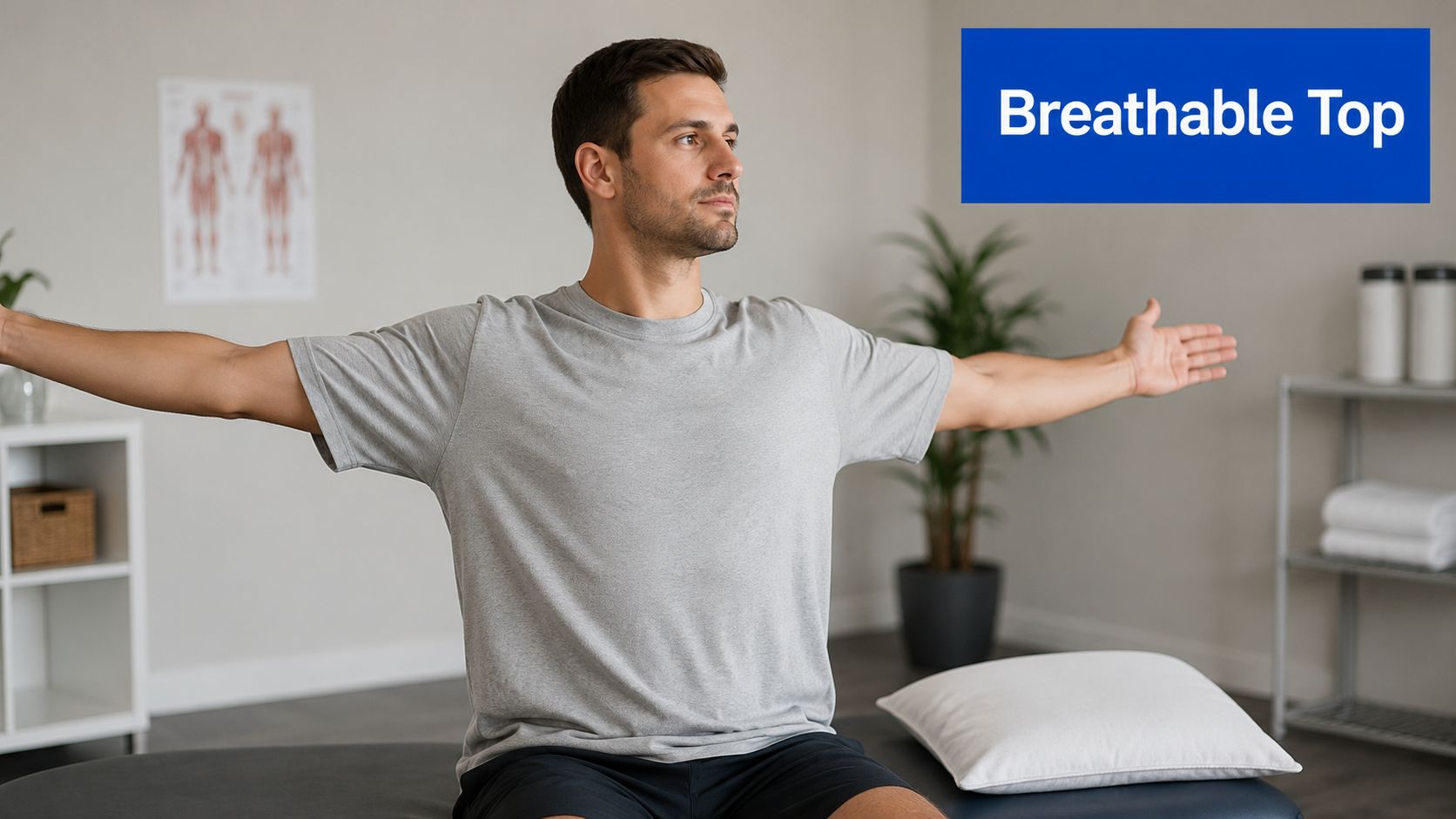
A good top makes assessment easier from the moment you walk in. If I'm checking how your neck, shoulders, ribcage, and upper back move, a soft t-shirt, tank, or relaxed long-sleeve top lets me see and feel what your body is doing instead of what the fabric is forcing it to do.
Why tops matter in upper-body assessment
Initial osteopathy consultations in Australia commonly run for 60 to 90 minutes and may include postural analysis, movement observation, and palpation, which work best when clothing allows free movement and easy access, as described in this Australian appointment guide. That's why fitted corporate shirts, stiff blouses, or layered winter outfits often create more work for everyone.
A cotton crew-neck t-shirt, bamboo athletic tank, or loose yoga top usually works well. Linen shirts can also be fine if they aren't tight across the shoulders. What doesn't work well is anything that pulls when you raise your arms, bunches heavily under the shoulder blades, or needs constant adjustment.
If you're coming straight from work, bring a spare top. Patients often arrive in office wear that looks fine for a desk but doesn't suit a treatment room. A simple change can make shoulder testing, thoracic rotation, and soft-tissue work far smoother.
Practical rule: If you can't comfortably reach overhead, hug yourself, and turn your torso in the top, it's probably too restrictive for osteopathic assessment.
A useful reference for posture-focused care is this posture and corporate ergonomics image from Bayside Osteopathic Health, because upper-body strain often starts with how people sit and load their shoulders all day.
- Best picks: Cotton t-shirts, loose tanks, soft long-sleeve tops, relaxed activewear.
- Usually awkward: Buttoned shirts with narrow sleeves, thick jumpers, shapewear tops, tops with heavy embellishment.
- Simple test at home: Lift both arms, rotate your neck, and twist side to side before you leave.
3. Flat Shoes or Minimal Footwear
Shoes often affect what I can assess before you even get on the treatment table. If I'm watching you walk, balance on one leg, or shift weight through a squat, bulky or raised footwear can change the picture at the foot, ankle, knee, and hip.
Why your shoes change what we see
In clinic, I often assess gait, foot loading, and lower-limb alignment both in shoes and barefoot. That comparison helps me see whether your usual footwear is supporting you well or masking a pattern that matters. A raised heel can tip the body forward. A stiff sole can reduce how clearly the foot moves. A narrow toe box can change balance and toe grip.
That's why flat, simple shoes are usually the best choice for an appointment. They come off quickly, they let us observe your natural standing posture more easily, and they don't add extra height or structure that can distort what your body is doing.
Good options include canvas sneakers, flat sandals, flexible trainers, loafers, and clean slip-on shoes. If you normally wear heels to work, bring a pair of flats to change into before the session. At Bayside Osteopathic Health, that small change often makes gait analysis and standing assessment much more useful.
Orthotics are a separate point. Bring them.
If you use orthotics regularly, I want to see them, and I also want to know which shoes you usually pair them with. The orthotic itself matters, but so does the shoe around it. A supportive runner with an orthotic gives very different information from a dress shoe that barely holds the insert in place.
A common problem is arriving in heavy boots, tight lace-up shoes, or fashion footwear that takes time to remove and changes how you stand. That doesn't mean treatment can't go ahead. It limits how accurately we can assess foot mechanics at the start, and it slows down the practical parts of the session.
Practical rule: Wear shoes you can remove in seconds, and if your everyday shoes have a heel or orthotic, bring the pair you use most often so we can assess the real setup.
- Best picks: Flat sneakers, flexible trainers, loafers, slip-ons, simple sandals.
- Usually awkward: High heels, heavy boots, rigid dress shoes, complicated lace-up footwear.
- Simple test at home: Walk a few steps, balance on one foot, and check whether the shoe feels stable without forcing your toes or lifting your heel.
3. Flat Shoes or Minimal Footwear
Shoes matter because osteopaths often assess the body from the ground up. The way your feet meet the floor can influence what happens at the knees, hips, pelvis, and spine.
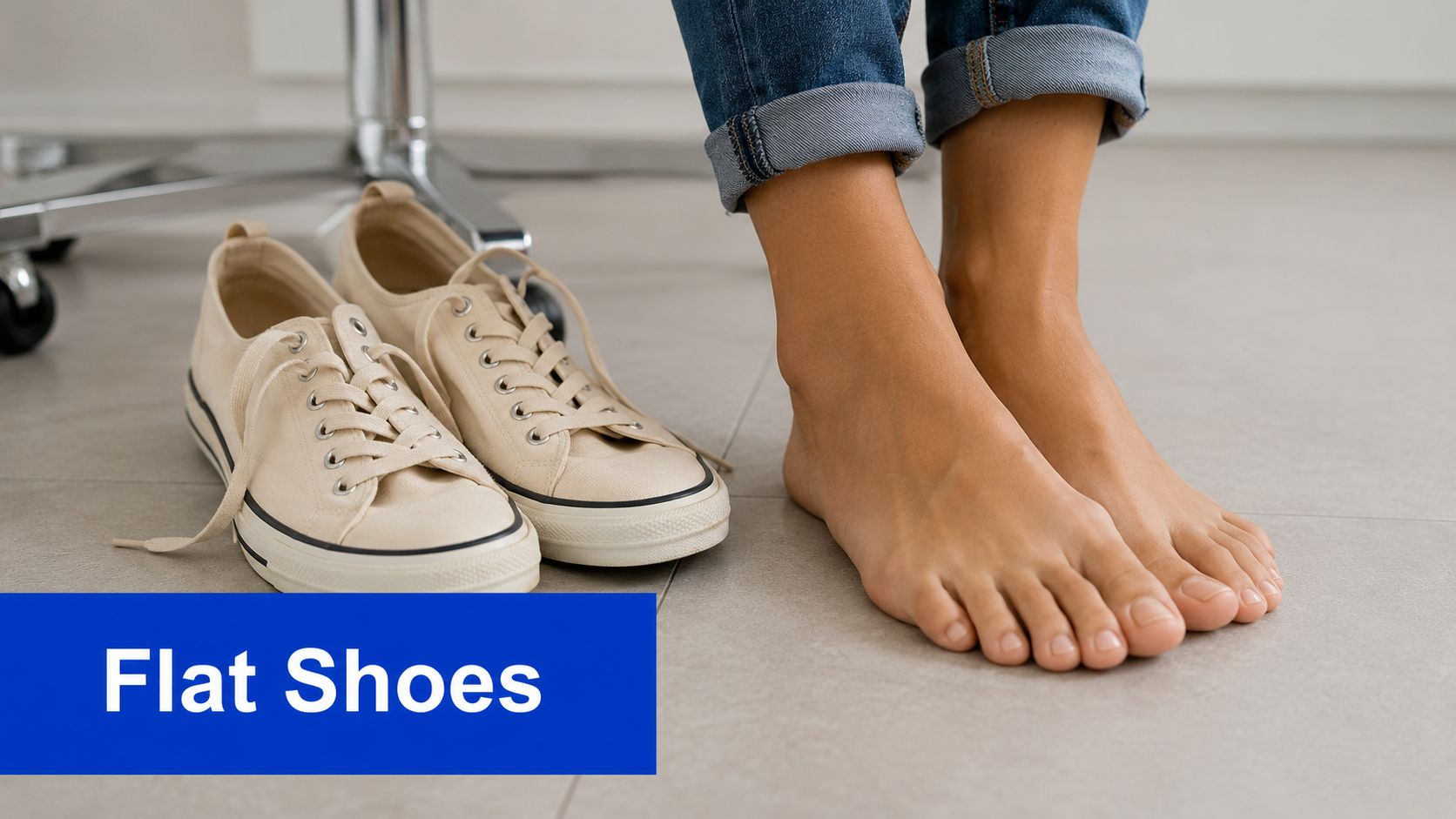
Here's the kind of footwear that usually works best in clinic.
Why your shoes change what we see
Australian clinics commonly recommend easily removable shoes, and barefoot assessment is often part of a session because foot and lower-limb mechanics are routinely evaluated. The same guidance notes that high heels and complicated lacing can interfere with gait analysis and balance testing, which is why simple footwear makes a practical difference, according to this first-appointment guide for Australian osteopathy patients.
Canvas sneakers, loafers, flat sandals, and slip-on shoes are easy choices. If you wear heels for work, bring flats to change into. If you use orthotics, bring them and mention them early so your osteopath can understand what your usual support setup looks like.
A common clinic scenario is someone arriving in boots with tight laces, narrow toe boxes, and a raised heel, then wondering why their lower back feels different by the afternoon. Footwear won't explain every problem, but it often contributes to the pattern we see.
For a quick visual explainer, this short video is a useful companion before your appointment.
Bring the shoes you actually wear most days, not just the nicest pair you own. Your usual footwear gives better clinical clues.
4. Avoiding Tight Jewellery and Accessories
This is the easiest part to overlook because jewellery doesn't feel like clothing. In treatment, though, watches, necklaces, belts, bras with heavy hardware, and even large hair clips can change access, comfort, and what the practitioner can feel with their hands.
Small items that create big distractions
A smartwatch pressing into the wrist during treatment can get in the way if the wrist, forearm, or elbow is being assessed. A tight belt can sit right across an area that needs palpation or movement testing. Heavy necklaces can dig into the chest or neck when you're lying down.
The practical fix is simple. Remove what you can before treatment starts and place it in a secure pocket, pouch, or bag. If you wear medical alert jewellery, keep it on and let your osteopath know.
This matters most when symptoms sit close to the accessory itself. Neck pain and a chunky chain are a poor combination. Mid-back stiffness and a rigid bra clasp can be surprisingly annoying in prone treatment. Wrist pain and stacked bracelets make a hands-on exam clumsy.
- Take off if possible: Watches, fitness trackers, belts, bracelets, heavy necklaces, large earrings.
- Keep and mention: Medical alert jewellery or anything you must wear for health reasons.
- Think ahead: If you need to remove several items, use a zip pocket or small case so nothing gets lost.
Small restrictions can create false impressions. If an area feels compressed by an accessory, the body may move differently simply to avoid that pressure.
5. Moisture-Wicking, Natural-Fibre Fabrics
Fabric choice isn't just about style. It affects heat, comfort, skin feel, and how well you tolerate hands-on treatment over the course of a session.
Comfort matters during longer hands-on work
Natural and breathable fabrics such as cotton, bamboo, linen, and merino usually feel better in clinic than heavy synthetics or stiff blends. They move with the body, they're less distracting, and they tend to be more comfortable if you're lying on the table, rolling side to side, or having an area treated for several minutes.
This section is one place where patients often expect hard outcome data. There isn't much precise evidence to cite here. The available background material explicitly notes that the search results contain no expert technical specifications, benchmark data, or region-specific clinical studies linking clothing choices to treatment outcomes in the Australian osteopathic sector, based on this overview of what to wear to an osteopathy appointment. So the advice is practical rather than numeric.
In day-to-day practice, breathable fabric tends to work better. A light cotton t-shirt and bamboo joggers are usually easier to wear than thick polyester activewear that traps heat. If you run warm, choose lighter colours and simpler layers. If you feel the cold, a merino layer you can remove easily is often ideal.
A good rule is to dress for movement, not for the waiting room. Osteopaths care far more about whether you can breathe, bend, and relax than whether the outfit looks polished.
- Good fabric choices: Cotton, bamboo, linen, merino, soft jersey blends.
- Less comfortable choices: Stiff denim blends, scratchy wool, heavy polyester, fabrics that squeak or drag on the table.
- Helpful extra: Skip strong perfume or heavily fragranced fabric softener if possible, especially if you're sensitive or being treated around the neck and chest.
6. Minimal or No Undergarments with Heavy Support
Undergarments can subtly change posture and movement. Sometimes that support is necessary for comfort. Sometimes it masks exactly what we need to assess.
Supportive is not always helpful
A very rigid underwired bra, tight compression shorts, or highly structured shapewear can hold the ribcage, shoulders, pelvis, or abdomen in an artificial position. That doesn't mean you must go without support. It means lighter support often gives a truer picture of how your body naturally sits and moves.
For many patients, a soft-cup bra, shelf-bra singlet, plain crop, or non-compressive underwear is the easiest middle ground. If your main issue is rib, thoracic, shoulder-blade, or upper-back pain, softer undergarments usually make the session more straightforward. If pelvic or low-back symptoms are the focus, bulky compression garments can get in the way.
Clinics that ask patients to undress to shorts and a bra for assessment and treatment also emphasise draping and patient choice, so modesty can still be preserved while allowing useful clinical access, as noted earlier in the Australian guidance. If privacy is a concern, say so early. Your practitioner should adapt.
Patients dealing with body changes in pregnancy or after pregnancy often need a bit more planning around support and comfort. This pregnancy postural support image from Bayside Osteopathic Health reflects the kind of practical support conversations that often happen in clinic.
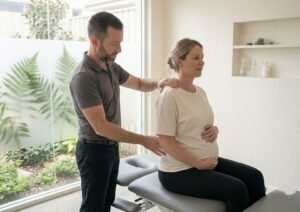
If you need firm support to feel comfortable, wear it to the appointment and bring a lighter option in your bag. That gives you a choice once treatment begins.
- Usually helpful: Soft bras, shelf-bra singlets, light underwear, breathable shorts.
- Often restrictive: Underwires, firm shapewear, medical-grade compression unless clinically needed, heavy seams or clasps over painful areas.
7. Easy-Access Clothing That Allows Layering
If you want the simplest answer to what to wear to an osteopath, layering is often it. Good layers give you control. You can stay covered when you want to and still make the relevant area accessible when needed.

The easiest way to balance comfort and access
A tank under a cardigan, a singlet under an open shirt, or a t-shirt under a zip hoodie works well because each layer comes off quickly. That's much easier than wrestling with a fitted jumper or a one-piece outfit when we need to assess your upper back, shoulder, hip, or abdomen.
For Bayside Osteopathic Health patients, this is especially useful if you're coming from work, school pickup, or another appointment. You don't need a special clinic wardrobe. You just need clothes that can adapt without fuss.
A practical outfit might be soft joggers, a cotton t-shirt, and a zip hoodie. Another might be leggings, a singlet, and a loose button shirt. For older adults or anyone who feels the cold, removable layers are often more comfortable than one thick garment that overheats you on the table.
If muscle tension is a major part of your problem, you may also find this remedial massage and muscle therapy image from Bayside Osteopathic Health useful as a reminder that easy clothing access helps with many hands-on approaches, not just osteopathy.
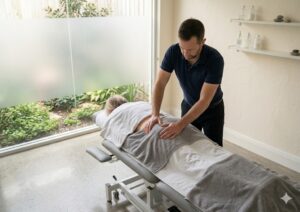
You shouldn't need a private changing-room production just to expose one shoulder or roll up one pant leg. Simple layers save time and reduce awkwardness.
- Best layer combos: Tank plus cardigan, singlet plus button shirt, t-shirt plus zip hoodie.
- Less useful combos: Tight pullovers, jumpsuits, bodysuits, outfits with tricky ties or multiple fastenings.
- Clinic tip: Wear the outermost layer with easy buttons or a zip so you can adjust privacy quickly.
7-Item Clothing Comparison for Osteopath Visits
| Item | Process / Complexity 🔄 | Resource Requirements ⚡ | Expected Outcomes ⭐ | Ideal Use Cases 💡 | Key Advantages 📊 |
|---|---|---|---|---|---|
| Loose-Fitting, Breathable Upper Garments | Very low, put on/adjust easily | Low, widely available, affordable | Clear visual/tactile access to shoulders, neck, thorax | Upper-body assessments and manual therapy | Enables full ROM, accurate posture observation |
| Elastic-Waist or Drawstring Bottoms | Very low, simple to change/adjust | Low, common casual bottoms | Reduced waistband interference; better lumbar/pelvic palpation | Lower back, hip and pelvic evaluations | Eliminates pressure on abdomen/spine for accurate palpation |
| Flat Shoes or Minimal Footwear | Low, may require bringing alternate shoes | Low–Medium, may need spare flats or orthotics | True gait and alignment assessment from ground up | Gait analysis, whole‑body biomechanics checks | Reveals natural posture; prevents heel-induced compensation |
| Avoiding Tight Jewellery and Accessories | Very low, remove before session | Minimal, small storage required | Unobstructed palpation and circulation assessment | Any hands‑on session, especially wrists/neck/torso | Improves tactile feedback and safety during treatment |
| Moisture‑Wicking, Natural‑Fibre Fabrics | Low, select appropriate fabrics | Medium, higher cost and care needs | Better tactile feel, comfort and temperature control | Extended sessions, sensitive skin, warm climates | Enhances practitioner grip; reduces irritation and sweat |
| Minimal or No Heavy‑Support Undergarments | Medium, may require discussion/alternative | Low, swap to lighter options | More accurate spinal, ribcage and thoracic assessment | Thoracic mobility, postural evaluation, breast/chest considerations | Reveals true posture; avoids artificial support masking issues |
| Easy‑Access Clothing That Allows Layering | Medium, coordinate removable layers | Low, simple garments preferred | Balances privacy with selective access for treatment | Patients valuing modesty; multi‑region appointments | Maintains dignity while enabling targeted exposure |
Your Checklist for a Successful Osteopathy Session
The best outfit for an osteopathy appointment is usually the least complicated one. Loose top, flexible bottoms, simple shoes, minimal accessories, and layers you can remove easily. That combination gives your osteopath a clearer view of how you move and gives you more control over comfort and modesty.
If you've been unsure about what to wear to an osteopath, the key point is this. Dress for assessment, not appearance. Your practitioner may need to observe posture, watch you bend or walk, feel how tissues respond under the hands, or work around the neck, shoulders, spine, hips, or legs. Clothing can either help that process or slow it down.
What works well is usually very ordinary. A cotton t-shirt, joggers or leggings, flat shoes, and a light layer are enough for most appointments. If you're coming from work, bring a spare top or flat shoes in your bag. If you wear support garments, choose the lightest version that still feels comfortable, or bring an alternative so you have options.
What doesn't work well is also predictable. Jeans, tight dresses, restrictive workwear, bulky jewellery, difficult boots, and rigid layers tend to create unnecessary obstacles. They don't ruin a session, but they often mean more adjusting, more guessing, and less efficient treatment.
At Bayside Osteopathic Health, patient comfort matters just as much as clinical access. You should never feel pressured to wear something that leaves you uneasy. If you'd prefer to remain more covered, say so. Osteopathic care should feel respectful, collaborative, and personalized for you.
Before you leave home, do one quick check. Can you lift your arms, bend forward, sit comfortably, and remove your shoes without a struggle? If yes, you're probably dressed well for the session.
That small bit of preparation can make your appointment smoother from the first posture check to the last piece of hands-on treatment.
If you're booking with Bayside Osteopathic Health, and you're still unsure what to wear, contact the clinic before your appointment. The team can guide you on what's most practical for your symptoms, whether you're coming in for back pain, neck tension, postural strain, or general mobility support.