
Falls cause more than bruises. They often lead to pain, loss of confidence, reduced independence, and a lasting fear of movement that can shrink daily life very quickly.
Ageing does not automatically mean falling. In practice, the best results come from addressing several risk factors at once: how you stand, how you walk, what pain is doing to your movement, what medications may be affecting balance, and what hazards are waiting at home. A plan works best when those pieces are assessed together rather than treated as separate problems.
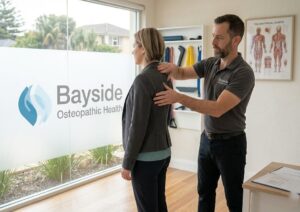
Osteopathic care adds value here because fall risk is often mechanical as well as medical. Stiff hips can shorten your stride. Neck restriction can affect how you orient yourself in space. Back pain can change the way you turn or recover after a stumble. A postural assessment image showing alignment and ergonomics helps illustrate the kind of whole-body view that matters. I often find that once posture, joint motion, and muscle tension are properly assessed, the next steps become much clearer.
That is why a strong fall prevention plan starts with structure and function. Hands-on assessment and treatment can support exercise, home changes, footwear advice, and medical review. None of these strategies replace the others. They work better together.
Below, you'll find 10 practical fall prevention strategies, with clear guidance on where osteopathic assessment and treatment fit within a wider plan to help you stay steady and active.
Table of Contents
- 1. Osteopathic Assessment and Postural Correction
- 2. Strength and Balance Training Programmes
- 3. Home Safety Modifications and Environmental Assessment
- 4. Medication Review and Management
- 5. Vision and Hearing Assessment
- 6. Osteopathic Soft-Tissue and Joint Mobilisation Therapy
- 7. Footwear Assessment and Selection
- 8. Nutritional Support and Bone Health Optimisation
- 9. Cognitive Assessment and Management of Dementia and Delirium
- 10. Multidisciplinary Fall Prevention Coordination and Action Plans
- 10-Point Comparison of Fall Prevention Strategies
- Build Your Personalised Fall Prevention Plan Today
1. Osteopathic Assessment and Postural Correction
One fall can change confidence for months. A careful osteopathic assessment aims to catch the movement problems behind that risk before they lead to an injury.
This is often the best place to start because falls rarely come from one cause. In practice, I look at how you stand, walk, turn, bend, reach, and shift weight from one leg to the other. I also look for the compensations people develop around pain, stiffness, old injuries, reduced joint motion, and fatigue. Those details matter because the body usually reveals the problem before the person can describe it clearly.
Many older adults do not present saying, “I'm worried about falling.” They come in for back pain, hip stiffness, neck tension, or reduced confidence on stairs. An osteopathic assessment helps connect those symptoms to balance risk. That gives the rest of the fall prevention plan a stronger foundation, because exercise, home changes, and footwear choices work better when they are built around the way your body moves.
A practitioner may assess spinal alignment, rib and pelvic position, ankle and hip mobility, muscle tension, gait, and postural habits in the same session. The goal is not to chase “perfect posture.” The goal is to find the positions and movement patterns that make you less stable, more guarded, or slower to correct yourself if you trip.
See the kind of posture-focused clinical setting this approach relates to in this posture and ergonomics image from Bayside Osteopathic Health.
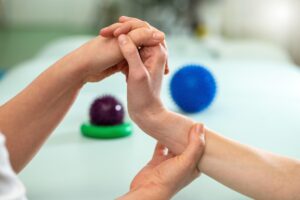
A rehabilitation plan may also include targeted home work, such as supported weight shifting, thoracic mobility, hip extension drills, or strategies to improve sit-to-stand control. You can see the rehabilitation context in this clinical rehabilitation exercise image.
Why it belongs near the start
Postural correction belongs early because untreated mechanics can limit the benefit of everything that follows. If you are leaning away from a painful hip, protecting a stiff lower back, or avoiding ankle movement after an old sprain, your balance system is already working with poor input and fewer options.
That is the osteopathic contribution to fall prevention. It looks at structure and function together.
The trade-off is that assessment and correction take follow-through. One appointment can identify the pattern, but lasting change usually depends on repeated practice, home advice, and the right progression. The upside is that this approach is highly individual. Instead of generic instructions to “stand up straighter,” you get a clearer explanation of what is restricting you, what can be treated hands-on, and what you need to retrain yourself.
Practical rule: If pain changes the way you move, address the pain pattern and the movement pattern together.
2. Strength and Balance Training Programmes
A well-designed exercise programme is one of the most reliable ways to lower fall risk in older adults. The key is specificity. Training needs to improve balance, leg strength, reaction time, and control during everyday tasks such as standing up, turning, reaching, and climbing steps.
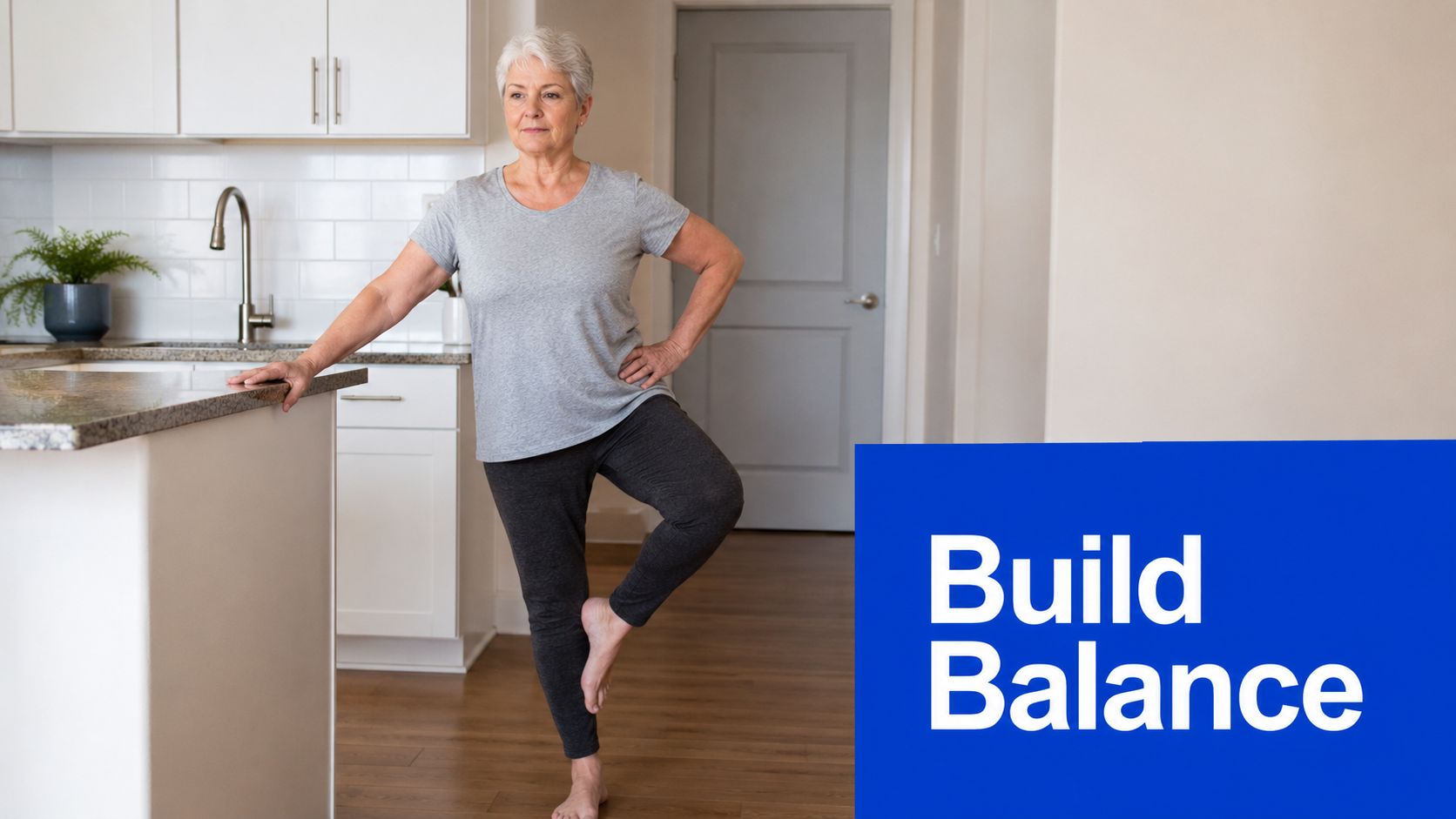
In practice, the best programme is not always the hardest one. It is the one you can perform safely, often enough, and with enough challenge to produce change. That usually means starting with clear baseline goals, then progressing in a planned way as your balance improves.
From an osteopathic point of view, exercise works better when it matches the body in front of us. If ankle stiffness limits your weight shift, if a painful hip changes how you load one side, or if thoracic rigidity affects turning, those findings should shape the programme. That is why structural assessment matters here. It helps us choose the right exercises, the right starting level, and the right progressions instead of handing out a generic balance sheet.
A useful example of that rehabilitation approach appears in this clinical rehabilitation exercise image.
What makes exercise effective
Programmes work best when they are progressive and task-based. Early exercises often include sit-to-stand practice, supported single-leg standing, step-ups, and controlled weight shifts. Later stages can add reaching outside your base of support, turning, carrying light objects, negotiating uneven ground, and recovering after a small loss of balance.
The aim is not just stronger muscles. The aim is better movement under real-world conditions.
- Leg strength: Chair rises, calf raises, step practice, and supported squats improve transfers, stair use, and walking confidence.
- Balance challenge: Narrow-stance standing, tandem work, direction changes, and controlled reaching train the systems that keep you upright.
- Functional control: Practising everyday patterns improves your ability to react when something unexpected happens.
- Progression: Exercises need to become gradually more demanding, or results tend to plateau.
There is a trade-off. If exercises are too easy, they feel comfortable but change very little. If they are too difficult too soon, people lose confidence or compensate with poor technique. Early supervision often helps, especially if pain, arthritis, neuropathy, or previous falls have already changed how you move.
For many people, consistency is the hardest part. Short, regular sessions usually work better than occasional long ones. A programme you follow three times a week with the right level of challenge will usually do more than a long list of exercises that never becomes part of your routine.
Practical rule: Choose exercises that are safe, specific, and challenging enough to improve balance, not just gentle enough to feel easy.
3. Home Safety Modifications and Environmental Assessment
A strong body still struggles in a poorly set up environment. I've seen many people who are reasonably mobile indoors during the day, then become unsteady at night because the hallway is dim, the bathroom floor is slippery, and the route to the toilet is cluttered.

This strategy is less glamorous than treatment or exercise, but it's often one of the fastest to implement. Remove loose rugs, secure cords, improve lighting, fit grab rails where needed, and make sure frequently used items are easy to reach without climbing or twisting.
What to change first
Start with the spaces where people rush, turn, or carry things. That usually means the bathroom, bedroom, hallway, and entry area.
- Lighting: Improve visibility near the bed, in the hallway, on stairs, and at the front door.
- Floor surfaces: Remove trip hazards, flatten rug edges, and keep walking paths clear.
- Bathroom setup: Use non-slip mats, stable seating if needed, and professionally installed grab rails.
- Furniture flow: Create wide, direct paths so you're not side-stepping around tables or baskets.
A safer home should still feel like your home. Good modifications support independence rather than making the space feel clinical.
The limitation is that home changes don't fix weakness, poor reaction time, dizziness, or pain-driven movement patterns. They reduce risk, but they work best as part of a broader plan.
4. Medication Review and Management
Medication review can change fall risk quickly, especially when dizziness, drowsiness, urgency, blurred thinking, or blood pressure drops are involved. People often assume a balance problem starts in the legs, but sometimes it starts in the medicine cabinet.
A careful review should include prescriptions, over-the-counter products, sleep aids, and supplements. Timing matters too. Some people feel worse first thing in the morning, others after an evening dose, and others when multiple medicines combine to make them light-headed.
Where medication review helps most
If you've noticed sudden unsteadiness, near falls when standing, grogginess, or confusion, ask your GP or pharmacist for a review. Bring a full list of what you take, including “as needed” tablets and anything bought without a prescription.
- Sedating medicines: These can slow reactions and reduce awareness.
- Blood pressure medicines: These may contribute to light-headedness, especially on standing.
- Pain medicines and muscle relaxants: These can affect alertness, coordination, or confidence walking.
- Multiple medicines together: Interactions matter, even when each medication seems reasonable on its own.
The trade-off is that useful medicines sometimes carry unavoidable risks. Stopping or changing them without supervision isn't safe. The goal is better management, not abrupt withdrawal.
5. Vision and Hearing Assessment
Balance isn't just about muscles and joints. Your eyes and ears constantly help your brain judge where you are in space. When either system isn't working well, people often slow down, shuffle, reach for furniture, or avoid moving in dim or busy environments.
This is one of the more overlooked fall prevention strategies because changes can creep in gradually. A person may say, “I'm just more careful now,” when the underlying issue is that depth perception, contrast sensitivity, or hearing awareness has dropped.
Small sensory problems create big movement problems
Vision review is particularly important if you feel less steady on stairs, curbs, patterned flooring, or at dusk. Hearing review matters too, because reduced auditory input can affect orientation and awareness of what's happening around you.
Useful points to raise at an appointment include:
- Glasses changes: Ask whether your current prescription still suits walking and stairs.
- Multifocal lenses: These can be awkward for some people when looking down while moving.
- Lighting needs: Better contrast and brighter task lighting may improve confidence at home.
- Hearing devices: If you already use hearing aids, adjustment can matter as much as the device itself.
The advantage here is broad. Better sensory input doesn't just help balance. It usually improves confidence, communication, and willingness to stay active.
6. Osteopathic Soft-Tissue and Joint Mobilisation Therapy
Pain changes the way people move long before they realise it. A stiff thoracic spine can shorten your stride. A painful hip can stop proper weight transfer. Reduced neck rotation can make turning feel uncertain, especially in busy spaces or when stepping around obstacles. Those compensations matter because fall prevention is not only about strength. It is also about giving the nervous system clearer movement input from the joints, muscles, and fascia.
In practice, I use hands-on treatment when restriction and discomfort are stopping someone from using the balance and strength strategies prescribed elsewhere in their plan. Osteopathic soft-tissue work and joint mobilisation can reduce guarding, improve joint motion, and make gait less rigid. For many patients, that means they can finally turn, reach, or shift weight with less hesitation.
You can see the type of clinical setting involved in this remedial massage and muscle therapy treatment image.
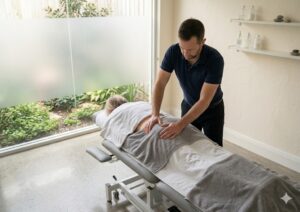
When hands-on treatment is useful
This approach often helps when exercise is technically appropriate but practically hard to do. I see this with people who have back pain during transfers, ankle stiffness that limits stepping reactions, or rib and mid-back tightness that affects posture and arm swing. The treatment itself is only part of the value. The bigger goal is to remove enough pain and restriction that exercise, walking practice, and postural retraining become possible and more effective.
That osteopathic perspective matters. Rather than treating the painful area in isolation, the assessment looks at how body regions work together. A restricted foot and ankle can affect knee control. Poor thoracic extension can shift balance backward. Pelvic stiffness can change how safely someone loads one leg. Addressing those linked problems gives the rest of the fall prevention plan a stronger base.
There are trade-offs. Hands-on treatment can improve comfort and movement quality, but the effect may fade if it is not followed by strength work, balance practice, and changes at home. It also needs to be matched to the individual. Someone who is frail, highly irritable, or living with significant osteoporosis may need a gentler approach and slower progression.
Used well, manual treatment supports the wider plan. It helps the body move more normally, so the other strategies you use have a better chance of sticking.
7. Footwear Assessment and Selection
Shoes can help or hurt balance every single day. The wrong pair makes the ground feel less predictable. The right pair gives you grip, a stable base, and enough support that your body doesn't have to work as hard to stay upright.
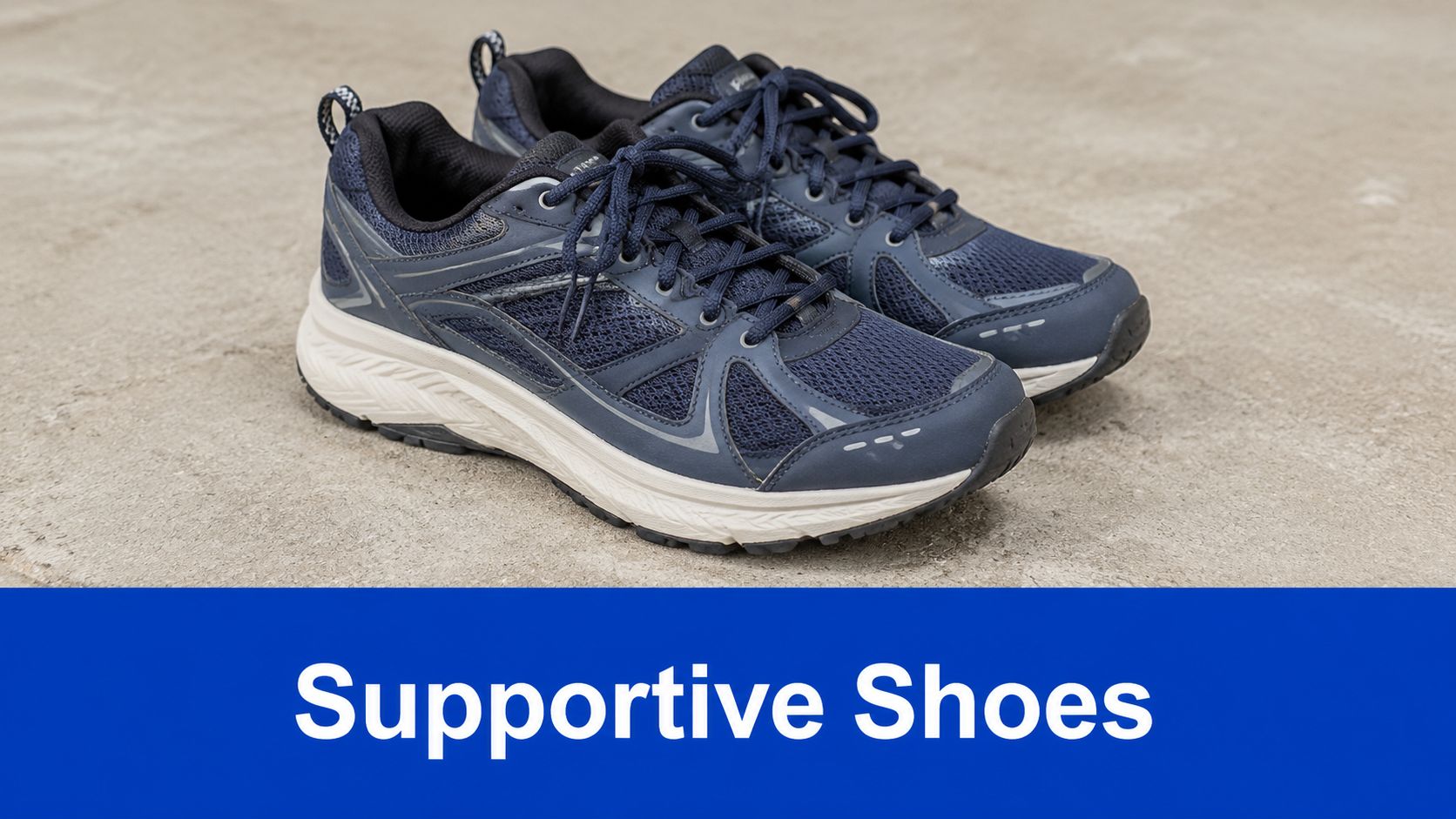
The common troublemakers are worn slippers, backless shoes, smooth soles, and footwear that's too loose through the heel. People often keep these because they're easy to put on, but easy to put on isn't the same as safe to walk in.
What good fall-prevention footwear looks like
You usually want a shoe with a secure fit, a low and stable profile, a firm heel counter, and reliable tread. It should bend where the toes bend, not collapse in the middle.
- Secure fastening: Laces, straps, or other closures help stop the foot sliding around.
- Grippy sole: Good traction matters indoors and outdoors, especially on smooth surfaces.
- Stable heel: Avoid high, narrow, or wobbly bases.
- Proper fit: There should be room for toes without heel slip or side-to-side movement.
This is one of the simplest fall prevention strategies to act on immediately. The trade-off is mainly behavioural. Some people own safe shoes but only wear them outside, then switch to unsafe footwear at home where many falls happen.
8. Nutritional Support and Bone Health Optimisation
Nutrition won't correct a trip hazard or fix poor balance by itself, but it shapes the strength and resilience behind every movement. If muscle mass is falling, appetite is poor, or meals are inconsistent, people often become weaker without noticing it until transfers, stairs, or long walks become harder.
Bone health matters too. Fall prevention is about stopping the fall, but it's also about reducing the chance that a fall leads to a serious injury. Good nutrition supports both sides of that problem.
Nutrition supports resilience, not just recovery
A practical review often focuses on protein intake, calcium-rich foods, hydration, meal timing, and whether vitamin or mineral supplementation is appropriate. This should be individualised, especially if you have kidney issues, digestive conditions, or medicines that interact with supplements.
Points worth discussing with your GP, dietitian, or treating clinician include:
- Protein intake: Adequate protein helps maintain muscle needed for balance and recovery.
- Bone support: Calcium and vitamin D may be relevant depending on diet, health status, and medical advice.
- Hydration: Dehydration can contribute to fatigue, light-headedness, and poorer physical performance.
- Weight loss or poor appetite: These can undermine strength and confidence.
This strategy works slowly, which can make it easy to underestimate. But when combined with exercise and pain management, nutritional support often helps people sustain the gains they make.
9. Cognitive Assessment and Management of Dementia and Delirium
Not every fall starts with weakness. Some start with poor judgement, confusion, distraction, or reduced awareness of limitations. That's why cognitive screening belongs in any serious conversation about fall prevention strategies.
This is especially important when someone has become more forgetful, impulsive, disoriented at certain times of day, or inconsistent with using walking aids. Family members often notice these changes before the person does.
Why awareness matters
One of the most concerning gaps in falls care is risk perception. Injury Matters notes that data from hospital settings showed one-third of patients did not realise their own falling risk, and knowledge deficits were a major barrier to mitigation. In the community, this can be even harder to spot because many people present with pain, fatigue, or “slowing down” rather than saying they feel unsafe.
That's why education has to be interactive and person-centred. Handing over a brochure rarely changes behaviour. People need explanations that connect the risk to their daily life, routines, and symptoms.
“I don't feel at risk” is often the first warning sign that a fuller assessment is needed.
The challenge is that cognitive issues can be emotionally difficult for individuals and families. Still, early recognition allows for practical changes in medication, supervision, routine, and environment that can make daily life safer.
10. Multidisciplinary Fall Prevention Coordination and Action Plans
Around one in three older adults who fall will have more than one contributing factor. In practice, that is why single-solution advice often falls short. A person may need pain treatment, balance training, medication changes, better footwear, vision care, and home adjustments at the same time.
Osteopathic care can help organise that picture. Structural assessment shows how posture, joint restriction, muscle guarding, and movement habits may be increasing instability. That matters because an exercise plan, a walking aid, or a home modification works better when it is built around how the person moves day to day.
Poor coordination creates its own risk. Patients hear “stay active,” “slow down,” “use the frame,” and “rest the pain” from different clinicians, then try to combine advice that does not fully match. The result is often confusion, low follow-through, and a plan that looks good on paper but is hard to use at home.
The most effective action plan is practical, specific, and shared by everyone involved.
A good plan should clearly set out:
- Main fall drivers: Pain, stiffness, weakness, dizziness, reduced confidence, poor vision, medication effects, cognitive changes, or hazards at home.
- First priorities: The two or three changes most likely to improve safety soon, rather than trying to fix everything at once.
- Roles: What the patient will do, what family or carers will monitor, and what each clinician is responsible for.
- Review dates: A clear time to reassess progress, barriers, and any new symptoms.
I usually tell patients that coordinated care takes more effort early on. There may be extra appointments, more communication between providers, and a need to sequence treatment properly. That trade-off is often worthwhile. If osteopathic treatment reduces pain and improves joint motion first, the person is often more able to participate in strength and balance work and more willing to keep going with it.
This section matters because fall prevention is rarely one decision. It is a series of linked decisions, made by the patient and the clinicians around them. When those decisions are aligned, the plan is safer, simpler, and far more likely to hold up in real life.
10-Point Comparison of Fall Prevention Strategies
| 🔄 Implementation Complexity | ⚡ Resource Requirements | ⭐ Expected Effectiveness | 📊 Expected Outcomes | Ideal Use Cases | 💡 Key Tip |
|---|---|---|---|---|---|
| Osteopathic Assessment and Postural Correction, Medium (practitioner-led, multiple visits) | Moderate, trained osteopath, clinic time | ⭐⭐⭐⭐, addresses structural causes | Improved alignment, reduced compensatory movement; gradual fall-risk reduction | Office workers with postural strain; older adults with arthritis | Schedule baseline assessment and commit to home exercises |
| Strength and Balance Training Programmes, Medium (programme design + adherence) | Moderate, trainer/physio or guided home programme, minimal equipment | ⭐⭐⭐⭐⭐, strong evidence (30–40% fall reduction) | Increased strength, proprioception; measurable fall-risk reduction | Older adults, preventive care, post-assessment rehabilitation | Train consistently (3+ sessions/week); start slow and progress |
| Home Safety Modifications and Environmental Assessment, Low (audit + fixes) | Low–Moderate, minor hardware, possible installation costs | ⭐⭐⭐⭐, immediate environmental risk reduction (≈26% reduction) | Immediate reduction in trip/slip hazards; broad household benefit | Older adults, anyone living at home, mobility-limited people | Begin with bathroom/bedroom changes and improve lighting |
| Medication Review and Management, Medium (clinical coordination) | Low, clinician/pharmacist time, medication history | ⭐⭐⭐⭐, direct physiological risk reduction | Reduced dizziness/drowsiness and medication-related falls; often immediate gains | Older adults on multiple meds, pain management patients | Keep up-to-date med list and report balance or dizziness promptly |
| Vision and Hearing Assessment, Low (routine screenings) | Low–Moderate, optometrist/audiologist visits; corrective devices | ⭐⭐⭐⭐, improves spatial awareness and balance | Better obstacle detection and orientation; fewer trips and missteps | Older adults or anyone with sensory decline | Schedule annual screenings; allow adjustment time for aids/lenses |
| Osteopathic Soft-Tissue and Joint Mobilisation Therapy, Medium (hands-on sessions) | Moderate, trained practitioner, regular appointments | ⭐⭐⭐⭐, improves mobility and proprioception | Reduced pain, improved joint mobility and balance over sessions | Chronic pain, joint restrictions, arthritis sufferers | Communicate limitations clearly and follow prescribed home stretches |
| Footwear Assessment and Selection, Low (quick assessment/action) | Low, purchase cost for quality shoes | ⭐⭐⭐⭐, immediate practical benefit | Improved grip, stability and confidence; immediate slip reduction | All ages, office workers, older adults seeking quick fixes | Avoid loose slippers; choose firm grip, low-heel, secure fastenings |
| Nutritional Support and Bone Health Optimisation, Low–Medium (assessment + follow-up) | Low–Moderate, dietitian consults, supplements as needed | ⭐⭐⭐, long-term physiological benefits | Improved bone density and muscle maintenance; reduced fracture severity over time | Older adults, restricted diets, osteoporosis risk | Ensure adequate vitamin D, calcium and protein; consult provider |
| Cognitive Assessment and Management of Dementia and Delirium, Medium–High (screening + ongoing care) | Moderate–High, specialists, caregiver involvement | ⭐⭐⭐⭐, early detection reduces cognitive-related falls | Better routines, safer environment, medication adjustments to reduce risk | Older adults with memory/change in cognition, at-risk individuals | Seek screening for new confusion and establish consistent routines |
| Multidisciplinary Fall Prevention Coordination and Action Plans, High (team coordination) | High, multiple providers, monitoring and follow-up | ⭐⭐⭐⭐⭐, most effective for complex cases | Comprehensive, prioritized interventions; improved adherence and large risk reduction | Older adults with multiple comorbidities; complex cases | Request a written, time-framed plan and regular multidisciplinary reviews |
Build Your Personalised Fall Prevention Plan Today
A fall rarely starts with the moment you hit the floor. It often starts earlier, with shorter steps, a cautious turn, a hand reaching for furniture, or the quiet decision to avoid certain tasks because they no longer feel safe.
That early change matters.
In clinic, I look for the reasons behind it. Pain, stiffness, reduced joint motion, postural strain, medication effects, poor vision, foot problems, and reduced confidence can all change how you stand, walk, and recover your balance. If you only address one part, such as balance exercises, progress can be slower and the plan may miss the underlying driver.
Osteopathic care adds a practical foundation to fall prevention because it examines how the whole body is functioning together. A structural assessment can pick up asymmetry, guarded movement, restricted hips or thoracic spine, reduced foot clearance, and inefficient movement patterns during standing, turning, and walking. Once those issues are clear, the rest of the plan becomes more accurate. Exercises can be matched to your actual limits. Home changes can focus on the places and tasks that pose a real risk. Conversations with your GP, pharmacist, optometrist, or family can be based on specific findings rather than general concern.
At Bayside Osteopathic Health, the aim is to identify what is making movement less reliable and what can realistically improve it. For some people, the first step is reducing pain and muscle guarding so walking becomes more even. For others, it is improving joint mobility, posture, transfer mechanics, and confidence so daily tasks feel steadier and less tiring.
The best plan is one you can keep doing.
A long list of ideal recommendations often fails in real life, especially during pain flares, fatigue, illness, or routine changes. A better approach is to start with a few targeted actions, review what is helping, and adjust as your mobility changes.
If you have noticed reduced balance, stiffness, changes in walking, or a growing fear of falling, seek an assessment early. Early action can reduce the chance that a near miss turns into an injury, hospital visit, or long recovery.
If you want a personalised starting point, book an appointment with Bayside Osteopathic Health. Our team provides gentle hands-on treatment, movement assessment, and clear advice to help reduce pain, improve mobility, and support safer day-to-day movement.