
You're halfway through the workday. Your shoulders have crept up towards your ears, your jaw is tight, and a dull pressure starts wrapping around your forehead like a band. It isn't dramatic, but it's draining. You can still function, yet everything takes more effort. Reading feels slower. Small decisions feel harder. By the afternoon, even your patience is thinner.
That pattern is familiar for a reason. Tension headaches often build gradually, and many people treat them as something they just have to push through. In practice, that's rarely the best approach. The pain may sit in the head, but the driver is often a mix of stress, neck strain, posture, poor recovery, and habits that keep feeding the cycle.
If you want real tension headache relief, the most useful approach is usually twofold. First, settle the current headache with simple measures that calm the system and reduce irritation. Second, deal with the neck and postural strain that often keeps the headache returning.
Table of Contents
- That Familiar Squeeze The Reality of Tension Headaches
- Finding Relief Right Now Quick Self-Care Strategies
- Releasing Tension at the Source Targeted Stretches
- Building Your Headache Prevention Plan
- When to See a Professional for Your Headaches
- How Osteopathy Addresses the Root Cause of Headaches
That Familiar Squeeze The Reality of Tension Headaches
A tension headache often doesn't arrive all at once. It creeps in. You notice it after a morning at the computer, after a tense meeting, or after hours of looking down at a phone. The pressure can feel broad and heavy rather than sharp. Many people also feel stiffness through the base of the skull, the top of the shoulders, or between the shoulder blades.
That combination matters. The headache may feel like a head problem, but the pattern often points lower. Neck muscles work harder when posture slips, screen height is wrong, or stress keeps the body braced for too long. Over time, those tissues become sensitive and the head pays the price.
In Australia, approximately 7 million people suffer from tension-type headaches, representing 36% of men and 42% of women, and stress is the leading trigger for 70% of these sufferers, with spinal health conditions identified as a major contributor, according to the Australian Chiropractors Association media release. That tells us two useful things. You're not unusual, and this isn't just about stress in the abstract. The body's mechanics are often involved.
What tension headaches usually feel like
- A band-like pressure around the forehead, temples, or back of the head.
- Neck and shoulder tightness that seems to build alongside the headache.
- Mental fog or reduced concentration even when the pain is only mild to moderate.
- Pain that builds with desk work or long periods in one position.
Tension headaches are common, but common doesn't mean you have to accept them as normal.
The encouraging part is that many people can improve this pattern when they stop treating the headache as an isolated event. Relief becomes more likely when you reduce the immediate pain, then unload the neck, improve movement, and make the day-to-day setup less irritating.
Finding Relief Right Now Quick Self-Care Strategies
When a headache has already started, the priority is simple. Lower the irritation without doing anything that makes the pattern harder to break later.
Use medication carefully, not automatically
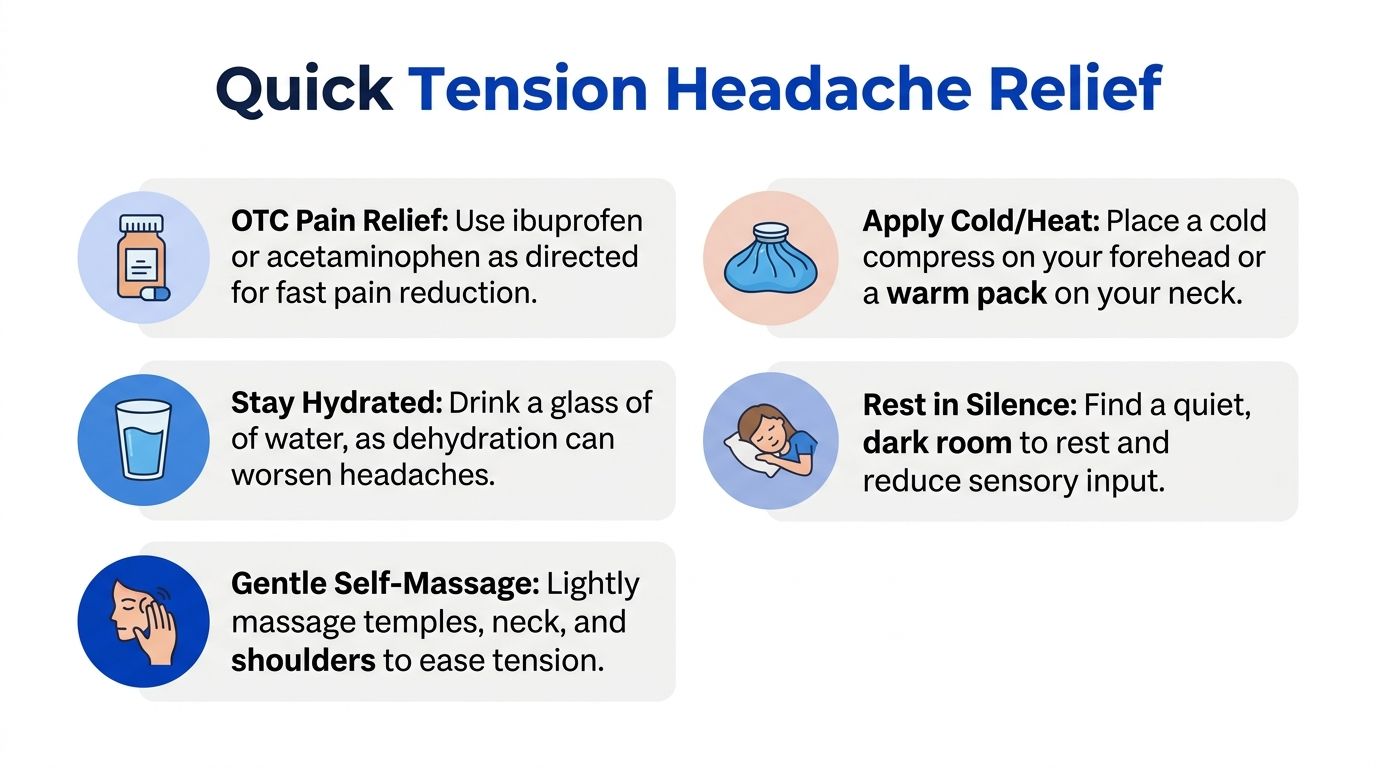
For many people, over-the-counter pain relief such as paracetamol or ibuprofen can help in the short term. The important trade-off is frequency. The Australian review on headache care notes that these medicines can be effective, but they should not be taken more than 2 to 3 times per week to avoid medication overuse, and it also recommends massage, heat application, and relaxation exercises as part of care. You can read that in the Australian headache review published on PubMed Central.
If you reach for tablets every time your head feels tight, pause and ask why the headache keeps returning. Medication may settle symptoms, but it won't correct a workstation that keeps your neck loaded or a body that stays braced all day.
Three ways to ease the pressure without more medication
Use warmth where the muscles are tight
A warm pack over the neck and upper shoulders often helps more than putting it directly on the head. Heat can calm guarded muscles and make movement easier afterwards.Try a brief self-massage
Use your fingertips to apply gentle pressure to the temples, jaw muscles, base of the skull, and upper shoulders. Keep it light. If you press hard and the area becomes more irritated, you've gone too far.Slow your breathing down
Try this for two minutes:
- Breathe in gently through the nose.
- Let the exhale run longer than the inhale.
- Drop the shoulders each time you breathe out.
- Unclench the jaw and let the tongue rest softly.
Practical rule: If a self-care strategy leaves your neck feeling looser and your head less pressured within a short time, it's probably useful. If it leaves you sorer, scale it back.
What usually doesn't work well
A common mistake is doing too much, too fast. Aggressive stretching, repeated cracking of the neck, heavy pressure into sore muscles, and relying on caffeine-combined pain tablets can all backfire for some people. Often the best immediate tension headache relief is quieter than expected: less force, more calming, better positioning, and a short interruption to the strain that triggered it.
Releasing Tension at the Source Targeted Stretches
Many recurring tension headaches have a clear mechanical component. The tissues at the base of the skull, the side of the neck, and the top of the shoulders often stay mildly overloaded for hours at a time. When they never get a reset, they become irritable.

A simple routine can help, especially when you pair it with better desk habits or hands-on care such as remedial massage and muscle therapy support where appropriate.

Start with the movement most people need
The most useful exercise for many office workers is cervical retraction, often called the chin-tuck. According to the Keilor Road Physio guide on tension headache exercises, a structured protocol involves 3 sets of 30-second cervical retraction exercises, performed 10 times daily, targeting the suboccipital muscles to reduce trigger point sensitivity and address postural strain.
Here's how to do it well:
- Sit tall with your breastbone relaxed and shoulders soft.
- Keep your gaze level. Don't look up or down.
- Glide the head straight back as if making a double chin.
- Don't tip the chin upward. The movement is horizontal, not diagonal.
- Hold for 30 seconds, rest briefly, then repeat for 3 sets.
This exercise matters because it unloads the small muscles at the base of the skull. Those muscles often stay shortened when your head pokes forward towards a screen.
Most people don't need a stronger neck. They need a neck that isn't constantly dragged forward.
Add gentle mobility around the neck and shoulders
After chin-tucks, add a few lower-force movements.
Neck rotation
Turn your head gently to one side, then the other. Stay within an easy range. This shouldn't feel like a competition with stiffness.Shoulder rolls
Roll the shoulders up, back, and down. Then reverse the direction. The aim is movement, not intensity.Upper-back opening stretch
Clasp your hands in front of you and gently reach forward while letting the upper back round slightly. This can reduce the rigid, chest-lifted posture that often accompanies neck tension.
A short visual demonstration can make technique easier to judge:
If these movements help during the exercise but the headache returns quickly every day, that's a clue. The neck is probably reacting to a bigger pattern such as workstation strain, jaw clenching, poor movement variety, or restricted joints that need assessment.
Building Your Headache Prevention Plan
Preventing tension headaches usually works better than repeatedly chasing them after they start. The goal isn't a perfect lifestyle. It's a setup that asks less of your neck and nervous system each day.
Set up your day so your neck does less compensating
Most posture advice is too vague to be useful. “Sit up straight” tends to create more tension, not less. A better target is a position you can maintain without gripping.
Use these checkpoints at your workstation, and compare them with practical corporate ergonomics and posture principles:

| Area | Better option | Common problem |
|---|---|---|
| Screen | In front of you at comfortable viewing height | Looking down for hours |
| Chair | Feet supported, hips settled, shoulders relaxed | Perching at the edge |
| Keyboard and mouse | Close enough that elbows can stay easy | Reaching forward |
| Phone use | Bring the phone up sometimes | Constant neck flexion |
Two other habits matter just as much. Change position regularly, and don't wait until your body feels awful to move. Even brief resets through the day can stop tension from layering up.
Calm the trigger cycle
The Australian government's Healthdirect guidance notes that preventing recurrent tension headaches improves when analgesics are combined with biofeedback or cognitive behavioural therapy, and it warns that over-reliance on caffeine-combined pain tablets can lead to rebound headaches. That advice appears in the Healthdirect page on tension headache.
That's clinically useful because many people treat only the pain and miss the cycle underneath it:
- stress rises
- sleep quality drops
- hydration slips
- muscle tension increases
- medication use becomes more frequent
- headaches become easier to trigger
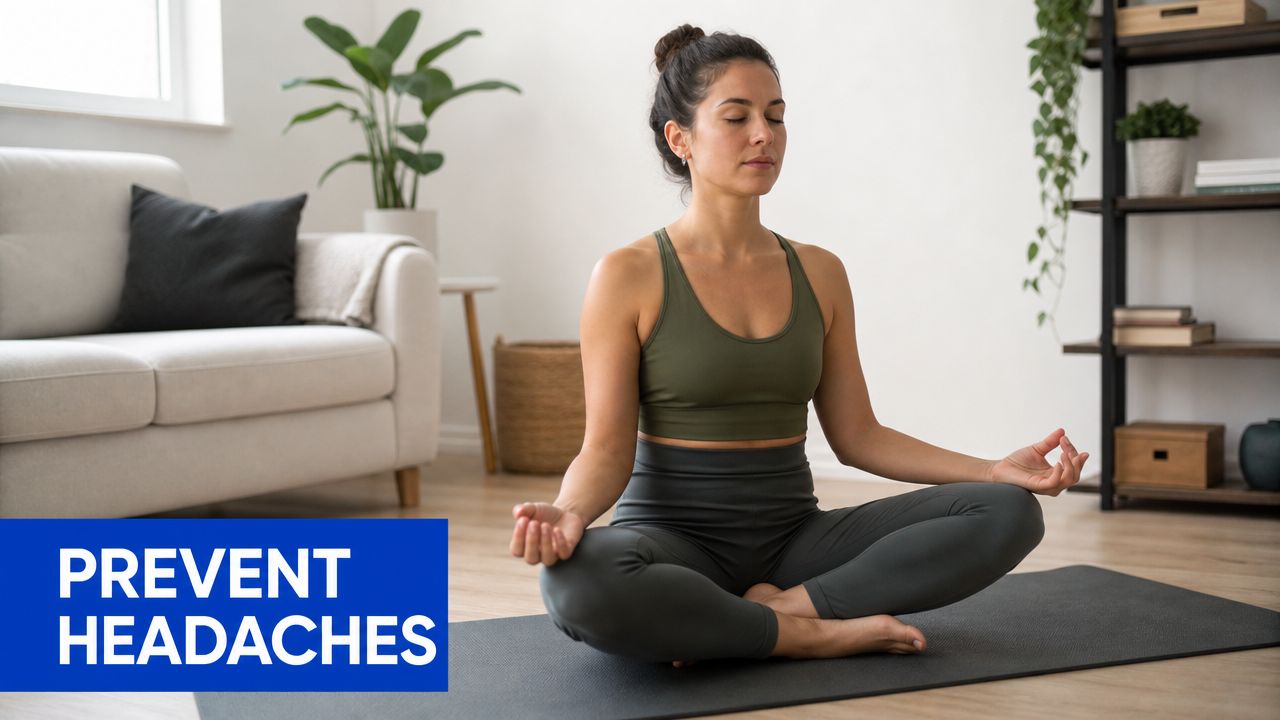
A prevention plan works best when it's small enough to keep doing:
- Start with one anchor habit such as drinking water with each meal.
- Protect your wind-down period so your nervous system gets a proper signal that the day is ending.
- Use simple CBT-style questioning when stress spikes. Ask, “What am I assuming right now?” and “What can I change in the next ten minutes?”
- Build in short movement breaks before the neck starts tightening, not after.
A good prevention plan is boring in the best way. It lowers the number of things your body has to fight through each day.
When to See a Professional for Your Headaches
Self-care is useful, but it has limits. If your headaches are frequent, more intense than usual, changing in pattern, or no longer responding to the strategies that used to help, it's time for assessment rather than more trial and error.
A clinician should also review headaches that wake you from sleep, follow an injury, or come with symptoms that don't fit a straightforward tension pattern. Examples include dizziness, weakness, numbness, unusual visual changes, speech changes, marked nausea, or a sense that something is distinctly different from your usual headache.
Signs that deserve proper assessment
- The pattern is escalating and you're needing pain relief more often.
- The headache feels linked to neck movement or stays stubborn despite improving stress habits.
- There are other neurological or systemic symptoms alongside the pain.
- You're unsure what type of headache you're dealing with and don't want to keep guessing.
For some people, a broader care discussion also helps clarify access and next steps, including questions around osteopathy and Medicare considerations.

The point of seeking help isn't to medicalise every headache. It's to stop missing the cases where the headache is being driven by something more persistent than temporary muscle tension.
How Osteopathy Addresses the Root Cause of Headaches
When tension headaches keep returning, the missing piece is often mechanical. The neck may not be moving well. Certain joints may be stiff. Muscles at the base of the skull may be overworking to hold the head in place. The upper back may be too rigid, forcing the neck to compensate.
Why generic advice sometimes falls short
A recent study found that 74% of Australian adults with chronic tension headaches had underlying cervical joint dysfunction unresolved by standard self-care, yet only 19% received targeted manual therapy, according to the study available on PubMed Central. That gap matters. It suggests many people are trying sensible things at home, but they're still missing an assessment of the neck itself.
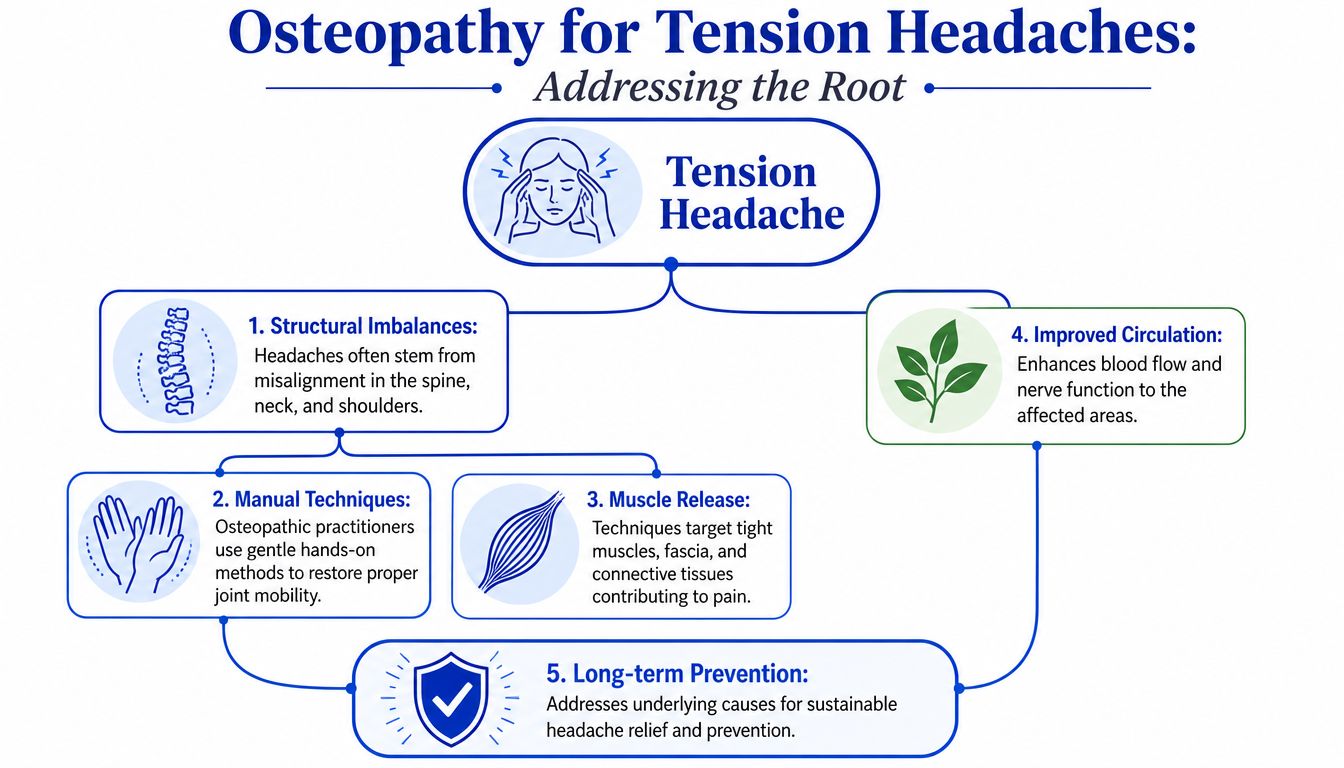
If the main driver is cervicogenic or posture-related, generic headache advice may only partly help. You might feel temporary relief from heat, stretching, or medication, but the pattern returns because the load through the neck hasn't changed enough.
What an osteopathic approach looks for
An osteopathic assessment looks beyond the head. It considers how the neck, upper back, ribs, shoulders, jaw, and posture interact. It also looks at how you move, where you brace, and which positions trigger symptoms.
Hands-on care may include:
- Soft-tissue work to reduce excessive tone through the neck and shoulders
- Gentle joint articulation or mobilisation where movement is restricted
- Postural advice that fits your actual workday rather than an idealised one
- Targeted home exercises so the benefit doesn't end when the appointment does
This approach is useful because it treats the structures contributing to the headache, not just the pain experience itself. For many people, lasting tension headache relief comes from that combination of manual treatment, clearer movement, and practical changes at home and work.
If your headaches keep coming back, Bayside Osteopathic Health offers gentle, hands-on osteopathic care focused on the underlying drivers of pain, including neck tension, postural strain, and restricted movement. We assess how your body moves as a whole, then build a personalized plan that may include soft-tissue work, joint articulation, mobility advice, and realistic self-care strategies you can use between visits. If you're ready for a clearer path to lasting relief, book an appointment and get trusted support close to home.