

You've probably done this before. Your back tightens, your neck starts nagging, or your knees feel stiff after sitting too long, so you search for a few exercises online. The plan looks simple enough. A few stretches, a few strengthening moves, maybe a “beginner routine”.
Then one of two things happens. You flare things up and stop, or you manage it for a few days before life gets in the way and the sheet of exercises ends up ignored on the bench.
That's where a good home exercise program needs to be different. It shouldn't feel like punishment, and it shouldn't depend on pushing through pain. For people with chronic back pain, neck tension, arthritis, joint stiffness, or postural strain, the best plan is usually a gentle one you can consistently repeat. The aim isn't to win at exercise. The aim is to move more comfortably, more confidently, and more often.
Table of Contents
- Moving Beyond One-Size-Fits-All Exercise Plans
- Laying the Foundation for Your Personal Program
- Choosing Your Core Exercises for Mobility and Strength
- Structuring Your Sessions and Planning Your Week
- Listening to Your Body and Staying Safe
- Tracking Your Progress and Seeking Expert Guidance
Moving Beyond One-Size-Fits-All Exercise Plans
Generic plans often fail for a simple reason. They treat pain like a motivation problem, when it's usually a matching problem. The exercise might be too strong, too fast, too awkward for your body, or poorly timed for your day.
If you've tried a routine that left you sorer in the wrong way, that doesn't mean exercise isn't for you. It usually means the dose was wrong. A useful home exercise program starts with what your body can tolerate today, not what a template says you should manage.
Gentle movement works better when it feels safe enough to repeat tomorrow.
For persistent pain, the goal is to lower threat, improve confidence, and rebuild motion gradually. That often means choosing fewer exercises, slowing them down, shortening the range, or using support from a chair, wall, towel, or bench. It also means dropping the idea that more reps automatically means more progress.
A personalised plan should answer three questions:
What movement currently feels limited or guarded
Bending, turning, standing up, walking, reaching overhead, or getting out of bed can all point to different priorities.What activity matters most to you
That might be working at a desk, gardening, sleeping more comfortably, or walking without feeling stiff after the first few minutes.What can you repeat consistently
The best plan is the one you'll still be doing next week.
A proper starting point looks more like a whole-body movement review in osteopathic care than a copied list of stretches. It pays attention to how you sit, walk, brace, breathe, and react to movement.

That shift matters. When you stop forcing movement and start working with your body, home exercise becomes less of a test and more of a tool.
Laying the Foundation for Your Personal Program
Before choosing a single exercise, take stock of what your body is already telling you. This step often saves weeks of frustration.
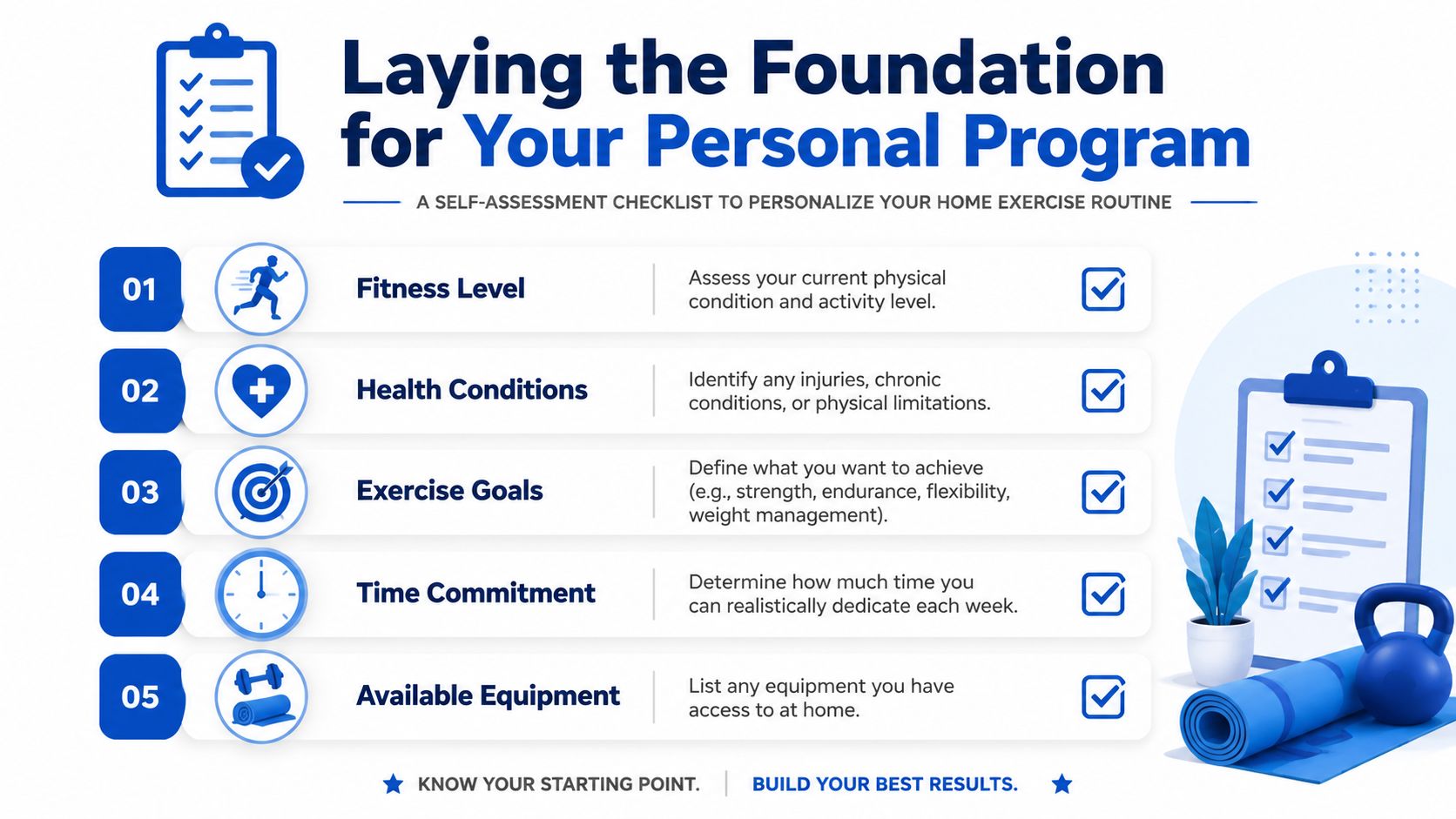
Start with your real day
Don't start with the ideal version of you. Start with the version that exists now.
Ask yourself:
When does pain usually show up
First thing in the morning, after sitting, after walking, late in the day, or only during certain tasks?Which positions ease it
Lying down, standing, leaning forward, changing position, or moving gently?Which movements feel risky or avoided
Twisting, stairs, lifting, reaching, getting off the floor, or carrying groceries?What's realistic this week
Five quiet minutes twice a day may be far more useful than planning long sessions you won't do.
For many people with chronic pain, the largest barrier isn't laziness. It's fear of making things worse. That matters because most home exercise programs for conditions like knee osteoarthritis see adherence rates drop below 50% within the first month, often due to pain fear and a lack of pain-contingent progression strategies, as noted in Peninsula Health's home activity guidance.
Define success in practical terms
Vague goals don't help when motivation dips. “Get fitter” is too broad. “Walk to the local shops without my back tightening halfway” is useful. “Sit through a work meeting without needing to constantly shift” is useful.
Write down two or three outcomes that matter in daily life:
Comfort goal
Example: less stiffness when getting out of bed.Function goal
Example: carry washing, garden, or cook for longer.Confidence goal
Example: stop avoiding stairs or getting down to the floor.
Practical rule: If your goal doesn't describe a real task, it's too vague to guide your exercise choices.
Use a short movement diary
A movement diary doesn't need to be elaborate. Three lines in your phone notes are enough.
Track these for a few days:
What you did
Sitting, walking, driving, housework, computer work.What you felt during or after
Tightness, aching, relief, fatigue, sharper pain, easier movement.What changed it
Resting, standing up, heat, shorter walking bursts, slower pace.
Patterns usually appear quickly. Some people discover their pain isn't triggered by movement itself, but by too much stillness before movement. Others notice that one bigger effort knocks them around, while several short movement breaks feel manageable.
That's the basis of a plan you can trust. It's built on your own responses, not on generic repetition counts.
Choosing Your Core Exercises for Mobility and Strength
A beginner home exercise program doesn't need a long list. It needs the right mix. For individuals experiencing chronic pain or stiffness, that means three pillars: mobility, strength, and posture.
Early on, less is often better. Pick one or two movements from each pillar and learn them well.
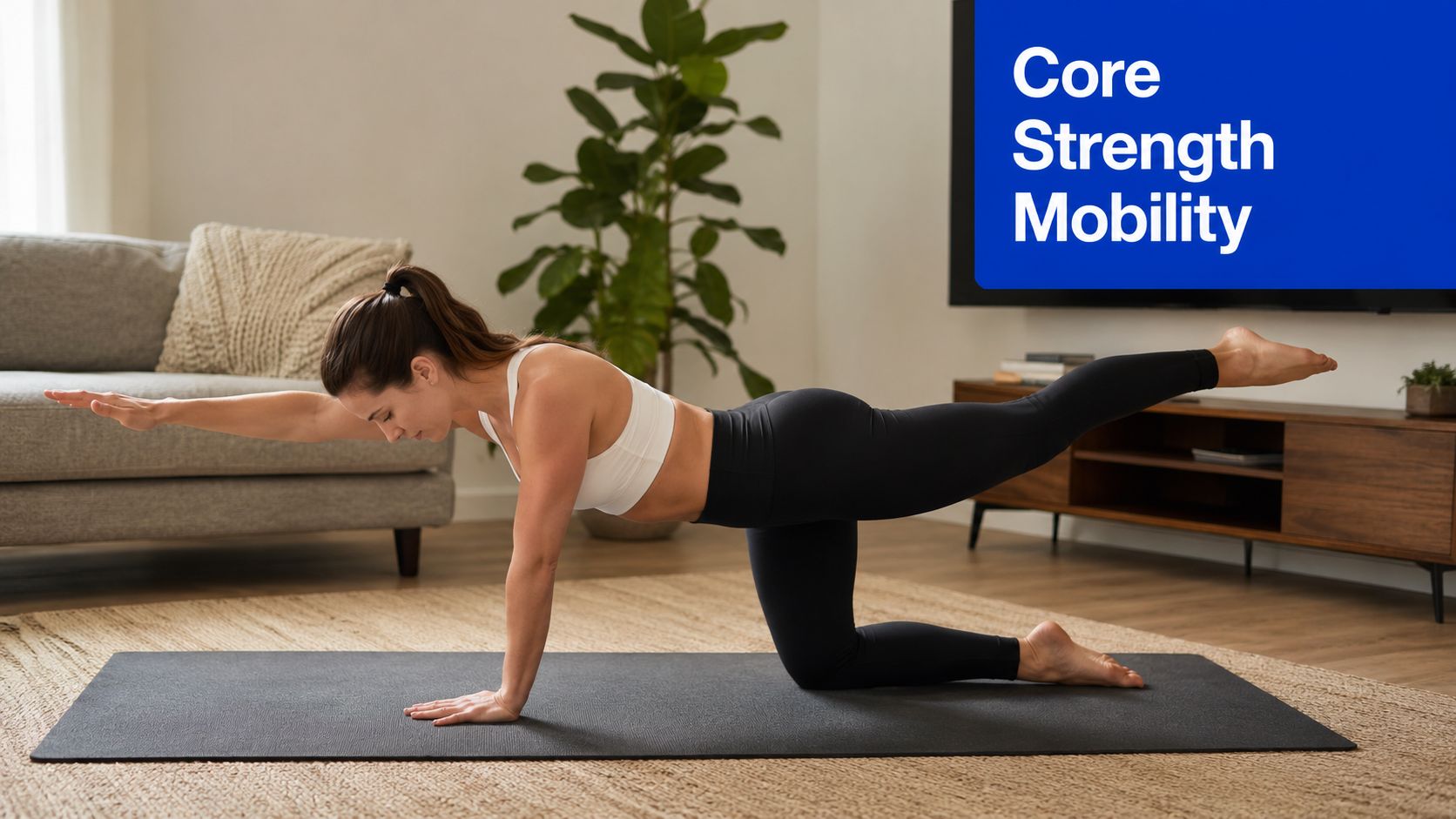
Mobility first
Mobility work helps reduce the feeling of rustiness. It's useful when your body feels guarded, especially after sleep, sitting, or long periods in one position.
Try these gentle options:
Cat-cow
Start on hands and knees, or do a seated version if floor work isn't comfortable. Slowly round your back, then gently lift your chest and tailbone. Keep the movement smooth, not forced.Seated spinal twist
Sit tall in a chair. Turn your shoulders gently to one side, then back to centre, then the other side. The aim is easy rotation, not a big stretch.Heel-toe ankle pumps
Ideal if you feel stiff after sitting. Alternate lifting heels and toes while seated or standing with support.
These don't need to feel dramatic. If the movement seems small, that's often fine. A body that feels safe tends to give you more range over time.
Build strength without provoking pain
Strength matters because it improves support around joints and helps everyday tasks feel less effortful. The mistake is jumping straight to hard strengthening before your body trusts the movement.
Start with controlled options:
Glute bridge
Lie on your back with knees bent. Gently tighten through your hips and lift only as high as feels comfortable. Lower slowly. If that's too much, begin with a small pelvic tilt.Bird-dog
From hands and knees, slide one leg back or reach one arm forward. You don't need to lift high. The goal is stability through the trunk without holding your breath.Sit to stand from a chair
Use a stable chair. Lean forward slightly and stand using your legs, then sit back down with control. This is one of the most practical strengthening movements because it copies daily life.
If arthritis or back pain makes dynamic movement irritable, isometric holds can be a better starting point. Pressing gently into a towel, holding a supported bridge, or pausing halfway in a sit-to-stand can build tolerance without chasing high reps.
A gentle, individualized approach can still work well in practice. In an Australian trial of older adults using a home exercise program for balance, participants recorded 85.3% adherence over six months and improved the Sit to Stand test by 7.0%, according to the Australian Department of Veterans' Affairs pragmatic trial.
Posture and micro-movement during the workday
People don't struggle because they lack a perfect 20-minute routine. They struggle because they spend hours still, then expect a short burst of exercise to undo it.
That's why posture work should be woven through the day.
Chin tucks
Sit tall and gently draw your head back as if making a small double chin. Don't tip the head up or down.Shoulder blade setting
Lightly draw the shoulder blades back and down. Hold briefly without stiffening your whole body.Standing heel raises during calls
Rise onto your toes while standing at the bench or desk, then lower slowly.
For office workers, these “micro-movement” strategies often fit better than formal sessions alone. Darling Downs Health's practical home movement advice supports integrating simple movements such as heel raises or seated twists into daily life, which is especially useful for posture-related strain.
If you're dealing with stiffness from arthritis, these gentle movement choices often sit well alongside joint mobility support strategies for daily function.
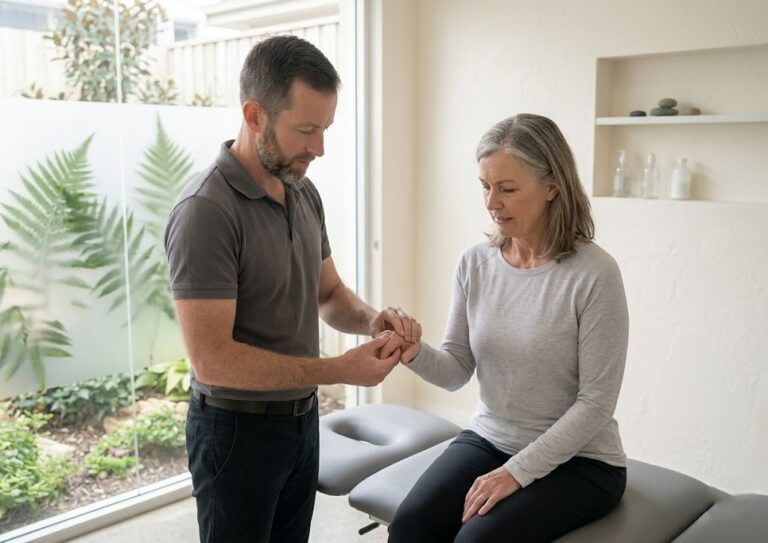
A short visual demo can help with form before you begin:
Structuring Your Sessions and Planning Your Week
A home program often falls apart on Wednesday, not Monday.
The first day usually feels manageable. By the middle of the week, pain has shifted, work has run late, and the original plan starts to feel too rigid to follow. For people living with chronic pain, that is often the point where an exercise sheet gets abandoned. A better structure leaves room for sore days, busy days, and low-energy days without losing momentum.
A simple session format
Keep each session predictable so you are not renegotiating the plan every time you start.
Check in first
Notice what feels stiff, tired, or guarded today. Take a few steady breaths and decide whether today suits a shorter session, a usual session, or brief movement spread through the day.Start with easy movement
Use simple warm-up options such as marching on the spot, shoulder rolls, ankle pumps, pelvic tilts, or a slow walk around the room.Do your main exercises
Choose a small group of movements that match your goals. For a beginner, two to five exercises is usually enough.Finish
Slow the pace before you stop. Repeat one easy mobility movement, add relaxed breathing, or walk for a minute so your body settles rather than stiffens.
Short and repeatable works better than ambitious and sporadic.
Pain-contingent progression
Many standard programs progress by numbers alone. Add reps. Add sets. Add resistance. That approach often misses the underlying barrier to adherence. A person with chronic pain may tolerate the exercise itself, then pay for it later with a flare that makes the next session harder to face.
Pain-contingent progression uses your response after the session to guide the next step. If a movement feels acceptable while you do it and settles reasonably well afterward, keep it in. If it stirs symptoms for hours, causes guarding, or makes the rest of the day worse, reduce something. That may be the range, the speed, the support level, or how many times you repeat it.
Useful ways to progress include:
Increase time before difficulty
Stay with the same movement and perform it a little longer before making it harder.Increase frequency before volume
Two or three brief sessions across the week often suit pain-sensitive bodies better than one bigger effort.Increase control before load
A cleaner, calmer movement pattern usually matters more than adding resistance early.Increase range only when it stays comfortable
More movement is only helpful if it does not trigger bracing or a symptom spike later.
This is the trade-off. Faster progression can feel satisfying in the short term, but slower progression is often what keeps the program going long enough to help.
A weekly plan that fits real life
A good week does not need seven formal workouts. Sedentary workers usually do better with a mix of short sessions and small movement breaks placed where they naturally fit, before work, after lunch, during calls, or while waiting for the kettle.
Here is a gentle starting framework for someone managing back, neck, or joint stiffness:
| Day | Focus | Example Activities | Duration |
|---|---|---|---|
| Monday | Mobility and posture | Cat-cow, chin tucks, seated twist, short walk | Short, comfortable session |
| Tuesday | Strength | Sit to stand, bridge or pelvic tilt, heel raises | Short, comfortable session |
| Wednesday | Recovery movement | Easy walk, shoulder rolls, ankle pumps | Light movement through the day |
| Thursday | Mobility and strength | Bird-dog, seated twist, shoulder blade setting | Short, comfortable session |
| Friday | Posture and micro-movement | Chin tucks, heel raises during calls, standing breaks | Spread across the day |
| Saturday | Functional movement | Walk, garden gently, stairs with support if suitable | Activity paced by comfort |
| Sunday | Restorative day | Easy stretching, breathing, brief mobility reset | Gentle recovery |
That plan is a template, not a rulebook.
If pain is higher after a poor night's sleep or a long day at the desk, swap a strength day for mobility and walking. If a session feels too much to start, reduce it to one or two movements and keep the habit alive. In practice, consistency usually comes from making the plan easier to return to, not harder to complete.
Listening to Your Body and Staying Safe
A good home exercise program should challenge you a little, but it shouldn't leave you guessing whether you've done damage. Learning that difference builds confidence.
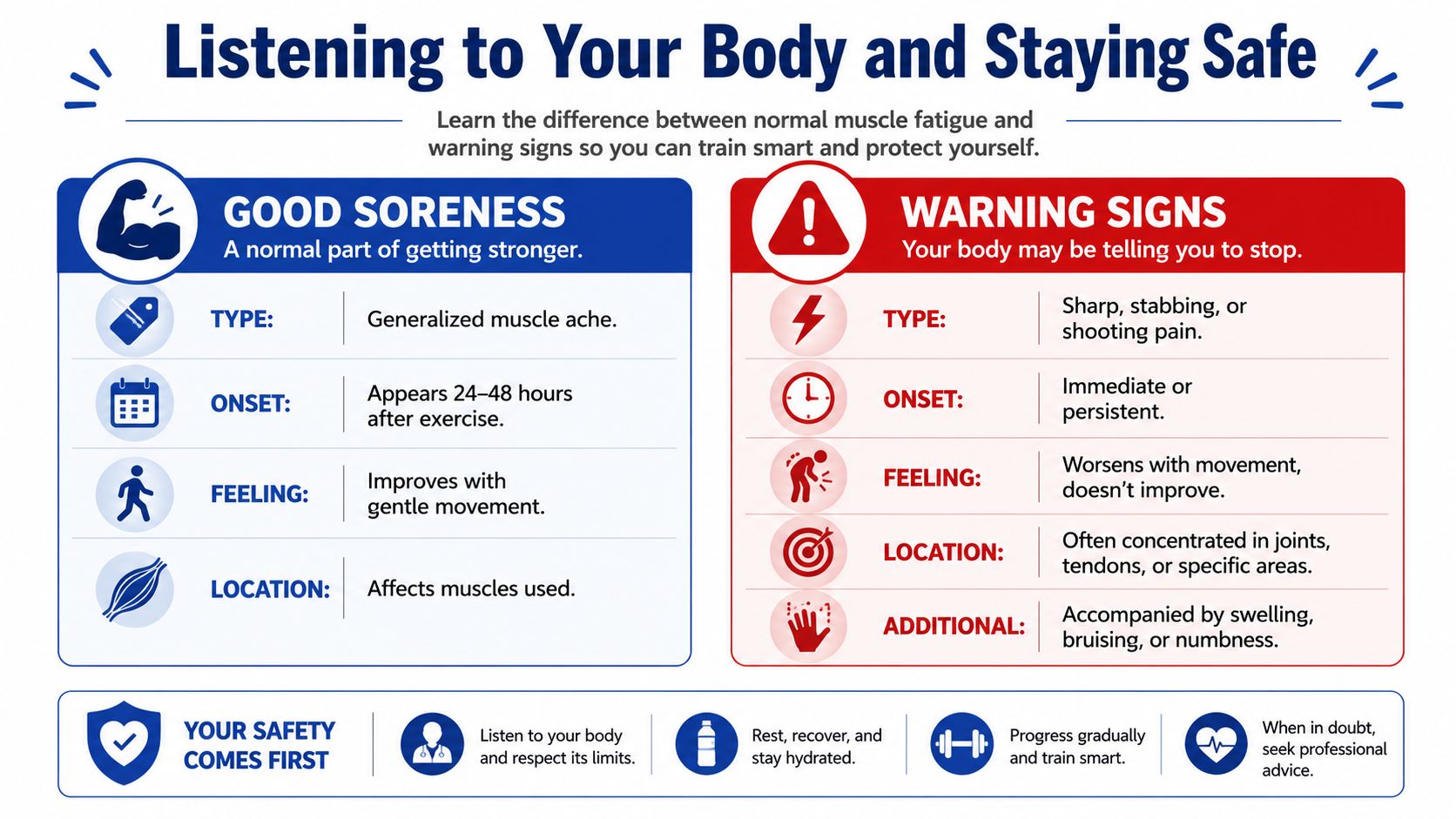
Use a traffic light system
This works well because it's simple enough to remember in the moment.
Green light
Mild effort, stretching, warmth, muscle fatigue, or a gentle ache that settles soon after. Movement still feels controlled.Yellow light
Discomfort that rises during the exercise, makes you brace, or lingers longer than expected. This is your cue to shorten the range, slow the pace, use more support, or stop earlier.Red light
Sharp, stabbing, shooting, or catching pain. Pain that makes you suddenly change how you move. Symptoms that keep escalating instead of easing.
If your body tenses up before the movement even begins, treat that as useful information. The exercise may be fine, but the version, speed, or timing may be wrong.
Normal post-exercise soreness is usually broad, muscular, and easier once you get moving. Warning pain is more often specific, protective, and harder to shake.
Red flags that mean stop
Stop the exercise session and seek professional advice if you notice:
Sharp or worsening joint pain
Especially if it feels unstable or catches repeatedly.Swelling, bruising, or visible irritation
Particularly around a joint or tendon.Numbness or tingling that appears or increases
Especially if it travels down an arm or leg.Pain that doesn't settle with rest or modification
If the body keeps reacting despite easing off, don't keep testing it.A clear loss of strength or control
If a limb gives way or feels unexpectedly weak, that needs review.
Exercise choice and support matter here. A meta-analysis of Australian home exercise research found that full adherence was only 21% overall, but adherence was higher in programs that included balance exercises and were delivered by a physiotherapist. That lines up with everyday clinical reasoning. People stick better with exercises that feel relevant, manageable, and well guided.
Tracking Your Progress and Seeking Expert Guidance
By week two or three, many people with persistent pain ask the same question. "How do I know if this is helping when my pain still changes from day to day?" That is the right question to ask.
Pain matters, but it is a noisy measure on its own. For sedentary workers especially, early progress often shows up as better tolerance to ordinary tasks, less bracing, and faster recovery after sitting, rather than a dramatic drop in symptoms. If your plan is built around pain-contingent progression, those small shifts are not side notes. They are the main signal that your body is coping better.
Track the changes that affect daily life
Keep your tracking simple enough that you will stick with it. A few lines once or twice a week is usually enough.
Useful signs to record include:
How you feel after sitting
You stand up with less stiffness, or need less time to straighten fully.How often you avoid movement
You bend, reach, turn, or climb stairs with less hesitation.How quickly symptoms settle
A flare settles later the same day instead of lingering into the next.How much movement fits into your day
You manage a short walk, a few mobility breaks, or your home program more consistently.How confident you feel
You are less focused on getting through the reps and more able to judge what your body can handle today.
Those notes give you something more useful than a raw pain score. "Needed fewer stretch breaks at my desk." "Walked after work and did not tighten up until later." "Reduced the exercise volume today and still felt in control." That is meaningful progress, especially in chronic pain where consistency usually beats intensity.
A good home exercise program gives you more capacity in daily life and a clear way to adjust on sore days, not just a target number of reps.
When professional help is the smart next step
Get advice if progress has flattened for a couple of weeks, if the pattern of pain has changed, or if you keep swinging between doing too much and backing off completely. I also recommend a review when every session feels like a test of willpower. In practice, that often means the progression is wrong for your current capacity, not that exercise is wrong for you.
Some people do well with a basic written plan. Others need more feedback, especially if they have been stuck in the boom-bust cycle for a long time. Australian research summarised by PEDro's review of digital support for home exercise found that digital support can improve short-term adherence in several trials, while professionally supported home-based programs were found to be significantly more cost-effective than gym-based follow-up over time.
A clinician should help you answer practical questions. Do you need more range, better control, a smaller starting dose, or a different exercise slot in your day? For office workers with neck strain, back pain, or recurring flare-ups, that kind of adjustment is often what closes the adherence gap. Support like guided hands-on rehabilitation and movement planning can make the next step much clearer.

If you'd like a gentle, personalised plan that matches your body, your pain pattern, and your daily routine, Bayside Osteopathic Health can help. We provide hands-on osteopathic care and practical home exercise guidance designed to ease pain, improve mobility, and make movement feel manageable again.