

You've probably felt it first as a small nuisance, then as a pattern. A few tingles in the thumb and fingers after a long spell at the keyboard, a numb hand that wakes you at 2 a.m., or that odd habit of shaking your wrist for relief before you can get back to sleep. That's the point where carpal tunnel relief stops being a casual search term and becomes a practical question: what settles it at home, what only masks it, and when it's time to have someone look at the nerve itself.
Table of Contents
- What Carpal Tunnel Discomfort Actually Feels Like
- Quick Relief Techniques You Can Use Today
- Stretching and Mobility Routines That Help
- Ergonomic Adjustments for Work and Home
- Self-Care Do's and Don'ts During Recovery
- Signs Your Self-Care Plan Is Not Enough
- How Osteopathic Care Fits into a Staged Plan
What Carpal Tunnel Discomfort Actually Feels Like
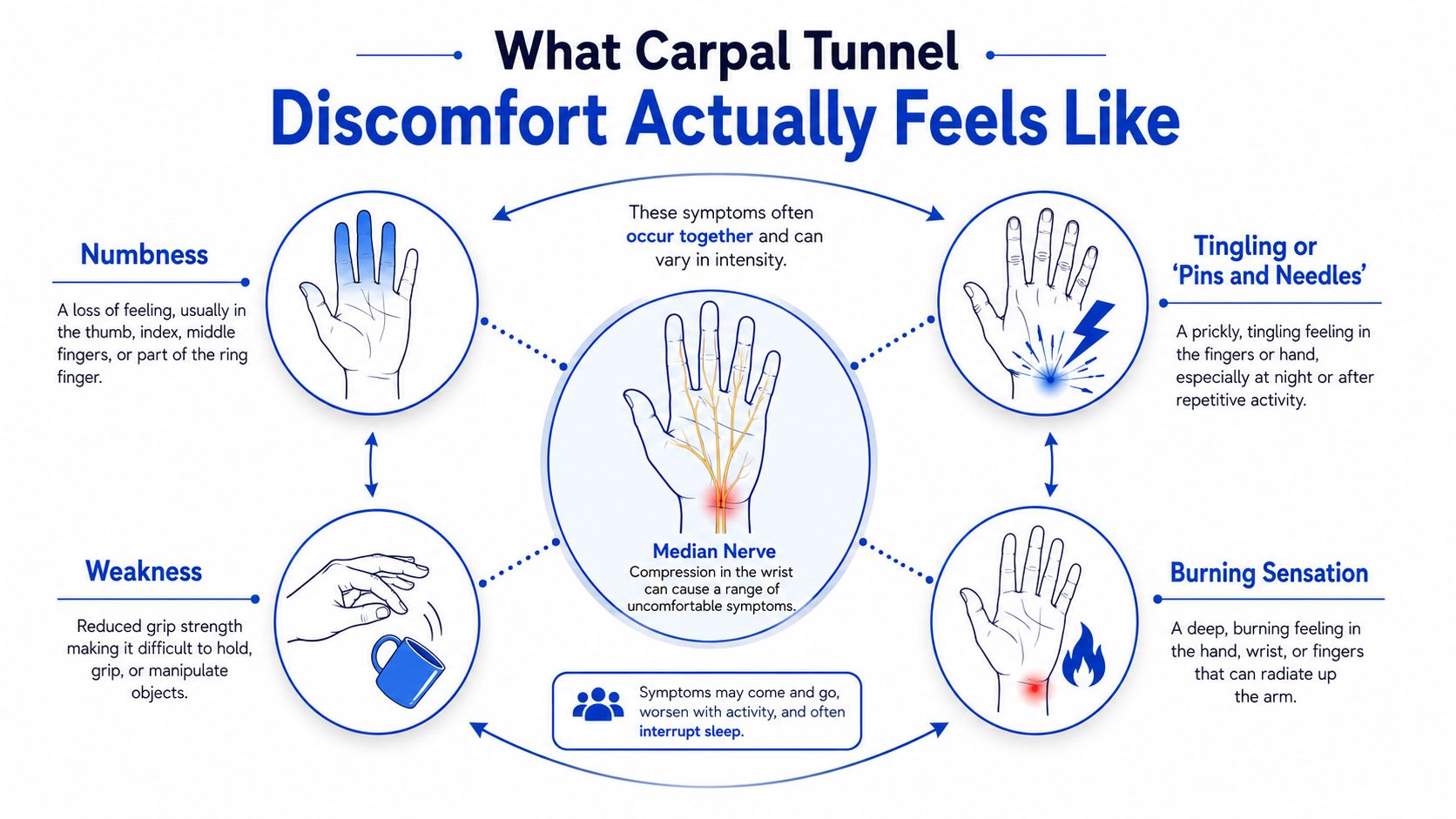
The classic story usually starts at a desk or in bed. Your hand feels normal for most of the day, then the thumb, index, and middle fingers begin to tingle, the wrist feels crowded, and by night the hand is numb enough to wake you. Some people say they need to shake the hand out before the sensation settles, which fits the pattern of a nerve that's being irritated rather than a joint that's stiff.
Why the symptoms show up the way they do
The median nerve passes through a tight passage at the wrist, and when pressure rises in that tunnel, sensation starts to misfire. That's why the discomfort often appears with repetitive hand use, prolonged wrist bending, or sleeping with the wrist curled. The problem isn't just pain, it's that the nerve becomes less tolerant of load and position.
Practical rule: if shaking the hand gives brief relief but the numbness keeps coming back, the nerve is being provoked, not fixed.
Early signs tend to be intermittent tingling, nocturnal waking, and clumsiness with buttons, cups, or typing. More concerning changes are symptoms that become constant, weaker pinch, or a hand that no longer feels fully normal between flares. Relief depends on lowering the pressure on the nerve, not just numbing the area.
Quick Relief Techniques You Can Use Today
When symptoms flare, the fastest win is usually position, not force. Keep the wrist neutral, stop whatever is holding it bent, and give the hand a short reset before you test it again. For many people, that means easing off before numbness turns into an evening of irritation.
Use short relief, then reassessment as the rule. Night splinting is commonly used first, followed by review within a couple of months, and steroid injection relief typically lasts several months rather than permanently. Conservative care can help mild to moderate cases, but it works best when you watch the response instead of repeating the same habits indefinitely. For the practical anatomy and soft-tissue context, see this trigger point therapy pain relief reference.

A two-minute reset that fits real life
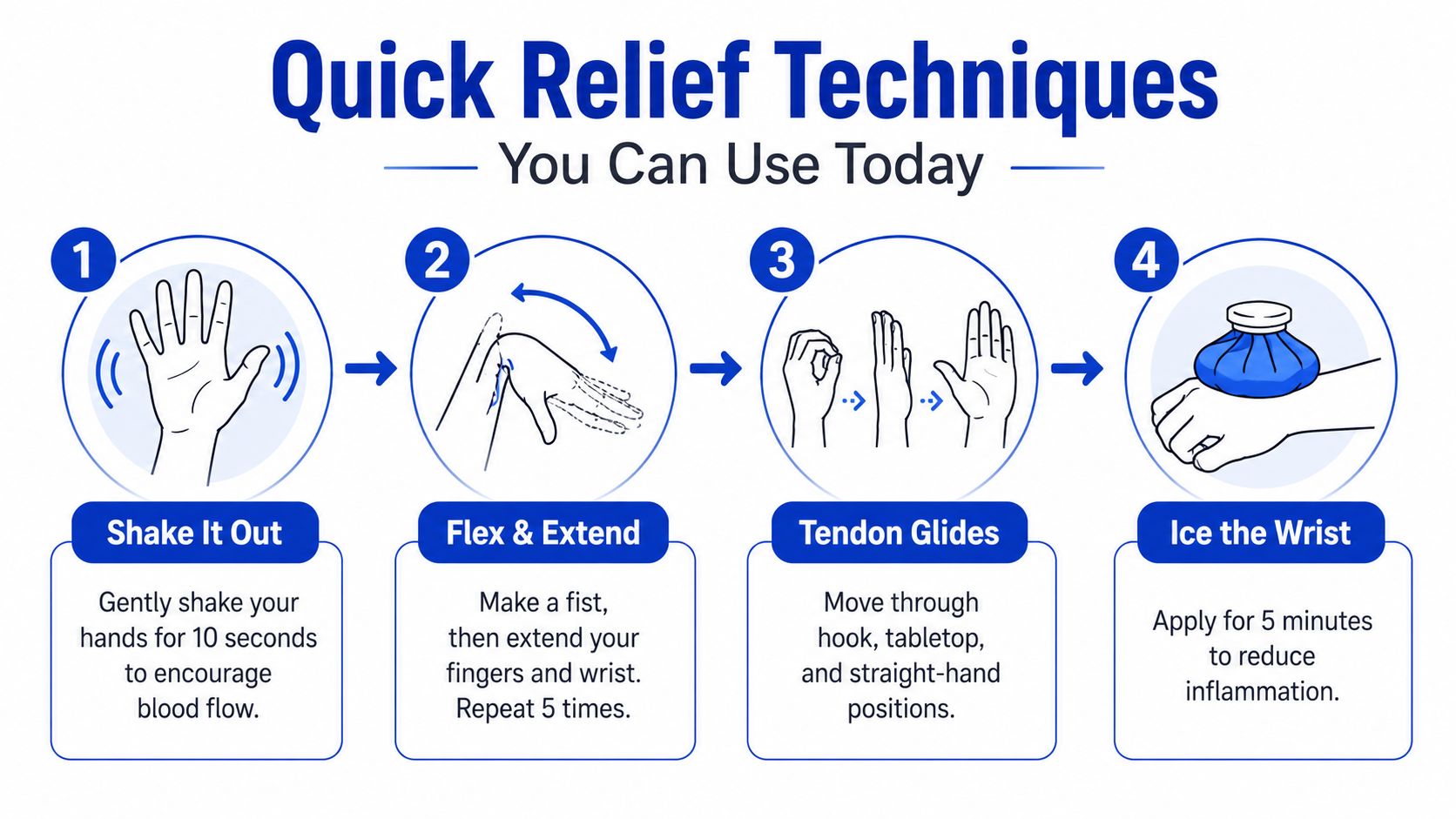
Start with 10 seconds of gentle shaking, just enough to move the hand without whipping it. Then make a light fist and open the fingers fully a few times, without forcing end range. If the wrist feels hot or irritated after a flare, a brief cold pack can calm the area, while warmth is better for stiffness rather than active tingling.
Keep the reset small. If a movement makes tingling climb instead of settle, stop and change position rather than pushing through it.
A simple rule for office work or home tasks is to pause before symptoms peak, not after. If you are typing, gaming, cooking, or doing a long phone scroll, the best relief is often a short break before the nerve gets angry enough to keep talking all night.
Stretching and Mobility Routines That Help
A gentle mobility routine can help, but the purpose is to keep the wrist and forearm moving well, not to chase a deep stretch. Good stretch sensations feel like a mild pull through the forearm or wrist, not a sharp sting, pins and needles, or a “buzzing” response in the fingers. If the nerve is already irritable, aggressive stretching can backfire.
A short sequence that doesn't overdo it
Begin with a wrist flexor stretch. Extend the arm, turn the palm up, and let the wrist open into a mild stretch for a few breaths. Then repeat with the palm down for the extensor side. Neither position should produce a strong symptom surge, and both should stay comfortably tolerable.
Tendon gliding can be added next, because it encourages the finger flexors to move without cramming the tunnel. Move through the hook, tabletop, and straight-hand positions slowly, with control. Nerve gliding can also help some people, but it needs a light touch and a stop signal if tingling spreads.
Here's the practical part, especially for desk workers and people who use tools or hobbies heavily.
- Use small doses: a few quiet repetitions are better than a long session that irritates the hand.
- Link it to routine: after brushing teeth, before a work block, or during a mid-afternoon pause.
- Watch the aftermath: if symptoms settle within a reasonable window, the dose is likely acceptable.
Stretching is supportive, not decisive. The evidence base notes that exercises may help for weeks or months, but they don't replace load management, and they won't reliably solve moderate symptoms on their own. If the hand keeps waking you, the routine needs to be paired with better positioning and, at times, a broader treatment plan.
Ergonomic Adjustments for Work and Home
Most carpal tunnel strain doesn't come from one big event, it comes from sustained wrist position. That means the workstation matters, but not in the generic “buy a fancy chair” way. The useful changes are the ones that reduce time spent in bent wrists, raised shoulders, and cramped reach.
What changes usually matter most
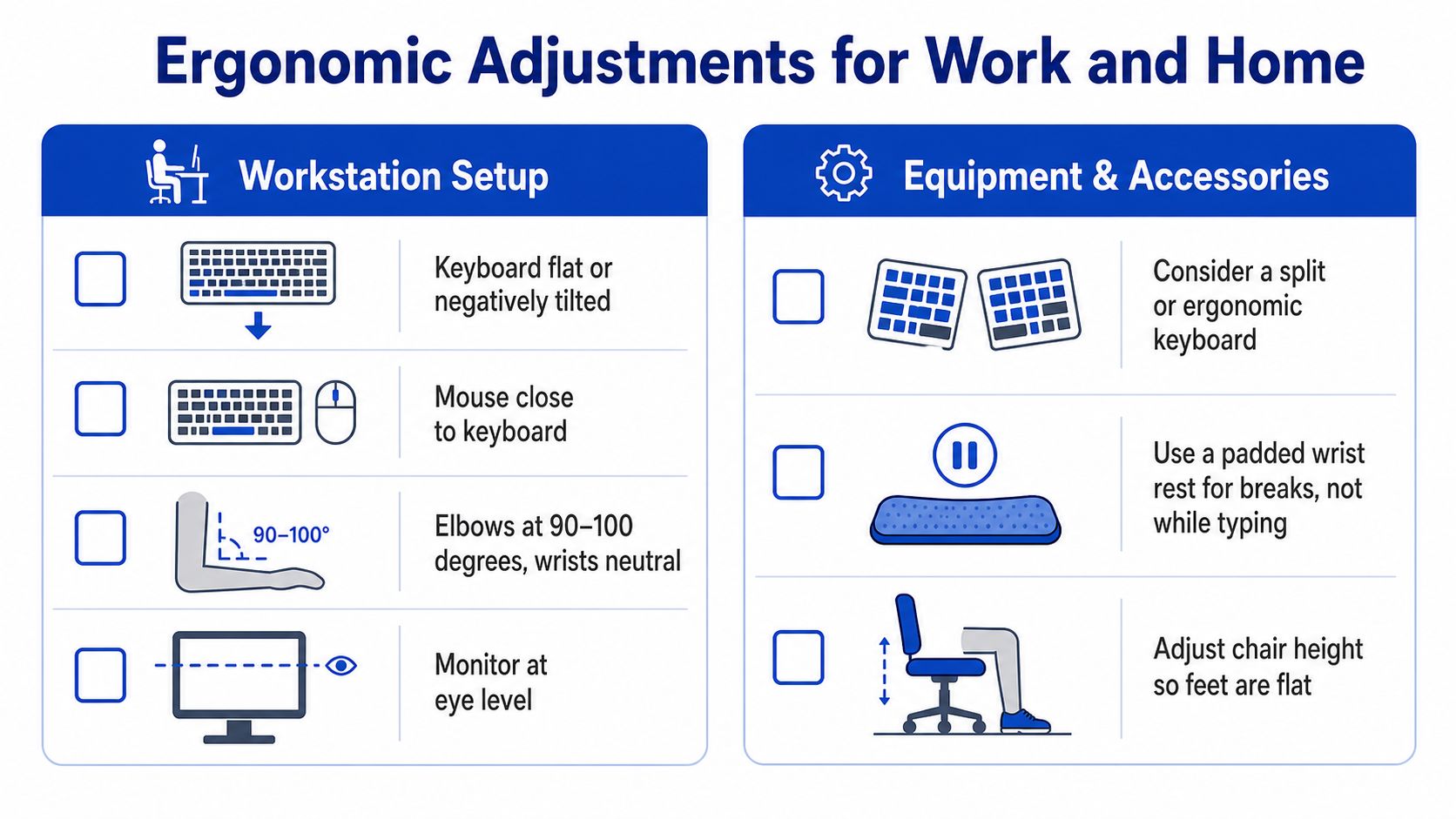
The keyboard should sit flat or slightly negatively tilted, the mouse should be close, and the elbows should rest around a comfortable right angle while the wrists stay neutral. If the monitor is too low, the body tends to collapse forward and the wrists often follow. A chair that lets the feet rest flat can reduce the chain reaction that starts in the shoulders and ends in the hands.
A split or ergonomic keyboard can help some people, but only if it reduces awkward reach. A wrist rest is useful for breaks, not for leaning on while typing, because constant pressure under the wrist can irritate an already compressed nerve. The same principle applies to phones, tablets, and laptops, which often invite bent wrists and longer uninterrupted use than people realise.
The video below is useful if your current setup leaves your forearms floating and your wrists doing too much work.
For a visual example of postural setup, this corporate ergonomics reference image can help you compare your own desk. The aim isn't perfection, it's lowering the number of hours your wrist spends under load.

Self-Care Do's and Don'ts During Recovery
Some habits help recovery, and some keep the nerve irritated even when they feel productive. The safest approach is to pace the hand, keep the wrist neutral in sleep, and let movement be frequent but gentle. The things that look “active” are not always the things that help.
Compare the habits that help and the ones that don't
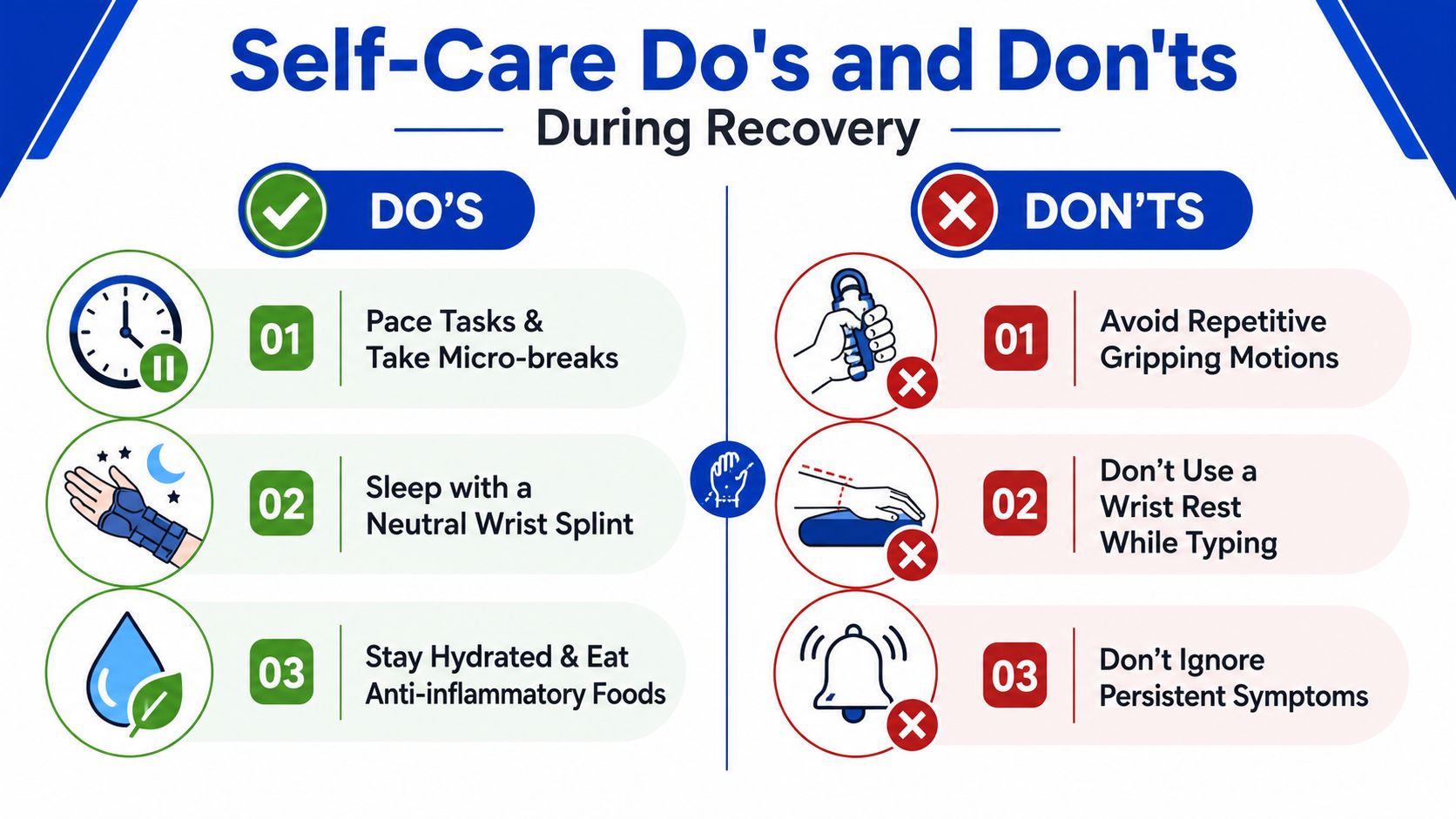
Do take micro-breaks during cooking, typing, gardening, or gym work. Short pauses let the hand settle before the nerve becomes more reactive.
Do wear a neutral wrist splint at night if symptoms are waking you, because sleep posture is a common trigger for morning numbness.
Do keep the day moving with light activity and normal hydration, then adjust the load if symptoms spike.
On the other side, don't grip through pain, keep working through severe tingling, or lean on the wrist in a way that compresses it further. Hot water bottles placed directly on an inflamed area can also be unhelpful when the problem is already reactive. The better test is simple, if a habit makes the hand calmer over the next day, it's probably supporting recovery. If it makes symptoms more frequent or more constant, it's not.
Signs Your Self-Care Plan Is Not Enough
This is the threshold people often miss. If symptoms are still waking you after several weeks of careful self-management, or if tingling is shifting from occasional to constant, it's time to reassess rather than just persist. The same applies if thumb weakness or pinch strength starts to slip, because that suggests the nerve is not merely irritated, it may be under more sustained pressure.
What needs prompt professional input
- Persistent night symptoms: waking repeatedly despite splinting and load changes.
- Weak pinch or grip: dropping objects, trouble opening jars, or trouble with fine tasks.
- Constant numbness: sensation no longer fully returns between flares.
- Visible thumb-base wasting: a change that needs clinical review rather than more self-care.
The evidence base supports a staged approach, conservative care first, then escalation if symptoms don't respond or if nerve damage is suspected. Clinicians may examine strength, sensation, and wrist mechanics, then decide whether further testing is needed. The point isn't to rush to surgery, it's to avoid waiting until the hand has already lost ground.
How Osteopathic Care Fits into a Staged Plan
An osteopathic review usually looks beyond the wrist alone. Shoulder position, neck tension, and the way the forearm is loaded can all influence how much irritation reaches the median nerve, so treatment often includes soft-tissue work, gentle joint mobilisation, and movement advice for the whole upper limb. That broader view can sit well beside splinting, pacing, and ergonomic changes when symptoms are still manageable but not fully settling.
A staged plan is also where an osteopath can help you make sense of mixed signals. A hand that feels better after manual treatment but still wakes at night needs monitoring, not guesswork. For some eligible Australian patients, Medicare pathways may apply through appropriate plans, which is one reason to ask about access before committing to a long care schedule.
One option in this space is Bayside Osteopathic Health, which provides hands-on assessment and treatment alongside home strategy advice. Their approach aligns with the idea that symptom relief works best when the wrist, elbow, shoulder, and daily loading habits are addressed together. The practical goal is straightforward, reduce irritation, restore movement, and decide early whether your self-care plan is working.
For a look at the manual approach often used in this kind of care, see this manual therapy benefits reference image.
If your hand is waking you, tingling is becoming more regular, or your grip feels weaker than it used to, book a review with Bayside Osteopathic Health. A short assessment can help you work out whether you need a tighter home plan, ergonomic changes, or a different treatment pathway before symptoms settle in for the long run.