
If your hip's been nagging you for weeks, you've probably tried the usual fixes. You've rested it, stretched it, maybe swapped shoes, and it still bites when you walk up stairs, sit too long, or roll over in bed. That's the moment many people start looking for an osteopath for hip pain, because they want a clear assessment, hands-on help, and a plan that doesn't jump straight to medication or surgery.
Hip pain isn't always just a “hip problem”. The joint sits in a chain with the pelvis, lower back, glutes, and knee, so a stubborn ache can come from more than one place. A careful osteopathic assessment makes sense early, especially when you want to know whether the hip itself is the issue or whether something upstream, or downstream, is feeding it.
Table of Contents
- Why Your Hip Hurts and Why You Might Be Searching for an Osteopath
- How the Hip Actually Works and Why It Rarely Acts Alone
- Common Causes of Hip Pain an Osteopath Sees Every Week
- What Happens During an Osteopathic Assessment and Treatment Session
- What Research Shows About Osteopathy and Hip Pain
- Simple Self-Management Strategies You Can Start This Week
- When Hip Pain Needs More Than an Osteopath
- Costs, Medicare and Booking with Bayside Osteopathic Health
Why Your Hip Hurts and Why You Might Be Searching for an Osteopath
A common scene in clinic is a Bayside local who's put up with a dull ache in the front of the hip or a deep groin pain for months. It might be worst on stairs, during a long drive, or after a morning walk that used to feel easy. By the time they book, they're often less interested in a label and more interested in one thing, what's driving it.
The pain often starts as a movement problem
Hip symptoms are common in older adults, and a population-based cohort study used to benchmark musculoskeletal progression found annual incidence rates of 37 per 1,000 person-years for hip symptoms and 20 per 1,000 person-years for radiographic hip osteoarthritis in adults aged 45 years and over across a median 5.5 years of follow-up (PMC study). That doesn't mean every sore hip is arthritis, but it does show why this complaint keeps bringing people in.
For many patients, the first worry is whether they've “done damage”. In reality, hip pain is often mechanical at the start, stiffness, overload, tendon irritation, or a movement pattern that's been tolerated until it isn't. That's where osteopathy can be useful, because the first step is usually not “treat the pain point”, but work out what the body is doing around it.
Practical rule: If your hip hurts most with walking, stairs, sitting, or getting out of a car, the problem may involve load and movement control as much as the joint itself.
Why people reach for osteopathy first
Many people want conservative care before they consider imaging, injections, or surgery. Osteopathic care fits that mindset because it's typically hands-on, personalised, and focused on function rather than a one-size-fits-all fix. In musculoskeletal practice, that usually means looking for mobility limits, soft-tissue restriction, and patterns that keep the hip overloaded.
A careful consultation also helps separate hip joint pain from pain that only feels like the hip. Groin pain, outer-hip pain, and buttock pain can each point in different directions, so a sensible first visit should create clarity, not just temporary relief.
How the Hip Actually Works and Why It Rarely Acts Alone
Think of the hip as a ball sitting in a deep socket. That ball-and-socket design gives you a lot of movement, but it also means the joint depends on surrounding muscles, the pelvis, and the lower back to keep load moving cleanly. If one part stiffens or weakens, the rest often starts compensating.
Why osteopaths look beyond the sore spot
An osteopath for hip pain usually assesses the hip, pelvis, lumbar spine, and even the knee because these areas share the work. The Osteopathic International Alliance describes osteopathic care as a musculoskeletal, hands-on model that combines manual therapy, advice, and guidance, with visits commonly lasting a minimum of 30 minutes (OIA global report). That model matters because the hip rarely behaves like an isolated hinge.
There's a useful concept here, regional interdependence. It means that stiffness or weakness in one area can subtly increase strain somewhere else. A stiff lower back can alter hip rotation. A tight hip can change how the pelvis moves. A cautious walking pattern can then feed the cycle back again.
The practical version of this is simple. If the hip is sore but the lumbar spine is moving poorly, treating only the hip may give incomplete relief. If the glutes are not sharing load well, the joint may keep getting hammered every time you climb stairs or stand up from a chair.
The assessment image below captures the kind of whole-body thinking that comes with osteopathic care in practice.
Arthritis and joint mobility reference image
Clinical takeaway: The hip is important, but it's often only one link in the chain. If the chain is moving poorly, the sore spot is not always the original problem.
Common Causes of Hip Pain an Osteopath Sees Every Week
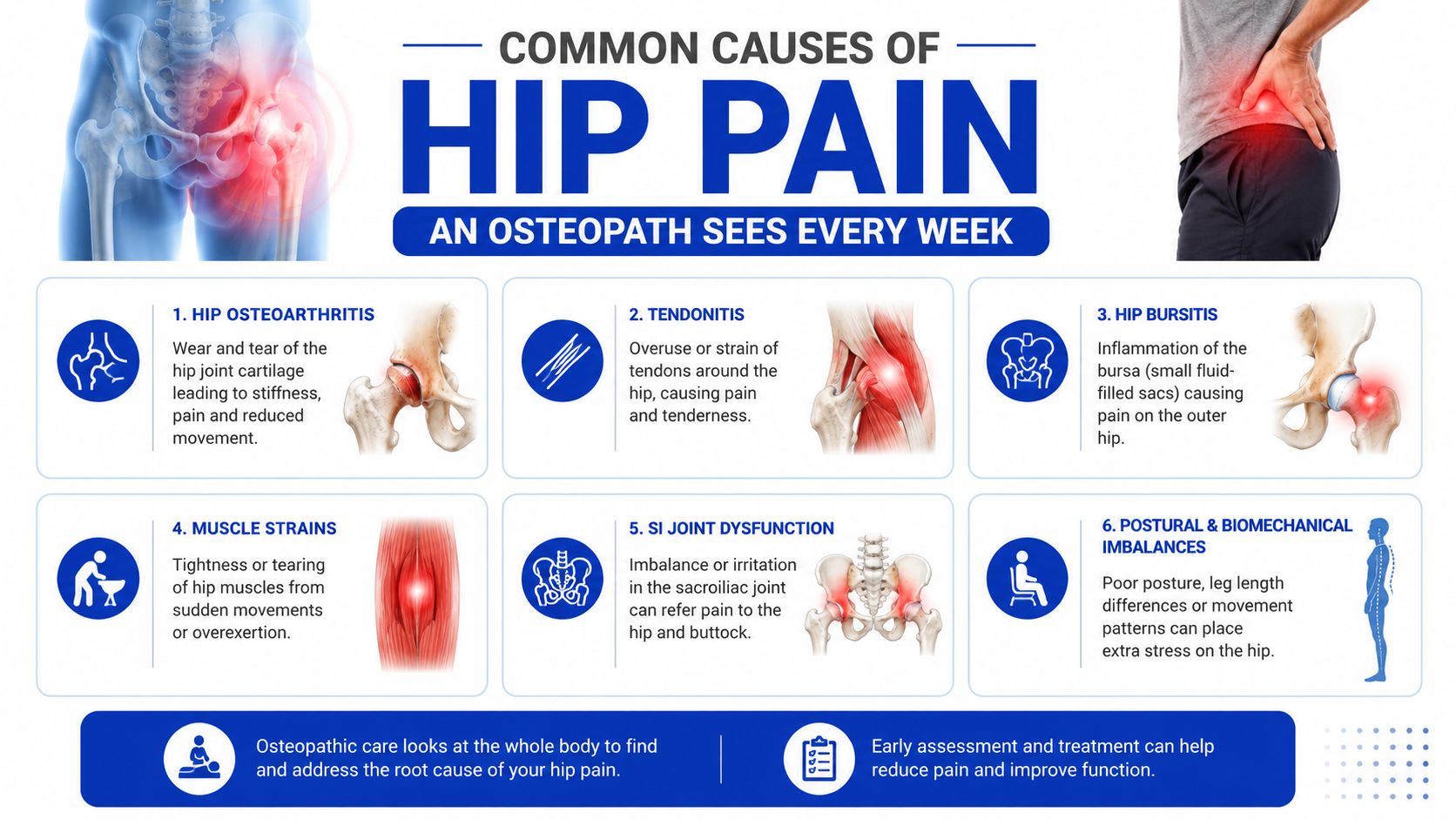
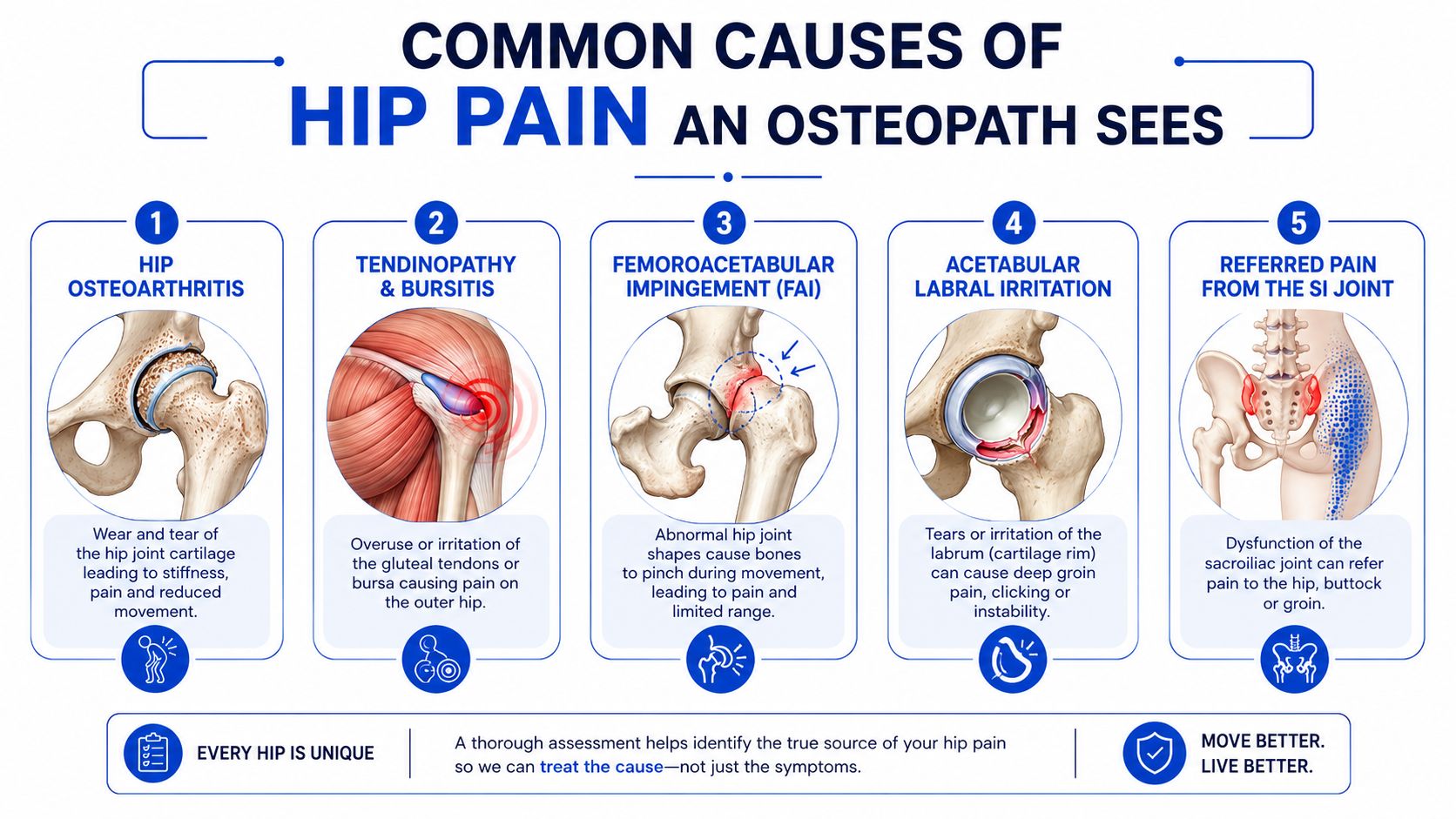
The most useful first question is not “Where does it hurt?” but “What pattern does it follow?” Hip osteoarthritis often feels different from gluteal tendinopathy, and both feel different again from pain referred from the lumbar spine or sacroiliac joint. That pattern matters because treatment should match the source.
Mechanical hip pain versus referred pain
Hip osteoarthritis often shows up as groin pain, stiffness after sitting, and difficulty with walking distance or stairs. Australian guidance for hip osteoarthritis prioritises function, education, exercise, and shared decision-making, which is a good reminder that passive treatment alone usually isn't the full answer.
Gluteal tendinopathy and bursitis tend to sit on the outer hip. Pain can flare with side-lying, stair climbing, or longer walks. Femoroacetabular impingement and labral irritation are more likely to produce catching, pinching, or deep joint pain with certain positions, especially flexion and rotation. Sacroiliac joint referral can be felt around the buttock or outer pelvis, while lumbar-driven groin pain can be misleading because the source is higher up.
A simple rule helps here. If the pain is clearly linked to loading, posture, or specific movements, a mechanical pattern is more likely. If it's constant, severe at night, or comes with neurological symptoms, it needs a wider medical lens.
Patterns that deserve closer attention
- Night pain or rest pain, especially when it keeps returning, deserves a more careful look.
- Pain that catches or locks can suggest a joint surface or labral issue.
- Pain radiating below the knee is less typical for a primary hip problem and raises the possibility of lumbar involvement.
- Pain after a fall or significant trauma changes the whole assessment.
Hip pain can look simple from the outside, but the differential diagnosis matters. If the source is the back, the sacroiliac region, the knee, or the foot, treatment has to follow that trail rather than assume the hip is guilty just because it hurts there.
What Happens During an Osteopathic Assessment and Treatment Session
You might come in expecting someone to work directly on the sore spot. The first appointment usually starts elsewhere. I want to know where the pain sits, what sets it off, how long it has been there, and whether you have stiffness, catching, night pain, or a change in walking tolerance. From there, I watch how you move and start working out which structures are driving the problem.
A good assessment feels thorough. It should also feel practical, because hip pain rarely makes sense if you only look at the joint itself.
The assessment usually follows a clear sequence
The session usually includes posture and gait observation, range-of-motion testing, palpation of tender or restricted tissues, and orthopaedic tests to help separate hip, pelvic, and lumbar drivers. That matters because pain location on its own does not tell the full story. A groin ache can come from the joint, from a tendon, or from referred pain elsewhere in the chain.
The hands-on part is matched to what the assessment finds. Common techniques include soft-tissue release, joint mobilisation or articulation, muscle energy technique, and gentle stretching. In plain terms, that means easing tight muscles, improving movement in stiff joints, and using your own muscle effort to help restore motion. It is controlled, specific work, not brute force.
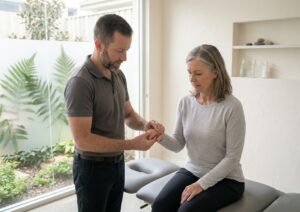
Manual therapy treatment image
The internal clinic image below gives you a sense of the manual, hands-on side of treatment.
Good treatment should feel targeted. If the hip is irritated, the aim is not to “crack” everything. The aim is to improve how the region moves and tolerates load.
What you're actually committing to
Osteopathic care for hip pain is usually not a one-off fix. Early visits may be closer together, then spaced out as pain settles and movement improves. The plan should change with your symptoms, your activity goals, and whether the pain behaves like a straightforward mechanical problem or something more complex.
The best sessions also include advice you can use at home, because hands-on care works better when it supports active change rather than replacing it. That combination is where many people get the most value.
What Research Shows About Osteopathy and Hip Pain
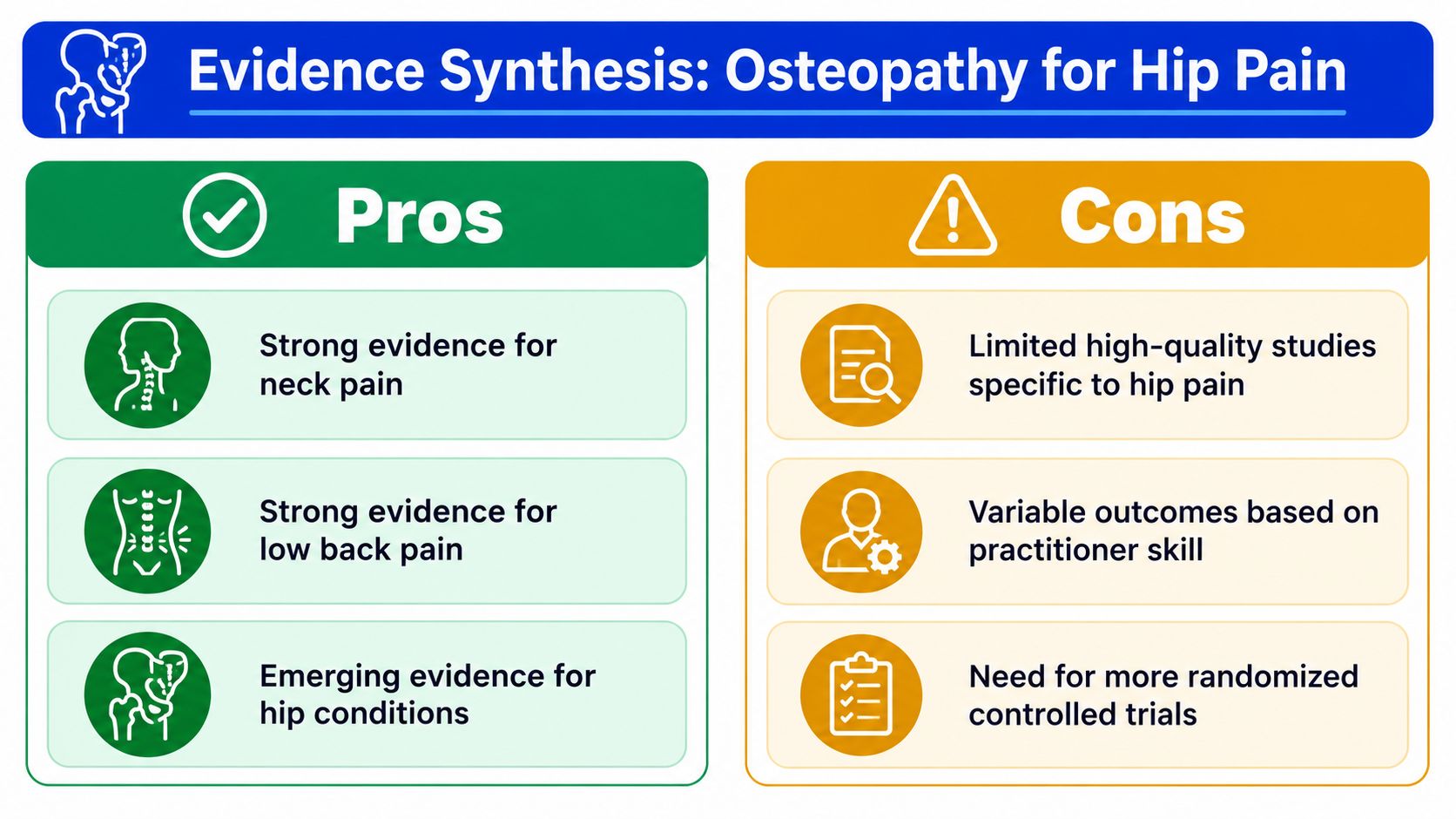
A patient with hip pain often wants a straight answer. Can an osteopath help, or is it just a short-term fix? The honest answer is that the evidence is strongest in some conditions and still building in others.
For musculoskeletal pain such as neck and low back complaints, evidence syntheses report benefit. For hip and knee osteoarthritis, the evidence base is growing, but it is still more limited, according to a PMC review. That is a fair starting point for treatment decisions.
Where hands-on care fits well
Osteopathic care is a sensible conservative option when the main problems are mobility restriction, muscle guarding, and movement compensation. In that setting, treatment can ease discomfort, improve how the hip moves, and make exercise more manageable. That matters because people usually do better when movement stops feeling so guarded and uncertain.
The Australian osteopathic profession is well established, and the OIA's global report describes osteopathic care as a standardised hands-on model used in many countries. It also notes positive evidence for manual therapy in pain reduction and function, including hip and knee osteoarthritis (OIA report). That supports osteopathy as part of conservative care, not as a stand-alone cure.
Where the limits sit
Manual therapy can help symptoms, but it does not reverse advanced hip joint degeneration on its own. Australian guideline-based care for hip osteoarthritis puts education, exercise, weight management when relevant, and shared decision-making ahead of passive treatment alone. Hands-on care may make movement easier for a period, but lasting change usually comes from treatment combined with active rehab.
A good osteopath keeps the bigger picture in view. If a person moves better and walks with less pain after treatment, that is useful progress. If function keeps dropping, or the pain pattern points to something more structural, the plan needs to change, and referral to a GP or orthopaedic specialist may be the right next step.
The manual, hands-on side of treatment can support that process, but it should never be the only plan when the hip is clearly not settling.
Simple Self-Management Strategies You Can Start This Week
A few well-chosen habits can make your hip much easier to live with between visits. The goal is not to “fix” everything at home. The goal is to calm flare-ups, keep the joint moving, and stop the rest of the body from stiffening around it.
Three practical moves that usually help
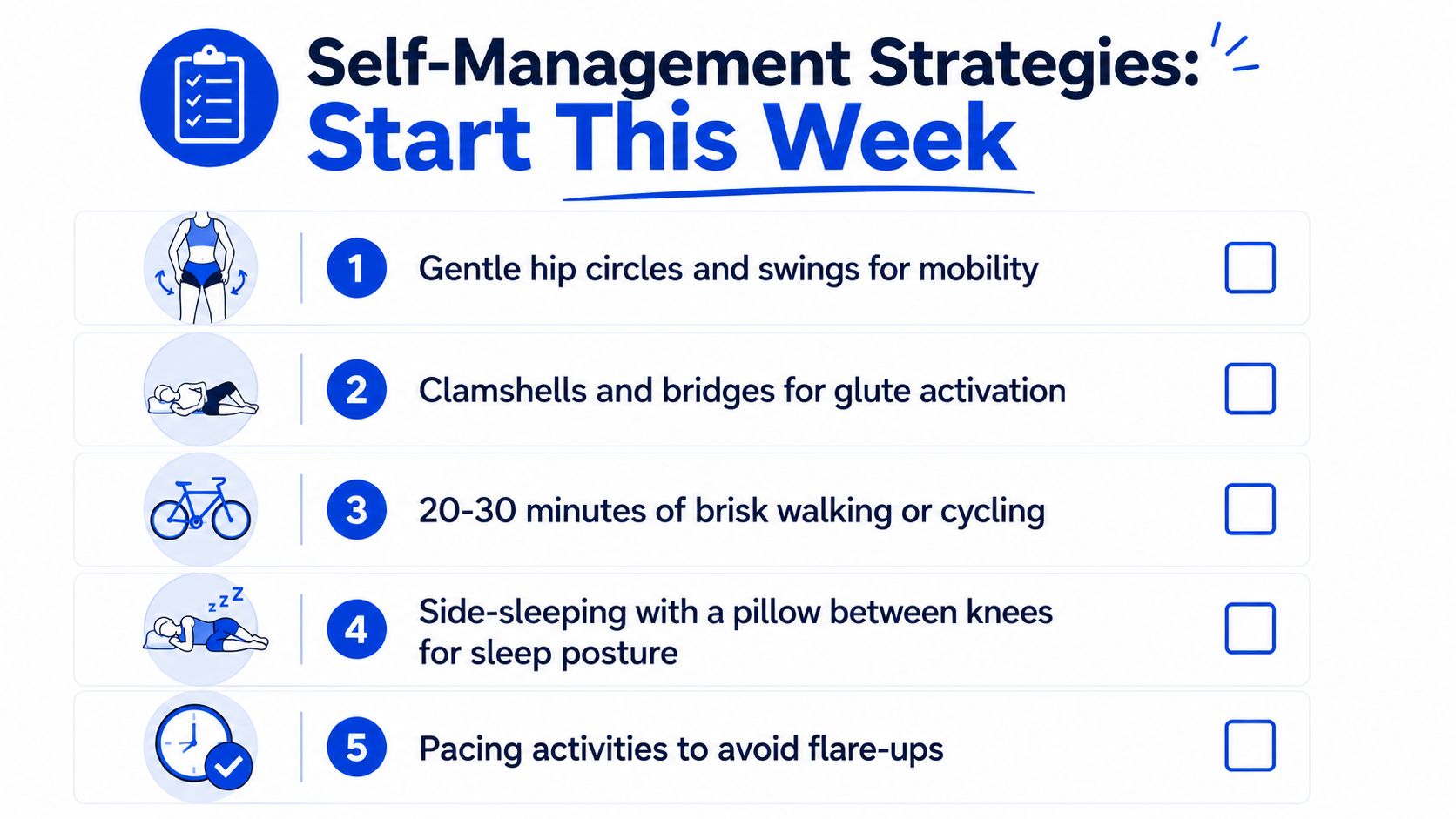
- Gentle mobility work: Try easy hip circles and leg swings for a few minutes most days. Keep them smooth and controlled, and back off if the movement creates a sharp pinch.
- Glute activation: Clamshells and bridges can help wake up the outer hip and buttock muscles. Small doses done consistently are usually better than a big workout once a week.
- Walking or cycling: A daily brisk walk or gentle ride can keep the joint from stiffening up, as long as symptoms stay manageable.
Sleep and sitting matter too. Side sleepers often do better with a pillow between the knees, and long periods of sitting usually need breaks before pain starts shouting. If you've had a flare-up, shorten the session rather than abandoning movement completely.
The checklist below gives a quick visual summary of the same ideas.
The short video here can also help you visualise the sort of mobility work and pacing habits that often suit hip pain management.
Pacing beats overdoing it. If an activity flares your hip every time, reduce the dose, split it up, or swap the movement pattern before it turns into a full setback.
When Hip Pain Needs More Than an Osteopath
Some hip pain needs a broader medical pathway, and good osteopathic care should make that easier, not harder. Constant night pain, pain at rest, unexplained weight loss, fever, neurological symptoms, or a major injury all need GP review. So does a rapid drop in walking tolerance or a clear decline in everyday function.
When to escalate care
If symptoms suggest a fracture, inflammatory condition, infection, or nerve involvement, your next step is medical assessment, not more manual therapy. Imaging may be useful when the history and exam point that way, but it should be driven by the clinical picture rather than ordered out of habit. For advanced hip osteoarthritis, orthopaedic review may eventually be part of the conversation if pain and loss of function keep progressing.
It's also important to remember that not every groin ache is a simple joint problem. Hip-region pain can be referred from the lumbar spine or other nearby structures, so a referral pathway isn't a failure of osteopathy. It's part of responsible care.
What a good referral looks like
A good osteopath explains why the symptoms don't fit a purely mechanical pattern, then helps direct you to the right next step. That might be a GP, a physiotherapist, an imaging request, or an orthopaedic opinion, depending on the presentation. If the pain source is outside the hip, treating the hip harder is just wasting time.
Patients often find this reassuring. You're not signing up for endless treatment. You're getting a clinical screen, an honest opinion, and a pathway if the problem needs more than conservative care.
Costs, Medicare and Booking with Bayside Osteopathic Health
Typically, hip pain care starts as a private appointment, often with private health cover helping where available. Medicare Chronic Disease Management plans may apply for eligible patients, but that depends on your GP's assessment and the plan in place, so it's worth asking rather than assuming a rebate will apply. The key point is to check your own cover before booking so there are no surprises.
Bayside Osteopathic Health offers a whole-body assessment, gentle manual techniques, and movement advice shaped around the way your body loads and moves. For hip pain, that usually means looking beyond the sore spot, then building a plan that combines hands-on care with practical home strategies. If appropriate, the clinic can also guide eligible patients on Medicare options as part of the booking conversation.
A first appointment is a good fit if you want a calm, clinical opinion on whether your hip pain is local, referred, or part of a broader movement problem. It's also a sensible step if you've tried rest and stretching and the pain keeps coming back.
If you're ready to sort out what's driving your hip pain, book an appointment with Bayside Osteopathic Health and get a clear plan that fits your symptoms, your goals, and the way you move day to day.