
You've probably been there. You search for an osteopath in Bayside, open a few clinic websites, and every profile starts to look the same. Each one says the practitioner is qualified, but that single word doesn't tell you much about how they trained, whether they're registered right now, or what keeps that registration current.
That's why osteopath qualifications Australia is more than a search term. It's a practical question about safety, legitimacy, and whether the person you're about to book is allowed to practise, not just well presented online. The simplest way to make sense of it is to look at three layers, university training, registration, and ongoing professional standards.
Table of Contents
- Why Osteopath Qualifications in Australia Matter to You
- The University Pathway to Becoming an Osteopath
- AHPRA and the Osteopathy Board of Australia
- Ongoing Standards That Keep an Osteopath Registered
- Qualifications for Overseas-Trained Osteopaths
- How Medicare and Private Health Cover Connect to Qualifications
- Verifying an Osteopath's Credentials in Bayside
- Qualification Questions Readers Ask Most
Why Osteopath Qualifications in Australia Matter to You
You're comparing clinics, maybe after a sore back, a stiff neck, or a joint that just won't settle. One website says “gentle hands-on care”, another says “whole-body treatment”, and both sound reassuring. Qualifications are what help you tell the difference between polished marketing and a practitioner who has met Australia's professional standards.
That matters because qualification in Australia isn't just about graduating from university. A registered osteopath has moved through formal training, registration, and ongoing requirements that stay in place after graduation. For patients, that's the useful part, because it means you're not relying on a vague promise of experience, you're checking a regulated pathway.
A good way to think about it is this, training tells you what someone has learned, registration tells you whether they can practise, and ongoing standards tell you whether they're keeping up. If any one of those layers is missing, the picture is incomplete. That's why a practitioner profile should raise questions, not just confidence.
Practical rule: if a clinic makes it hard to see who the osteopath is, where they trained, and whether they're registered, treat that as a sign to verify before you book.
The rest of this guide breaks those layers down in plain English, so you can read a profile, a booking page, or an AHPRA record with more confidence. If you'd like a visual cue to pair with the anatomy side of osteopathic care, this diagram is a useful reference point: osteopath-for-hip-pain anatomy diagram.

The University Pathway to Becoming an Osteopath
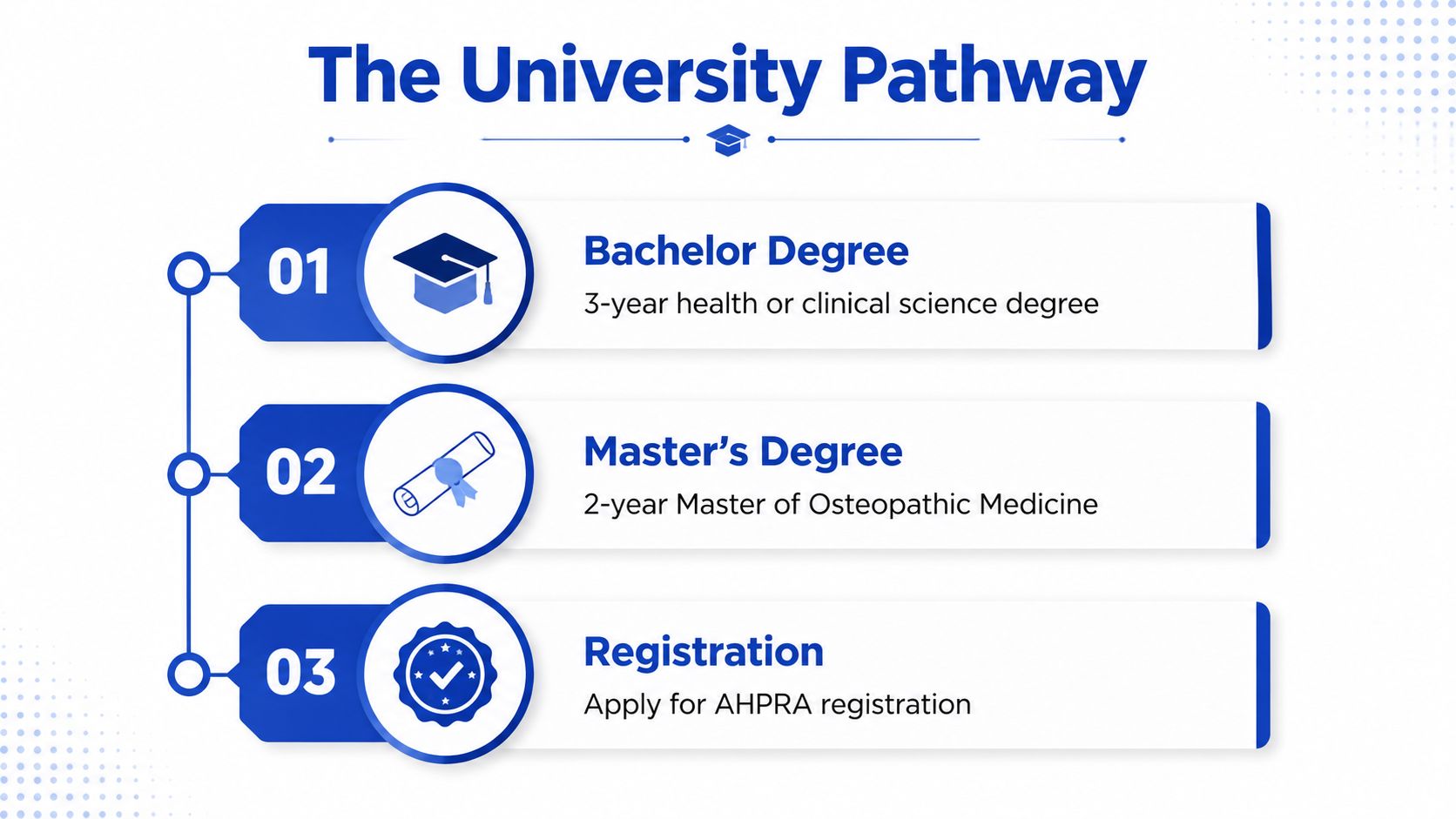
Australian osteopaths do not come through a short vocational course and begin treating patients straight away. The usual route involves minimum 5 years of university training, often made up of a 3-year bachelor degree in health or clinical science, followed by a 2-year master's degree in osteopathic medicine, before registration is even considered. Australian career guidance and training information for the profession describe that pathway as the standard route, and it is the baseline most patients should expect to see in Australia Australian career guidance on osteopathy training requirements.
The bachelor degree lays the groundwork. Students build the science base they will use later, which is why subjects like anatomy, physiology, pathology, diagnosis, and osteopathic techniques sit at the centre of the training. The master's degree then adds clinical reasoning and supervised, hands-on application on top of that foundation.
That order matters because the training is designed to build judgement in layers. An osteopath does not only learn how to move a joint, they learn why movement may be limited, what structures may be involved, and how to assess the situation safely. Put plainly, the degree pathway turns broad health knowledge into clinical decision-making.
For patients, the five-year minimum gives a clear signal. It shows that the practitioner has completed a long university-based program rather than a brief course focused on one technique. In an appointment, that difference should be visible in the assessment, the reasoning, and the way treatment is explained.
University training is the starting point, not the end point. A degree prepares someone for registration, but it does not, by itself, give them the right to practise.
The infographic above shows the sequence clearly, bachelor degree first, master's degree second, then registration. It helps separate academic training from legal practice, which is where many people get confused.
AHPRA and the Osteopathy Board of Australia
Graduation and registration are not the same thing. A person can finish university and still not be legally allowed to call themselves an osteopath in Australia until they've gone through the registration process with AHPRA and the Osteopathy Board of Australia.
That distinction matters because AHPRA is the national regulator, and the Osteopathy Board sits within that system to oversee the profession. In everyday terms, the university says, “this person completed the training”, while the regulator says, “this person meets the requirements to practise now”. Patients often merge those two ideas, but they're separate milestones.
Why the public register matters
If you're checking a practitioner, the public register is the practical test. It tells you whether someone is currently registered, not just whether they once studied osteopathy. That's a much better filter than relying on a clinic biography alone.
The Board also sets the expectations that sit around registration, which is where the process becomes more than paperwork. A practitioner can't finish a degree and assume the work is done. They have to stay within the rules of registration, keep their details current, and remain in good standing with the regulator.
The useful takeaway for patients is simple. Academic qualification starts the process, registration authorises practice. If you're looking at an osteopath in Australia, both parts matter, and both should be easy to verify.
A profile that names the practitioner, identifies their registration status, and describes their clinical focus is more reassuring than a profile that only uses vague phrases like “qualified therapist”. The regulatory layer is what turns a health graduate into a practising osteopath.
Ongoing Standards That Keep an Osteopath Registered
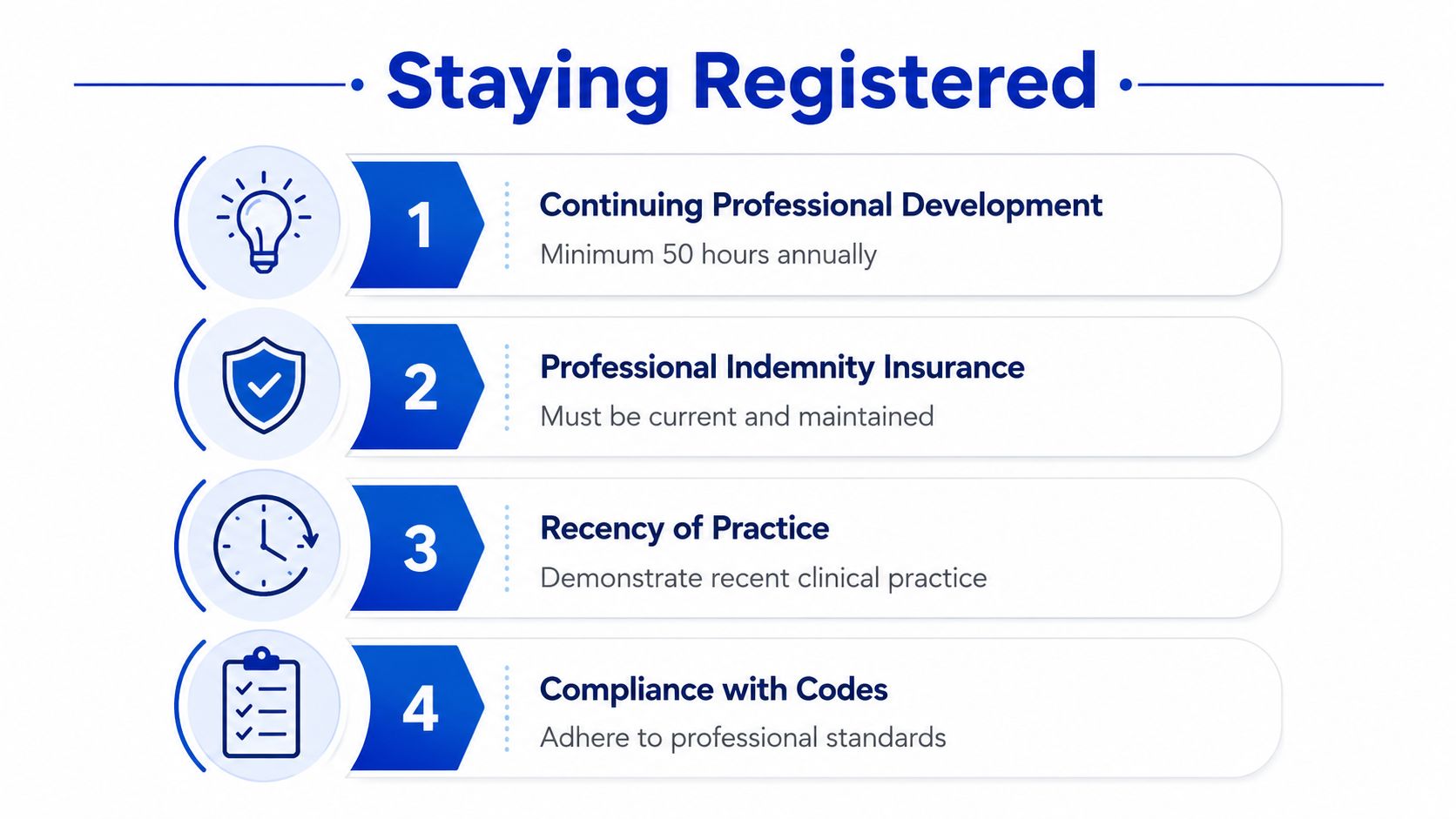
Qualification doesn't freeze in place after the first registration. In Australia, osteopaths have to keep meeting ongoing standards to stay registered, and that's one of the most important parts of osteopath qualifications Australia that people miss. The Board requires 25 hours of CPD each year, including 4 hours of mandatory CPD activity, plus at least 450 hours of clinical practice in the previous 3 years to satisfy recency-of-practice requirements in the clinical domain Osteopathy Board of Australia registration guidance.
What those requirements actually mean
Continuing professional development means the practitioner is still learning. That can include formal study, workshops, or other approved activities that keep clinical knowledge current. The point is not box-ticking, it's making sure treatment decisions reflect current professional standards.
Recency of practice is different. It asks whether the osteopath has stayed active enough in the clinical setting to remain sharp. A practitioner who has been away from hands-on work for a long stretch may need to meet extra requirements before returning to practice.
The Board also refers to an IELTS 7 English-language standard in its registration guidance. That matters because good communication is part of safe clinical care, especially when a practitioner needs to explain assessment findings, consent, home advice, or referral decisions clearly.
A registered osteopath isn't just someone who once met a standard. They have to keep meeting it.
The result is a profession where registration is maintained, not assumed. For patients, that's reassuring. It means the person treating you has to stay current, stay active, and stay within the profession's rules, not rely on an old degree hanging on the wall.
Qualifications for Overseas-Trained Osteopaths
Overseas training doesn't automatically translate into Australian registration. That's where many readers get stuck, because a degree from another country may be strong, but it still has to be assessed against Australian standards before someone can work here.
Domestic and overseas pathways are not identical
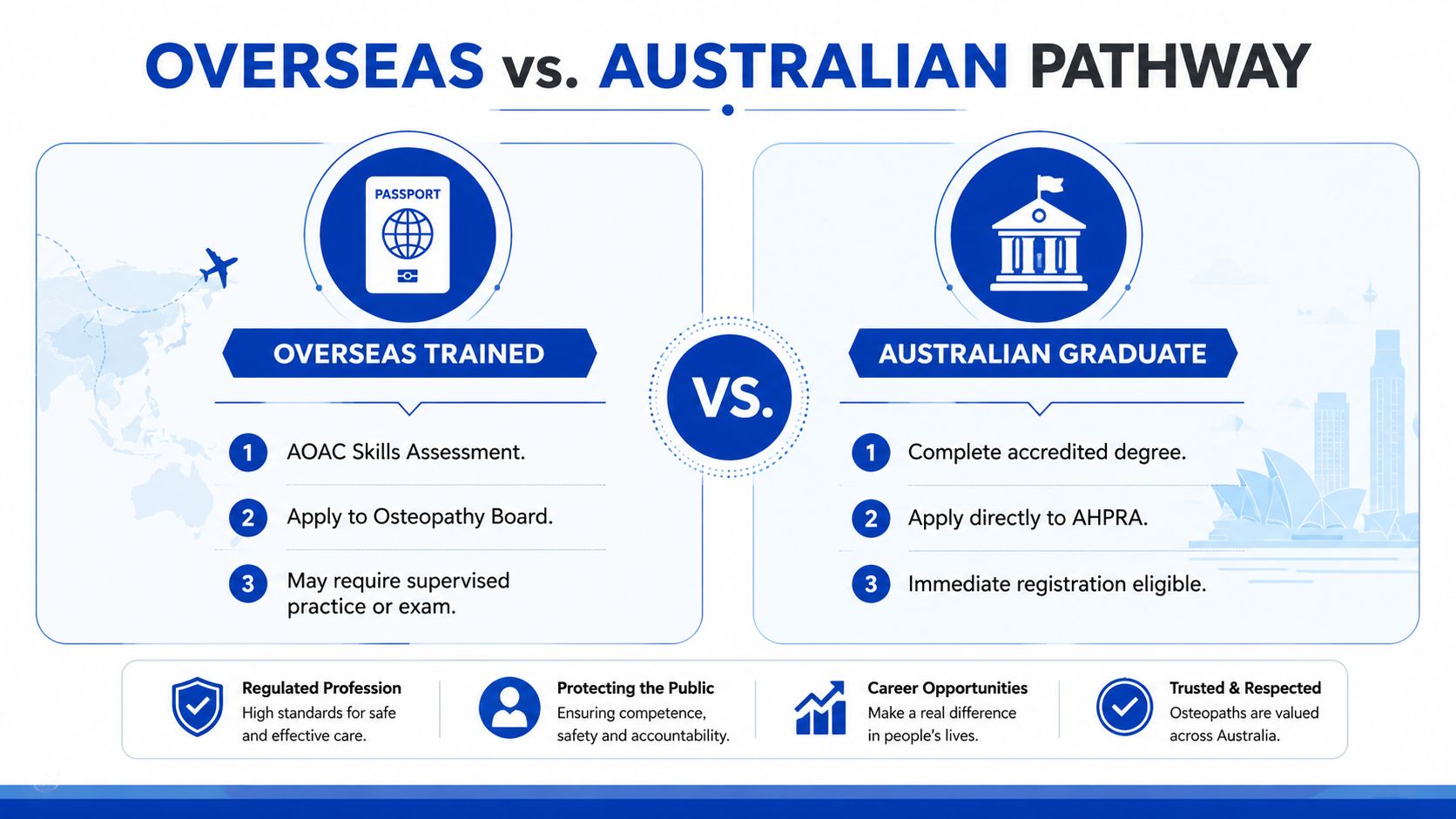
An Australian graduate usually comes through an accredited university pathway and then applies for registration. An overseas-qualified practitioner takes a different route, starting with an AOAC skills assessment and then applying to the Osteopathy Board of Australia. In some cases, limited or provisional registration pathways may apply for supervised practice AOAC qualification and skills assessment information.
That split matters for patients who see a practitioner with international training and assume the credential is automatically equivalent. It isn't always. Australia checks whether the training and competence align with local registration expectations, rather than treating every overseas degree as interchangeable.
For a migrant practitioner, that means the question is not, “Did you study osteopathy?” The question is, “Has the training been assessed for Australian practice, and is the practitioner currently registered here?” Those are two separate checks.
For patients, the takeaway is straightforward. If a practitioner trained overseas, they should still be able to show how they became locally registered, and their current status should appear on the Australian register if they're practising independently. If they're working under a supervised or provisional arrangement, that should also be clear.
How Medicare and Private Health Cover Connect to Qualifications
A rebate question often tells you more than people expect. If a clinic can explain Medicare or private health cover clearly, that usually points to a practitioner who understands the registration rules that sit behind the billing.
Australian osteopathic care can connect to private health insurance extras, and under specific GP-arranged plans, it can also connect to Medicare through a Chronic Disease Management arrangement. Those payment pathways sit alongside registration and scope of practice. If a practitioner is not properly registered, the rebate discussion is usually premature.
Use cover as a verification step
Asking about rebates is also a practical way to test whether a clinic understands the system it works in. A registered practitioner should be able to explain what applies to your situation in plain language, without sounding uncertain or evasive.
A simple way to read it is this. Rebates are easier to confirm when the practitioner's credentials are real, current, and recognised. If you are trying to work out whether a clinic is legitimate, the Medicare or private health question helps you check the broader picture.
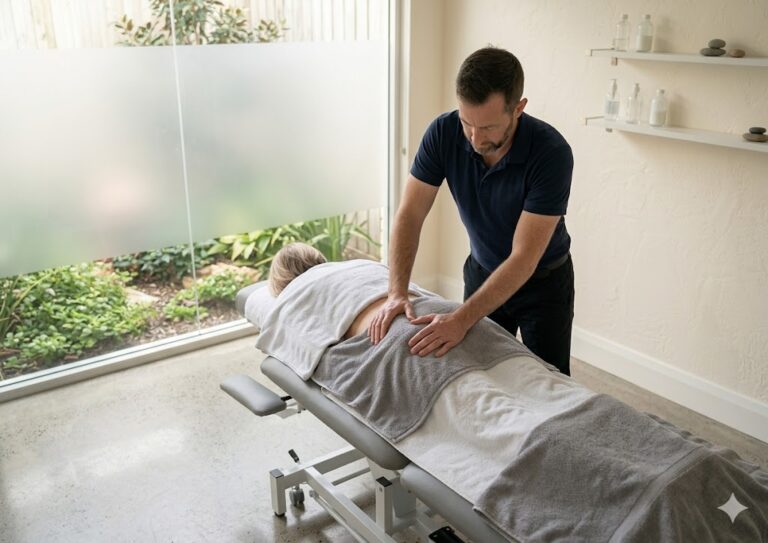
If you want a reminder of how osteopathic care often looks in a treatment setting, this clinic image gives a sense of the hands-on environment patients expect: osteopathic consultation reference image.
Verifying an Osteopath's Credentials in Bayside
If you live in Bayside, you don't need to become a regulator to check a practitioner. You just need a repeatable habit before booking. Start with the AHPRA public register, then match the name on the register to the name on the clinic website, and make sure the practitioner is listed as currently registered.
A quick Bayside checklist
- Confirm the register first: Search the practitioner's name on AHPRA before you book, and make sure the registration is current.
- Match the identity carefully: Check that the person you found on the register is the same person who appears on the clinic profile.
- Look for plain language about training: A trustworthy profile usually names the university pathway clearly, not just a vague “qualified” label.
- Ask about recent practice if needed: If a practitioner has had a break from clinical work, ask how they've maintained their recency of practice.
- Check how they explain rebates: Clear answers about Medicare or private health often reflect a clinic that understands the registration system, not just the front desk script.
The best local clinics make this easy because they understand patients want certainty, not jargon. A calm, transparent profile is usually a good sign. If you want a close-up example of how a Bayside clinic presents itself to patients, this local review analysis image is a practical reference: Beaumaris medical centre reviews analysis.
If the practitioner can't be verified on the register, pause. A friendly website doesn't override a missing registration record.
Qualification Questions Readers Ask Most
Does an interstate Australian qualification transfer automatically? Usually, yes in practical terms, because the key issue is registration status, not where within Australia the person studied. The register is still the thing to check.
Can a prior health degree shorten the pathway? It may help with entry into study, but it doesn't replace the need for the recognised osteopathy pathway and registration requirements. The end point still has to meet Australian standards.
What if I can't find the practitioner on AHPRA? Don't book until you've confirmed the details. Ask the clinic to clarify the exact spelling, the registration status, or whether the person is practising under supervision.
Bayside Osteopathic Health offers gentle, hands-on care for people who want clear explanations as well as treatment. If you'd like help from a clinic that values transparent credentials, practical advice, and a whole-body approach, visit Bayside Osteopathic Health and book a consultation when you're ready.