
You roll your ankle stepping off a Bayside kerb, it puffs up within minutes, and the first thought is usually the same, “Should I just rest it, ice it, and wait?” Sometimes that's enough. Sometimes it isn't, and the difference matters because ankle pain treatment is often decided in the first day, not after the swelling has already settled into a longer problem.
In Australian general practice, foot, ankle, and leg problems are a significant part of everyday care, not a niche issue. A large BEACH dataset study found GPs managed 50,877 foot, ankle, or leg problems across 1,568,100 patient encounters, which worked out to 3.24 problems per 100 encounters. The study also estimated an average cost per encounter of A$52 and a total annual cost of A$256 million (study details). That's the situation with a sore ankle in the community; it's common, it disrupts work and walking, and it often starts in frontline care rather than a specialist clinic.
Table of Contents
- Understanding Ankle Pain in Bayside
- Immediate Self-Care with PEACE and LOVE
- Progressive Mobility and Strengthening Exercises
- Manual Osteopathic Care and Clinic Visits
- Red Flags and Urgent Care Needed
- Ankle Pain Advice for Older Adults and Arthritis
- Preventing Reinjury and Returning to Bayside Life
Understanding Ankle Pain in Bayside
A typical Bayside story starts on a normal walk, not on a sporting field. Someone misses the edge of a footpath, feels a sharp twist, keeps limping because they've got somewhere to be, and hopes it settles overnight. The ankle might be sore, stiff, swollen, or bruised, and the hard part is that those signs can belong to a simple sprain or something more serious.

A closer look at Anatomical foot and ankle structures helps explain why ankle pain treatment needs more than a generic “rest and see” answer. In community practice, ankle complaints sit alongside other foot and leg problems as everyday workload, not one-off oddities. Many people also arrive after trying to push through the pain for a few days, then realising the ankle is not settling the way they expected. Early decisions matter because the first assessment often has to be made before anyone has an X-ray, a rehab plan, or a clear diagnosis.
Why that matters for local care
In a Bayside setting, people usually want to walk, work, coach, or get back to the beach without making the problem worse. That is why early conservative care earns its place. If the ankle is stable enough, movement advice, load management, and a sensible return plan can stop a temporary injury from becoming a longer interruption.
Practical rule: if the ankle is swollen but still moving, don't assume it's fine, and don't assume it's broken. The right response is a calm assessment of how it behaves, not just how it looks.
That local, functional approach is the reason ankle pain treatment belongs in community care. The goal isn't to ignore pain. It's to decide quickly whether the ankle needs protection, progress, or urgent escalation.
Immediate Self-Care with PEACE and LOVE
The first hours matter, but they don't need to be dramatic. For an acute lateral ankle sprain, the evidence-supported approach starts with PRICE in the first phase, then moves into early range of motion, weight-bearing as tolerated, and balance work. Immobilisation is not the default, and if it's used for pain or swelling control, it should be limited to no more than 10 days (sprain guidance).
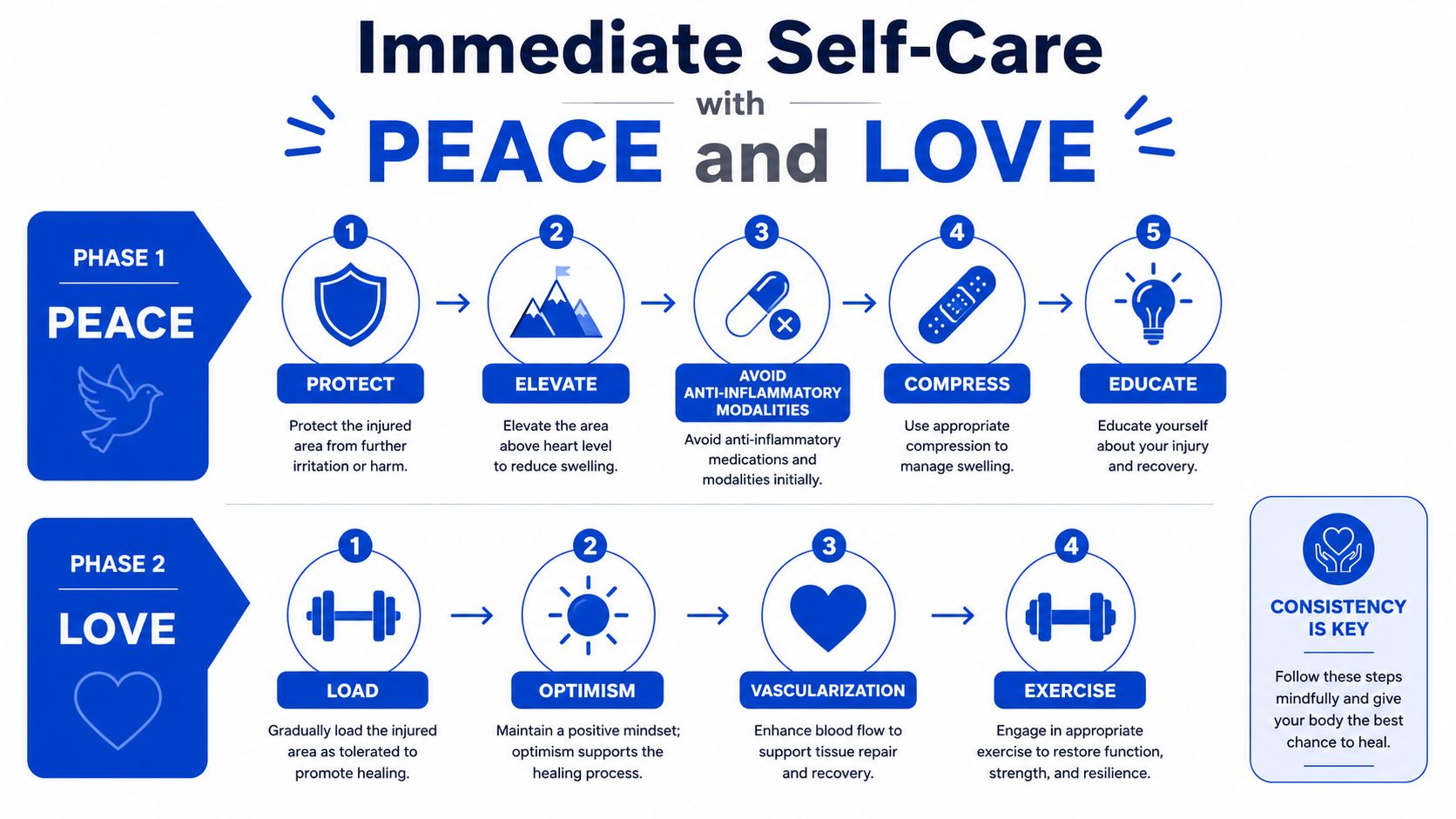
The modern PEACE and LOVE framework is a useful way to remember the sequence. PEACE covers the earliest phase, Protect, Elevate, Avoid anti-inflammatory modalities, Compress, and Educate. Then LOVE takes over, Load, Optimism, Vascularisation, and Exercise. The logic is simple, protect the tissue from a fresh flare-up, then reintroduce movement early enough that the ankle doesn't stiffen and decondition.
What to do first
Start by protecting the ankle from more twisting. That can mean reducing walking, avoiding uneven ground, and using support if needed for a short period. Elevation helps swelling settle, compression can manage fluid build-up, and education matters because people often overreact in one of two directions, either doing nothing at all or pushing too hard too soon.
Avoid the trap of making pain the only guide. Pain matters, but so does how the ankle responds over the next day. If it becomes more swollen, more unstable, or markedly harder to walk on, that's not a sign to “tough it out”.
When to start loading again
As soon as basic protection is in place and the ankle is settling, shift towards gentle loading. That doesn't mean sport, and it doesn't mean a long walk to test it. It means light, controlled movement that restores confidence and stops the joint from becoming guarded.
Keep the ankle active enough to avoid stiffness, but not so hard that you trigger a new swelling cycle.
That balance is the whole point of ankle pain treatment in the acute stage. Good early care isn't about freezing the joint, it's about giving it enough structure to recover without going quiet for too long.
Progressive Mobility and Strengthening Exercises
Once the ankle settles, the work shifts. Protection alone is no longer enough, because the joint needs motion, strength, and balance to trust load again. In practice, I look for objective clearance criteria before advancing, not just the passage of time. The stepwise approach used in the literature relies on three domains before progression, a patient-reported outcome target, a standardised clinical exam, and performance testing (rehab algorithm).
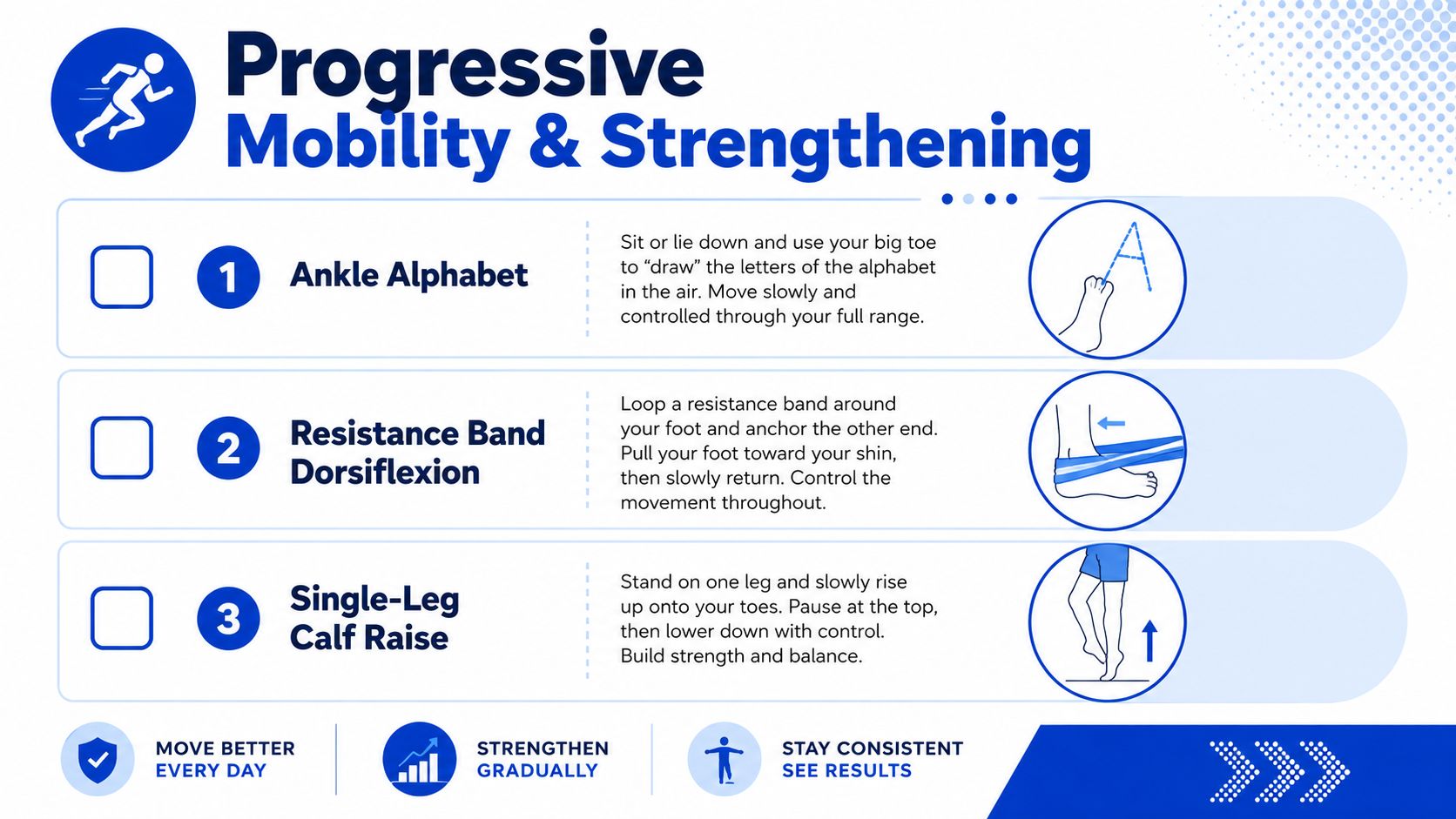
The order below is practical, but the ankle's response is what decides whether it stays there. If a drill increases swelling, makes the ankle feel less stable, or leaves it sorer the next morning, the load is too high.
- Ankle Alphabet: draw the letters with your foot while seated. This restores gentle motion without forcing the joint.
- Resistance Band Dorsiflexion: pull the forefoot back against the band to strengthen the front of the ankle and lower leg.
- Single-Leg Calf Raise: rise slowly onto the ball of the foot, using support if needed, to rebuild calf strength and control.
Balance work is not optional
A sprained ankle often loses single-leg control before range of motion fully returns. Balance drills address that loss of trust. Standing on one leg near a wall, then progressing to head turns, closed eyes, or unstable surfaces, helps the ankle relearn proprioception, the body's sense of position and movement.
Bracing or taping can still have a role while control is rebuilding. Guideline literature reports lower recurrent sprain risk and lower first-time sprain risk with brace or tape use, especially in sport settings. It supports the rehab process, it does not replace it.
How to know you're ready to advance
A recovering ankle should do more than bend passively. It needs to handle walking, turning, and single-leg loading without a flare-up. If stairs, quick changes of direction, or short walks still feel unreliable, the ankle is not ready for the next level.
This rehabilitation image is a useful reminder that recovery is active work, not passive waiting. For ankle pain treatment at this stage, the aim is to regain function, then prove it holds up in daily life and back around Bayside activity.

Manual Osteopathic Care and Clinic Visits
Hands-on care has a place when the ankle is not settling the way it should, or when the problem isn't just the ankle. In clinic, assessment usually looks beyond the sore spot. Foot mechanics, calf tone, knee rotation, hip control, and even gait patterns can affect how the ankle loads when you walk or change direction. That broader view matters because a twisted ankle often comes with compensations that keep the pain going.

Osteopathic care for persistent ankle pain often combines soft-tissue work, joint articulation, gentle mobilisation, and movement advice. The Australian-relevant literature on foot and ankle musculoskeletal care describes common modalities such as stretching, manual therapy, therapeutic exercise, footwear modification, and orthoses, but it also says more studies are needed to determine whether non-pharmacologic interventions such as taping and soft-tissue mobilisation provide long-term pain relief (foot and ankle care review). That's the honest position. Manual treatment can help the way the ankle feels and moves, but it shouldn't be sold as a magic fix.
What a good clinic visit should include
A proper assessment should check more than tenderness. It should look at how you walk, whether the ankle is loading symmetrically, and whether nearby joints are contributing to the problem. If the pain has lingered, a clinic plan may combine home exercises with manual treatment and footwear advice, rather than relying on treatment alone.
Bayside Osteopathic Health offers this kind of onsite osteopathic manual therapy as one option for musculoskeletal ankle care, alongside exercise prescription and practical self-care. Medicare access may be possible where a patient is eligible under the relevant plan. The key is not the label on the treatment, it's whether the plan matches the tissue stage and your daily demands.
When clinic care is the better choice
If walking stays awkward, if the ankle keeps re-swelling, or if progress stalls once you start loading it again, clinic care makes sense. That's especially true when the issue is no longer simple pain relief but restoring confidence in movement.
If self-care is not changing the pattern after a reasonable trial, the next step is a whole-body reassessment, not more guessing.
That's where ankle pain treatment becomes a pathway instead of a guesswork cycle. The body needs the right inputs at the right time, and sometimes that's easier to sort out face to face.
Osteopathy qualifications in Australia can also help people understand what a qualified practitioner is doing during assessment and treatment.

Red Flags and Urgent Care Needed
A lot of ankle pain isn't a simple sprain. That's the part many people miss, and it's where delays cause trouble. Australian evidence-based guideline review has pointed out gaps in acute diagnosis and management for ankle conditions like syndesmosis injury, deltoid ligament injury, dislocation, and fracture, which helps explain why online advice often stops at “rest, ice, brace” and never says when to escalate (guideline review of ankle conditions).
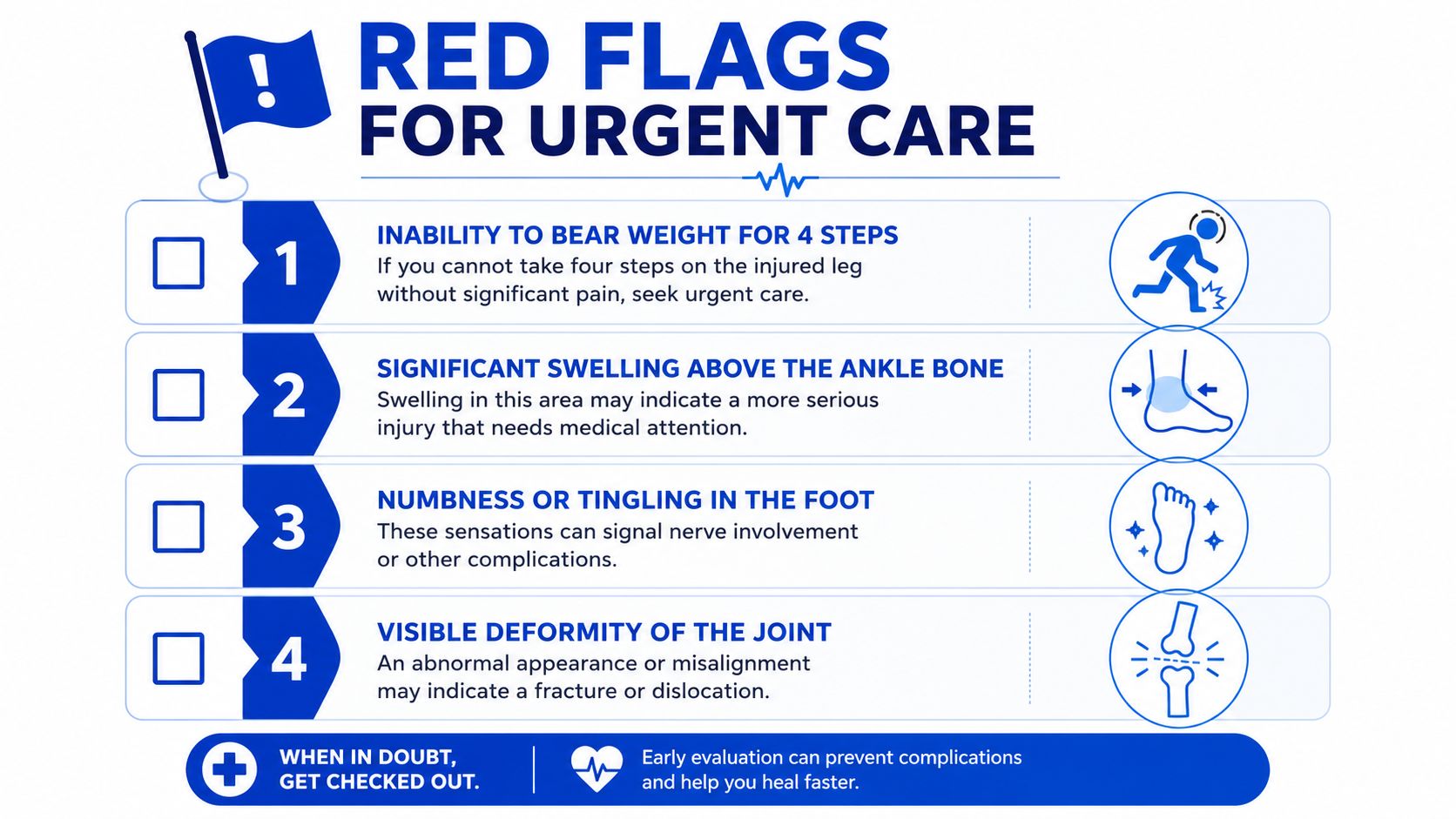
Signs that need urgent review
- You cannot bear weight for four steps. That's a strong reason to get assessed promptly, because fractures can still be walked on sometimes, but that doesn't make them safe.
- Swelling is marked or spreading quickly. Rapid change after a twist or fall can mean more than a routine ligament sprain.
- Numbness or tingling appears in the foot. That raises concern for nerve involvement or a more significant injury pattern.
- The joint looks deformed. Visible misalignment is not a home-care problem.
If the injury happened with a pop, a clear shift in the joint, or severe pain that's worsening rather than easing, stop treating it like an ordinary sprain. That's not a rehab issue anymore, it's an urgent assessment issue.
Why escalation matters
The practical risk is not just pain. Missed fractures and unstable ligament injuries can lead to prolonged disability and a slower return to normal walking. A deformed, numb, or non-weight-bearing ankle needs proper medical review, not another round of self-treatment.
If the ankle is hot, badly swollen, or you're unsure whether the problem is getting worse, urgent care or imaging may be the right step. Home care is useful, but it only works when the injury behaves like a straightforward sprain.
Ankle Pain Advice for Older Adults and Arthritis
Older adults often need a slower, more protective ankle plan. The goal is not to “push through” stiffness, because joint irritation, reduced balance, and other health conditions can all make a fast loading program unrealistic. An ankle that hurts in someone with arthritis may need gentler movement, better footwear, and more attention to fall risk than a sports ankle does.
Keep the ankle moving without provoking a flare
Chair-based ankle circles, light pumps, and short range movements often work better than aggressive stretching. The ankle should feel used, not attacked. If a movement creates a sharp pain spike or lingers as a flare into the next day, it's too much for now.
Supportive footwear matters more in this group than people sometimes admit. A stable heel counter, a secure fit, and enough sole traction can make everyday walking easier and safer. That can matter as much as any treatment performed in clinic, because the ankle lives inside the shoe all day.
Modify load around the home
Use a cane or walker when balance is unreliable, not only after a fall. That isn't a step backwards, it's a way to keep moving while reducing risk. Shorter bouts of walking, planned rest breaks, and avoiding slippery or uneven surfaces can protect an irritable ankle without forcing full inactivity.
Practical rule: if arthritis pain settles after gentle movement, keep the movement gentle. If pain worsens with each repetition, reduce the range and load.
Manual osteopathic care can still help here, especially for stiffness and surrounding muscle tension, but the technique should be adapted. In older adults, a softer, calmer approach is usually more useful than forceful treatment.
The target is independence. Good ankle pain treatment for older people should help them keep getting to the shops, the tram, the garden, and social commitments without a fear-driven shutdown.
Preventing Reinjury and Returning to Bayside Life
Getting back to Bayside life is not just about the ankle stopping pain. It's about being able to walk the foreshore, join a local group, stand at a café, or return to a Saturday game without wondering whether the ankle will fold again. The best prevention is boring in the right way, consistent balance work, sensible footwear, and not rushing the final phase.
A simple maintenance routine
Keep some balance practice in your week even after the ankle feels normal. A few controlled single-leg stands, calf raises, and gradual directional changes help the body remember how to react when the ground changes unexpectedly. That matters on footpaths, stairs, sand, and the uneven edges of local parks.
Footwear deserves a second look once recovery is underway. If the shoe is unstable, worn out, or too loose, the ankle has to do more of the stabilising work itself. That's a poor trade when you're trying to prevent another twist.
Use the earlier clearance criteria for real-life return
Return to walking groups, beach walks, and sport in stages. If the ankle still struggles with stairs, fast turns, or single-leg loading, it's not ready for a full return. The same three clearance domains still apply, how the ankle feels, how it tests in clinic, and how it performs under load.
A useful Bayside checklist looks like this.
- Walking feels normal again.
- Balance is steady on one leg.
- The ankle doesn't swell after activity.
- Shoes are supportive and secure.
- You've checked whether brace or tape still helps during higher-risk activity.
If the answer to any of those is shaky, don't treat it as a failure. Treat it as a signal to slow the return and tighten the plan.
As for broader ankle pain treatment, the long game is prevention through movement literacy. The people who do best usually don't wait until the ankle is perfect, they build a routine that keeps it predictable.
If your ankle pain is still affecting walking, work, or exercise, Bayside Osteopathic Health can assess how the whole body is loading the joint and build a practical care plan around it. Visit Bayside Osteopathic Health to book a consult, ask about suitable treatment options, and get a recovery pathway that fits your day-to-day life in Bayside.