

Your hands feel stiff before you've even finished your first cup of tea. The lid on the jar won't budge. Buttons are awkward. Standing up after sitting for a while makes your knees complain. By the end of the day, you're wondering whether an arthritis pain relief cream might help, or whether it's just another product promising more than it delivers.
That's a reasonable question. For many people, a cream or gel is a sensible first step when pain is localised and daily function matters more than grand claims. It can be easier to apply something directly to a sore hand or knee than to add another tablet to an already crowded routine. The key is knowing which products have solid evidence behind them, which ones mainly create a temporary sensation, and how to use any cream safely.
Table of Contents
- Finding Relief from the Daily Ache of Arthritis
- How Arthritis Creams Provide Targeted Relief
- Decoding the Ingredients in Your Pain Relief Cream
- How to Choose the Right Cream for You
- Using Arthritis Creams Safely and Effectively
- Beyond Creams Your Holistic Pain Management Plan
- When to See Your Doctor or Osteopath
Finding Relief from the Daily Ache of Arthritis
Arthritis rarely announces itself in dramatic fashion. More often, it chips away at ordinary tasks. Turning a key, carrying shopping bags, getting out of a chair, or walking after a long drive can become the moments that shape your day.
That kind of pain can feel isolating, but it's extremely common. In Australia, around 3.7 million people were living with arthritis in 2022, or roughly 14% of the population, and osteoarthritis affected about 2.1 million people, according to reporting that cites the Australian Institute of Health and Welfare in this Australian arthritis market summary. If your joints are interfering with routine movement, you're far from alone.

For localised discomfort, an arthritis pain relief cream can be a practical option. It won't reverse arthritis, and it won't suit every person or every joint. But for hands, knees, wrists, feet, and other more accessible joints, it can make movement more manageable when used properly.
A smart plan usually looks broader than a single tube from the chemist shelf. It helps to combine symptom relief with movement advice, load management, and attention to how the rest of the body is coping. Even simple daily habits, including better posture and ergonomic setup, can reduce unnecessary strain on already irritated joints.

Arthritis care works best when you stop asking, “What's the strongest cream?” and start asking, “What gives me the best function with the least risk?”
How Arthritis Creams Provide Targeted Relief
Tablets travel through the whole body. Creams and gels aim for a much narrower job. That's the main reason topical treatments are worth considering when pain sits in a specific area.
Targeted delivery to the sore joint
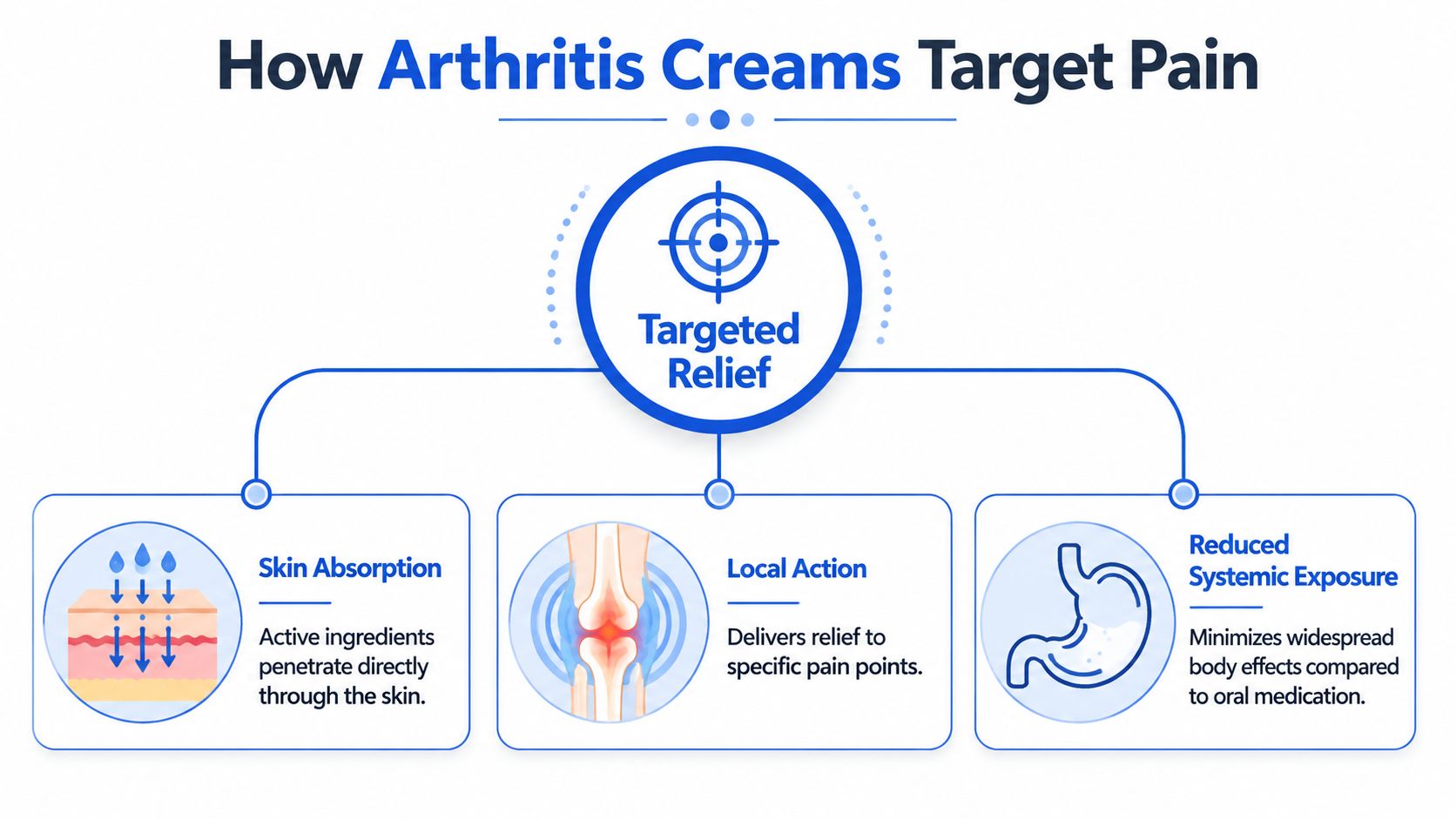
Think of an arthritis pain relief cream as a local delivery service. Instead of sending medicine through your entire system first, you apply it over the painful area and let the active ingredient move through the skin toward the tissues underneath.
With topical NSAIDs, the drug accumulates in synovial tissue at concentrations clinically validated to inhibit prostaglandin synthesis, which helps reduce pain signalling. Topical application also allows the skin to act as a sustained reservoir, delivering effect before the drug is even detectable in plasma, unlike oral medication that has to distribute systemically first. That pharmacokinetic profile is described in the verified data provided for this article.
Not all creams work the same way
This often causes confusion. “Arthritis cream” sounds like one category, but the products on the shelf work in different ways.
- Anti-inflammatory creams and gels reduce inflammatory pain at the site.
- Nerve-active products such as capsaicin work by changing how pain is signalled or perceived over time.
- Counterirritant rubs create cooling or warming sensations that can distract from pain but don't necessarily address inflammation.
If your pain is driven by local joint irritation, products with anti-inflammatory action tend to make the most sense first. If you're choosing based on smell, marketing, or how strong the cooling sensation feels, you may miss the option with the best evidence.
Why local treatment can suit older adults
Many people with arthritis are already managing several health issues and medications. In practice, that matters. A treatment that targets one painful joint without adding broad body exposure can be useful when someone wants symptom relief but needs to think carefully about stomach, kidney, or cardiovascular risk.
Practical rule: If the pain is mainly in one or two accessible joints, a topical option often deserves consideration before another oral medicine.
Decoding the Ingredients in Your Pain Relief Cream
A chemist shelf can make weak options look equal to stronger ones. They aren't. The label matters more than the branding.
Topical NSAIDs
Topical non-steroidal anti-inflammatory drugs, or NSAIDs, are the most evidence-backed cream or gel option for many people with localised osteoarthritis pain. Expert analysis of Australian clinical guidance indicates they hold SORT Level A evidence for decreasing musculoskeletal pain, which places them above counterirritants such as menthol and camphor, which generally have Level B evidence or no significant difference compared with placebo in that analysis.
You'll commonly see diclofenac in this category. It's a familiar over-the-counter option in Australia and is used for joints such as the hands, wrists, elbows, knees, ankles, and feet. That makes it especially relevant when the painful structure sits relatively close to the skin.
The strongest point in favour of topical NSAIDs is that they don't just create a sensation. They address inflammatory pathways locally.
Capsaicin
Capsaicin is derived from chilli peppers. It doesn't work like an anti-inflammatory gel. Instead, it affects pain signalling in the skin and superficial nerves. Some people find it helpful, particularly when they use it consistently rather than sporadically.
The downside is practical. It often causes a burning or stinging sensation, especially early on. That can be enough to make people abandon it before they've used it properly. If you already have sensitive skin, capsaicin may be difficult to tolerate.
Capsaicin can be worth considering if NSAIDs aren't suitable or if you've tried other options without enough relief, but it usually isn't the simplest first purchase.
Counterirritants and salicylates
Menthol, camphor, and salicylate-based rubs are common because they're easy to market. Cooling feels medicinal. Warming feels active. Neither sensation guarantees meaningful arthritis relief.
These products can still have a place. Some people like them for short-term comfort before walking, after gardening, or in the evening. But evidence for these ingredients is weaker or mixed compared with topical NSAIDs. They're better thought of as symptom distractors than first-choice anti-inflammatory treatment for osteoarthritis.
A strong smell or strong tingle doesn't mean strong evidence.
What about CBD and compounded creams
Patients often ask about CBD creams, mixed-ingredient products, and custom compounded formulas. The honest answer is that shelves and online ads can get ahead of the evidence. If a product doesn't have clear evidence behind its active ingredient for arthritis pain, it's wiser to treat the claims cautiously.
Compounded creams may be discussed in some settings for complex pain, but they aren't standard over-the-counter arthritis solutions. If someone is considering a compounded product, that decision should sit within a clinician-led plan rather than impulse buying.
Arthritis cream ingredient comparison
| Ingredient Type | How It Works | Best For | Evidence Strength |
|---|---|---|---|
| Topical NSAIDs | Reduces inflammation locally in the painful joint | Localised osteoarthritis pain in hands, knees, feet, wrists | Strongest support |
| Capsaicin | Alters pain signalling with repeated use | People who can tolerate burning and use it consistently | Can help some people |
| Counterirritants | Creates cooling or warming sensations that distract from pain | Short-term comfort, mild aches | Weaker or mixed |
| Salicylates | Topical pain-relief effect, but evidence is less convincing for arthritis | Mild symptoms, trial use if preferred | Weaker or mixed |
| CBD and mixed novelty formulas | Mechanism and claims vary by product | Situations needing careful scrutiny | Unclear for routine arthritis use |
If you want the shortest version, it's this: for a typical over-the-counter arthritis pain relief cream, topical NSAID gel or cream is the ingredient class to look for first.
How to Choose the Right Cream for You
The right product depends less on marketing and more on your joint, your health history, and what you need the cream to do.
Start with the joint that hurts
Topical products tend to make the most sense for joints that are easier to reach and closer to the skin. Hands and knees are the classic examples. Ankles, feet, wrists, and elbows can also be suitable.
Deeper joints are a different story. If you're dealing with hip pain, for example, a cream may still feel pleasant on the surface, but expectations need to stay realistic. Pain from a deep joint often needs a broader plan than a rub-on product alone.
Check your health profile before you buy
For older Australians in particular, the real question often isn't “cream or no cream”. It's whether a topical option is the safer starting point than another oral anti-inflammatory. Consumer guidance around topical diclofenac notes that topical products can help targeted pain and may reduce systemic exposure, but they aren't a cure, and a clinician review is important if you're already using oral NSAIDs or have GI, kidney, or cardiovascular risk factors, as outlined in this guidance on how OTC arthritis cream and gel works.
Use that as a checkpoint, not a footnote.
- If you already take oral anti-inflammatories, don't assume adding a topical NSAID is automatically harmless.
- If you've had stomach trouble, kidney concerns, or heart-related medication issues, ask your GP or pharmacist before starting regular use.
- If your pain is widespread rather than localised, a cream may only address a small piece of the problem.
Match your expectations to the product
A good choice is one that fits the job.
If you want evidence-backed relief for a sore knee or hand, start by looking for a topical NSAID. If you mainly want a brief cooling or warming sensation, a counterirritant may satisfy that preference, but it shouldn't be confused with the strongest evidence-based option.
If you're not sure what you're treating, pause before buying. Joint pain can come from arthritis, but also from referred pain, tendon irritation, overload, or a movement pattern that keeps flaring the same area.
Using Arthritis Creams Safely and Effectively
Technique matters more than is often realised. A good product used poorly often gets blamed for disappointing results.
Start with the basics.
A simple application routine
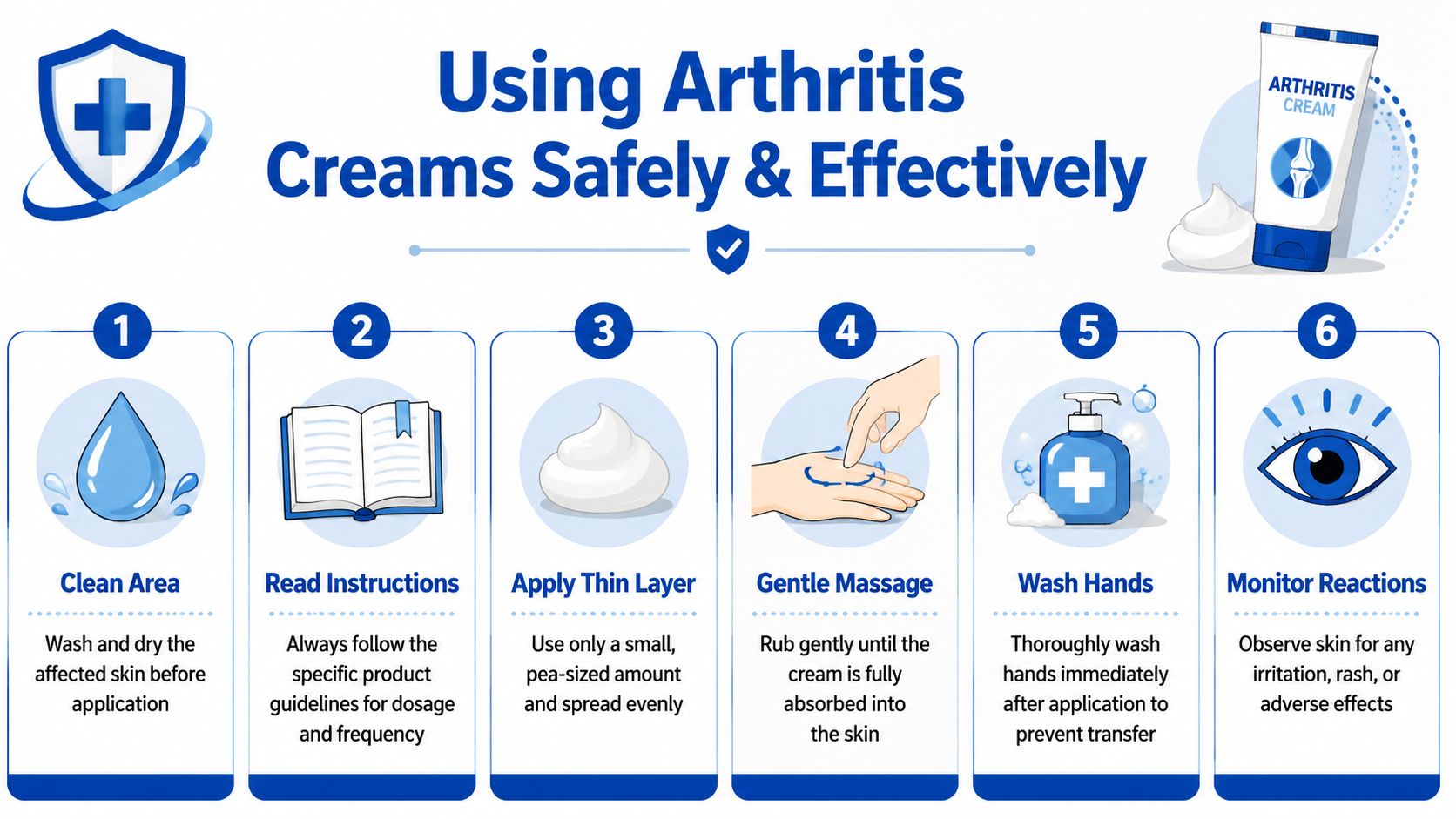
Using an arthritis pain relief cream properly usually comes down to a few consistent habits:
- Read the product directions before the first use. Different active ingredients have different schedules and precautions.
- Apply only to clean, intact skin. Broken or irritated skin changes absorption and raises the chance of a reaction.
- Use the recommended amount. More product doesn't automatically mean more relief.
- Rub it in gently over the painful area, then let it absorb.
- Wash your hands afterwards, unless your hands are the treated area.
Many people do better when application becomes part of an existing routine, such as morning stiffness management or evening wind-down. Consistency often matters more than chasing instant relief.
For some people, combining this with hands-on support such as remedial massage and muscle therapy approaches can make the surrounding muscles feel less guarded and easier to move.

Here's a useful visual guide to application and self-care:
Common mistakes that reduce benefit
Many users don't realise that correct use affects both safety and outcome. Public-facing guidance notes that benefit is often modest and depends on consistent application to intact skin, while heating pads and occlusive bandages should be avoided, as outlined in this Mayo Clinic overview of osteoarthritis pain medicines.
The common errors are predictable:
- Applying to irritated skin because the joint is sore there.
- Using heat over the area to “push it in further”.
- Covering it tightly straight after application.
- Stopping too soon because the first day didn't feel dramatic.
Safety note: Heat and tight covering can change absorption. If the label says avoid them, take that seriously.
When skin irritation means stop
A little warming from some products can be expected. A rash, marked redness, or worsening irritation isn't something to push through. Wash the area, stop using the product, and seek advice if the reaction is significant or persistent.
If a cream helps the pain but your skin hates it, that doesn't mean you've run out of options. It means the product, the ingredient, or the way it's being used needs review.
Beyond Creams Your Holistic Pain Management Plan
A cream can reduce friction in daily life. It usually can't solve the whole picture. Arthritis pain changes with load, joint mobility, muscle tension, pacing, sleep, and how confidently you move.
That's why the most useful question isn't “Which cream is best forever?” It's “What combination helps me move better this week, and keeps me moving over time?”

Why pain relief works better as a system
When a joint is sore, nearby tissues often start compensating. A stiff knee can change the way you climb stairs. A painful thumb can alter grip. A cranky neck can tighten the upper back and shoulders. If you only chase pain at the exact site, you can miss the mechanical reasons the area keeps getting overloaded.
A more complete plan often includes:
- Movement support through joint-friendly exercises that maintain confidence and function.
- Load management so flare-ups don't keep following the same activities.
- Supportive symptom relief from creams, heat, cold, or bracing where appropriate.
- Manual assessment and treatment when stiffness, guarding, or altered movement are maintaining the problem.
Where osteopathic care fits
Osteopathic care looks at how the body is moving as a whole. That matters in arthritis because the sore joint is often only part of the story. Hands-on treatment may help reduce surrounding muscle tension, improve comfort in adjacent joints, and make movement strategies easier to follow.
In clinic, this often means assessing not just the painful area, but what's above and below it. A stiff ankle can change knee load. Thoracic stiffness can alter neck and shoulder mechanics. Hip restriction can shift pressure elsewhere. That whole-body view is one reason some people find osteopathic care useful alongside topical pain relief.
If joint stiffness is limiting your day-to-day movement, resources focused on arthritis and joint mobility support can also help you think beyond symptom suppression.

Local pain often has a local trigger and a broader movement pattern behind it.
Other tools worth using alongside cream
A cream tends to work best when it supports, rather than replaces, sensible self-management.
- Exercise: Gentle strengthening and mobility work can reduce the feeling that every movement is a threat.
- Heat or ice: These can be useful, but they shouldn't be applied over a freshly used topical product when the label advises against it.
- Bracing or taping: Sometimes helpful for specific joints, especially when activity predictably flares symptoms.
- Pacing: Doing less on bad days isn't weakness. Doing everything on good days often causes the next flare.
When to See Your Doctor or Osteopath
Self-care is useful, but it has limits. If pain is new, severe, unexplained, or not behaving like your usual arthritis pattern, it's worth getting assessed rather than repeatedly changing creams.
See a doctor or osteopath if any of these apply:
- Your pain keeps worsening despite sensible home care.
- A joint becomes swollen, hot, or suddenly much harder to move.
- Night pain or rest pain is becoming prominent and doesn't fit your usual flare pattern.
- You're relying on multiple pain products at once and aren't sure what's safe together.
- The pain may not be arthritis, especially if it feels sharp, unstable, radiating, or linked to a recent injury.
- Everyday tasks are shrinking because you're moving less to avoid discomfort.
Professional care isn't the next step because you've failed at self-management. It's the next step because arthritis often needs a specific approach. The right clinician can help you sort out what tissue is likely involved, what kind of topical treatment makes sense, what movement strategies are realistic, and when further medical review is needed.
If a cream gives partial relief, that's useful information. If it does nothing, that's useful too. Both help shape a plan that's more precise than trial and error.
If arthritis pain is making everyday movement harder, Bayside Osteopathic Health offers gentle, hands-on care focused on easing pain, improving mobility, and helping you build a practical plan that goes beyond short-term symptom relief. If you'd like personalised support for joint stiffness, posture strain, or ongoing musculoskeletal pain, their team can help you take the next step with confidence.