

You lift a grocery bag from the floor, turn towards the kitchen bench and feel your back seize. The next question usually isn't “What caused this?” It's “How am I supposed to get through work, sleep and the school run today?”
For many Australians, back pain relief at home starts with simple measures, but simple doesn't mean vague. You need to know what to do in the first couple of days, how to move without provoking a flare-up, which stretches are sensible, and when home care has reached its limit. Healthdirect reports that more than 9 out of 10 cases of back pain aren't caused by a serious medical problem, while keeping active is the most effective way to manage non-specific back pain. Healthdirect's back injury guidance also advises against resting the back for more than a day or 2.
This is a practical plan for Australian adults managing work, family, arthritis, ageing or recurring episodes. It covers early self-care, beginner movement, posture and sleep adjustments, adaptations for older adults, a graded activity plan and clear thresholds for booking an osteopathic assessment. The aim isn't to push through pain or promise an instant fix. It's to help you make calm decisions while protecting movement, sleep and daily function.
Table of Contents
- When Your Back Goes and You Want Help Today
- First 48 Hours of Safe Self-Care at Home
- Stretches and Strengthening Moves You Can Trust
- Posture, Workstation and Sleep Setup That Actually Helps
- Adapting Home Relief for Older Adults and Arthritis
- A Weekly Plan for Graded Activity and Pacing
- Warning Signs and When to Seek Osteopathic Care
When Your Back Goes and You Want Help Today
You reach for a grocery bag, turn towards the kitchen bench and feel your back seize. Work still starts, children still need attention and dinner will not organise itself. The immediate task is to decide what you can safely do today, not to find the perfect explanation for the pain.
A brief pause can help when movement feels sharp or frightening. After that, test small, controlled movements rather than staying on the couch for hours. Change position, take a short walk around the room and use the position or temperature that makes symptoms easier to manage. Healthdirect's back pain information lists practical measures including strengthening, posture, healthy weight and safer lifting technique.
The useful question isn't “Should I rest or exercise?” It's “What level of movement can I tolerate today without creating a bigger problem tomorrow?”
Many everyday episodes involve irritable muscles, joints or other sensitive tissues after lifting, prolonged sitting, an awkward night's sleep or an unfamiliar activity. Pain can be genuine and intense without signalling serious damage. However, pain that is worsening, travelling into the leg or changing your ability to walk deserves closer attention.
A sensible home plan
For a mild flare-up, choose comfortable movement in short doses. Set up sleep so turning is manageable, and use heat or cold according to what settles your symptoms. Gentle mobility usually comes before strengthening. Leave heavy lifting, rapid twisting and forceful stretching until ordinary movements feel less threatening.
Use these boundaries while you judge whether home care is enough:
- Early self-care: Rest briefly when needed, then resume easy movement instead of remaining in bed.
- Mobility and strength: Work through a controlled, tolerable range. A mild increase during an exercise should settle soon afterwards, not build through the day.
- Daily setup: Adjust your desk, car and bed if the same position repeatedly aggravates your back.
- Pacing: Increase one demand at a time. If you are clearly worse later that day or the next morning, reduce the dose rather than abandoning movement altogether.
- Escalation: Arrange professional assessment if the episode is not steadily settling, keeps returning or prevents ordinary work, sleep or family responsibilities.
Home care is reasonable when symptoms remain manageable and your function is gradually improving. It is less suitable when you cannot move normally, are repeatedly bracing against pain or have tried sensible adjustments without progress. Seek prompt medical advice for warning symptoms such as new weakness, significant numbness or changes involving bladder or bowel control.
Recurring episodes also deserve more than repeated short-term fixes. An osteopath can assess how you move, identify aggravating loads and help set a plan that fits work and family demands. If pain is frightening, persistent or interfering with basic activities, booking an assessment is the wiser next step than continuing to experiment alone.
First 48 Hours of Safe Self-Care at Home
The first day after a back flare is usually about making movement possible, not forcing recovery. Brief rest can settle an irritable back, but staying in bed for long periods often increases stiffness and makes the next movement feel harder. Home care is reasonable when you can move, manage basic tasks and notice gradual improvement.
Make the first day manageable
For a new, sharp pain after a strain or sudden flare, wrap an ice pack in a tea towel and apply it for 15 to 20 minutes. Let the skin return to its normal temperature between applications. Cold can be useful during the first 24 to 48 hours, but never place ice directly on the skin. Stop if the area becomes numb or more painful.
Once the strongest spasm has eased, a heat pack, warm shower or safely wrapped hot-water bottle may feel better. Heat can relax guarding muscles and make gentle movement less threatening. The Healthdirect advice on back injuries also supports heat for improving blood flow and reducing pain. Choose whichever gives you easier movement. You do not need to keep using a treatment that clearly aggravates symptoms.
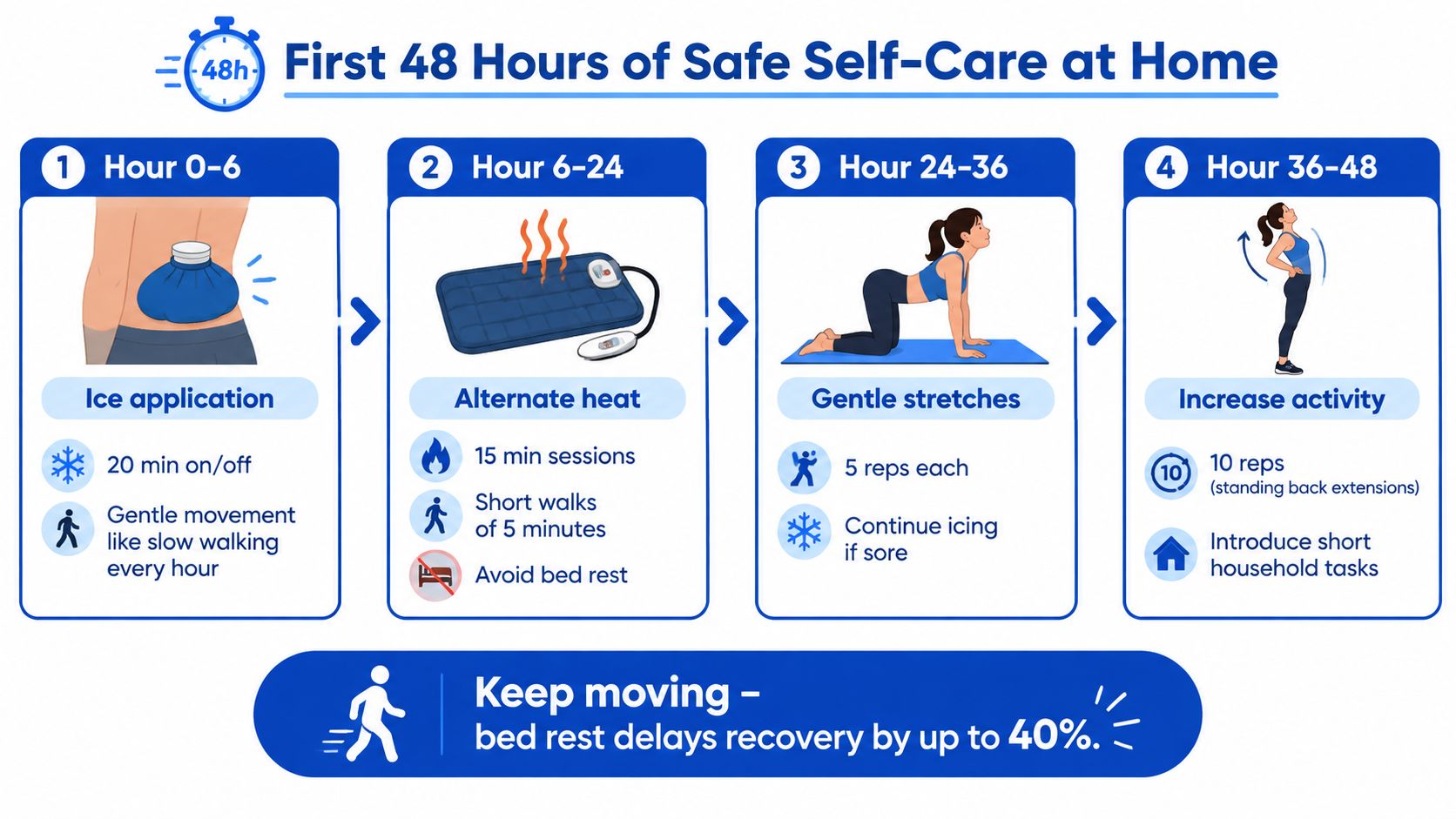
“Keep active” means small, repeatable doses. It does not mean cleaning the whole house or taking a long walk while limping and bracing.
- Walk briefly around the house every hour or 2. A few trips between rooms are preferable to staying on the couch, then attempting one demanding task.
- Change position regularly. Alternate sitting and standing, or lie down briefly before returning to an easy activity.
- Try gentle pelvic tilts. Lie on your back with knees bent, lightly flatten the lower back towards the bed for a comfortable breath, then release.
- Use knee-to-chest rocks only if relieving. Bring one knee towards the chest without pulling hard, then return it slowly.
A pharmacist can advise whether paracetamol or ibuprofen suits you and check interactions, allergies, pregnancy considerations and conditions that make anti-inflammatory medicines unsuitable. Follow the product label or pharmacist's instructions rather than copying another person's dose. Eat and drink normally, and avoid heavy lifting, loaded bending and twisting.
Use the next-morning test to set your pace. A mild increase during movement should settle soon afterwards. If you are clearly worse later that day or the next morning, reduce the amount rather than abandoning movement. Arrange professional assessment if symptoms are not steadily settling, keep returning or prevent ordinary work, sleep or family responsibilities. Seek prompt medical advice for new weakness, significant numbness or changes involving bladder or bowel control.
Stretches and Strengthening Moves You Can Trust
The best beginner routine doesn't attack the painful spot. It gives your hips, thoracic spine, abdominal muscles and glutes more options, so the lower back doesn't have to handle every movement on its own.
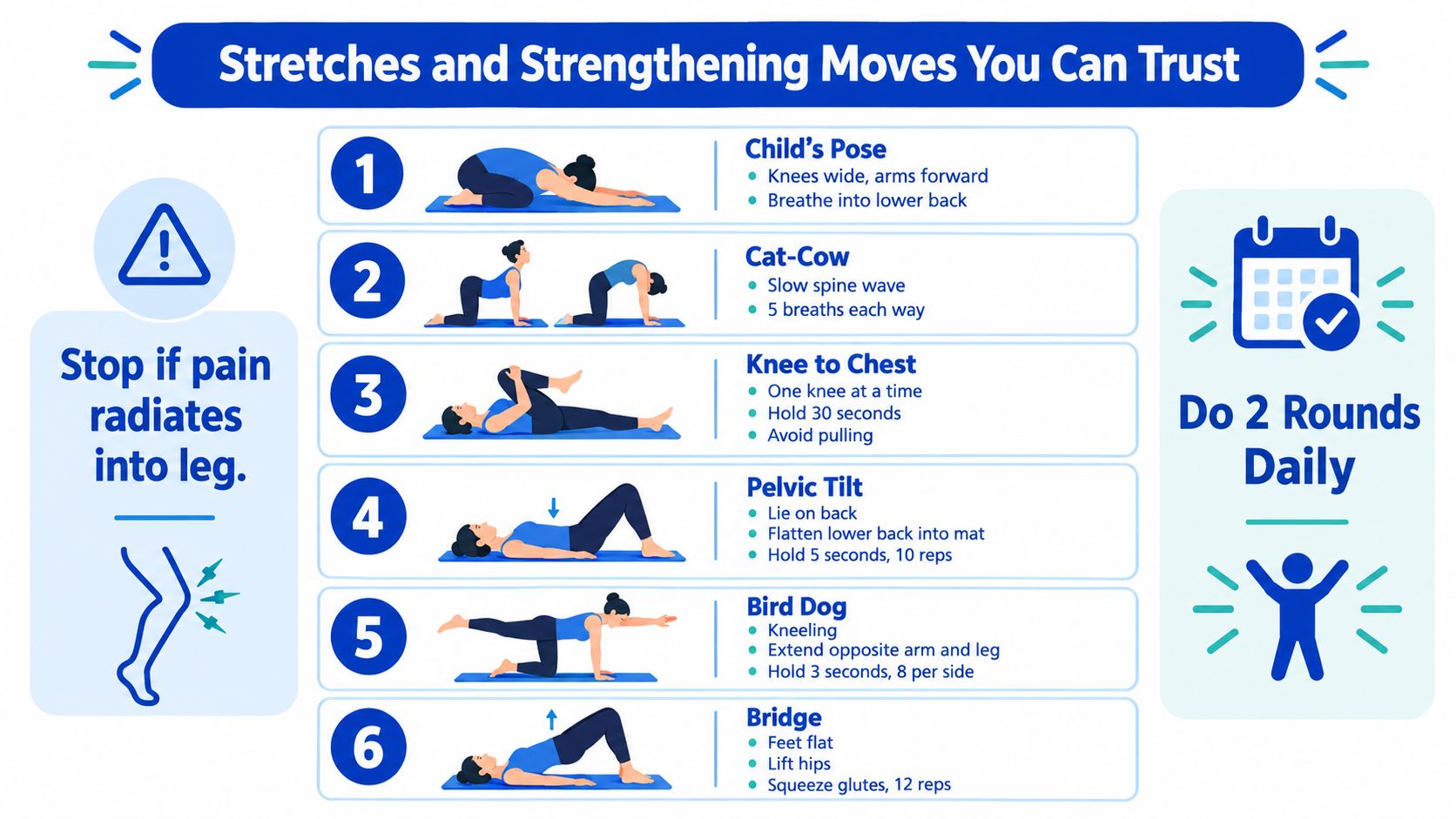
Do the sequence on a firm living-room mat, preferably after a warm shower. Move slowly, breathe continuously and stop short of sharp pain. A short routine once or twice daily is enough to begin.
Start with mobility
- Child's pose: Kneel with your knees comfortably apart and sit your hips towards your heels. Reach your arms forward, lengthen through the spine before settling down and take 5 slow breaths. Put a cushion under your hips or chest if the floor position feels too demanding.
- Cat-cow: Begin on hands and knees. Exhale as you gently round the spine, then inhale as you allow the chest and tailbone to move in the opposite direction. Make a slow wave through the spine for 5 breaths each way, without dropping heavily into the lower back.
- Single knee-to-chest: Lie on your back with both knees bent. Bring one knee towards the chest and hold for about 30 seconds, keeping the other foot supported if that feels steadier. Don't yank on the leg or force the pelvis to lift.
- Double knee-to-chest: Only add this if the single-leg version is comfortable. Bring both knees in gradually, hold within an easy range and return one foot at a time.
Add control, not force
- Glute bridge: Lie on your back with feet flat and knees bent. Press through the feet, exhale as you lift the hips, squeeze the glutes lightly and lower without dropping. Begin with 8 to 12 repetitions.
- Bird-dog: From hands and knees, brace gently, then extend the opposite arm and leg. Hold for about 3 seconds, return with control and complete 6 to 8 repetitions per side. Keep the pelvis level rather than lifting the leg high.
- Cobra-style extension: Lie on your stomach and place your hands beneath or slightly ahead of your shoulders. Press only as far as comfortable, allowing the chest to rise while the pelvis remains relaxed. Hold briefly and repeat 5 to 8 times. If extension increases leg symptoms, leave it out.
A good home routine should leave you feeling the same or easier afterwards. If pain travels down the leg, produces new tingling or becomes sharper with each repetition, stop that exercise. Bouncing, twisting under load and pushing through a pain spike aren't signs of productive training.
The RACGP guidance on exercise for chronic low back pain describes home programs as a combination of strengthening, stretching and walking. It recommends progressing under guidance rather than waiting for all pain to disappear before moving.
Posture, Workstation and Sleep Setup That Actually Helps
Posture rarely causes a back episode by itself. The more common problem is staying in one position for too long, then asking a stiff body to lift, drive or exercise without preparation. The fix isn't to hold a rigid “perfect” posture all day. It's to make your usual positions easier to change.
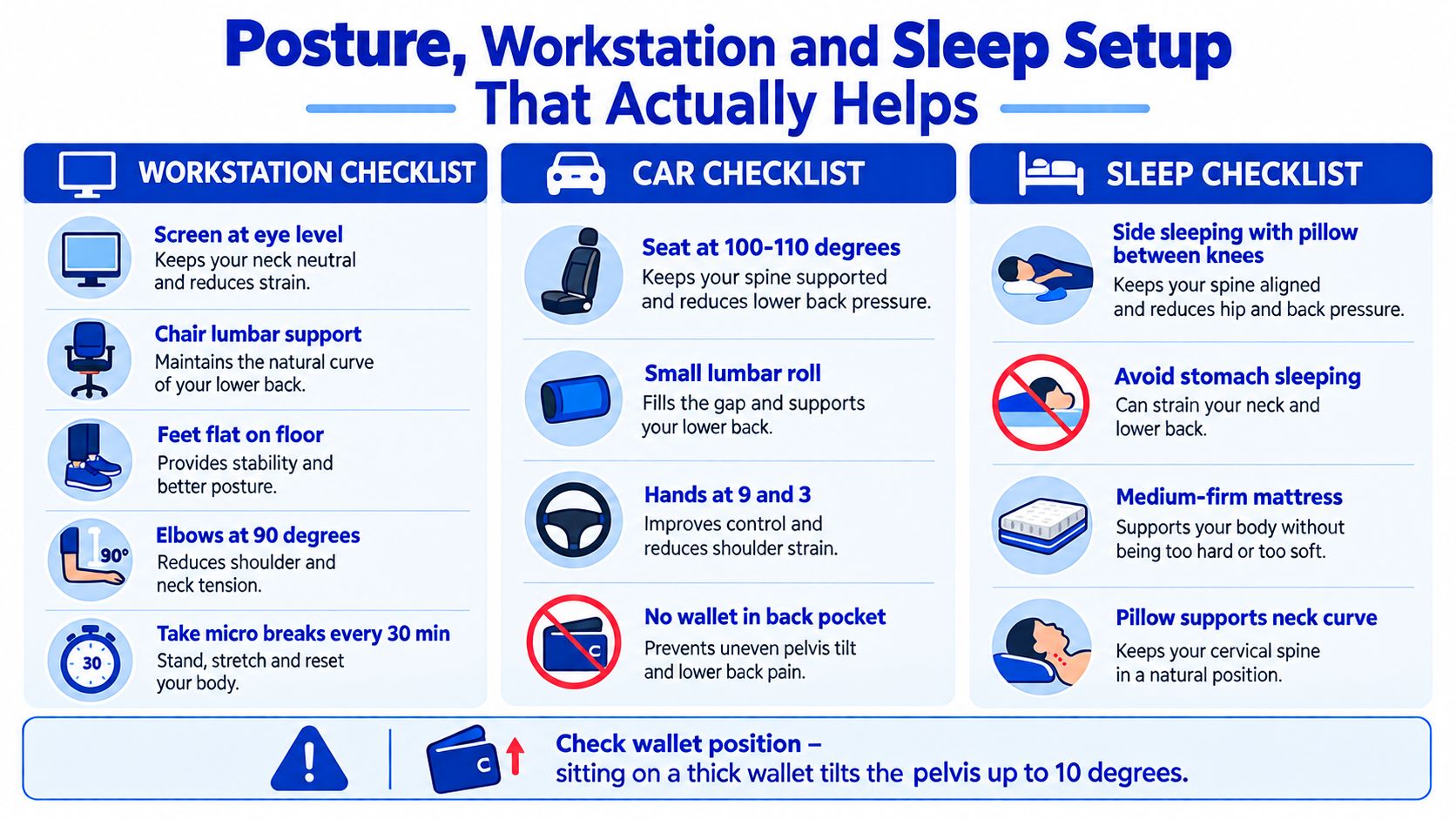
At a desk, raise the monitor so your eyes meet the upper part of the screen without a sustained neck bend. Set the chair so your hips sit slightly higher than your knees, keep both feet supported and allow your forearms to rest roughly parallel to the floor. A rolled towel placed at the natural lumbar curve can provide useful feedback and support without requiring an expensive chair.
Change the position, not just the furniture
Remote workers often improve their chair and then remain seated for hours. Set a timer, use a phone call as a reason to stand or place frequently used items just far enough away that you need to change position. The Bayside workstation posture guide can help you review the arrangement visually.
In the car, bring the seat close enough that you aren't reaching through the shoulders. Keep the seatback comfortably supported rather than dramatically reclined, and use a small lumbar roll if the lower back feels unsupported. Remove a bulky wallet from the back pocket, since it can tilt the pelvis and make one side work harder.
Sleep should feel supported rather than prescribed. Side sleepers often benefit from a pillow between the knees, while back sleepers may prefer support under the knees. Choose a mattress that feels stable without creating pressure points, and use a pillow that supports the neck rather than pushing the head sharply forward.
Run a simple audit this week. Note when your symptoms are worst, then check what happened beforehand. If the pattern follows video meetings, long drives, feeding a child or a particular sleep position, change that one variable first. One useful adjustment repeated daily is more valuable than buying several products you don't use.
Adapting Home Relief for Older Adults and Arthritis
The core principles remain the same, but the delivery needs to fit the person. A floor routine that suits a younger, confident mover may be unsafe for someone with balance concerns, knee arthritis or difficulty getting up from the ground.
| Reader profile | Key adjustments to home plan | Watch out for |
|---|---|---|
| Older adults | Use a chair, wall or kitchen bench for support. Begin with standing mobility and short walks. | Loss of balance, sudden weakness or difficulty rising after floor exercises |
| People with arthritis | Use heat before movement, keep ranges gentle and choose shorter, frequent sessions. | Forcing a stiff joint or continuing when swelling and irritability build |
| Desk-based workers | Break up sitting, alternate sitting and standing, and include hip mobility. | Repeating the same seated position through an entire work block |
| Parents lifting children | Bring the child close, bend through the hips and knees, and turn with the feet rather than twisting. | Repeated one-sided carrying, lifting from the floor while rotated, or rushing |
For an older adult, “keep moving” might mean several supported standing sessions rather than a long walk. Hold the bench lightly, practise weight shifts and use a stable chair for sit-to-stand work. Avoid making the person get repeatedly onto the floor if that creates fear or a fall risk.
Arthritis often responds better to warmth and gradual motion than to an intense stretch. Start with small hip and spinal movements, pause before the joint becomes irritated and repeat later rather than trying to complete one demanding session. The Bayside arthritis mobility guide offers a visual prompt for adapting movement.
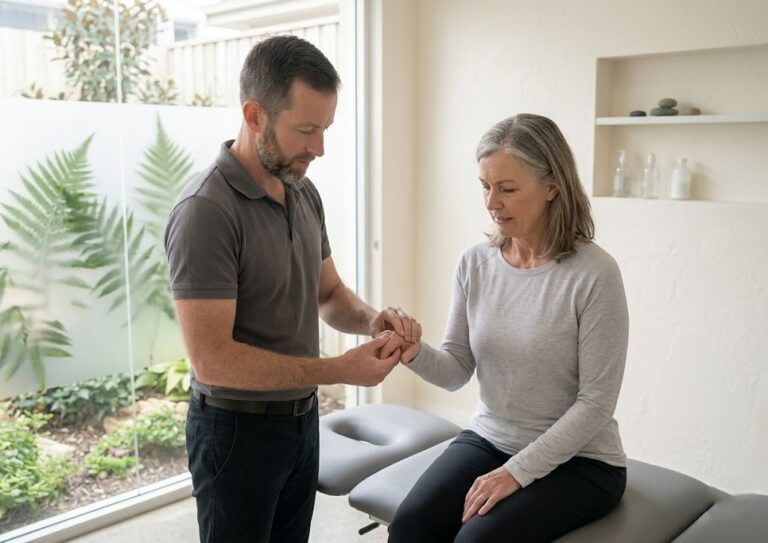
Parents need a lifting strategy they can repeat while tired. Step close to the child, keep the load near your body, exhale as you lift and avoid rotating while rising. If the child needs to move from one side to the other, reposition your feet instead of twisting through the waist.
The same advice changes again for someone with recurring pain. Their priority isn't today's comfort. It's building enough confidence and capacity to handle ordinary work, sleep disruption and family demands without a major flare.
A Weekly Plan for Graded Activity and Pacing
A useful plan starts below your current limit. If a session leaves you feeling that you have finally “done enough”, the workload may already be too high. The RACGP advice on ongoing low back pain supports beginning under your known tolerance, then increasing activity by about 10% each week toward at least 30 minutes on most days. Split that time into shorter blocks around work, school runs or household duties.
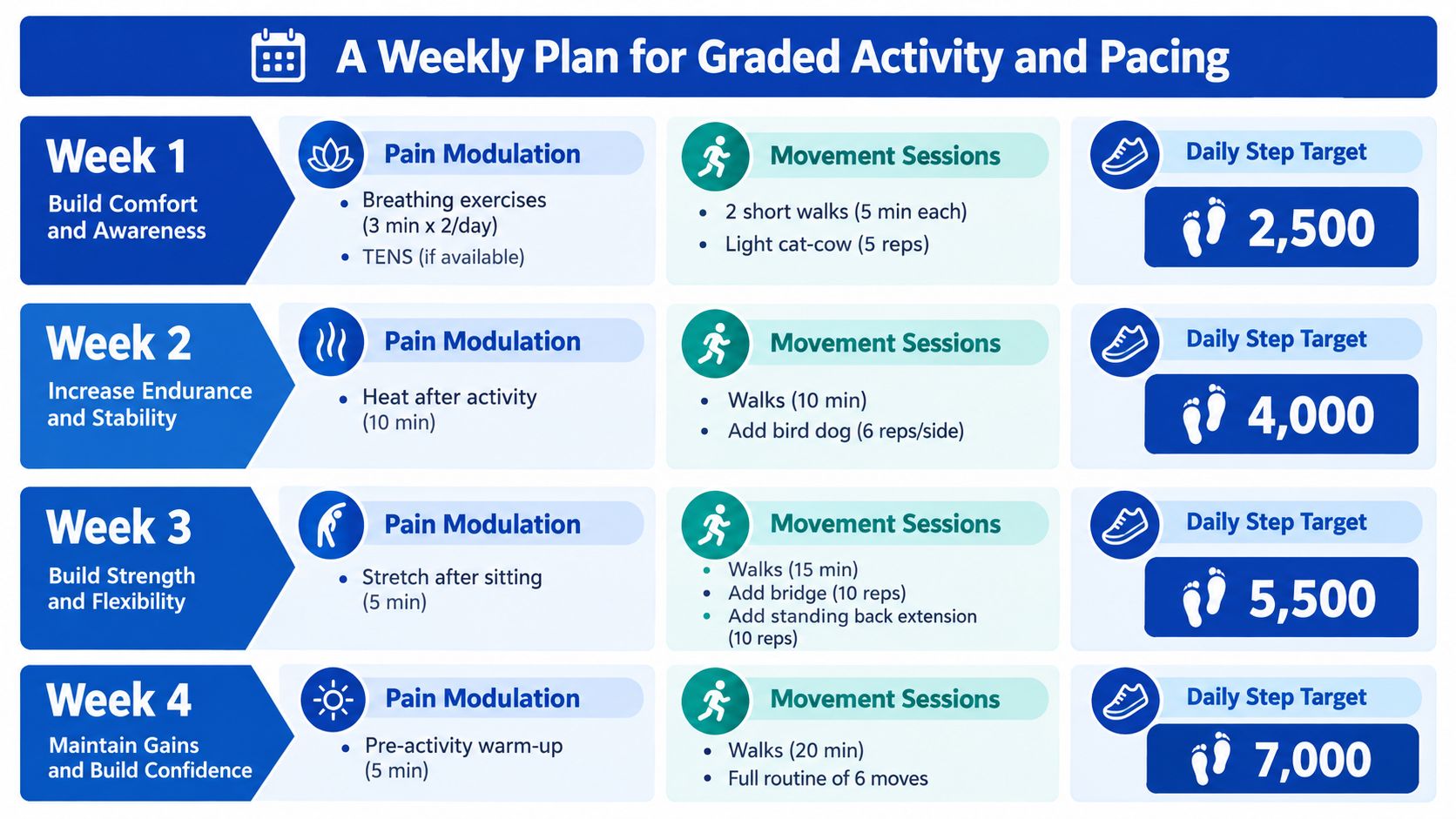
Use this graded activity and mobility plan illustration as a visual reminder to build capacity gradually, rather than testing your back with a sudden heavy job.

Four weeks of controlled progression
Week 1 settles the system. Use comfortable heat or cold, practise relaxed breathing for a few minutes and take two short walks each day. Add a small amount of cat-cow or pelvic tilting if it eases stiffness. Aim for regular practice, not distance.
Week 2 adds range carefully. Continue the short walks and complete one round of your mobility sequence. Cat-cow may work better as three small sets across the day than as one longer session. Keep each repetition below the point where symptoms spike.
Week 3 introduces strength. Perform bird-dog and glute bridges on alternate days. Check your symptoms that evening and the following morning. If the next morning is clearly worse, repeat the same level or reduce the volume. Do not progress because the calendar says to.
Week 4 returns movement to daily life. Extend walking in manageable blocks and reintroduce light shopping, meal preparation or gentle household work. Keep the warm-up, change positions regularly and leave demanding lifting until your recovery is predictable.
At the end of each week, review:
- Pain trend: Is the overall pattern improving, stable or worsening?
- Sleep: Are you settling more easily or waking more often?
- Function: Can you walk, sit, lift or work with less guarding?
- Recovery: Are you back to baseline by the next morning?
- Consistency: Was the plan too demanding to fit around work and family?
Steady progress supports a small increase. A flare that settles by the next morning usually calls for holding the level, not abandoning activity. Pain that remains high, function that declines or symptoms that spread means stop progressing and arrange an assessment. Home care should build useful capacity, not consume the week.
Warning Signs and When to Seek Osteopathic Care
“Stay active” is useful advice for non-specific back pain, but it's incomplete. Home care is appropriate for mild mechanical symptoms that are stable or gradually improving. It isn't a substitute for assessment when the pattern changes.
Seek prompt medical advice for numbness or tingling travelling down a leg, new weakness in the foot, loss of bladder or bowel control, pain after a significant fall or accident, unexplained weight loss, fever with back pain or night pain that repeatedly wakes you. These symptoms need medical assessment, and emergency care may be appropriate for severe neurological changes or loss of bladder or bowel control.
For ordinary flare-ups, use a clear review point rather than waiting indefinitely. If the pain isn't clearly trending better after 14 days of consistent home care, book a professional assessment. Recurring episodes also deserve attention, particularly when each episode reduces your work capacity, sleep or willingness to move.
What an osteopathic appointment involves
A consultation should begin with your history, including how the pain started, what aggravates it, your general health and any relevant injuries. The practitioner then observes movement and may perform orthopaedic or neurological testing to understand which activities are limited and whether referral is needed.
Hands-on care may include soft-tissue techniques, joint articulation and gentle mobilisation, depending on the findings and your comfort. The practical part matters just as much. You'll usually leave with a home program, advice about pacing and specific changes to work, lifting or sleep.
Australian osteopaths are AHPRA-registered primary care practitioners. Osteopathy can complement GP, physiotherapy and other allied health care, and an osteopath can refer for imaging or medical review when clinically indicated. It shouldn't replace urgent assessment for red flags.
Escalation ladder: Use home care for mild, improving mechanical pain. Arrange an osteopathic assessment for persistent or recurring symptoms. Choose GP or emergency care when warning signs appear.
Australia's long-term burden makes this decision increasingly relevant. Recent Australian estimates indicate that 2.95 million people had long-term back problems in 2024, with a projection of 3.26 million by 2033, as reported in Healthdirect's low back pain information. The aim of home care isn't merely to make pain quieter. It's to preserve movement, sleep, work capacity and confidence, while recognising when you need skilled help.
If your back pain keeps returning, Bayside Osteopathic Health can assess how you move, provide gentle hands-on treatment and build a practical home program around work, family and daily activity. Visit Bayside Osteopathic Health to arrange an appointment and get a clear next step for your back pain.