

Osteopathy may ease sacroiliac-region pain and support movement for some people as part of active care, but it isn't a proven cure, so expectations should stay realistic. If standing up after sitting brings a sharp catch across your lower back or buttock, gentle hands-on care may be one part of a plan to help you move more comfortably.
That moment can be unsettling. You might feel fine while sitting, then wince as you rise, roll over in bed, climb stairs or step out of the car. The pain's location can make it seem as though one joint has slipped out of place, but symptoms around the pelvis don't reliably tell you exactly which structure is responsible.
A careful assessment looks beyond the sore spot. It considers how your back, hips and pelvis move, what activities aggravate your symptoms, and whether anything needs medical attention first. The aim isn't to promise a quick fix. It's to find a sensible way to ease irritation, build confidence in movement and return to the things you need or enjoy doing.
Table of Contents
- When SI Joint Pain Hijacks Everyday Movement
- Understanding How Your Sacroiliac Joints Work
- How an Osteopath Assesses SI Joint Pain
- Gentle Hands On Techniques Used for Relief
- What Results to Expect and What Evidence Shows
- Safety Red Flags and When to Seek Care
- Getting Help in Bayside and Next Steps
When SI Joint Pain Hijacks Everyday Movement
You sit through a meeting, stand up to refill your water and feel a sharp ache near one side of your buttock. A few steps help, but later you notice the same catch climbing the stairs or turning over in bed. When pain keeps appearing during ordinary transitions, it can be hard to know whether to rest, stretch or seek treatment.
Pain near the sacroiliac joint, often shortened to SI joint, can feel localised to one side of the lower back or buttock. It may also seem to spread towards the hip or thigh. Those sensations don't prove that the SI joint itself is the source, because nearby muscles, hip joints and the lower back can produce overlapping symptoms.
The short answer to “Can osteopathy help sacroiliac joint pain?” is that it may help some people manage symptoms and move more comfortably. The best way to think about it is as one possible part of conservative care, alongside activity advice and exercise, rather than a guaranteed way to fix the joint.
A useful starting point: Pain is real, but it doesn't automatically mean a bone or joint has moved out of position.
A Bayside osteopath will usually want to understand what changed before recommending treatment. Did the pain build gradually after long periods of sitting? Did it begin after a new activity, a fall or a change in exercise? What would you most like to do more comfortably, such as walk along the foreshore, sleep without waking, or get out of the car?
Those answers help turn a vague worry into a practical plan. This guide will help you understand what the SI joints do, what an assessment and treatment may involve, what the evidence can and can't say, and when a doctor should assess your symptoms.
Understanding How Your Sacroiliac Joints Work
The SI joints sit where the sacrum, the broad bone at the base of your spine, meets the pelvis. You have one on each side. Together, they help transfer load between your upper body and legs as you stand, walk, lift and change position.
A bridge is a useful analogy. The spine and pelvis are like two sides of a structure that must share weight, while the SI joints help connect them. They also work a little like shock absorbers, allowing small amounts of movement as your body handles the repeated impact of everyday activity. The joints aren't designed to swing freely, but they aren't completely motionless either.

Pain in this region can develop when the area becomes sensitive to a particular combination of load and movement. For example, sitting for a long time may leave you stiff, while repeated lifting, a change in walking routine or reduced strength and conditioning may make familiar movements feel more demanding. During pregnancy, changes in posture, load and ligament behaviour can also affect how the pelvis and surrounding muscles manage movement. Arthritis-related stiffness may be another factor.
None of these possibilities confirms a diagnosis by itself. A sore spot near the back of the pelvis isn't a reliable map of the exact tissue involved. Think of it less as a loose hinge that must be forced back into place, and more as a working area that may need its load adjusted and its movement rebuilt gradually.
That distinction matters because hands-on treatment shouldn't be sold as a permanent anatomical correction. Australian guidance supports time-limited manual therapy, including massage or joint mobilisation, for short-term relief as an addition to active care rather than a stand-alone fix for a supposedly misaligned joint (Australian Physiotherapy Association guidance on back pain). For many people, the more useful question is not “How do I put the joint back?” but “What helps this area tolerate movement again?”
How an Osteopath Assesses SI Joint Pain
An assessment should feel like a conversation and a series of manageable movement checks, not a test you have to pass. Your osteopath will ask when the pain began, where you feel it, what makes it better or worse, and how it affects daily activities. They'll also ask about your health history, previous injuries, medications and any symptoms that could call for medical review before hands-on treatment.
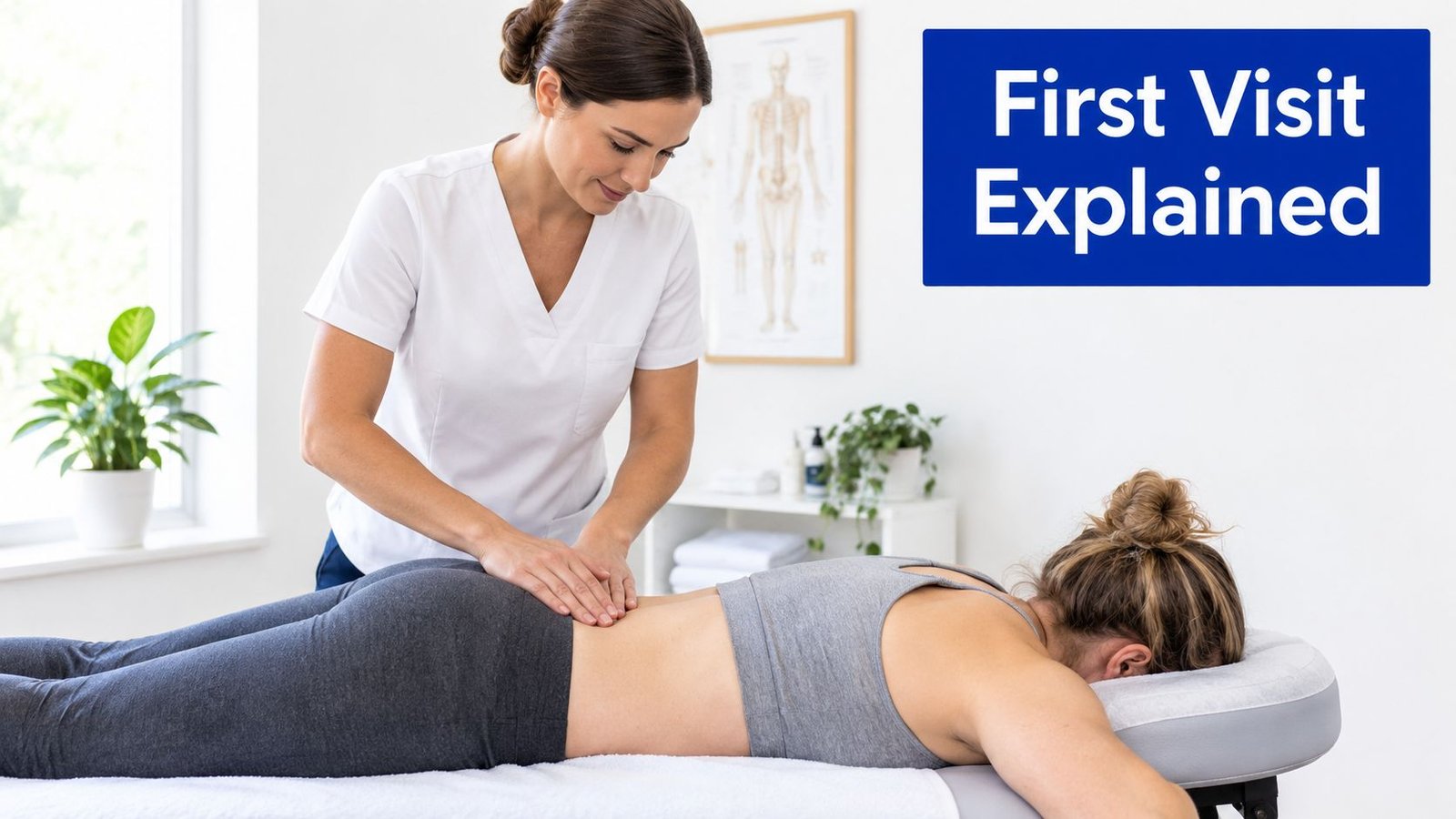
Next, the practitioner may observe how you walk, sit, stand, bend or move between positions. They might check how your lower back and hips move, and gently feel around the relevant muscles and joints for tenderness or tension. If they use SI-region provocation tests, they'll interpret them as part of a broader clinical picture, not treat one test as proof of the cause.
Why the assessment includes more than the sore joint
The pelvis works with the rest of the body. A stiff hip, sensitive lower-back area or change in how you load one leg can influence what you feel around the SI region. That's why a whole-body assessment can include the lumbar spine, hips and, where appropriate, other parts of the spine rather than focusing only on the point that hurts.
A good clinician should explain what they're checking and ask for your consent before any examination or treatment. You can say if a movement feels uncomfortable, ask for a pause, or decline a technique. Shared decision-making means the plan should fit your goals and preferences, not just the practitioner's preferred approach.
Progress is easier to judge when you agree on practical markers. You might track how far you can walk before symptoms build, whether sitting through a meal feels easier, how often pain interrupts sleep, or whether you can return to a valued activity. Those measures give you and your practitioner something concrete to review and help determine whether the approach is useful.
The video below offers another view of osteopathic care and hands-on assessment.
An assessment should also identify when an osteopath isn't the right first stop. If your history or symptoms suggest a condition that needs medical investigation, the practitioner should explain that and help direct you to appropriate care.
Gentle Hands On Techniques Used for Relief
Treatment should be chosen for your symptoms, comfort and health history. It doesn't have to involve forceful twisting or a dramatic crack. Many approaches use gentle contact and are adjusted as you respond.
| Technique | Purpose | What to expect |
|---|---|---|
| Soft-tissue work | Ease tension or protective muscle guarding around the lower back, buttocks and hips | Gentle pressure or massage. Tell your osteopath if pressure feels too strong. |
| Joint articulation | Encourage comfortable movement through small, repeated motions | Rhythmic movement within a range that feels manageable. |
| Gentle mobilisation | Address stiffness in relevant spinal or pelvic areas | Slow, controlled movement. You can ask for a lighter touch or a different position. |
| Exercise and movement advice | Help you gradually rebuild tolerance for daily tasks | A tailored activity plan, which may include trunk or hip exercises and adjustments to aggravating movements. |
Soft-tissue treatment may feel like massage around a tender area, but the aim isn't to “break up” anything. Articulation and mobilisation involve guided movement rather than a forceful thrust. Your osteopath should describe the technique beforehand and check how it feels during treatment.
Hands-on care is only one part of the toolkit. If sitting for long spells aggravates your symptoms, a practitioner might suggest changing position more often. If walking feels uncomfortable, you could discuss a tolerable starting distance and build from there. Exercises for the trunk and hips may also help you practise controlled movement and gradually increase what the area can manage.
There isn't one routine that suits everyone. Age, frailty, pregnancy, osteoporosis risk, blood-thinning medication, a recent injury and neurological symptoms can all affect which techniques are appropriate. A gentle approach may be more suitable than a stronger technique, or the safest next step may be to check with a GP first.
Ask before treatment: “What are you planning to do, what should it feel like, and what will we do if it aggravates my symptoms?” A clear answer helps you make an informed choice.
What Results to Expect and What Evidence Shows
The most relevant Australasian review is cautious. Commissioned by New Zealand's Accident Compensation Corporation, it identified 84 studies, including 24 systematic reviews, 38 controlled trials and 19 observational studies. Its conclusion was that evidence for osteopathic manipulation in SI joint dysfunction was “weak or very weak”, with findings focused mainly on short-term pain and disability rather than lasting recovery (ACC osteopathy evidence review summary).
That doesn't mean hands-on care can't help an individual. It means the research doesn't support presenting osteopathy as a proven cure for SI joint pain or claiming it reliably outperforms other conservative options. Much of the wider osteopathy evidence concerns non-specific low-back pain, which isn't the same as confirmed SI joint pain.
A broader evidence overview reported a small reduction in pain for osteopathic manipulative treatment compared with standard care in a pooled analysis of six randomised trials involving 728 participants. The review also described moderate-quality evidence and low heterogeneity, but those results relate broadly to low-back pain and related conditions, not proof of a specific effect for SI joint pain (overview of osteopathic manipulative treatment evidence).
What a useful treatment trial looks like
A sensible plan is time-limited and reviewed against your goals. Rather than promising a particular result, you and your osteopath can agree on what you'll monitor, such as easier sit-to-stand movement, longer comfortable walks, less disruption to sleep or a gradual return to exercise.
If those changes aren't happening, the plan should be reconsidered. That might mean shifting more attention to exercise and self-management, coordinating with a physiotherapist, or asking your GP whether further assessment is appropriate. Improvement in symptoms is worthwhile, but durable progress also means being able to do more without relying on repeated hands-on treatment alone.
Safety Red Flags and When to Seek Care
Pain around the pelvis often relates to movement and load, but don't assume that every episode is routine soreness. A new symptom after a major accident, or pain accompanied by signs of illness or nerve changes, deserves medical attention rather than a trial of manual treatment.
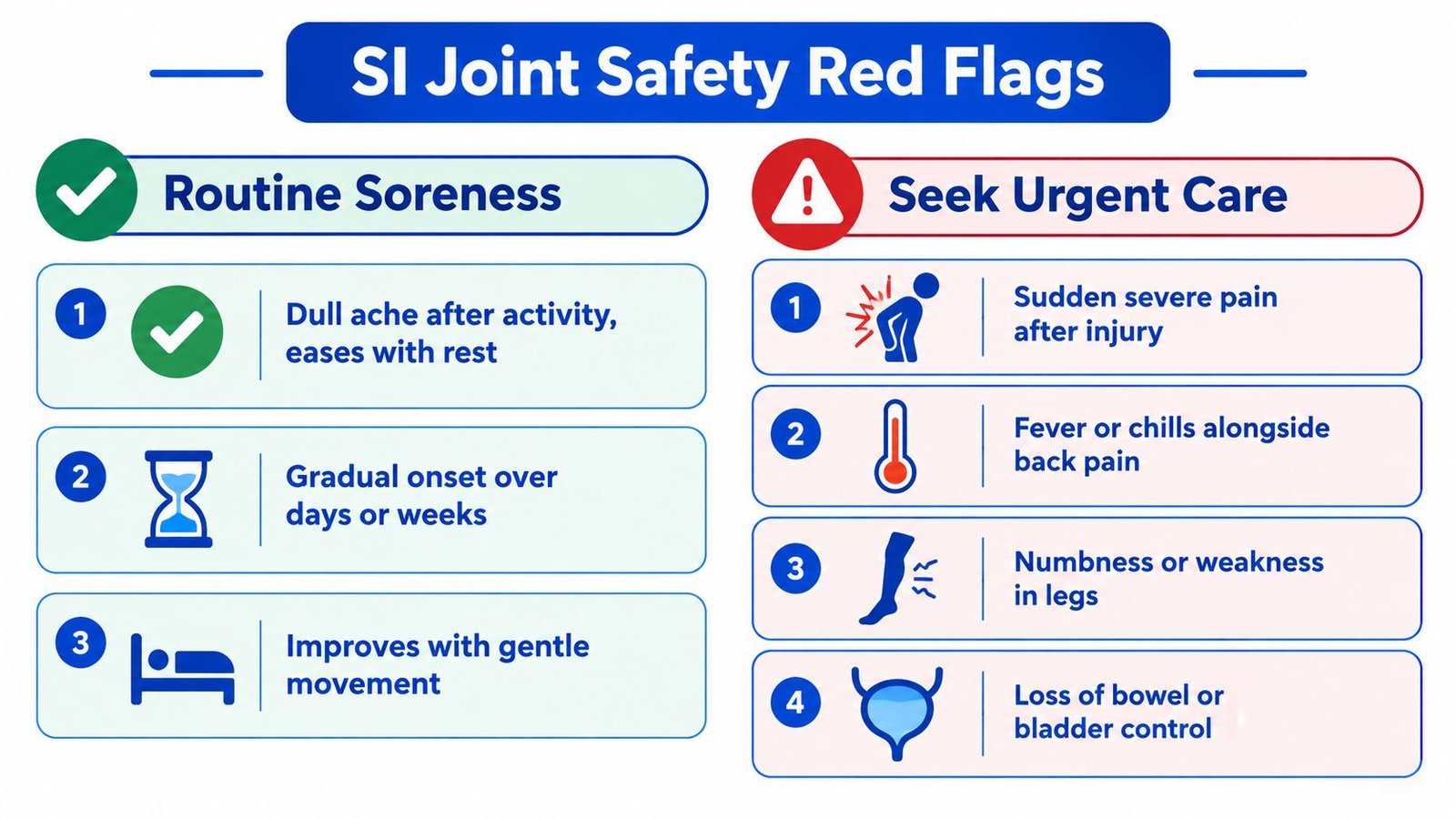
Seek urgent medical advice for severe pain after major trauma, fever, unexplained weight loss, progressive weakness, changes in bowel or bladder control, or persistent night pain. These symptoms don't establish a particular diagnosis, but they do warrant assessment. If symptoms are rapidly worsening or you feel seriously unwell, contact urgent medical services.
For other concerns, book a GP appointment before hands-on care if you have pain travelling down the leg with neurological symptoms, a recent injury, or symptoms that aren't settling with appropriate conservative care. NSW guidance includes red-flag assessment in acute low-back-pain care, while RACGP guidance recommends further investigation where radicular pain, neurological signs, red flags or failure of non-operative care are present (NSW acute low-back-pain guidance).
Factors that change treatment choices
Tell your clinician if you have osteoporosis, take anticoagulant medication, are pregnant, have had recent trauma or experience numbness or weakness. These details don't automatically rule out treatment, but they matter when deciding what is safe and whether a medical review should come first.
Gentle mobilisation and soft-tissue work aren't the same as high-velocity manipulation. Your practitioner should explain the proposed approach and adapt it to your circumstances. You can also choose not to have a technique, or stop a treatment if it feels wrong.
If you're unsure where to start, use this simple guide:
- Book an osteopathic assessment when symptoms seem linked to movement and you have no warning signs, and you want help with activity, mobility and conservative care.
- Speak with your GP first when symptoms are persistent, worsening, travelling with nerve changes, or affected by a medical condition or medication.
- Seek urgent medical attention for serious warning signs, especially loss of bowel or bladder control, progressive weakness, fever with back pain or severe pain after an injury.
Getting Help in Bayside and Next Steps
A practical plan begins with the activity you want back. If getting out of a chair hurts, your first goal might be to make that transition easier. If walking is the problem, you could start with a manageable route and adjust the pace or distance according to how your symptoms respond. Small, repeatable changes are often more useful than stopping all movement and waiting for pain to disappear.
At home, try breaking up long sitting spells with comfortable movement. Notice whether a particular chair, stride length or sleeping position consistently aggravates symptoms, and adjust one thing at a time. You don't need to push through sharp or escalating pain to prove that you're making progress.

A Bayside appointment can bring together a whole-body movement assessment, appropriately selected hands-on care, activity guidance and practical home exercises. Bayside Osteopathic Health provides osteopathic assessment and treatment for sacroiliac joint dysfunction and lower-back pain, with care suited to the person rather than focused only on the sore spot. If you have an eligible GP plan, ask your GP or clinic whether Medicare options apply to your circumstances.
The aim is a plan you understand and can take part in. Ask what the practitioner thinks may be contributing to your symptoms, what each treatment is intended to do, what you can practise at home and how you'll review progress. If the assessment suggests another clinician should be involved, a GP or physiotherapist can help coordinate the next step.
You don't need to decide that your SI joint is out of place before seeking help. Start with the movement that's hardest today, take note of what changes it, and choose a clinician who listens, explains options and supports active self-care.
If SI-region pain is making sitting, walking or getting up from a chair difficult, book an assessment with Bayside Osteopathic Health to discuss gentle, care and practical steps for moving more comfortably. Bring your questions and the activities you'd like to return to, so you can work together on a clear plan.