
You've booked an osteopathy appointment for a stiff neck or aching back, and the practitioner mentions mobilisation and manipulation. You may wonder whether one is safer, stronger, or more effective than the other, especially if you've heard that manipulation can produce a clicking or popping sound.
The difference between mobilisation and manipulation isn't “gentle treatment versus forceful treatment”. Both are skilled hands-on techniques, but clinicians choose between them according to how irritable your symptoms are, how restricted the joint feels, your health history, your preferences, and the outcome you're trying to achieve. Exercise, advice, and self-care also matter, because hands-on treatment works best as part of a broader plan.
Table of Contents
- What to Expect from Hands-On Osteopathic Care
- Understanding Mobilization and Manipulation Techniques
- When Each Technique Is Used in Clinical Practice
- What the Evidence Says About Recovery and Outcomes
- Safety Considerations and Who Should Avoid Certain Techniques
- How Bayside Osteopathic Health Personalizes Your Treatment
What to Expect from Hands-On Osteopathic Care
You arrive at an osteopathy clinic with a backpack over one shoulder, a sore neck from desk work, or a lower back that's been grumbling for weeks. At reception, you may already be thinking about what will happen on the treatment table. Will the osteopath stretch the area, press into tight muscles, move your joints, or use a quick thrust?

A consultation usually starts with questions about your symptoms, daily activities, previous injuries, medical history, and goals. Your osteopath may watch you walk, turn your head, bend, reach, or stand. They're not only locating the painful spot. They're considering how different parts of your body move together and whether the painful area is sensitive, stiff, guarded, or affected by another movement problem.
Hands-on care is broader than one technique
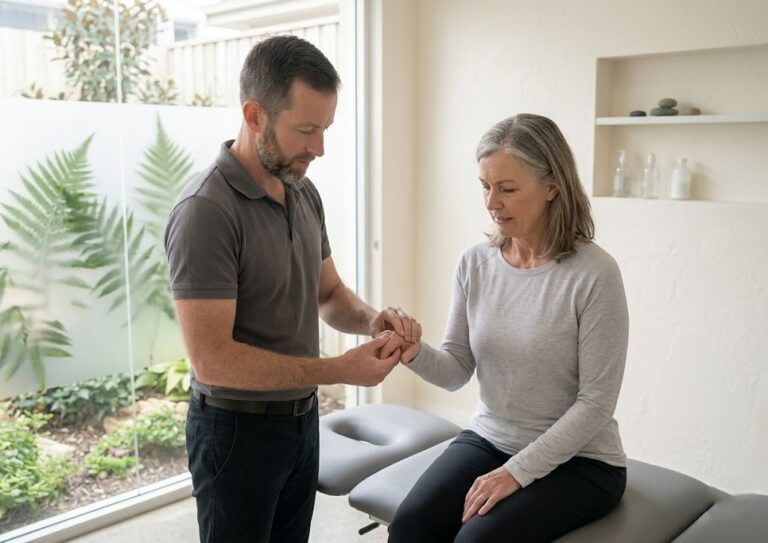
Mobilisation and manipulation are two manual approaches within osteopathic care. They may be combined with soft-tissue work, joint articulation, stretching, breathing strategies, and movement advice. The treatment choice can change during the appointment if your response suggests that a technique isn't the right match.
A person with a freshly irritated neck may feel worse if treatment is too ambitious. Someone with a long-standing, stiff mid-back may tolerate a more direct approach, provided screening shows it's suitable and they're comfortable proceeding. The same technique isn't automatically appropriate for every person with the same diagnosis.
The practical question isn't “Which technique is strongest?” It's “Which approach gives this person a useful, safe response today?”
Your osteopath should explain what they're recommending and why. You can ask whether the technique is a mobilisation or manipulation, what you might feel, whether an audible release is likely, and what alternatives are available. You can also decline a technique. Consent remains part of good clinical care throughout the appointment, not just at the beginning.
The aim is usually functional. You might want to turn your head more easily, sit through a workday, sleep with less discomfort, walk more confidently, or return to exercise. Hands-on treatment may help create a window in which movement feels easier, but your longer-term plan often includes active exercises and practical changes that help you use that improvement.
Understanding Mobilization and Manipulation Techniques
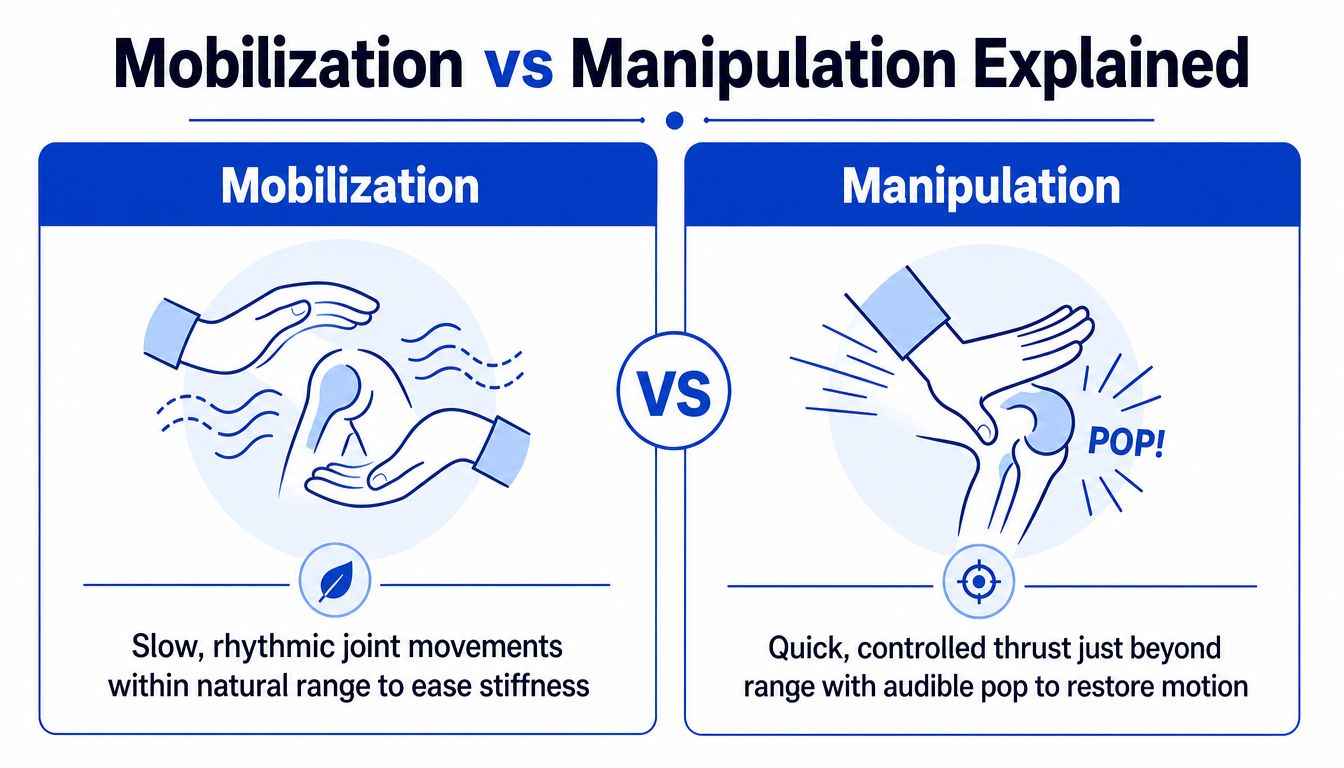
The clearest way to understand these techniques is to compare speed, force, and range. Both involve a practitioner moving a joint, but they don't use the same movement pattern.
Mobilisation uses a gradual movement
Australian osteopathic and manual-therapy guidance describes mobilisation as passive joint movement within the physiological range. The practitioner may use rhythmic oscillations, gentle rocking, or a sustained glide while monitoring your comfort and the joint's response. The movement is controlled and can be adjusted continuously.
Think of a door that feels stiff on its hinges. You wouldn't slam it open to test whether it works. You'd move it back and forth carefully, noticing where resistance starts and gradually encouraging smoother motion. Mobilisation applies a similar principle to a joint, although an osteopath uses clinical assessment rather than a simple household analogy.
Mobilisation can be used to settle pain, reduce protective muscle guarding, or explore how much movement you can tolerate. The practitioner can change the direction, rhythm, pressure, and range almost immediately. That makes it useful when symptoms are sensitive or when the treatment goal is a measured increase in movement confidence.
Manipulation uses a brief, precise thrust
Manipulation is a higher-velocity, smaller-amplitude thrust delivered at or near the end of range. It's quick and carefully positioned rather than a long, forceful movement. An audible pop may occur, but the sound isn't the purpose of the technique and it doesn't prove that a bone has been “put back into place”.
The key difference is the speed and force profile, not necessarily the practitioner's intention. Both techniques may aim to improve movement and reduce pain, but manipulation delivers its stimulus over a much shorter period. It's generally considered for a stiffer, less irritable presentation when the person has been screened and has given informed consent.
| Feature | Mobilisation | Manipulation |
|---|---|---|
| Speed | Slow or rhythmic | Rapid and brief |
| Movement size | Graded movement within the physiological range | Small-amplitude thrust near the end of range |
| Force delivery | Adjustable throughout the movement | Precise impulse |
| Common reason for choosing it | Pain modulation, sensitivity, or gradual motion tolerance | Stiffness and a suitable, screened presentation |
| Patient control | The practitioner can modify the movement continuously | The thrust happens quickly and requires prior agreement |
Neither approach is automatically superior. The right choice depends on your presentation and the response observed during and after treatment. An osteopath may begin with mobilisation, reassess your movement, and decide that no thrust is needed. In another case, manipulation may be discussed as one option after gentler assessment and treatment.
A short demonstration can make the distinction easier to visualise. The following video provides a visual explanation of manual techniques and joint movement:
If you're also exploring other hands-on approaches, this illustration of myofascial release techniques shows why osteopathic treatment isn't limited to joint-based methods. Soft tissues, joints, breathing patterns, and everyday movement can all form part of the clinical picture.
When Each Technique Is Used in Clinical Practice
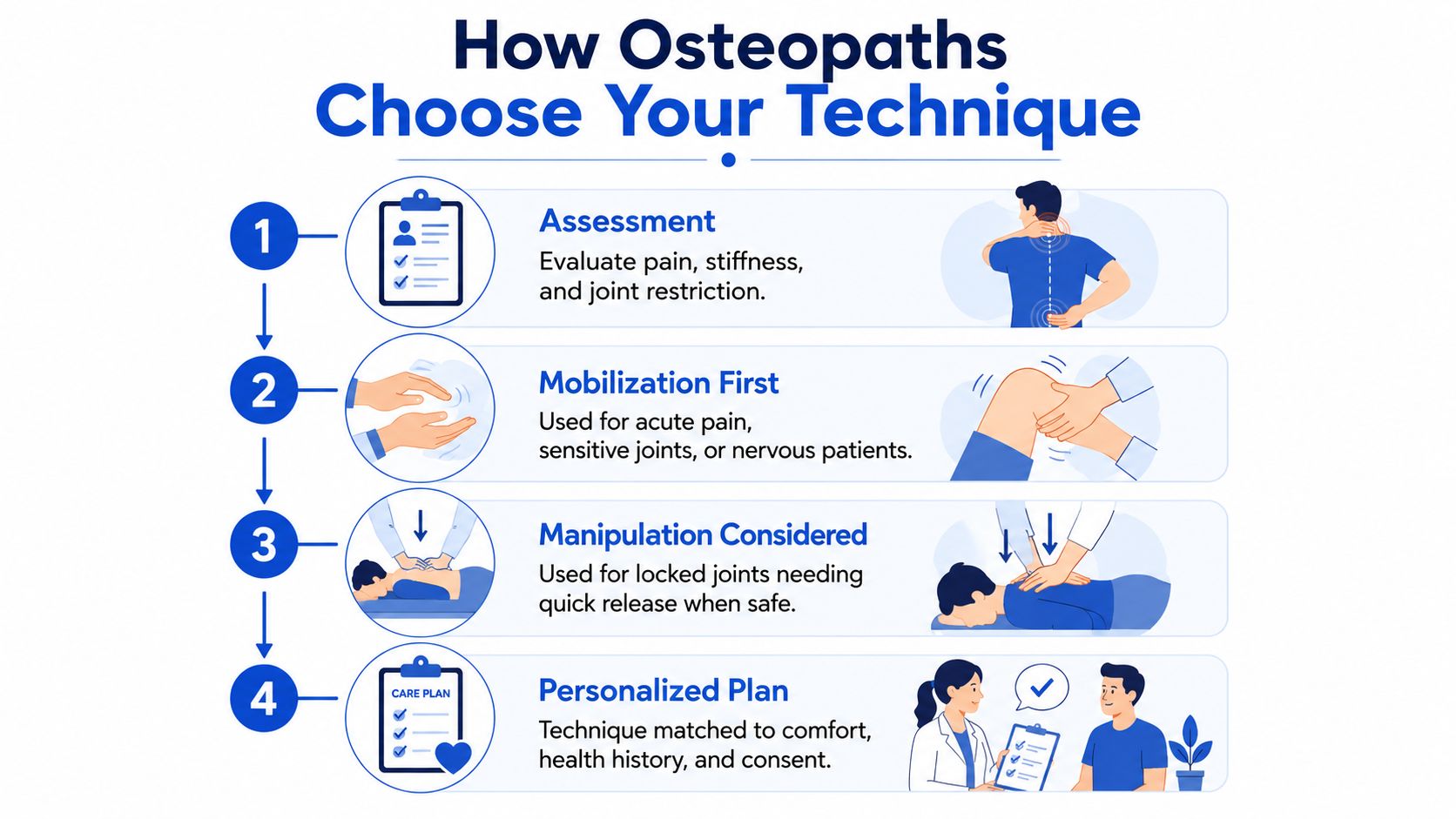
An osteopath doesn't choose between mobilisation and manipulation by looking only at a scan or naming a condition. They assess irritability, stiffness, risk, and treatment goals together.
Irritability describes how easily your symptoms are provoked and how long they take to settle. A highly irritable neck may hurt with small movements and remain aggravated after minor activity. A less irritable but stiff thoracic spine may feel restricted without producing a strong pain response. Those presentations call for different levels of treatment input.
Mobilisation often suits a sensitive presentation
Mobilisation may be favoured when:
- Pain is easily provoked: A slow, graded movement allows the practitioner to stay within a tolerable range.
- Symptoms are recent or reactive: The treatment can focus on easing discomfort and building motion tolerance rather than pushing for a large change immediately.
- You're apprehensive: Some people feel more comfortable with a technique they can experience gradually, without a sudden thrust or expected popping sound.
- The goal is controlled movement: The osteopath can reassess how your range, pain, or task performance changes during the session.
For example, someone with recent neck pain who finds turning to check traffic uncomfortable may benefit from a lower-force approach while the clinician monitors the response. Mobilisation doesn't mean treatment is ineffective or incomplete. It can be the most sensible starting point when the nervous system and surrounding muscles are protective.
Manipulation may be considered for selected stiffness
Manipulation may be discussed when a joint feels notably restricted, symptoms are less irritable, and the person meets the relevant safety criteria. A person with persistent mid-back stiffness who tolerates examination and prefers a quicker technique may choose manipulation after the clinician explains the benefits, limitations, and alternatives.
The technique still isn't a shortcut around assessment. A thrust may be inappropriate if the risk profile is unclear, if the area is highly sensitive, or if the patient doesn't want it. A qualified practitioner should be able to offer a plan that doesn't depend on manipulation.
Australian historical practice data illustrates this graduated approach. In a study of 1,090 cervical treatments, cervical manipulation accounted for 20.2% of treatments, while cervical joint mobilisation accounted for 77.6%. The study also reported that 42% of subjects received manipulation at some point, and that manipulation was commonly combined with passive mobilisation during the same course of care, often later in a 12-treatment programme. These figures come from Australian cervical treatment practice research and describe historical practice patterns, not a rule that applies to every clinic today.
The same reasoning applies to joint stiffness linked with arthritis. A visual guide to arthritis, joint mobility, and anatomy can help explain why reduced movement doesn't automatically mean a thrust is needed. The clinician still has to consider the individual joint, surrounding tissues, symptoms, general health, and what movement you need to regain.
What the Evidence Says About Recovery and Outcomes
Many patients want a simple verdict. Is manipulation better than mobilisation? For recent-onset neck pain, Australian trial evidence doesn't support a universal winner.
A major Australian randomised controlled trial in primary care physiotherapy, chiropractic, and osteopathy clinics in Sydney compared neck manipulation with neck mobilisation for people whose neck pain had lasted less than three months. The median recovery time was 47 days in the manipulation group and 43 days in the mobilisation group. The hazard ratio was 0.98, with a 95% confidence interval from 0.66 to 1.46, indicating no meaningful difference in recovery speed and no superiority of manipulation in that Australian setting, as reported in the Sydney neck pain trial.
What that result means for patients
The finding doesn't mean neither technique can help. It means the label attached to the technique shouldn't drive expectations that one option will reliably produce faster recovery for everyone. People can respond to either approach, and the useful treatment may be the one that matches their tolerance and allows them to move more confidently.
It also helps separate pain relief from functional improvement. You may notice that turning, walking, lifting, or working becomes easier even if some discomfort remains. A treatment plan should track the activities that matter to you, not only whether pain disappears immediately.
Australian evidence summaries support manual therapy for short-term pain and function in some neck and back disorders, but the strongest practical role is usually alongside exercise rather than as a stand-alone intervention. Australian guideline-linked reviews report moderate to strong short-term benefit for manual therapy in acute to subacute low back pain, and moderate evidence for mobilisation plus exercise in acute whiplash-associated disorders, as summarised in this Australian evidence review.
A hands-on technique can make movement feel more available. Exercise helps you practise and keep using that movement.
Recent evidence summaries from PEDro's Australian musculoskeletal evidence resources report that spinal manipulative therapy wasn't better than guideline-recommended interventions for pain at one month or twelve months. A 2026 meta-analysis also found that manual therapy plus exercise didn't significantly improve short-term pain compared with exercise alone, although disability outcomes improved. That distinction supports realistic conversations about what treatment is for. The aim may be better function and participation, not a promise of complete or immediate pain elimination.
Safety Considerations and Who Should Avoid Certain Techniques
A common assumption is that mobilisation is always safe because it's gentle, while manipulation is always unsafe because it's quick. That's too simplistic. Both techniques require appropriate assessment, and the suitability of any manual treatment depends on the body region, symptoms, medical history, and the practitioner's findings.
Manipulation deserves particular care around the neck. The Australian Physiotherapy Association's 2025 cervical factsheet advises avoiding end-range neck positions during high-velocity manipulation, reflecting the need for caution with cervical techniques. You can read the APA cervical safety factsheet for the guidance in full.
Screening changes the treatment decision
Before recommending a thrust, a practitioner should ask about relevant health conditions and symptoms that may alter the risk profile. These can include a history of dizziness associated with neck movement, neurological symptoms, significant bone fragility, vascular concerns, severe or unusual pain, or recent trauma.
Mobilisation isn't an automatic substitute if a thrust is unsuitable. Some medical or joint problems may make particular manual techniques inappropriate altogether. If you have progressive weakness, loss of sensation, severe unremitting pain, problems with balance, or other concerning symptoms, your practitioner may recommend medical assessment rather than proceeding with routine hands-on care.
Older adults and people with arthritis may need a more conservative plan, but age alone doesn't decide the technique. The clinician considers bone health, medication, previous fractures, joint changes, balance, tissue tolerance, and your goals. A slow approach may be sensible, but the specific choice still needs individual assessment.
Consent should be specific
You should know what's being proposed before treatment begins. Ask:
- What technique are you recommending? Ask whether it's mobilisation, manipulation, soft-tissue treatment, or another approach.
- Why does it suit my presentation? The explanation should relate to your symptoms, movement, irritability, and goals.
- What are the alternatives? You can ask whether exercise, advice, or a lower-force technique could address the same goal.
- What should I expect afterwards? Your practitioner should explain how to respond if symptoms change and when to seek further advice.
If you're uncomfortable with a thrust, say so. A patient-centred osteopath can adapt treatment rather than treating your preference as an obstacle. This resource on joint stiffness and pain may also help you discuss the difference between restricted movement and treatment choice during an appointment.

How Bayside Osteopathic Health Personalizes Your Treatment
A useful osteopathic plan starts with your real-life problem, not with a favourite technique. If neck pain stops you reversing the car, the assessment should consider that movement. If back stiffness makes gardening difficult, the plan should relate treatment and exercise to bending, lifting, and getting up from the ground.
The practitioner considers how your body moves as a whole, then selects techniques that fit your symptoms and tolerance. Mobilisation, manipulation, soft-tissue work, joint articulation, and movement advice can all be considered, but none should be added because it's routine.
Treatment should respond to your presentation
A person with a sensitive, recent flare may need a calm, graded approach that builds confidence. Someone with persistent stiffness and low irritability may be offered a different option after screening. The response immediately after treatment matters too. Has your range changed? Is a daily task easier? Did the technique increase symptoms rather than settle them?
That reassessment helps the clinician decide whether to continue, modify, or leave out a technique. It also gives you a clearer way to judge progress. The question isn't whether your joints made a sound. It's whether the plan is helping you move and function in a way that matters.
Your care continues outside the clinic
Hands-on treatment is often paired with simple exercises, pacing advice, posture or workstation adjustments, and self-care strategies. These recommendations should be practical enough to fit around work, family responsibilities, sleep, and activity. If you're managing arthritis or long-standing pain, the plan may focus on maintaining useful movement and confidence rather than chasing a perfect symptom-free state.
Bayside Osteopathic Health provides hands-on osteopathic care using approaches such as soft-tissue work, joint articulation, and gentle mobilisation, alongside movement advice and home self-care strategies. The clinic also provides guidance on Medicare options where applicable, so you can ask about eligibility and how it may relate to your care.
The key lesson is straightforward. Mobilisation and manipulation are different tools, and a skilled osteopath chooses between them according to irritability, risk, consent, and the result you're trying to achieve. If you're dealing with neck, back, or joint pain in the Bayside community, book an assessment to discuss which options suit your body and goals, then visit Bayside Osteopathic Health to take the next step towards easier, more confident movement.