
Medicare can cover osteopathy in Australia, but only for chronic conditions managed through a GP care plan, not for general check-ups or acute flare-ups. If you're dealing with ongoing back, neck, or joint pain around Bayside and trying to work out whether treatment is affordable, the answer is often yes, but only if you go through the right process first.
A lot of people arrive at this question after weeks or months of putting up with pain. It might be the stiff neck that never quite settles, the low back pain that keeps returning after gardening, or the arthritic joint that makes walking along the foreshore less enjoyable than it used to be. By the time they start searching whether Medicare covers osteopathy, they usually want something simple: a straight answer, a clear process, and no surprises at the desk.
That confusion is understandable. Medicare doesn't cover osteopathy in the same way it covers a GP visit. For osteopathic care, Medicare support sits inside a specific pathway for people with longer-term health issues, and your GP is the person who opens that door. Once you understand that, the system becomes much easier to manage.
If you live in Bayside, the practical questions tend to be the same. Do I qualify? What does my GP need to write? How many appointments can I use? Do I still pay something out of pocket? This guide answers those questions in plain English, with the focus on what happens in practice from the GP appointment through to your osteopathy visit.
Table of Contents
- Navigating Osteopathy Costs and Medicare
- Understanding the Chronic Disease Management Plan
- Who Is Eligible for Medicare Rebates
- Your Step-by-Step Guide to Accessing the Rebate
- What Medicare Does and Does Not Cover
- Using Private Health Insurance for Osteopathy
- A Simple Checklist for Bayside Patients
- Frequently Asked Questions About Medicare and Osteopathy
- Can I use all of my referred allied health visits on osteopathy
- Do I need a new plan every year
- Does Medicare cover osteopathy for acute pain
- Can I use a CDM referral and private health insurance for the same visit
- Do I need a referral for ordinary private osteopathy
- What if my GP says no
- Is the rebate paid before or after the appointment
- What should I ask my GP if I'm unsure where to start
Navigating Osteopathy Costs and Medicare
You might already know osteopathy could help, but the cost is the sticking point. That's common with persistent pain. People are often willing to invest in care once they know it's the right fit, but they don't want to start treatment only to discover they misunderstood what Medicare does and doesn't pay for.
A typical Bayside scenario goes like this. Someone has had nagging back pain for months. They've tried resting, changing chairs, stretching at home, and perhaps the odd massage. The pain improves for a few days, then returns. They start looking into osteopathy, then pause when they realise Medicare rules aren't straightforward.
That's where the key distinction matters. Medicare-funded osteopathy isn't general cover for any appointment you choose to book. It's available through a GP-managed pathway for chronic conditions. If your issue is short-term, new, or unrelated to a longer-term medical problem, Medicare usually won't apply.
The practical question most people need answered
The better question isn't, "does Medicare cover osteopathy?" It's, "Can my GP include osteopathy as part of managing my chronic condition?" Once you frame it that way, the next step becomes much clearer.
Practical rule: If your pain has been around for the longer term, or your GP already manages it as an ongoing health issue, it's worth asking specifically about a Chronic Disease Management plan.
What tends to work and what doesn't
What works is booking a proper GP appointment and explaining how the condition affects daily life. What doesn't work is assuming a clinic can create the Medicare pathway for you, or turning up for treatment without the referral paperwork in place.
Patients often feel relieved once they know there is a process, even if it isn't as simple as bulk billing. Clarity matters. If you know the pathway, you can decide whether to use Medicare, private health, or standard private treatment based on your own situation.
Understanding the Chronic Disease Management Plan
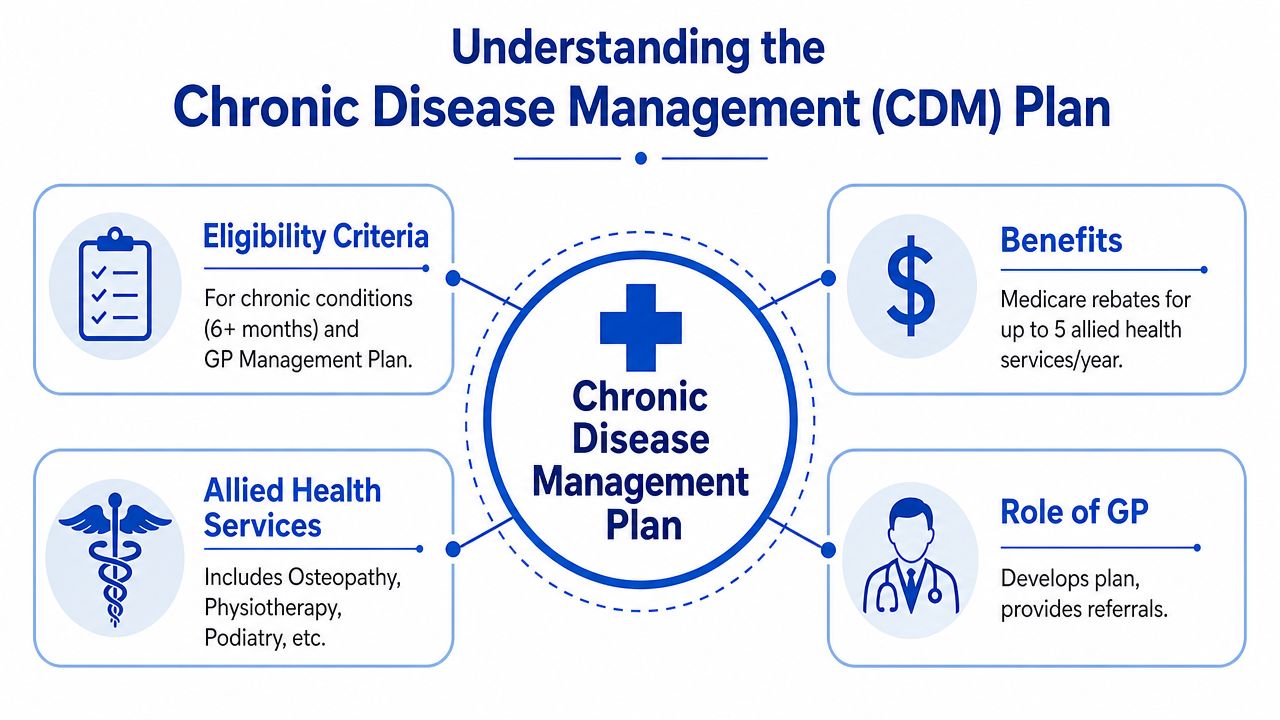
The reason Medicare can contribute to osteopathy is a Chronic Disease Management plan, often shortened to CDM plan. Some people still call it an EPC plan because that was the older name, and you'll still hear that term used in conversation. In practice, people usually mean the same GP-managed allied health pathway.
What a CDM plan actually is
A CDM plan is a structured way for your GP to organise care when you're living with a condition that's ongoing rather than short-lived. The plan isn't just about one provider. It's about coordinated management. Your GP looks at the bigger picture and decides whether allied health input, such as osteopathy, is appropriate.
That point matters because many people assume Medicare offers a standing rebate for osteopathy. It doesn't. The plan is the gateway. Without it, osteopathy is generally treated as a private service or claimed through private health extras if your policy includes it.
A CDM plan also isn't automatic just because a condition has lasted a long time. Your GP still needs to assess your overall health needs and decide whether allied health care belongs in your management.
Why the GP sits at the centre
Your GP isn't just signing a form. They are making a clinical decision about whether your condition fits the criteria for chronic care and whether osteopathy has a legitimate role in that care. That means the most useful GP appointment is one where you clearly explain the pattern of your symptoms, what you've already tried, and how the problem limits function.
A GP referral is mandatory for Medicare-funded osteopathy under a CDM arrangement. You can't self-refer and then claim later.
The GP may also consider whether you need input from more than one allied health provider. That's important because the available services under the plan are shared across allied health, rather than sitting in a separate bucket just for osteopathy.
What this means for osteopathic treatment
From an osteopath's perspective, a CDM referral usually means the consultation is focused on the chronic issue listed by your GP. That could involve assessment, hands-on care, movement advice, pacing strategies, postural guidance, and practical ways to manage flare-ups between visits.
What doesn't work well is using a CDM referral as a vague "wellness" pass. These appointments are intended to support management of a defined chronic condition. The more specific the referral and clinical goal, the more useful the treatment tends to be.
Who Is Eligible for Medicare Rebates
Eligibility starts with one central idea. You need to have a chronic medical condition, meaning a condition that has been present, or is likely to be present, for a longer period rather than a brief episode. In day-to-day practice, that usually means an issue your GP recognises as ongoing and worth managing in a coordinated way.
What counts as a chronic condition
Some readers are surprised that the condition doesn't have to be dramatic or hospital-level to count as chronic. It can be very common, very familiar, and still significantly disruptive. Persistent back pain, arthritis-related stiffness, recurrent neck pain linked to long-term posture issues, or headaches with a musculoskeletal component can all fall into the sort of conversation where a GP considers a CDM plan.
Examples that often come up include:
- Chronic low back pain: Pain that keeps returning or never fully settles, especially when it affects work, sleep, walking, or exercise.
- Osteoarthritis: Joint stiffness and pain that limit mobility and make ordinary tasks harder.
- Persistent neck and shoulder tension: Common in desk workers and remote workers when symptoms have become a longer-term pattern.
- Scoliosis or long-standing postural strain: Particularly when it contributes to pain, movement restriction, or recurrent flare-ups.
- Recurring headaches with a musculoskeletal driver: In some cases, your GP may decide osteopathy belongs in the broader management approach.
Common situations where osteopathy may be included
The key issue isn't whether the condition appears on a public list you found online. The key issue is whether your GP believes allied health treatment is appropriate for your management. That's why two people with similar symptoms may not get exactly the same outcome at the GP clinic.
One person may be managing an occasional problem that doesn't need a formal care plan. Another may have the same pain pattern layered on top of arthritis, reduced mobility, or multiple ongoing health concerns. That second situation is more likely to fit coordinated care.
If you're wondering whether you qualify, don't focus on diagnosing yourself from a list. Focus on whether your condition is ongoing, medically recognised, and affecting daily function.
If your issue is acute, such as a fresh strain after lifting, a sudden sports injury, or a new episode of pain that hasn't yet become a longer-term problem, Medicare usually isn't the pathway. Osteopathy may still help, but it would generally be treated as a standard private consultation.
Your Step-by-Step Guide to Accessing the Rebate
This is the part often sought to be simplified. The process isn't difficult once you know the order, but it does need to happen in the right sequence.
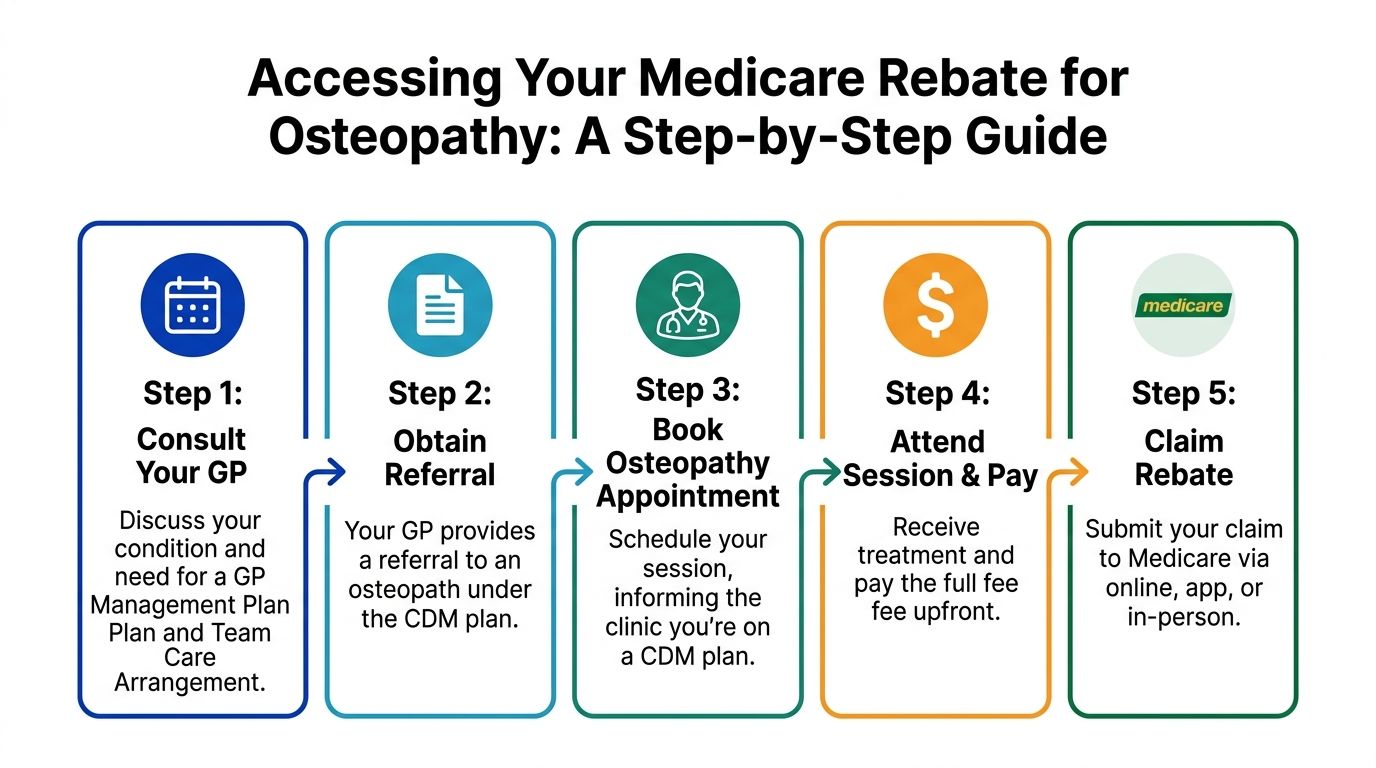
The referral process in real life
Book a dedicated GP appointment
Don't squeeze this into a rushed visit for a script repeat. Ask for enough time to discuss your ongoing condition properly and mention that you'd like to ask whether a CDM plan is appropriate.Explain the history clearly
Tell your GP how long the issue has been going on, what aggravates it, what you've tried, and how it affects work, sleep, exercise, walking, or other daily tasks. GPs make better decisions when they can see the functional impact.Ask whether osteopathy can be included
Be direct. If you think hands-on treatment and movement support would help, say so. Your GP will decide whether osteopathy fits into your broader management.Get the referral paperwork before booking
Often, people overlook this. The referral needs to be organised first. If the paperwork isn't in place, your appointment is usually just a normal private consultation.Book your osteopathy appointment and mention the referral
Let the clinic know you're attending under a CDM referral so they can tell you what to bring and how claiming works.
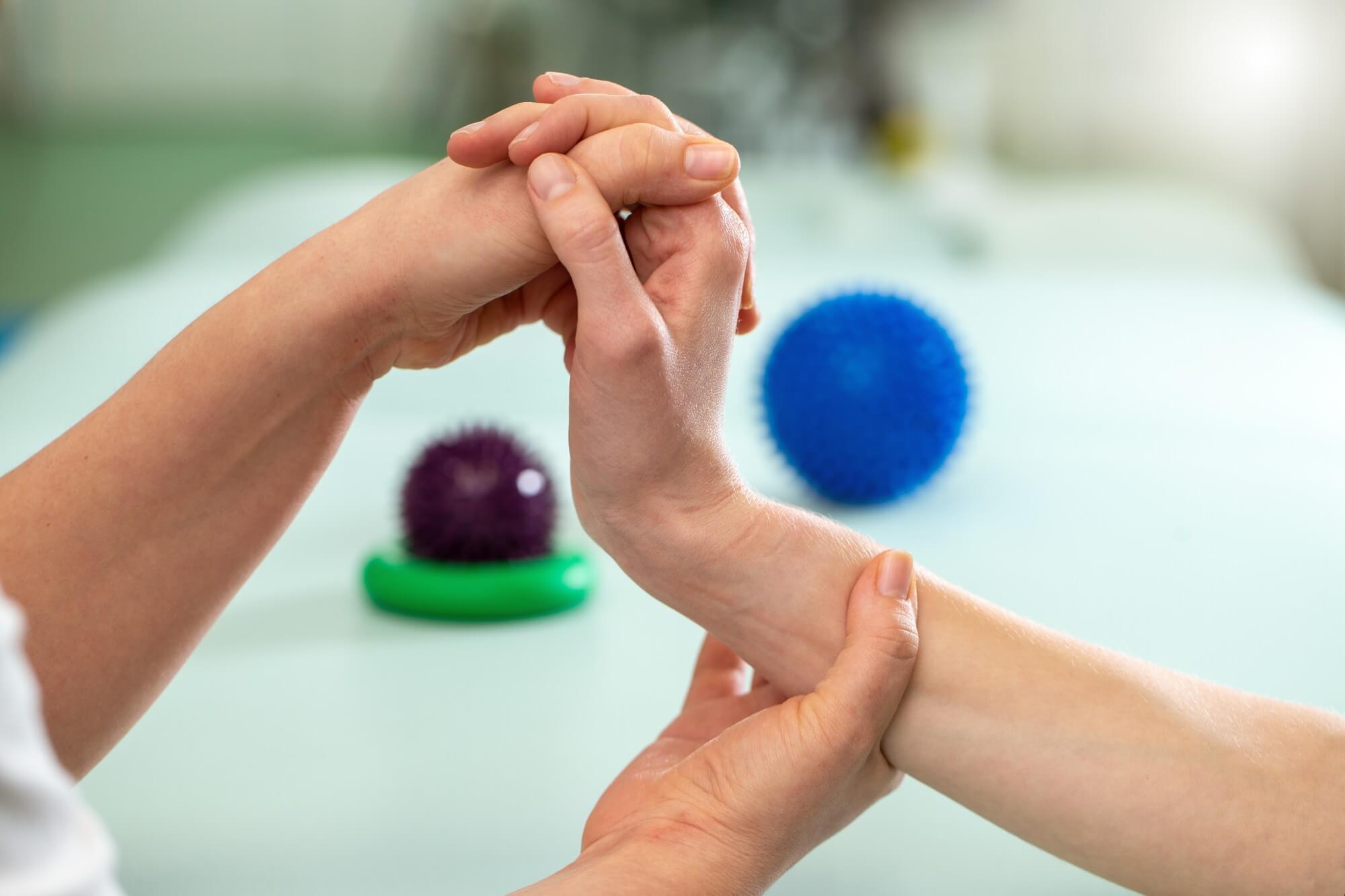
For readers who want a visual overview of musculoskeletal rehabilitation and guided care, this rehabilitation support image for osteopathic care reflects the kind of practical treatment context many patients are looking for.
What to bring and what to expect on the day
Bring your referral paperwork, your Medicare card, and any relevant scan reports or specialist letters if they help clarify the condition. If you've had previous treatment elsewhere, a simple summary of what has and hasn't helped is useful.
At the appointment, the osteopath will usually assess how the condition is presenting now, not just what it was called on paper. That may involve looking at posture, movement, joint restriction, muscle tension, aggravating patterns, and daily habits that keep feeding the problem.
Payment is another point people often ask about. In many clinics, you pay for the consultation first and then process the Medicare claim. Some clinics can help process the rebate on the spot, while others ask you to claim through Medicare afterwards.
What Medicare Does and Does Not Cover
The biggest misunderstanding is thinking Medicare pays for the whole appointment. In most cases, it doesn't. It contributes toward an eligible consultation under your referral, and you may still have an out-of-pocket amount to cover.
What is usually included
When a CDM referral is used for osteopathy, the covered part generally relates to the consultation itself for managing the chronic condition named in the referral. That typically means things such as assessment, treatment planning, hands-on osteopathic techniques, and advice relevant to the condition.
A practical way to think about it is this: Medicare supports a clinically necessary allied health consultation within a chronic care plan. It doesn't function like an unlimited treatment pass.
| Item | Cost |
|---|---|
| Example of Medicare Rebate vs. Consultation Fee (2026) | Costs vary by clinic and referral type |
| Osteopathy consultation fee | Set by the clinic |
| Medicare rebate portion | Set by Medicare for eligible CDM consultations |
| Your gap payment | The difference between the clinic fee and the rebate |
What usually sits outside the rebate
The gap payment is the first thing to expect. If the clinic fee is higher than the Medicare contribution, you pay the difference. That's standard and often catches people off guard only because nobody explained it clearly at the start.
Other items that may fall outside the rebate include:
- Extended appointment time: Longer consultations may attract fees beyond the standard rebated service.
- Products and equipment: Items such as supports, pillows, braces, or home-care tools aren't usually part of the consultation rebate.
- General maintenance visits: If the appointment isn't being used to manage the chronic condition under referral, Medicare usually won't apply.
- Extra care beyond referred services: Once your referred allied health services are used, additional osteopathy sessions are generally private unless another valid pathway applies.
A useful way to frame this is with the same mindset people use for arthritis and joint mobility support. The consultation may be partially supported, but managing a chronic condition still often involves shared costs, ongoing self-care, and treatment choices outside a single rebate.
Clear fee conversations before the first appointment prevent most billing frustration. Ask what the clinic charges, whether there is a gap, and how claiming is processed.
Using Private Health Insurance for Osteopathy
If you're not eligible for Medicare, or if you need more care than your GP-managed referral allows, private health extras cover is the other common funding pathway for osteopathy.
How extras cover differs from Medicare
Private health and Medicare work very differently. Medicare osteopathy support depends on a chronic condition and a GP referral. Private health extras usually doesn't. If your policy includes osteopathy, you can generally book directly without first asking your GP to create a chronic care plan.
That makes extras cover more flexible for people who want help with newer pain episodes, maintenance care, sport-related problems, or posture strain that doesn't fit a chronic disease pathway. The trade-off is that cover depends entirely on your policy rules, annual limits, and rebate structure.
Things worth checking with your insurer include:
- Whether osteopathy is included: Not every extras policy covers the same allied health services.
- Whether you have waiting periods: New policies or upgraded cover may not be available immediately.
- How claims are paid: Some insurers rebate at the clinic through HICAPS, while others reimburse later.
- What your annual cap looks like: Once that limit is reached, additional sessions become private.
When private health can be the better fit
In practice, private health is often more useful when the problem doesn't meet chronic care criteria, when you've already used your referred allied health services, or when you want treatment without going back through your GP each time.
It can also be the cleaner option if your symptoms are mechanical rather than clearly part of a broader chronic disease picture. For example, office workers with recurring upper back tension often prefer the simplicity of booking directly and claiming through extras rather than organising medical paperwork.
What usually doesn't work is trying to combine different funding pathways without checking the rules. Some patients assume they can stack benefits on the same visit. Sometimes they can use one pathway for one appointment and another pathway for another, but you should check the insurer and clinic process before assuming anything.
A Simple Checklist for Bayside Patients
If you live locally, the easiest way to avoid delays is to keep the process simple and organised.
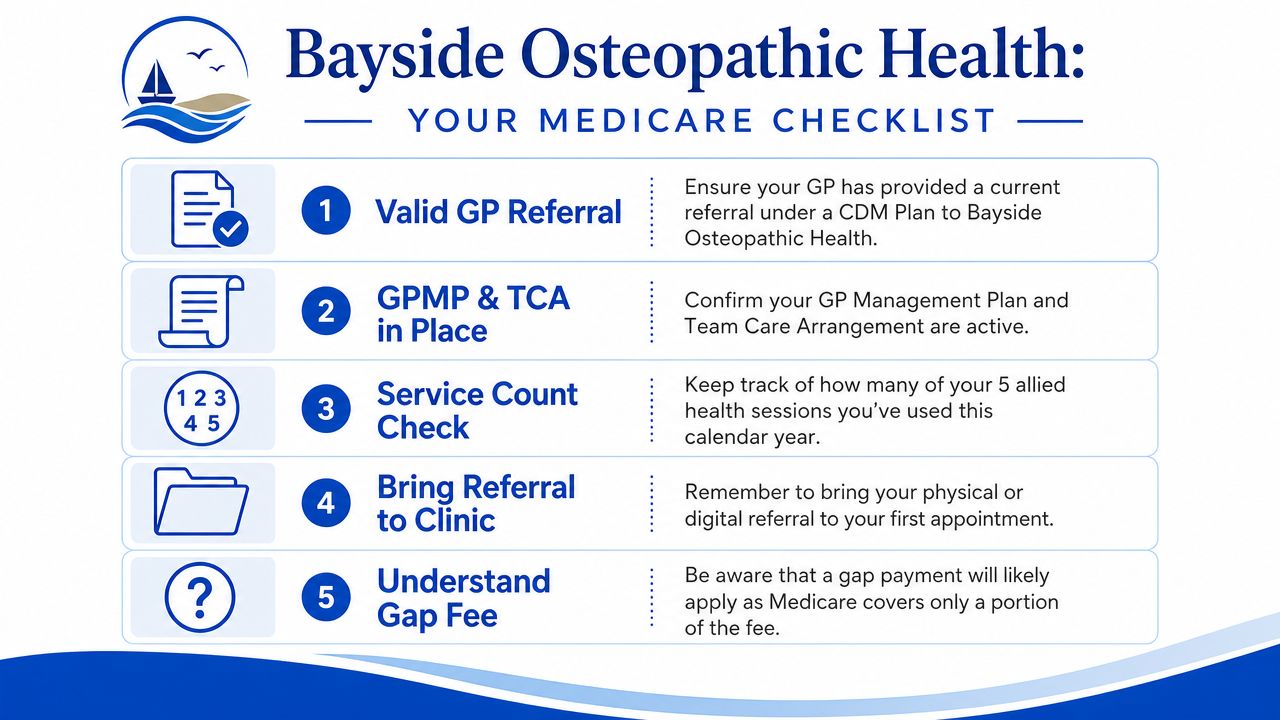
Before you book
- See your GP first: Ask whether your ongoing condition is suitable for a CDM plan that includes osteopathy.
- Check the referral details: Make sure the paperwork is current and clearly names osteopathy as part of your allied health care.
- Confirm how many allied health services you've used: These services are shared, so previous visits to other allied health providers can matter.
- Ask about claiming: Some clinics process claims on the day, while others ask you to submit through Medicare yourself.
If you want to identify the clinic material quickly when searching local information, this Bayside clinic logo image is the one associated with the local practice website.

At your first appointment
Bring your referral, Medicare card, and any information that helps clarify the history of your condition. If you've had scans, specialist input, or previous treatment, that context can save time.
This is also the right moment to ask practical questions, not just clinical ones:
- Will there be a gap fee?
- Can the rebate be processed on site?
- Is this consultation being billed under my referral?
- How should I use the remaining allied health services if I also see other providers?
For local patients, one straightforward option is Bayside Osteopathic Health, which provides osteopathic care and guidance on Medicare-related processes where applicable. The important point isn't the clinic name. It's making sure the provider understands CDM referrals and tells you clearly what paperwork and payment steps apply.
Frequently Asked Questions About Medicare and Osteopathy
Can I use all of my referred allied health visits on osteopathy
Sometimes, yes. It depends on what your GP decides and whether they want those services shared across different allied health providers. If you're also seeing a physiotherapist, podiatrist, or another allied health practitioner, those visits may come out of the same pool.
Do I need a new plan every year
You may need review or updated paperwork over time, and your GP is the person who determines what needs refreshing. Don't assume an old referral remains valid indefinitely. If in doubt, ask your GP clinic to confirm whether your plan and referral are current before you book.
Does Medicare cover osteopathy for acute pain
Usually not through the CDM pathway. If you've just strained your back, slept awkwardly on your neck, or injured yourself recently, osteopathy may still be appropriate, but Medicare generally doesn't fund it under chronic disease management unless the issue sits within a recognised long-term condition.
Can I use a CDM referral and private health insurance for the same visit
Rules can vary depending on your insurer and claiming method, so don't assume both can be applied to the one consultation. The safest approach is to ask both the clinic and your health fund before the appointment.
Do I need a referral for ordinary private osteopathy
No. If you're attending as a private patient and not claiming under Medicare, you can usually book directly with an osteopath.
What if my GP says no
That doesn't automatically mean osteopathy isn't suitable. It means your GP doesn't believe the Medicare chronic care pathway is appropriate in your case. You can still choose private treatment, and if you have extras cover, you may be able to claim through your insurer instead.
Is the rebate paid before or after the appointment
That depends on the clinic setup. Some clinics ask for full payment first and then help process the Medicare claim. Others may have different claiming workflows. Ask before you attend so there are no surprises.
What should I ask my GP if I'm unsure where to start
Keep it simple. Tell them the problem is ongoing, explain how it affects daily life, and ask whether a Chronic Disease Management plan that includes osteopathy is appropriate for you.
If you're in Bayside and want help understanding whether your situation may fit the Medicare pathway for osteopathy, Bayside Osteopathic Health can talk you through the practical side of booking, referrals, and what to bring to your appointment. If you already have a GP referral, reach out before your visit so the paperwork and claiming process are clear from the start.