
You're rubbing a stiff neck after a long day at a desk, or maybe your lower back has been nagging you for weeks and a friend has suggested needles. Then you search dry needling vs acupuncture and end up with two treatments that look similar at first glance, but promise different things, come from different clinical traditions, and carry different kinds of evidence behind them.
That confusion is normal. Both use fine needles, both can be part of pain care, and both are offered for musculoskeletal problems. The choice isn't about which one sounds more modern or more traditional, it's about what you want treated, how much safety and outcome data you want to lean on, and whether you need a technique on its own or one piece of a broader hands-on care plan.
Table of Contents
- Why Patients Search for Dry Needling vs Acupuncture
- What Dry Needling and Acupuncture Actually Are
- Comparing Evidence and Clinical Outcomes
- Safety Data and Adverse Event Rates in Australia
- How Needling Therapies Fit Into Osteopathic Care
- What to Expect From Sessions Costs and Medicare Options
- Choosing the Right Treatment for Your Pain and Goals
Why Patients Search for Dry Needling vs Acupuncture
A patient usually doesn't start with a philosophy debate. They start with pain. A shoulder that catches when they reach overhead. A neck that tightens every afternoon. A knee that's sore after gardening, or a back that hasn't settled since the last flare-up. Then someone mentions dry needling, someone else says acupuncture helped them, and the search begins.
That's where the problem shows up. The two treatments look close enough to be confusing, but they're not identical in how they're used, how practitioners reason through them, or how much evidence has been gathered around each one. If you're already sore, you don't want a vague answer. You want a clear sense of what each approach is trying to do.
The question people are really asking
People aren't asking, “Which theory is more elegant?” They're asking whether the needles are likely to help their pain, whether the treatment is safe, and whether it will fit into the rest of their care. That's especially true for people who want to stay active, keep working, and avoid bouncing from one short-lived fix to the next.
Practical rule: if pain is the reason you're comparing treatments, the useful question is not which technique sounds more familiar, it's which one matches your goal, your diagnosis, and your tolerance for uncertainty.
Why this comparison matters in Australia
In Australia, the comparison also matters because safety surveillance and regulation aren't the same across the two approaches. Acupuncture has a much clearer population-level safety record, while dry needling has a weaker and less standardised reporting base. For a patient sitting in a treatment room, that's not a theoretical detail, it affects confidence and informed consent.
There's another layer too. People often want more than short-term symptom relief. They want better movement, fewer flare-ups, and a plan that holds up after the session ends. That's why the dry needling vs acupuncture decision needs to be tied to function, follow-up, and the way the therapist thinks about the whole body, not just the sore spot.
What Dry Needling and Acupuncture Actually Are
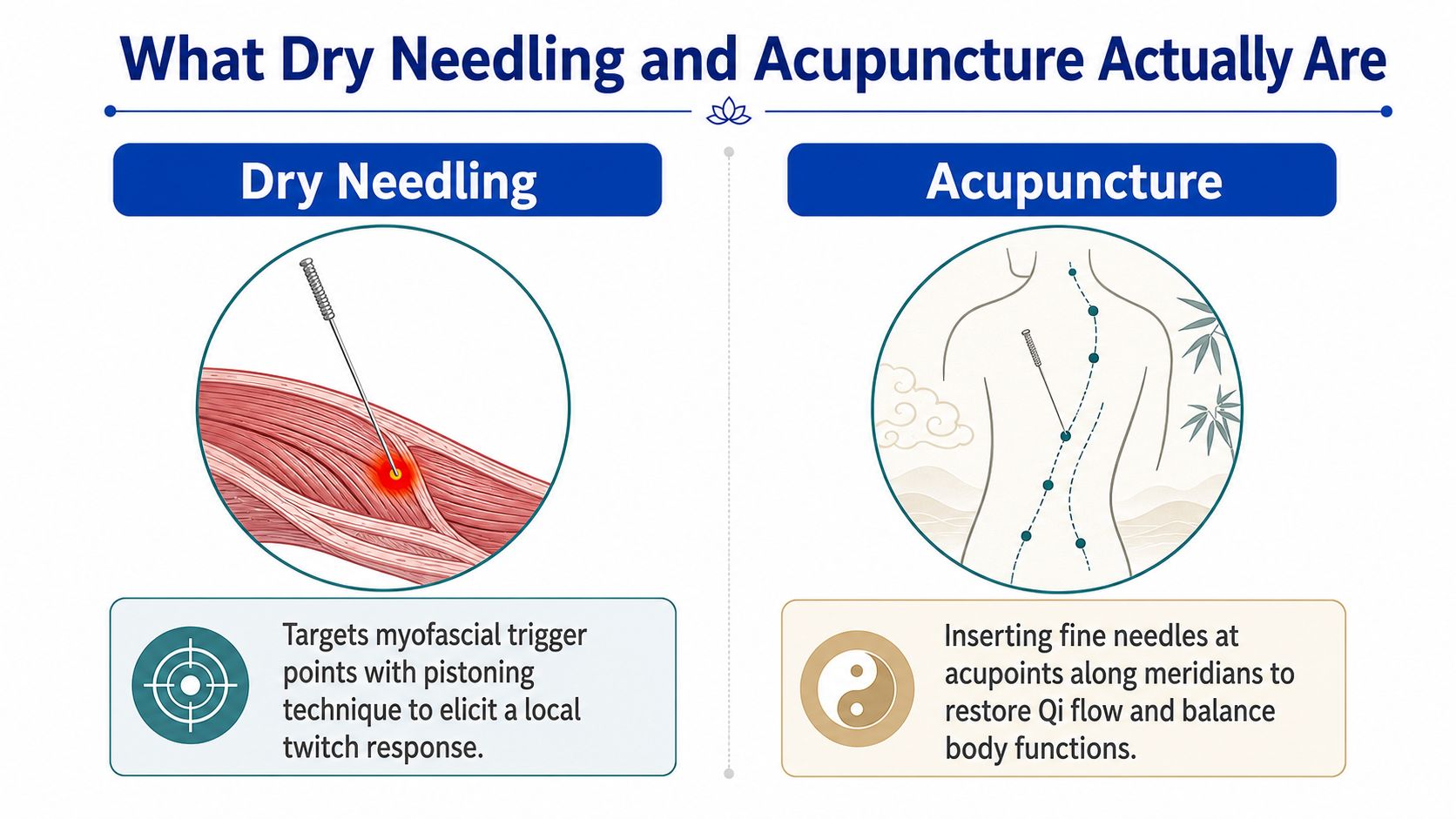
Both therapies use the same kind of tool, a solid filiform needle, and peer-reviewed comparisons note that they can produce similar physiologic effects as described in the comparative review. The difference is in the map, the reasoning, and the intended response. One approach is usually built around a local muscle problem, the other around an acupuncture framework that may consider location, depth, chronicity, and temperature influence.
Dry needling in plain language
Dry needling is usually used for myofascial trigger points, which are tight, irritable spots in muscle that can refer pain elsewhere. The needle is often moved with a pistoning style, and the clinician may be looking for a local twitch response. In practice, that means the treatment is directed by what the practitioner finds in the tissue on that day, not by a fixed point map.
That matters because two people with the same label, like “neck pain”, may not get needles in the same places. The work starts with the muscle, the movement pattern, and the specific restriction the clinician can palpate.
Acupuncture in plain language
Acupuncture follows a different logic. It uses fine needles at specific points within a traditional framework that may consider body balance, meridians, and broader symptom patterns. The review material in the brief notes that acupuncture protocols may vary by location, depth, chronicity, and temperature influence, which is one reason the treatment can feel more system-wide than purely local.
A useful way to think about it is this. Dry needling often asks, “Which muscle is driving this problem right now?” Acupuncture more often asks, “Which point pattern fits this person's presentation?” The same needle can be used in both, but the clinical map is different.
Why the distinction still matters
A peer-reviewed Medical Acupuncture analysis went further and concluded that dry needling is one type of acupuncture when acupuncture needles are used, because both share the same four core features, needles, target points, action mechanisms, and therapeutic effects as outlined in that analysis. That doesn't erase the practical difference patients feel in clinic, though. It just reminds us that the debate is less about the metal in the needle and more about how the clinician uses it.
Comparing Evidence and Clinical Outcomes
The research picture is more cautious than most marketing copy. A systematic review of needling therapies for musculoskeletal pain found that, across 134 combined study participants, needling did not show a statistically significant overall advantage over placebo, and it also reported high heterogeneity, with I² = 88% source. That tells you the field has mixed studies, mixed conditions, and mixed outcomes, so it's a mistake to talk about either treatment as a universal fix.
A later 2022 systematic review, also cited in the brief, found that dry needling was superior to sham or no intervention for short-term pain relief, but it wasn't consistently superior to acupuncture and in some analyses performed worse than acupuncture or other interventions on short-term outcomes. That's the kind of nuance patients rarely hear when they're choosing between the two.
Evidence summary for the treatment room
| Criteria | Dry Needling | Acupuncture |
|---|---|---|
| Typical clinical aim | Local muscle and trigger point pain | Point-based treatment within a broader acupuncture framework |
| Short-term pain relief | Can help in some cases, especially for local symptoms | Can also help, and some comparisons do not show dry needling doing better |
| Overall research consistency | Mixed across conditions | Mixed across conditions |
| Functional outcomes | Not clearly superior for disability or mobility | Not clearly superior for disability or mobility |
| Evidence certainty | Depends heavily on diagnosis and study design | Depends heavily on diagnosis and study design |
That table is the simplest honest answer. Neither technique has a clean win across every outcome that matters.
What the mobility question really means
One of the most useful takeaways from the chronic pain literature is that the common promise, that one needle approach clearly restores function better than the other, is overstated. A 2023 review found that deep needle insertion in either dry needling or acupuncture can improve pain in spinal-related painful conditions, but it did not detect differences in disability outcomes as summarised in the brief. In clinic terms, that means less pain doesn't automatically equal better movement.
For patients, that distinction matters. If your main goal is to get through a workday with less ache, the evidence may support a trial of needling. If your goal is lasting function, the needle has to sit inside a bigger plan that also addresses load, posture, strength, sleep, and activity pacing.
The clearest clinical message is not that one therapy is “better” in every case. It's that the choice should be made according to pain pattern, expected outcome, and how the treatment fits with the rest of care. That's a much more realistic standard than asking a single needle technique to solve everything.
See a shoulder care example used in a broader rehabilitation context
Safety Data and Adverse Event Rates in Australia
Safety is where the Australian data becomes especially useful. A 2021 review covering 12.9 million acupuncture treatments found 7.57% of treatments involved minor adverse events, while serious adverse events occurred at 7.98 per one million treatments, which is about 0.000798% Australian review cited in the brief. That's a large safety base, and it shows serious complications are extremely rare at a population level.
The same Australian legislative testimony noted that dry needling has a weaker evidence base for safety reporting. One 2020 study cited there found 36.7% minor adverse events and 20 major events in 20,494 treatments, which is about 0.1%, or roughly 1 in 1,024 treatments. Those numbers don't mean dry needling is unsafe. They do mean the monitoring framework is less settled.

How to read the numbers without panic
Minor reactions can include things like local soreness or a brief post-treatment ache. In pain care, that kind of response is not the same thing as harm, but it still matters because it affects how someone feels after the appointment and whether they want to continue. The useful point is that the Australian acupuncture record is broad enough to give patients and clinicians more confidence about population-level safety.
Clinical takeaway: the question is rarely whether needling is “dangerous”. The more relevant question is whether you want to choose from a therapy with large-scale safety surveillance, or one with a more limited and less standardised safety record.
Why this matters for consent and confidence
When a patient is deciding between dry needling vs acupuncture, safety isn't just a box to tick. It shapes the conversation about expectations, aftercare, and what counts as a normal reaction. A patient who understands the likely sensations and the rarity of serious events is more likely to consent calmly and stay engaged with treatment.
A video resource is included below for patients who want to see the general logic of needling care in a visual format.
How Needling Therapies Fit Into Osteopathic Care
Osteopathic care starts from the whole person, not just the painful structure. In practice, that means I'm looking at how you move, where you guard, what your posture is doing, and which regions are compensating for the one that hurts. Needling can fit into that picture, but it usually works best as an adjunct, not as the whole answer.
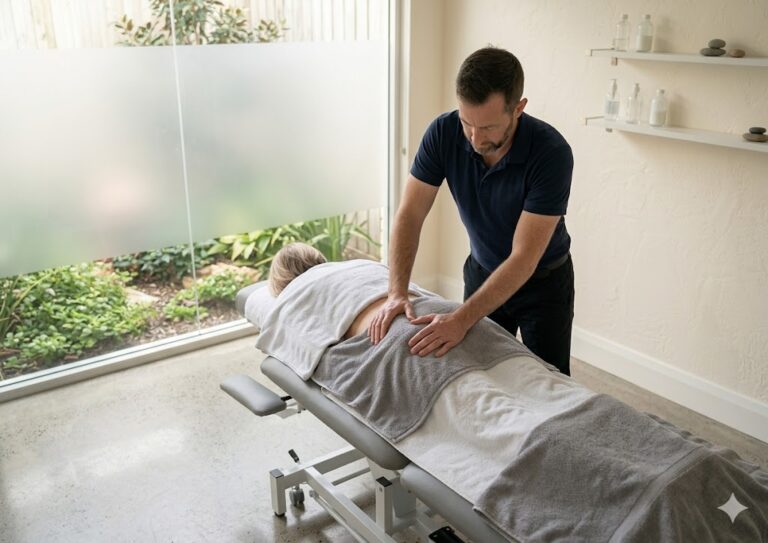
This rehabilitation image shows how movement work sits alongside hands-on treatment

Where dry needling adds value
Dry needling can be useful when a very local muscle problem is dominating the picture. A stubborn upper trapezius knot, a tight gluteal pattern, or a painful trigger point that keeps referring symptoms can all be reasons to consider it. In those cases, it may help settle the tissue enough for manual therapy and exercise to do their job more comfortably.
That's why I rarely think of it as a standalone fix. If the trigger point returns because the same load pattern is still there, the needle may help briefly but won't change the underlying mechanics on its own.
Where acupuncture may fit better
Acupuncture can suit patients who prefer a broader treatment framework or who want a more established, well-regulated needling approach with a larger safety evidence base. Some people also find the treatment style more appropriate for persistent, multi-site pain where the complaint isn't coming from one obvious muscle alone.
At Bayside Osteopathic Health, the practical question is always the same. Will a needling technique help this person move better, settle pain enough to exercise, or complement the manual work already being done? If the answer is yes, it may be included. If not, the plan can stay with soft-tissue work, joint articulation, mobilisation, and movement advice.
What a whole-body plan actually looks like
A balanced treatment plan often combines a few elements:
- Manual treatment: soft-tissue work and gentle mobilisation to ease guarding and restore motion.
- Movement advice: simple changes that reduce overload between sessions.
- Needling when suitable: used for a specific pain driver, not just because it's available.
- Self-management: practical home strategies that keep progress going.
The point is not to chase the newest technique. The point is to choose the least complicated intervention that still moves you toward better function.
Example rehabilitation content used in a clinic setting
What to Expect From Sessions Costs and Medicare Options
A first session usually starts with questions about your pain pattern, your health history, and what aggravates or eases symptoms. If needling is appropriate, the clinician places the needles and watches how you respond. Some people feel little beyond the insertion itself, while others notice a deep ache, twitch, or a brief cramp-like sensation, especially with dry needling.
The after-feel matters too. Mild soreness is common, and a person may leave feeling looser, a bit fatigued, or unsure until later that day. That's normal enough that I always tell patients to judge the result over the next day or two, not in the first minute after they get off the table.
Practical booking questions
Before you book, it helps to ask a few direct things:
- What training does the practitioner have? Ask whether they're qualified for the specific needling approach they offer.
- What is the aim of treatment? Pain relief, movement, or an adjunct to rehab are different goals.
- What should I expect after treatment? A clear explanation of soreness, activity, and follow-up matters.
- How does this fit my broader plan? Needling should make sense alongside exercise and manual care.
One more practical note for Australian patients, Medicare and private health coverage can vary depending on the service and your individual extras policy. Some osteopathy services may be covered under certain prescribed treatment plans, so it's worth checking with the clinic and your fund before you assume anything.
Who should be cautious
Needling isn't for every person on every day. If you're nervous around needles, have a very low pain tolerance, or have a medical reason to avoid invasive procedures, that changes the discussion. The best clinician won't push ahead just because a treatment is available.
The decision should also be simple if your pain is widespread, your main concern is anxiety around treatment, or you've had poor experiences with needling before. In those cases, hands-on osteopathic care without needles may be the smarter starting point.
Choosing the Right Treatment for Your Pain and Goals
The decision gets easier when you stop asking which treatment is universally better and start asking which one suits the job in front of you. If the problem is a very local muscle knot, especially one that's repeatedly limiting movement, dry needling may be the more direct choice. If you value a more established safety surveillance base, or your pain presentation feels more diffuse and chronic, acupuncture may be the better fit.
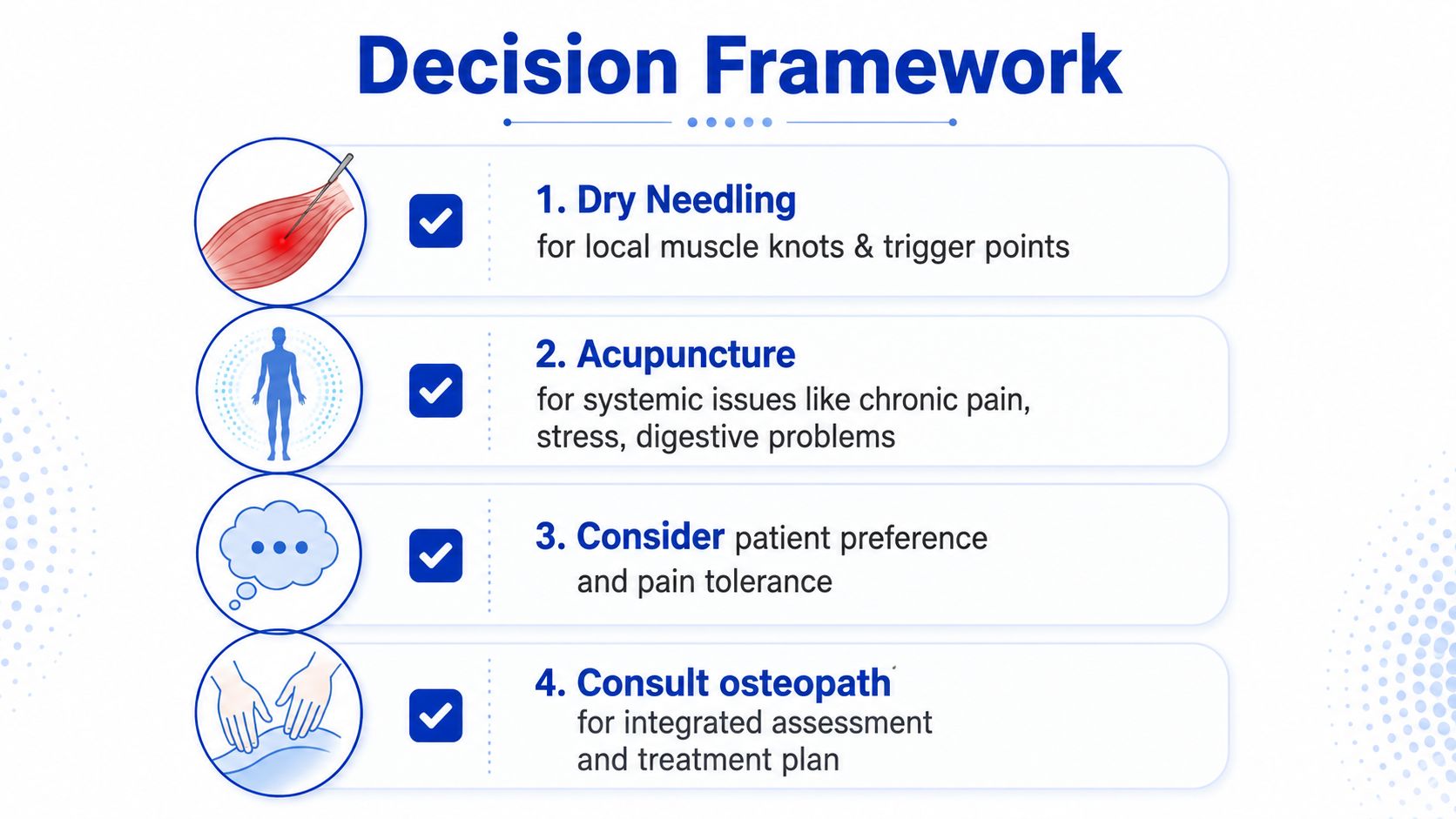
A simple decision framework
- Choose dry needling for local muscle knots and trigger points when the main target is a specific tissue problem and you want it integrated into a musculoskeletal plan.
- Choose acupuncture for broader or chronic pain patterns when you want a more established needling framework and you're comfortable with a different treatment logic.
- Factor in your own tolerance and preference because the best treatment is one you can tolerate and follow through with.
- Use an osteopathic assessment when you want the whole body considered rather than treating the painful site in isolation.
That final point matters more than people realise. A needle can change pain input, but it can't by itself retrain movement habits, rebalance load, or fix the reasons the area keeps getting irritated.
What I'd tell a patient in the room
If you want the shortest honest answer, it's this. Dry needling and acupuncture can both help with pain, but they're not the same conversation. Dry needling is often more local and musculoskeletal in focus, acupuncture sits inside a broader established framework, and the Australian safety data base is clearer for acupuncture than for dry needling.
The right call usually depends on three things, your diagnosis, your goal, and the kind of care model you trust. If you want integrated care that combines assessment, hands-on treatment, movement guidance, and a considered use of needling when appropriate, Bayside Osteopathic Health can help you work through those options and decide what makes sense for your pain, your body, and your day-to-day life.