
You get out of bed, take that first step, and a sharp ache catches you in the heel, arch, or ankle. It might ease after a few minutes, then return again when you've been sitting too long, standing too long, or trying to “walk it off”. Foot and ankle pain can feel minor at first, but it often changes how you move through the whole day, from the way you stand in the kitchen to the way you climb stairs.
In Australia, that experience is common. A population-based study found 17.4% of adults reported foot pain, aching, or stiffness in at least one foot, which the authors described as nearly one in five people in the community, with higher prevalence in women, adults aged 50 years and over, and people classified as obese (population-based Australian foot pain study). The good news is that most foot and ankle problems are workable once you understand what's driving them, and a careful osteopathic approach can help connect the dots between the sore spot and the rest of the body.
Table of Contents
- Why That First Step in the Morning Hurts
- Understanding Your Foot and Ankle Anatomy
- Common Causes of Foot and Ankle Pain
- When Pain Becomes a Red Flag
- How an Osteopath Assesses Foot and Ankle Pain
- Effective Treatment and Management Strategies
- Your Path to Recovery in Bayside
Why That First Step in the Morning Hurts
The classic story is simple. You get up, place your foot on the floor, and the first few steps feel stiff, sharp, or stubbornly sore. After a bit of movement it settles, which makes it tempting to ignore, but that pattern is often the body's way of saying a tissue is being loaded faster than it can tolerate.
Morning pain can happen because tissues tighten when you've been still, then complain when they're asked to lengthen and absorb force again. That doesn't point to one single diagnosis, which is why it's worth treating foot and ankle pain as a real clinical issue, not just a nuisance that should disappear on its own.
Practical rule: pain that repeats with the same movement, the same shoes, or the same start to the day usually has a mechanical driver. Mechanical pain responds better when you change load, not when you simply grit your teeth.
The Australian benchmark matters here because it normalises the problem and also shows that the burden isn't random. The same study that found 17.4% prevalence in adults also noted higher rates in women, adults aged 50 years and over, and people classified as obese (Australian population estimate). Even in adults under 45, at least 10% reported foot pain, so this is not just an older person's issue.
That's why a good plan starts with understanding the structure, then identifying the likely tissue involved, then matching the load to the tissue's capacity. That sequence is what makes relief more predictable.
Understanding Your Foot and Ankle Anatomy
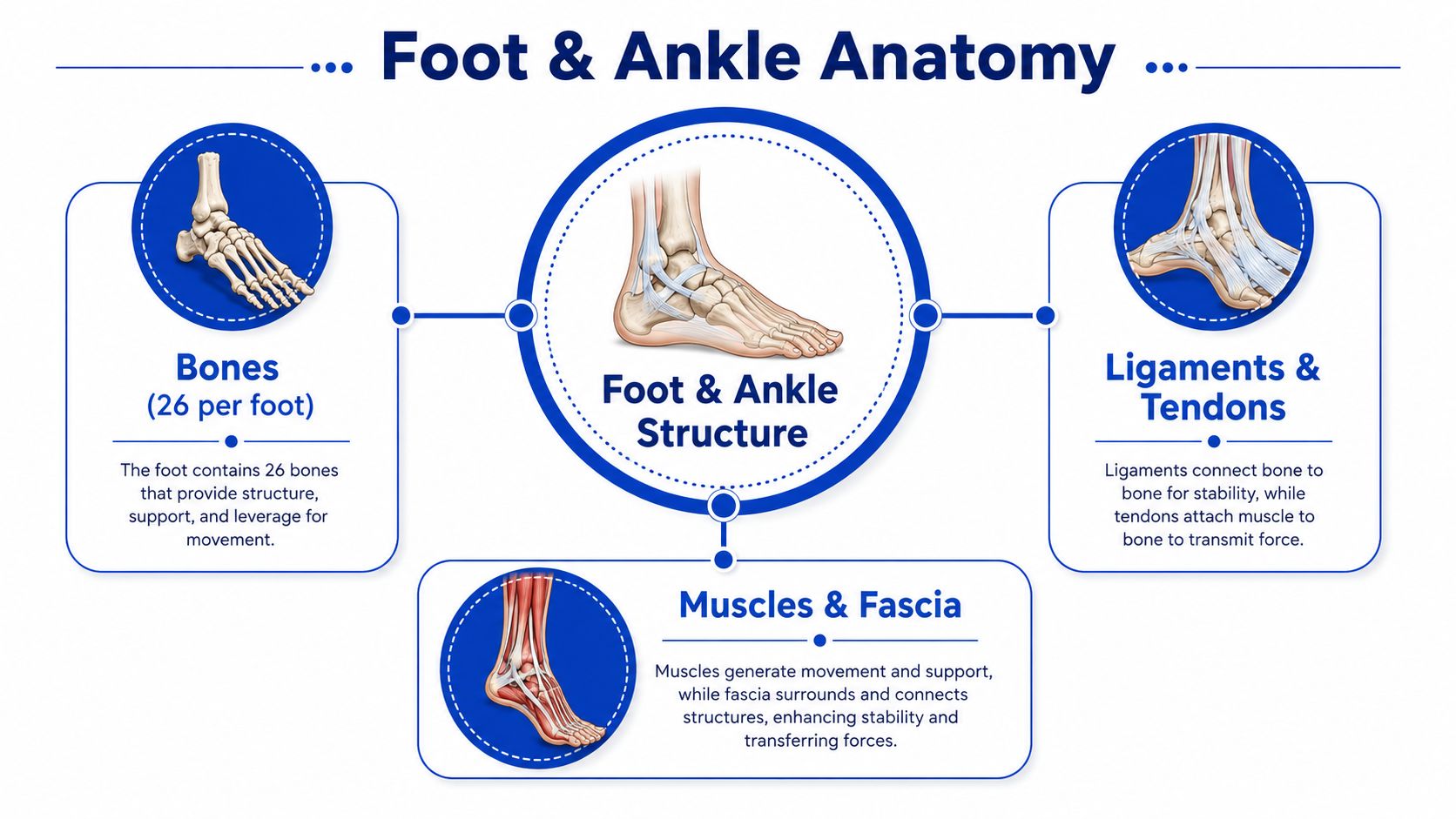
Think of the foot and ankle as the body's foundation. A house doesn't stay stable if the slab is uneven, and your movement chain doesn't work well if the base is overloaded, stiff, or collapsing at one point.
The foot contains a dense mix of bones, joints, ligaments, tendons, fascia, nerves, and blood vessels, all sharing space and tasking each other every time you walk. That's why the same complaint can come from very different tissues, and why pain location alone doesn't tell the full story (regional assessment of the ankle-foot complex).
The main players
The plantar fascia acts like a strong supporting strap under the foot, especially when you push off. The Achilles tendon connects the calf to the heel and helps with propulsion. The ligaments stabilise the ankle and midfoot, while the muscles control motion and absorb shock.
What matters practically is not memorising the anatomy, but recognising that a strain in one area can shift load elsewhere. If the calf is tight, the arch may work harder. If the hip is weak or the stride is altered, the foot often pays the price later in the chain.
A sore foot is sometimes a local problem, but it can also be the place where a larger movement pattern shows up.
That's why foot and ankle pain rarely responds well to a one-size-fits-all plan. The right treatment depends on which structure is overloaded, which joints are stiff, and which movements are asking too much of the tissue.
Common Causes of Foot and Ankle Pain
Foot and ankle pain is a symptom, not a single diagnosis. A sudden twist can injure a ligament right away, while other problems build slowly from repeated walking, standing, training, or footwear that keeps putting the same area under pressure.
A rolled ankle usually brings swelling and pain quickly, and the joint may feel unstable straight away. Overuse problems behave differently. They often creep in after load has outpaced recovery, so the pain shows up after longer walks, runs, shifts on your feet, or a change in exercise. Nerve-related pain has a different feel again, often showing up as burning, tingling, numbness, or weakness rather than a plain ache.
Burning pain, tingling, numbness, or weakness can point to a nerve entrapment or a systemic issue rather than a local soft-tissue injury. The NHS foot and ankle pain advice also flags tingling or loss of feeling, diabetes, and worsening pain as reasons to seek review. That matters, because foot pain is not always a simple strain that settles with rest.
Common conditions at a glance
| Condition | Common Symptoms | Potential Osteopathic Focus |
|---|---|---|
| Ankle sprain | Swelling, pain after a twist, instability | Reduce load, restore joint motion, rebuild control |
| Plantar fascia pain | Morning heel or arch pain, pain after sitting | Calf flexibility, foot loading, gait mechanics |
| Achilles tendinopathy | Stiffness, pain at the tendon, tenderness | Progressive loading, calf function, footwear review |
| Morton neuroma | Forefoot pain, tingling, shoe-related flare-ups | Footwear changes, pressure reduction, load management |
| Stress fracture pattern | Focal pain that worsens with impact | Offload early, assess training load, refer if needed |
A useful osteopathic view is that the painful spot is often only part of the story. The foot works as the end point of a movement chain, so hip weakness, altered posture, or restricted ankle motion can change how force reaches the ground. A foot that is overloaded may be reacting to poor mechanics higher up the chain, even when the pain seems local.
That is why the same symptom can need different care. One person may need load reduction and tissue recovery, while another needs better calf mobility, improved foot control, or a look at how the hip and pelvis are influencing the way they stand and walk.
When Pain Becomes a Red Flag
Some symptoms deserve a faster response, not more patience. If you cannot bear weight, the foot looks deformed, or pain came on suddenly without a clear reason, don't try to “wait it out” for long.
Swelling, bruising, and a pain pattern that is worsening instead of settling are also warning signs. If the area is hot, very red, or you feel unwell, infection or another more serious problem needs to be ruled out.
Seek prompt review if the pain is sharp and severe, the joint feels unstable, or the symptoms don't match a simple strain.
Numbness, tingling, or loss of feeling should be taken seriously, especially when they don't fit the usual “sore after exercise” pattern. The NHS advice on foot and ankle pain specifically flags tingling, loss of feeling, diabetes, or worsening pain as reasons to seek professional review (NHS symptom guidance).
A small but important distinction helps here. Pain that improves gradually with sensible load changes is usually manageable. Pain that escalates, spreads, or changes character is telling you the problem needs reassessment. That's the point where self-care stops being enough and proper clinical judgement matters.
How an Osteopath Assesses Foot and Ankle Pain

A thorough osteopathic assessment starts with the painful area, then widens out to the ankle-foot complex and the rest of the chain that shapes how you move. The knee, hip, pelvis, and lower back all influence how much load reaches the foot and ankle, so the local problem is rarely assessed in isolation.
What gets checked first
The first part of the exam usually involves palpation, movement testing, and specific stress manoeuvres to identify the likely tissue source. That matters because the same symptom can come from different structures, and a clear structural diagnosis often depends on side-to-side comparison and targeted tests to separate tendinopathy, ligament injury, plantar fascia pathology, and stress fracture patterns (regional evaluation of foot and ankle pain).
An osteopath may also watch how you walk, stand, squat, or rise onto your toes. These simple movements show whether the body is sharing load well or whether one area is compensating for stiffness, weakness, or poor control.
Why the whole chain matters
A painful heel can reflect an arch that is doing too much work. The arch may be overloaded because the ankle is stiff. The ankle can be taking extra strain because the hip is not controlling rotation well. That pattern is easy to miss if attention stays only on the sore spot.
When I assess someone with ongoing foot pain, I am looking for the upstream driver as well as the local irritation. Sometimes the answer is straightforward and the problem sits mainly in the foot. Sometimes the foot is coping with a movement fault somewhere else, and the treatment plan has to reflect that.
A good assessment changes the plan. If the problem is load-related, the rehabilitation approach is different from what you would use for a sprain or a nerve-related pain pattern.
That practical view matters in Bayside too. Osteopathic care can be a useful option alongside other health services when you want hands-on assessment, movement advice, and a plan that links the foot to the rest of the body.
Effective Treatment and Management Strategies
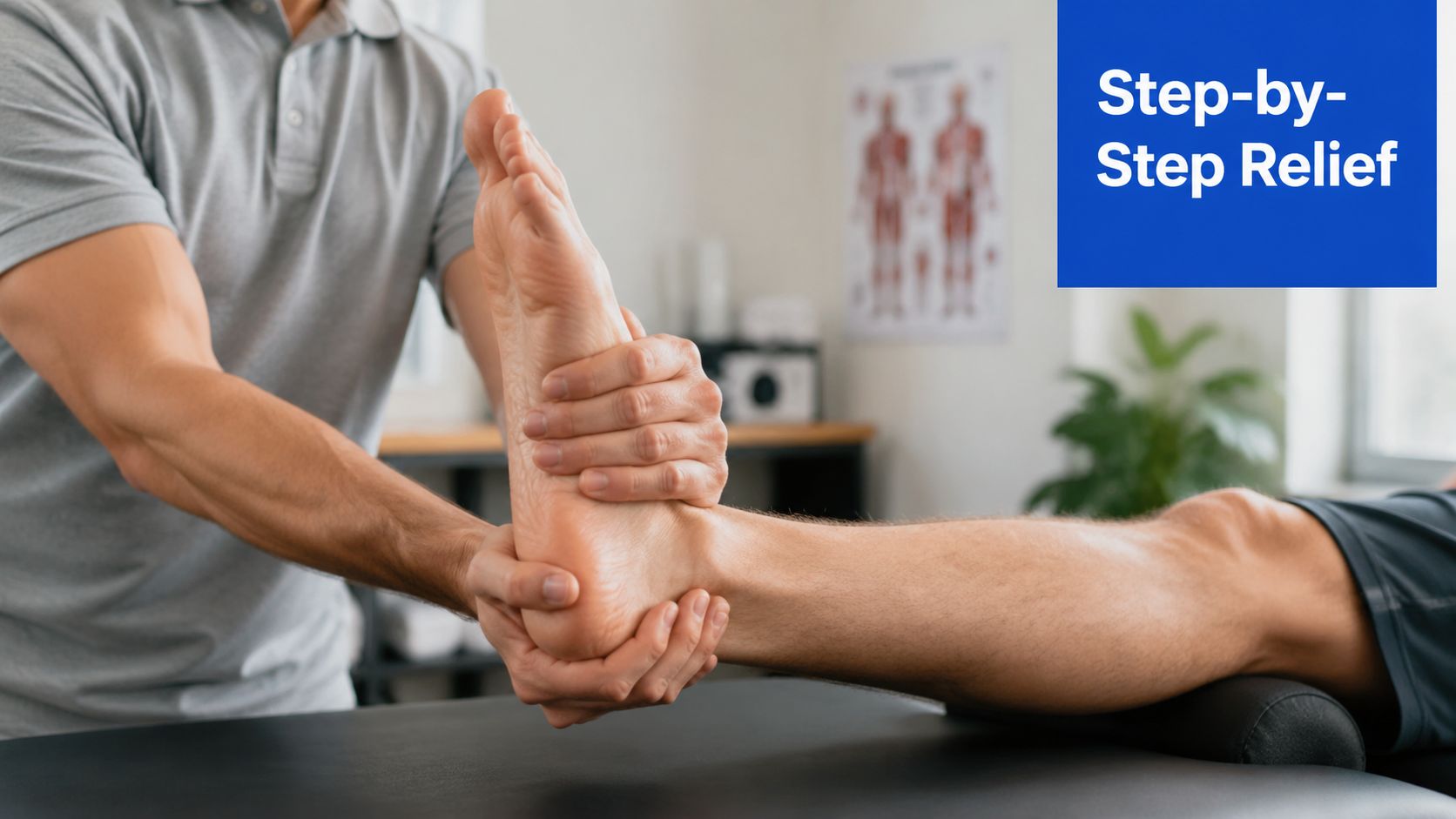
A painful foot or ankle often settles faster when treatment matches the load that is provoking it. Hands-on care can reduce pain and stiffness, but the long-term change usually comes from rebuilding tolerance to standing, walking, running, or whatever activity has been setting it off.
What tends to help
For many chronic foot and ankle pain conditions, the first-line approach is load modification plus tissue-specific rehabilitation, rather than complete rest (AAFP guidance on foot and ankle pain management). You keep the tissue moving, but you stop repeating the exact pattern that is irritating it.
Manual techniques can still play a useful role. Soft-tissue work may ease the muscles around the sore area, while joint mobilisation or articulation can improve movement where stiffness is creating extra strain. These treatments work best when they are chosen for a clear finding, not used as a blanket fix for every painful foot.
The local problem is only part of the story. A heel can be overloaded because the arch is doing too much work, and the arch can be working overtime because the ankle is stiff or the hip is not controlling rotation well enough. That is why an osteopathic approach often looks above and below the painful spot, not just at the tender tissue itself.
A practical example is calf-related heel pain. Gentle calf stretching can reduce strain where the Achilles and plantar structures are being asked to do too much. For tendon issues, progressive strengthening usually matters more than prolonged protection, because tendons respond to sensible load over time. If the ankle is not moving well, the exercise plan may need to start with mobility and control before higher-impact work is added again.
What to do at home
- Adjust the load: reduce the activity that spikes symptoms, then reintroduce it gradually.
- Check footwear: worn shoes, poor heel support, or unstable soles can keep re-irritating the area.
- Use targeted exercise: calf raises, foot doming, or balance work may be appropriate depending on the diagnosis.
- Avoid relying on painkillers alone: short-term NSAIDs may reduce pain, but they can also distract from the work of rebuilding capacity, so they should not replace progressive loading (AAFP treatment guidance).

The trade-off is straightforward. Rest can calm a flare-up, but too much rest leaves the tissue less prepared for the next day's demand. Active recovery builds capacity again, which is why it usually serves people better over the long run.
Some cases need more caution. If pain is spreading, numb, or clearly nerve-related, exercise alone is not the first move. The cause needs to be identified first, then the rehab plan can be matched properly.
Your Path to Recovery in Bayside
Frequent foot and ankle pain is not just common, it can be limiting. In adults in middle and older age, about two-thirds of people with frequent foot or ankle pain reported moderate or worse disability with daily activities (meta-analysis of adult foot and ankle pain). That's a strong reason not to dismiss symptoms that keep returning.

The most useful next step is a proper assessment that looks at your feet, your ankle motion, your walking pattern, and the way your hips and spine are sharing the load. If the problem is local, you get a targeted plan. If the problem is higher up the chain, you address that too, which is how you reduce the chance of the pain coming back.
Bayside Osteopathic Health offers hands-on osteopathic care with movement assessment, soft-tissue techniques, joint mobilisation, and practical advice for home. If you're in Bayside and want a thoughtful, whole-body approach to foot and ankle pain, you can visit Bayside Osteopathic Health to book an appointment and take the next step toward comfortable movement.
If your foot or ankle pain keeps returning, it's worth getting it assessed before it changes the way you walk, train, or work. At Bayside Osteopathic Health, you'll get a whole-body evaluation and a treatment plan aimed at easing the load on the painful area. Book a visit at Bayside Osteopathic Health and start with a clear, practical plan for recovery.