
You bend to pick up a shopping bag, reach for something on a high shelf, or lower yourself into a chair, and one side of your body feels noticeably tighter. Perhaps your back catches, your shoulder refuses to move freely, or your knee feels uncertain on stairs. These small frustrations often seem unrelated, but they can share a movement pattern.
Functional movement screening offers a structured way to observe how your body performs basic tasks. It doesn't diagnose the cause of pain, and it can't predict the future with certainty. Instead, it helps identify asymmetries, mobility restrictions and stability challenges that may influence how you move at work, during exercise or around the home.
For adults in Bayside, that perspective matters. A screen can turn a vague complaint such as “my hips feel stiff” into a clearer conversation about squatting, stepping, balance and control. It can also help a practitioner choose gentle, personalised treatment rather than handing you a generic list of exercises. Even everyday factors such as desk setup and prolonged sitting can affect how movement feels, as illustrated in this posture and corporate ergonomics resource.
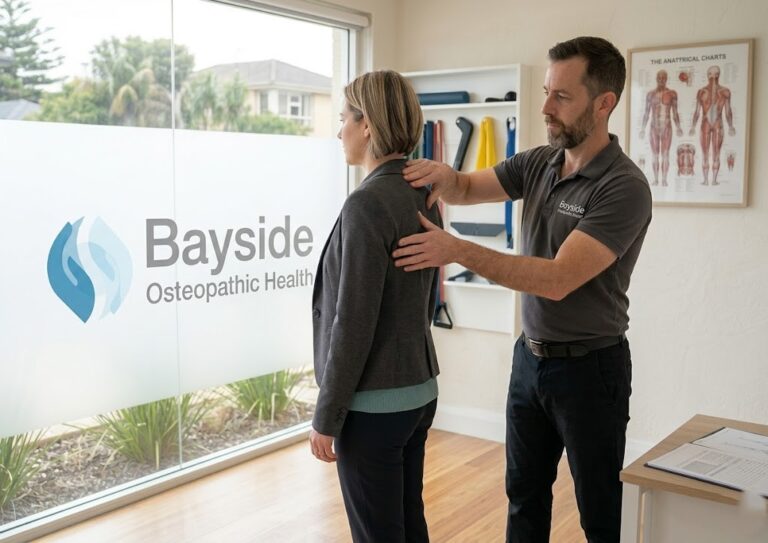
Table of Contents
- Introduction to Functional Movement Screening and Why It Matters
- What Functional Movement Screening Is and How It Works
- The Seven Core Movement Tests and How Scoring Works
- Benefits Limits and What Australian Research Shows
- Who Should Consider Screening and How Results Shape Your Care Plan
- What to Expect at Bayside Osteopathic Health and Medicare Considerations
- Putting Your Movement Insights Into Action
Introduction to Functional Movement Screening and Why It Matters
A movement screen is useful when your body has started making ordinary activities feel less ordinary. You might stand up after working at a desk and need a moment before your lower back straightens. You might notice that one arm reaches higher than the other, or that you always lead with the same leg when climbing stairs. None of these observations proves that something is damaged, but each one gives a practitioner a reason to look more closely.
The value lies in structured observation. Rather than testing one painful area in isolation, functional movement screening looks at patterns that involve several joints and muscle groups together. Squatting, stepping, lunging, reaching and controlling your trunk all require the body to share work effectively. If one area lacks mobility, another may compensate with extra movement or tension.
A useful way to think about screening: it shows how your body solves a movement task, not simply whether you can complete it.
The process is designed to be calm and practical. Australian course providers describe the Functional Movement Screen as an entry-level assessment that takes about 10 minutes, using seven fundamental movement patterns before exercise or rehabilitation planning. Australian FMS education information also shows that training is available across Adelaide, Wollongong, Sydney, Brisbane and Melbourne, reflecting an established national education pathway rather than a tool used only in specialist sporting clinics.
This guide builds from the basic idea to the seven tests, then considers what Australian research says about their limits. It also explains how findings may influence a gentle care plan for an office worker, an active adult or an older person concerned about balance.
If you already have pain, the screen should be part of a broader clinical assessment. A painful movement deserves attention in its own right, rather than being treated as a score to improve. Medicare support may be available in some circumstances for eligible patients under a GP-prescribed Chronic Disease Management plan, so it's sensible to discuss eligibility with your GP and confirm details with your practitioner or health fund.
What Functional Movement Screening Is and How It Works
A movement screen operates like a building inspection. The practitioner observes how several parts work together before deciding where a closer check is needed. A sticking door may reflect an issue with the frame, hinges or floor. In the body, a restricted ankle, hip or upper back can change how another area moves.
The Functional Movement Screen, commonly called FMS, is a standardised, entry-level movement assessment. It uses seven fundamental patterns to observe mobility, stability, coordination and left-to-right differences. The findings can highlight asymmetry or mobility-stability deficits before exercise or rehabilitation planning, rather than diagnose an injury. Further background is available in this overview of how FMS is used nationally.
The method was developed by physical therapist Gray Cook and athletic trainer Dr Lee Burton to provide a consistent way to observe foundational movement. It does not measure strength alone, even though some patterns involve supporting your body weight. It also cannot show a torn tendon, arthritic joint or specific spinal condition. A low result points to an area for further assessment. It does not identify the medical problem by itself.
What happens during the screen
A trained practitioner demonstrates each pattern, then watches how you perform it. They consider:
- Range of motion: Can the relevant joints move far enough for the task?
- Control: Can you keep your pelvis, trunk and limbs organised while moving?
- Coordination: Can different regions work together without excessive compensation?
- Symmetry: Does one side behave differently from the other?
- Pain: Does the movement provoke symptoms that need clinical assessment?
Each pattern receives a score from 0 to 3, based on movement quality and pain response. The number is not a diagnosis or a judgement about fitness. It gives you and the practitioner a shared reference point, alongside your symptoms and daily movement demands.
The seven tests are shown in this visual overview:
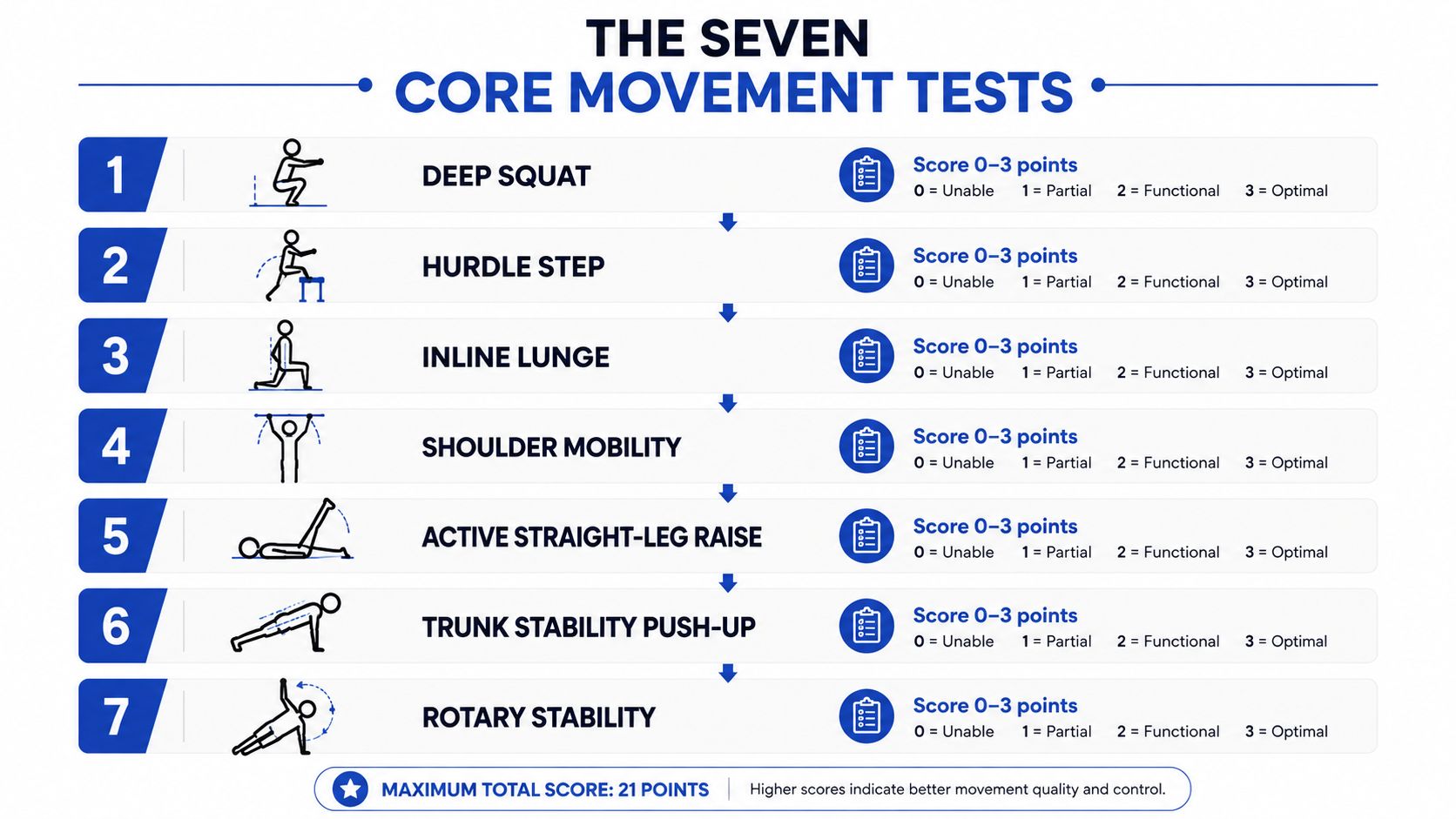
For Bayside adults, the practical value often lies in what the pattern reveals. A side-to-side difference or poor mobility and stability may help explain recurring stiffness, pain during work or exercise, or reduced confidence on stairs and uneven ground. Those findings can guide an osteopath towards gentle, personalised exercises, such as improving one joint's movement while teaching another area to provide steadier support.
The screen works best within a broader assessment. Symptoms, health history, work demands, previous injuries, exercise habits and personal goals all influence what the findings mean.
Here is a short visual demonstration of the movement-screening approach:
The Seven Core Movement Tests and How Scoring Works
The seven patterns are questions posed to the body. Can you lower yourself while keeping your feet grounded? Can you step over an obstacle without losing pelvic control? Can your shoulders and spine work together when you reach overhead? Each task gives the practitioner a closer look at how mobility, balance and stability share the workload.
Deep squat
The deep squat observes whole-body coordination. Your ankles, knees, hips, upper back and shoulders all contribute, while your trunk stays controlled. If an ankle is restricted, the heels may lift. Limited hip or upper-back movement can instead create a forward lean.
Hurdle step
The hurdle step examines single-leg balance and stepping mechanics. One leg provides stability while the other travels through space. The practitioner looks for a dropping pelvis, trunk sway, poor hip control or difficulty clearing the obstacle smoothly. These details can matter when stairs, kerbs or uneven paths feel uncertain.
Inline lunge
The inline lunge narrows the base of support and asks the hips, knees, ankles and trunk to coordinate under greater demand. It may show difficulty controlling rotation, maintaining balance or keeping the lower limb aligned. Someone may complete the lunge yet shift the torso or move the foot to avoid the challenge.
Shoulder mobility
This pattern compares both shoulders across different directions. It also shows how the shoulder blades and upper back contribute to reaching. A right-to-left difference can be more informative than a total score because it highlights an uneven movement strategy, such as one side doing more work during lifting or dressing.
Active straight-leg raise
The active straight-leg raise examines how high one leg can move while the opposite side and pelvis remain controlled. It tests active mobility, rather than allowing someone else to move the leg. Hamstring or calf restriction, reduced hip control or unwanted pelvic movement may affect the result.
Trunk stability push-up
Despite its name, this test does not only measure upper-body strength. The key question is whether the trunk stays organised while the arms push. The practitioner watches whether the body rises as one unit or whether the hips sag, ribs flare or head moves ahead of the spine.
Rotary stability
Rotary stability challenges control as the arms and legs move in different directions. Everyday examples include reaching while stepping, turning to place an object down or getting up from the floor. The task can expose difficulty resisting rotation through the trunk and pelvis, which may affect confidence during ordinary movements.
The scoring system is simple. A 3 means the movement is completed as intended. A 2 means it is completed with compensation. A 1 means the required pattern cannot be completed, while a 0 is recorded when pain occurs during the movement. A painful result changes the focus from movement training to clinical assessment.
The number alone does not explain the cause of a limitation. The useful detail is the pattern around it: whether one side differs, where control breaks down and which daily activity resembles the test. Those findings help an osteopath choose gentle, personalised exercises, such as improving one joint's movement while teaching another area to provide steadier support.
Benefits Limits and What Australian Research Shows
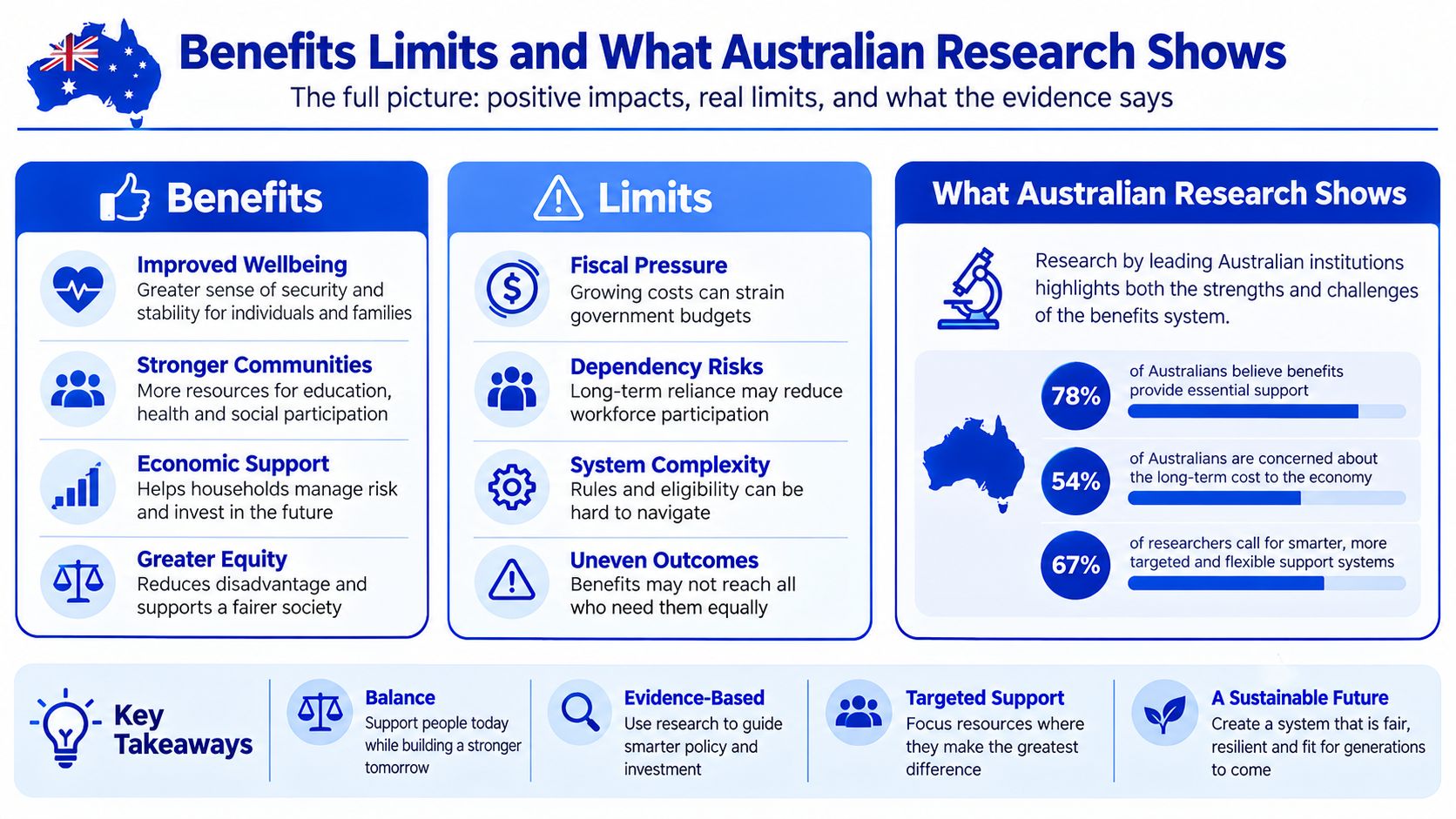
Functional movement screening can help organise an assessment, but it shouldn't be sold as a crystal ball. The most useful question is usually not, “Will this person get injured?” It is, “What movement quality deserves attention before this person progresses?”
That distinction matters because Australian research has tested the FMS in local sporting populations and found limited standalone predictive value. In a prospective cohort of 237 elite junior Australian football players, an FMS composite score of 14 or below wasn't associated with increased injury risk when used alone, with a hazard ratio of 1.1 and a p-value of 0.834. The same research found that asymmetry was a stronger signal, with one or more asymmetrical sub-tests associated with about double the injury risk, and two or more asymmetries associated with a further increase. These figures are reported in the Australian coaching education summary of the study.
Why the composite score can mislead
A composite score adds results from different movement patterns into one number. That can be convenient, but it may hide an important detail. Two people can have a similar total while one has a clear right-to-left difference and the other has several mild limitations spread across different tasks.
A separate three-season study of 573 elite junior Australian football athletes found that FMS alone didn't meaningfully predict non-contact injury. However, when a composite score of 14 or below was considered alongside previous injury history, the combined condition was associated with a moderate increase in injury risk, with a hazard ratio of 2.22. The PubMed record for this study reports that adding physical performance tests such as sprinting, jumping, agility and shuttle running didn't improve prediction beyond the combined FMS and injury-history approach.
These findings don't make the screen useless. They show why interpretation requires context.
Clinical perspective: an asymmetry is a prompt for investigation and targeted care, not a prediction that injury is inevitable.
What FMS can and can't tell you
The screen can help identify:
- Movement differences: one leg, shoulder or side of the trunk may work differently.
- Mobility challenges: a joint or linked region may not provide the range a pattern requires.
- Stability and control issues: you may have the range but struggle to control it.
- Pain during a task: symptoms may indicate that a broader assessment is needed.
It can't establish a diagnosis, explain every cause of pain or replace a medical history and physical examination. For a Bayside adult with back stiffness, the practical value may be a clearer starting point for care. For an athlete, it may help guide training priorities, but it shouldn't be used as a standalone clearance or injury forecast.
Who Should Consider Screening and How Results Shape Your Care Plan
You don't need to play competitive sport to benefit from a closer look at movement. Functional movement screening may be useful for people whose daily activities have become less comfortable, especially when the problem involves stiffness, recurring discomfort or uncertainty about how to begin exercising.
Everyday situations that may justify a screen
An office worker may sit for long periods, then feel restricted when standing, walking or reaching. An active adult may notice that lunges feel stable on one side but awkward on the other. Someone returning to exercise after a period of pain may want a starting point that feels more individual than a generic workout.
Older adults are another important group. Australian movement guidance recommends functional activities that target mobility, balance and coordination on three or more days per week, and the updated guidance states that functional, mobility and balance activity lowers falls and fall-related injury while supporting cognitive and physical function. The Australian 24-hour movement guidelines provide the relevant public-health framework.
From observation to practical care
A result only becomes useful when it changes what happens next. If a squat reveals restricted ankle movement, care may prioritise gentle ankle and lower-limb mobility before asking you to perform deeper squats. If a hurdle step shows pelvic control differences, the plan may use supported single-leg movements and gradual balance work.
An osteopath may combine hands-on techniques such as soft-tissue work, joint articulation and gentle mobilisation with movement advice. The aim isn't to force the body into a shape or make you repeat a test until the score improves. It is to make the movement more comfortable and controlled, then build capacity at a pace that suits your symptoms.
- For desk-related strain: treatment may focus on areas that contribute to reaching, turning and standing, followed by manageable movement breaks.
- For persistent pain: the screen can help identify tolerable starting points while the practitioner considers your history and symptom behaviour.
- For exercise preparation: findings can guide warm-up choices, mobility work and control drills before heavier loading.
- For balance concerns: stepping, supported lunging and coordination tasks can be introduced progressively and safely.
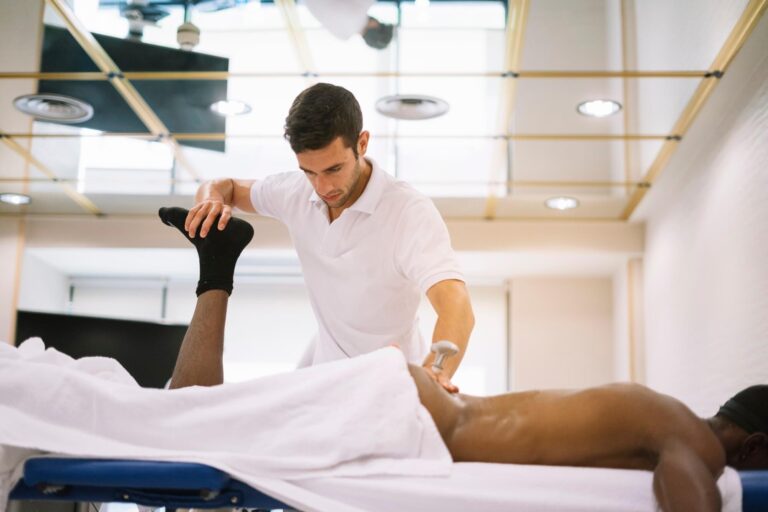
A practical example of patient-centred movement care can be seen in this clinical treatment image. The important principle is personalisation. Your plan should reflect your age, symptoms, confidence, work demands and the activities you want to resume.

What to Expect at Bayside Osteopathic Health and Medicare Considerations
An appointment usually starts with a conversation. The practitioner may ask what has changed, which activities feel difficult, whether symptoms come and go, and what you want your body to do more comfortably. This context gives the movement findings a useful meaning, rather than treating a score as a diagnosis.
You may then be asked to squat, step, lunge, reach or hold your body in a controlled position. The practitioner observes how you move, including whether one side works differently from the other. Like checking the alignment of a bicycle before a ride, this process looks for patterns that may affect comfort and control. You will not be expected to push through pain, and an unsuitable movement can be adapted.
A typical appointment flow
- Health discussion: Your symptoms, history, goals and relevant medical information are reviewed.
- Movement assessment: Basic patterns are observed, with attention to mobility, stability, coordination and asymmetry.
- Explanation: Findings are discussed in plain language, including what they may and may not mean.
- Hands-on care: Gentle techniques may address areas of tension or restricted movement where clinically appropriate.
- Home strategy: You receive practical exercises or movement suggestions that fit your routine.
The assessment is not a competition. A lower score does not mean your body is failing, while a higher score cannot guarantee that pain or injury will not occur. The useful part is connecting the result with your symptoms, daily demands and goals. A small difference between sides, for example, may guide exercises that improve control or confidence without forcing a painful range.
Your practitioner can also explain whether a finding needs attention now or deserves monitoring. That distinction helps keep care focused and reassuring.
Medicare coverage depends on your circumstances. Some osteopathy services may be available under a GP-prescribed Chronic Disease Management plan for eligible patients. Ask your GP whether the plan applies to you, then confirm appointment and rebate details with the clinic and your private health fund. A Medicare plan does not automatically cover every assessment or exercise recommendation, so checking beforehand can prevent confusion.
Putting Your Movement Insights Into Action
Functional movement screening is most helpful when it replaces guesswork with a clearer starting point. It can show whether your daily movement is limited by mobility, control, coordination or a difference between sides, then help a practitioner choose an appropriate response.
For a desk worker, that may mean addressing the movements that feel stiff after sitting and building manageable breaks into the day. For an active adult, it may mean refining a lunge, step or reaching pattern before adding more load. For an older adult, it may mean practising balance, mobility and coordination in a supported way, consistent with Australian movement guidance.
The result isn't a label. It's information you can use.
Keep your attention on comfort, confidence and function rather than chasing a perfect score. If you want to explore shoulder mobility at home, use a gentle, symptom-free approach and consider this shoulder pain exercise resource as general education, not a substitute for individual assessment.
For persistent pain, repeated asymmetry or concerns about balance, arrange an assessment with a qualified practitioner. A careful conversation, movement screen and plan can help you take a steady first step towards easier movement.
Bayside Osteopathic Health offers gentle hands-on osteopathic care, functional movement assessment and personalised exercise guidance for back, neck and joint concerns across the Bayside community. Visit Bayside Osteopathic Health to book an appointment, discuss Medicare options where applicable, or join the newsletter for practical advice on moving with greater comfort and confidence.