
If two people point to the exact same spot at the back of the head, can you assume they have the same problem? You can't, and that's where most advice about a headache at base of skull goes wrong. Location tells you where you feel it, not what's causing it. The pattern, timing and triggers tell you far more, and they decide whether gentle home care makes sense or whether you need urgent medical care first.
Table of Contents
- Causes of Base-of-Skull Headache at a Glance
- Clues That Separate Neck Pain From Nerve Pain
- Red Flags That Need Urgent Care Rather Than Self-Treatment
- How to Ease Base-of-Skull Pain at Home Step by Step
- What Hands-On Osteopathic Care Involves
- Habits That Keep Base-of-Skull Pain Returning
- Book the Right Assessment for Persistent Base-of-Skull Pain
Causes of Base-of-Skull Headache at a Glance
Most base-of-skull pain isn't an emergency. It usually fits one of four patterns, cervicogenic headache, occipital neuralgia, tension-type headache or migraine, while a small group of secondary causes needs urgent assessment. Headaches are also common in general. In 2024, 77.1% of 978 Australian participants reported an active headache disorder during the previous year, a figure published by the Australian Headache Epidemiology Data (AHEAD) study. That doesn't mean all those people had pain at the base of the skull. It means you need a way to sort patterns, not just a location label.
How to Read the Table
Match the typical pattern first, then check the key clue, then look at the usual first step. If the pattern and the clue don't line up, don't force yourself into a row. Overlap is common, and a clinician may need to sort it out.
Likely causes of base-of-skull headache compared
| Likely cause | Typical pattern | Key clue | Usual first step |
|---|---|---|---|
| Cervicogenic headache | Dull, aching, often one side, builds through the day | Neck movement or a held posture reproduces it | Assess neck movement and posture; physiotherapy or osteopathy |
| Occipital neuralgia | Sharp, shooting or electric, may come in brief bursts | Tender points over the occipital nerves; scalp sensitivity | Clinical nerve examination; specialist referral if it persists |
| Tension-type headache | Band-like pressure on both sides, mild to moderate | Stress or long desk hours; no nausea | Posture changes, pacing, relaxation; simple pain relief used sparingly |
| Migraine | Throbbing, moderate to severe, lasting 4 to 72 hours | Nausea, light or sound sensitivity, family history | GP review for diagnosis and treatment options |
| Secondary cause (urgent) | Sudden, severe, worsening, or new after injury | Fever, confusion, neurological or visual change | Emergency assessment; call Triple Zero (000) |
Here's a quick example. Say your pain is a dull, one-sided ache that builds after an hour at a screen and eases when you move around. That points you toward the cervicogenic row, because the pattern fits and posture is a clue. Now imagine a different picture. The headache hits suddenly, it's the worst you've had, and you're vomiting. That's the bottom row, even if you feel it in the same spot.
Practical rule: Location alone doesn't decide the row. Pattern plus clue does.
Before any appointment, keep a one-week diary. Write down when it started, how long it lasted, what you were doing beforehand, what helped, and any other symptoms. That record often answers the first questions a clinician will ask, and it stops you relying on memory when you're already sore.
Clues That Separate Neck Pain From Nerve Pain
Say a 45-year-old office worker gets pain under the left side of the skull after long reading sessions. It eases when lying down and returns when turning the head to check a second monitor. That story already gives clues, but it doesn't prove a diagnosis on its own.
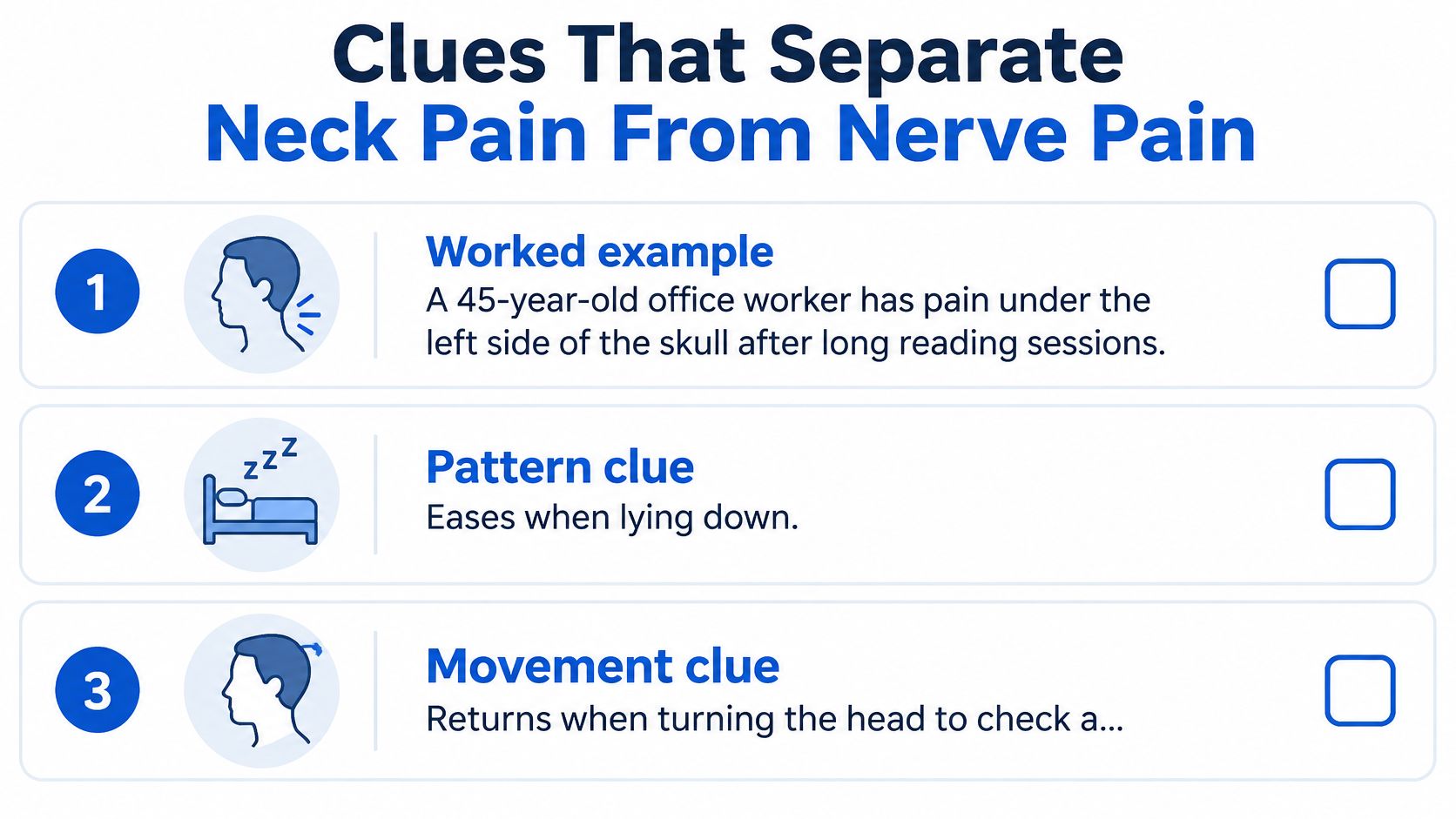
A clinician usually asks six questions beyond location. Each answer nudges the likely cause in a different direction.
The Six Questions That Narrow It Down
- Does neck movement or a sustained posture reproduce the pain? If turning, tilting or holding one position reliably brings it on, that points toward a cervicogenic headache, where upper neck joints or muscles refer pain to the head.
- Is the pain throbbing or shock-like? A throbbing quality fits migraine better. A sharp, shooting or electric burst fits nerve pain better.
- Do you have nausea or light sensitivity? Those features point toward migraine, even when the neck feels tight during an attack.
- How long does each attack last? Bursts lasting seconds to minutes suit occipital neuralgia. Attacks lasting hours suit cervicogenic or tension-type headache, while migraine often runs much longer.
- Is the pattern new or changing? A stable pattern you've had for years is different from a new headache, a clear change in frequency, or pain that's steadily getting worse. Change needs review.
- Are the occipital nerve points tender when pressed? Marked tenderness or scalp sensitivity at the back of the head, sometimes painful even when brushing hair, points toward occipital neuralgia.
Apply those questions to the office worker. Movement reproduces the pain, the ache is dull rather than electric, there's no nausea, and each episode lasts hours. Lying down helps, which removes the postural load. That combination fits a neck-driven pattern better than a nerve pattern, but it's still a working impression, not proof.
That caution matters because diagnostic boundaries are messy. A 2025 mapping review found reported cervicogenic-headache occurrence ranging from 0.4% to 42%, a spread that reflects inconsistent diagnostic criteria. In plain terms, different studies aren't counting it the same way.
A tight neck doesn't prove the neck is the cause.
Migraine can include neck pain, upper neck problems can refer pain toward the head, and nerve pain can sit alongside another headache type. That's why hands-on treatment shouldn't replace proper assessment when shock-like pain, nausea or light sensitivity dominates. If your pattern sounds more like pressing, band-like pain on both sides, it's worth comparing it with tension headache relief options before assuming the neck joints are to blame.
Write down your six answers and take them to your GP or physiotherapist. You'll give them a clearer starting point than "it hurts here," and you'll help them decide whether the next step is neck-focused care, migraine treatment, nerve assessment or further testing.
Red Flags That Need Urgent Care Rather Than Self-Treatment
Urgency depends on the pattern, not the location. A headache at base of skull that's sudden, severe, feverish, neurological or new after a head or neck injury needs assessment before any stretching, heat or hands-on care. Irritated upper neck joints, muscles or nerves can cause pain here, but location alone can't establish the cause, which is why Healthdirect neck pain guidance treats headache with neurological or systemic features as a potential emergency.
Warning signs at the base of the skull and what to do
| Warning sign | Why it matters | What to do |
|---|---|---|
| Sudden, extremely severe onset | Can indicate bleeding around the brain | Call Triple Zero (000) or go to an emergency department |
| Fever or chills with a stiff neck | Can indicate meningitis | Emergency assessment now |
| Vomiting, confusion or seizures | Can indicate raised pressure or a serious brain condition | Call Triple Zero (000) |
| Limb weakness, numbness or loss of balance | Possible nerve or brain involvement | Urgent medical review the same day |
| Visual change or bowel or bladder change | Can accompany serious neurological causes | Urgent medical review |
| Pain began straight after a head or neck injury | Trauma must be excluded | Emergency assessment |
| Pain steadily worsening over weeks | Change in pattern needs investigation | GP review within days |
Also seek medical review if neck-associated warnings appear alongside the headache. These include fever or chills, limb weakness, numbness or pins and needles, dizziness, impaired concentration, and bowel or bladder changes. A headache that begins immediately after a traumatic event, or sudden severe neck pain after trauma, should be treated as an emergency.
What to Note Before You Call
Document the details while they're fresh:
- Onset speed: Did it peak in seconds, minutes or hours?
- Any trauma: Was there a fall, collision or whiplash-type event?
- Fever: Have you measured a temperature or felt chills?
- Neurological symptoms: Any weakness, numbness, balance trouble or confusion?
- Visual symptoms: Blurring, double vision or loss of vision?
- Direction: Is the pain steadily worsening rather than settling?
Meningitis and bleeding around the brain are the serious conditions this pattern can hide. A thunderclap onset, meaning pain that reaches maximum intensity very suddenly, is never treated as routine neck strain. It needs emergency exclusion of a vascular cause first.
If none of these signs are present and the pain is stable and familiar, home care is a reasonable next step. Keep watching for change, though. A non-urgent pattern today doesn't excuse ignoring new weakness, fever or confusion tomorrow.
How to Ease Base-of-Skull Pain at Home Step by Step
Gentle self-care is only for non-urgent patterns. If you have marked neck stiffness with fever, don't start with exercises. Healthdirect headache guidance notes meningitis can present with a very bad headache, stiff or sore neck and light sensitivity, and identifies it as a medical emergency needing emergency department assessment or Triple Zero (000). It also describes subarachnoid bleeding from a ruptured aneurysm, which may produce an abrupt, extremely severe headache with nausea, vomiting and neck pain. Gentle self-care or manual treatment should be deferred until urgent causes have been excluded.
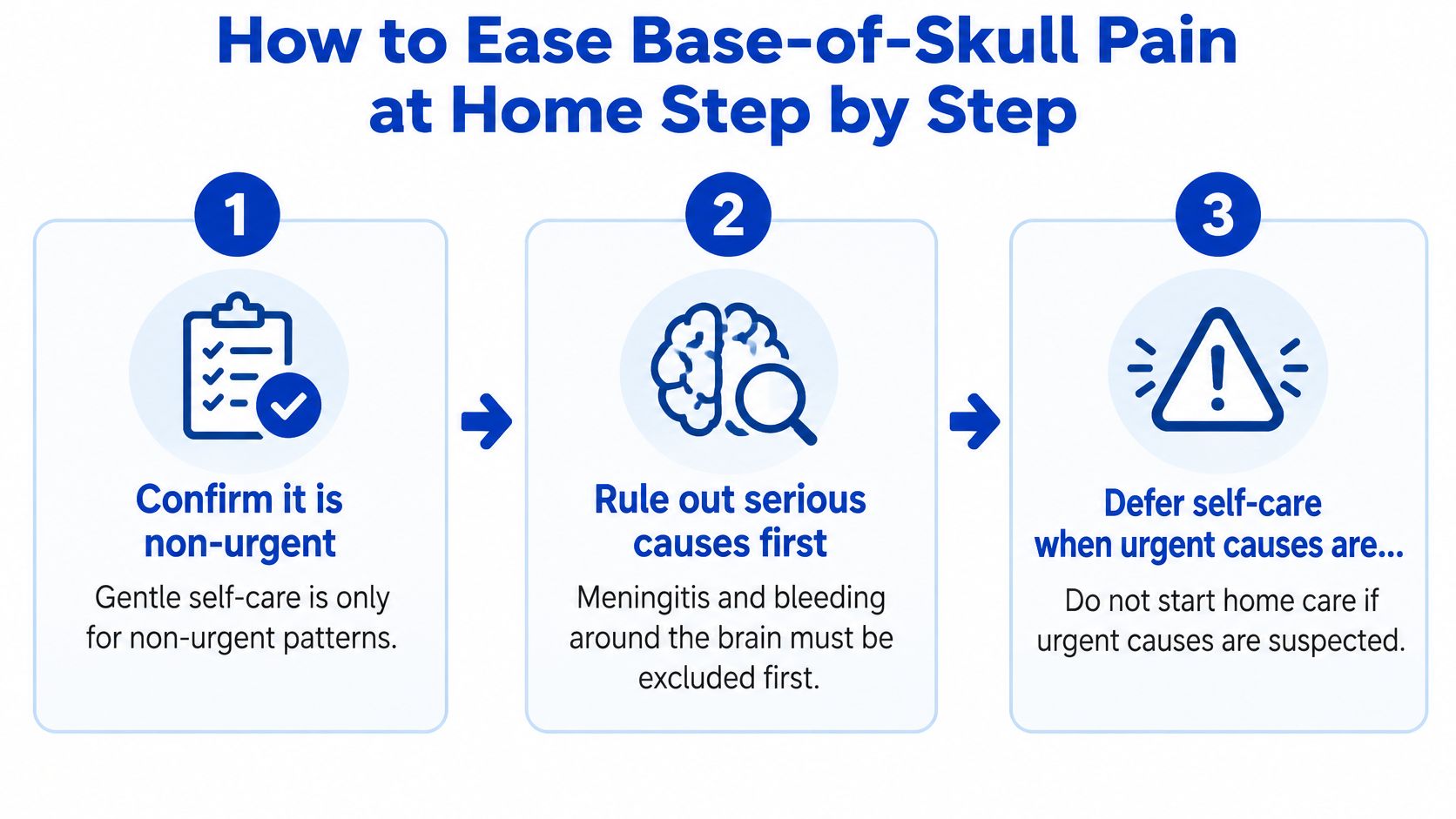
Once you're confident the pattern is stable, non-urgent and familiar, work through this routine in order.
The Daily Routine
- Set the top of your monitor at eye level and support your forearms on the desk. This reduces the forward-head load on the upper neck. The common slip is raising the screen but still leaning in with unsupported arms.
- Take a two-minute movement break every 30 to 45 minutes. Short breaks stop one posture loading the same tissues for hours. Standing still beside your desk doesn't count if you don't move your neck and shoulders.
- Do five slow chin tucks, holding each for five seconds. Glide your chin straight back as if making a gentle double chin. Stop if dizziness, tingling or rising pain appears, and don't force the movement.
- Turn your head slowly within a pain-free range, five times each side. Small, controlled movement helps maintain mobility without provoking irritated joints. The slip is pushing into the painful end range to "stretch it out."
- Apply heat for 15 to 20 minutes to tight muscles, and use cold for a sharp flare. Heat suits stiffness and muscle guarding. Cold suits a fresh, sharp flare that feels inflamed. Don't fall asleep with either on your neck.
- Sleep with your neck in neutral, using a pillow that fills the gap between your head and shoulder. Your head shouldn't tilt up or drop sideways all night. Stacking two thick pillows often pushes the neck into flexion instead.
- Keep a diary of onset, duration, triggers and any pain relief taken. Patterns usually show up within a week or two. Writing "bad day" isn't enough. Record times and what you were doing beforehand.
If you want more detail on pacing these changes at home, these neck pain relief strategies for home cover the same principles in a practical order.
Progress over two to four weeks usually looks like fewer episodes, shorter episodes, or the same ache arriving later in the day instead of by mid-morning. It rarely disappears in three days. Stop and seek review if pain keeps escalating, new symptoms appear, exercises repeatedly provoke dizziness or tingling, or you're using pain relief more often to get the same effect.
What Hands-On Osteopathic Care Involves
Hands-on care suits the cervicogenic pattern best, where neck joints, muscles and sustained posture appear to contribute. It's less suitable as the main plan when electric nerve pain or migraine features dominate. A clinician should confirm the pattern first rather than treating the sore spot and hoping.
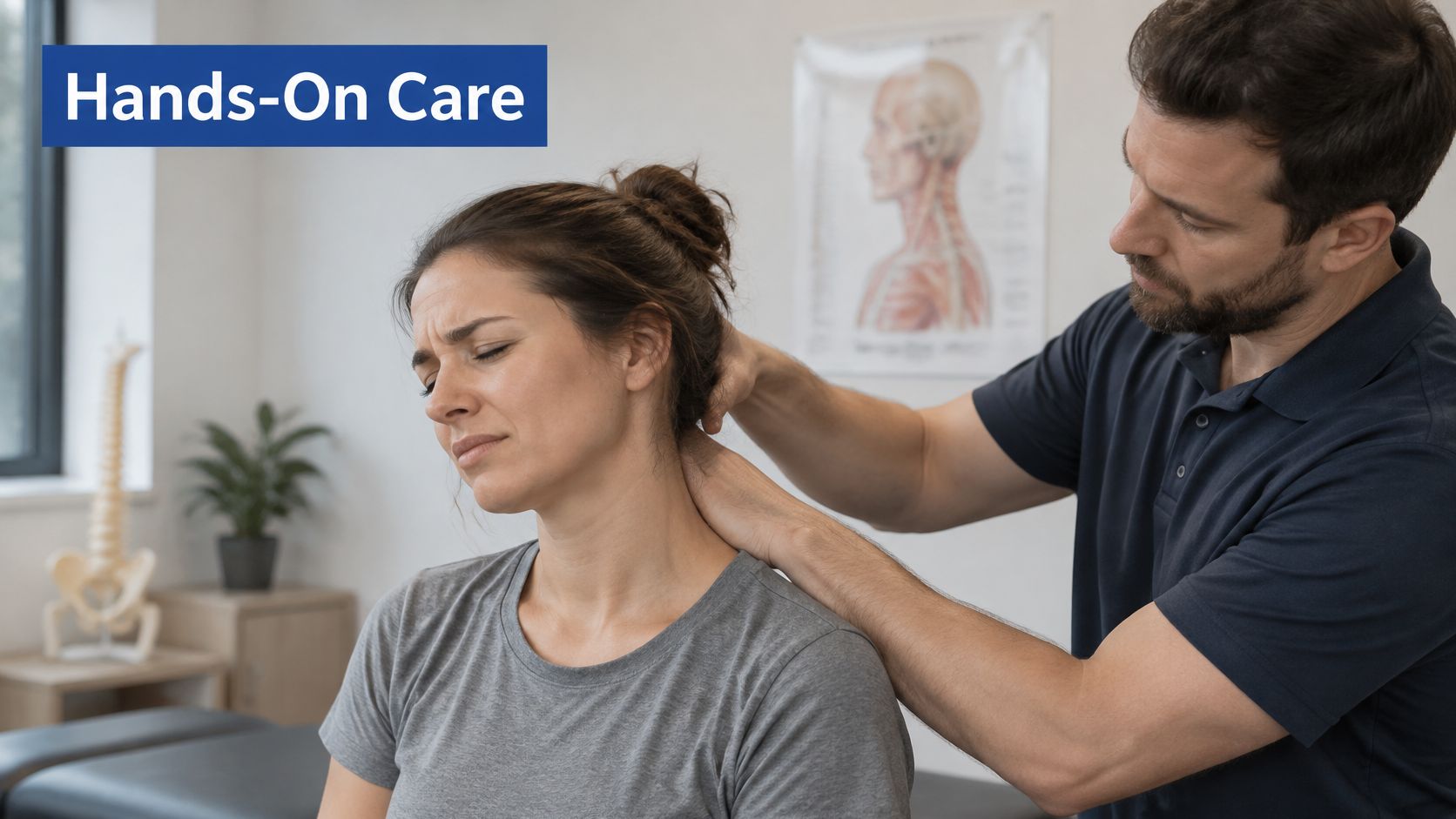
A typical first visit for a headache at base of skull starts with questions, not treatment. We take a detailed case history and complete a physical assessment of posture, movement and the specific area of concern. That includes how your neck turns and tilts, which positions reproduce your familiar pain, and whether the upper back and shoulders move well.
What Treatment Feels Like
Treatment may include soft-tissue work, joint articulation and gentle mobilisation. The aim is to reduce tension, restore comfortable movement and lower the load on irritated structures. These techniques are graded to your tolerance rather than forced through pain.
We also start spinal pain treatment with a whole-body assessment to trace contributing factors rather than treating only the site of pain. For example, a stiff mid-back or a desk setup that holds your head forward may keep reloading the upper neck even if local treatment helps briefly. That's why care is combined with the movement and posture changes you use between visits.
Treatment should never be painful, though mild temporary soreness may be felt after a session. That soreness usually settles quickly and feels more like post-exercise tenderness than a flare. Tell your practitioner if anything feels sharp, electric or wrong during treatment.
If you're comparing providers, ask these three questions, including when you contact a neck pain osteopath:
- Assessment: How did you decide this pattern is neck-driven rather than migraine or nerve pain?
- Plan: What's the treatment plan, and when will we review whether it's working?
- Self-care: What should I continue, change or avoid between visits?
A practitioner should stop and refer if red flags appear, if the pattern changes, or if you're not improving as expected. Good hands-on care includes knowing when hands-on care isn't the right next step.
Habits That Keep Base-of-Skull Pain Returning
Some habits keep reloading the same tissues or blur the diagnosis. Each one below is paired with its replacement, because stopping a habit without a substitute rarely lasts.
Forcing neck cracks or aggressive self-manipulation can irritate already sensitive joints and muscles, so replace it with gentle range-of-motion work within a pain-free range. The temporary release after a forceful crack can fool you into repeating it more often while the underlying stiffness stays unchanged.
Taking simple pain relief on most days of the month can contribute to medication-overuse headache, so replace automatic use with a diary-tracked limit and book a review if you need relief on 15 or more days a month. Your diary should name the medicine, dose and time, not just tick a box.
Reading or scrolling with your head pushed forward loads the upper neck for hours, so replace it by bringing the screen and phone up closer to eye level. A laptop on your knees and a phone at chest height create the same problem in different rooms.
Sleeping on your stomach with your head turned holds your neck rotated for much of the night, so replace it with side or back sleeping using a pillow that supports a neutral neck position. Waking with the worst pain of the day often points to sleep position rather than your mattress brand.
The Assumption Worth Dropping
Repeating the same treatment without improvement is a sign to reassess, not a sign to try harder.
Waiting months before seeking a diagnosis lets an unclear pattern become your normal, so replace it by booking a review once symptoms persist beyond two to four weeks. That's especially important if the character of the pain changes, even if the location stays the same.
The deeper misconception is that a tight neck proves the neck caused the headache. Migraine can make the neck feel tight, and poor sleep or stress can raise muscle tension without being the primary driver. If neck-focused care isn't changing frequency or intensity, the label needs revisiting rather than more of the same.
Book the Right Assessment for Persistent Base-of-Skull Pain
Use this decision rule. If your headache at base of skull persists or keeps returning after two to four weeks of consistent home care, book a GP appointment for diagnosis. Don't wait for it to become daily before you ask why it's happening.
Your GP can then direct the next step based on the pattern. A confirmed cervicogenic pattern may lead to physiotherapy or osteopathy focused on neck movement, posture and load management. Shock-like nerve pain, persistent migraine features or an unclear changing pattern may need neurology or pain specialist review instead.
What to Bring to the Appointment
- Your headache diary: Onset, duration, triggers, severity and what helped.
- All medicines: Names, doses and how many days each month you take them.
- Your clue checklist answers: Movement triggers, pain quality, nausea, light sensitivity, attack length and any scalp tenderness.
- Any red flags noted: Even if they've settled, write down what happened and when.
That preparation shortens the guesswork. A clinician can look for a pattern across episodes rather than judging one painful day out of context.
Where the pattern points to neck or posture contributors, Bayside Osteopathic Health is one option alongside the GP route rather than a replacement for it. We welcome enquiries about whether osteopathic care is right for a person, and we prioritise prompt bookings for patients with acute or urgent pain. You can contact us at hello@baysideosteopathic.com.au or on 0419110004.
Take one action this week. Either book the GP appointment or sit down and make sure your diary is complete enough to take with you. If any red flag appears, do not wait for an appointment. Call Triple Zero (000) or go to an emergency department.
If your base-of-skull pain fits a neck or posture pattern and hasn't settled with home care, Bayside Osteopathic Health offers a detailed assessment of your posture, movement and area of concern, followed by gentle hands-on care and a practical home plan where appropriate. Get in touch to ask whether osteopathic care is right for you and to arrange a prompt booking.