
You wake in your Bayside home, turn your head towards the alarm, and feel that familiar catch at the base of your neck. Yesterday's laptop work ran long, your phone spent much of the evening below eye level, and now a heat pack seems like the easiest answer. It may settle the discomfort for a while, but if the same daily demands remain, the stiffness often returns.
The practical answer to how to cure neck pain isn't a magic exercise or a gadget. It's a staged self-management plan that calms the flare, restores movement, builds capacity, changes the habits that keep irritating the area, and includes clear points for professional assessment. Australian guidance generally favours active, conservative care, including advice, exercise and medicines, rather than prolonged immobilisation or passive treatment alone. (NSW SIRA clinical guidance)
Table of Contents
- Why Neck Pain Needs a Plan, Not a Quick Fix
- Immediate Relief Strategies for the First Few Days
- Progressive Mobility and Strengthening Exercises
- Posture, Workstation Setup and Tech Neck Habits
- Where Gentle Osteopathic Care Fits In
- Red Flags and When to Seek Professional Help
- Your Two-Week Starter Plan and Ongoing Prevention
Why Neck Pain Needs a Plan, Not a Quick Fix
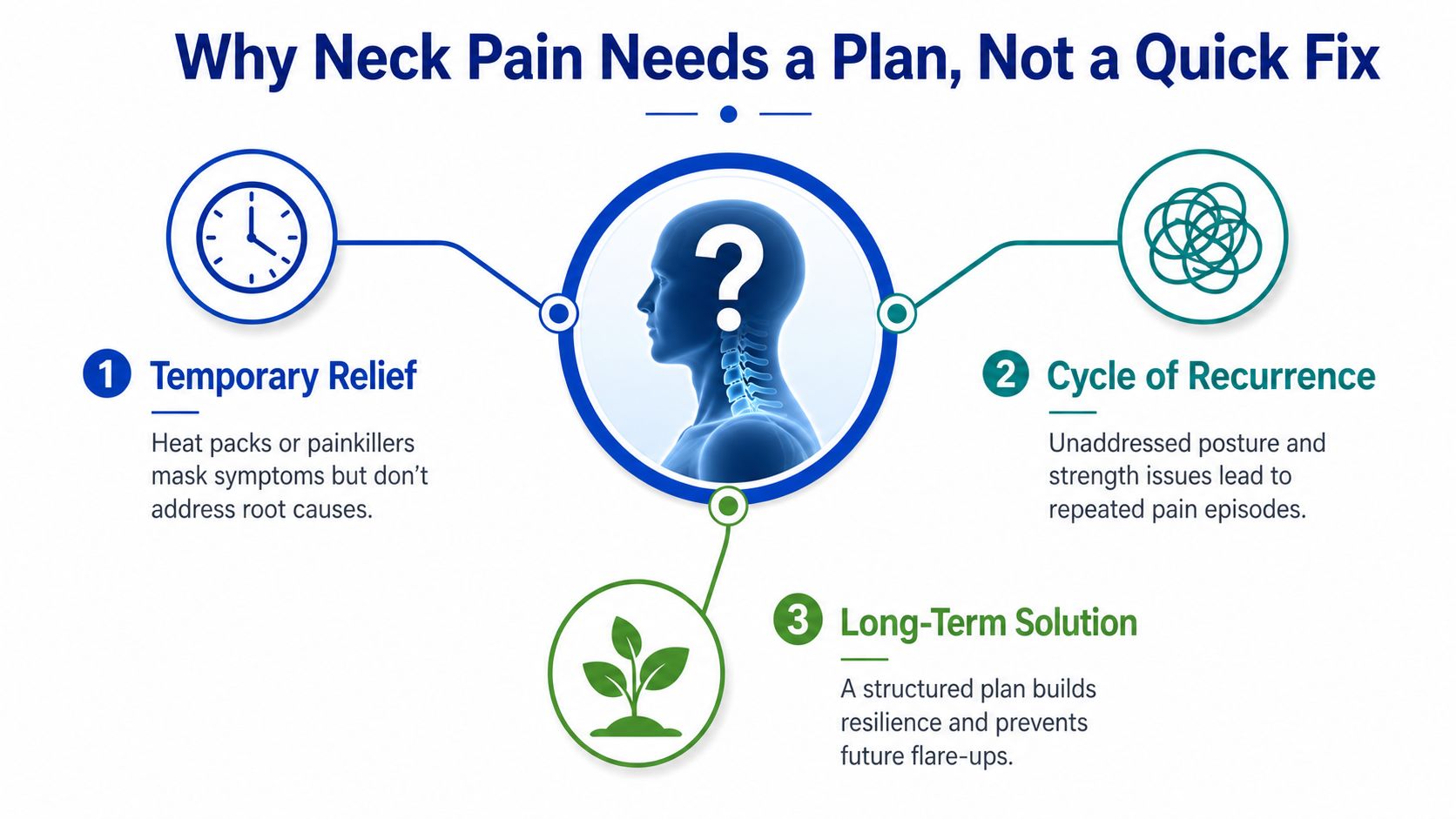
A stiff neck after a long screen day is common. If the same pain keeps returning, the answer usually lies in how you manage the flare, restore movement, build capacity and adjust the habits that keep irritating it. A global burden analysis estimated 494,000 prevalent neck-pain cases in Australasia in 2019, alongside 48,800 years lived with disability. (Australasian burden analysis)
That context matters in the treatment room. A heat pack, medication or hands-on session may make turning your head easier, but short-term relief does not rebuild strength or change the work, sleep and movement patterns behind the flare. Ask what will help your neck cope better next week, not only what feels better today.
Four principles for lasting improvement
-
Keep moving within your tolerance. Complete rest can make ordinary movements feel more threatening and leave you less prepared for daily activity. Gentle walking, comfortable neck movements and regular position changes are usually more useful than staying in bed.
-
Build capacity gradually. Your neck works with the upper back and shoulder blade muscles. Progressive loading helps those areas regain control and endurance without demanding too much during an acute flare.
-
Change the inputs. A monitor that sits too low, a phone held at waist height, an unsuitable pillow and uninterrupted desk work can all contribute to repeated irritation. Posture matters, but so do movement variation, break frequency and the way a hybrid working day is organised.
-
Use checkpoints. Self-care is reasonable when symptoms are mild, stable and gradually improving. Worsening pain, neurological symptoms, significant injury or failure to improve should prompt professional assessment.
Australian evidence also supports an ongoing approach. An Australian office-worker study reported a one-year incidence of neck pain of 49%, with a 95% confidence interval of 36% to 62%. (NSW SIRA guideline summary) A structured routine is therefore about reducing the chance that each busy week becomes another setback, while recognising when self-care has reached its limit.
Immediate Relief Strategies for the First Few Days
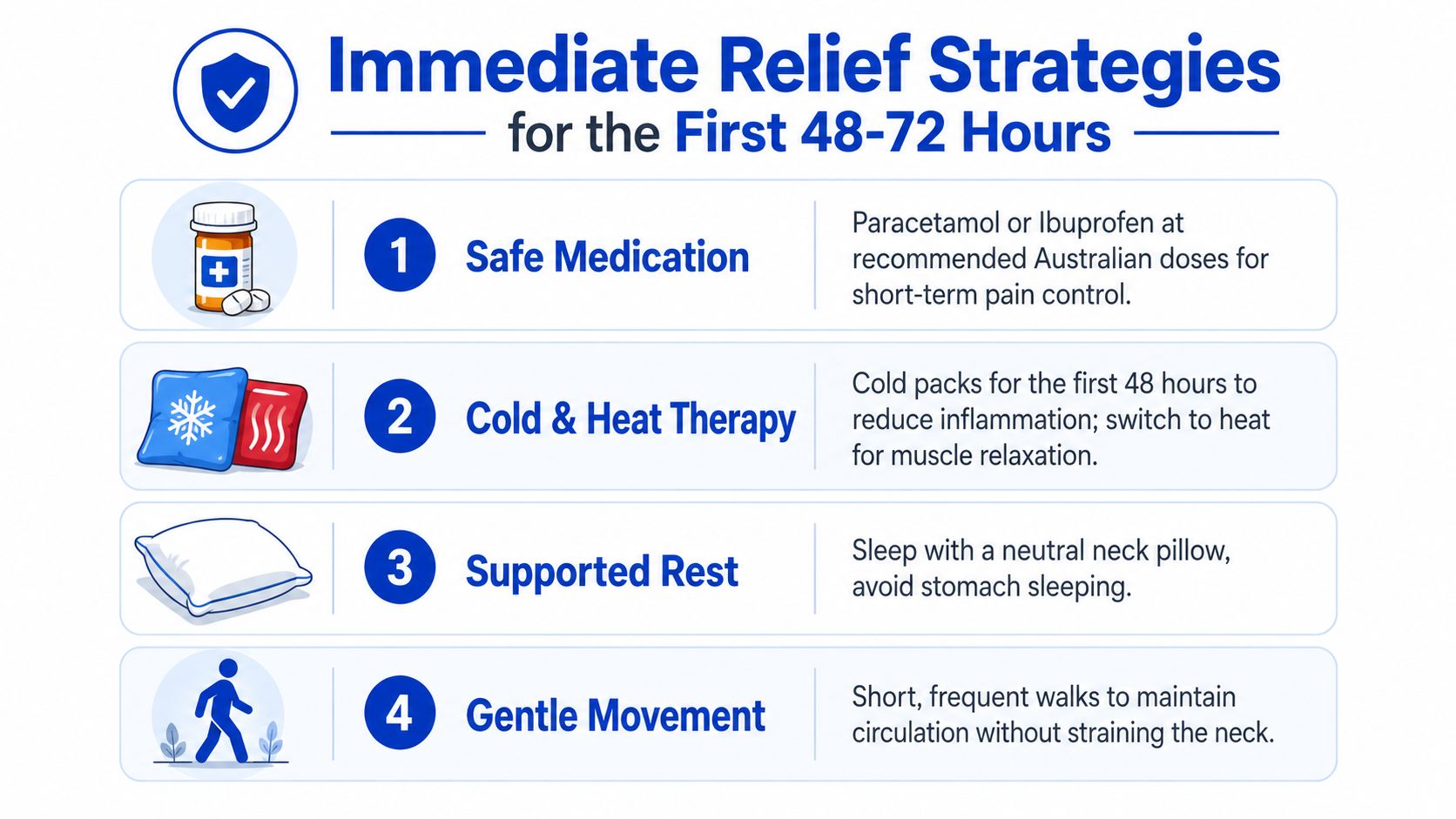
A neck flare can make ordinary tasks feel unexpectedly difficult. During the first few days, restore comfortable movement while keeping sharp symptom increases in check. Reduce activities that clearly aggravate the pain, and keep light movement in your routine where it feels manageable.
Settle symptoms without becoming completely still
Short, easy walks around the house or workplace can reduce guarding and make position changes less daunting. At your desk, move before your neck feels locked. A reminder for regular movement breaks is useful during long laptop sessions, particularly when work shifts between home and the office.
Heat and cold are comfort options. A cold pack may feel better when the area is hot or freshly irritated, while warmth can ease muscular tension. Choose the option that provides relief, protect your skin, and stop if discomfort increases.
Paracetamol or ibuprofen may suit some adults when used according to the product instructions. Ibuprofen is unsuitable for some people, including those with certain stomach, kidney, cardiovascular or medication-related risks. Ask a pharmacist or GP if you are unsure. Medication may make movement easier, but worsening symptoms still require attention.
Make sleep and movement easier
Support your head in a neutral position rather than stacking several pillows underneath it. Side and back sleeping are often easier to adjust than stomach sleeping, which commonly keeps the neck turned for longer periods.
Use these low-force movements only within a comfortable range:
- Chin nods: Lie supported or sit tall, then make a small nod as though saying “yes”. Keep it subtle and avoid pushing your head forwards.
- Supported rotations: Turn your head slowly towards one side, return to centre, then repeat on the other side. Stop before a sharp catch.
- Shoulder movement: Roll your shoulders gently and let your arms move, provided this does not reproduce arm symptoms.
Practical rule: During an acute flare, comfortable motion matters more than achieving a dramatic stretch.
Avoid aggressive stretching, forceful self-manipulation and prolonged cervical-collar use unless a qualified clinician has advised them. Australian clinical guidance places physical activity at the centre of care and generally does not recommend imaging for acute or recurrent nonspecific neck pain when there are no signs suggesting a structural cause, as outlined in this Australian neck-pain guidance review.
The following video may help you visualise gentle movement. Do not copy any exercise that causes escalating pain, dizziness, tingling or weakness.
These measures can make the next few days more manageable. They are an initial response, not a complete rehabilitation plan. As movement settles, graded work for the neck and shoulder girdle becomes appropriate.
Progressive Mobility and Strengthening Exercises
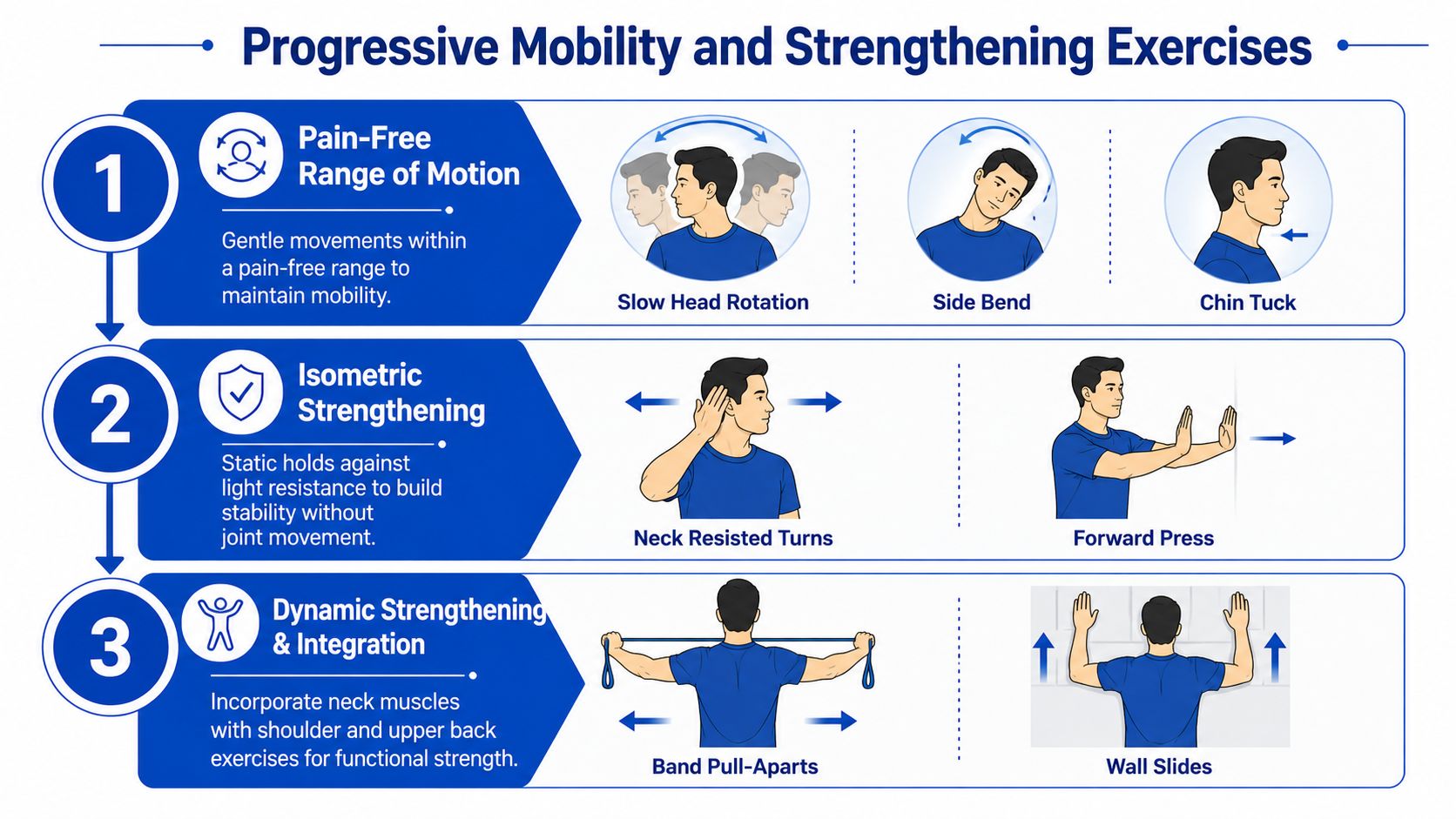
A useful neck programme moves from comfortable range, to muscle control, then to endurance. There is no universal repetition target for every neck complaint. Use movement quality, your response later that day and the following morning, and your ability to add a small amount of work without a flare as the guide.
Stage one restores range
Begin with slow rotations, gentle side bends and controlled chin nods. Work through a range that feels easy or mildly restricted, then return to centre without bouncing. Short, frequent practice is often more practical than one demanding session, particularly when sitting and driving are still part of your day.
Stay here if movement is jerky, symptoms build between sessions or your shoulders start compensating. Progress when you can move with less guarding and everyday tasks feel more predictable.
Stage two gives the neck a stable base
The shoulder blades support muscles that attach around the neck. Start with gentle scapular setting, drawing the blades comfortably down and back without pinching them together. Then try a resistance-band row, keeping the ribs relaxed and the neck long.
A prone Y to W pattern may suit people who can lie comfortably on their stomach. It should not become a test of how high you can lift your arms. Keep the movement controlled, and shorten the lever if the upper trapezius starts doing most of the work.
For desk-related neck pain, targeted neck and shoulder strengthening addresses the problem more directly than general conditioning alone. Australian clinical guidance cautions against relying on unsupervised handouts when symptoms restrict movement. Supervised exercise is preferred, with at least one treatment session plus one follow-up specified in the guidance. Technique and adherence affect whether the programme is useful. (Neck Pain Clinical Practice Guideline)
Stage three builds deep control and endurance
Low-load deep neck-flexor work can start with small head nods against gravity, or with pressure-cuff feedback after a clinician has demonstrated its use. Keep the jaw relaxed and avoid lifting the head forcefully. Thoracic extension over a foam roller can help you practise moving through the upper back rather than asking the neck to provide all the movement.
Progress by adding a little time under tension, improving control or modestly increasing daily frequency. Remain at the current stage if symptoms stay elevated into the next day. Hands-on treatment can sometimes accompany exercise when stiffness or muscle sensitivity limits progress. This myofascial therapy illustration shows the type of soft-tissue approach a practitioner may discuss, although it does not replace graded exercise or assessment.

Posture, Workstation Setup and Tech Neck Habits
“Sit up straight” is too narrow to solve modern neck pain. A hybrid worker may spend the morning at a laptop, check messages on a phone while walking to the tram, use a tablet on the sofa, then return to a desk for evening tasks. The neck responds to the total pattern, not one isolated posture.
Evidence involving computer-using workers found that working from home was associated with higher odds of neck pain, and poor sitting posture was also strongly linked. Sleep quality and female sex were additional correlates in that research. (Computer-worker evidence) The practical implication is broader than holding your chin up. You need a workspace and routine that make position changes easier.
Make the workstation support movement
Set the monitor so you can look ahead without repeatedly bending the neck. Keep the keyboard close enough that your elbows remain near your sides, support the forearms where possible, and use a chair that supports your lower back. A laptop stand with a separate keyboard and mouse can make a larger difference than repeatedly reminding yourself to “sit better”.
Use this quick check at the start of the day:
- Screen: Place the main screen near eye level and close enough that you aren't leaning forwards to read.
- Arms: Keep the elbows comfortably bent and the shoulders relaxed rather than lifted.
- Chair: Let the backrest support you, with feet supported and the desk at a workable height.
- Phone: Raise the device or use a headset instead of holding the phone between your ear and shoulder.
- Variation: Alternate sitting, standing, walking and looking away from the screen.
This posture and corporate ergonomics guide can help you review the physical arrangement, but equipment won't fix a schedule that never allows movement.
Change the rhythm, not just the pose
A short movement reset every 20 to 30 minutes can be more realistic than trying to maintain one perfect sitting position for an entire work block. Stand during a phone call, walk to refill water, gently rotate the shoulders, or look across the room while your eyes and neck recover from close work.
Sleep deserves the same practical attention. Choose a pillow height that keeps the head aligned with the body in your usual side or back position, then adjust based on morning stiffness rather than marketing claims. Australian workplace messaging has increasingly focused on breaks, device positioning, ergonomics, exercise, education and workload or workplace-culture changes, not posture alone. That broader approach suits Bayside workers whose neck pain is tied to how work is organised as much as to where the monitor sits.
Where Gentle Osteopathic Care Fits In
Hands-on treatment can be useful, but it shouldn't be sold as a standalone cure. The strongest role for manual care is often to make movement easier, clarify what is limiting you and support the exercise plan you can continue between appointments.
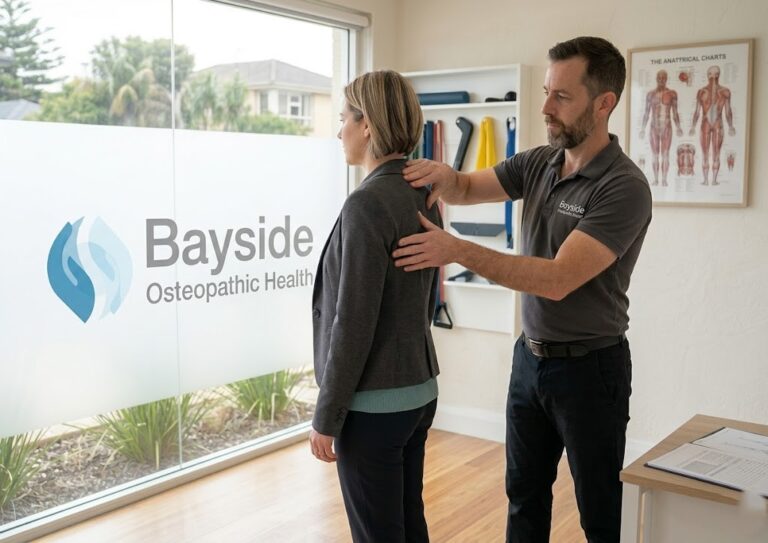
A thorough session begins with a history. The practitioner asks how the symptoms started, what aggravates them, whether they travel into the arm, and how they affect sleep, work and daily movement. They then assess posture, neck and upper-back motion, shoulder function and relevant neurological signs before choosing treatment.
What gentle treatment may include
Depending on the findings, care may involve soft-tissue techniques for guarded muscles, joint articulation, gentle mobilisation, myofascial release or balanced ligamentous tension approaches. These are different from high-velocity thrust techniques, which involve a quicker movement and aren't automatically appropriate for every person or every presentation.
Ask your practitioner what technique they plan to use and why. You can also tell them if you prefer a gentle approach, if a previous treatment felt too forceful, or if you want the session linked to a specific home exercise goal.
When treatment earns its place
Manual therapy may be worth adding when an acute spasm makes basic movement difficult, when post-injury stiffness limits normal activity, or when recurring headaches appear to have a cervical movement component. It can also help when you've followed a sensible exercise plan but have plateaued and need an assessment of technique, mobility restrictions or load progression.
The trade-off is straightforward. Appointments require time and money, and short-term improvement won't last if your daily habits and strengthening work remain unchanged. A useful session should leave you with a clearer plan, not a sense that you must depend indefinitely on passive treatment.
Bayside Osteopathic Health provides assessment, gentle hands-on techniques and customized movement advice for people dealing with neck stiffness, postural strain and related mobility problems. You can review this osteopathic treatment illustration to see how a whole-body assessment can sit alongside home care.

Red Flags and When to Seek Professional Help
A sore neck after ordinary strain often improves with sensible movement and reduced aggravating load. The decision changes when symptoms suggest injury, nerve involvement or broader illness. Screen for those signs before relying on home care, and set a review point rather than waiting indefinitely.
Seek urgent assessment for warning signs
Arrange same-day medical assessment for neck pain associated with:
- Significant trauma: Severe pain after a fall, collision, diving incident or other injury needs prompt evaluation.
- Progressive neurological change: New or worsening weakness, spreading numbness, loss of coordination or changes in walking require medical attention.
- Bladder or bowel changes: Loss of control alongside neck or spinal symptoms is an emergency warning sign.
- Systemic illness: Fever with marked neck stiffness, unexplained weight loss or feeling acutely unwell should not be managed with home exercises alone.
- Unrelenting night pain: Pain that does not ease when you change position warrants assessment, particularly alongside another warning sign.
Pain travelling into an arm or leg, tingling, weakness or a severe headache also changes the decision. As noted earlier, Australian clinical guidance supports avoiding routine imaging for acute or recurrent nonspecific neck pain when structural warning signs are absent. That guidance does not mean serious symptoms should be ignored. Seek medical advice when the pattern is unusual, worsening or difficult to explain.
Set a review point for ordinary flares
If symptoms are stable and gradually easing, continue the gentle plan and monitor function. Arrange a review if pain is worsening, spreading, disturbing sleep or preventing work despite consistent self-care. Repeatedly changing exercises without checking the underlying problem can delay useful treatment.
A practical reassessment window is two to four weeks for symptoms that are not settling, provided there are no urgent warning signs. A GP can assess medical causes and coordinate referrals. An osteopath or physiotherapist can examine movement, load tolerance and exercise technique. Imaging or specialist review is considered when the history and examination suggest it will change management, rather than just because pain feels worrying.
Bayside Osteopathic Health can assess neck symptoms, movement and exercise tolerance, then combine hands-on care with a plan for self-management when appropriate.
Good self-management includes knowing when to stop self-managing.
Your Two-Week Starter Plan and Ongoing Prevention
A useful routine should fit around school drop-offs, office meetings, commuting and home working. Keep the effort modest enough to repeat, then adjust it according to your symptoms instead of forcing a fixed programme. The aim is steady improvement in movement and daily function, with clear points for professional review.
Your first week
Day one: Reduce the task that provokes the flare, take short walks, use heat or cold for comfort, and practise small chin nods with supported rotations.
Day two: Repeat the easy mobility work. Check your pillow, raise your screen if needed and bring the keyboard closer so your shoulders can relax.
Day three: Reassess. Is turning your head easier, unchanged or worse? If symptoms are escalating, spreading or accompanied by neurological signs, seek professional advice rather than progressing the exercises.
Days four and five: Continue mobility and add gentle scapular setting. Introduce a light banded row only if you can keep your neck relaxed and the movement controlled.
Days six and seven: Review your work pattern. Identify the phone, laptop, driving or sleep habit that most reliably increases symptoms, then change that input. Do not add resistance just because the calendar says you should.
Your second week
Days eight to ten: Keep the mobility routine and gradually increase time under tension in the shoulder-blade exercises. Add low-load deep neck-flexor nods if the earlier stages remain comfortable.
Days eleven to thirteen: Include upper-back movement, such as controlled thoracic extension, and practise the exercises in the positions you use at work. Transferable control matters more than a perfect performance in an exercise room.
Day fourteen: Compare function with day one. Can you turn your head more comfortably, work with fewer interruptions or sleep with less stiffness? If there is no meaningful improvement, or symptoms return whenever normal activity resumes, book an assessment.
Chronic pain affects many Australians, so a neck plan needs to remain useful after the initial flare. Self-management should continue beyond the point when the heat pack comes off, while persistent or recurring symptoms deserve a closer assessment.
Keep the gains practical
- During desk work: Use regular movement reminders and alternate tasks where possible.
- For exercise: Maintain mobility, shoulder-blade control and endurance work at a level you can repeat.
- For sleep: Keep the neck aligned and adjust pillow height if you wake stiff.
- For workload: Discuss task rotation, break opportunities and workstation needs rather than treating posture as an individual failure.
- For recurrence: Ask whether the same trigger has returned and whether a professional review could identify a missing piece.
Consistency, rather than intensity, prepares your neck for ordinary Bayside life, whether that involves cycling near the foreshore, commuting, caring for family or working from a home office. Start with the smallest useful step today, then build only when symptoms and movement quality allow it.
Bayside Osteopathic Health offers osteopathic assessment, hands-on treatment and personalised movement or workstation advice for neck pain, stiffness and screen-related strain. Visit Bayside Osteopathic Health to discuss your symptoms and create a practical plan for comfortable movement at home and work.