
You finish the workday, stand up from your chair, and your neck doesn't feel like it got the message. Your shoulders are creeping towards your ears. Your upper back feels dense and tired. You've stretched a few times, rolled your shoulders, maybe even had a heat pack on, but by dinner the same tension is back again.
That pattern is common in clinic. People often search for how to reduce muscle tension when what they really want is to understand why it keeps returning. The answer usually isn't “stretch harder”. Muscle tension can come from overworked tissues, poor movement variety, long periods at a desk, and a nervous system that has stayed switched on for too long. Real relief starts when you treat the cause, not just the sensation.
Table of Contents
- Why Your Muscle Tension Keeps Coming Back
- Immediate Relief With Targeted Stretches and Self-Massage
- Calm Your Nervous System With Relaxation Practices
- Prevent Daily Strain With Smarter Work Habits
- Build Long-Term Resilience Through Lifestyle Choices
- When to See an Osteopath for Your Muscle Tension
- Your Personalised Home-Care Plan for Lasting Relief
Why Your Muscle Tension Keeps Coming Back
A typical example is the person who works from home in Brighton, Sandringham, or Hampton, finishes a full day at the laptop, then notices the same old ache across the base of the neck. They've already stretched their upper traps. They've changed chairs. They've even tried “better posture”. Relief comes, then disappears.
Part of the problem is that persistent tension isn't always just a short muscle. Sometimes the body is staying guarded because the nervous system is still in a low-grade stress response. A 2024 Western Australian CCI resource reports that 54% of Australian patients with persistent muscle tension exhibit neurological hyperarousal, which standard stretching can't resolve on its own.
The stretch-and-return cycle
When tension is mainly mechanical, stretching can help. If your chest is stiff after hours of typing, opening the front of the shoulders may give useful relief. But if your jaw is clenched, your breathing is shallow, and your shoulders rise again within minutes, your system may be treating tension like protection.
That's why people often say things like:
- “I stretch every day but still wake up tight.”
- “My shoulders loosen for an hour, then seize again.”
- “Massage helps, but the ache keeps rebuilding.”
These aren't signs that you're failing. They're signs that the body needs a broader approach.
Clinical insight: If tension returns quickly after good stretching, don't assume you need more force. Often you need better timing, better movement during the day, or a calmer nervous system.
What usually sits underneath it
In practice, recurring tension often has more than one driver. The common combination looks like this:
| Driver | What it often feels like |
|---|---|
| Long static sitting | Neck, upper back, or low back stiffness that builds through the day |
| Stress load | Clenched jaw, tight shoulders, shallow breathing |
| Reduced movement variety | A body that feels “stuck” even after rest |
| Old pain patterns | Muscles that stay guarded because another area isn't moving well |
If you've been trying to work out how to reduce muscle tension, this is the shift that matters most. Don't ask only, “Which muscle do I stretch?” Ask, “Why is my body still holding on?”
Immediate Relief With Targeted Stretches and Self-Massage
When you're sore right now, you need something practical. Gentle, targeted work can reduce the sense of tightness and help your body move more normally again.
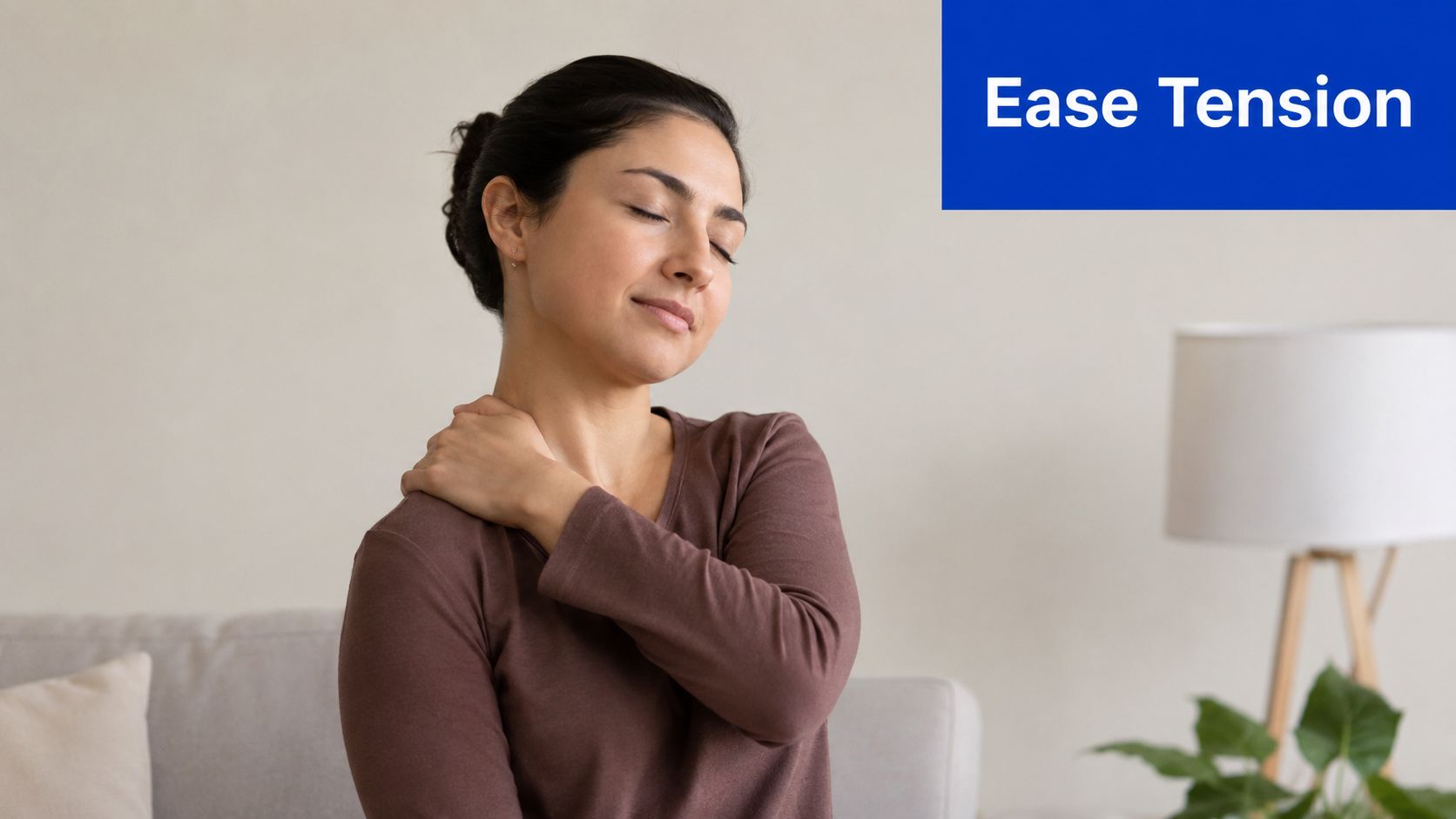
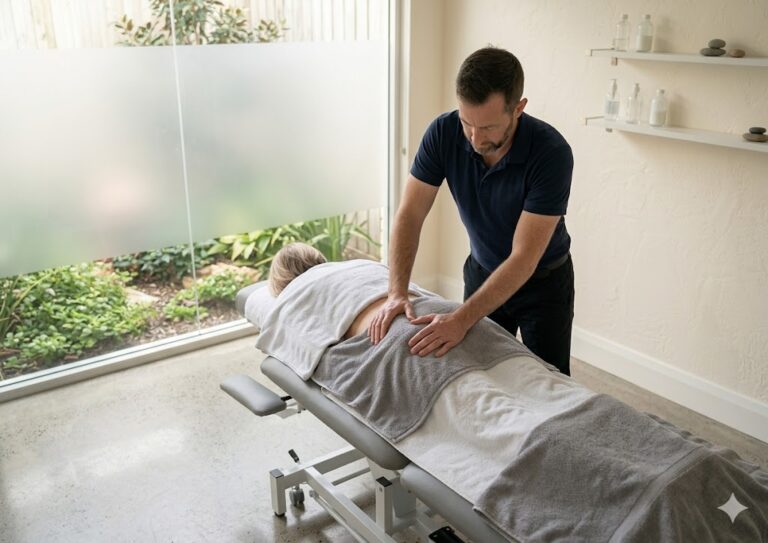
A hands-on approach is worth keeping in your toolkit. According to Medical News Today's summary of a 2021 study on releasing chronically tight muscles, even a single brief session of massage can immediately reduce muscle tightness. That lines up with what many people feel after well-placed pressure to a sore band of muscle. It doesn't solve every cause, but it can calm an irritated area quickly.
If you're considering more focused bodywork, options such as remedial massage and muscle therapy can also complement home care when self-treatment only gets you part of the way.
Start with the areas that tighten first
These are simple, low-risk techniques for common desk-related tension.
Upper trapezius stretch
Sit tall. Let one arm hang heavy, then gently tilt your head away from that side. You should feel a mild stretch along the top of the shoulder and side of the neck, not a sharp pull. Breathe slowly and keep the jaw soft.
Doorway chest stretch
Place your forearm on a doorframe and step through gently until you feel the front of the chest open. This is useful when rounded desk posture leaves the shoulders pulled forward. Keep the stretch easy. If your neck starts working harder, back off.
Child's pose or supported low-back fold
If your lower back feels compressed after sitting, a gentle fold can reduce that “jammed” feeling. Move slowly into the position and let the breath expand the ribs and low back. The aim is easing, not forcing.
Move into a stretch until the body says “that's enough”. If you have to grit your teeth, you've gone too far.
Use self-massage when stretching isn't enough
Sometimes a stretch glides over the top of the problem and doesn't touch the knot itself. That's where a tennis ball or lacrosse ball can help.
For the upper back by the shoulder blade
- Place the ball between your upper back and a wall.
- Lean in gently and search for a tender spot, not a severe pain point.
- Hold or make tiny circles for a short period while breathing slowly.
- Step away and retest your shoulder movement.
For the glutes or back of the hip
- Sit on the ball with one ankle crossed over the opposite knee if comfortable.
- Shift your body weight slowly until you find a dense, familiar ache.
- Pause there rather than rolling quickly.
- Stand up and walk for a minute afterwards.
A short demonstration can help if you're more of a visual learner.
What works and what usually doesn't
Usually helpful
- Gentle pressure on a clear sore spot
- Slow breathing while stretching
- Short sessions repeated through the week
- Matching the technique to the body part rather than using one stretch for everything
Usually unhelpful
- Aggressive stretching into pain
- Quick foam rolling with no pause on tender areas
- Holding your breath while trying to relax
- Treating every tight muscle as if it's the main problem
Immediate relief matters. It just works best when you treat it as a reset, not the whole plan.
Calm Your Nervous System With Relaxation Practices
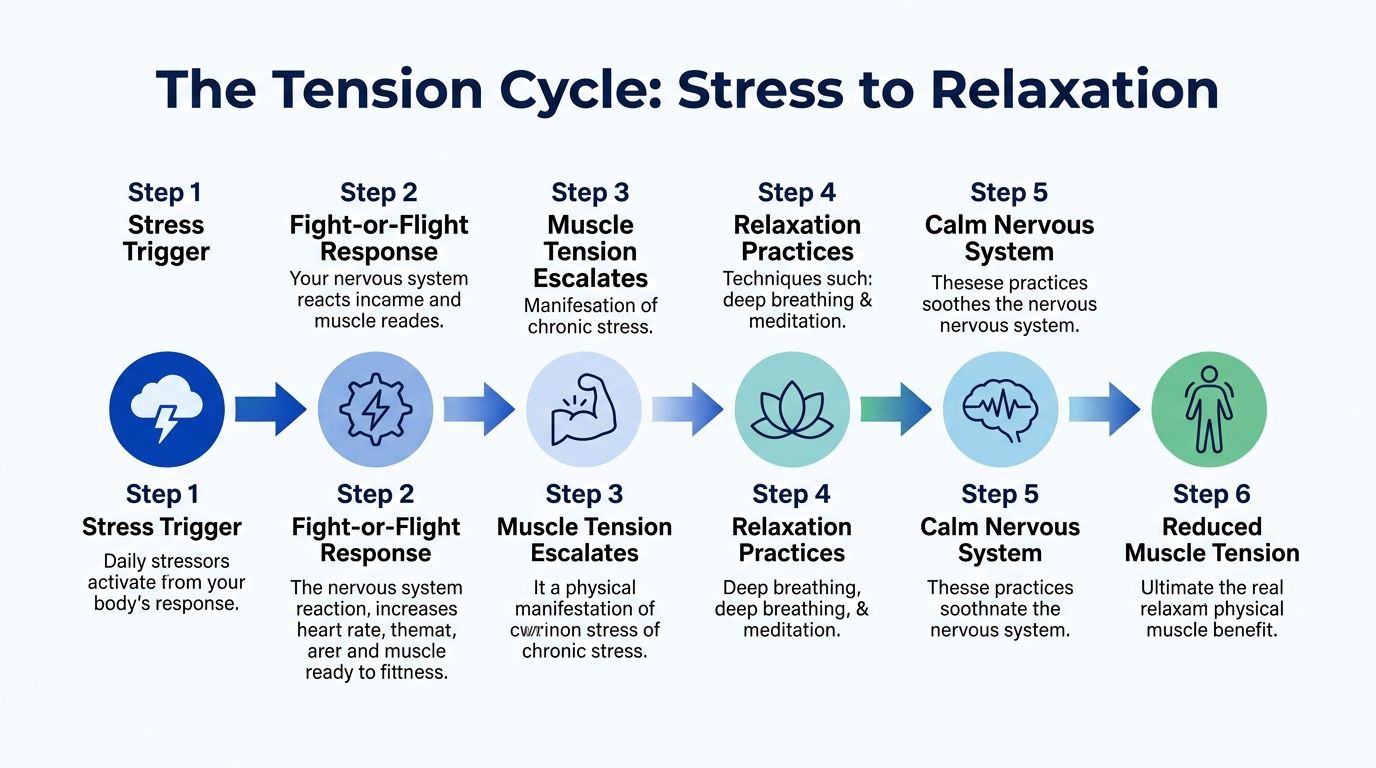
Some muscle tension starts in the muscles. Some starts in the alarm system.
Why stress shows up in your muscles
When you're overloaded, the body often responds by bracing. The jaw tightens. The neck shortens. The shoulders lift. The lower back stiffens. Many people think they have a flexibility problem when they really have a regulation problem.
Progressive Muscle Relaxation, or PMR, can be very effective. The method is simple and structured. A Hamilton Health Sciences guide on progressive muscle relaxation states that consistent PMR practice, using 5 to 10 seconds of tensing followed by 10 to 15 seconds of relaxing, has a 60 to 70% success rate in reducing chronic tension pain within 4 to 6 weeks.
A simple PMR routine you can follow tonight
Find a quiet spot. Sit in a supportive chair or lie down.
Start with your feet
Gently tense the muscles in your feet and lower legs for 5 to 10 seconds. Use only a moderate effort, not a maximal squeeze.Release fully
Let the muscles soften for 10 to 15 seconds. As you let go, exhale slowly.Move upward
Work through calves, thighs, glutes, abdomen, hands, arms, shoulders, neck, and face.Keep the effort sensible
The movement should feel deliberate, not forceful. Sharp pain means the contraction is too strong.Repeat daily
Consistency matters more than intensity.
Practical rule: PMR works best when you treat it like practice, not rescue. A few calm minutes each day will usually do more than one long session after you're already wound up.
Common mistakes that reduce the effect
A lot of people try relaxation by thinking about relaxing. PMR is different because it gives the body a clear physical contrast between tension and release.
Watch for these errors:
- Going too hard so the muscle cramps or feels aggravated
- Rushing the release instead of letting the softening phase happen
- Skipping the breath and unintentionally bracing through the whole sequence
- Stopping after two days because it doesn't feel dramatic straight away
If stretching hasn't touched your symptoms, this is one of the most useful ways to change the baseline tone in the body. It teaches your system what “off” feels like again.
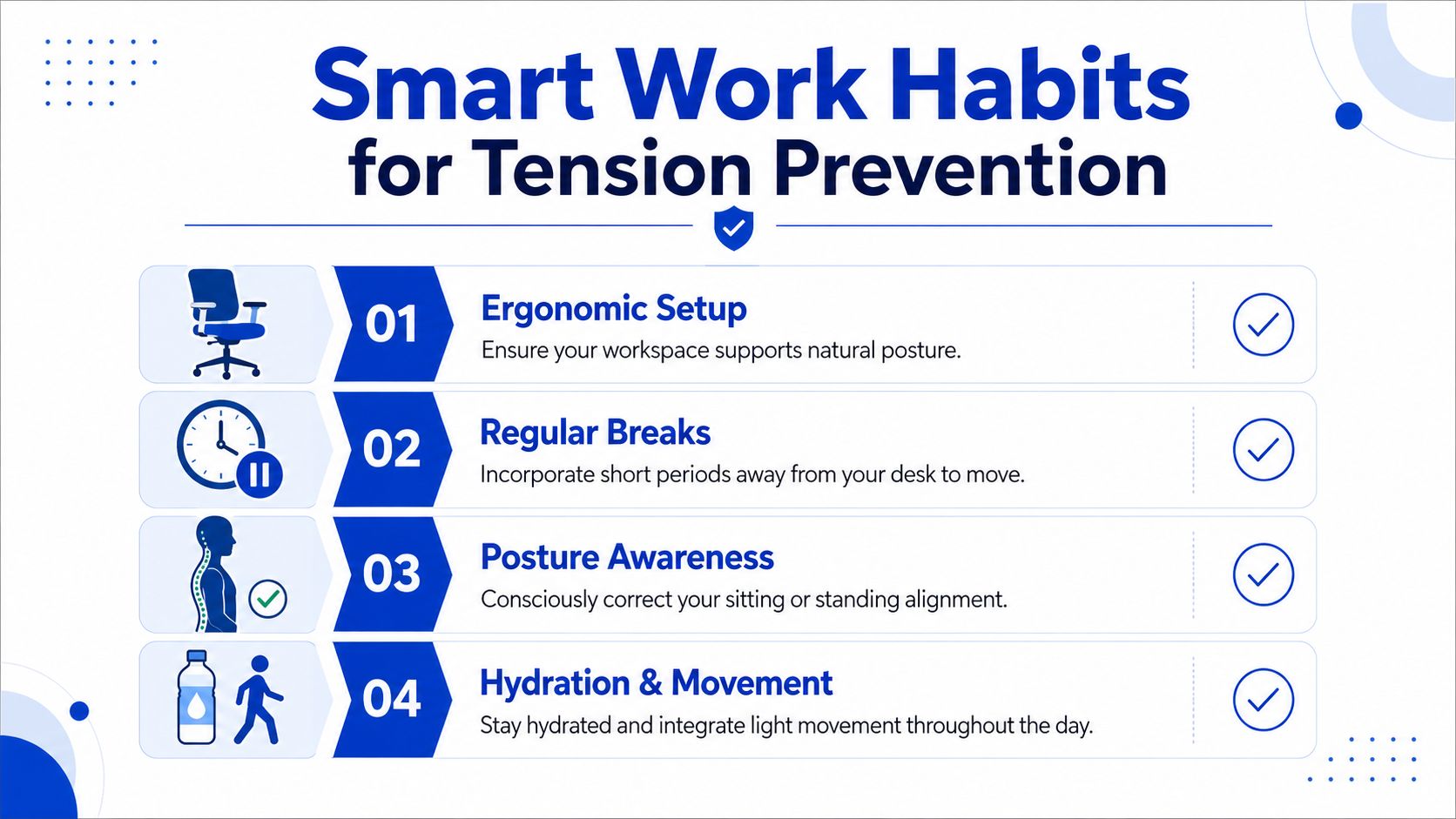
Prevent Daily Strain With Smarter Work Habits
Common advice suggests stretching after work. That's not wrong. It's just incomplete.
Why after-work stretching often isn't enough
If you sit still for long blocks, the body often stiffens in layers. By the end of the day, a quick stretch may feel good but won't always undo hours of low-level muscle holding.
Research on Australian remote workers found that micro-mobilisation cycles performed every 15 minutes during work reduced post-sedentary rebound tension by 40%. The useful point here is the contrast. Movement during the workday can outperform the usual strategy of waiting until work is finished and then trying to stretch everything out.
That's especially relevant if your current setup still leaves you tight. Even a well-arranged ergonomic work-from-home setup won't protect you if you stay fixed in one position for too long.
A practical micro-mobilisation cycle
You don't need a gym session in the middle of your inbox. You need brief movement that interrupts the build-up.
Try this every 15 minutes:
| Movement | What to do |
|---|---|
| Neck reset | Gently turn your head side to side, then nod up and down |
| Shoulder reset | Roll shoulders back, then reach arms overhead if comfortable |
| Chest opener | Stand, clasp hands behind your back or place arms wide and breathe |
| Hip reset | Stand and shift weight side to side, or do a few easy leg swings |
| Spine reset | Walk to the kitchen, printer, or doorway and let your arms move naturally |
Each one only takes moments. The effect comes from frequency.
Set up your desk, but don't worship posture
A better workstation helps. Aim for a screen around eye height, shoulders relaxed, and feet supported. Keep your mouse and keyboard close enough that you're not reaching all day. Those changes reduce unnecessary load.
But the most helpful mindset is this:
- Best posture isn't a frozen posture
- A supportive chair doesn't replace movement
- Standing all day isn't automatically better than sitting
- Your body usually tolerates variety better than perfection
The body handles work best when you change position before discomfort becomes your reminder.
If you're trying to learn how to reduce muscle tension at a desk, prevention beats repair. Small movement done often is easier on your body than one heroic stretch session at 6 pm.
Build Long-Term Resilience Through Lifestyle Choices
A tense body usually isn't asking for one magic exercise. It's asking for a better weekly rhythm.
Movement variety matters more than one perfect exercise
People often think they need a dedicated stretching routine and nothing else. In reality, the body usually responds better to variety. Walking, light strength work, mobility drills, household activity, swimming, or gentle cycling all expose tissues to different loads and different ranges.
That matters because repeated positions create repeated strain. If your weekdays are full of sitting, then your body benefits from movement that opens the hips, rotates the spine, swings the arms, and changes pace. Even a regular walk can help because it restores natural arm swing, breathing rhythm, and trunk rotation.
A resilient routine usually includes:
- General movement on most days, not only on “exercise days”
- Some strength work so muscles don't have to rely on constant gripping for stability
- Mobility work in areas that get stiff first, often the thoracic spine, hips, and chest
- Recovery habits that tell the body it's safe to soften
Sleep, hydration, and recovery
Poor sleep and persistent tension often travel together. When sleep is fragmented, pain sensitivity tends to rise and recovery feels slower. People wake already stiff, then assume the mattress or pillow is the whole problem. Sometimes those matter, but so does the quality of down-regulation before bed.
Hydration is another quiet factor. Muscles and connective tissue tend to feel less forgiving when you've gone through the day on coffee, stress, and very little water. Hydration won't fix every pain pattern, but it supports tissue function and helps the body tolerate activity better.
If you need ideas for regular gentle movement, resources such as mobility exercise illustrations for daily movement can be a useful prompt to keep the body moving through comfortable ranges.
Recovery isn't passive. Sleep, walking, breathing, and varied movement are all active inputs that shape how much tension your body carries tomorrow.
When to See an Osteopath for Your Muscle Tension
Home care is useful. But there's a point where repeated self-treatment becomes guesswork.
Signs self-care may not be enough
If any of these sound familiar, it's worth getting assessed:
- The same tension returns quickly even though you're stretching and moving regularly
- Pain spreads into the arm, chest, jaw, buttock, or leg
- You notice numbness, tingling, or weakness
- Headaches keep accompanying neck and shoulder tension
- You've started avoiding movement because you don't trust what will flare it
- Your sleep is disrupted by pain or bracing
These patterns can suggest that the issue isn't only the tight muscle. Joint stiffness, postural load, movement compensation, or nerve irritation may be feeding the problem.
What an osteopath looks for
An osteopath doesn't just ask, “Where does it hurt?” The more useful question is, “What is making that area overwork?”
Assessment usually looks at:
How you move as a whole
A sore neck may be linked to a stiff upper back, restricted rib movement, or a shoulder that isn't gliding well.Where the body is guarding
Some muscles feel tight because they're overactive. Others feel tight because they're protecting another weak or restricted area.How your daily habits load the system
Desk setup, lifting patterns, driving, sleep position, and training habits all matter.
Manual treatment can help when it's matched to the right diagnosis. According to Australian Physical Therapy Association benchmarks discussed in this manual therapy article, techniques such as myofascial release and joint mobilization have a 72% success rate in resolving chronic neck and back tension after 6 to 8 weekly sessions.
That doesn't mean everyone needs a course of treatment. It means skilled hands-on care has a clear role when tension has become persistent, patterned, and resistant to basic self-care.
Your Personalised Home-Care Plan for Lasting Relief
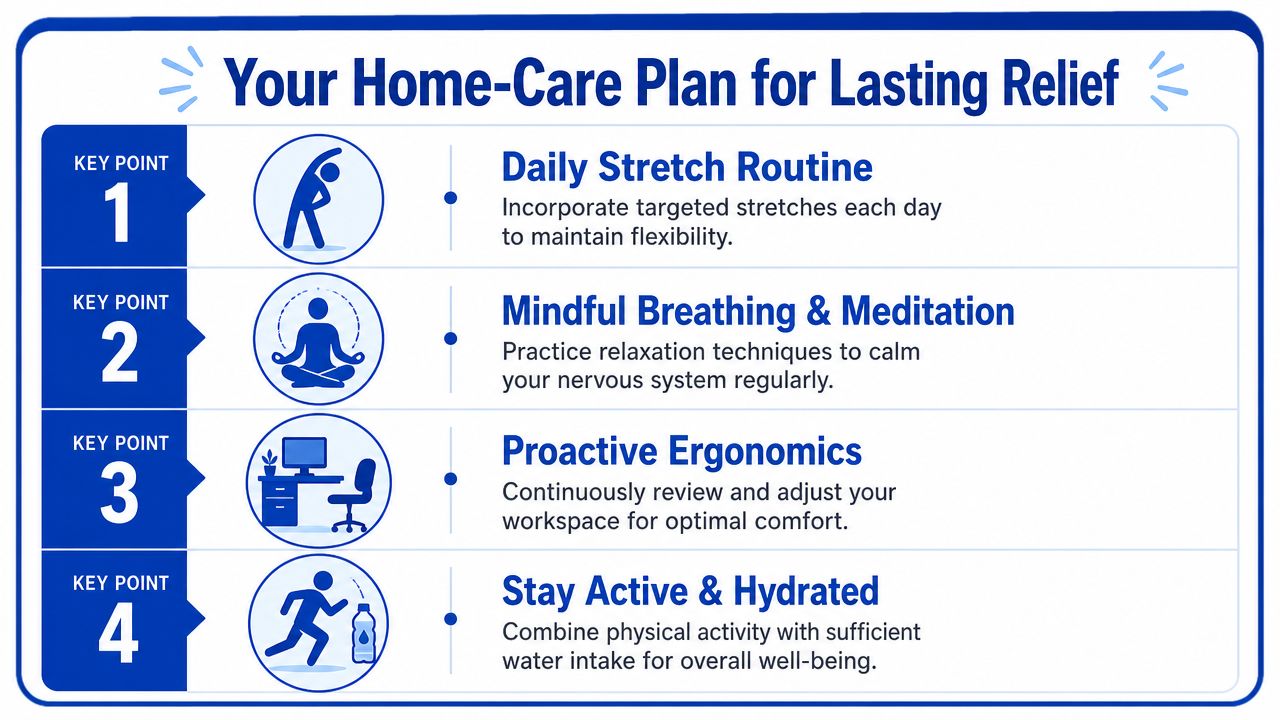
Better to have a repeatable plan than a long list you'll never use. Keep it simple enough that you'll do it.
Every day
Use short inputs that stop tension building momentum.
- Micro-mobilise during desk work rather than waiting until the end of the day
- Take a few slower breaths when you feel the shoulders rising or jaw clenching
- Do one or two targeted stretches for the areas that tighten first
- Walk regularly so the body doesn't spend the whole day in one shape
Every week
Build capacity, not just relief.
A good week usually includes some varied movement, a little strengthening, and at least one longer reset session where you move more deliberately. That might be a walk along the foreshore, a light gym session, swimming, yoga, or simple mobility work at home. The exact method matters less than consistency and variety.
As needed
Use symptom relief tools when flare-ups appear, but use them with purpose.
- Self-massage with a ball for a clear knot or trigger point
- PMR in the evening if stress is driving the tension
- Heat or a warm shower when the body feels generally guarded
- A pause from aggravating positions if one task keeps reigniting symptoms
The big shift is this. Learn how to reduce muscle tension by combining immediate relief, nervous system regulation, and prevention through movement. Stretching still has a place. It just works better when it's part of a broader plan.
If your tension keeps returning, or you'd like a plan designed for your body and daily routine, Bayside Osteopathic Health offers gentle, hands-on care for neck pain, back pain, joint stiffness, and posture-related strain. A personalised assessment can help you understand what's driving the tension and what will truly help it settle for the long term.