
Is osteopathy evidence based, or does the label merely make broad promises sound more scientific? That's the question many people ask after persistent back pain, a stiff neck, or recurring joint discomfort has resisted quick fixes. They're not only looking for relief. They want to know whether hands-on care is supported by credible research, whether it's appropriate for their condition, and how to avoid claims that go further than the evidence.
The honest answer is yes for some musculoskeletal problems, particularly low back pain, but not equally for every condition or every osteopathic technique. Osteopathy in Australia is a regulated health profession with an evidence-informed practice framework. At the same time, the research remains limited for several non-musculoskeletal claims, and osteopathy generally hasn't been shown to be decisively superior to physiotherapy, exercise, or other active care.
Table of Contents
- The Evidence Question Patients Really Ask
- What Osteopathy Actually Is
- Clinical Evidence by Condition
- Limitations and Gaps in the Evidence
- Choosing a Qualified Osteopath
- Making Informed Decisions About Osteopathic Care
The Evidence Question Patients Really Ask
For a patient with persistent low back pain, evidence-based care means asking what research says about manual therapy for that problem, not treating “osteopathy” as one intervention with one outcome. The decision also depends on the diagnosis, the proposed technique, available alternatives, and the patient's goals.
A sound clinical recommendation combines research findings with examination, professional judgement, and patient preferences. The Australian Osteopathy Board's professional capability framework describes practice in those terms, requiring osteopaths to integrate research evidence, clinical expertise, and patient values. That standard helps distinguish accountable care from claims based mainly on tradition or personal belief.

The useful question is more specific
Rather than asking only, “Does osteopathy work?”, ask:
- For which condition? Research is more developed for non-specific low back pain than for broad claims involving internal or other non-musculoskeletal problems.
- For which treatment? Manual therapy, exercise, education, and self-management can serve different purposes within one care plan.
- Compared with what? A treatment may reduce symptoms without outperforming physiotherapy, exercise, or usual care.
- What outcome matters? Pain, walking tolerance, sleep, work capacity, and confidence with movement should be assessed separately.
- When will we reassess? Treatment should include a practical point at which progress is reviewed and the plan is changed if needed.
Australian practice data reflects this qualified picture. In a national survey, 74.9% of Australian osteopaths said research evidence had a moderate to high impact on their practice, while 74% reported using exercise prescription, according to the Australian osteopathy practice survey. These findings describe how practitioners report working. They do not establish strong evidence for every technique used in every consultation.
Practical rule: Ask which evidence supports the proposed approach for your specific diagnosis, what benefit is expected, and how you will judge whether it is helping.
Osteopathy can be a reasonable option for selected musculoskeletal problems when assessment is careful, uncertainty is explained, and treatment supports active recovery. A practitioner should also be willing to stop, modify, or refer when the response is poor or the presentation does not fit the evidence.
What Osteopathy Actually Is
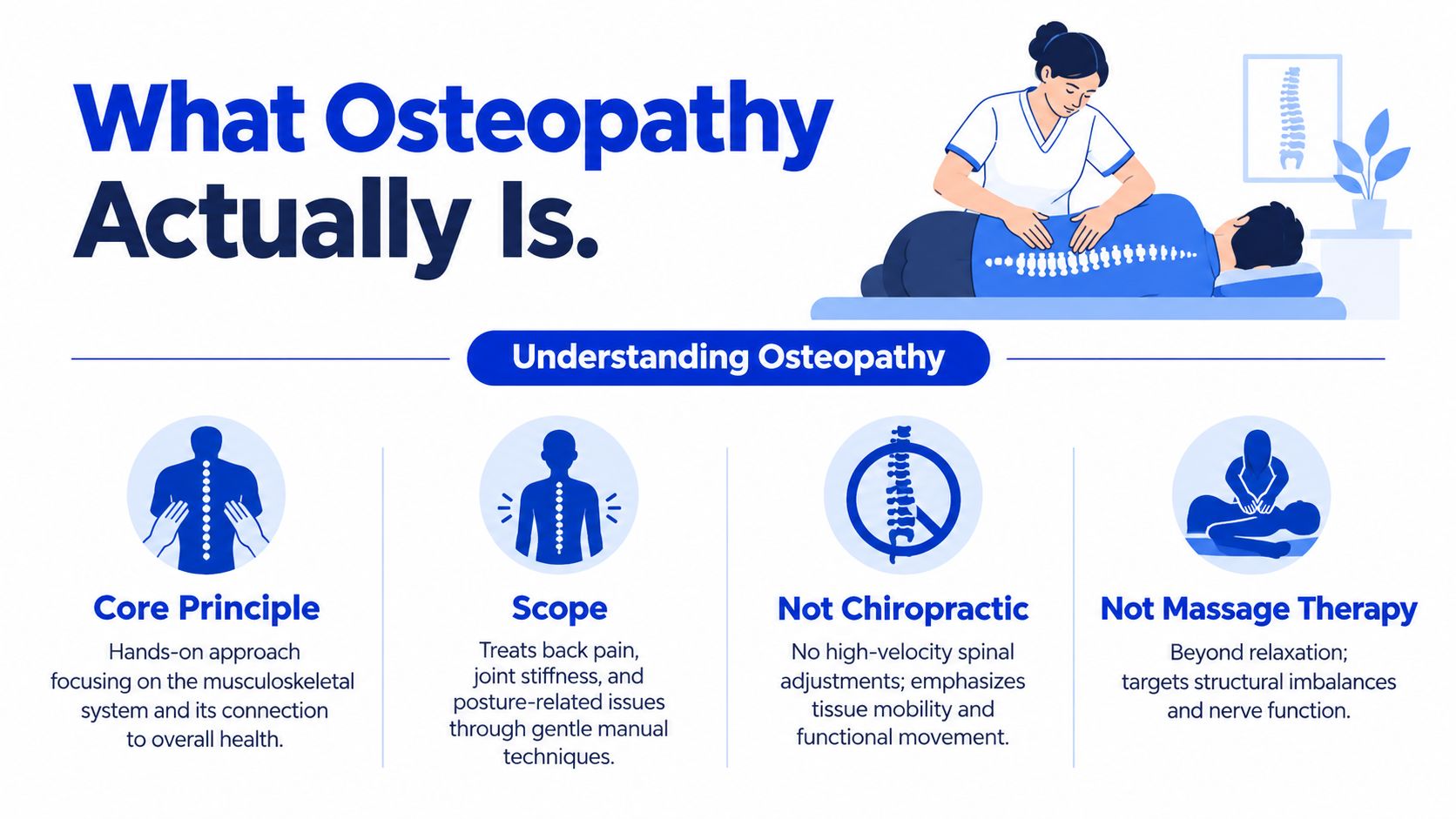
What does an osteopath assess and treat? Osteopathy is a regulated form of allied health care centred on the musculoskeletal system, including muscles, joints, connective tissues, and coordinated movement. In practice, an osteopath assesses symptoms, considers likely contributors, checks for problems requiring referral, and selects manual treatment or movement advice when those options fit the presentation.
Osteopathic care is often explained through principles such as the relationship between structure and function and the body's capacity to regulate and recover. These ideas may inform clinical reasoning, but they do not establish that every traditional osteopathic explanation is scientifically proven. A sound consultation connects the assessment and proposed treatment to current evidence, clinical findings, and the patient's response.
Treatment is broader than a technique
An osteopath may choose soft-tissue work to reduce protective muscle tension around a painful area, joint articulation when a restricted movement can be safely explored, or mobilisation when graded movement is appropriate. Stretching, neuromuscular techniques, activity advice, and prescribed exercises may also form part of the plan. These choices are not suitable for every patient. Severe, unexplained, or medically concerning symptoms require appropriate assessment and may call for referral rather than hands-on treatment.
A click or pop can occur during some mobilisation techniques, but it does not show that treatment has worked. The meaningful test is whether the patient moves more comfortably, performs relevant activities more easily, or gains confidence with movement.
Osteopathy differs from massage therapy, which may prioritise relaxation, comfort, or soft-tissue symptoms. Osteopathic assessment also considers joint function, loading, movement patterns, and the wider musculoskeletal presentation. There is overlap with physiotherapy and chiropractic care, particularly in manual therapy and exercise, but training, clinical emphasis, and practitioner methods vary.
The relationship between movement and body structures is illustrated in this guide to joint mobility and anatomy. The treatment label matters less than the clinical reasoning, intended goal, and evidence supporting the chosen approach.
Regulation and evidence answer different questions
Professional registration sets requirements for practice and accountability. It does not prove every proposed application of osteopathy. The RACGP discussion of osteopathic care describes limited evidence for many indications, with stronger support for some musculoskeletal problems than for broad claims about unrelated disease.
A practitioner can offer appropriate hands-on care without claiming that osteopathy replaces medical diagnosis or corrects every aspect of health through structural adjustment.
Clinical Evidence by Condition
Which osteopathic applications have the clearest evidence? The answer is narrower than a general claim that osteopathy works for every health problem. Osteopathic manual treatment may provide modest improvements in pain and function for selected musculoskeletal conditions, with the clearest support for non-specific low back pain.
Low back pain has been studied more extensively than many other indications. An overview of systematic reviews found promising evidence that osteopathic manipulative treatment can reduce pain and improve function in acute and chronic non-specific low back pain. Evidence for other conditions was more limited or contradictory. A cited meta-analysis reported MD -14.93 for pain and SMD -0.32 for function in chronic non-specific low back pain, as discussed in the comparative evidence review of osteopathy and other care.
For lay readers, MD -14.93 represents an average reduction of about 15 points on a 0 to 100 pain scale. That is a modest average effect, not a guaranteed result for an individual patient. It also does not show that manual treatment should be used alone. Low back pain care generally works better as a plan combining education, graded activity, exercise, and symptom-guided manual treatment. Practical movement advice, including guidance on sitting position and lower back pain, can support that broader approach.
What the evidence supports most clearly
| Clinical situation | What can reasonably be said |
|---|---|
| Non-specific low back pain | Manual treatment may offer modest pain and functional benefits, particularly when combined with exercise, education, and self-management. |
| Neck pain and related musculoskeletal symptoms | Research reports potential short- to mid-term benefits, although certainty is commonly lower than for low back pain. |
| Headaches with a musculoskeletal component | Osteopathic approaches may help selected patients, but the evidence is less developed than it is for low back pain. |
| Non-musculoskeletal conditions | High-level evidence remains limited, so broad treatment claims require caution. |
Neck pain and headache presentations may involve muscles, joints, movement habits, sleep, stress, or neurological features. Assessment should first establish whether symptoms fit a musculoskeletal pattern and whether medical referral is needed. Manual treatment may be reasonable for some patients. Research findings do not justify treating every headache or episode of dizziness as a structural problem.
Comparable care is still worthwhile care
Australian and near-Australian evidence reviews describe short- to mid-term benefits for neck and low back pain, while overall certainty ranges from low to moderate. Results are often comparable with other active care options rather than clearly superior. The comparative review helps answer the practical question patients usually have: whether osteopathy can help, and whether it performs better than physiotherapy or exercise.
A treatment does not need to outperform every alternative to be appropriate. Osteopathy may suit patients who prefer hands-on care, can participate in exercise, and receive a clear plan with reassessment. Care is less consistent with an evidence-informed approach when a practitioner relies only on passive treatment and avoids discussing exercise, self-management, or other options.
Limitations and Gaps in the Evidence
Can a positive trial result show that a particular osteopathic technique caused the improvement? Often, the answer is less certain than patients expect. People receiving manual therapy usually know they are being touched, and practitioners know which treatment they provide. That makes blinding difficult. Expectations, reassurance, attention, education, natural recovery, and increased activity can all affect pain and confidence alongside the technique itself.
Osteopathic care is also frequently individualised. Two people with similar back pain might receive different combinations of mobilisation, soft-tissue treatment, exercise, and advice. That flexibility can make sense clinically, yet it complicates research. A trial may test one protocol that does not reflect everyday practice, while a review may combine interventions that share a label but differ in content.
Beyond condition-specific effects, study design limits how confidently improvement can be attributed to a specific technique rather than to contact, support, or recovery over time. Small studies, inconsistent treatment protocols, and limited follow-up can leave uncertainty about who benefits, how much, and for how long.
Where caution matters
Claims outside established musculoskeletal applications need careful scrutiny. High-level evidence for osteopathic management of non-musculoskeletal conditions remains limited, and findings about individual techniques may not support broad treatment promises. A patient's improvement is real and deserves respect, but it cannot by itself show that a technique treats an underlying disease or will work reliably for other patients.
Be cautious when a practitioner:
- Promises a universal solution: One structural explanation should not be used to account for unrelated symptoms without clear supporting evidence.
- Uses fear to secure ongoing visits: Warnings that your body will deteriorate without frequent treatment are not a substitute for a documented rationale.
- Rejects other care: An evidence-informed clinician should discuss GPs, physiotherapists, exercise professionals, imaging, or specialist referral when relevant.
- Avoids measurable goals: “Better alignment” is less useful than improved walking, lifting, sleep, or daily function.
- Treats symptoms outside their scope: New neurological symptoms, unexplained systemic symptoms, significant trauma, or rapidly worsening pain may require medical assessment.
Responsible care includes knowing when osteopathy isn't the right treatment.
The profession's size and distribution also affect how widely study findings can be applied. The Osteopathy Board annual reporting describes an established profession with a relatively small and unevenly distributed workforce, including greater concentration in Victoria. That context does not determine whether treatment works, but it can limit the reach of research samples and make results less representative of every patient or practice.
Choosing a Qualified Osteopath
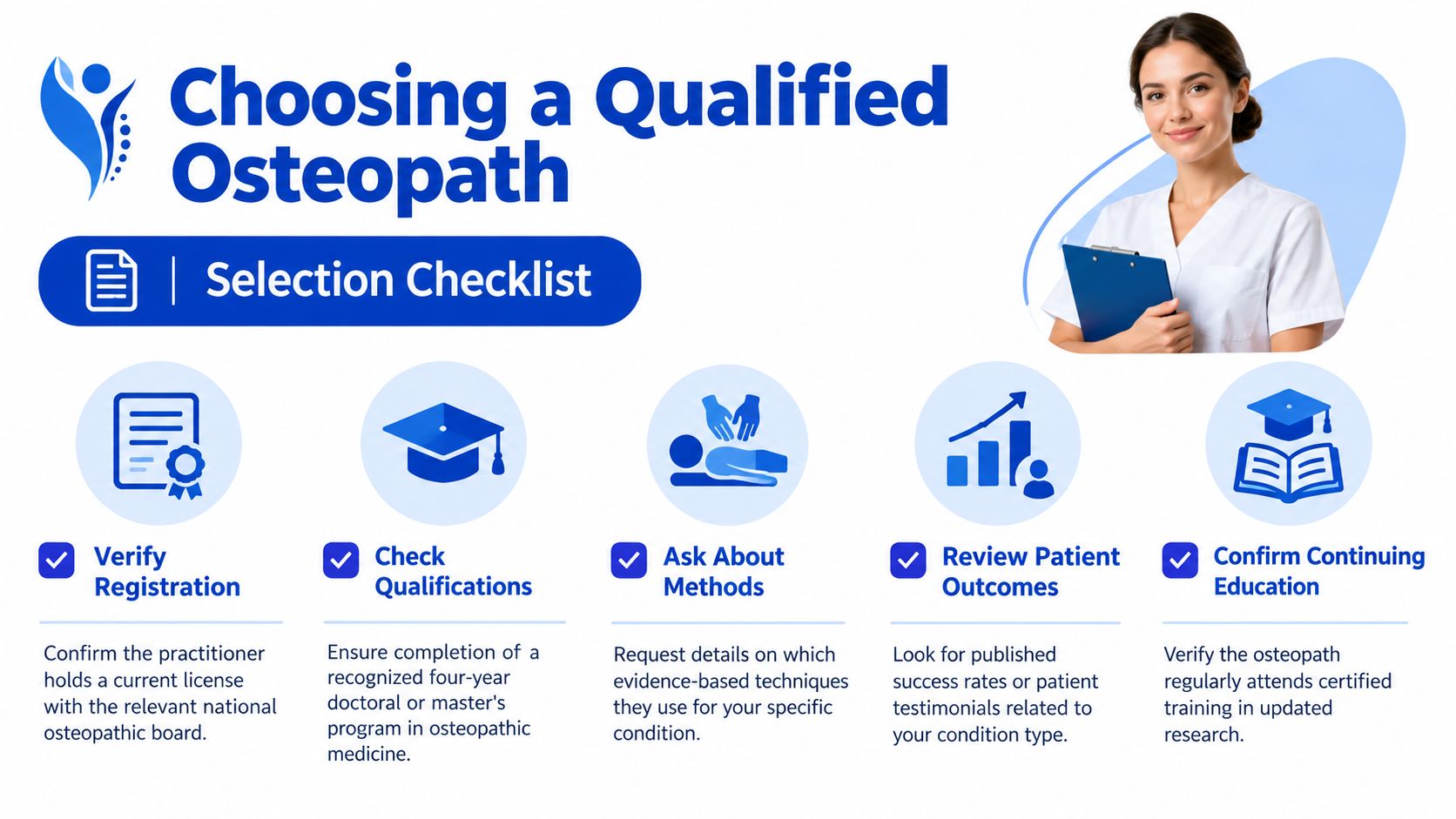
How can you tell whether an osteopath is qualified and whether the proposed care is appropriate for your problem? Start with registration, not testimonials. In Australia, an osteopath should be registered with the Osteopathy Board of Australia, which operates through the national registration system. You can verify registration at ahpra.gov.au by selecting Search the Register, entering the practitioner's name, and choosing Osteopathy. Registration cannot guarantee a treatment outcome, but it provides a basic check on professional accountability.
Questions worth asking before treatment
A useful first consultation should clarify what the practitioner thinks is happening, which treatment they recommend, and how progress will be judged. Ask:
- What is the working diagnosis? You do not need a perfect label, but you should receive a clear explanation of the likely contributors to your symptoms.
- What is the purpose of each treatment? The answer should connect a technique with a symptom or functional goal.
- What alternatives are reasonable? Exercise, physiotherapy, GP care, watchful waiting, and referral may all be appropriate, depending on the presentation.
- What should I do between appointments? Self-management should generally be part of care for persistent musculoskeletal pain.
- When will we review progress? Agree on practical markers such as movement, work tolerance, sleep, or everyday activities.
An evidence-informed osteopath should welcome these questions and explain uncertainty. A confident explanation is not a substitute for evidence, particularly when a treatment is being proposed for a condition with limited research support.
Understand access and practical costs
Medicare access for osteopathic care is limited under the Chronic Disease Management and Team Care Arrangements pathways. Eligibility is generally capped at five sessions per person per year. The Medicare access and utilisation evidence also documents substantial use of osteopathic services through Medicare.
Ask whether you are eligible, which referral or care-plan requirements apply, what fee remains after any rebate, and whether private health insurance may contribute. A session limit should inform planning, not justify treatment that is no longer helping. Continue only while progress is meaningful and the clinical rationale remains clear.
You can use this illustrated guide to booking an osteopath online to prepare for arranging an appointment. Bayside Osteopathic Health provides registered osteopathic assessment, gentle manual treatment, movement advice, and self-care guidance for common pain and mobility concerns. Compare clinics by registration, communication, treatment rationale, and willingness to coordinate with other health professionals.
Making Informed Decisions About Osteopathic Care
Is osteopathy appropriate for your problem, and what should you expect from treatment? The answer depends on the diagnosis, the strength of evidence for that condition, and whether the plan helps you function better. For non-specific low back pain or another mechanical musculoskeletal complaint, osteopathy may be reasonable when hands-on care is combined with exercise and practical advice. Symptoms suggesting serious disease, substantial neurological involvement, major trauma, or an unclear diagnosis require medical assessment first.
Use these questions before booking or continuing care:
- Is the problem within musculoskeletal care? Pain related to movement, loading, stiffness, or function may be suitable for assessment.
- Is the plan specific? The practitioner should explain how the proposed technique relates to your symptoms and what it is intended to change.
- Does the plan build independence? Exercise, pacing, education, and confidence with movement should support progress, particularly when pain persists.
- Will progress be measured? Agree on functional outcomes that matter in your daily life.
- Is there a review point? If meaningful improvement does not occur, the practitioner should reconsider the diagnosis, adjust treatment, or refer you.
Describe what the problem stops you doing, not only how severe it feels. “I can't sit through a work meeting” or “I avoid lifting my child” gives the practitioner a practical target. It also shows whether a modest symptom change is producing a worthwhile improvement.
A sensible plan uses osteopathy as one part of care rather than a replacement for every other option. Manual treatment may make movement easier for some people, while exercise and gradual exposure can help maintain gains. Sleep, workload, stress, previous injury, general health, and expectations also affect recovery. Treatment should respond to these factors instead of attributing every symptom to one joint or tissue.
The answer to is osteopathy evidence based is conditional. Osteopathy is regulated and evidence-informed, with stronger support for selected musculoskeletal problems, particularly non-specific low back pain. Support is less consistent across conditions, techniques, and broad claims about whole-body health. Choose a registered practitioner who explains those limits, supports self-management, and changes direction when results do not justify continuing.
If you have back pain, neck pain, joint stiffness, or movement-related strain in the Bayside area, visit Bayside Osteopathic Health to arrange an assessment. The clinic discusses plans that may combine gentle hands-on care, movement advice, self-management strategies, and applicable Medicare options.