
You wake up, open your mouth for the first sip of coffee, and feel that familiar catch on one side of your jaw. Breakfast turns into a careful chew, talking feels oddly effortful, and by lunchtime you're noticing the headache, the ear pressure, or the tight neck that seems to go with it. That mix of pain, stiffness, and uncertainty is exactly why jaw pain treatment needs a calm, practical plan, not guesswork.
Jaw pain is common, and it's usually manageable when the cause is matched to the right type of care. In many adults, the problem sits in the same broad temporomandibular disorder (TMD) range described in major dental and family medicine reviews, and only a minority of people end up needing more than conservative care. The goal is not to push through it or chase the quickest fix, it's to understand what's driving it and choose the next step with a clear head.
Table of Contents
- Why Jaw Pain Feels So Disruptive
- Understanding What Is Actually Causing the Pain
- At-Home Strategies You Can Start This Week
- Clinician-Led Treatments and How They Differ
- What to Expect from an Osteopathic Assessment
- When to Seek Further or Urgent Care
- Accessing Care at Bayside Osteopathic Health
- Your Next Steps Toward a Calmer Jaw
Why Jaw Pain Feels So Disruptive
The annoyance usually starts before breakfast. You yawn, your jaw feels stiff or clicks, and the first bite of toast sends a sharp reminder that something isn't right. By the time you're getting ready for work, you've already changed how you chew, how wide you open, and sometimes even how much you speak.
Small movements become big decisions
The jaw is used constantly, so even mild pain has a way of spreading into ordinary life. Eating becomes a calculation, talking feels tiring, and sleep can feel less restorative if you're clenching through the night or waking with a sore face. A person can look perfectly fine from the outside and still be spending the day guarding every jaw movement.
That's why jaw pain often feels bigger than the tissue itself. It can affect concentration, patience, and mood because it keeps reminding you it's there. When people finally seek help, it's often not because the pain is dramatic, it's because the pain has become persistent, intrusive, and hard to ignore.
Practical rule: if you're changing how you eat, speak, or sleep because of your jaw, the problem has moved beyond a minor nuisance.
The reassuring part is that jaw pain is not usually a one-way road to worsening damage. In the evidence base used for clinical planning, TMD sits in a common but often under-treated musculoskeletal range, and conservative care is the usual starting point rather than invasive treatment. That matters because the next sensible step is usually to understand the pattern, calm the irritability, and restore normal movement, not to assume the worst.
Understanding What Is Actually Causing the Pain
Think of the jaw as a hinge that also slides. It doesn't just open and close, it glides, loads, and coordinates with muscles in the face, neck, and upper back. That's why jaw pain can come from more than one place at once, and why the symptom you feel in the jaw isn't always coming from the joint alone.
The main buckets to keep in mind
Temporomandibular disorder, or TMD, is an umbrella term, not a single diagnosis. It covers problems in the joint, the muscles that move the jaw, and the way those structures are being loaded day to day. In practice, that means two people can both say “my jaw hurts” and need quite different care.
The common causes usually fall into four broad categories.
- Muscle overuse. Clenching, grinding, stress-related guarding, or long hours holding tension in the face can leave the jaw muscles sore and overworked. People often notice this as morning tightness, a tired chewing muscle, or pain that worsens after concentration-heavy days.
- Joint dysfunction. The jaw joint itself can become irritable, noisy, or stiff. Clicking, catching, limited opening, or pain with wide yawning often points this way.
- Dental and bite issues. A tooth problem, recent dental work, or an irritated bite can make chewing painful. This is the category where a dentist's assessment matters most.
- Systemic or referred pain. Sometimes the source sits elsewhere, such as the neck, the upper back, or a wider pain pattern that sends discomfort into the face and jaw.
A useful question is, “What makes it worse?” Wide opening, chewing, and clenching often point to load-related jaw pain. Tooth sensitivity, swelling, or a clear dental trigger points the other way.
The infographic below pulls those four buckets together into one simple map.
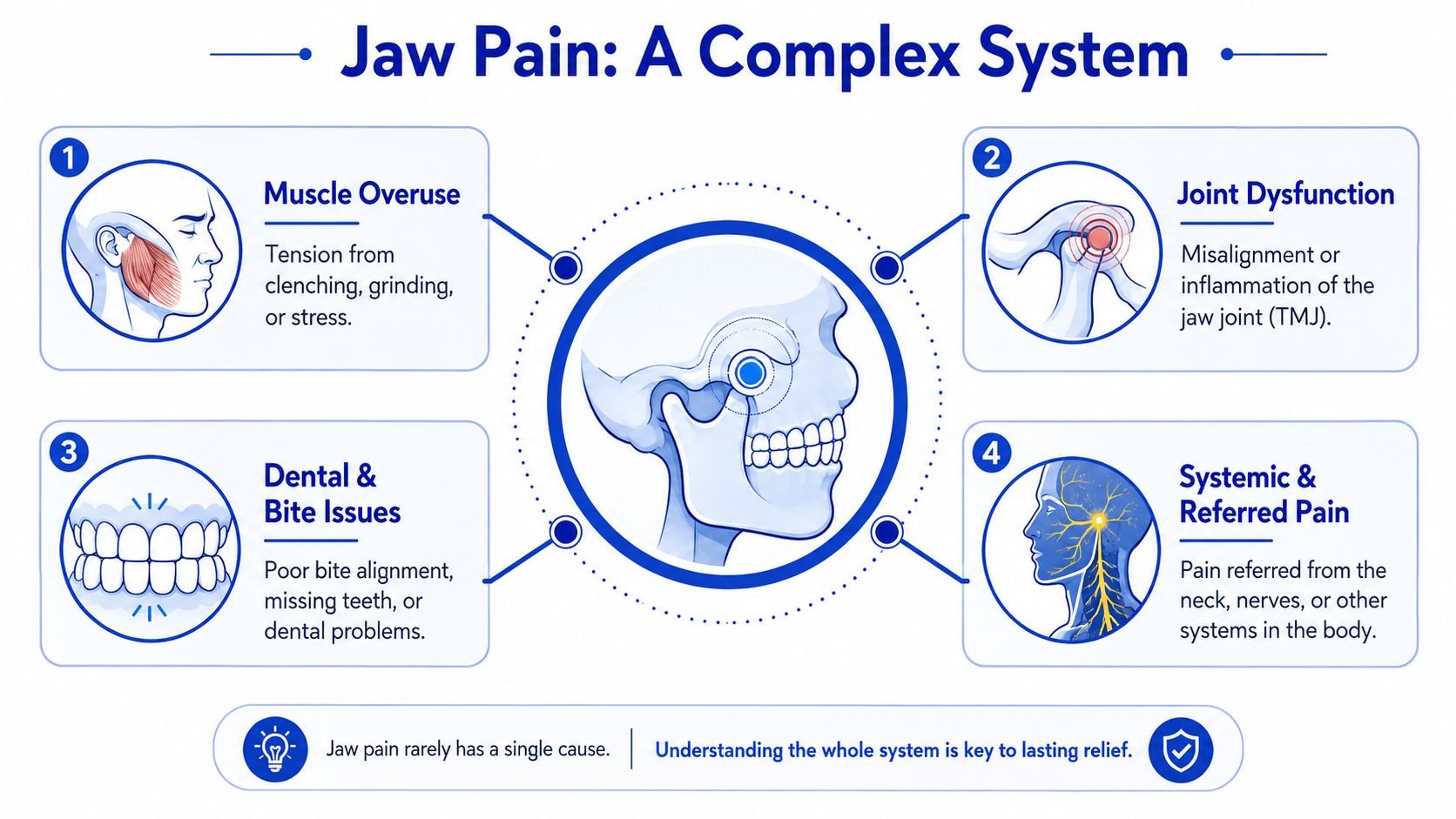
When you can place your symptoms into one of those categories, the rest of the decisions become easier. You're no longer asking, “What is wrong with me?”, you're asking, “Which system needs help first?”
At-Home Strategies You Can Start This Week
The safest first response is usually to reduce irritation, not to keep testing the painful movement. That means backing off heavy chewing, jaw clenching, and repeated wide opening for a short period while the tissue calms down. If you keep provoking it every hour, even a good treatment plan has less room to work.
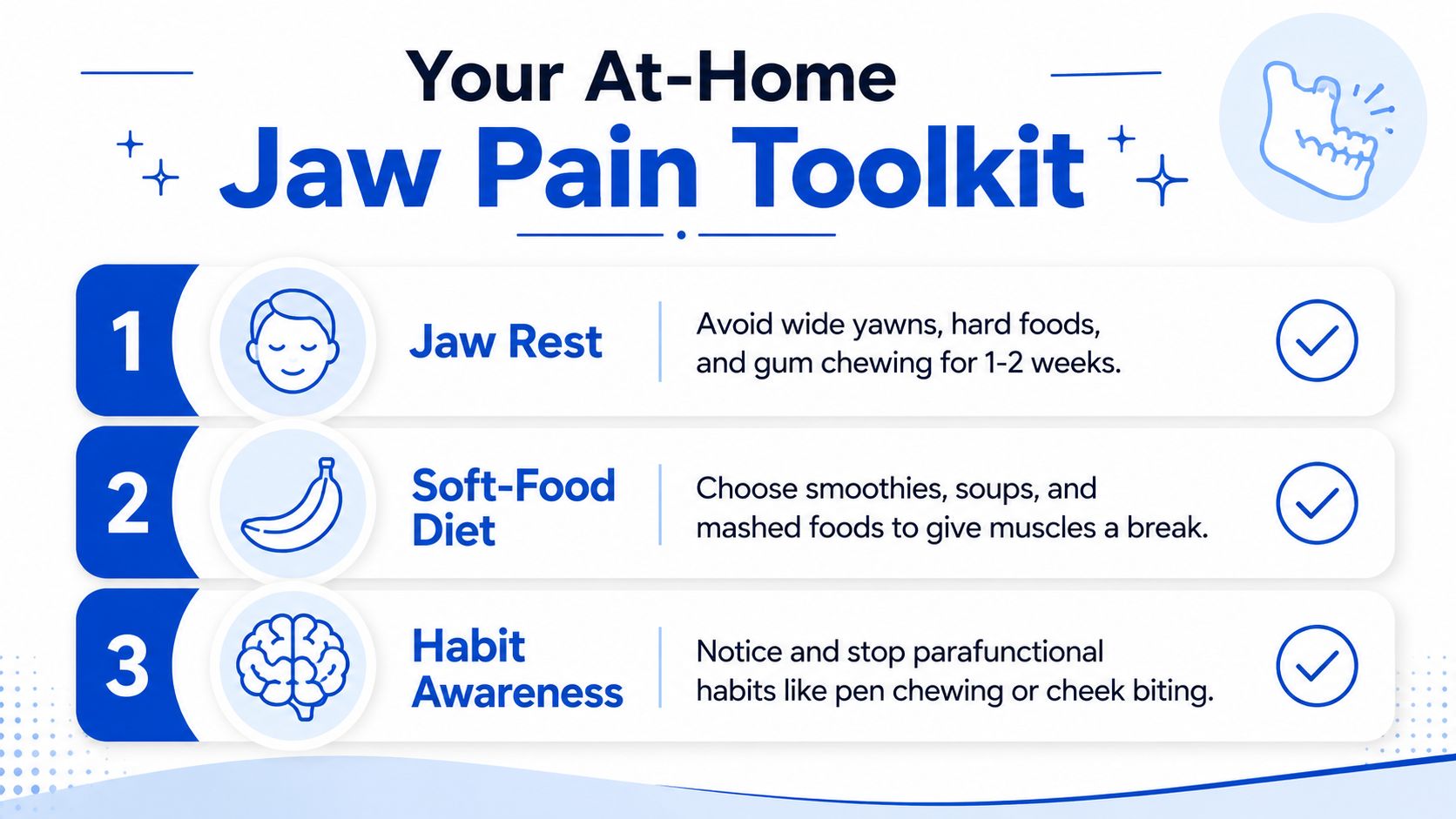
Start with rest, food choice, and habit awareness
The simplest place to begin is jaw rest. Choose softer foods for a few days, take smaller bites, and avoid chewy or hard textures that make the joint and muscles work harder. Keep an eye on everyday habits too, because gum chewing, pen biting, cheek chewing, and nail biting can keep the jaw under constant load without you noticing.
Here's a simple order to follow at home.
- Reduce load first. Skip gum, hard crusts, and wide yawns where you can.
- Use temperature for comfort. Heat often helps a tight, guarded jaw feel less rigid, while cold can be useful when the area feels hot or acutely irritated.
- Add gentle movement. Small, pain-free opening and closing movements are more useful than forceful stretching.
The short video below offers a visual reminder of how posture and jaw tension often travel together.
For many people, posture breaks matter because the jaw rarely works in isolation. If you spend a lot of time at a desk or on a laptop, a quick reset for the neck and shoulders can reduce the background tension that feeds jaw clenching. A simple ergonomic check can help, and you can compare your workstation habits with the posture guidance in this Bayside ergonomics resource.

A short course of over-the-counter NSAIDs such as ibuprofen may help some people when appropriate, especially if inflammation and pain are getting in the way of eating or sleeping. The trade-off is straightforward, pain relief can make you more comfortable, but medication alone won't solve the movement pattern that keeps the jaw irritated. If symptoms are still hanging around, the next step is assessment, not just another round of tablets.
Clinician-Led Treatments and How They Differ
A person with jaw pain may walk into different clinics and hear different questions first. That is not a contradiction, it is a clue. A dentist usually looks for tooth trouble, bite changes, gum or joint issues, and signs of oral disease. A GP is more likely to check for medical causes, decide whether pain relief or imaging is appropriate, and coordinate referral if the picture is not straightforward. A physiotherapist or osteopath usually spends more time looking at jaw movement, neck loading, posture, and the muscles around the jaw and upper body.
What each clinician tends to contribute
Dental care is the right place to start if the pain seems tied to a tooth, recent dental work, a bite change, swelling, or symptoms that fit a local mouth problem. If the question is whether the pain is coming from a tooth or from the joint itself, a dental assessment helps sort that out. A dentist can also check whether the pain pattern matches something inside the mouth rather than a load-related jaw problem.
Medical care matters when the picture is broader, unclear, or red-flag driven. A GP can help with pain relief, imaging decisions, referral pathways, and ruling out non-musculoskeletal causes. That becomes more important when symptoms are unusual, spreading, or linked with other health concerns, because jaw pain is sometimes only one part of a wider health issue.
Physiotherapy and osteopathy usually sit in the conservative care space. They are often the place to look when the jaw seems irritated by how it is being used, rather than by disease in the mouth. The 2023 BMJ network meta-analysis of 153 randomised trials with 8,713 participants found moderate-certainty evidence supporting CBT with biofeedback or relaxation therapy, therapist-assisted jaw mobilisation, and manual trigger point therapy for chronic TMD pain, alongside supervised jaw and postural exercise. The same guidance issued strong recommendations for supervised jaw exercise and stretching, supervised postural exercise, and usual care such as home exercises, stretching, reassurance, and education, while recommending against reversible occlusal splints alone, arthrocentesis, botulinum toxin, gabapentin, benzodiazepines, and NSAIDs combined with opioids. See the evidence summary in the BMJ clinical practice guideline on chronic TMD pain.
That does not mean every jaw pain problem should be handled the same way. It means the clearest direction in current evidence points toward movement-based, conservative care rather than moving straight to procedures.
If a first recommendation sounds aggressive, ask what problem it is supposed to solve. Good conservative care should make sense biomechanically, not just sound impressive.
For some people, the right next step is a practitioner who can assess the jaw together with the neck, upper back, and the way the body is holding tension. In Bayside, that may include Bayside Osteopathic Health as one option among other conservative providers, especially when the pattern looks musculoskeletal rather than dental.
What to Expect from an Osteopathic Assessment
A first osteopathic appointment usually starts with questions, then follows with a gentle physical assessment. You'll be asked when the jaw pain began, what makes it flare, whether there is clicking, locking, or stiffness, and whether dental work, clenching, sleep disruption, or stress seem to be involved. That history gives clues about the load on the joint, the habits that keep it irritated, and the surrounding tension that can keep symptoms going.
If you have ever had jaw pain that feels worse after a long day of talking, chewing, or sitting at a desk, that pattern is often useful information rather than a side note. It helps the osteopath decide whether the pain looks more mechanical, more muscle-driven, or more likely to need another kind of review.
The assessment usually goes beyond the jaw
The hands-on part is usually careful and broad. An osteopath may examine the jaw itself, then check the neck, upper back, shoulders, and posture to see how those areas are sharing the strain. A jaw does not work in isolation, so tension in the neck or upper back can change how the jaw moves and how hard the muscles have to work.
You may feel soft tissue work around the jaw, face, or neck muscles, along with joint articulation or gentle mobilisation. These techniques are used to reduce guarding, improve movement, and make opening and closing the mouth feel less like the joint is catching or working against resistance. The approach is usually light and controlled, because the goal is to settle irritation rather than force movement.
A personalised plan usually includes more than what happens on the table. Expect advice that may cover jaw rest, exercises, posture changes, and how to manage load during eating, talking, and desk work.
Hands-on treatment can calm sensitivity and improve movement, but the day-to-day pattern matters just as much. If the same habits keep overloading the jaw, the benefit often fades. If the symptoms look more dental, or if there are concerns that point outside the musculoskeletal system, that is where a dentist or GP may be the better next step.
When to Seek Further or Urgent Care
Some jaw pain is part of a manageable TMD pattern. Some isn't. The main job is knowing which one you're dealing with, so you don't sit on a problem that needs faster action.
Red flags that need prompt review
If the pain follows trauma, especially with suspicion of fracture, it needs medical assessment. Sudden severe swelling, fever, or a jaw that won't close properly also deserves urgent attention. Neurological signs such as facial numbness or vision changes should not be brushed off.
Persistent limitation in opening, chewing, or speaking is a different kind of warning. If that functional problem doesn't settle after a trial of conservative care, or if pain has no clear source and keeps going for more than 3 to 6 months, referral to an oral and maxillofacial surgeon or another specialist is appropriate, as noted in the NIDCR guidance on temporomandibular disorder care.
Practical rule: the trigger for escalation is not pain alone. It's pain plus persistent function loss, unclear cause, or red-flag features.
That framing helps people avoid two common mistakes. The first is waiting too long because the pain isn't dramatic enough. The second is panicking over every click or flare even when the pattern still looks mechanical and calmable. Escalation is not failure, it's matching the level of care to the level of risk.
Accessing Care at Bayside Osteopathic Health
A first visit for jaw pain often starts with a simple story. You explain where the pain sits, what makes it worse, and whether it feels linked to chewing, stress, sleep, or long hours at a desk. Bring any dental notes, imaging if you already have it, and a list of medicines or supplements you're taking. If you have noticed a pattern, write that down too. A short note about when the jaw tightens can save time and help the clinician sort out whether the problem looks more local to the jaw, more linked to the neck, or part of a broader strain pattern.
The osteopathic approach is usually gentle and practical. Care may include hands-on treatment, movement advice, and home strategies that fit into ordinary Bayside routines. That matters because jaw pain often behaves like a chain, one tight link can change how the whole system moves, so a single technique rarely tells the whole story. The clinic setting is shown in the Bayside Osteopathic Health screenshot.

An osteopathic assessment is different from a dental or GP visit, even though the same person may need all three at different points. A dentist is often the right first stop if the pain seems tied to a tooth, bite, or dental structure. A GP is the right place for broader medical review, medication questions, or signs that the pain may sit outside the jaw itself. An osteopath looks at how the jaw, neck, posture, and movement patterns are working together, then uses that picture to decide whether hands-on care and exercise advice make sense, or whether another referral is the better next step. That is the practical value for local Bayside patients, the plan can be matched to the problem instead of forcing every sore jaw into the same box.
If you are eligible for Medicare support under a plan, ask the team about coverage options before you book, because the right administrative setup depends on your situation. That keeps the process clearer and avoids surprises. It also gives you a care path that fits local life without adding unnecessary friction.
Your Next Steps Toward a Calmer Jaw
Jaw pain usually settles best when you combine the right kind of rest, the right kind of movement, and the right kind of assessment. One small check today can help, notice whether you're clenching, whether opening feels limited, and whether chewing is changing your routine. Write that pattern down, because a clear symptom history makes every next decision easier.
If your jaw has been stiff, clicking, or sore for longer than you'd like, Bayside Osteopathic Health can assess how the jaw, neck, and posture are working together and build a plan around gentle hands-on care plus practical home strategies. If you're ready to get a clearer picture of what's driving it, visit Bayside Osteopathic Health and book a visit with the team.