
You wake up, swing your legs out of bed, and your lower back feels like it needs a few minutes to join the rest of you. Or you stand after a long stretch at the desk and notice that first upright step feels guarded, tight, and awkward. For many people, lower back stiffness isn't dramatic enough to feel like an “injury”, but it's persistent enough to affect work, sleep, walking, exercise, and mood.
That matters because back pain isn't a niche problem. In Australia, low back pain was the most prevalent musculoskeletal condition in 2019 and the leading driver of disability burden, accounting for one-fifth of total years lived with disability nationally, with rates peaking in older adults, according to Australian low back pain burden data published in Chiropractic & Manual Therapies. Stiffness is often the part people notice first, especially in the morning, after sitting, or when getting back into activity.
The encouraging part is that stiffness usually has a pattern. It isn't random, and it rarely improves for long with guesswork alone. When you understand whether that “tight” feeling is coming from joints, muscles, movement habits, sensitivity in the nervous system, or a mix of all three, the next step becomes much clearer.
Table of Contents
- That Familiar Ache Unpacking Lower Back Stiffness
- Understanding What Stiffness Really Means
- Common Causes Behind a Stiff Lower Back
- Active Mobility Exercises for Lasting Relief
- Preventing Stiffness With Smart Daily Habits
- Red Flags When to Seek Professional Care
- How Gentle Osteopathy in Bayside Can Help
That Familiar Ache Unpacking Lower Back Stiffness
Lower back stiffness often shows up in ordinary moments. Getting out of the car. Bending to put on shoes. Standing at the kitchen bench after sitting through emails for too long. It can feel like your back is “locked”, slow to move, or resistant in one direction.
That sensation frustrates people because it sends mixed messages. Sometimes it eases once you get moving. Other times it lingers all day, especially after repetitive work, poor sleep, stress, or a burst of activity your body wasn't ready for. Many patients worry that stiffness automatically means damage. Usually, it's more useful to think of it as a signal that the system around your lower back isn't moving or tolerating load as well as it could.
There's also a reason so many people recognise this feeling. Lower back pain affects approximately 4 million people in Australia, or 16% of the population, and at any given time affects between 1 in 4 and 1 in 7 Australians, according to Australian back pain statistics compiled from ABS and AIHW data. Stiffness is one of the common ways that burden is experienced day to day.
Why it feels worse at certain times
Morning stiffness often reflects a back that doesn't like sudden movement after being still. Desk-related stiffness usually points to prolonged posture, reduced variation, and muscles doing too much static holding. Exercise-related stiffness can mean the load was fine, but recovery, control, or technique needs attention.
Lower back stiffness usually makes more sense when you look at timing, triggers, and what eases it, not just where it hurts.
The key question to ask
Ask yourself this: does movement help, at least a little, or does every movement make it worse? That single question often gives the first clue about what kind of stiffness you're dealing with.
Understanding What Stiffness Really Means
Many people use stiffness, tightness, and pain as if they all mean the same thing. They don't. That difference matters, because the right response for a stiff joint isn't always the right response for an overworked muscle.
Stiff doesn't always mean tight muscles
A useful way to picture it is this. A joint restriction behaves more like a rusty hinge. It doesn't glide well, especially after rest, and it may improve once it warms up. A muscle tension problem is closer to a tight rope. It feels loaded, guarded, or tired, and it may react to overuse, stress, or poor endurance.
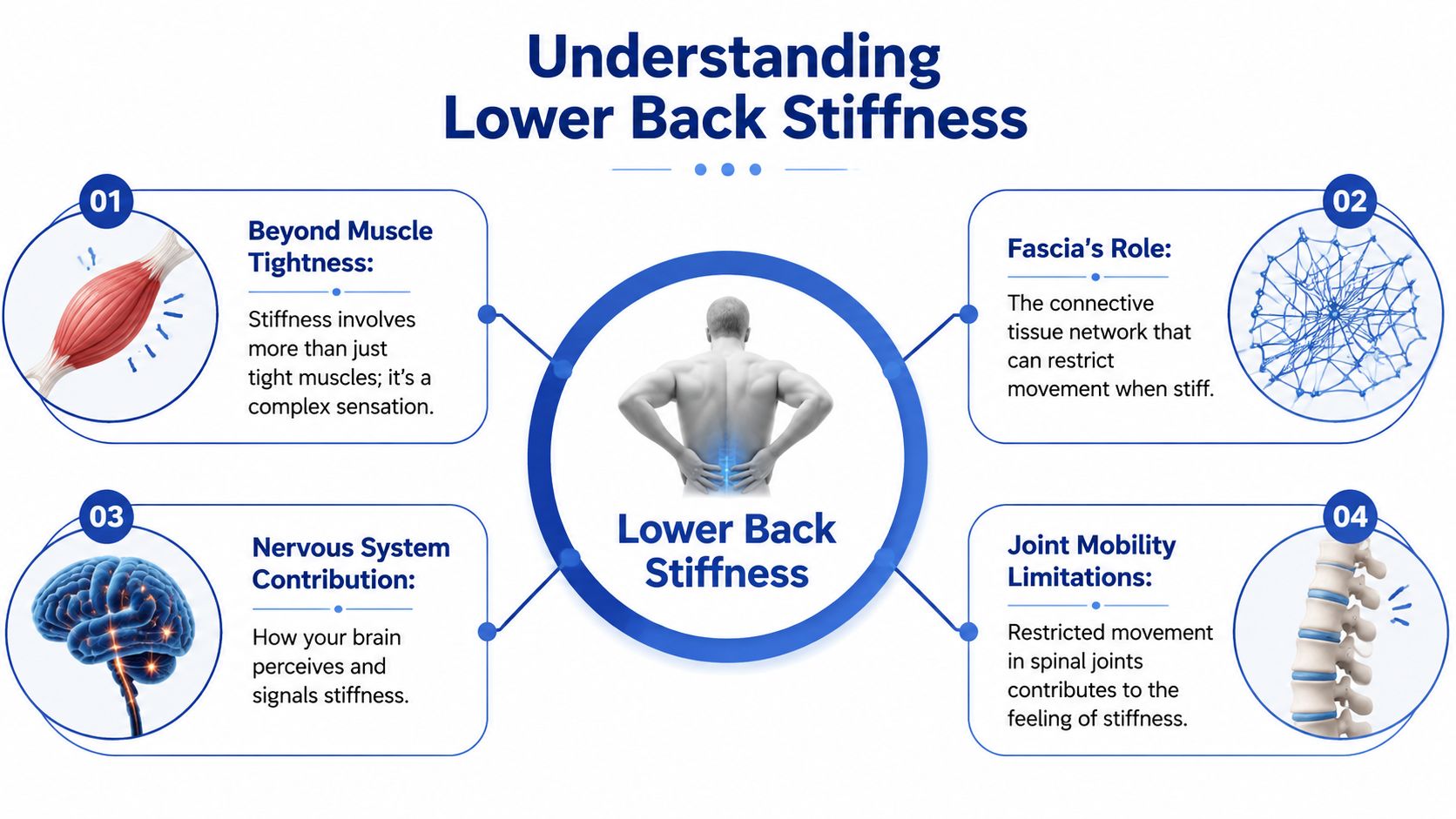
Lower back stiffness typically involves some combination of both. The muscles around the spine, hips, and pelvis can tighten to protect an area that feels vulnerable. At the same time, one or more segments in the lower back may stop moving freely. Fascia and connective tissue can also contribute to that sense of drag or resistance.
Why the feeling can be real even when scans aren't helpful
Stiffness also has a nervous system component. If your body expects movement to be uncomfortable, it may increase muscle guarding before you even bend. That doesn't mean the problem is “just stress” or “all in your head”. It means the body is trying to protect you, sometimes more than necessary.
Australian clinical guidance for low back problems highlights the importance of proper assessment, including palpation through the lower thoracic to lumbosacral region to identify segmental stiffness, and it also makes clear that hands-on care should sit alongside active treatment, not replace it, as outlined in Australian guidance on back problems and management principles.
A simple way to think about it is:
- Joint-driven stiffness often feels blocked in a particular direction.
- Muscle-driven stiffness often feels broad, tired, or gripping.
- Sensitivity-driven stiffness often feels worse when you're stressed, under-slept, or worried about movement.
Practical rule: If your back feels better after gentle movement, heat, and position changes, that usually points to a movement problem that responds well to active care.
Common Causes Behind a Stiff Lower Back
A stiff lower back usually has more than one driver. It helps to group the causes, because each category has a different pattern.
Mechanical causes
Mechanical stiffness is the most common pattern I see clinically. This includes reduced spinal movement, poor load tolerance, postural strain, deconditioned trunk and hip muscles, and irritation from repeated bending, lifting, twisting, or long hours sitting.
Common examples include:
- Desk-related immobility: You sit for long periods, then feel stiff standing upright.
- Deconditioning after inactivity: Your back feels vulnerable after illness, travel, or a break from exercise.
- Protective muscle guarding: The muscles tighten because the area feels threatened, even if there's no major injury.
- Hip and pelvic contribution: Limited hip movement can force the lower back to do extra work.
Inflammatory and system-wide contributors
Some stiffness has a different flavour. It may be more pronounced first thing in the morning, harder to shake off, or linked with known inflammatory conditions such as arthritis. In these cases, the back may feel less like it is “tight from sitting” and more like it is slow, irritable, and persistently restricted.
Stress, poor sleep, and general fatigue can also amplify stiffness. They don't create all back problems, but they can increase muscle tension and lower your tolerance for normal daily loads.
Signs of Different Types of Back Stiffness
| Symptom / Clue | Likely Mechanical Cause | Likely Inflammatory Cause |
|---|---|---|
| Worse after sitting | Common | Can happen, but less typical |
| Eases once you start moving | Common | May improve, but can remain pronounced |
| Triggered by lifting, awkward bending, or a new gym load | Common | Less typical |
| Strong morning stiffness | Possible | More suggestive |
| Broad ache with movement hesitation | Common | Possible |
| Persistent stiffness not clearly linked to posture or activity | Less typical | More suggestive |
This table isn't a diagnosis. It's a pattern guide. The same person can sit in both columns, especially if an old mechanical issue has led to chronic guarding.
If your stiffness has a clear mechanical trigger, active movement usually helps more than complete rest.
Active Mobility Exercises for Lasting Relief
One of the biggest misconceptions about lower back stiffness is that the answer must be more stretching. That sounds logical. If it feels tight, stretch it. But that approach often gives only brief relief.
Why passive stretching often falls short
Australian evidence has challenged the idea that passive therapies such as stretching or foam rolling resolve lower back stiffness for the long term. That evidence prioritises directional specific movements to address joint stiffness and neuromuscular control, as discussed in this Australian clinical commentary on low back pain myths and movement-based care.

That doesn't mean stretching is always bad. It means passive stretching alone often doesn't change the reason your back keeps stiffening up. Joints need movement. Muscles need coordinated loading. The nervous system needs repeated proof that motion is safe.
If you'd like a visual example of active rehab-focused movement, this rehabilitation exercise image reflects the sort of controlled, purposeful work that tends to help more than random stretching.

Four movements worth trying
Try these gently. None of them should create sharp, spreading, or escalating pain.
Cat-cow on hands and knees
Start on all fours. Round your back slowly, then gently arch it the other way. Keep the movement easy and smooth. This helps introduce spinal motion without loading the back heavily.Pelvic tilts lying on your back
Lie with knees bent and feet flat. Gently rock your pelvis so your lower back alternates between flattening slightly into the floor and easing away again. This is a small movement, but it's excellent for reconnecting with control around the lower spine.Glute bridge
From the same starting position, press through your feet and lift your hips only as far as feels comfortable. Pause, then lower slowly. A bridge encourages the hips and glutes to share load, which often reduces how much the lower back has to brace.Supported rock-back
Stay on hands and knees and slowly sit your hips back toward your heels, then return. If your knees don't like that position, place a cushion behind them or reduce the range. This can ease compressive stiffness and restore confidence with flexion.
For a guided movement option, this video can be a useful starting point:
How often to do them
The aim is consistency, not intensity.
- Start small: Do a short set once or twice a day.
- Use symptom response: If you feel looser afterwards and no worse later, that's a good sign.
- Keep the effort modest: Mobility work should feel like practice, not punishment.
- Progress gradually: Once stiffness settles, add walking, basic strength work, and more demanding movement patterns.
A common mistake is doing nothing for days, then attacking the problem with one long stretching session. Your back usually responds better to frequent, calm exposure to movement.
Preventing Stiffness With Smart Daily Habits
Relief matters. Prevention matters more. Most recurring lower back stiffness is built by daily routines, which means daily routines can also reduce it.
A better daily setup
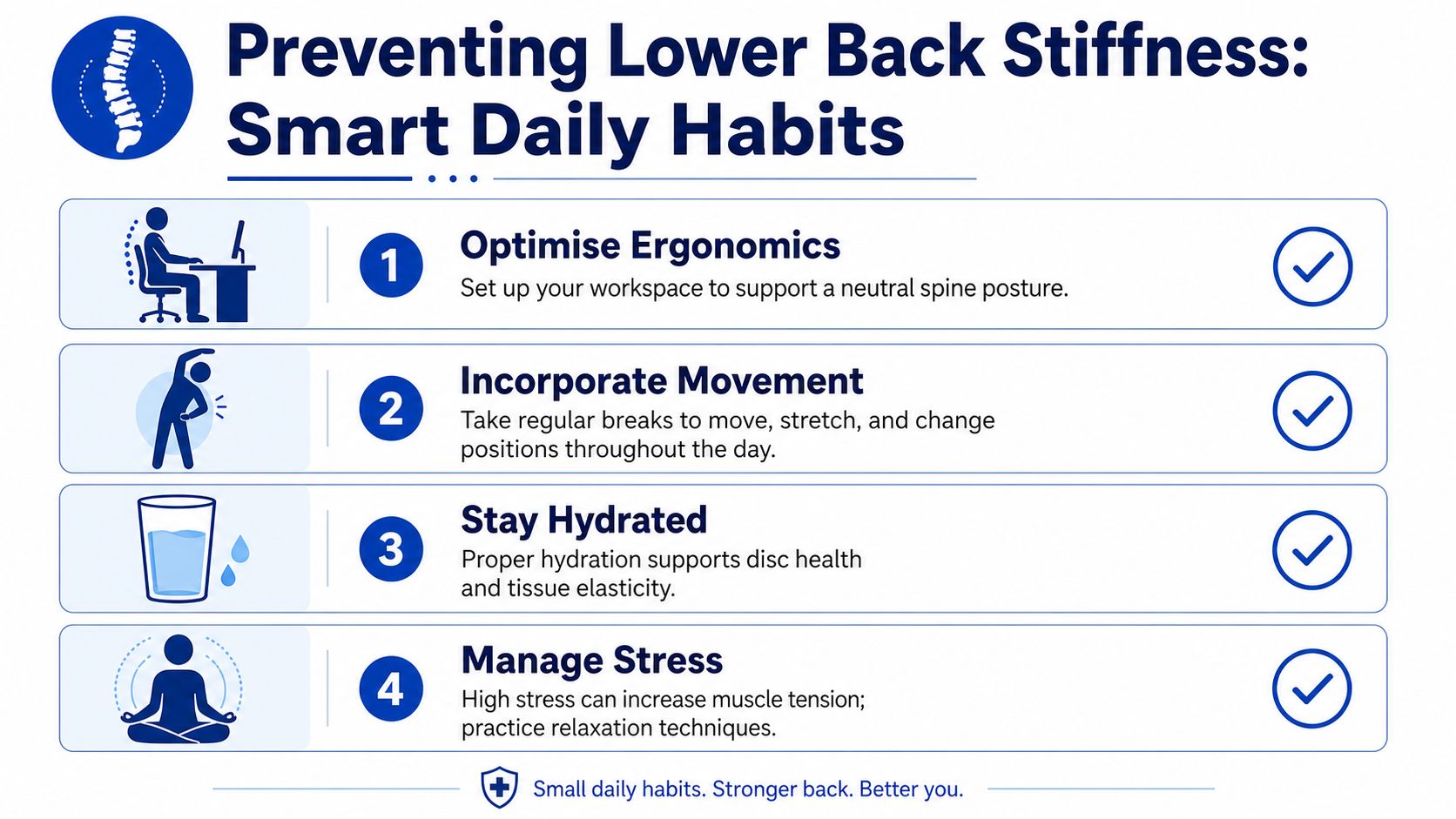
Your back generally tolerates many postures. What it dislikes is staying in any one of them for too long. If you work at a desk, set things up so you can sit comfortably, stand occasionally, and change position without fuss. A practical ergonomic posture reference image can help you visualise a more neutral workstation arrangement.
A few useful checks:
- Chair height: Feet flat, knees comfortable, and no need to perch.
- Screen position: High enough that you're not dropping your head forward for hours.
- Keyboard and mouse: Close enough that your shoulders can stay relaxed.
- Movement options: Keep water, printer tasks, or calls far enough away to make standing up normal.
Small habits that reduce flare-ups
- Break static time: Stand, walk, or change task regularly. The exact interval matters less than the habit of not staying frozen.
- Lift with planning: Get close to the object, use your legs and hips, and avoid rushed twisting.
- Build general strength: A resilient back usually comes from stronger hips, trunk, and legs, not from chasing perfect posture.
- Manage load spikes: Weekend gardening after a sedentary week is a classic recipe for stiffness.
- Respect stress and sleep: Poor sleep and high stress often show up physically as guarding and tension.
The most effective prevention plan is usually boring in the best possible way. Move often, vary your posture, and keep your body strong enough for the tasks you ask of it.
Red Flags When to Seek Professional Care
Most episodes of lower back stiffness are mechanical and manageable. Some are not. It's important to know when to stop self-managing and get assessed promptly.
Symptoms that need prompt medical review
Seek medical care urgently if lower back stiffness or pain comes with any of the following:
- Bladder or bowel changes: Difficulty controlling bladder or bowel function needs immediate attention.
- Leg weakness or numbness: Especially if it's new, progressing, or affecting walking.
- Pain spreading below the knee with neurological symptoms: Particularly if paired with weakness or altered sensation.
- Fever or unexplained weight loss: These symptoms need medical review.
- Recent significant trauma or fall: Especially in older adults or anyone with known bone fragility.
- Night pain or pain unrelated to movement: This pattern deserves assessment.
When persistence matters
Even without dramatic red flags, don't ignore stiffness that keeps returning, steadily worsens, or stops you from normal daily activity. Low back pain already accounts for a very large disability burden in Australia. By 2019, it was responsible for 44% of all years lived with disability from musculoskeletal conditions, and projections indicate 5.23 million Australians will be living with chronic back problems by 2050, according to Australian burden and projection data indexed on PubMed.
That statistic isn't there to scare you. It's there to underline a simple point. Persistent back problems deserve proper care before they become your new normal.
If symptoms are severe, unusual, or getting progressively worse, the safest move is medical assessment first and self-treatment second.
How Gentle Osteopathy in Bayside Can Help
Osteopathic care can be a useful option when lower back stiffness isn't settling with simple home measures, or when the problem keeps cycling back. The value isn't just hands-on treatment. It's the combination of assessment, movement guidance, and a plan built around how your whole body is managing load.
What osteopathic care aims to do
A good osteopathic assessment looks beyond the exact sore spot. It considers spinal movement, hip mobility, pelvic control, breathing pattern, work demands, training history, recovery, and whether the body is guarding because of pain, poor load tolerance, or both.
Treatment may include gentle soft-tissue work, articulation, and mobilisation to help reduce protective tension and improve movement comfort. But the hands-on part shouldn't be the whole plan. Australian clinical practice guidance states that manual therapy, including osteopathic techniques, should be used only as an adjunct to active treatments like graded exercise for non-specific low back pain. That principle supports a blended approach rather than passive treatment alone.
What a local care plan can include
For Bayside residents, practical care usually works best when it includes:
- A movement assessment: Identifying which motions feel blocked, guarded, or poorly controlled.
- Gentle hands-on treatment: Used to make movement easier, not to create dependence.
- Targeted exercise advice: Simple drills matched to your pattern of stiffness.
- Activity modification: Adjusting walking, gym work, lifting, desk setup, or recovery habits.
- A broader health view: Looking at sleep, stress, arthritis-related change, and recurring strain.
A holistic osteopathic assessment example shows the kind of whole-body thinking that often matters more than chasing the painful spot alone.
If you have a chronic condition, ask your GP whether you're eligible for Medicare-supported allied health care under an appropriate plan. Eligibility depends on your circumstances, so it's worth discussing directly with your doctor rather than assuming you do or don't qualify.
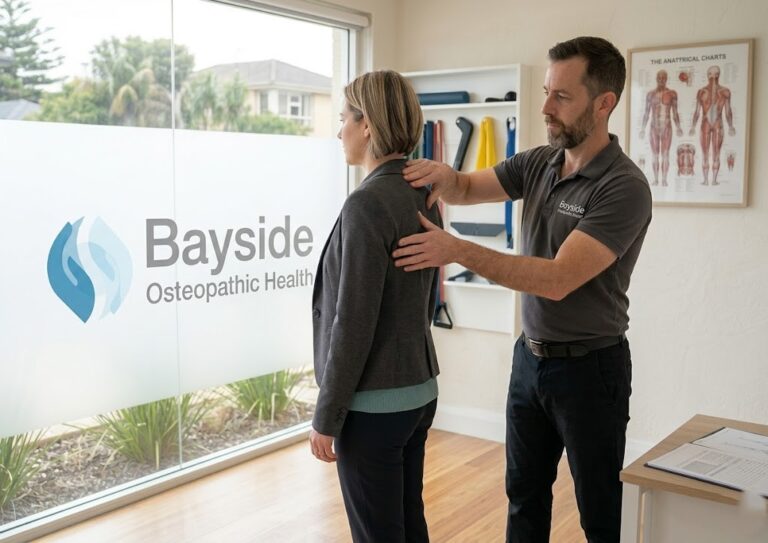
If lower back stiffness is affecting your mornings, workday, or confidence in movement, Bayside Osteopathic Health offers gentle, hands-on care for people across the local community. The team focuses on easing pain, improving mobility, and helping you build a practical plan that includes treatment, movement advice, and self-care you can actually stick with.