
You wake with a dull ache in one shoulder, reach for your seatbelt, and discover that a simple movement has become a careful negotiation. By the end of the day, your neck feels tight, your upper back seems locked, and sleeping on either side is uncomfortable. You may have tried resting, stretching, massage, or searching for an osteopath for shoulder pain, yet still be unsure what is driving the problem.
Shoulder recovery is rarely about treating one painful spot in isolation. The shoulder blade, collarbone, ribs, neck, mid-back, and even the way your hips and feet support movement all influence how the arm works. A whole-body osteopathic assessment can help identify those relationships, while a sensible plan combines hands-on care, exercise, daily adjustments, and appropriate medical review.
Table of Contents
- Understanding Shoulder Pain and Recognising Red Flags
- How Osteopathic Assessment and Treatment Work
- Realistic Recovery Timelines and Expected Outcomes
- At-Home Exercises and Daily Self-Care Strategies
- Your Experience at Bayside Osteopathic Health
- Navigating Medicare Options and Booking Your Visit
- Common Questions About Osteopathic Shoulder Care
Understanding Shoulder Pain and Recognising Red Flags
A typical shoulder complaint often begins without warning. You spend long hours at a laptop, carry a baby on the same side, paint a ceiling, return to tennis after a break, or increase gym training too quickly. At first, reaching overhead feels mildly restricted. Then putting on a jacket, washing your hair, or turning in bed starts to hurt.
The shoulder is designed for considerable movement, but it depends on coordinated support from the rest of the upper body. A stiff thoracic spine can limit the way the shoulder blade rotates. A restricted rib cage can alter breathing and upper-body control. Neck tension may increase protective muscle activity around the shoulder, while poor load management can leave tendons and joints sensitive even after the original irritation has settled.
Australian osteopaths regularly treat shoulder complaints. A national workforce survey recorded 801 osteopaths, representing 81.0% of respondents for that survey item, managing shoulder musculoskeletal disorders in practice, while a later Australian and New Zealand analysis found 147 osteopaths, or 86.5%, reported treating shoulder pain often. These figures are reported in the Australian osteopathy workforce research, and indicate that shoulder pain is a routine presentation rather than a niche reason to seek care.
When conservative care isn't the first step
Most movement-related shoulder pain can be assessed conservatively, but some symptoms need prompt medical attention. Arrange urgent review if pain follows a significant fall, collision, or other trauma and you can't actively lift the arm, or if the shoulder looks visibly deformed.
Seek medical assessment for sudden or profound weakness, rapidly increasing swelling, unexplained fever, marked redness, or pain that feels unrelated to movement. Numbness, pins and needles, or electric pain travelling from the neck into the arm may indicate nerve involvement and shouldn't be managed by repeatedly working on the sore shoulder without proper examination.
Chest discomfort, breathlessness, sweating, nausea, or pain spreading into the jaw or arm requires emergency care. An osteopath should be part of a coordinated plan only after serious causes have been considered.
Practical rule: A manual treatment should make sense within a diagnosis and safety screen. It shouldn't delay medical review when the pattern doesn't look like ordinary musculoskeletal pain.
How Osteopathic Assessment and Treatment Work
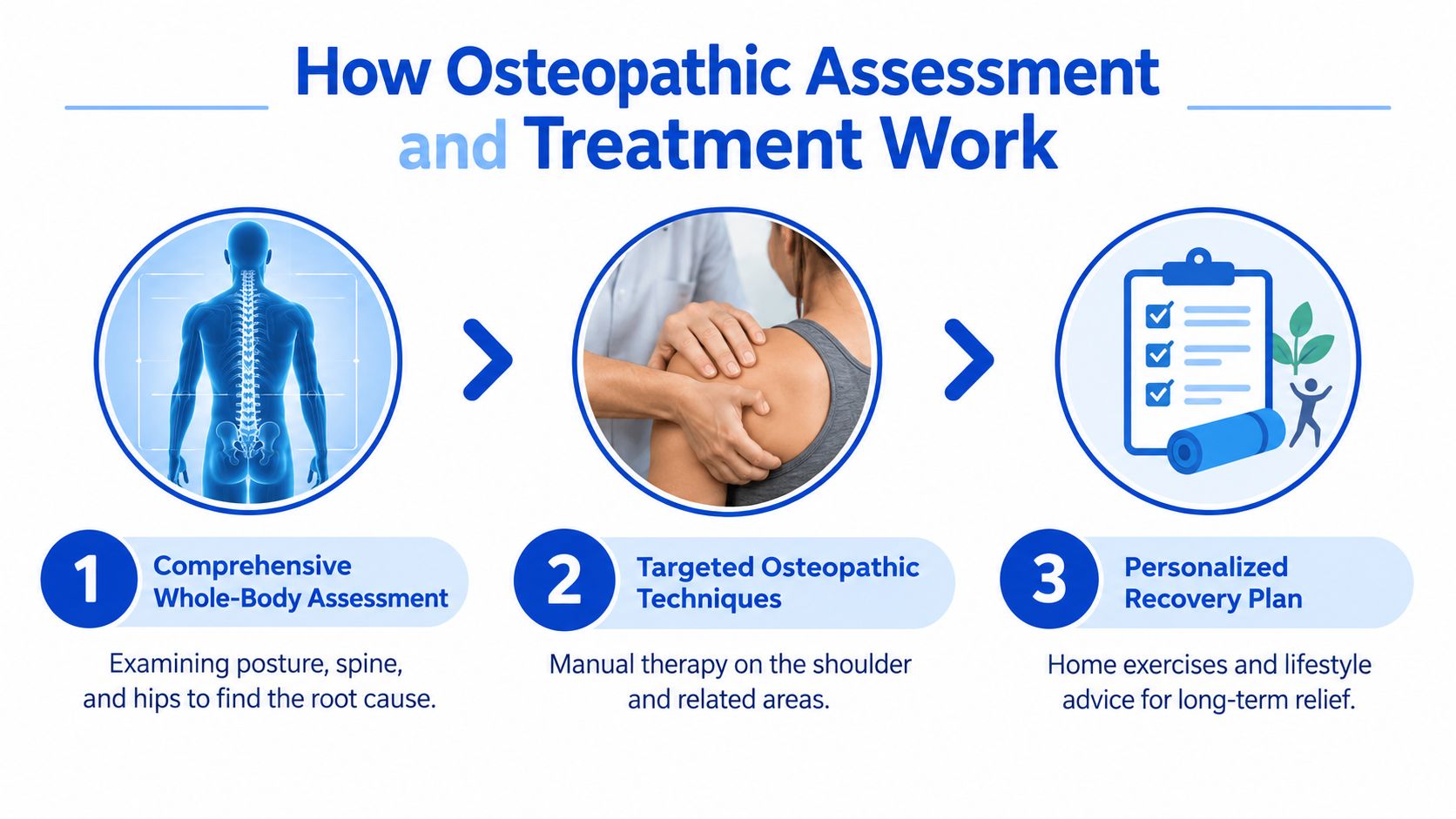
A first consultation should answer two questions. What is limiting your movement, and what load or habit is keeping the area irritable? The painful shoulder is important, but it isn't always the only place that needs attention.
The assessment
The practitioner will ask when the pain began, which movements provoke it, whether symptoms disturb sleep, and how work, sport, lifting, or previous injuries affect your day. They may compare active and passive shoulder movement, observe the shoulder blade during elevation, and assess strength, coordination, and neck movement.
The examination can extend through the cervical spine, thoracic spine, ribs, and upper limb. The reason is mechanical rather than mystical. If the mid-back can't extend and rotate comfortably, the shoulder blade may have less room to move. If the neck is guarding, the muscles around the shoulder may work harder than necessary.
The clinician may also consider referred pain and symptoms that don't fit a local shoulder problem. Australian workforce research involving 1,254 practitioners across Australia and New Zealand found that shoulder pain was commonly reported among clinicians who often treated non-musculoskeletal complaints, with an association reported as OR 1.60, 95% CI 1.01–2.55. The Australasian workforce analysis supports careful differentiation rather than assuming every shoulder symptom starts inside the shoulder joint.
The treatment
Treatment is selected according to what the examination finds and what you can tolerate. Soft-tissue techniques may reduce guarding in the upper trapezius, pectoral muscles, posterior shoulder, or surrounding thoracic tissues. The aim isn't to force a painful release. It is to make movement easier and give you a more comfortable starting point for active rehabilitation.
Joint articulation uses controlled movement through a joint's available range. This may be applied to the shoulder, upper back, ribs, or neck, depending on the presentation. Gentle mobilisation can help restore a sense of glide without provoking the protective response that often follows aggressive treatment.
The most useful manual therapy is usually paired with movement. After treatment, you may practise a comfortable wall slide, supported reach, thoracic rotation, or low-load strengthening exercise so your nervous system and tissues learn to use the new range. Hands-on care can open a door, but your daily movement is what helps keep it open.
A short visual explanation of this process is available below.
Realistic Recovery Timelines and Expected Outcomes
A shoulder may feel freer during or soon after treatment, particularly when guarding has eased. That change is encouraging, but it does not mean the tissues are fully recovered. Pain sensitivity, muscle coordination, tendon capacity, joint irritation, sleep, and the demands placed on the arm adapt at different speeds.
An acute muscular overload can settle once the provoking activity is reduced and comfortable movement returns. A long-standing tendinopathy often takes longer because strength, load tolerance, and movement habits have changed over time. Progress may be gradual rather than linear. Arthritis-related stiffness can become more comfortable and useful without restoring every degree of movement.
Measure progress by function
Pain matters, but it can vary with sleep, stress, workload, and expectation. Functional milestones often give a clearer picture:
- Reach: Can you put on a shirt or reach a shelf with less compensation?
- Sleep: Can you stay in a comfortable position for longer?
- Capacity: Can you work, drive, train, or carry groceries with better control?
- Confidence: Are you using the arm more naturally instead of protecting it?
Recovery is also about how the whole body shares movement. Your neck, ribs, upper back, shoulder blade, and trunk may all influence how the shoulder loads during reaching or lifting. Improving that coordination can reduce strain on the painful area, although it does not replace graded strengthening or a clear diagnosis.
The RACGP guidance on chronic shoulder pain supports a staged conservative approach, with activity, exercise, and clinical review guiding early management. Imaging or specialist input may become appropriate when the presentation, examination, or response to treatment calls for it.
When the plan needs changing
A plateau does not automatically mean care has failed. The exercise load may be too high, the working diagnosis may need reconsideration, sleep may remain poor, or work and sport may be repeatedly irritating the shoulder. Reassess the pattern rather than repeating the same technique without adjustment.
Seek further clinical review if weakness progresses, function remains severely limited, symptoms change character, or a well-organised conservative plan produces no meaningful functional improvement. Good conservative care includes recognising when imaging, another clinician, or a different rehabilitation focus is appropriate. Recovery should be steady enough to build confidence, while remaining flexible enough to respond to new findings.
At-Home Exercises and Daily Self-Care Strategies
Your shoulder spends far more time outside the treatment room than on the treatment table. The home plan should therefore be simple enough to repeat and gentle enough to avoid a flare. The right exercise is the one that gives you useful movement without leaving a worsening reaction later that day or the next morning.
Begin with comfortable motion rather than forcing a stretch. A supported table slide lets you move the arm forward while reducing its load. A slow wall slide can encourage shoulder-blade rotation, provided you don't shrug or push through sharp pain. Thoracic rotation in a side-lying position may help you move through the upper back while keeping the shoulder supported.
Build movement into the day
Long, uninterrupted periods at a desk can make the upper body feel fixed. Change position regularly, bring the screen to a comfortable height, keep the keyboard close enough that your shoulders can relax, and let your forearms rest when possible. The aim isn't to hold a perfect posture for hours. It is to give your body varied positions and manageable movement.
Use daily activities as low-intensity practice. Walk while taking a phone call, alternate the arm used for light carrying, and avoid repeatedly testing the painful movement just to see whether it still hurts. If an exercise causes sharp pain, increasing weakness, or symptoms travelling down the arm, stop and ask for an individual assessment.

Sleep and recovery habits
Side sleepers often benefit from supporting the sore arm with a pillow in front of the chest, rather than allowing it to fall across the body. Back sleeping may feel easier with the forearm supported so the shoulder isn't left hanging into an uncomfortable position. Choose the position that reduces symptoms, and change it if numbness or increased pain develops.
A personalised movement resource can help you remember the exercises between appointments. You can also review this rehabilitation exercise visual alongside instructions from your practitioner.

The useful dose is repeatable, not heroic. A modest movement routine performed consistently is more valuable than an ambitious programme that repeatedly aggravates the shoulder.
Your Experience at Bayside Osteopathic Health
Your first visit should feel like a conversation and an examination, not a guessing game. At Bayside Osteopathic Health, the consultation begins with your history. You explain what changed, what you can no longer do comfortably, what makes the symptoms better or worse, and what you need to return to.
The practitioner then observes how you stand, breathe, turn, reach, and use the shoulder. Assessment may include the neck, thoracic spine, rib cage, shoulder blade, shoulder joint, and surrounding soft tissue. This broader view matters when a desk-based worker, swimmer, tradesperson, or parent has developed a similar symptom but a different movement problem.

What treatment may feel like
Treatment can include soft-tissue work, joint articulation, and gentle mobilisation. Techniques are adapted to your sensitivity and the findings on the day. You shouldn't feel pressured to tolerate aggressive treatment, and the practitioner should explain what they are doing and why.
A useful appointment ends with a plan you understand. That may include a small number of home movements, advice about work or sleep, and guidance on which activities to continue, modify, or temporarily reduce. The purpose isn't to make you dependent on appointments. It is to help you regain control of movement and gradually increase what your shoulder can manage.
Bayside Osteopathic Health provides hands-on osteopathic care for shoulder stiffness and related movement concerns, with treatment that can include assessment of the shoulder, thoracic spine, rib cage, neck, and nearby soft tissues. The clinic's approach combines manual care with movement advice and practical self-care, as shown in this overview of osteopathic care.

A collaborative decision
You don't need to arrive with the perfect diagnosis. You do need to describe your goals clearly. “I want to sleep on my right side,” “I need to lift at work,” or “I want to return to swimming” gives the practitioner a functional target that is more useful than chasing a pain score alone.
If symptoms suggest a need for medical investigation, a responsible practitioner will explain that and help you coordinate the next step. Australian osteopathy has formal regulatory oversight, with the Osteopathy Board of Australia workforce statistics published quarterly since 2012. That doesn't make every treatment appropriate for every person, but it places osteopathic care within an established registered health profession.
Navigating Medicare Options and Booking Your Visit
The administrative side of care can be confusing, particularly if shoulder pain has already made work and daily tasks difficult. Osteopathic appointments aren't automatically covered by every Medicare arrangement. Eligibility may apply when osteopathic care forms part of a general practitioner's chronic disease management plan, so speak with your GP and ask what the plan covers before booking.
Your GP can explain whether you meet the relevant requirements, provide any required referral or plan documentation, and clarify the number and type of allied-health services available under your circumstances. Coverage, gap payments, and claiming arrangements can vary, so confirm details with both the practice and your health fund rather than relying on a general assumption.
A straightforward booking process
When contacting a clinic, have a short description ready:
- Describe the pattern: Mention when the pain began, whether it followed trauma, and which movements are restricted.
- State your goal: Explain whether you want better sleep, easier work, improved overhead reach, or a return to sport.
- Mention relevant history: Include previous shoulder injuries, surgery, imaging, medical conditions, and current symptoms such as numbness or weakness.
- Ask practical questions: Confirm appointment availability, fees, cancellation terms, and what to bring.
You don't need to stop all activity while waiting for care unless a clinician has advised it. Keep movement within a tolerable range, avoid repeatedly provoking the sharpest motion, and seek prompt medical attention if red flags appear.
A good booking decision is based on fit. Look for a registered practitioner who takes a proper history, examines more than the painful point, explains uncertainty clearly, and includes active recovery rather than promising a quick hands-on fix.
Common Questions About Osteopathic Shoulder Care
Is osteopathy suitable for arthritis-related stiffness?
It can be appropriate when the presentation is suitable for conservative care. Osteopathic treatment cannot reverse cartilage loss or rebuild a degenerating joint. It can, however, help improve comfortable movement, reduce protective muscle tension, and support useful strength and activity.
Treatment may include gentle articulation, soft-tissue techniques, and advice on managing load around irritable movements. The aim is to work with the joint's current capacity rather than force a damaged joint through pain. Home exercise and regular, modified activity usually form part of the plan. If symptoms persist, worsen, or suggest another condition, medical review may be needed.
Is an osteopath better than a physiotherapist?
Neither profession is automatically right for every shoulder problem. Physiotherapy often focuses strongly on diagnosis-specific exercise progression, strength, and return-to-sport planning. Osteopathy commonly combines those active elements with hands-on assessment and treatment of the shoulder, spine, ribs, and surrounding tissues.
The useful question is what your presentation requires and whether the clinician offers a clear, safe plan. A rotator-cuff injury with measurable weakness may need focused rehabilitation and medical assessment. A shoulder that feels restricted alongside neck or thoracic stiffness may benefit from examining the wider movement chain. Some patients use both services as part of coordinated care.
Do I need an MRI immediately?
Usually, an MRI is not the first step for shoulder pain. Recent 2026 Australian guidance encourages GPs and physiotherapists to avoid unnecessary early shoulder scans, reporting that many shoulder problems improve with self-management, education, and time, while early imaging and surgery are often overused. The Australian guidance report supports clinical assessment before advanced imaging is ordered.
An MRI becomes more useful when its findings are likely to change management, such as with persistent significant weakness, suspected major structural injury, or symptoms that fail to improve as expected. Osteopathy may help reduce shoulder pain, but the available evidence remains limited and does not justify promising a predictable result. You can review this visual summary of evidence-based osteopathic therapy while keeping expectations realistic.
Bayside Osteopathic Health offers individual assessment, gentle hands-on treatment, and practical movement plans for shoulder pain and stiffness across the Bayside community. Book a consultation through Bayside Osteopathic Health to discuss your symptoms and choose a safe next step.