
You're halfway through the morning, your inbox is finally under control, and then it starts. A deep ache low in your pelvis, a pressure through your tailbone, or a burning feeling you can't quite place. You shift to one side, perch on the edge of the chair, stand for relief, then sit again because work still needs doing. If pain in pelvis when sitting has become a daily negotiation, you're not imagining it, and it's rarely solved by sitting up straighter.
Table of Contents
- When Sitting Becomes the Hardest Part of the Day
- What Can Actually Cause Pelvic Pain on Sitting
- Reading Your Own Symptoms Without Self-Diagnosing
- Seating, Posture, and Workday Habits That Can Help
- Gentle Stretches and Mobilisations You Can Try at Home
- Red Flags and the Australian Reality of Under-Addressed Pelvic Pain
- How Osteopathic Care at Bayside Can Fit Into Your Plan
When Sitting Becomes the Hardest Part of the Day
People describe it in ordinary moments. Driving to the shops becomes uncomfortable before leaving the suburb. A coffee with friends ends early because the café chair feels unbearable. At a desk, they rotate between sitting, standing, kneeling on a cushion, and walking to the kitchen for no reason other than to change position.
That restlessness tells a clinician something useful. Sitting isn't rest for the pelvis. It's a sustained load, held in one shape, often for far longer than the tissues involved would choose.
Why a Chair Loads the Pelvis Differently
When you sit, your hips stay flexed and much of your upper body weight passes through the ischial tuberosities, the bony points you can feel under your buttocks. Soft tissue, gluteal muscles, and the pelvic floor sit between those bones and the seat. At the same time, your trunk weight creates ongoing pressure through the abdomen and pelvis.
Standing and walking spread that load differently. Your hips extend, muscles contract and release in turns, and pressure shifts from step to step. Sitting removes most of that variation. If a joint is irritable, a nerve is sensitive, or pelvic floor muscles are already tense, sustained pressure can keep provoking the same spot.
Position matters too. Slumping loads the tailbone and sacrum more. Sitting bolt upright for hours loads spinal and hip muscles that have to hold you there. Neither posture is automatically good or bad. What usually hurts is staying in either one past the point your tissues tolerate.
What People Often Get Wrong at the Start
Many patients arrive convinced they've caused the problem with poor posture. They've bought a new chair, a coccyx cushion, maybe a standing desk, and they're frustrated that relief lasted a week. Those tools can help, but they only change load. They don't identify what's being loaded.
Changing the chair can change symptoms. It rarely explains them on its own.
That's the distinction worth holding onto. Sitting is the provocation, not necessarily the cause. A seat can aggravate a sacroiliac joint, compress sensitive perineal tissue, expose hip stiffness, or coincide with bladder, bowel, or menstrual pain. Each needs a different next step.
You don't need to be alarmed by that list. Most sitting related pelvic discomfort is manageable once the pattern is understood, and much of it improves with sensible load changes and targeted care. But persistent pain deserves more than a posture lecture. The practical goal is to work out which structures are likely involved, spot the signs that need medical review, and build a home plan that settles symptoms without masking something important.
What Can Actually Cause Pelvic Pain on Sitting
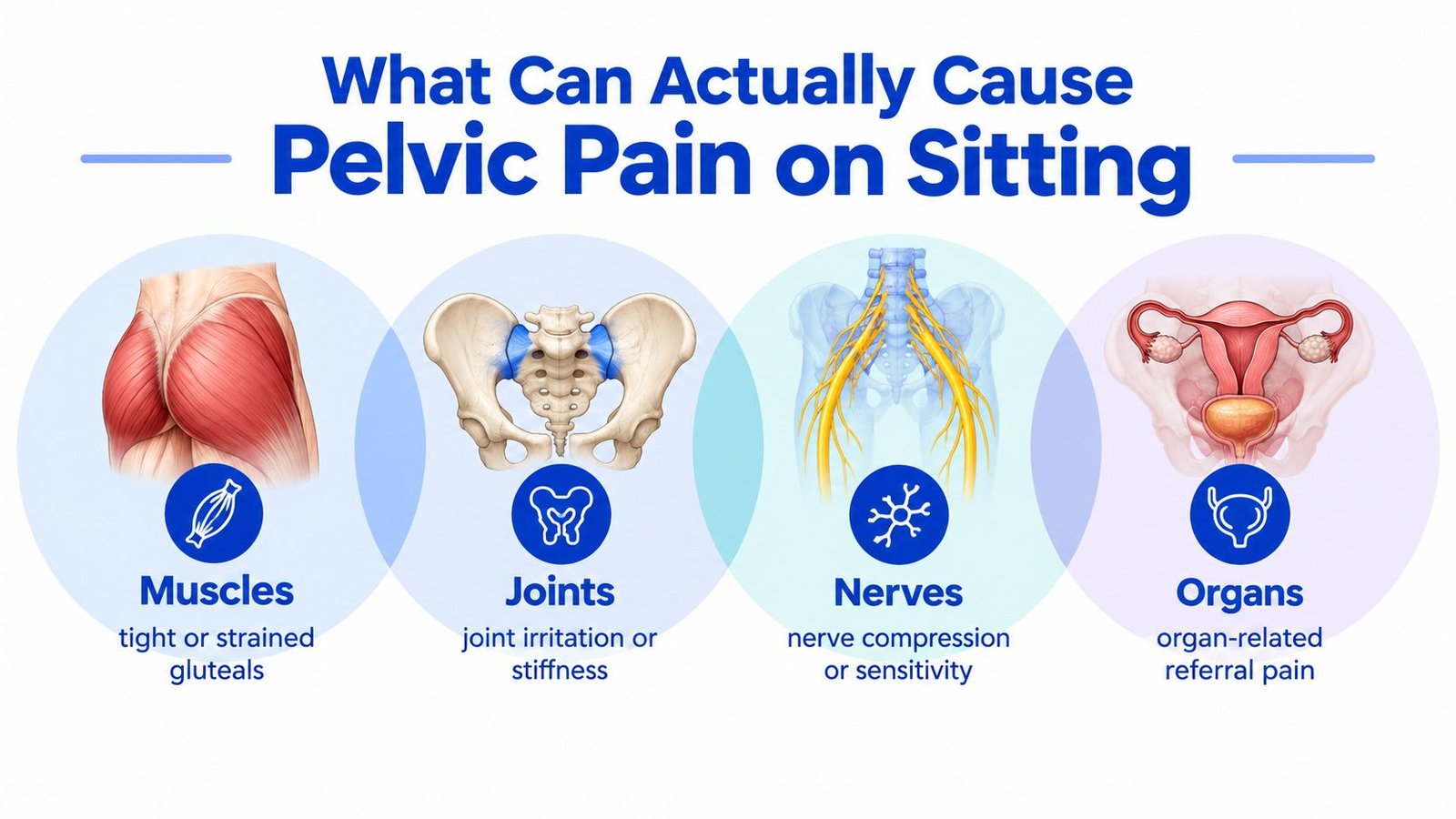
The pelvis is a crossroads. The lower spine, sacroiliac joints, hips, pelvic floor, bladder, bowel, reproductive organs, and several nerves all occupy or pass through a small region. That's why pelvic pain on sitting is a symptom, not a diagnosis. The same chair can provoke very different problems in different people.
Australian clinical guidance frames persistent pelvic pain as a condition with multiple overlapping contributors rather than a single cause, affecting up to 1 in 4 Australian females and around 1 in 12 Australian males. Overlap isn't unusual. It's often the rule.
The infographic below groups the main contributor families so you can see them side by side.
Musculoskeletal Contributors
The sacroiliac joint sits where the sacrum meets the pelvis, and irritation there often feels like deep buttock or low back ache that's worse after staying seated and stiff on standing. The coccyx, or tailbone, produces more localised pain, especially on hard seats or when leaning back. Hip joint problems tend to show up as groin ache or a pinch when the hip is flexed, while deep gluteal muscles such as the piriformis can create buttock pain that spreads down the back of the thigh. The lumbar spine can also refer pain into the pelvis and buttock, so pain location alone doesn't settle the question.
Pelvic Floor and Nerve Contributors
The pelvic floor is a group of muscles that supports the bladder, bowel, and reproductive organs and helps control continence and sexual function. When those muscles stay overactive or can't relax properly, sitting can feel like pressure, aching, or a sense of sitting on something. Postnatal change, surgery, prolonged guarding after pain, or habitual breath holding can all keep that tension going. Strengthening isn't always the answer here. A tense pelvic floor often needs down training first.
Nerve related pain feels different. Burning, shooting, tingling, or electric sensations through the perineum, genitals, or buttock raise the possibility of pudendal nerve sensitivity or irritation of other nerves around the pelvis and hip. Sciatic irritation more often travels down the leg. Nerve symptoms that worsen directly with perineal pressure, such as on a bike seat, are worth describing precisely to a clinician.
Visceral and Medical Contributors
Organs can refer pain to the pelvis too. Endometriosis, bladder pain syndrome, prostatitis, ovarian cysts, and inflammatory bowel conditions can all produce pelvic pain that happens to be noticed while seated. Sitting may not be the driver in these cases. It may be when you're still enough to notice, or when abdominal pressure and hip flexion add to existing sensitivity. That's why cycle timing, urinary changes, and bowel symptoms matter so much in an assessment.
| Contributor family | Typical location of pain | Aggravators when seated | Common associated signs |
|---|---|---|---|
| Musculoskeletal | Buttock, tailbone, groin, low back | Hard seats, leaning back, long drives | Stiffness on standing, pain with stairs or hip movement |
| Pelvic floor | Perineum, deep pelvis, tailbone | Sustained sitting, straining, holding tension | Urgency, constipation, pain with intercourse |
| Nerve related | Perineum, genitals, buttock, down the leg | Direct pressure, bike seats, certain hip positions | Burning, tingling, numbness, shooting pain |
| Visceral or medical | Lower belly, deep pelvis, rectum | Full bladder or bowel, cycle related flare | Bleeding, urinary or bowel change, cycle linked pain |
Reading Your Own Symptoms Without Self-Diagnosing
You can't diagnose yourself from a symptom list, and you shouldn't try. What you can do is describe your pattern so clearly that a clinician spends less time guessing. Location, timing, and associated symptoms are the three details that help most.
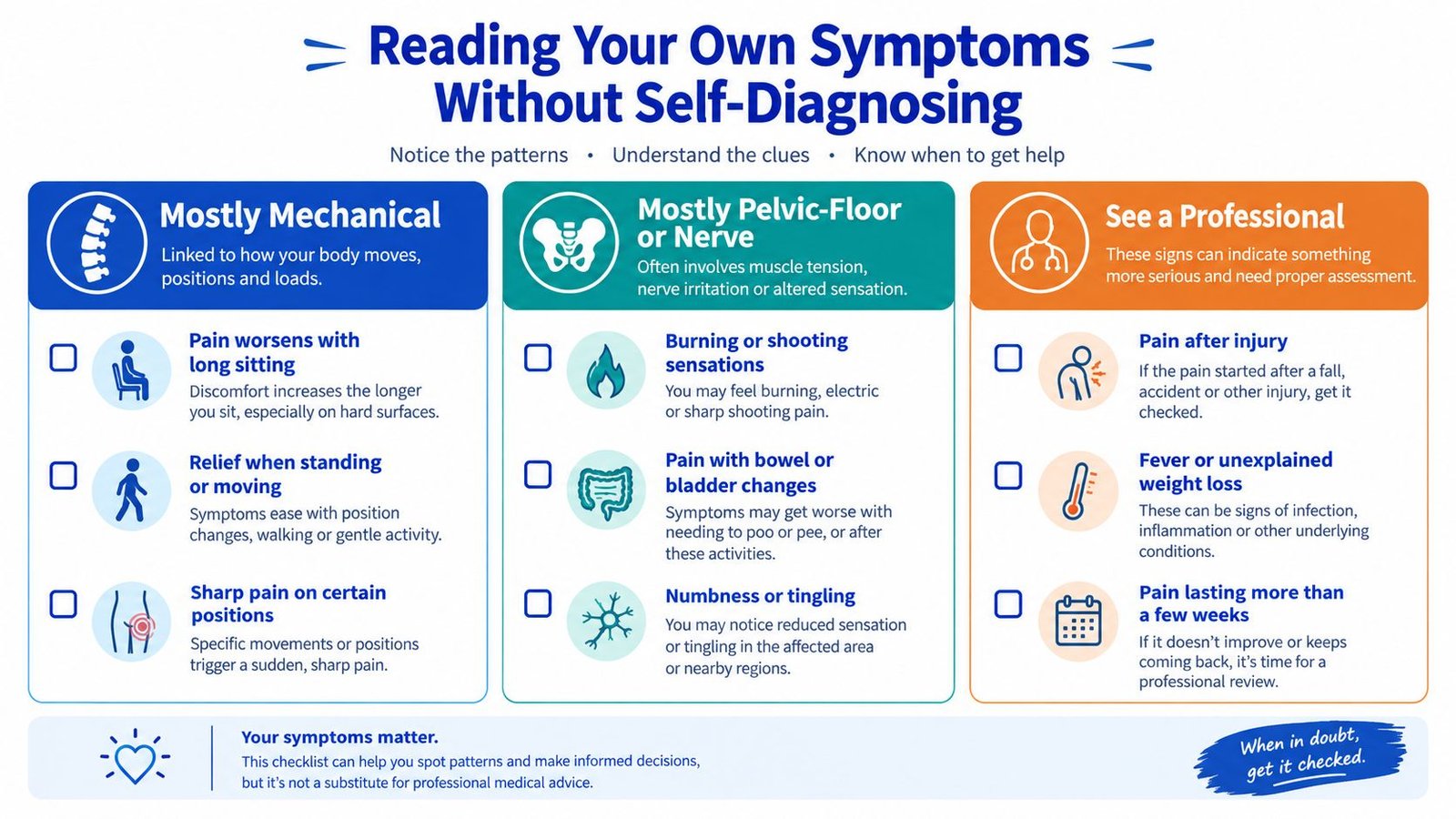
The checklist below groups common patterns into broad categories. Treat it as a conversation starter, not a verdict.
Patterns That Often Point Mechanical
Mechanical pain usually behaves predictably with load. It builds after a consistent sitting duration, eases when you stand or walk, and returns in similar positions. A hard chair hurts more than a soft one, leaning back provokes tailbone pain, or crossing your legs consistently sets off one buttock. Morning stiffness that loosens with movement also fits here.
That predictability is reassuring but not conclusive. A hip joint problem and a sacroiliac problem can both look mechanical, and they aren't managed identically. What the pattern really tells you is that load modification and hands on assessment are reasonable first steps.
Patterns Suggesting Pelvic Floor or Nerve Involvement
Perineal or genital burning, a feeling of pressure or fullness, pain that's worse when you need to urinate or open your bowels, and pain during or after intercourse all point a clinician toward pelvic floor or nerve contributors. Numbness, tingling, or altered sensation in the saddle region or down a leg deserves prompt attention, particularly if it's new or progressing.
- Burning or shooting quality: More suggestive of nerve sensitivity than simple muscle ache.
- Bladder or bowel links: Urgency, hesitancy, constipation, or pain with bowel movements can accompany pelvic floor overactivity.
- Pressure that builds while seated: Can reflect pelvic floor tension rather than weakness.
Signs That Should Move You to a GP Sooner
Some features change the order of priorities. Pain linked to your menstrual cycle that's worsening over time, pain with intercourse, new bladder or bowel change, unexplained bleeding, fever, unexplained weight loss, or pain that wakes you at night and doesn't settle with position change all warrant medical review before you persist with stretches and cushions.
Practical rule: If the pain pattern is changing, spreading, or bringing new symptoms with it, get it assessed rather than categorised at home.
Avoid the symptom checking spiral. Search results rank by engagement, not by likelihood, and rare conditions read as vividly as common ones. Write down what you feel, when it happens, and what changes it. That record is more useful to any practitioner than a label you've settled on at midnight.
Seating, Posture, and Workday Habits That Can Help
There's no perfect posture to hold all day. Your next posture is usually your best one, because variation spreads load across tissues instead of concentrating it. The aim with seating changes is symptom guided load modification, not rigid correction.
Queensland Health describes persistent pelvic pain as pain on most days for longer than three months that may be aggravated by sitting or standing and can coexist with low back or hip pain, and its guidance favours modifying load according to symptoms over prolonged immobility. That principle applies well to everyday sitting pain too.
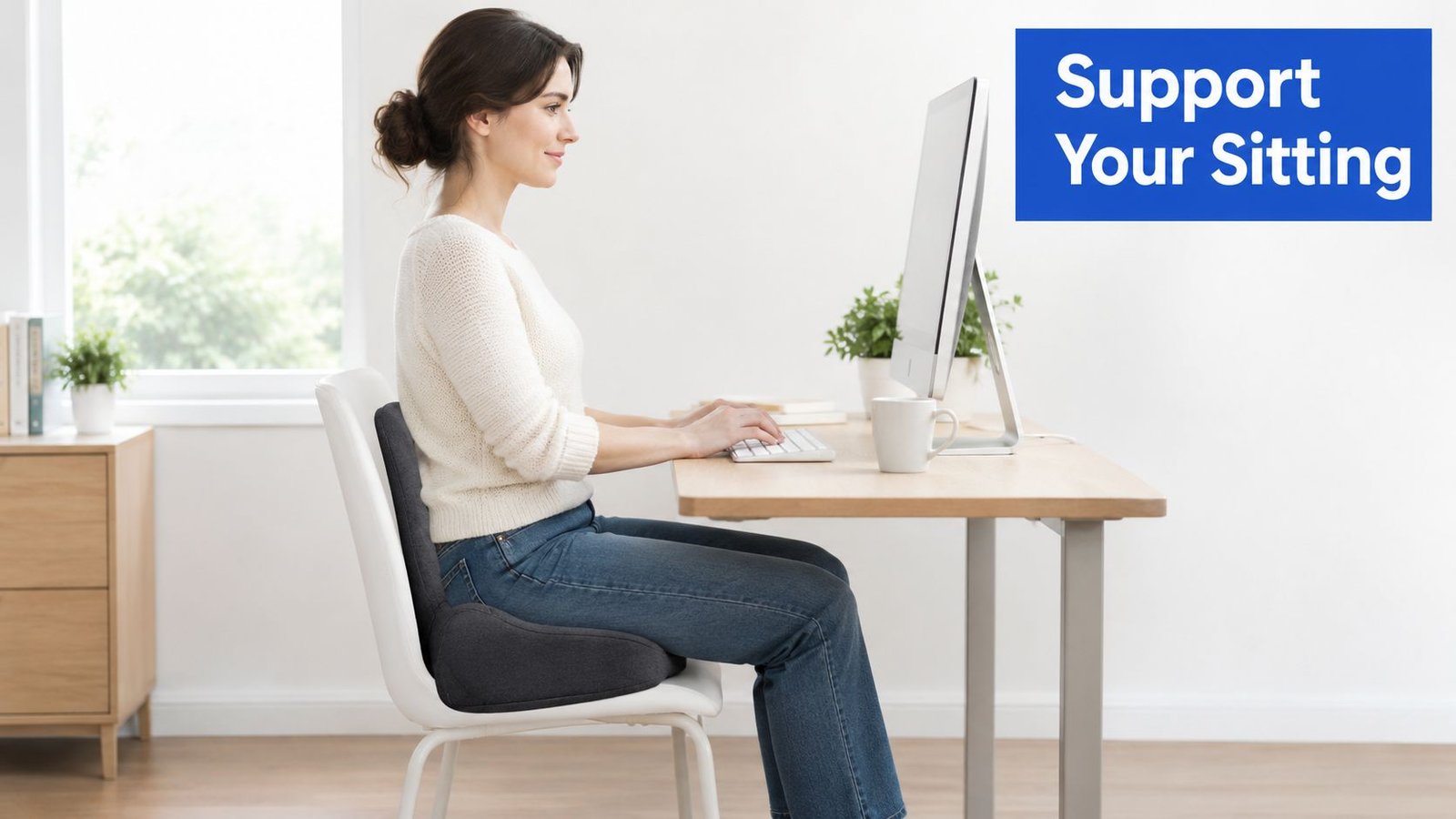
The photo below shows a typical desk set up where a cushion is used to redistribute pressure rather than force an upright shape.
Chair and Cushion Choices That Reduce Pressure
A cushion with a rear cut out can unload an irritable coccyx, while a contoured foam cushion can spread weight through the thighs and sitting bones. Perineal pain sometimes responds better to a cushion with a central channel, but responses vary, so borrow before you buy if you can. Donut rings deserve caution. They can concentrate pressure around the ring's edge and increase perineal pressure for some people, so prolonged use without improvement isn't a strategy.
Seat height matters as much as padding. Set the chair so your feet rest flat and your thighs share the load rather than dangling or pressing into the seat edge. In the car, move the seat slightly closer and more upright than feels natural, so your pelvis isn't rolled back onto your tailbone for the whole drive.
Build a Sit Stand Rhythm Into the Day
Change position before pain peaks, not after. If symptoms reliably build at forty minutes, standing at thirty works better than pushing through and recovering for an hour. Use triggers you'll keep, such as finishing an email batch, refilling water, or taking calls standing.
- Micro breaks: Stand or walk briefly every twenty to thirty minutes if your tolerance is low, then lengthen intervals as symptoms settle.
- Foot position: Keep both feet supported so weight isn't hanging through one side of the pelvis.
- Pelvic tilts between tasks: Gently rock the pelvis forward and back a few times to vary load without leaving your chair.
- Heat: A heat pack over the low back or gluteals can ease muscle guarding, but keep sessions short and don't use heat to endure positions that keep flaring you.
Slouching occasionally isn't a moral failure, and rigid tall sitting often creates its own ache. Judge a posture by how your symptoms behave during and after it, and by whether you can change out of it easily.
Gentle Stretches and Mobilisations You Can Try at Home
Movement helps most sitting related pelvic pain when it's dosed like medicine, in small amounts that leave you no worse afterward. Stretching into pain to force a release usually backfires, particularly with nerve or pelvic floor symptoms. Work at a level you'd describe as a mild stretch, breathe normally, and stop any movement that produces burning, tingling, or pain that lingers and builds after you finish.
The sequence below shows four low load options that suit beginners starting out.
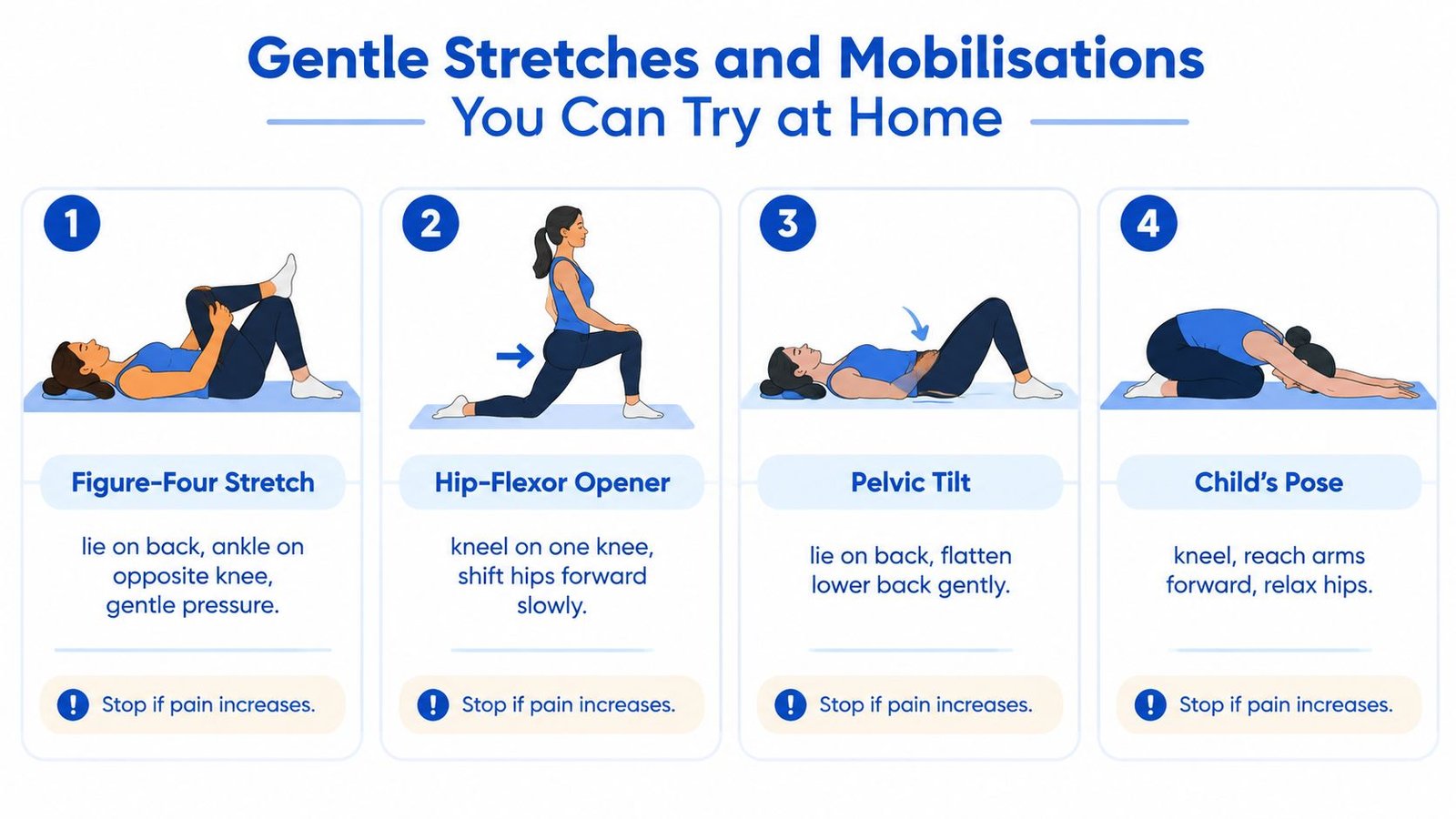
A Short Routine That Respects Pain
Start with a supported figure four stretch lying on your back, one ankle resting on the opposite knee, easing the knee away until you feel a gentle stretch deep in the buttock. Hold briefly, repeat a few times, and keep the range smaller on the irritable side. This targets the deep gluteal muscles that often guard when sitting hurts.
For hip flexors shortened by long seated days, try a kneeling hip flexor opener on a folded towel. Tuck your pelvis slightly, shift forward a small amount, and stop at the first stretch through the front of the hip. If kneeling bothers your knee, the same position works standing with one foot on a step.
Add diaphragmatic breathing lying down, one hand on your lower ribs. Breathe in slowly so the ribs widen, and let the pelvic floor soften as you exhale rather than bracing. This is relaxation training, not strengthening, and it suits people whose pain feels like pressure or tension. Finish with gentle pelvic tilts or cat cow movements to move the lumbar spine and pelvis through a comfortable range.
The video below demonstrates pacing and positions in real time, which helps if written cues feel abstract.
Knowing Whether It's Helping
Judge the routine over a week, not a single session. Helpful movement usually means you can sit a little longer before symptoms build, or recover faster after a flare. If each session leaves you worse for the rest of the day, the dose or the choice of exercise is wrong for now. Skip deep stretches, aggressive foam rolling into the buttock, and repeated pelvic floor contractions on flare days. Once a practitioner has identified your pattern, a personalised programme will usually outperform a generic routine.
Red Flags and the Australian Reality of Under-Addressed Pelvic Pain
Most pelvic pain on sitting isn't an emergency, but some presentations shouldn't wait for a routine appointment. Seek urgent medical review for sudden severe pelvic or abdominal pain, fever with pelvic pain, vomiting, unexplained vaginal or rectal bleeding, inability to pass urine, or pain in pregnancy that concerns you. New saddle numbness, progressive leg weakness, or loss of bladder or bowel control needs emergency assessment the same day.
Other signs warrant prompt GP review rather than emergencies. Unexplained weight loss, pain that's steadily worsening despite load changes, new pain after a significant fall onto the tailbone, or symptoms lasting months and limiting work, sleep, or exercise all belong in that category.
Why So Many People Wait Too Long
Australian data shows how common and disruptive this problem is. The 2023 National Women's Health Survey found that 47% of adult women had experienced pelvic pain in the previous five years, with approximately one in four saying it affected daily activities, work or study, or exercise. Yet many people still describe being told their pain is normal, or having it attributed to posture or stress without further assessment.
A normal scan rules out some things. It doesn't rule out pelvic floor dysfunction, nerve sensitivity, or several other causes of real, disabling pain.
Routine imaging can't show excessive pelvic floor tension, impaired muscle relaxation, or many nerve related problems. So a clear scan combined with ongoing symptoms isn't the end of the conversation. It's a sign the assessment needs to widen, possibly across GP, pelvic health, gynaecology, urology, gastroenterology, or pain services depending on your pattern.
Arrive With a Record That Helps
A short symptom diary makes appointments more productive, especially when time is limited. Two weeks is usually enough to show a pattern without becoming a second job.
- Sitting tolerance: How long before pain builds, and which seats are worst.
- Cycle timing: Where flares sit in relation to menstruation, if relevant.
- Bladder and bowel notes: Urgency, hesitancy, constipation, or pain with either.
- Impact: Sleep, work, exercise, intercourse, and what you've stopped doing.
- What's been tried: Cushions, medication, exercises, prior treatment, and what helped.
Bring that record even if it feels incomplete. Duration and impact matter clinically, and pain that's disrupting your life deserves coordinated assessment whether or not early tests show anything.
How Osteopathic Care at Bayside Can Fit Into Your Plan
An osteopathic appointment for sitting related pelvic pain starts with history before hands on work. Expect questions about where you feel it, how long you can sit, bladder and bowel habits, cycle links, previous injuries, and what a flare costs you at work or at home. That history decides whether treatment is appropriate, whether GP review should come first, or whether both should happen in parallel.
Examination usually looks beyond the sore spot. Lumbar spine movement, sacroiliac and hip function, gluteal and abdominal muscle behaviour, and how you sit, stand, and walk all influence pelvic load. Internal pelvic floor examination isn't part of standard osteopathic assessment, so if your pattern suggests pelvic floor involvement, referral to a pelvic health practitioner may be part of the plan rather than something handled in the same room.
Treatment, where appropriate, uses gentle techniques such as soft tissue work, joint articulation, and mobilisation, matched to your tolerance rather than applied by routine. At Bayside Osteopathic Health, that hands on care is paired with movement advice and home strategies drawn from your assessment, including seating changes and exercises dosed to your current sitting tolerance. The honest scope matters. Osteopathy can address mechanical contributors and help you manage load. It doesn't diagnose or treat endometriosis, bladder conditions, or prostate problems, and any practitioner who suggests otherwise is overclaiming.
That coordination point isn't academic. A 2025 Victorian parliamentary inquiry reported that 71% of respondents cited dismissal by health professionals and 62% cited long waits as barriers, which is why a clear local pathway, with each clinician knowing their role, helps people avoid repeating their story across disconnected services.
Practically, you don't need a referral to book an osteopathic appointment, though your GP may discuss Medicare supported pathways under certain care plans if you're eligible. Coverage under those plans is partial and capped, so ask about any gap before you commit. Wear comfortable clothing you can move in, and bring your symptom diary and any relevant imaging reports.
You also don't need a finished diagnosis to make a useful first appointment. Bringing a clear pattern, a list of what you've tried, and honest questions about what's realistic is enough to start.
If sitting has become the hardest part of your day, a whole body osteopathic assessment can help identify the mechanical contributors, settle irritable tissues with gentle hands on treatment, and build a seating and movement plan around your actual tolerance. Visit Bayside Osteopathic Health to book an appointment, ask about Medicare pathways you may be eligible for, or join the newsletter for practical local guidance on pelvic, back, and hip pain.