
You're wiping after a cough, bracing against a dull ache, or feeling pressure you can't quite name, and you're trying to decide whether this is just something to live with. Maybe you've told yourself it's “normal” after birth, after ageing, or after months of sitting too long. It isn't a personal failure, and it isn't something you have to guess your way through.
Pelvic floor rehabilitation is the structured, evidence-based way clinicians help the muscles, nerves, and movement patterns around the pelvis work better together. In Australia, urinary incontinence is the most common pelvic floor problem and affects an estimated 5 million people according to the Continence Foundation of Australia, which is why conservative care matters so much in everyday practice. The good news is that this field reaches far beyond leakage, and the right plan can also address pain, bowel symptoms, breathing mechanics, and posture.
Table of Contents
- Why Pelvic Floor Rehabilitation Matters More Than You Think
- Understanding Your Pelvic Floor Anatomy and Common Dysfunctions
- What a Pelvic Floor Assessment Involves
- Evidence-Based Treatment Options for Pelvic Floor Recovery
- A Progressive Pelvic Floor Exercise Programme
- The Bayside Osteopathic Health Approach to Pelvic Floor Care
- Red Flags and Your Next Steps Toward Recovery
Why Pelvic Floor Rehabilitation Matters More Than You Think
A lot of people sit with leakage, pelvic heaviness, or pain with sex for months, sometimes years, before they mention it. The worry is often the same. It feels too small to bring up, or too ordinary to change. That hesitation makes sense, but it also means people keep adapting around symptoms that deserve proper attention.
More than a bladder problem
Pelvic floor rehabilitation sits inside mainstream conservative care in Australia, not on the fringe. Australian continence policy identifies pelvic floor muscle training as a core, evidence-based management strategy, so rehab is a first-line option rather than something saved for the end in the national review of practice and policy. The reason this matters is simple. Pelvic floor problems affect people across primary care, postnatal care, and ageing populations, so the work belongs in ordinary healthcare, not only in specialist rooms.
A common mistake is to treat pelvic floor symptoms as separate, unrelated complaints. In real practice, the same person may leak when they cough, rush to the toilet, feel heaviness after standing, and get pelvic pain when they sit for too long. Those symptoms can belong in one rehabilitation plan because the pelvic floor works as a system, with pressure, movement, breathing, and load all influencing one another.
Practical rule: if a symptom changes with pressure, movement, toileting, or sex, it deserves assessment rather than dismissal.
Why early care changes the conversation
Structured rehab gives the body a new pattern to learn. It is a bit like retraining a team that has started calling the wrong signals at the wrong time. With the right guidance, the muscles can learn when to support, when to relax, and when to coordinate with the rest of the trunk. That is one reason supervised care tends to matter more than random exercises done in isolation.
Longer-term outcomes also show why follow-up matters. In one study published in PubMed, many people maintained their post-treatment continence level and some improved months later. Results like that support the idea that pelvic floor rehab is not only about short-term symptom control. It is about helping the body keep a better pattern once the initial teaching phase is over.
Pelvic floor dysfunction also reaches beyond one symptom label or one stage of life. People often look for help only after symptoms begin to affect work, exercise, intimacy, or confidence. By then, compensation patterns are usually already in place. They can still be treated, but the plan often needs to account for pain, bowel symptoms, breathing mechanics, posture, and how the whole body shares load.
Understanding Your Pelvic Floor Anatomy and Common Dysfunctions
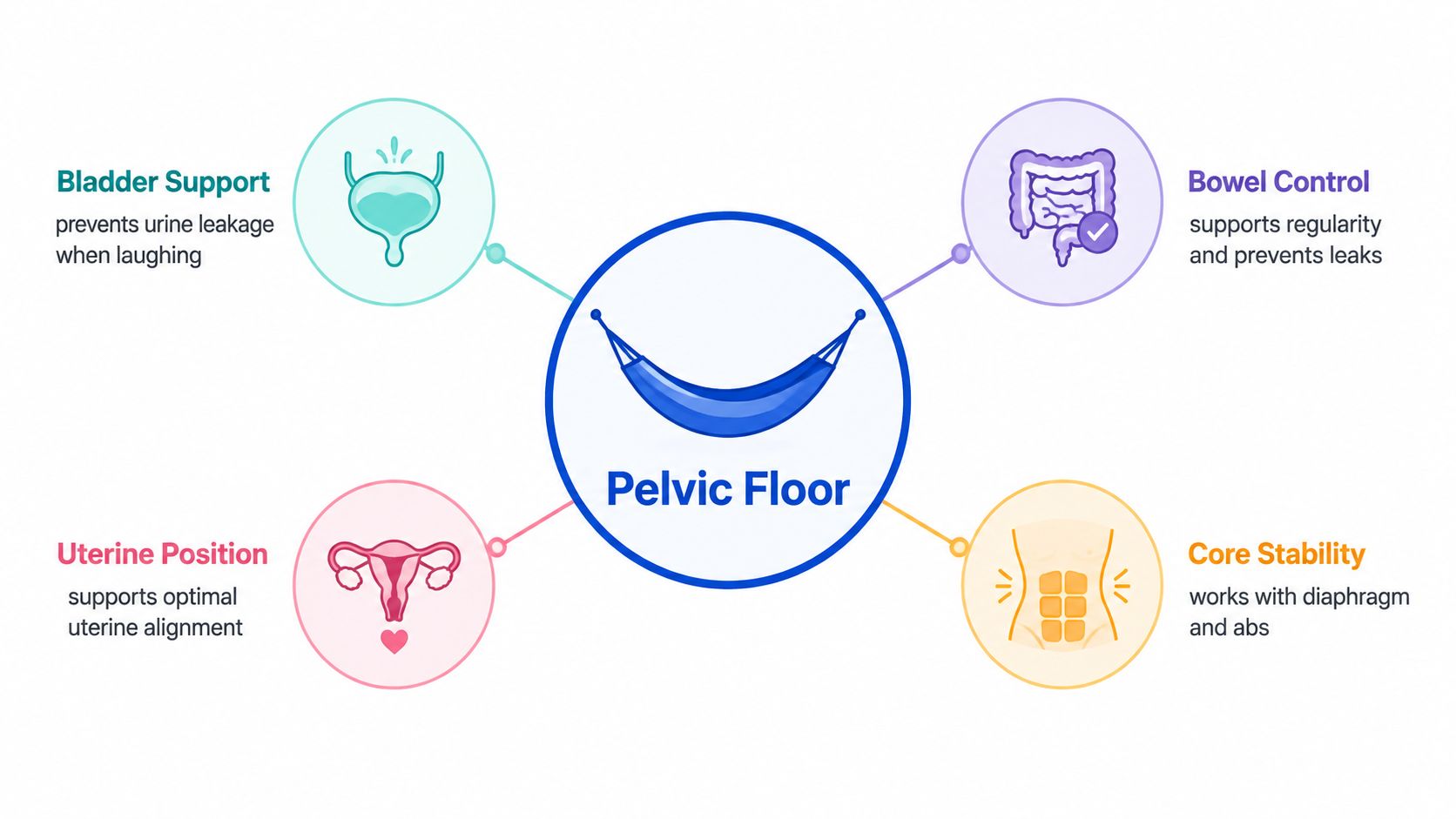
The pelvic floor forms a supportive layer at the base of the pelvis. It helps support the bladder, bowel, and reproductive organs, and it works with the diaphragm, abdominal wall, hips, and spine so you can cough, lift, walk, and pass urine or stool in a coordinated way. It is a moving, pressure-handling system that works alongside the rest of the trunk.
When the system is under too much load
Pelvic floor dysfunction does not only mean weakness. Some people have muscles that do not switch on well, some have muscles that stay too tight, and some have a timing problem where the muscles contract at the wrong moment. A person can be strong in the gym and still leak with a sneeze, or feel tight and painful despite doing lots of exercises.
Stress incontinence usually shows up when pressure rises, such as during coughing, jumping, or lifting. Urge incontinence feels different, because the bladder signals suddenly and it is hard to delay the trip to the toilet. Pelvic organ prolapse can feel like heaviness, dragging, or pressure, especially later in the day or after standing for a long time.
Pain, bowel symptoms, and coordination problems
Pelvic pain often confuses people because they expect a muscle issue to feel like soreness in the legs or back. In the pelvic floor, pain can feel like burning, aching, guarding, or a sense that the muscles will not let go. Bowel dysfunction can look like straining, incomplete emptying, constipation, or pain with bowel movements, and it often overlaps with urinary symptoms rather than appearing on its own.
The key point is simple. Weak, tight, and poorly coordinated are different problems, and they need different rehab strategies.
Recent literature also shows the field still focuses heavily on urinary incontinence, pelvic pain, bowel dysfunction, conservative management, exercise, and pregnancy-related care, while psychological, cognitive, behavioural, social, and occupational factors are under-investigated and not well translated into practice as summarised in the literature review. That gap matters because a pelvic floor problem is rarely just a muscle problem. It is often a movement, pressure, and habit problem too.
A careful assessment may also look at the tissues around the pelvis and how they respond to touch, breathing, and load. In practice, that can include an external and, when appropriate, internal examination, sometimes with support from a physiotherapist treating a man using equipment, so the clinician can see whether the issue is strength, relaxation, coordination, sensitivity, or a mix of all four.

What a Pelvic Floor Assessment Involves
The first appointment is usually less dramatic than people fear. A good clinician starts with a conversation before anything hands-on. You'll be asked about leakage, pain, bowel habits, exercise, birth history if relevant, sleep, work demands, and what makes symptoms better or worse.
The external assessment comes first
The practitioner then looks at how you breathe, stand, sit, bend, and move. That matters because breathing and posture change pressure inside the abdomen, and the pelvic floor has to respond to that pressure in real time. If your ribs are flaring, your breath is held, or your spine is rigid, the pelvic floor may be doing a job it was never meant to do alone.
You may also be asked to do simple tasks like a squat, a cough, or a pelvic tilt so the clinician can see how your body manages load. Hip mobility, trunk control, and spinal positioning can all influence pelvic floor stress, so the assessment is broader than many people expect. That broader view is useful when symptoms seem mixed, like leakage plus back pain, or bowel issues plus pelvic tightness.
Consent matters: internal assessment is optional, and you should know why it's being suggested before anything happens.
Internal examination and why it's different
If an internal assessment is useful, the clinician should explain it clearly and get informed consent first. RANZCOG and Australian continence resources emphasise that PFMT should be individualised and technique-checked, because incorrect bracing or breath-holding can increase intra-abdominal pressure and worsen symptoms as outlined in the clinical guidance review. That is one reason internal examination can be helpful, because it shows whether the muscle is lifting, relaxing, or holding tension.
This process checks strength, endurance, timing, and the ability to relax fully after a contraction. In some cases, a clinician can build a strong treatment plan without internal work. In others, the internal exam gives the clearest picture of what the muscles are doing.
A patient should leave this visit with a clear explanation, a few early strategies, and a sense that the problem has been understood rather than guessed at. That sense of clarity is often the first real relief.
Evidence-Based Treatment Options for Pelvic Floor Recovery
A person can have leakage, pelvic pain, constipation, or a feeling of pressure, and each pattern can point to a different treatment path. A tight, painful pelvic floor needs a different approach from a weak or underactive one. The strongest programmes usually combine methods instead of depending on one exercise or one device.
What helps when leakage is the main issue
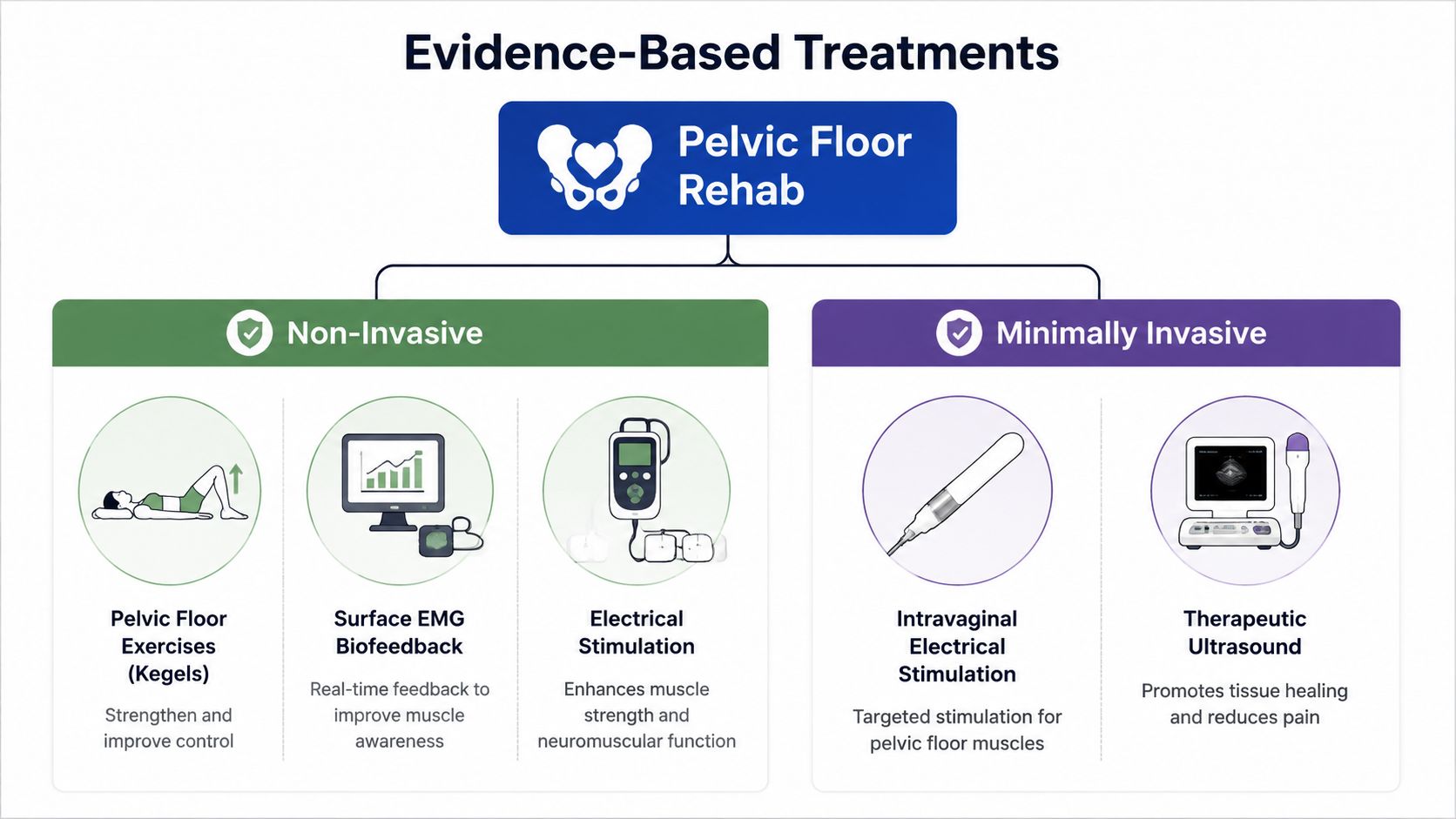
For stress urinary incontinence, the clearest results usually come from supervised pelvic floor muscle training with digital palpation, biofeedback, and vaginal cones over about 12 weeks according to the systematic review. That combination matters because feedback helps people find the right muscles and repeat the movement correctly, much like learning to balance on a bike with training wheels before riding on your own.
Biofeedback is most helpful when someone cannot tell whether the right muscles are working, or when the body keeps recruiting the abdomen, glutes, adductors, or breath-holding instead. Digital palpation helps the clinician confirm whether there is a lift, a release, and enough coordination between the two. Vaginal cones can then add a graded load once the pattern is reliable.
What helps when tightness or pain leads the picture
Hands-on treatment is often more relevant when the pelvic floor is overactive, protective, or painful. That can include soft tissue release, gentle mobilisation, and fascial work, depending on the clinician's training and the person's presentation. The goal is not to force the muscles to let go. It is to calm threat enough for the tissues and nervous system to settle.

Bladder and bowel retraining often sits alongside manual care when the problem is timing, urgency, or toileting habits. Breathing retraining and postural work matter too, because many people brace through the abdomen and upper chest without realising it. Lifestyle changes, such as toileting rhythm and movement strategies, help the body practise a less reactive pattern during the day.
If a treatment plan never changes and your symptoms do, the plan probably is not specific enough.
A useful reminder of how broad pelvic floor rehabilitation can be comes from an outpatient study from PubMed, where the typical patient group included urinary problems, bowel problems, and pelvic pain alongside chronic symptoms. That range shows why pelvic floor rehab is rarely just a bladder programme. It is a whole-function programme, with the pelvic floor sitting inside breathing, posture, hip motion, and daily pressure management.
A gentle, whole-body service such as Bayside Osteopathic Health can fit into this picture when someone needs hands-on care that considers spinal, hip, and breathing contributions alongside exercise. The value is not in replacing pelvic floor rehabilitation, but in supporting the mechanical side of it.
A Progressive Pelvic Floor Exercise Programme
A pelvic floor programme works best when awareness comes before effort. When a person cannot feel the muscles clearly, training becomes guesswork. When they cannot let them go again, strengthening on its own often creates more guarding. The first aim is a clean contraction and a clean release.
Build the pattern before adding load
The early stages usually begin in lying, sitting, or supported standing, because those positions make the muscles easier to sense. A practitioner watches for abdominal gripping, buttock squeezing, and breath-holding, since all three can hide what the pelvic floor is doing. The right cue is often smaller than people expect, more of a gentle inward and upward lift than a hard squeeze.
Breathing comes next. On the in-breath, the pelvic floor should soften and follow the pressure change, and on the out-breath it should lift if that is the aim of the exercise. If the breath is held, the exercise becomes a pressure management drill rather than a pelvic floor exercise.
Progress by function, not by ego
Once the movement pattern is clear, endurance work can be added with longer holds. Speed work trains quick responses for coughs, sneezes, or sudden movement. Load work comes later, when the person can keep control during tasks like lifting, squatting, or changing direction.
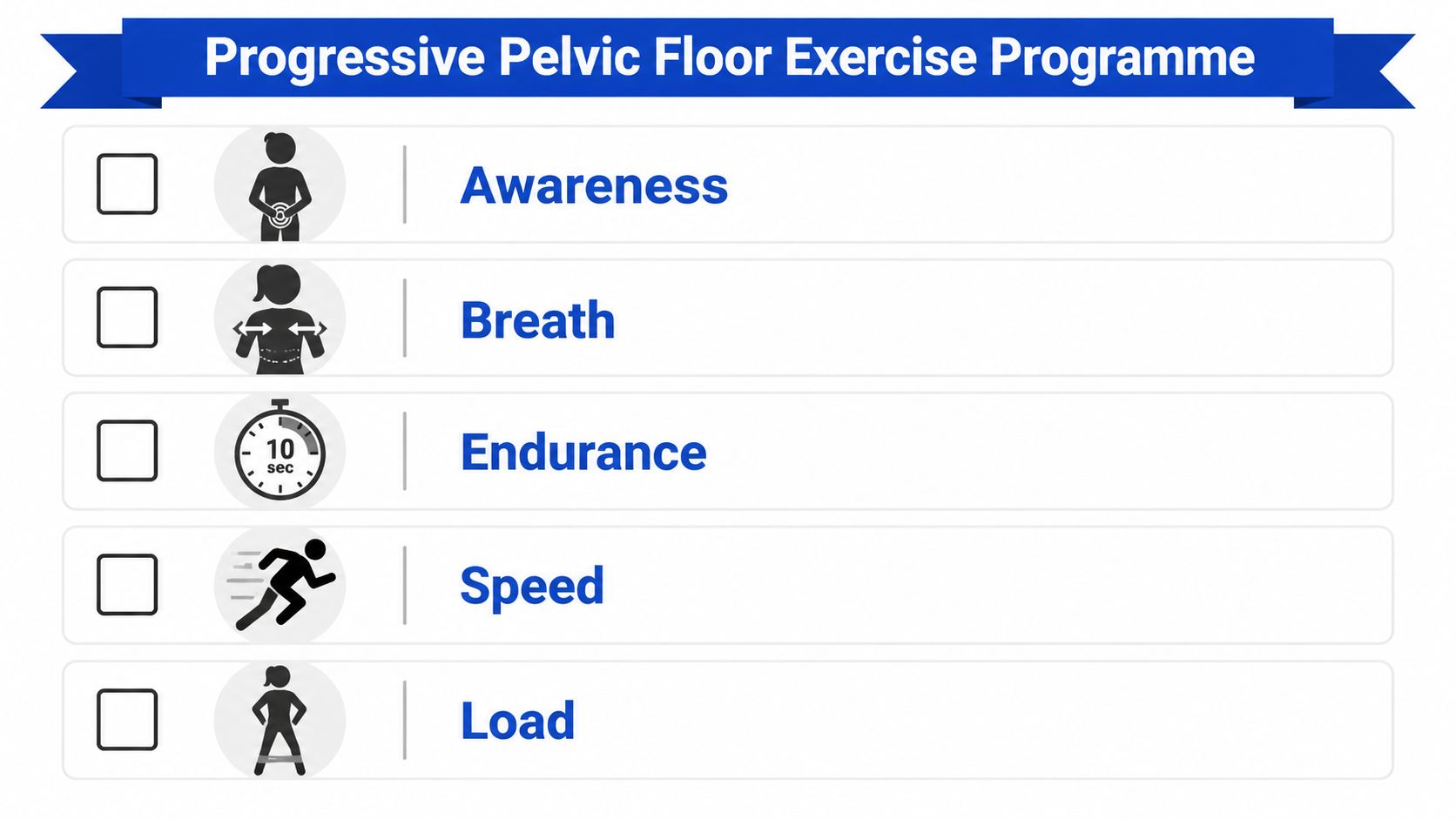
Progression follows five functional stages, awareness, breath, endurance, speed, and load.
- Awareness: learn where the muscles are and how they feel when they lift and relax.
- Breath: match pelvic floor action with steady, unforced breathing.
- Endurance: hold the contraction long enough to support daily tasks.
- Speed: practise quick responses for pressure spikes.
- Load: bring the same pattern into real movement.
Rule of thumb: if a person cannot relax after a contraction, the programme should not advance yet.
Common mistakes show up early. Some people bear down instead of lifting. Others brace through the ribs, or recruit the glutes so strongly that the pelvic floor never does its part. If that happens, the plan should be reduced and rechecked, not pushed harder.
Technique needs to be checked before progression, and supervised work matters more than endless home repetitions. The clinical guidance review as noted in the clinical guidance review supports this approach, because correct form and load management are what make the exercise useful, not the number of repetitions alone.
View a clinician guiding a rehabilitation exercise session
The Bayside Osteopathic Health Approach to Pelvic Floor Care
A woman may come in worried that her pelvic floor is the whole problem, because the symptoms feel so local. In clinic, the pattern is often wider. A stiff rib cage, guarded breathing, restricted hips, or a body that has spent too long bracing can make the pelvic floor work far harder than it should. An osteopathic lens helps by looking at how load is shared through the trunk, pelvis, and breath.
Whole-body assessment with practical treatment
At Bayside Osteopathic Health, care starts with gentle hands-on assessment and then, where appropriate, soft-tissue techniques, joint articulation, mobilisation, and movement advice. The goal is to reduce the mechanical strain that keeps the pelvis braced or overloaded. For one person, that may mean easing lumbar stiffness. For another, it may mean improving rib movement so breathing stops feeding pressure into the pelvis.
The useful part is joining the dots between symptoms and movement. A person who tightens through the abdomen every time they stand up may need breathing and posture retraining before exercise feels comfortable. Someone with pelvic pain may need more calming input, more mobility, and less loading at the start. If the trunk is acting like a clenched fist, the pelvic floor often has no room to do its job well.
Access and referral conversations
If you are thinking about care, it makes sense to ask your GP whether a Chronic Disease Management referral applies to your situation. That can help eligible patients access osteopathic care under Medicare pathways where appropriate. The right referral pathway depends on your circumstances, so it is worth raising early rather than trying to work it out alone.
This local pregnancy and postural support resource also reflects how posture and load often shape symptoms, especially at times when the pelvis and trunk are changing quickly. The image below shows the kind of support that can matter when the body is adapting.
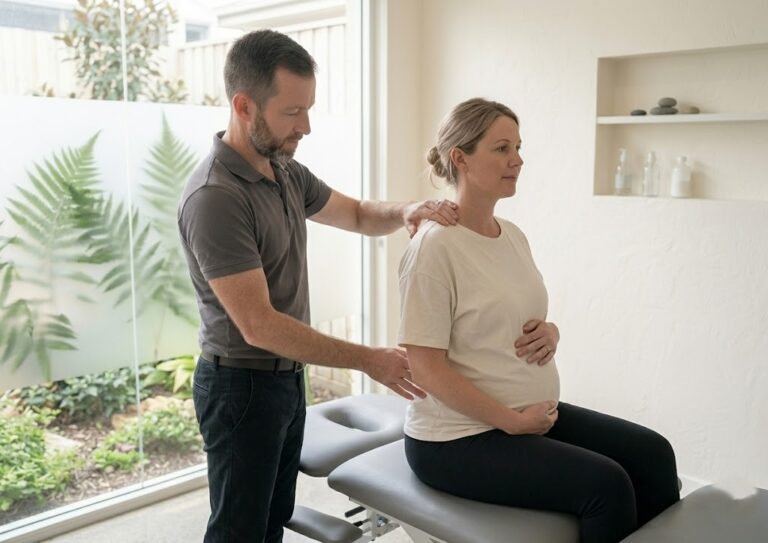
The key idea is simple. Pelvic floor rehab works better when the rest of the system is helped to move well too.
Good care doesn't just ask, “How do we strengthen this muscle?” It also asks, “Why is this muscle working too hard, too late, or in the wrong pattern?”
Red Flags and Your Next Steps Toward Recovery
Some symptoms need urgent medical review, not routine rehab. Sudden incontinence with neurological symptoms, unexplained bleeding, severe acute pain, or signs of infection should be assessed promptly by a doctor or urgent care service. If something feels new, severe, or dramatically different from your usual pattern, don't wait on an exercise plan.
For non-urgent symptoms, the next step is usually simple. Speak with your GP about a referral if that fits your situation, then book an assessment with a practitioner who can look at the whole picture, not just the pelvic floor in isolation. Early care is often less complicated than delayed care because the body hasn't had as much time to compensate.
A small starting habit can help before the appointment. Notice when you hold your breath, clench your jaw, or brace your abdomen during the day. Gentle diaphragmatic breathing and relaxed awareness are enough to begin.
Pelvic floor dysfunction is common, but it's also treatable, and the treatment is more varied than many expect. If you're ready for clear guidance, Bayside Osteopathic Health can help you work through the mechanical, breathing, and movement pieces in a calm, practical way. Book a visit with Bayside Osteopathic Health and take the first step toward care that's built around your symptoms, your goals, and your body.