
Looking for Pilates on the Mornington Peninsula often means you're not just seeking a workout. You might be dealing with a stiff neck after long hours at a desk, a lower back that flares when you garden, or hips and shoulders that don't move as freely as they used to. You may also be wondering whether Pilates will help, or whether it could make things worse.
That hesitation is reasonable. For people with pain, the question is not limited to "Is Pilates good for you?" It's "What type is right for my body, who should guide me, and how do I start safely?"
Local context matters. The Mornington Peninsula has a visible and expanding Pilates scene, but not every class is built for the same person. Some studios focus on fitness and conditioning. Others are better suited to people who need more individual attention, clearer modifications, and a slower progression.
Table of Contents
- Why Is Everyone Talking About Pilates on the Mornington Peninsula
- What Is Pilates and How Does It Actually Work
- Specific Benefits of Pilates for Chronic Pain and Posture
- Mat vs Reformer vs Clinical Pilates Explained
- How to Choose a Safe and Qualified Pilates Instructor
- Integrating Pilates with Your Osteopathic Care Plan
Why Is Everyone Talking About Pilates on the Mornington Peninsula
A lot of people first hear about Pilates through a friend who says their posture improved, or that their back "finally feels supported again". Others notice reformer studios opening nearby and wonder whether this is another short-lived fitness phase.
It doesn't look that way locally. The Peninsula sits within a broader Australian Pilates market with a clear commercial presence, and brands such as STRONG Pilates have established a Mornington location. STRONG describes its Mornington studio as a Pilates-inspired strength and cardio offering, and notes that the brand was founded in 2019 by Michael Ramsey and Mark Armstrong, which shows how recent but visible this format has become in Australia through its Mornington studio information.
That matters for one simple reason. When a movement method shows up in multiple local formats, it usually means people are using it for different needs. Some want conditioning. Some want low-impact exercise. Some are trying to stay active without aggravating old injuries.
Practical rule: If pain is part of the reason you're looking into Pilates, don't choose a class the same way you'd choose a café or a gym membership. Choose it the way you'd choose someone to guide your recovery.
The term Pilates Mornington Peninsula can therefore mean very different experiences. One class may be fast-paced and fitness-driven. Another may slow everything down and focus on breathing, spinal control, and modified loading. Both can be useful, but only if they match your starting point.
Many people also get stuck between two extremes. They either avoid movement because they're worried about triggering pain, or they jump into a class that's too advanced and end up discouraged. A better path usually sits in the middle. Start with a style and an instructor that can meet your body where it is now, not where you wish it was.
For people with chronic back pain, neck tension, joint stiffness, or postural strain, Pilates can become more than exercise. It can be a structured way to rebuild trust in movement.
What Is Pilates and How Does It Actually Work
Pilates is often described as "core exercise", but that doesn't really explain why it helps some people so much. A better way to think about it is this. Pilates helps retune the way your body moves.
If a guitar is out of tune, playing it harder won't fix the sound. Your body works in a similar way. If you move with poor sequencing, weak support around the trunk, or too much tension in the wrong muscles, repeating everyday tasks can keep feeding the problem. Pilates aims to improve the quality of movement first.
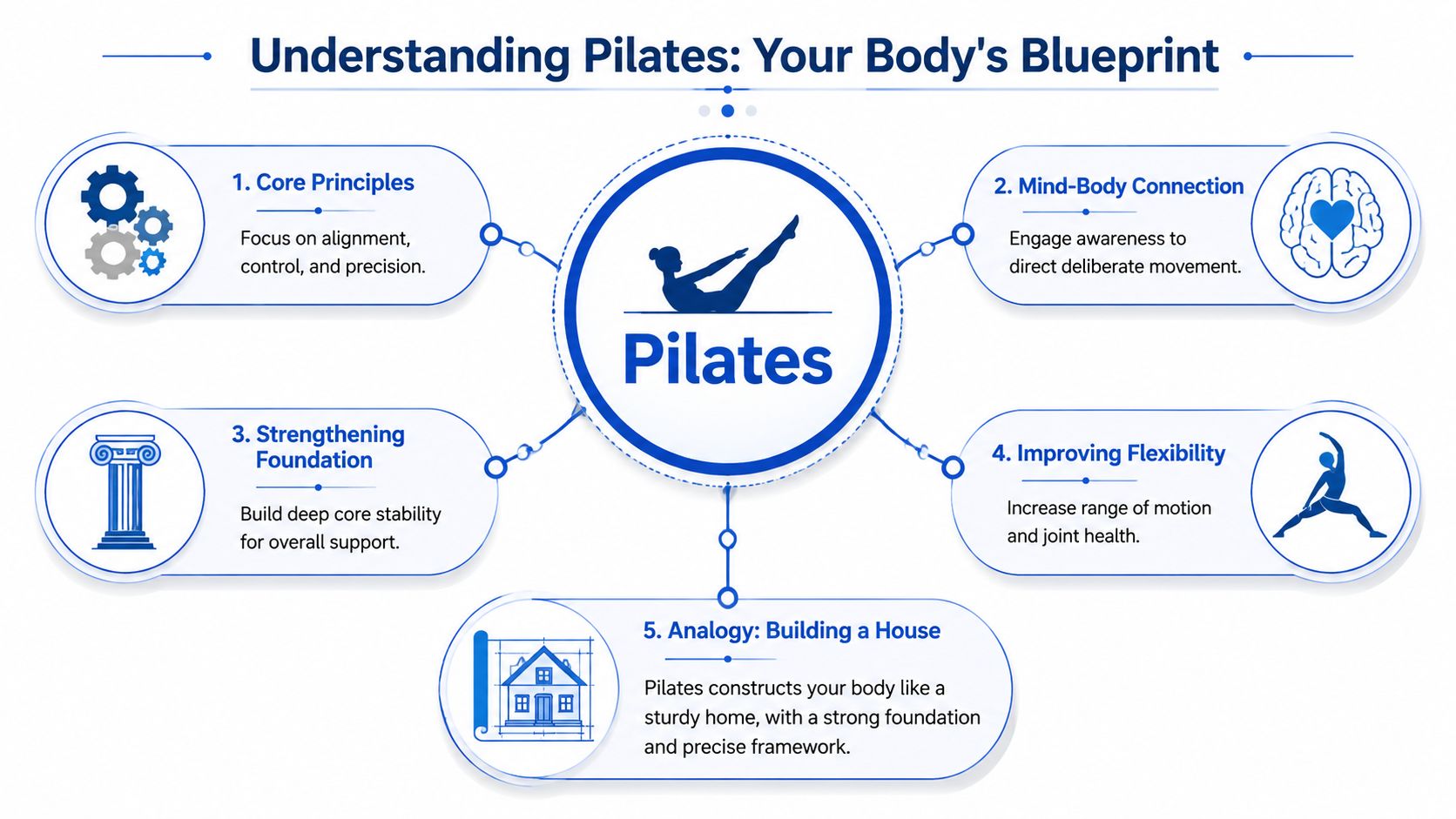
The basic idea behind Pilates
Pilates trains you to organise your body with more awareness and control. Instead of powering through repetitions, you pay attention to where your ribs are sitting, how your pelvis is moving, whether your neck is gripping, and whether your breath is helping or interfering.
Traditionally, Pilates is built around six principles:
- Concentration means noticing what you're doing rather than switching off.
- Control means moving with intention, not momentum.
- Centring refers to support through the trunk and pelvis.
- Flow means movements connect smoothly rather than feeling jerky.
- Precision means quality matters more than doing lots.
- Breathing helps manage tension and coordinate movement.
Those principles are why Pilates feels different from many gym-based sessions. The point isn't just to make muscles tired. The point is to teach the body a better strategy.
Why that matters for pain and posture
People with ongoing pain often develop protective habits without realising it. They brace too much through the upper abdominals, clench the jaw, lock the knees, or hold the breath during effort. That pattern can make simple tasks feel harder than they should.
Pilates slows movement down enough for you to spot those habits. Then it gives you a safer way to practise an alternative. Over time, that can help your body spread load more evenly instead of asking the same tight or irritated area to do all the work.
Pilates isn't magic. It's practice. The value comes from repeating well-guided movements until your body starts choosing them more naturally in daily life.
This is also why people sometimes say Pilates feels deceptively hard. Small, controlled movements can expose poor balance, weak coordination, or shallow breathing very quickly. That's not a failure. It's useful information.
When taught well, Pilates becomes a form of movement education. You learn how to stack your body, control transitions, and tolerate load with less strain.
Specific Benefits of Pilates for Chronic Pain and Posture
Pilates can help when pain has changed the way you move. Many people on the Mornington Peninsula come in with a similar story. Their scan may not fully explain their symptoms, stretching gives only brief relief, and exercise feels hit-and-miss. What often needs attention is not one tight spot, but the way breathing, balance, joint control, and muscle timing work together.
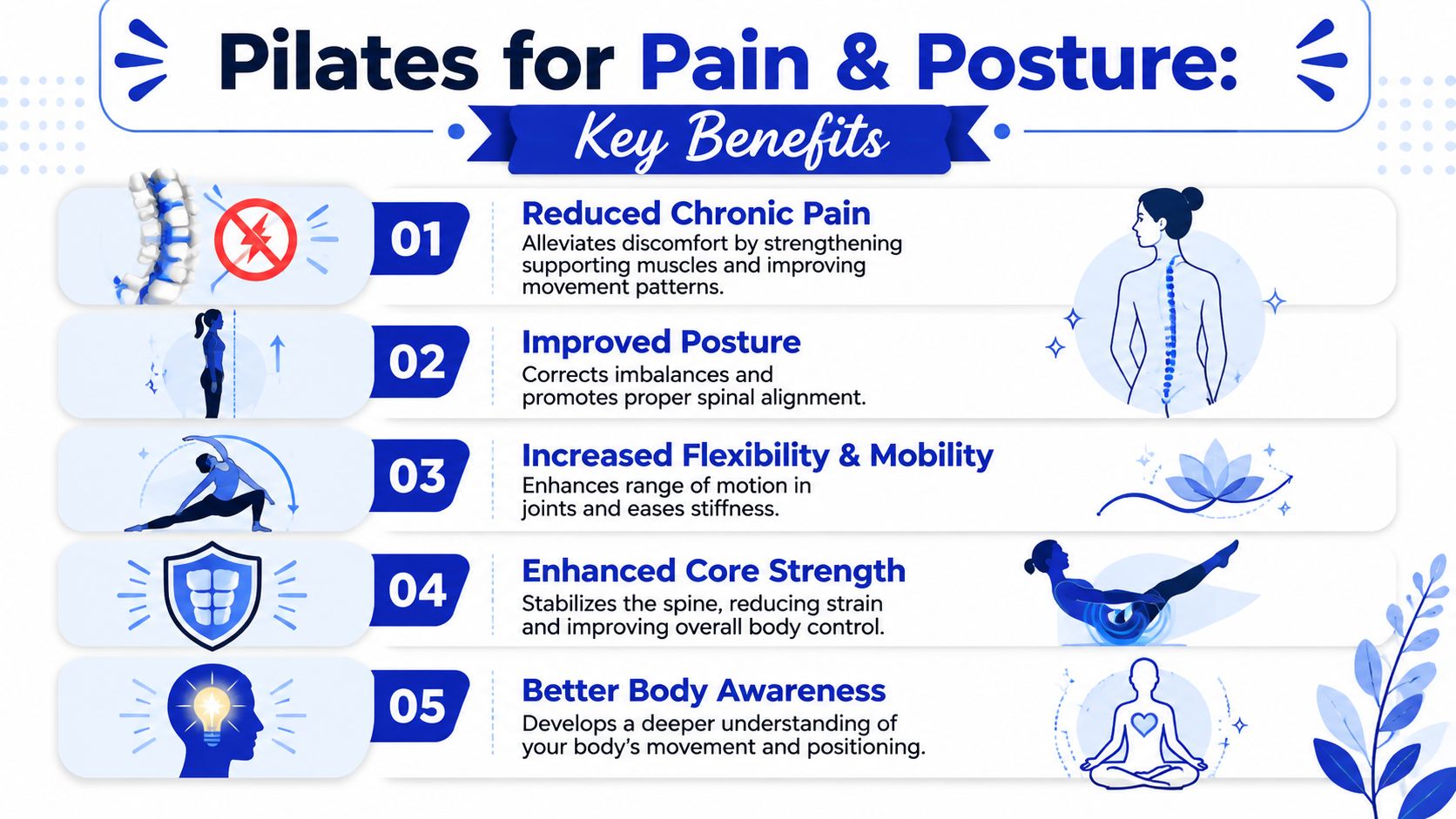
Reducing back and neck strain
Persistent back or neck pain is often linked to poor load sharing. One area ends up doing too much while another area contributes too little. The body can cope with that for a while, then everyday jobs such as sitting at a desk, lifting shopping bags, or turning to reverse the car start to feel more irritating than they should.
Pilates helps by improving control through the trunk, ribcage, pelvis, and shoulder blades. That matters because the neck and lower back often become the "workers of last resort" when the rest of the system is not doing its share. A well-taught program gives you repeated practice in spreading effort more evenly across the body.
For a person who spends hours over a laptop, posture problems rarely come from one weak muscle in isolation. They usually come from a repeated pattern. Rounded upper back, poked chin, stiff ribs, shallow breathing, tired shoulders. Pilates gives you a low-impact way to rehearse a different pattern until it starts to feel more natural.
If your upper back stays stiff and your shoulders drift forward, targeted mobility work can support what you practise in class. This guide to upper and middle back exercises for thoracic movement and posture shows the kind of movement focus that often fits well alongside Pilates.

Improving posture without forcing a rigid position
Posture is often misunderstood. Good posture does not mean holding yourself bolt upright all day like a soldier on parade. It means having enough control and movement options to change position before strain builds up.
That distinction matters for people with chronic pain.
If you have been sore for months, you may start guarding without noticing it. You might brace through the stomach, clench through the buttocks, lock the knees, or fix the shoulders back too hard in an effort to "sit properly". Those strategies can feel helpful at first, but they often create more tension and fatigue.
Pilates teaches a more useful skill. It helps you notice where you are overworking, then adjust with smaller, more efficient corrections. You begin to recognise when your ribs are lifting, when your weight shifts more to one side, or when your neck is gripping during arm movements. That awareness is one of the main reasons Pilates can improve posture in a lasting way.
Better posture comes from better control and more options, not from holding one perfect position.
Building confidence in stiff or sensitive joints
People with stiff hips, sore shoulders, or an achy spine are often told to stretch more. Sometimes that helps. Sometimes it just irritates an already sensitive area because the joint lacks support during the movement.
Pilates combines motion with control. That is the key difference.
A helpful way to picture it is this. Stretching alone can be like loosening a hinge without checking whether the screws are stable. Pilates works on the hinge and the support around it. You are not only trying to get more range. You are teaching the body how to use that range with less threat and less compensating.
This is especially useful for people managing chronic pain, postural strain, or deconditioning. The movements can be made smaller, slower, or more supported. That gives your nervous system a chance to trust movement again, which is often the first step before strength and endurance improve.
Why this matters from a healthcare perspective
From a clinical point of view, the benefit of Pilates is that it can bridge the gap between treatment and daily life. Hands-on care may settle pain and improve movement in the short term, but lasting change usually depends on what your body can do for itself between appointments.
Pilates gives you a way to practise that. You learn how to sit with less collapse, reach without shrugging, bend without gripping, and move from one position to another with more control. Those gains are practical. They show up when you get out of bed, work at a desk, walk the dog along the foreshore, or spend a weekend in the garden.
The goal is not perfect posture or pain-free movement every single day. The goal is a body that shares load better, reacts with less tension, and feels more capable in ordinary life.
Mat vs Reformer vs Clinical Pilates Explained
The biggest source of confusion for new clients is that Pilates isn't one single format. The words sound simple, but the class experience can vary a lot.
On the Mornington Peninsula, reformer Pilates has a strong local footprint. The local market is concentrated in reformer-based, low-impact conditioning models, and examples from the area show how equipment shapes the class style. Soul Haven's Mornington site reports 11 reformer beds, while The Pilates Bay specifies 4 Balanced Body Allegro 2 reformers, which points to small-group programming and closer supervision than an open-gym setup through Soul Haven Yoga. IBISWorld also tracks a dedicated Australian Pilates and Yoga Studios industry segment, which reinforces that this isn't a fringe offering.
What each style feels like
Mat Pilates uses bodyweight and, sometimes, small props. It can be excellent for learning basics like breathing, pelvic control, and trunk stability. It tends to suit people who are comfortable getting up and down from the floor and can manage without machine support.
Reformer Pilates uses a spring-loaded carriage, straps, and footbar. That setup changes everything. Springs can assist or resist movement, which means some exercises feel more supported while others become more demanding. For people with pain, that flexibility can be useful.
Clinical Pilates is usually the most individualised option. It's often used when someone is recovering from injury, managing ongoing symptoms, or needs closer assessment and exercise selection. The pace is typically slower, and the program is more customized.
For a visual sense of the equipment many people ask about, this reformer Pilates image shows the style of setup commonly used for guided spring-based work.

Which Pilates class is right for you
| Class Type | Best For | Equipment | Typical Class Size |
|---|---|---|---|
| Mat Pilates | Learning basics, general control, home practice | Mat, sometimes small props | Often larger group or private |
| Reformer Pilates | People wanting guided resistance, support, and structured progressions | Reformer machine with springs, straps, footbar | Small group or private |
| Clinical Pilates | Injury recovery, persistent pain, complex movement issues | Reformer and other studio equipment, chosen case by case | Usually one-to-one or very small group |
A few quick decision points help:
- If you're in active pain: Start with the format that offers the most assessment and modification.
- If you're deconditioned or unsure: Reformer can feel more approachable because the machine helps guide position and resistance.
- If you already move well and want fundamentals: Mat can be a strong starting point.
- If you have a history of flare-ups: Look for a provider who can explain why each exercise is being chosen, not just what to do.
The best class isn't the trendiest one. It's the one your body can tolerate consistently.
How to Choose a Safe and Qualified Pilates Instructor
For someone with chronic pain, arthritis, or a history of injury, the instructor matters more than the décor, the playlist, or how new the reformers look. A polished studio can still be the wrong fit if the teaching is generic.
The safety gap in local Pilates content is real. Beginner pages often explain what to wear or whether grip socks are needed, but they don't always explain how to judge whether a provider can safely work with pain.
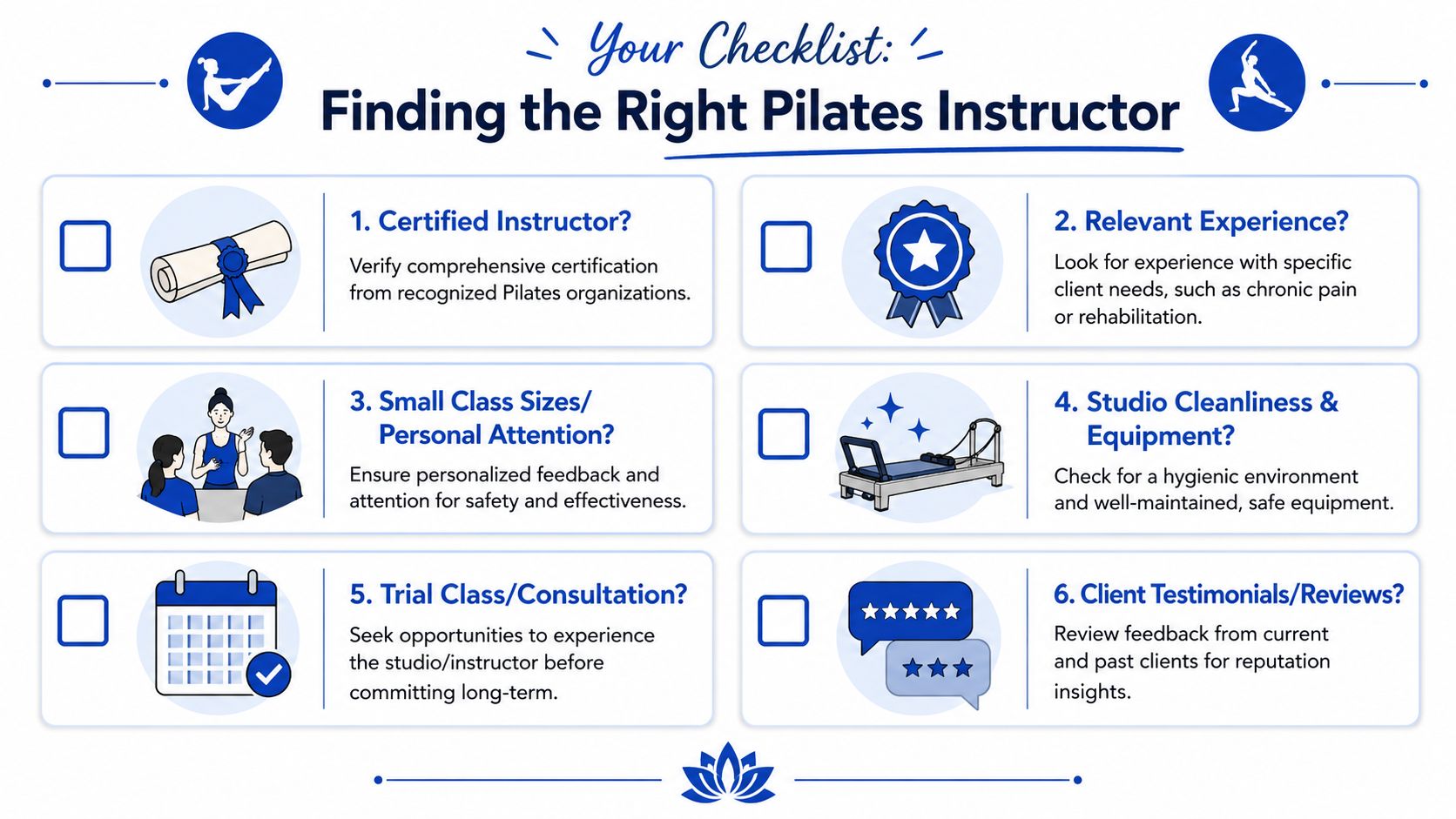
The questions worth asking before you book
The Pilates Association Australia gives a very practical starting point. It advises people to check whether an instructor is a full member, whether a studio is registered, and whether an initial assessment reviews medical history, movement faults, goals, and ability level before training begins through its Pilates Association Australia FAQ.
If you're comparing Pilates options on the Mornington Peninsula, ask direct questions like these:
- What training does the instructor have? Ask where they trained and whether they regularly work with people who have pain or movement limitations.
- Do you do an initial assessment? If the answer is no, that's a concern when symptoms are involved.
- How do you modify exercises? You want a specific answer, not "we can make it easier if needed".
- What happens if pain increases during class? A good instructor should have a clear plan.
- Is this class appropriate for my condition? If they can't answer confidently, keep looking.
One broader health reality is worth keeping in mind. The Pilates Association Australia notes that people should be screened properly before beginning, and the Australian Bureau of Statistics reports that around one in two Australians have a chronic condition, which is why generic exercise advice often isn't enough for many adults.
A good instructor won't be annoyed by careful questions. They should expect them.
This short video gives a useful overview of what thoughtful instruction and setup can look like in practice.
Local practical details that still matter
Once safety is covered, practical details still affect whether you'll stick with it.
- Access and parking: Mornington can be busy at peak times, so check how easy it is to arrive without rushing.
- Booking flexibility: If your pain varies week to week, rigid cancellation rules may add stress.
- Class size: Smaller groups usually allow more feedback and safer progression.
- Studio style: Some people do better in a calm, clinical-feeling space. Others prefer a general fitness environment. Neither is automatically better.
The best sign is usually this. The instructor listens, asks follow-up questions, watches how you move, and changes the plan when your body needs it.
Integrating Pilates with Your Osteopathic Care Plan
A common pattern looks like this. Your back or neck settles for a few days after treatment, then tightens again once work, driving, or poor sleep load the same tissues. That usually does not mean treatment failed. It often means the body needs two kinds of help. First, reduce irritation. Then retrain how you move so the area is not asked to do the same job in the same strained way.
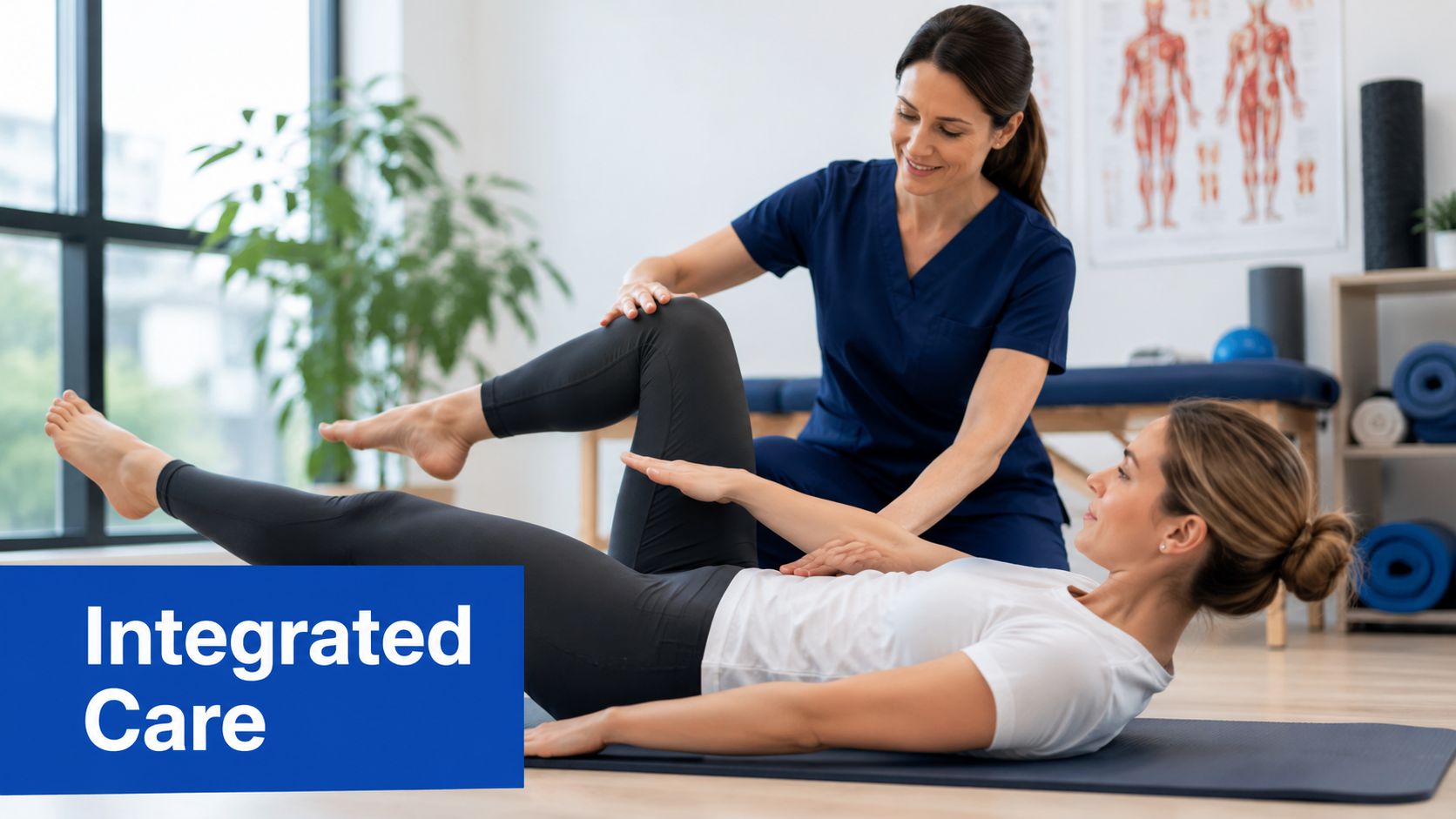
Reset then reinforce
Osteopathic care can create the opening. If a joint feels stiff, the surrounding muscles are guarding, or pain has made you hesitant to move, hands-on treatment may help settle things enough for movement to feel safer again. That can include soft-tissue work, joint articulation, and gentle mobilisation. A treatment approach like the one shown in this soft tissue treatment example can create a short window where turning, bending, or standing upright feels less restricted.

Pilates helps you use that window well.
Instead of relying only on temporary relief, you begin practising better load-sharing through the trunk, hips, shoulders, and breathing pattern. In simple terms, treatment can reduce the noise, and Pilates can teach the body a steadier movement pattern. For people with chronic pain or postural strain, that combination often makes more sense than either approach on its own.
The key is timing and dosage. If you are in the middle of a flare-up, a busy group class may be too much too soon. If symptoms are calmer, a carefully chosen mat, reformer, or clinical Pilates session may help you rebuild tolerance without stirring things up. As noted earlier, musculoskeletal problems place a heavy load on day-to-day function and work capacity, so the goal is not just feeling better on the table. It is holding onto improvement between appointments.
Clinical reasoning matters. An osteopathic assessment can help answer practical questions that people often struggle with on their own. Is this pain mostly driven by irritation, weakness, stiffness, poor endurance, or fear of movement? Which positions are helpful right now, and which ones need modifying for a few weeks? How much effort is enough to create progress without provoking a setback?
Bayside Osteopathic Health offers hands-on osteopathic assessment and treatment for people dealing with back pain, neck pain, joint stiffness, postural strain, and arthritis-related discomfort. In practice, that can help clarify whether you are ready for a class, which Pilates style is likely to suit you, and what early changes may make sessions feel safer and more productive.
More Pilates is not always better. For painful bodies, the goal is the right dose, the right supervision, and steady progression.
If you are unsure how to combine Pilates with treatment, start with a simple plan. Settle the flare-up. Choose the right format. Begin below your limit, not at it. That approach is often what helps Mornington Peninsula patients stay consistent long enough to notice meaningful change.
If you're unsure where to start with Pilates on the Mornington Peninsula, Bayside Osteopathic Health can help you make that decision with more clarity. A hands-on assessment can identify what may be driving your pain, whether Pilates is appropriate right now, and what type of movement plan is most likely to support safe, confident progress.