

You wake with a stiff neck, assume you slept awkwardly, then notice tingling in your fingers that won't settle. By lunchtime, you're wondering whether it's a tight muscle, a problem in your hand, or a nerve coming from your neck.
Pinched nerve in neck symptoms can show up well beyond the neck. Where the symptoms travel, whether sensation changes, and whether your arm or hand is losing strength often matter more than how sore your neck feels. This guide can help you describe the pattern, but it can't replace a neurological examination.
Table of Contents
- Symptoms That Point to a Pinched Nerve in the Neck
- How a Pinched Nerve Differs From Other Neck Pain
- Where Nerve Pressure Shows Up in the Arm and Hand
- Warning Signs That Need Urgent Medical Care
- Symptom Log and Self-Care Before Your Appointment
- Scans, GP Visits and Next Steps
Symptoms That Point to a Pinched Nerve in the Neck
Neck pain is common in Australian general practice. The Royal Australian College of General Practitioners' neck pain guidance reports that it accounts for approximately 15% of soft-tissue problems seen in general practice and describes the symptom frequencies below in assessed nerve-related presentations.
A nerve root is the part of a nerve that leaves the spinal cord before branching towards the arm. Irritation can produce pain along its pathway, while impaired nerve function can affect sensation, muscle strength or reflexes.
How often each symptom is reported in nerve-related neck presentations
| Symptom | How often it is reported | What it suggests |
|---|---|---|
| Shooting pain into the arm | 99% | A radicular pattern, typical of nerve-root irritation |
| Pins and needles, numbness or altered sensation | 85% | Sensory involvement; note the exact fingers |
| Neck pain | 79% | Common, but not required |
| Pain around or between the shoulder blades | 52% | Scapular pain can accompany nerve-root symptoms |
| Weakness in grip, lifting or the arm | Present in some cases | Possible motor involvement requiring prompt assessment |
| Reduced reflexes | Identified through clinical examination | A clinician checks the reflex response, not something to test yourself |
These percentages aren't your personal odds of having a pinched nerve. They describe symptom patterns in people assessed for nerve-related problems, not everyone who wakes with neck stiffness. Having several symptoms doesn't create a diagnostic score.
The terms also need separating. Cervical radicular pain describes pain arising from an irritated nerve root; cervical radiculopathy involves a pattern of neurological dysfunction, such as altered sensation, reduced strength or reflex changes. Ordinary local neck pain isn't automatically either condition.
A useful first self-check
Notice whether your symptoms stay near the neck or follow a recognisable route down an arm. Then distinguish a painful movement from a movement you can no longer perform normally.
- Map the symptoms: Note the shoulder, forearm, hand and fingers involved.
- Describe the sensation: Shooting, burning, tingling and reduced feeling are different observations.
- Check everyday function: Record difficulty holding a mug, fastening buttons or lifting something familiar.
Don't repeatedly provoke symptoms to prove a theory. Your observations should help a clinician examine you, not replace that examination.
How a Pinched Nerve Differs From Other Neck Pain
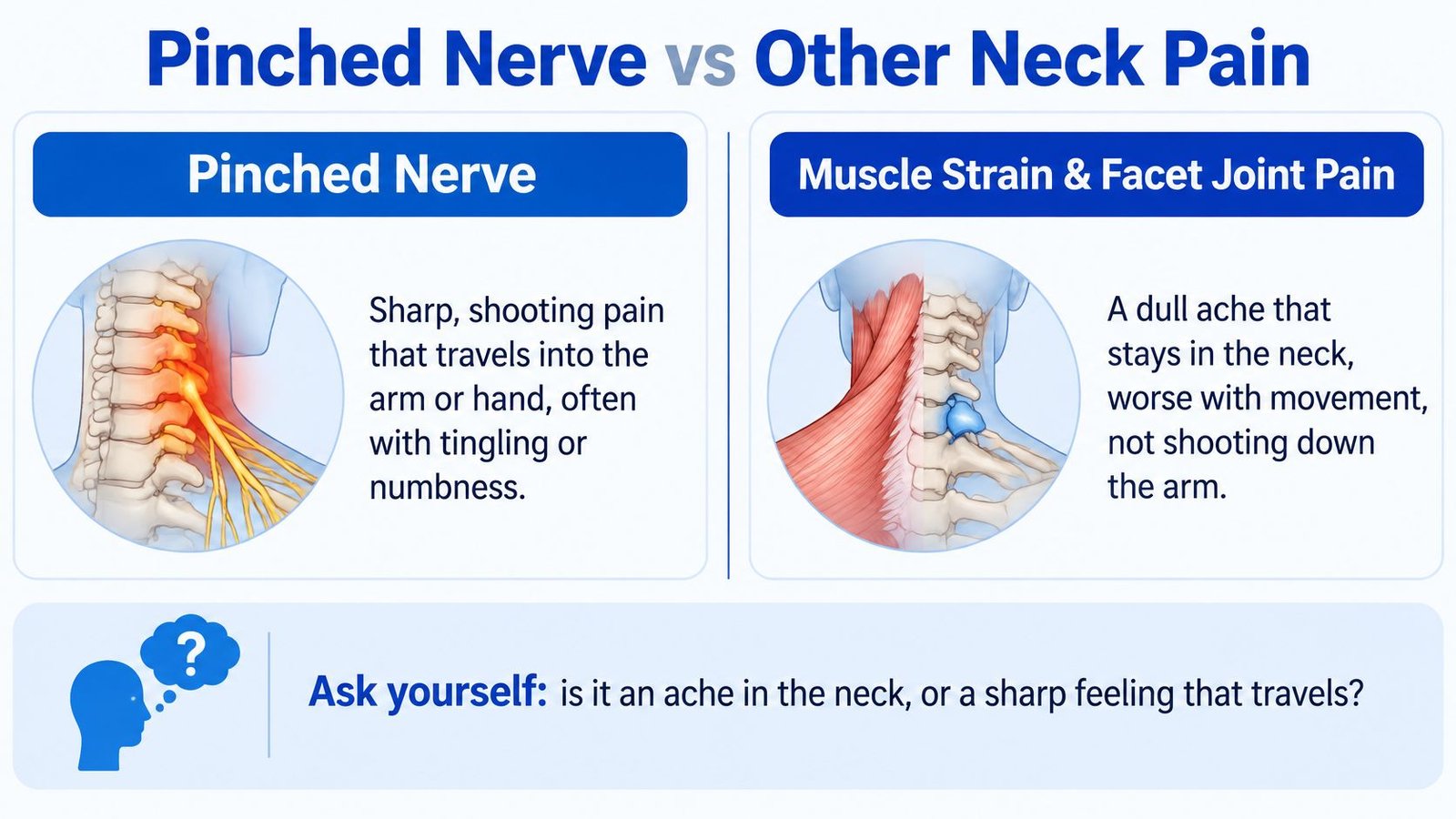
Start with a simple question: is this an ache that stays around the neck, or a sharp feeling that travels into the arm? That distinction is useful, but it isn't a pass-or-fail test.
The RACGP's MRI clinical guidance distinguishes typically sharp, shooting radicular pain from more aching referred neck pain, and reports weakness in approximately 15% of cervical radiculopathy cases. Sensory changes or loss of strength can occur without the familiar neck-to-arm pain pattern.
Pinched nerve compared with other common causes of neck pain
| Feature | Pinched nerve | Muscle strain | Joint or facet pain | Shoulder problem |
|---|---|---|---|---|
| Pain quality | Sharp, shooting, burning or electric | Dull, aching or tight | Aching and stiff | Often a deep ache |
| Where pain travels | Shoulder, arm or hand along a nerve pathway | Mainly neck and upper back | Near the neck, sometimes towards the head or shoulder | Around the shoulder, sometimes into the upper arm |
| Numbness or tingling | Can affect a strip of the arm or particular fingers | Not typical | Not typical | Finger tingling isn't typical of an isolated shoulder problem |
| Weakness | Grip or arm strength may fall | Movement may be limited by pain | Movement may be limited by pain | Possible, including with rotator cuff problems |
| Typical trigger or contributor | Disc herniation or age-related narrowing | Overuse, sustained positioning or sudden movement | Joint loading, stiffness or age-related changes | Overhead or repetitive activity |
| Usual course | May improve, persist or worsen; neurological changes need review | Often settles gradually | May fluctuate with movement and loading | Often changes with shoulder activity |
These are typical patterns, not exclusive rules. Muscle pain can spread towards the shoulder, and shoulder pain can make an arm feel weak because movement hurts. A clinician separates pain-limited effort from reduced muscle power caused by nerve dysfunction.
This visual summarises the broad distinction, rather than diagnosing either cause.
When weakness matters more than pain
Say your neck is only mildly uncomfortable, but you keep dropping a coffee cup. The important question isn't whether holding it hurts, but whether your hand has lost its usual strength or control.
Practical rule: A less painful neck doesn't make new weakness less important.
Don't dismiss clumsiness because you don't have shooting arm pain. Equally, don't assume every dropped object proves a neck problem. Peripheral nerves, shoulder conditions and spinal-cord disorders can produce overlapping difficulties, so new or worsening loss of function needs medical assessment.
Where Nerve Pressure Shows Up in the Arm and Hand
Think of a nerve root as a cable leaving a junction box in the spine. Irritation near the junction can alter signals further along the cable, so you may feel symptoms in your hand even when your neck barely bothers you.
Hand discomfort during desk work can therefore need a broader assessment than the wrist alone.

A herniated disc or age-related narrowing can irritate a cervical nerve root. Healthdirect's spinal disc guidance explains that cervical disc problems can cause pain radiating into the shoulder, arm or hand, with numbness or weakness when nerves are affected.
Nerve root, area affected and typical signs
The following is a clinical orientation map, not a precise boundary chart. Sensory territories overlap, and clinicians interpret them alongside strength and reflex findings.
| Nerve root | Typical area affected | Common weakness or reflex change |
|---|---|---|
| C5 | Outer upper arm and shoulder | Weakness lifting the shoulder out to the side; biceps reflex may be reduced |
| C6 | Thumb side of the forearm, thumb and sometimes index finger | Weak wrist extension; biceps or brachioradialis reflex may be reduced |
| C7 | Middle finger and back of the forearm | Weak elbow extension or wrist flexion; triceps reflex may be reduced |
| C8 | Little finger, part of the ring finger and inner forearm | Weak finger flexion or grip; no routinely tested standard tendon reflex |
Say an office worker notices tingling in the ring and little fingers after prolonged computer work. C8 involvement is one possibility, but an ulnar nerve problem near the elbow or wrist can produce a similar pattern. Finger location narrows the questions; it doesn't identify the diagnosis by itself.
Thumb-side symptoms can also overlap with peripheral nerve conditions. Our guide to carpal tunnel relief discusses another possible source of hand symptoms, which needs distinguishing from a neck-related problem.
The video below provides another way to visualise neck-related nerve symptoms.
What the pattern can tell you
Holding your head in the same position may aggravate symptoms, but posture alone doesn't establish the cause. Record the affected fingers, whether the palm or back of the hand is involved, and whether the area changes.
A consistent sensory pattern accompanied by measurable strength or reflex changes is more informative than finger tingling alone. Leave reflex testing and resisted strength testing to a clinician rather than trying forceful neck manoeuvres at home.
Warning Signs That Need Urgent Medical Care
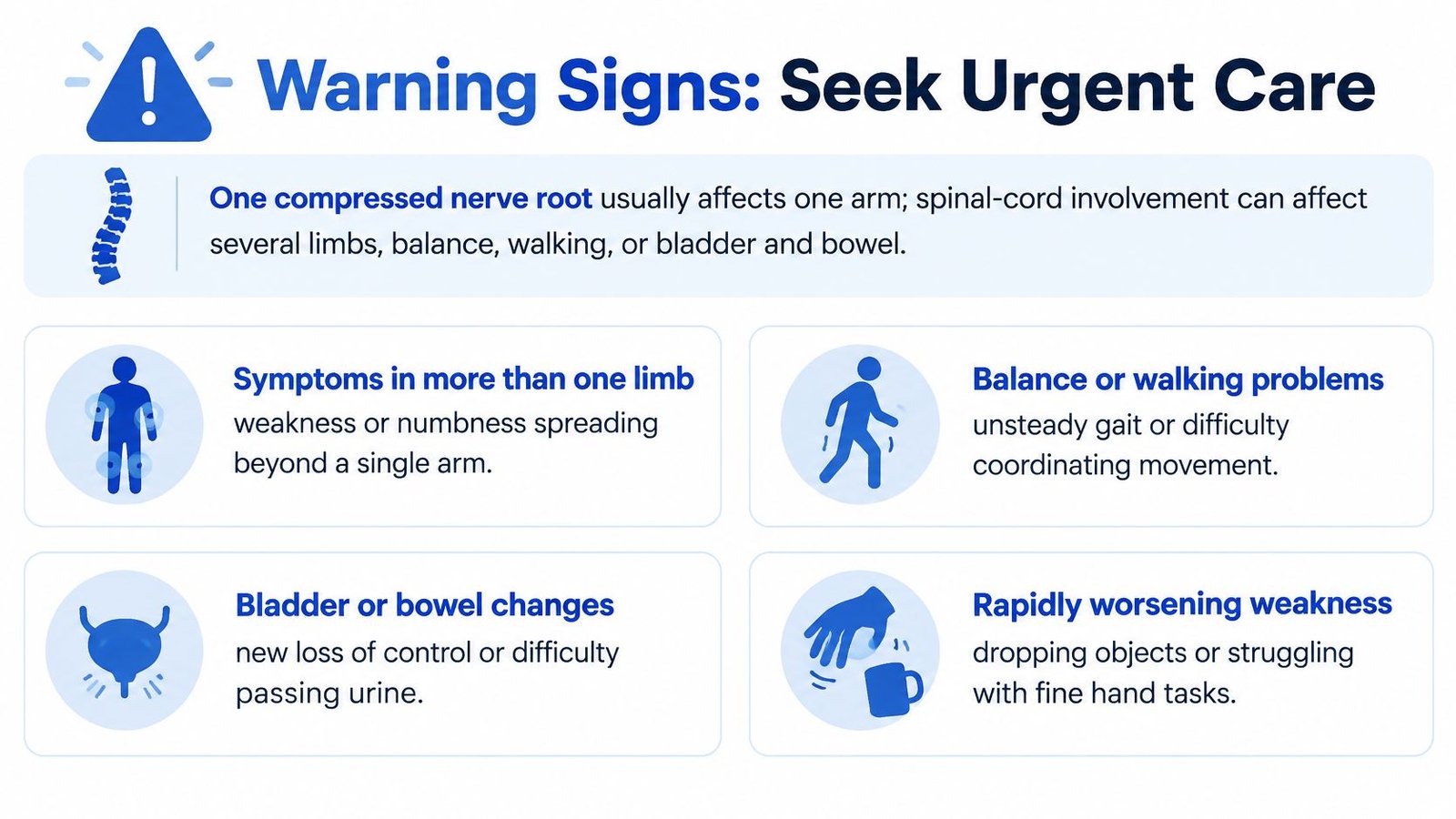
A single irritated nerve root usually produces regional symptoms in an arm. Spinal-cord involvement can affect several limbs, walking, balance or bladder and bowel control, which changes the urgency.
Call Triple Zero (000) or seek emergency care for loss of limb movement or sensation, new bowel or bladder-control problems, sudden severe neck pain after a crash or other trauma, or neck pain with chest pain, shortness of breath or sweating, as advised by healthdirect's neck pain guidance. Don't assume these symptoms are a pinched nerve.
Match the symptoms to the urgency
Pins and needles, numbness or weakness accompanying neck pain warrant urgent medical review. Symptoms in both arms, symptoms in the legs, or new problems with walking or hand coordination are particularly concerning and shouldn't wait for a routine treatment appointment.
Pain severity alone doesn't determine urgency. Mild neck pain with worsening hand control may be more concerning than a painful but uncomplicated muscular strain.
| Urgency | Signs | What to do |
|---|---|---|
| Emergency now | Loss of limb movement or sensation; new bowel or bladder problems; severe neck pain after a crash; chest pain, shortness of breath or sweating with neck pain | Call Triple Zero or go to the nearest emergency department |
| Urgent medical review | New pins and needles, numbness or weakness, especially in both arms or the legs; progressive weakness; new walking or hand-coordination difficulty | Seek urgent medical review, the same day where possible |
| Routine GP review | Pain without urgent neurological signs that persists, worsens or interferes with daily activities | Book a GP appointment and keep a symptom log; seek a sooner appointment if pain is severe |
The checklist below highlights patterns that require prompt escalation.
Don't wait for pain to become unbearable before acting on a loss of movement, sensation or control.
Until you've been assessed, stop activities that clearly reproduce radiating pain or worsen weakness. Don't stretch harder, seek forceful neck manipulation, or treat increasing neurological loss as ordinary muscle tightness.
If you're unsure which category fits, describe the actual change when seeking care: an arm that won't lift, fingers that have lost feeling, or newly unsteady walking. Those details are more useful for triage than saying you think you have a pinched nerve.
Symptom Log and Self-Care Before Your Appointment
A brief symptom log helps your GP distinguish a stable complaint from a changing neurological pattern. Use a phone note or a simple outline of an arm and hand rather than relying on memory.
- Mark the location: Record the areas affected and the exact fingers involved.
- Track changes: Note whether tingling or numbness spreads, retreats or becomes constant.
- Describe function: Record changes in grip, lifting, buttons, handwriting or carrying bags.
- Note triggers and relief: Include sustained computer work, head position and movements that alter symptoms.
- Record the course: Include when symptoms began, whether they interrupt sleep and whether they're improving.
A worked example
A hypothetical office worker's early entry might read: Tingling in the ring and little fingers after screen work. Grip feels normal. Sleep interrupted.
A later entry might read: Tingling now reaches another finger, and lifting my usual bag feels harder. That change should prompt medical review, not another log entry while waiting.
Keep self-care gentle and symptom-led. Change position before symptoms build, support your arms comfortably, and avoid repeatedly testing movements that send pain down the arm. Our neck pain relief at home guide offers general comfort advice, but it isn't a substitute for assessment of neurological symptoms.
Bring the log and a list of medicines or treatments you've tried. Don't deliberately lift heavy objects to test whether your strength has deteriorated.
Scans, GP Visits and Next Steps
MRI isn't automatically the first step: SA Health's diagnostic guide for cervical disorders generally considers it when radicular symptoms persist despite 4–6 weeks of conservative care, when neurological findings persist or progress, or when red flags are present. That timeframe isn't permission to wait through worsening weakness.
A suspected pinched nerve isn't always a benign mechanical problem. Equally, an early scan may be unnecessary when examination reveals no neurological deficit or warning signs.
What changes the investigation plan
Tell your GP about features that could point beyond uncomplicated nerve irritation:
- Significant trauma: Include the circumstances of any crash, fall or injury.
- Systemic concerns: Mention fever, unexplained weight loss or a history of cancer.
- Unremitting night pain: Distinguish persistent severe pain from discomfort in an awkward sleeping position.
- Associated neurological symptoms: Report dizziness combined with visual changes, swallowing or speech difficulty, or sudden unexplained falls.
Your GP will take a history and examine movement, sensation, muscle power and reflexes. These findings help determine whether imaging would answer a useful question and whether specialist referral is needed.
Care after urgent causes are excluded
Suspected spinal-cord compression needs urgent hospital assessment. An uncomplicated presentation may instead begin with monitored conservative care, with clear instructions about which changes require reassessment.
At our initial assessment, we take a detailed case history and examine posture, movement and the specific area of concern, considering the body as a whole. Once medical assessment has excluded urgent causes, our neck pain treatment options can help you understand approaches to associated stiffness and movement-related discomfort.
Bring your symptom log, examination findings and any existing imaging reports. Emergency signs override any appointment or plan to wait, and progressive neurological changes need medical reassessment rather than routine hands-on care.
Bayside Osteopathic Health offers gentle, personalised osteopathic care for neck pain and cervical stiffness, with movement advice and practical self-care planning. Once urgent causes have been excluded, visit Bayside Osteopathic Health to arrange an assessment and discuss support for more comfortable daily movement.